-
Orissa
Wood, extensively polychromed
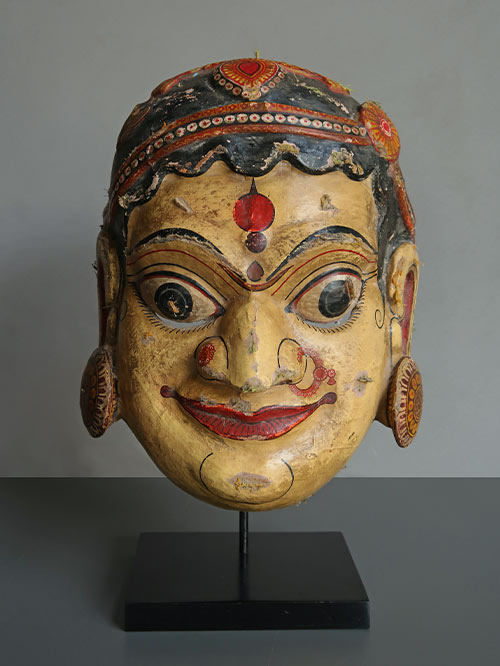
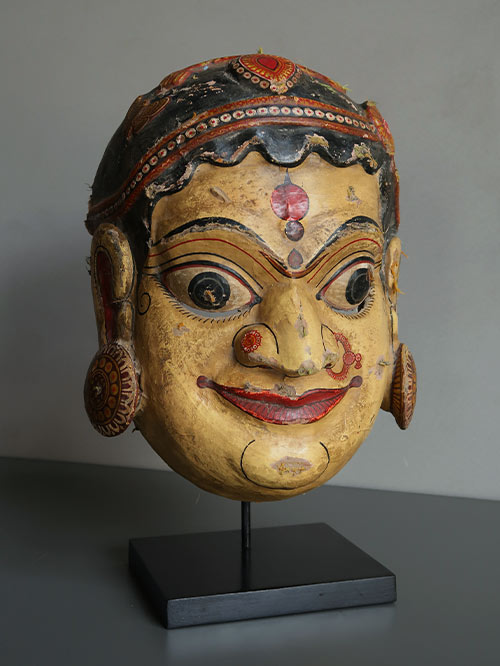
This delicately painted and unusual dancing mask depicts Sita the consort of Lord Rama. Sita wear large kundala earrings and various nose and an unusual butterfly shaped hair ornament. A prominent tilaka adorns her forehead. Elongated slits have been cut out under her piercing eyes to help the dancer navigate while wearing the mask. This mask would have been used during folk performances of the Ramalila in Orissa.
The Ramalila (folk re-enactment of the life of Rama) is a widespread type of popular performance. The genre encompasses various dramatic enactments of the story of Rama by non-professional actors, men playing women’s roles, common throughout north India, ranging in duration from ten to thirty-one nights, concluding on the autumn holiday of Dussehra. In Orissa in particular, Ramalila is performed during the two weeks following Rama’s birthday, Ramanavami, in March or April, a time that makes sense for an enactment that begins with Rama’s birthday, on Ramanavami. This timing also coincides with the agricultural cycle, making the performance a celebration of the spring harvest. Also it is pleasant at the beginning of intense summer heat for villagers to enjoy the cool night hours with performances, generally from midnight till dawn, while actors and audience are free to sleep in the daytime.
Size with stand (cms): 40(H) x 27(W) x 22(D)
Size with stand (inches): 15.5(H) x 10.5(W) x 8.5(D)
-

Southern Orissa
Papier-mâché, wood and cloth
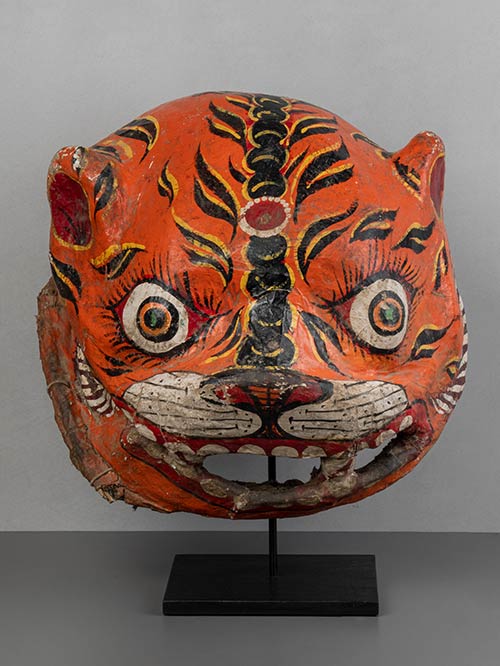
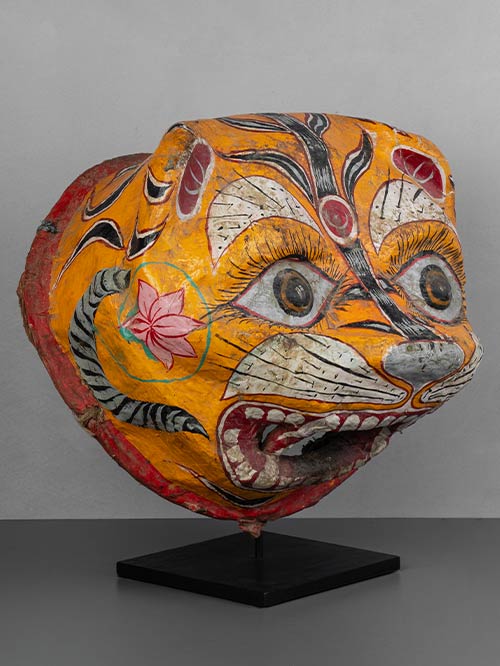
The Bhaga Naacha (Tiger Dance) was once a popular and highly regarded unique folk dance form in Orissa. It used to be performed before and after hunting. Now it intricately associated with the Thakurani Yatra festival that is celebrated in the Ganjam district in Southern Orissa. The ritual festival celebrates the Mother Goddess Thakurani or Durga who also rides on a tiger or lion. Apart from Tiger, the Bull, Deer and Horse dance are also typical features of this region.
During the performance the dancers are surrounded by a group of Changu (drum) players who by beating the changus encourage them to dance. The dancers work in coordination under the cane frame concealed by a thick cloth richly decorated with mirrors and applique. The masks are bigger than the head with colourful traditional paintings and decorations. This fast and dynamic dance needs enthusiasm and energy not only for the dancers but also for the drummers and bell players. Acrobatic movements and hissing sound charm, captivate and excite the audience especially children. Although visibly it seems simple, it needs skills, energy, coordinated staging and skilled direction. The thematic variations within the dance include encounter between tiger and ox, encounter between tiger and hunter and tiger preying on horse etc.
Mask Size (cms): 63(H) x 67(W) x 34(D), 70(H with Stand)
Mask Size (inches): 25(H) x 26.5(W) x 13.5(D), 27.5(H with Stand)
-
Southern Orissa
Papier-mâché, wood and cloth
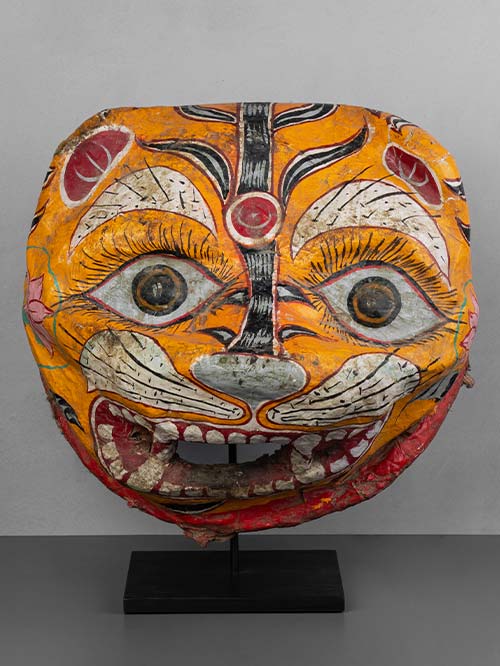
The Bhaga Naacha (Tiger Dance) was once a popular and highly regarded unique folk dance form in Orissa. It used to be performed before and after hunting. Now it intricately associated with the Thakurani Yatra festival that is celebrated in the Ganjam district in Southern Orissa. The ritual festival celebrates the Mother Goddess Thakurani or Durga who also rides on a tiger or lion. Apart from Tiger, the Bull, Deer and Horse dance are also typical features of this region.
During the performance the dancers are surrounded by a group of Changu (drum) players who by beating the changus encourage them to dance. The dancers work in coordination under the cane frame concealed by a thick cloth richly decorated with mirrors and applique. The masks are bigger than the head with colourful traditional paintings and decorations. This fast and dynamic dance needs enthusiasm and energy not only for the dancers but also for the drummers and bell players. Acrobatic movements and hissing sound charm, captivate and excite the audience especially children. Although visibly it seems simple, it needs skills, energy, coordinated staging and skilled direction. The thematic variations within the dance include encounter between tiger and ox, encounter between tiger and hunter and tiger preying on horse etc.
Mask Size (cms): 63(H) x 67(W) x 34(D), 70(H with Stand)
Mask Size (inches): 25(H) x 26.5(W) x 13.5(D), 27.5(H with Stand)
-
Orissa
Wood, extensively polychromed
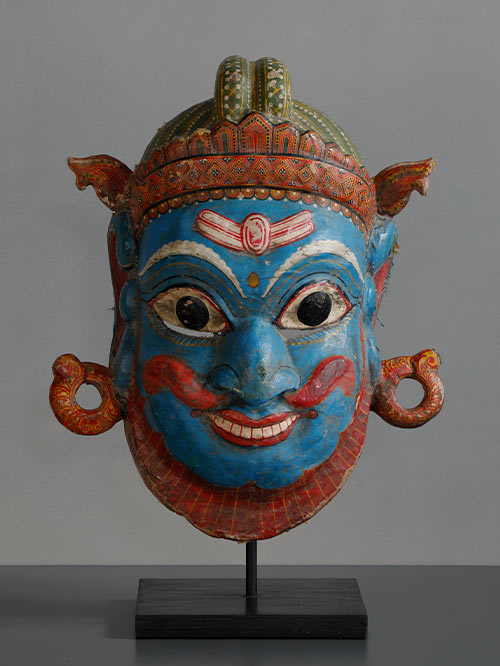
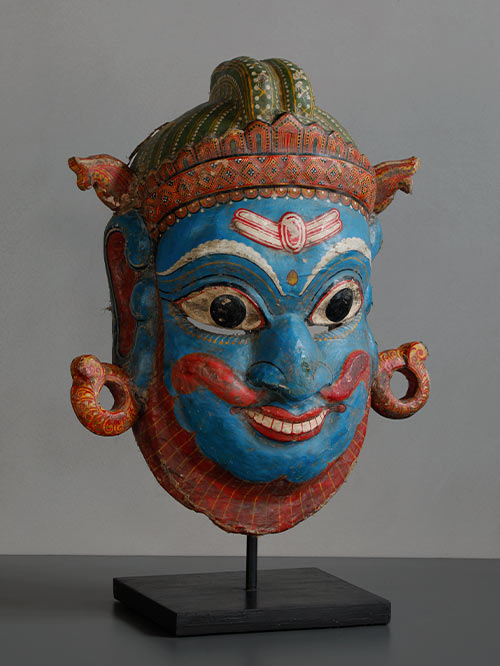
An attractive dancing mask depicting the rakshasa Vibhishana. Painted in a brilliant blue, Vibhishana wears an elaborate turbaned crown decorated with geometric and floral patterns motifs and two large hooped earrings which dangle from his ears. Distinctive features include a prominent Shaivite tilaka, large piercing eyes and a joyous smile. The vibrant red twirling moustache and matching beard stands out on his blue skinned face. Ovular slits have been cut out beneath the eyes of Vibhishana to help the dancer navigate while wearing the mask.
Vibhishana, Ravana’s younger brother, was a rare good-hearted Rakshasa; he was beautiful, pious and assiduous in his religious observances. When Brahma granted him a boon, he asked never to swerve from the path of righteousness and to be illumined by divine knowledge. Vibhishana joined Rama in his campaign against Ravana, and helped Rama’s army to cross the ocean into Lanka. When invisible Rakshasas infiltrated Rama’s camp, Vibhishana caused them to become visible, and Rama’s monkey soldiers destroyed them. After Rama’s final victory over Ravana, the loyal Vibhishana was made king of Lanka.
Shahi Jatras (royal processions) of Orissa present different episodes from the Ramayana during the spring season, usually lasting for for one week. Actors, carrying huge wooden masks and gorgeous costumes, walk on the streets with stylized gait and mime with the accompaniment of loud drumming. The Desia Nata of Koraput, Orissa, also uses masks for representing gods, goddesses, animals, birds and demons. These themes are also taken from Ramayana.
Size(cms): 43(H) x 34(W) x 19(D), 51(H with stand)
Size(inches): 17(H) x 13.5(W) x 7.5(D), 20(H with stand)