-
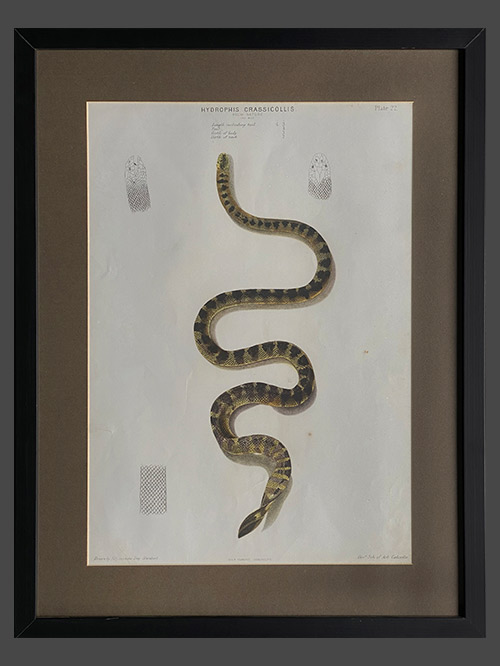
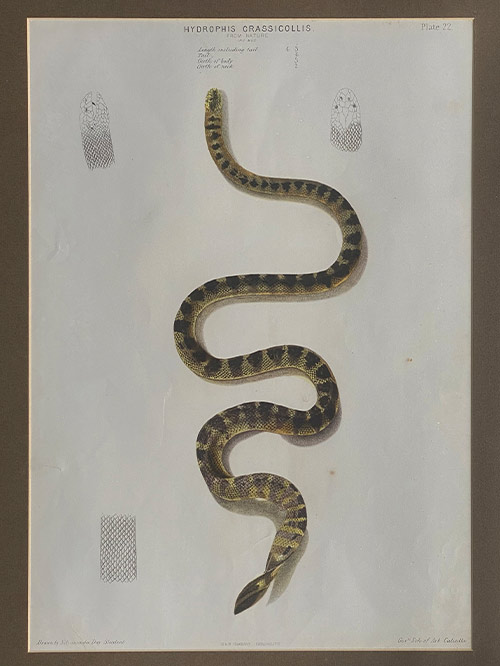
by Sir Joseph Fayrer
from The Thanatophidia of India
original hand coloured chromolithograph
Captioned ‘Hydrophis Crassicollis’
Sir Joseph Fayrer, 1st Baronet (6 December 1824 – 21 May 1907) was an English physician noted for his writings on medicine in India. After studying medicine at Charing Cross Hospital, London and completing his medical degree in 1849, he was appointed as an assistant surgeon in Bengal in 1850. Fayrer, who became a fellow of the Royal Society in 1877, wrote much on subjects connected with the practice of medicine in India, and was especially known for his studies on the poisonous snakes of that country and on the physiological effects produced by their venom. He set up a zoological society and the zoo at Calcutta. He was President of the Asiatic Society of Bengal in 1867.
The Thanatophidia of India is a description of the venomous snakes of the Indian Peninsula and the physiological effects produced by their venom. These plates were drawn by students from the Govt. School of Art in Calcutta.
Size framed (cms): 57 (H) x 44 (L)
Size framed (inches): 22 (H) x 17.5 (L)
-
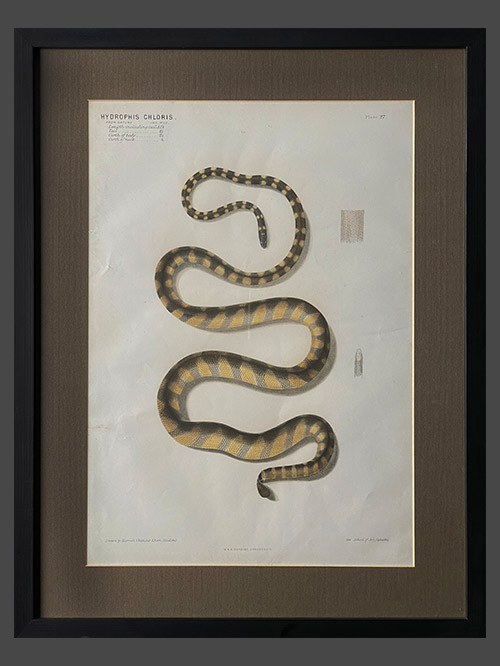
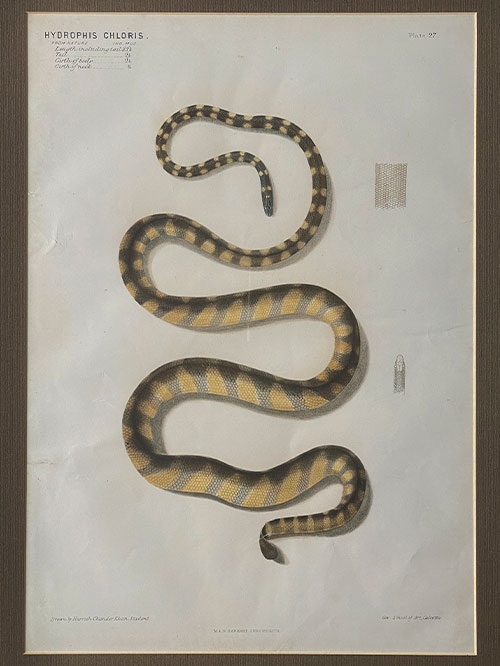
by Sir Joseph Fayrer
from The Thanatophidia of India
original hand coloured chromolithograph
Captioned ‘Hydrophis Chloris’
Sir Joseph Fayrer, 1st Baronet (6 December 1824 – 21 May 1907) was an English physician noted for his writings on medicine in India. After studying medicine at Charing Cross Hospital, London and completing his medical degree in 1849, he was appointed as an assistant surgeon in Bengal in 1850. Fayrer, who became a fellow of the Royal Society in 1877, wrote much on subjects connected with the practice of medicine in India, and was especially known for his studies on the poisonous snakes of that country and on the physiological effects produced by their venom. He set up a zoological society and the zoo at Calcutta. He was President of the Asiatic Society of Bengal in 1867.
The Thanatophidia of India is a description of the venomous snakes of the Indian Peninsula and the physiological effects produced by their venom. These plates were drawn by students from the Govt. School of Art in Calcutta.
Size framed (cms): 57 (H) x 44 (L)
Size framed (inches): 22 (H) x 17.5 (L)
-
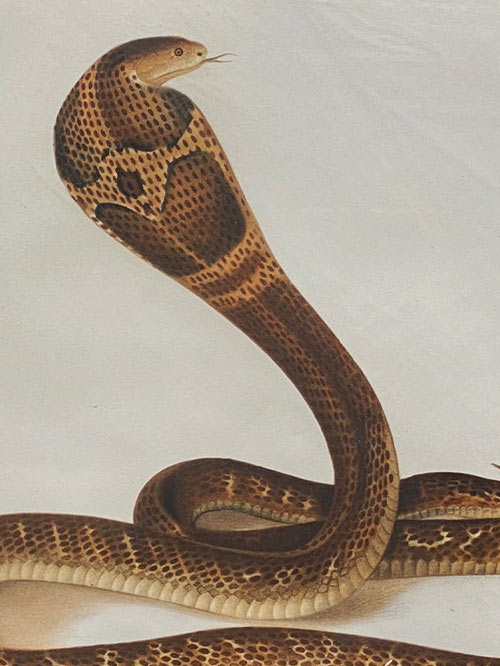
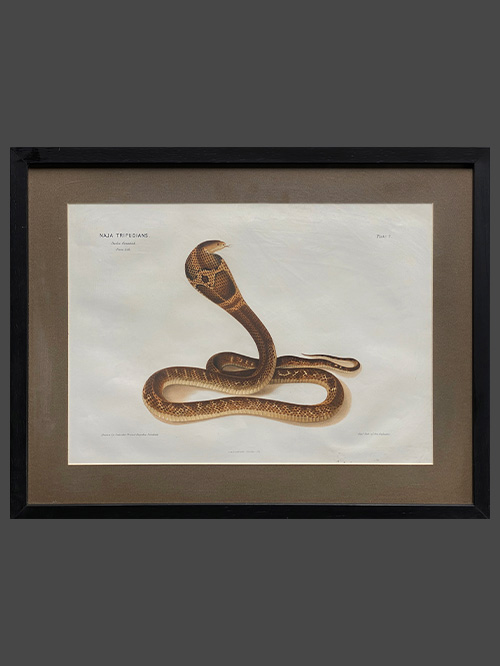
by Sir Joseph Fayrer
from The Thanatophidia of India
original hand coloured chromolithograph
Captioned ‘Naja Tripudians’
Sir Joseph Fayrer, 1st Baronet (6 December 1824 – 21 May 1907) was an English physician noted for his writings on medicine in India. After studying medicine at Charing Cross Hospital, London and completing his medical degree in 1849, he was appointed as an assistant surgeon in Bengal in 1850. Fayrer, who became a fellow of the Royal Society in 1877, wrote much on subjects connected with the practice of medicine in India, and was especially known for his studies on the poisonous snakes of that country and on the physiological effects produced by their venom. He set up a zoological society and the zoo at Calcutta. He was President of the Asiatic Society of Bengal in 1867.
The Thanatophidia of India is a description of the venomous snakes of the Indian Peninsula and the physiological effects produced by their venom. These plates were drawn by students from the Govt. School of Art in Calcutta.
Size framed (cms): 44 (H) x 57 (L)
Size framed (inches): 17.5 (H) x 22 (L)
-
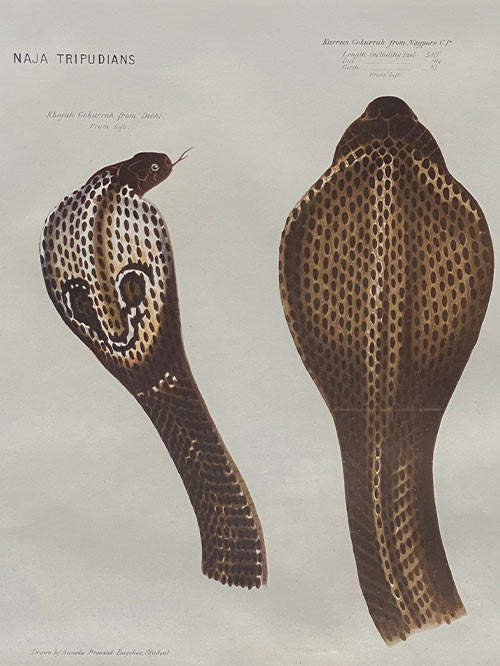
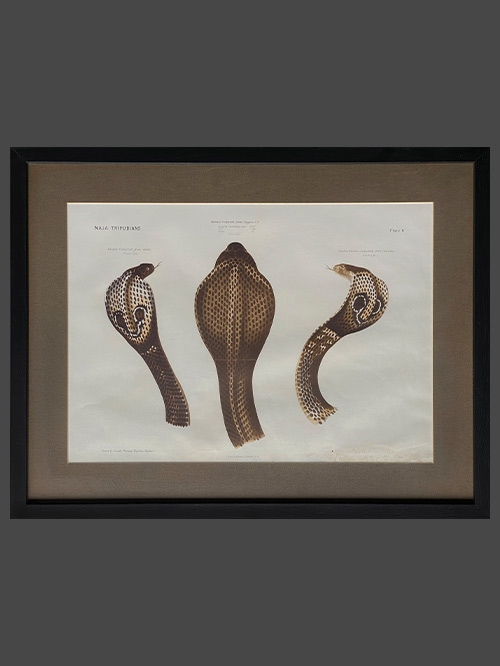
by Sir Joseph Fayrer
from The Thanatophidia of India
original hand coloured chromolithograph
Captioned ‘Naja Tripudians’
Sir Joseph Fayrer, 1st Baronet (6 December 1824 – 21 May 1907) was an English physician noted for his writings on medicine in India. After studying medicine at Charing Cross Hospital, London and completing his medical degree in 1849, he was appointed as an assistant surgeon in Bengal in 1850. Fayrer, who became a fellow of the Royal Society in 1877, wrote much on subjects connected with the practice of medicine in India, and was especially known for his studies on the poisonous snakes of that country and on the physiological effects produced by their venom. He set up a zoological society and the zoo at Calcutta. He was President of the Asiatic Society of Bengal in 1867.
The Thanatophidia of India is a description of the venomous snakes of the Indian Peninsula and the physiological effects produced by their venom. These plates were drawn by students from the Govt. School of Art in Calcutta.
Size framed (cms): 44 (H) x 57 (L)
Size framed (inches): 17.5 (H) x 22 (L)
-
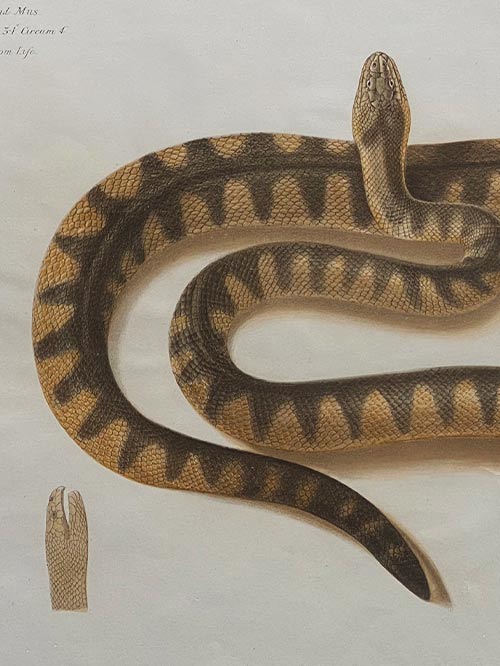
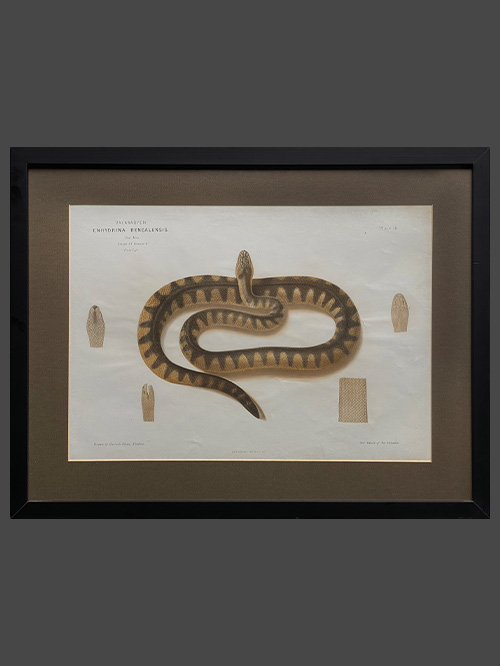
by Sir Joseph Fayrer
from The Thanatophidia of India
original hand coloured chromolithograph
Captioned ‘Enhydrina Bengalensis’
Sir Joseph Fayrer, 1st Baronet (6 December 1824 – 21 May 1907) was an English physician noted for his writings on medicine in India. After studying medicine at Charing Cross Hospital, London and completing his medical degree in 1849, he was appointed as an assistant surgeon in Bengal in 1850. Fayrer, who became a fellow of the Royal Society in 1877, wrote much on subjects connected with the practice of medicine in India, and was especially known for his studies on the poisonous snakes of that country and on the physiological effects produced by their venom. He set up a zoological society and the zoo at Calcutta. He was President of the Asiatic Society of Bengal in 1867.
The Thanatophidia of India is a description of the venomous snakes of the Indian Peninsula and the physiological effects produced by their venom. These plates were drawn by students from the Govt. School of Art in Calcutta.
Size framed (cms): 44 (H) x 57 (L)
Size framed (inches): 17.5 (H) x 22 (L)
-
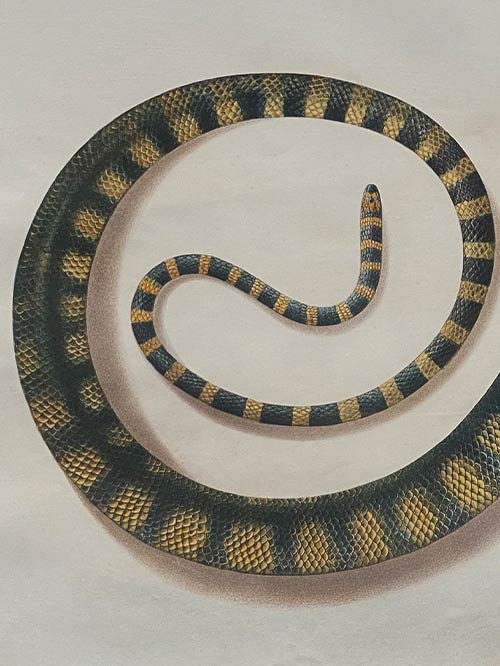
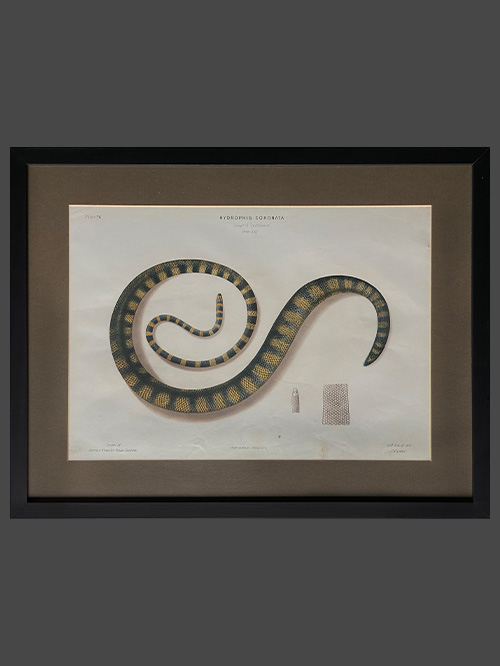
by Sir Joseph Fayrer
from The Thanatophidia of India
original hand coloured chromolithograph
Captioned ‘Hydrophis Coronata’
Sir Joseph Fayrer, 1st Baronet (6 December 1824 – 21 May 1907) was an English physician noted for his writings on medicine in India. After studying medicine at Charing Cross Hospital, London and completing his medical degree in 1849, he was appointed as an assistant surgeon in Bengal in 1850. Fayrer, who became a fellow of the Royal Society in 1877, wrote much on subjects connected with the practice of medicine in India, and was especially known for his studies on the poisonous snakes of that country and on the physiological effects produced by their venom. He set up a zoological society and the zoo at Calcutta. He was President of the Asiatic Society of Bengal in 1867.
The Thanatophidia of India is a description of the venomous snakes of the Indian Peninsula and the physiological effects produced by their venom. These plates were drawn by students from the Govt. School of Art in Calcutta.
Size framed (cms): 44 (H) x 57 (L)
Size framed (inches): 17.5 (H) x 22 (L)
-
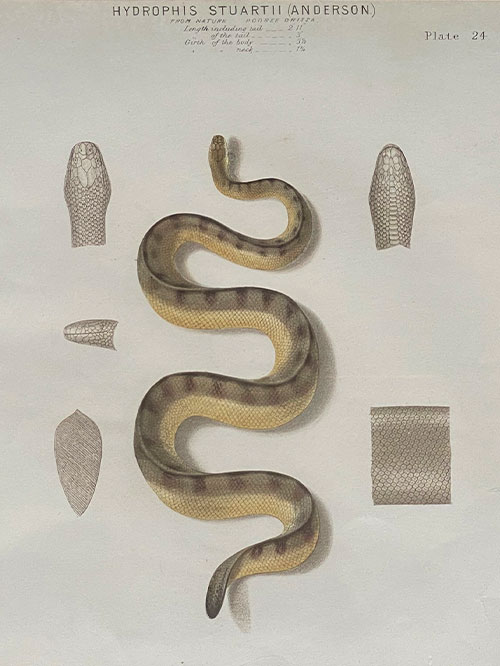
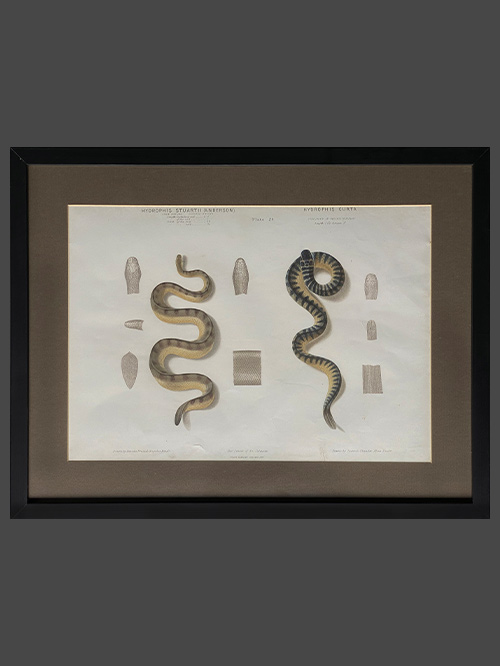
by Sir Joseph Fayrer
from The Thanatophidia of India
original hand coloured chromolithograph
Captioned ‘Hydrophis Stuartii and Hydrophis Curta’
Sir Joseph Fayrer, 1st Baronet (6 December 1824 – 21 May 1907) was an English physician noted for his writings on medicine in India. After studying medicine at Charing Cross Hospital, London and completing his medical degree in 1849, he was appointed as an assistant surgeon in Bengal in 1850. Fayrer, who became a fellow of the Royal Society in 1877, wrote much on subjects connected with the practice of medicine in India, and was especially known for his studies on the poisonous snakes of that country and on the physiological effects produced by their venom. He set up a zoological society and the zoo at Calcutta. He was President of the Asiatic Society of Bengal in 1867.
The Thanatophidia of India is a description of the venomous snakes of the Indian Peninsula and the physiological effects produced by their venom. These plates were drawn by students from the Govt. School of Art in Calcutta.
Size framed (cms): 44 (H) x 57 (L)
Size framed (inches): 17.5 (H) x 22 (L)
-
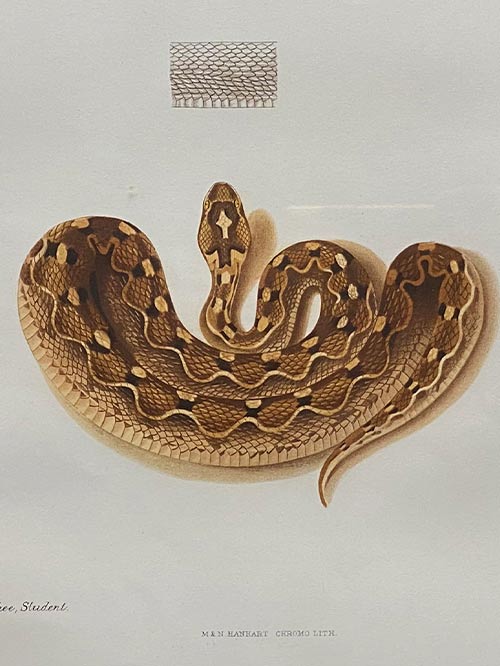
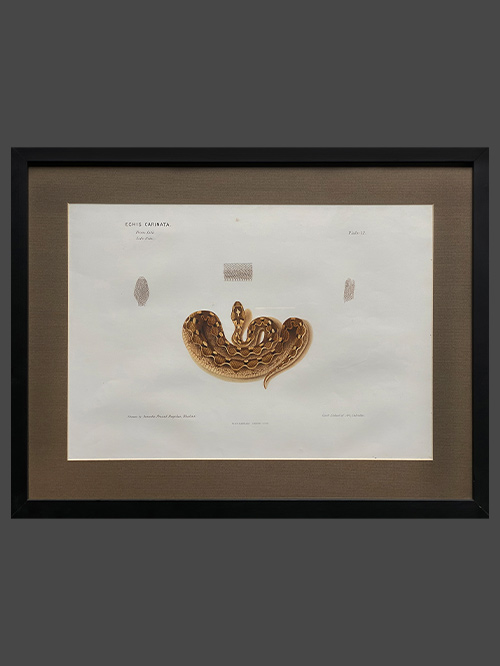
by Sir Joseph Fayrer
from The Thanatophidia of India
original hand coloured chromolithograph
Captioned ‘Echis Carinata’
Sir Joseph Fayrer, 1st Baronet (6 December 1824 – 21 May 1907) was an English physician noted for his writings on medicine in India. After studying medicine at Charing Cross Hospital, London and completing his medical degree in 1849, he was appointed as an assistant surgeon in Bengal in 1850. Fayrer, who became a fellow of the Royal Society in 1877, wrote much on subjects connected with the practice of medicine in India, and was especially known for his studies on the poisonous snakes of that country and on the physiological effects produced by their venom. He set up a zoological society and the zoo at Calcutta. He was President of the Asiatic Society of Bengal in 1867.
The Thanatophidia of India is a description of the venomous snakes of the Indian Peninsula and the physiological effects produced by their venom. These plates were drawn by students from the Govt. School of Art in Calcutta.
Size framed (cms): 44 (H) x 57 (L)
Size framed (inches): 17.5 (H) x 22 (L)
-
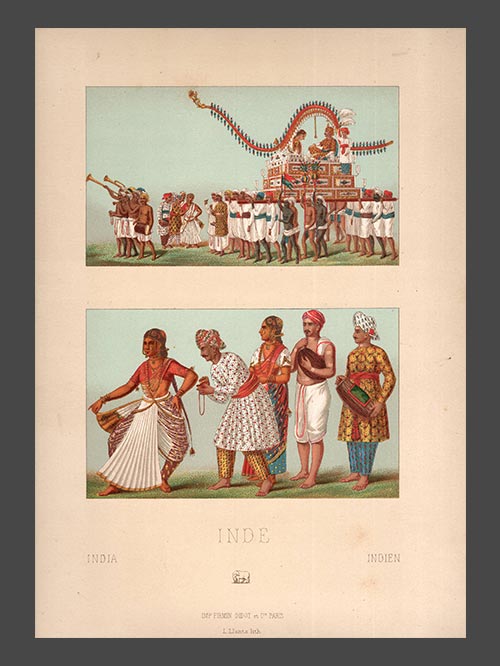
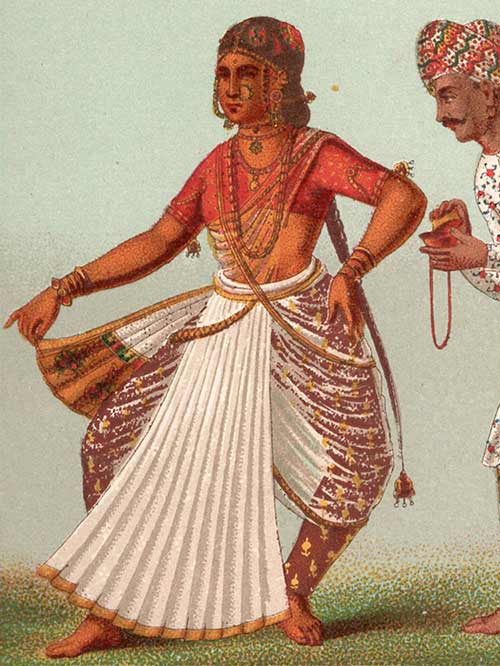
by A Racinet
from Le Costume Historique
original chromolithograph
Racinet’s ‘Le Costume Historique’ is the most famous of the 19th-century books on dress, and the first fashion book to use colour lithography. It is a wide-ranging survey of costumes through time. Publication was made possible by significant developments in colour printing technology, and a resurgence of interest in ‘the other’ as a new period of European colonialism gathered pace from the mid-19th century. The emphasis here is on recognising continuity in traditional dress, rather than innovation in fashion, and linking costume to local history, custom and social organisation. Racinet was keen to produce a visually appealing book that deployed chromolithography to full effect; in his enthusiasm he sometimes toyed with authenticity by adding colour to some of his sources. His representations of Indian fashion are largely inspired by miniature paintings from the collection of French lithographer Firmin Didot.
Image Size (cms): 17.5 (H) x 15.5 (W)
Image Size (inches): 7 (H) x 6 (W)
Print Size (cms): 30 (H) x 21.5 (W)
Print Size (inches): 11.8 (H) x 8.5 (W)
-
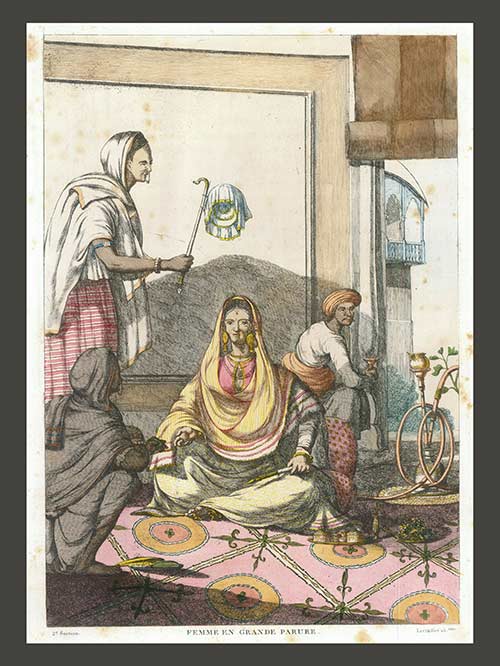
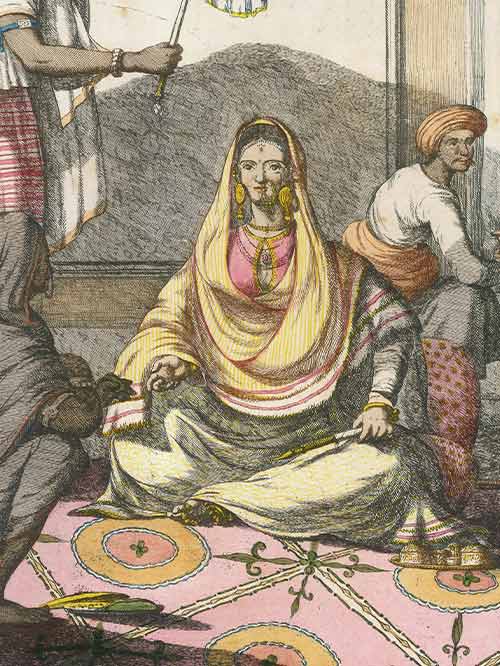
by Francois-Balthazar Solvyns (1760-1824)
Original coloured etching
from Les Hindous
Pub. Paris
Solvyns provides a vivid portrayal of a wealthy Hindu woman in full dress, emphasising both the magnificence of her attire and the richness of her surroundings. The woman is seated on a luxurious carpet, with her legs and arms supported by embroidered silk cushions. She is attended by two ayahs (maid servants). One maid offers her paan while another fans her with a hand pankh to refresh the air around her face. In the background, a hookah-bearer prepares the hookah for her to smoke. The lady’s appearance is meticulously described: her hair, made shiny with cocoa oil, is plaited and adorned with pearls or precious stones, with the largest gem positioned in the middle. Solvyns highlights her isolation and idle life, noting that women of her rank live in seclusion, removed from both labor and society, their lives marked by a lack of purpose and contribution, engaging in minimal activities such as playing the tom-tom.
Frans Balthazar Solvyns, was a skilled engraver and painter hailing from Antwerp, embarked on a transformative journey to India in 1790. Settling in Calcutta, Solvyns immersed himself in the intricacies of Indian life, studying Hindi and forging relationships with Brahmins and pundits. Inspired by his surroundings, he commenced his ambitious project in 1791, aiming to depict the diverse facets of Indian society, from occupations to customs which he published in a series of engravings. Despite its sensitive portrayal, the venture encountered little success initially, prompting Solvyns’ departure from India in 1803. However, his legacy endured through subsequent publications, notably “The Costume of Hindoostan” and the expanded edition of “Les Hindous,” offering an intimate and detailed glimpse into 18th-century Indian life across professions, festivals, and daily rituals, immortalising a unique historical moment with both reverence and curiosity.
Image Size (cms): 35(H) x 24(W)
Image Size (inches): 14(H) x 9.5(W)
Mount Size (cms): 51(H) x 41(W)
Mount Size (inches): 20(H) x 16(W)
-
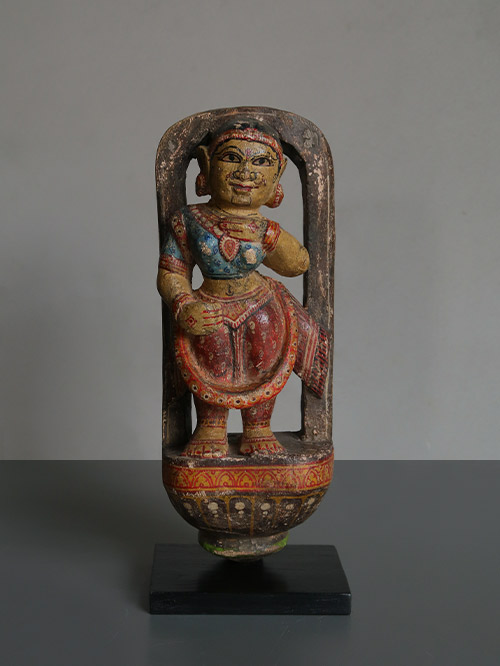
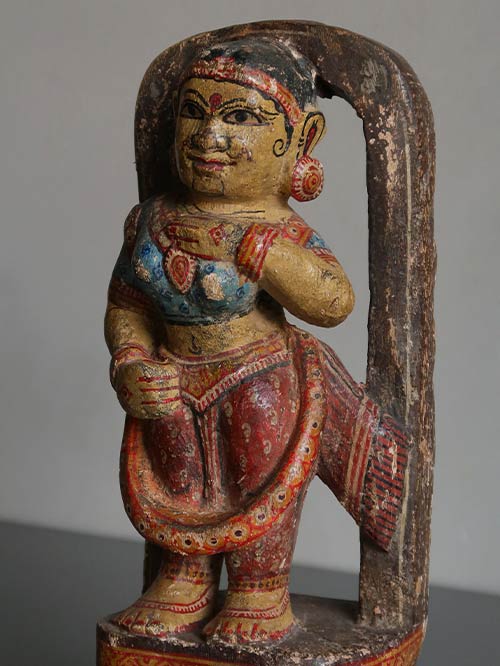
Orissa
Wood, polychromed
An elegant figure of an apsara wearing a patterned blouse. The apsara wears extensive jewellery; including multiple hand and leg ornaments. She has a stylised form with a narrow waist and large breasts and carries a flute in her hands. She has a full face with a pronounced chin, large arched eyebrows over bulbous eyes and a gentle smile.
Apsaras means ‘essence of the waters’ or ‘moving in or between the waters’. The Apsaras are divine beauties, the dancers of the gods, who dwell in Indra’s paradise, svarga (heaven). Mistresses of the Gandharva’s (semi divine beings) and, occasionally, of men, they can assume any form at will. Generally they are believed to have originated from the churning of the ocean, alone with the wish fulfilling Parijata, their favoured tree. They are often sent by the gods to seduce Rishis (holy men) and ascetics. Heroes who fall in battle are swept away to Svarga by the Apsaras. They are reputed to dwell in trees along with the Gandharvas. The chief of the Apsaras is Urvashi.
Size (cms): 33(H) x 13(W) x 10(D)
Size (inches): 13(H) x 5(W) x 4(D)
-
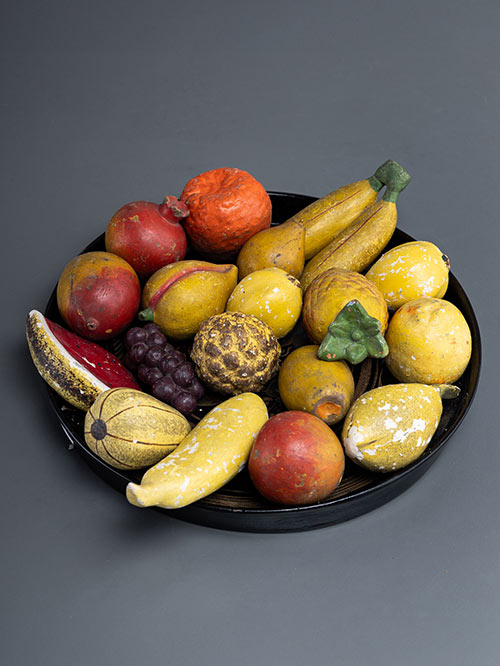
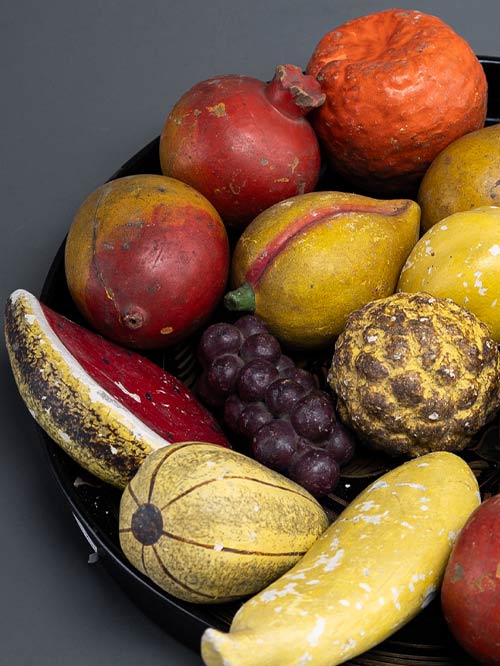
Maharashtra
Polychromed clay fruits and lacquer tray
The decorative group of delicately modelled fruits reflects the skill and creative flair of the ‘karigar’ who crafted them. Among the realistically rendered fruits are a pair of bananas, a diminutive pineapple, a cluster of grapes, a watermelon slice, a custard apple, a pomegranate, and a pear. The fruits sit on a stained black Burmese lacquer tray adorned with floral sprigs.
Fruit offerings, known as “phala” in Sanskrit, hold an auspicious role in Hindu puja rituals. Fresh fruit offerings symbolize respect, gratitude, and devotion to the gods and goddesses. Clay and other artificial fruits were sometimes used as substitutes for these offerings, providing the same ritual merit as their fresh counterparts. These clay offerings were meticulously crafted to closely resemble real fruits in appearance. Unlike fresh fruit, they were considered a more affordable, durable, and accessible alternative in smaller rural villages and towns.
Size (cms): 6(H) x 31(Diam)
Size (inches): 2.5(H) x 12(Diam)
-
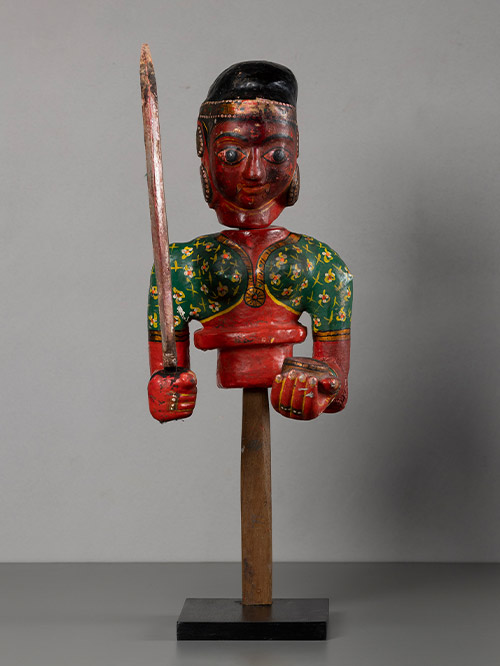
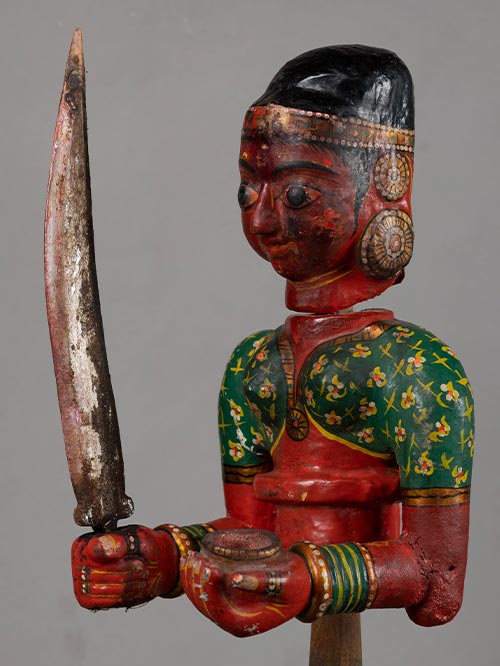
Karnataka
Wood, extensively polychromed
A fine two armed bust of the Goddess Durga wearing a patterned blue blouse. She is adorned with jewelled necklaces and bracelets and wears large globular earrings. In her hands she carries a sword and a bowl.
Durga – “The Unconquerable form of Devi” – Durga is the most splendid manifestation of Devi. Virginal and sublime, contain within her the power of all the gods combined, she is the invincible power of Nature who triumphs over those who seek to subjugate her. Durga is one of the names of the goddess that is the wife of Shiva. Durga has the role of a warrior goddess who destroys demons. She is usually depicted with ten arms that hold the weapons of the various gods. Her vahana is a lion which acts as her means of transportation and one of her many weapons.
During festive occasions, the utsavar (portable figures of deities) are placed on chariots or pedestals in the mandapam (audience hall of a temple) or on their respective vahana (vehicle) and taken out for public viewing or darshana. Darshana refers to the occasion where the devotee is not only able to see the image of the deity but also to sense its omnipresence.
Size (cms): 59(H) x 20(W) x 18(D)
Size (inches): 23(H) x 8(W) x 7(D)
-
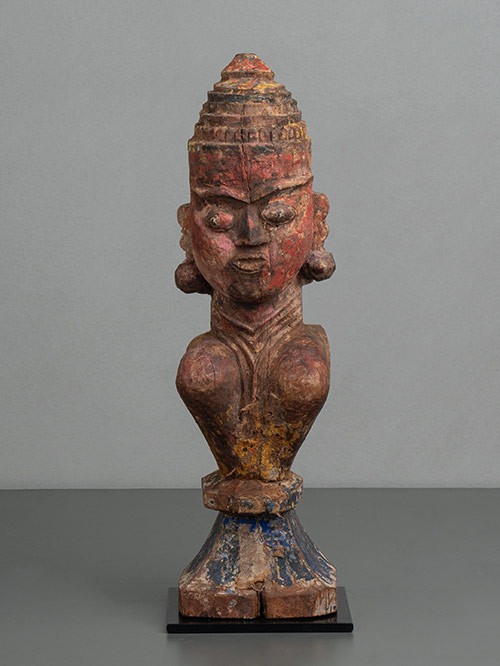
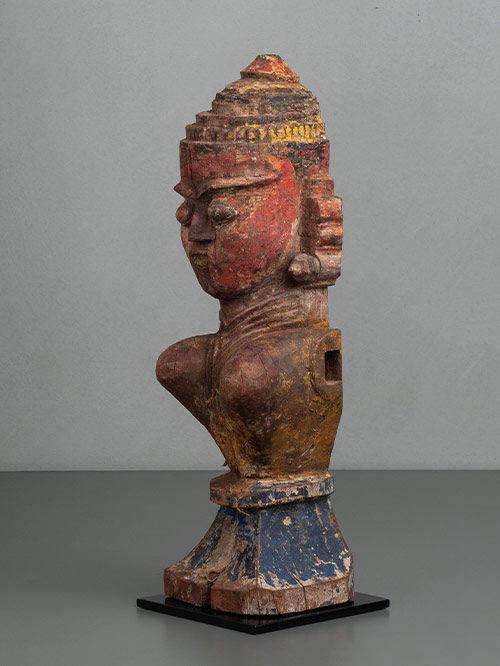
Karnataka
Wood with traces of polychroming
This decorative folk bust of Durga has an austere expression and an exaggeratedly proportioned torso, once painted to resemble a blouse. She is richly adorned with globular earrings, layered necklaces that hang low on her chest, and a striking tiered crown.
Durga – “The Unconquerable form of Devi” – Durga is the most splendid manifestation of Devi. Virginal and sublime, contain within her the power of all the gods combined, she is the invincible power of Nature who triumphs over those who seek to subjugate her. Durga is one of the names of the goddess that is the wife of Shiva. Durga has the role of a warrior goddess who destroys demons. She is usually depicted with ten arms that hold the weapons of the various gods. Her vahana is a lion which acts as her means of transportation and one of her many weapons.
During festive occasions, the utsavar (portable figures of deities) are placed on chariots or pedestals in the mandapam (audience hall of a temple) or on their respective vahana (vehicle) and taken out for public viewing or darshana. Darshana refers to the occasion where the devotee is not only able to see the image of the deity but also to sense its omnipresence.
Size (cms): 39(H) x 13(W) x 13(D)
Size (inches): 15.5(H) x 5(W) x 5(D)
-
Karnataka
Wood, extensively polychromed
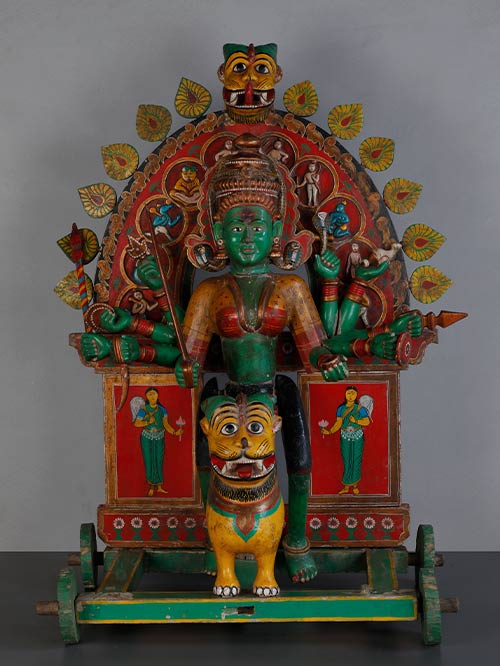
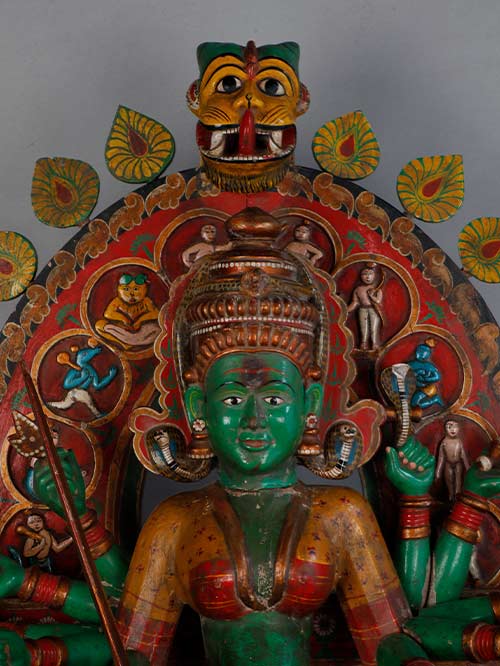
An exceptional multi-armed articulated figure of the Goddess Durga riding her Tiger vahana. She is seated on a complete chariot with a resplendent prabhavali which is painted with chauri bearers and a flaming aureole. Diminutive roundels are placed in an arch within the prabhavali each depicting the ten incarnations of Lord Vishnu starting with Matysa and ending with Kalki. The Goddess wears a patterned red and yellow blouse and an elaborate tiered crown. In her arms she carries various weapons, including a sword, cakra, conch, naga and blood bowl.
Durga – “The Unconquerable form of Devi” – Durga is the most splendid manifestation of Devi. Virginal and sublime, contain within her the power of all the gods combined, she is the invincible power of Nature who triumphs over those who seek to subjugate her. Every year, during Navratri, processional images of the goddess are carried in evocative ceremonies. Depending on the day of the festival, her vahana, the vehicle on which she rides changes, with each of her vehicles holding a different and unique significance. The tiger she rides here signifies her ferociousness and strength.
Size (cms): 95(H) x 69(W) x 44(D)
Size (inches): 37.5(H) x 27(W) x 17.5(D)
-
Puri (Orissa)
Wood, polychromed
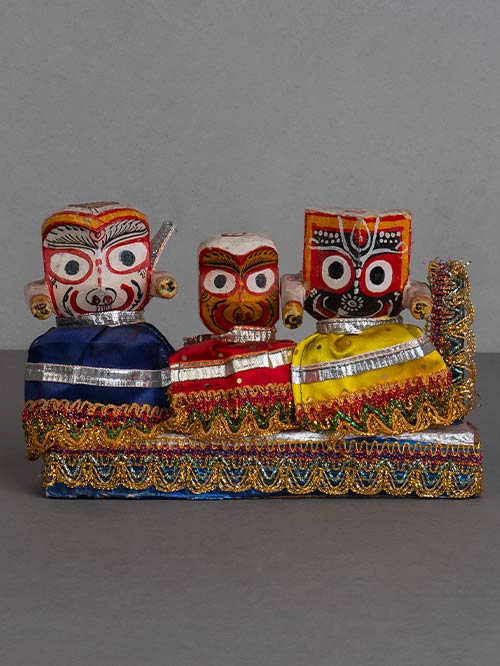
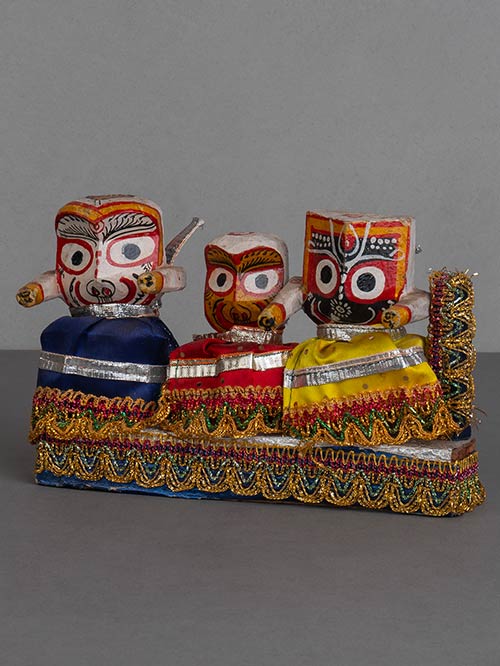
In the heart of Puri lies the ancient pilgrimage centre and temple of the Jagannatha cult. There, Jagannatha, a form of Krishna, the eighth incarnation of Vishnu, is worshipped along with his brother Balabhadra and sister Subhadra. These diminutive portable figures were produced in the markets surrounding the Jagannatha temple and bought by pilgrims on their journey home. The figures are depicted as legless posts surmounted by large heads. Jagannatha (black faced) and Balabhadra (white faced) and the petite Subhadra (yellow faced).
The cult of Jagannatha in Puri is one of India’s oldest popular iconic traditions. Puri lies in Orissa is on the eastern coast of India in the Bay of Bengal. The figures of the gods remain in the temple for most of the year, but in the rainy season (June or July), they are installed in huge chariots and pulled through the streets of Puri to another temple, allowing the public to have Darshan (‘a holy view’) of the deities as they pass. It is from the huge chariots carrying Jaganath and his siblings that the English word ‘Juggernaut’ originates. Smaller figures such as these may have been used in home altars or shrines.
Size (cms): 14(H) x 21(W) x 5(D)
Size (inches): 5.5(H) x 8.5(W) x 2(D)