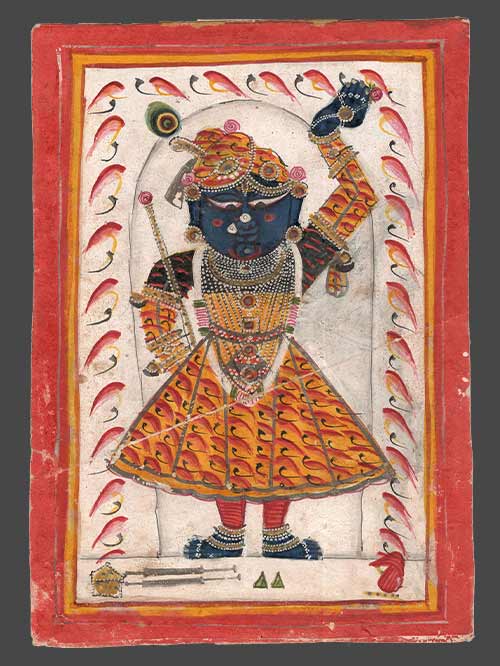
Shrinathji during Phalguna
Nathdwara (Rajasthan)
Opaque pigments on paper
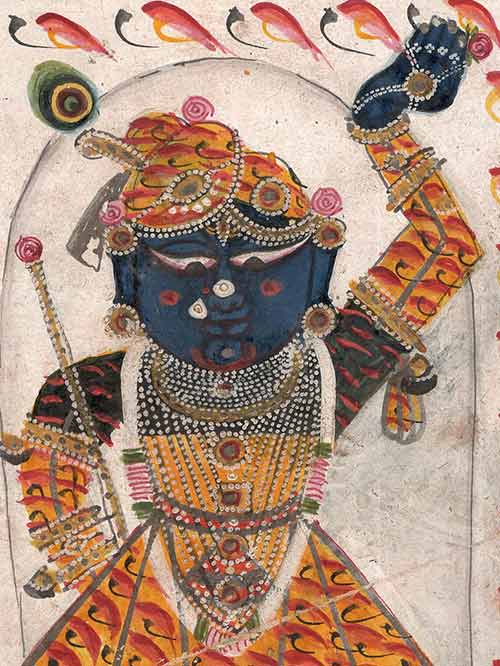
Shrinathji is adorned with rows of pearls and gem studded necklaces, armlets, anklets and turban ornaments. He holds with his arm around his back his cowherds stick (lakut) and a fully bloomed lotus in his left arm which is raised towards the sky. He is dressed in a saffron coat (gherdaar wagha with choli) and turban surmounted by a peacock feather plume (pagh with chandrika). His chest, shoulders and clothes are smeared with red gulal and dark lines of burnt sandalwood powder. His cheeks too are marked with red gulal. Similarly, dark lines of burnt sandalwood can also be seen on the white pichvai behind him, along with red gulal and yellow sandalwood. At his feet are the prescribed banta, or snack box, paan-bida or folded betel leaves, the covered pot of Jumna water. Two syringes filled with gulal (colour) are kept on the platform for Shrinathji to play with. This painting depicts Shrinathji in his shringar during Phalguna.
Phalguna (Spring) is the last month of the year in the Hindu calendar, usually corresponding to February/March in the Gregorian calendar. From festival of Vasant Panchami, which greets the arrival of the season until the festival of Dol Utsav (the day after Holi), a plain white pichvai is hung behind Shrinathji. Each day the head priest of the temple decorates it with different designs in gulal (coloured powder).
Painting Size (cms): 17.5(H) x 12(W)
Painting Size (inches): 7(H) x 4.5(W)