-
Coastal Karnataka (Bhuta culture)
Wood, polychromed
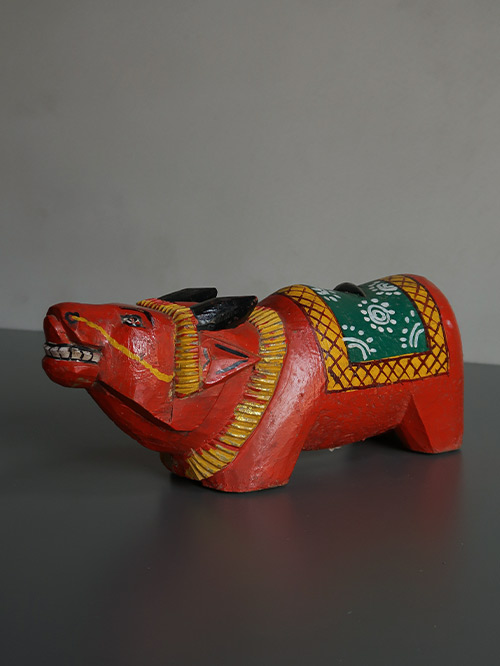
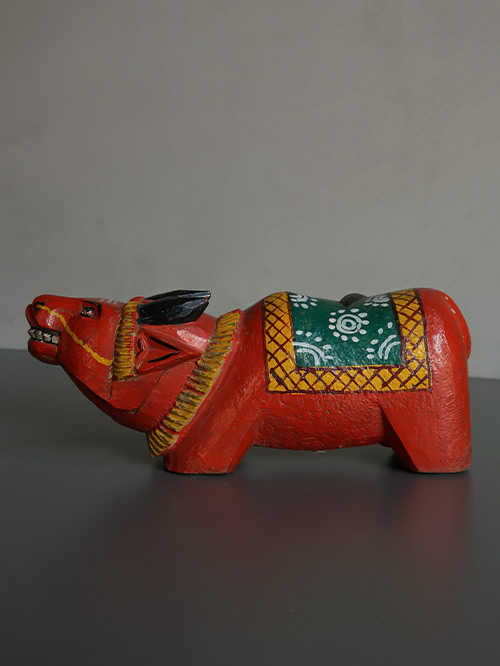
A fine painted wood figure of a standing nandi. Displaying the typical folk bhuta style of coastal Karnataka, this figure is painted predominantly in red It displays a typical stylised form with a horizontal head with slightly protruding tongue, horns adorned with ornaments, a floral painted saddlecloth and a curled back tail resting on its back.
The bhuta tradition is popular on the Malabar coast. Bounded by the dramatic sweep of the forested ghats to the east and the Arabian sea to the west, and encircled by rivers, the South Kanara district of coastal Karnataka has enjoyed relative geographic isolation until recent years. The totemic origin of this bull bhuta is quite obvious in a land of agriculture and farms where ploughs are pulled by bulls and where cow milk is one of the main sources of protein. The link with Hinduism is also easily established through Nandi the vahana (“vehicle”) of god Shiva.
Size (cms): 14(H) x 35.5(W) x 11(D)
Size (inches): 5.5(H) x 14(W) x 4.5(D)
-
Coastal Karnataka (Bhuta culture)
Wood, polychromed
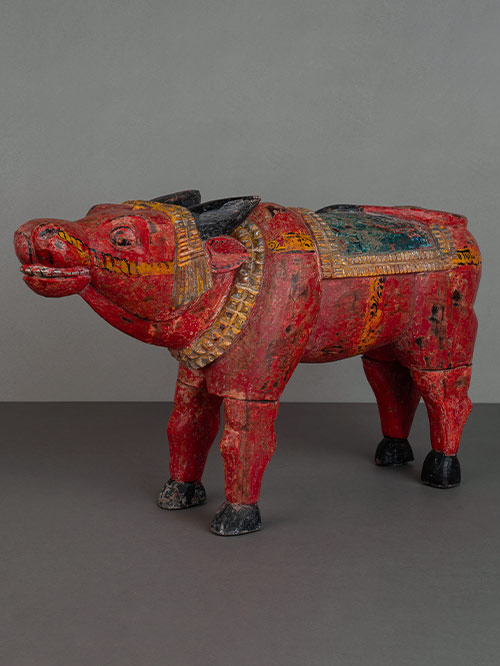
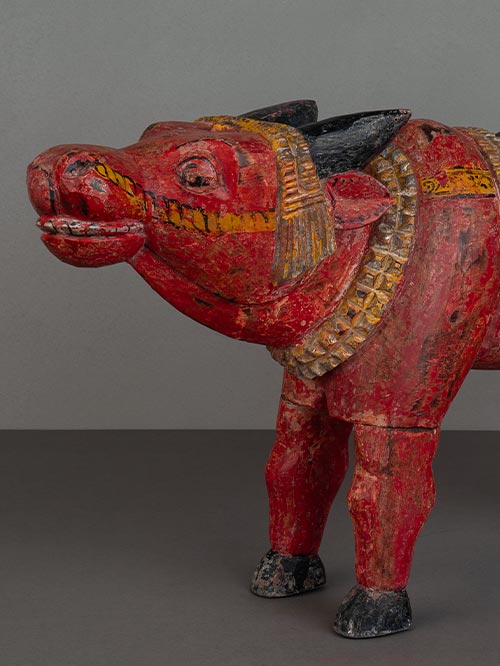
A fine painted wood figure of a standing nandi. Displaying the typical folk bhuta style of coastal Karnataka, this figure is painted predominantly in red with a painted saddlecloth and a curled back tail resting on its back.
The bhuta tradition is popular on the Malabar coast. Bounded by the dramatic sweep of the forested ghats to the east and the Arabian sea to the west, and encircled by rivers, the South Kanara district of coastal Karnataka has enjoyed relative geographic isolation until recent years. The totemic origin of this bull bhuta is quite obvious in a land of agriculture and farms where ploughs are pulled by bulls and where cow milk is one of the main sources of protein. The link with Hinduism is also easily established through Nandi the vahana (“vehicle”) of god Shiva.
Size (cms): 32(H) x 52(W) x 14(D)
Size (inches): 12.5(H) x 20.5(W) x 5.5(D)
-
Sindh
glazed pottery
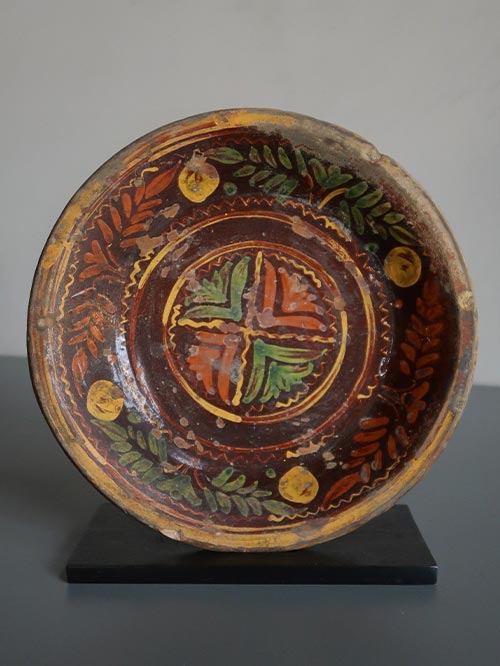
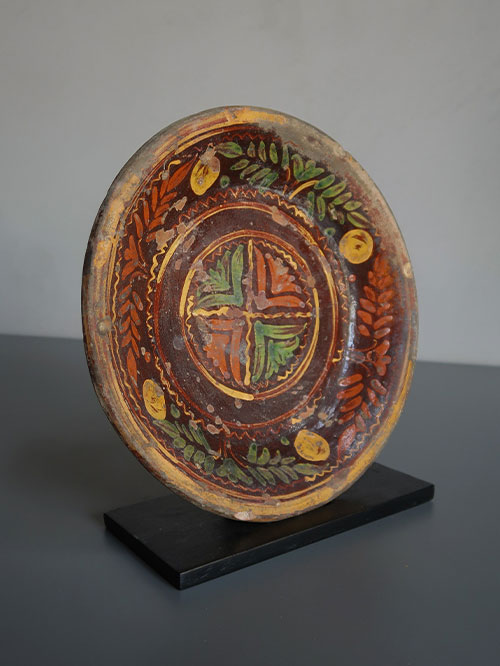
A decorative glazed pottery dish from the Sindh region, beautiful for its simplicity in shape, the spontaneity, directness, and propriety of its ornamentation, and the beauty of its colouring. This dish is very different from the commonly available unglazed pottery of Sindh and the Punjab. The glazed pottery of Sindh is made principally at Hala, Hyderabad, Tatta and Jerruck. The pieces are glazed mostly in turquoise, of the most perfect transparency, or in a rich dark purple, or dark green, or golden brown. Sometimes they are diapered all over by the pâte-sur-pâte method, with a conventional flower, the seventi, or lotus, of a lighter colour than the ground. Generally they are ornamented with the universal knop and flower pattern, in compartments formed all round the bowl, by spaces alternately left uncoloured and glazed in colour. Sometimes a wreath of the knop and flower pattern is simply painted round the bowl on a white ground. The glazed pottery of Sindh also inspired the Bombay School of Art pottery. Some of the best potters from Sindh were brought to the School to teach the pupils the technique.
Size (cms): 3.75(H) x 26(Diam)
Size (inches): 1.5(H) x 10(Diam)
-
Karnataka (South India)
Wood, polychromed
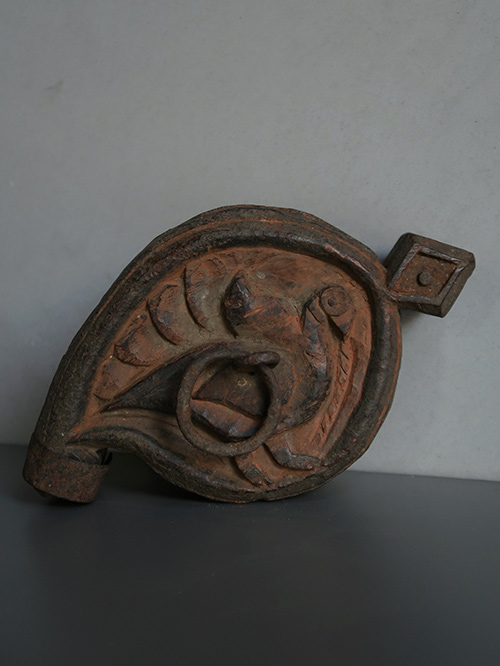
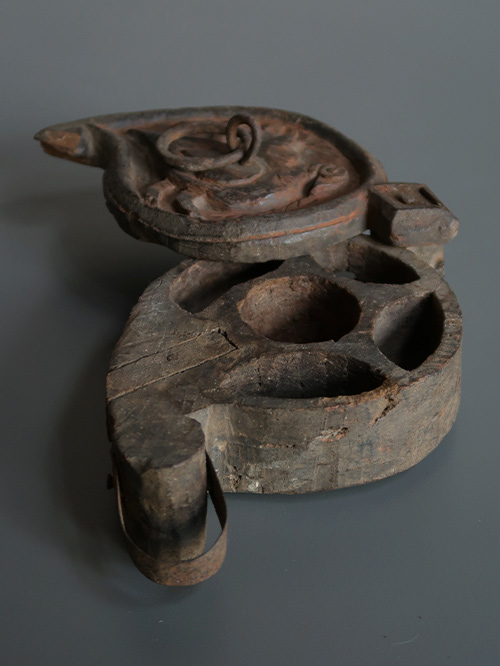
An unusual vermillion box with a stylised Hamsa (goose) on the lid, and five containers inside.
The hamsa a mythological aquatic bird that resembles a goose or a swan. The hamsa is one of the most important of the Indian birds and is a familiar motif in Indian art, literature, sculpture and textiles. Revered by Hindus, Buddhists and Jains, it plays a prominent role in mythology, folklore, literature and religion. In Vedic times the hamsa was connected with the sun and represented virility. It is reputed to eat pearls and to be able to separate milk from water. The hamsa is the vahana of Brahma.
Sindoor is a traditional vermilion red or orange-red colored cosmetic powder from India, usually worn by married women along the part of their hair. In Hindu communities the use of sindoor indicates a woman is married and ceasing to wear it usually implies widowhood. Sindoor originally comes from the sindoor tree and is used mainly for religious purposes, when worshiping the deity and other Hindu rituals. The main component of modern traditional sindooram is usually turmeric.
Size (cms): 8(H) x 20(W) x 12(D)
Size (inches): 3(H) x 8(W) x 4.5(D)