Filter products Showing all 2 results
Sort By
Filter By Style
Show Per Page
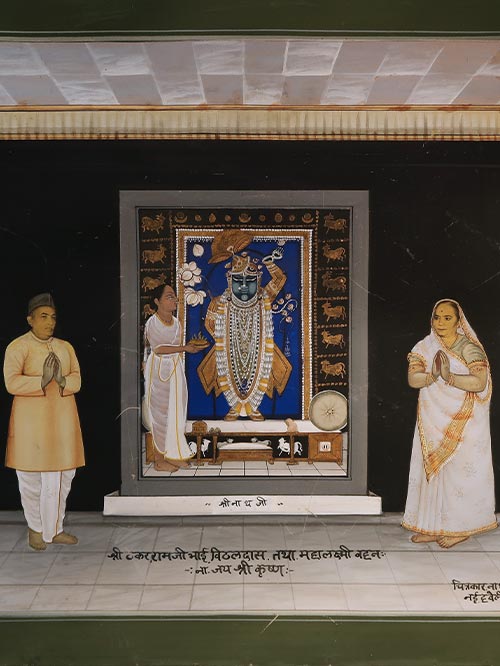
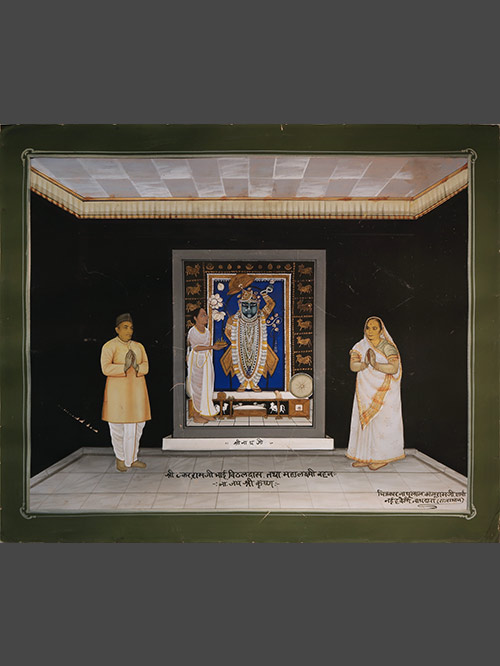
  • Manorath Painting

    Manorath Painting

    Nathdwara (Rajasthan)

    Opaque watercolour, gold and gelatin silver print on paper

    Inscribed on recto ‘Nathulal Kaluramji Sharma, Nathdwara

    In Pushti Marga terminology, to perform a manoratha is to offer a seva ( ritualistic service) to the deity in fulfilment of a long cherished inner yearning to serve him in a special way on a particular day. Only a few select Goswamis, direct descendants of Vallbhacharya, are given this privilege and every Goswami longs to perform a manoratha at least once in a lifetime. A wealthy devotee can also perform a manoratha on an important day of his life or in the fulfilment of a vow. This is done by contributing towards the expenses of a particular darshana ( formal viewing of a deity) or by paying for the seva of an entire day. To commemorate this event, devotees usually commission a painting showing them on both sides of Srinathji outside the threshed of the sanctum. In the present painting actual photographs of the donors faces are incorporated into the painting. This served as a visual record of their worship before the famed icon.

    Sri-Nathji ( The Lord of Shri, Goddess of Wealth) enshrined at Nathdwara is the most important svarupa (own form) in the Pushti Marga, and represents Krishna at the age of seven. Sri-Nathji is Krishna incarnate, the tutelary deity of the Vallabhacharya whose swarupa or image is enshrined at Nathdwara.

    Painting Size (cms): 50.5 (H) x 60.5 (L)
    Painting Size (inch): 19.9 (H) x 23.8 (L)
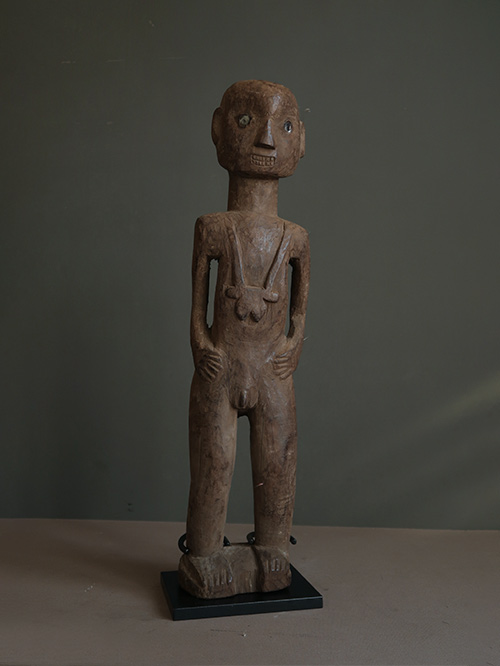
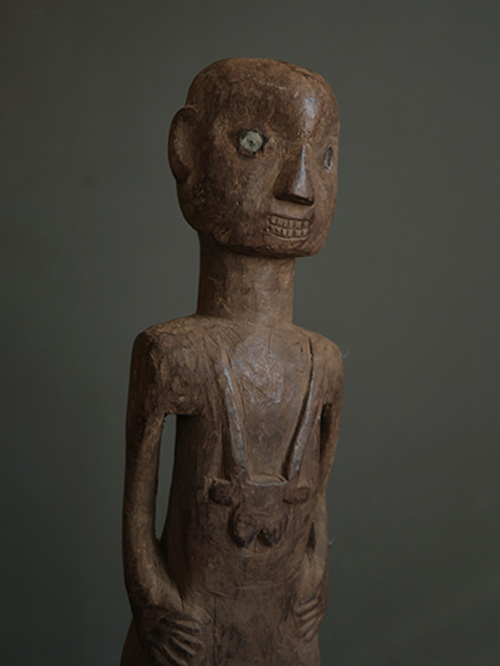
  • Morung Figure

    Morung Figure

    Nagaland (North-East India)

    Wood and glass

    A key fixture in nearly all Naga settlements was the Morung, or Men’s House, which served as something of a community center. It was usually the biggest and most beautifully furnished building in a village, spacious and decorated with ornate carvings. Numerous wooden sculptures decorated the walls and posts of the farthest end of the innermost space of the Morung. They expressed the narrative traditions of the Naga. Wooden sculpture such as this, depicting would be posted near the walls of the Morung, were not uncommon and thought to relate to fertility.

    The Naga are a group of culturally and linguistically linked tribes who live in the mountainous regions of northeastern India and northwestern Burma (Myanmar). As headhunters, they were feared and avoided by their neighbours, allowing them to develop a distinctive material culture—in which objects they created are of impressive aesthetic value and possess great symbolic importance to the community—and a complex system of norms and taboos. The main tribal groups of the Naga include the Angami, Sema, Ao, Kalyo- Kengyu, Konyak, Lhota, Rengma, Tangkhul, Chang, Sangtam and Sema.

    Size(cms): 53 (H) x 13 (W) x 8 (D)
    Size(inches): 20.9 (H) x 5.1 (W) x 3.1 (D)

Phillips Antiques

PHILLIPS

Subscribe to our Newsletter to stay updated with newest arrivals.
SUBSCRIBE NOW
close-link