-
Nathdwara (Rajasthan)
opaque watercolour and gold on paper
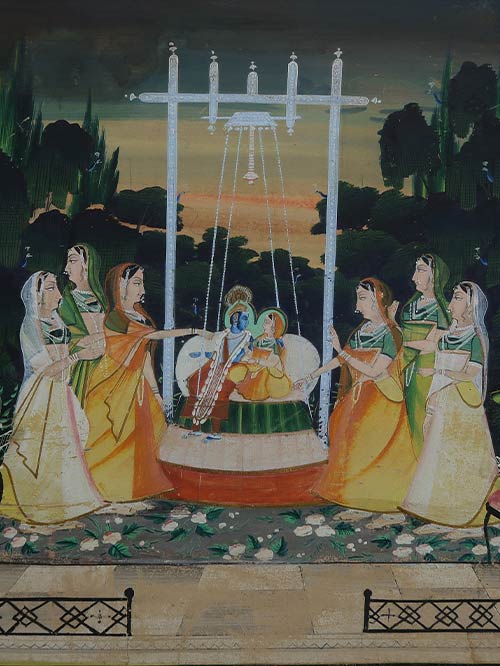
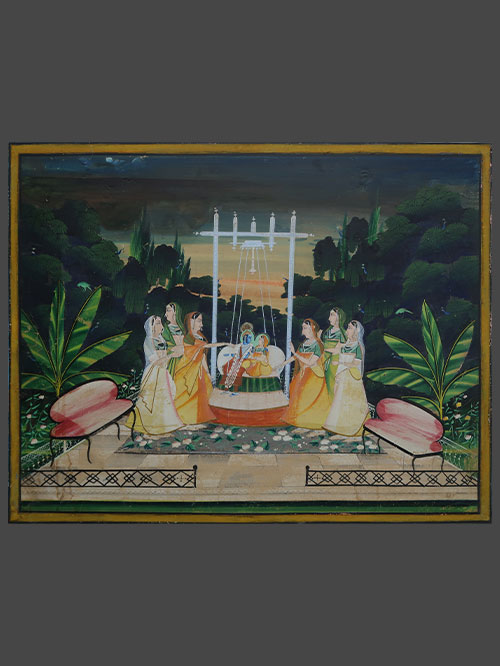
Krishna and Radha sit resting against a large white bolster on an ornate silver swing. Underfoot is a floral decorated carpet on a chequered marble floor with iron balustrades. Six female attendants flank the nimbate couple whose gazes are firmly fixed on each other. In the foreground are a pair of European style pink settees while in the distance an orange hued sky indicates the setting sun. Dense clusters of trees and foliage sprinkled with parrots and peacocks envelope the central scene.
Such large and dramatic scenes were painted by Nathdwara artists who produced these images for devotees who visited the great Krishna temple at Nathdwara in Rajasthan. Founded in the 17th century, this temple has attracted an enormous following even to this day, in turn ensuring a continuing tradition of devotional images. The extravagant size and conception of these paintings remind one of the constant importance of religious images in India, not only as ritual objects but also items for pilgrims to acquire and bring home from the great Hindu shrines.
Towards the end of the nineteenth century and early twentieth century Nathdwara artists were exposed for the first time to European art prints whose influence can be seen in the paintings of this period.
Size Painting (cms): 44.5 (H) x 57 (W)
Size Painting (inch): 17.5 (H) x 22.4 (L)
-
Nathdwara (Rajasthan)
Opaque watercolour, gold and gelatin silver print on paper
Inscribed on recto ‘Nathulal Kaluramji Sharma, Nathdwara’
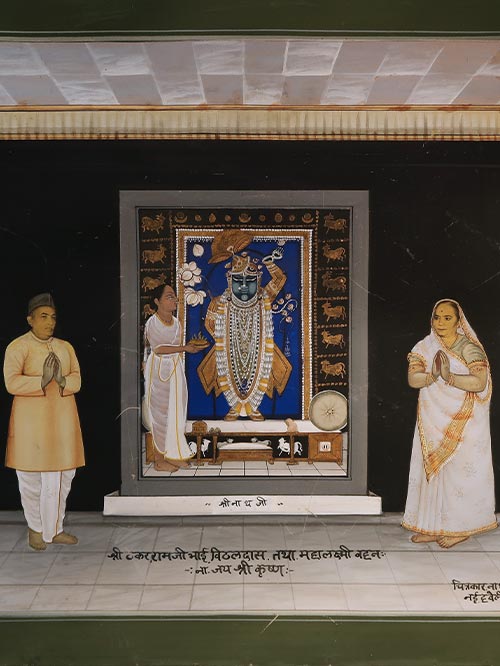
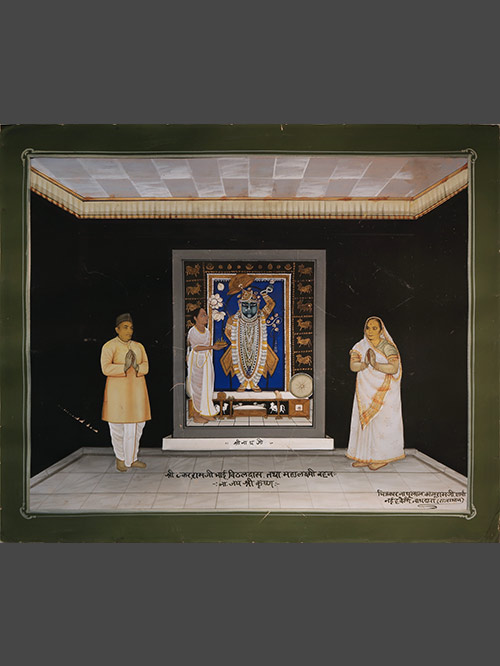
In Pushti Marga terminology, to perform a manoratha is to offer a seva ( ritualistic service) to the deity in fulfilment of a long cherished inner yearning to serve him in a special way on a particular day. Only a few select Goswamis, direct descendants of Vallbhacharya, are given this privilege and every Goswami longs to perform a manoratha at least once in a lifetime. A wealthy devotee can also perform a manoratha on an important day of his life or in the fulfilment of a vow. This is done by contributing towards the expenses of a particular darshana ( formal viewing of a deity) or by paying for the seva of an entire day. To commemorate this event, devotees usually commission a painting showing them on both sides of Srinathji outside the threshed of the sanctum. In the present painting actual photographs of the donors faces are incorporated into the painting. This served as a visual record of their worship before the famed icon.
Sri-Nathji ( The Lord of Shri, Goddess of Wealth) enshrined at Nathdwara is the most important svarupa (own form) in the Pushti Marga, and represents Krishna at the age of seven. Sri-Nathji is Krishna incarnate, the tutelary deity of the Vallabhacharya whose swarupa or image is enshrined at Nathdwara.
Painting Size (cms): 50.5 (H) x 60.5 (L)
Painting Size (inch): 19.9 (H) x 23.8 (L)
-
Nathdwara (Rajasthan)
Opaque pigments on paper
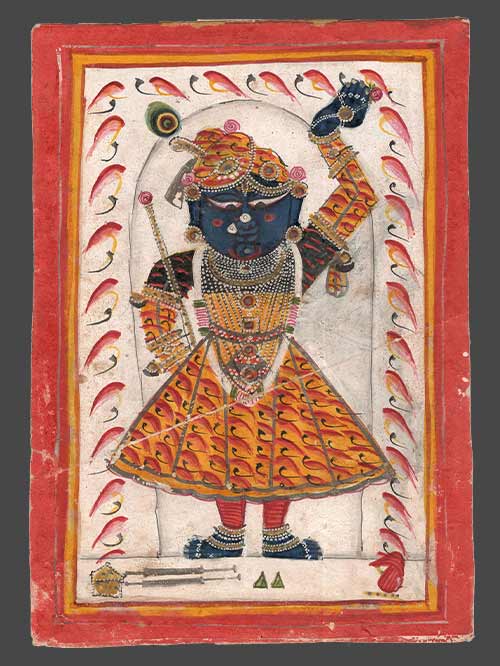
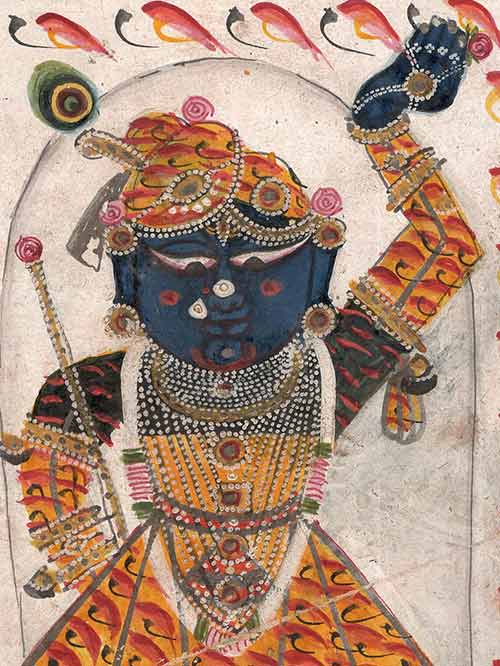
Shrinathji is adorned with rows of pearls and gem studded necklaces, armlets, anklets and turban ornaments. He holds with his arm around his back his cowherds stick (lakut) and a fully bloomed lotus in his left arm which is raised towards the sky. He is dressed in a saffron coat (gherdaar wagha with choli) and turban surmounted by a peacock feather plume (pagh with chandrika). His chest, shoulders and clothes are smeared with red gulal and dark lines of burnt sandalwood powder. His cheeks too are marked with red gulal. Similarly, dark lines of burnt sandalwood can also be seen on the white pichvai behind him, along with red gulal and yellow sandalwood. At his feet are the prescribed banta, or snack box, paan-bida or folded betel leaves, the covered pot of Jumna water. Two syringes filled with gulal (colour) are kept on the platform for Shrinathji to play with. This painting depicts Shrinathji in his shringar during Phalguna.
Phalguna (Spring) is the last month of the year in the Hindu calendar, usually corresponding to February/March in the Gregorian calendar. From festival of Vasant Panchami, which greets the arrival of the season until the festival of Dol Utsav (the day after Holi), a plain white pichvai is hung behind Shrinathji. Each day the head priest of the temple decorates it with different designs in gulal (coloured powder).
Painting Size (cms): 17.5(H) x 12(W)
Painting Size (inches): 7(H) x 4.5(W)