-
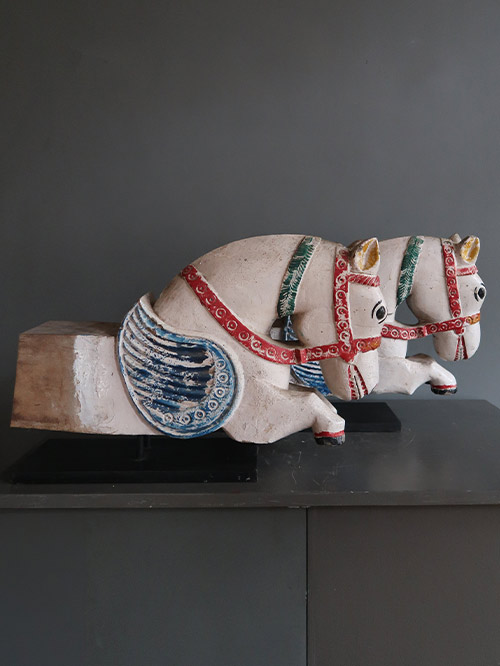
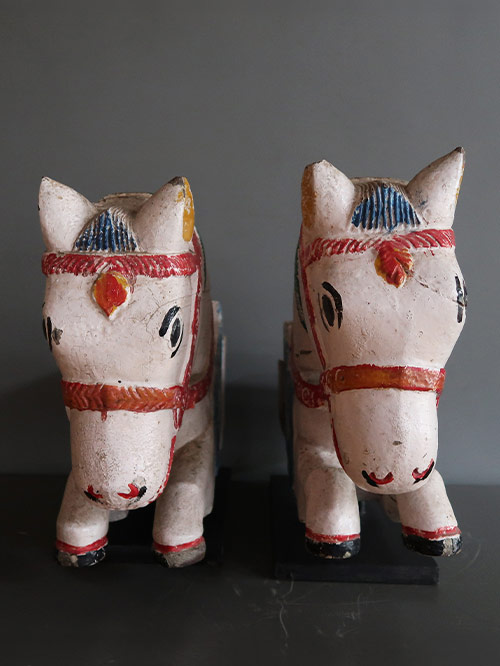
Andhra Pradesh (South India)
Wood
These horse brackets once formed the two ends of a door lintel. The horse or ashva was a very popular motif in architectural wood carvings in South India. Its prototype, the divine Uchchaihshravas emerged from the churning of the ocean. It was white and endowed with wings. The god Indra appropriated it and, after cutting its wings to ensure that it would remain on earth, donated it to mankind.
The horse played a pivotal role in establishing the supremacy of kings, as demonstrated, for instance by the great horse sacrifice, the Ashvamedha, which might have been established in the course of the Vedic period. Equestrian motifs appear prominently in Indian art, for example in Orissan sculpture of the 12th and 13th centuries, and in that of the late Vijaynagara and Nayak periods (early 16th to early 18th century) in southern India. There is a branch of literature specialising in the training of horses, which contains detailed passages on colouring, proportions, gait, auspicious and inauspicious marks and lists of appropriate names for horses.
Individual Size (cms): 40(H) x 64(W) x 18(D)
Individual Size (inches): 15.5(H) x 25(W) x 7(D)
-
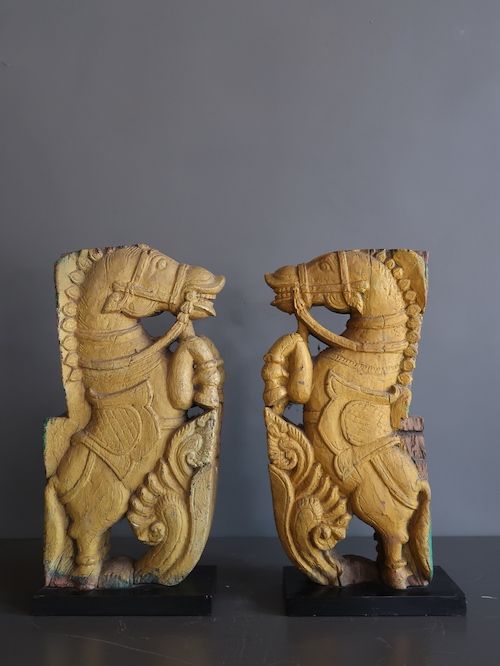
Andhra Pradesh (South India)
Wood, polychromed
These horse brackets once formed the two ends of a door lintel. The horse or ashva was a very popular motif in architectural wood carvings in South India. Its prototype, the divine Uchchaihshravas emerged from the churning of the ocean. It was white and endowed with wings. The god Indra appropriated it and, after cutting its wings to ensure that it would remain on earth, donated it to mankind.
The horse played a pivotal role in establishing the supremacy of kings, as demonstrated, for instance by the great horse sacrifice, the Ashvamedha, which might have been established in the course of the Vedic period. Equestrian motifs appear prominently in Indian art, for example in Orissan sculpture of the 12th and 13th centuries, and in that of the late Vijaynagara and Nayak periods (early 16th to early 18th century) in southern India. There is a branch of literature specialising in the training of horses, which contains detailed passages on colouring, proportions, gait, auspicious and inauspicious marks and lists of appropriate names for horses.
Size individual (cms): 47 (H) x 10 (W) x 23 (D)
Size individual (inches): 18.5 (H) x 4 (W) x 9 (D)
-
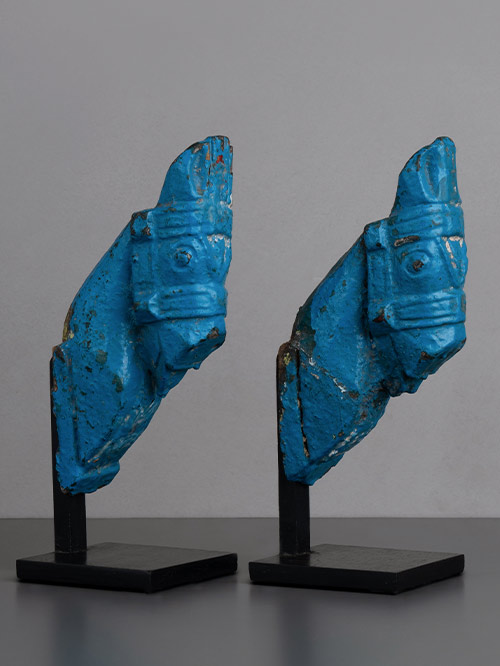
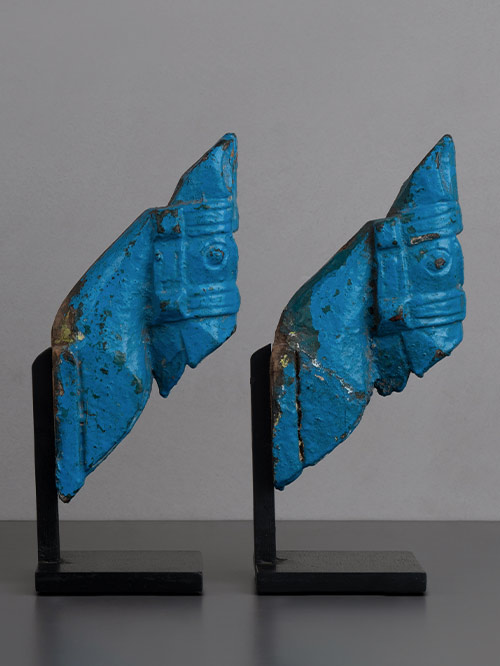
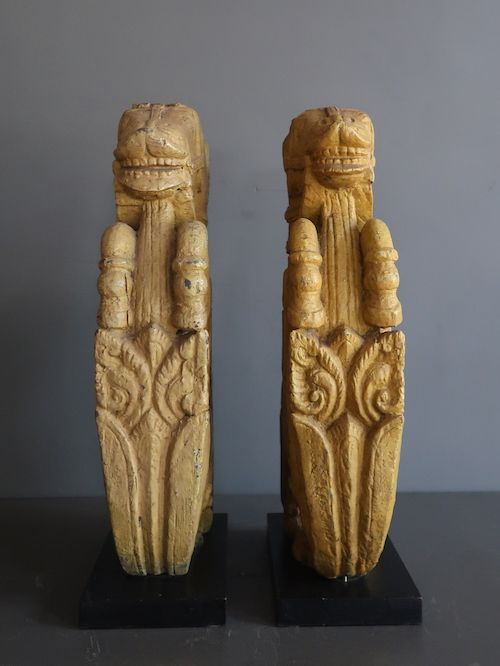
Andhra Pradesh (South India)
Wood, extensively polychromed
These horse brackets once formed the two ends of a door lintel. The horse or ashva was a very popular motif in architectural wood carvings in South India. Its prototype, the divine Uchchaihshravas emerged from the churning of the ocean. It was white and endowed with wings. The god Indra appropriated it and, after cutting its wings to ensure that it would remain on earth, donated it to mankind.
The horse played a pivotal role in establishing the supremacy of kings, as demonstrated, for instance by the great horse sacrifice, the Ashvamedha, which might have been established in the course of the Vedic period. Equestrian motifs appear prominently in Indian art, for example in Orissan sculpture of the 12th and 13th centuries, and in that of the late Vijaynagara and Nayak periods (early 16th to early 18th century) in southern India. There is a branch of literature specialising in the training of horses, which contains detailed passages on colouring, proportions, gait, auspicious and inauspicious marks and lists of appropriate names for horses.
Individual Sizes (cms):28(H) x 10(W) x 13(D)
Individual Sizes (inches): 11(H) x 4(W) x 5(D)
-
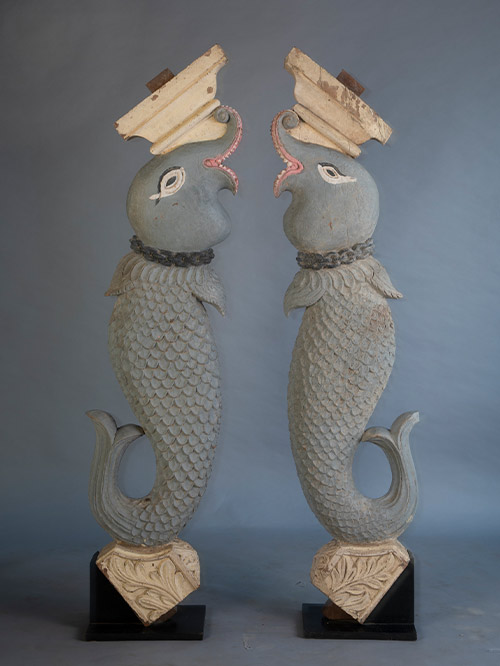
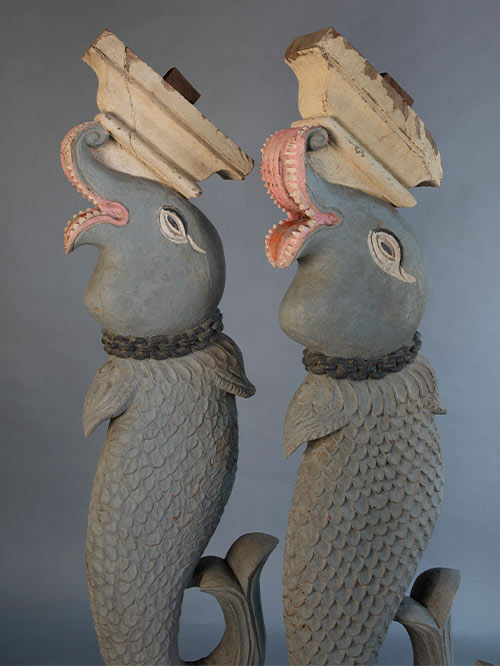
Gujarat (Western India)
Wood with polychrome
An unusual and impressive set of carved makara brackets (architectural struts) probably originally from the upper pavilion of a mansion or temple. Their open mouths reveal rows of prominent teeth, the upper jaw is formed as a short upturned trunk. The necks have a linked chain, the lower body is encompassed by scales resembling a fish and have an upturned tail.
The Makara is a mythical aquatic creature that is said to combine the body of a crocodile with the head of a lion and the trunk of an elephant. One of India’s most ancient symbols, harking back more than two thousand years to a time when the natural world was seen as both symbol and reality, and fantastic creatures were invented to express the complexity of nature. The Makara is considered auspicious and purifying by Hindus and related to fertility. He is the vehicle (vahana) of Varuna, god of the waters of heaven and earth, and the emblem of Kama, the god of love.
Individual Sizes (cms): 155(H) x 38(W) x 21(D)
Individual Sizes (inches): 61(H) x 15(W) x 8.5(D)
-
Karnataka (South India)
brass alloy
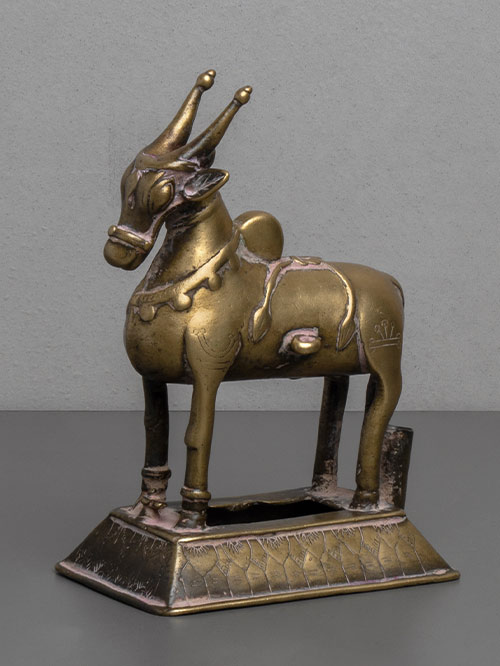
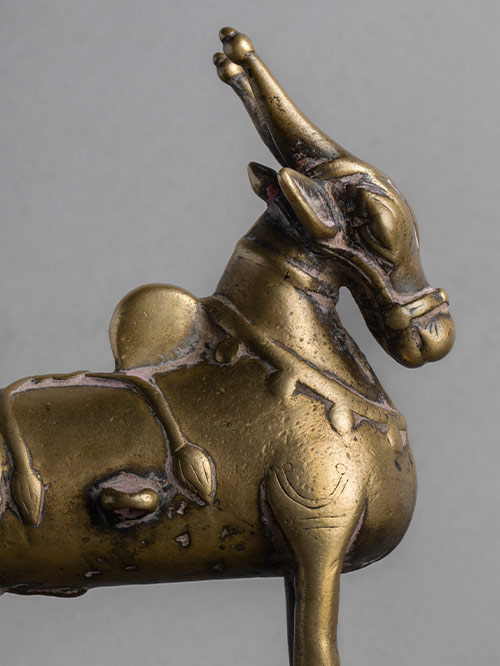
This gracefully proportioned standing Nandi is delicately incised with head and neck ornaments and stands on a trapezoidal base.
Nandi or nandin, the bull vahana of Shiva has always been noted for his strength and virility. Usually depicted in a life-like naturalistic manner, Nandi is present in every Shaivite temple, often with his own temple enclosure but facing the Shiva lingam. Figures like this of Nandi on a platform base with a cobra canopy are common objects of worship, especially found in home shrines.
Size (cms): 16.5(H) x 10.8(W) x 7.6(D)
Size (inches): 6.5(H) x 4.5(W) x 3(D)
-

Karnataka (South India)
copper alloy
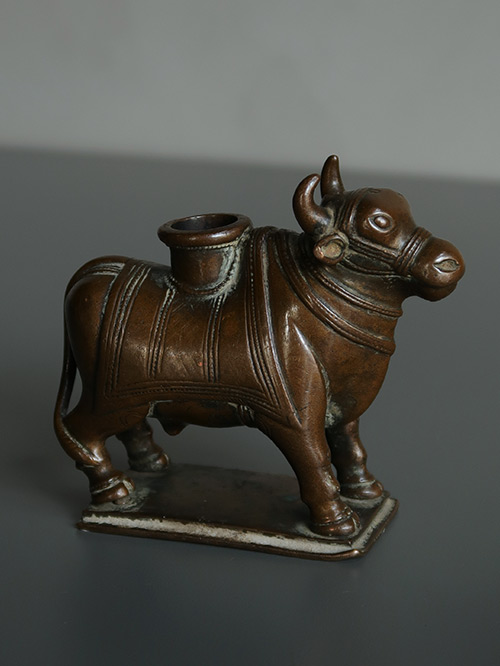
A beautifully caparisoned copper Nandi standing on a rectangular plinth. The Nandi wears an engraved saddle blanket which is surmounted by a bowl-like structure which would have held an incense burner or an oil reservoir. He is bridled and decorated with necklaces around his neck.
Nandi or nandin means rejoicing, gladdening. It is the name of Shiva’s conveyance (vahana) the white bull. Nandi was probably a folk deity later incorporated into the Brahmanic lore. Nandi symbolises on the one hand moral and religious duty (dharma), and on the other, virility, fertility and strength. Apart from being Shiva’s vehicle, nandi in his form as nandikeshvara, depicted as a human with a bulls head, is believed to be one of the great masters of music and dancing. In southern India his recumbent image is placed either opposite the main sanctuary or in the hall leading to it, facing the linga.
Size (cms): 10.8(H) x 11.5(W) x 4.7(D)
Size (inches): 4.5(H) x 4.5(W) x 2(D)
-
Karnataka
Brass alloy
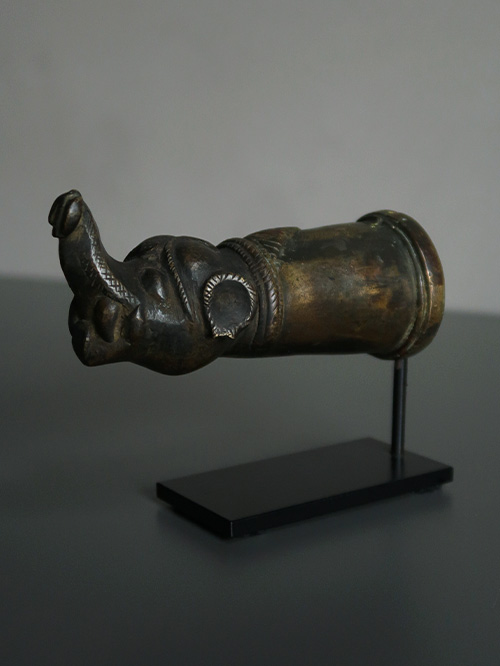
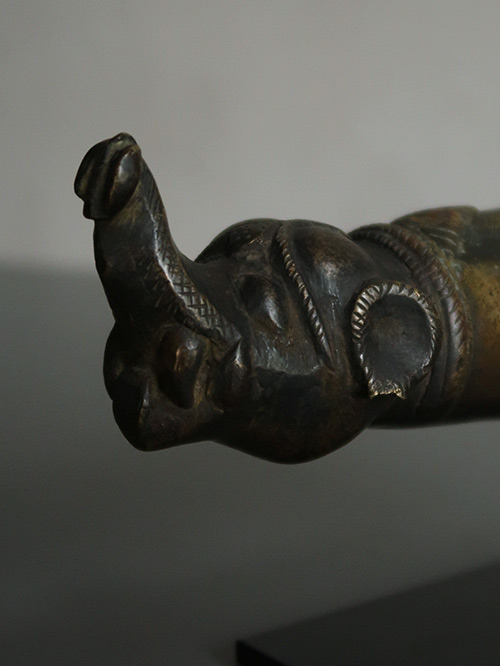
A diminutive palanquin pole finial taking the sculptural form of a makara head with large pointed ears, beady eyes and a gaping mouth. The emotive expression of the makara, with his open mouth is powerful yet unthreatening, underlying its protective function, benign in character though capable of potential ferocity when attacked. It is almost as if he is showing off, displaying his power and status, probably reflecting that of the palanquin’s grand passenger.
Palanquins or sedan chairs were used throughout India, the larger ones to transport people and the smaller ones for religious deities to be taken around the temple complex on festival days. The present example is from the latter category. It was fitted to the wooden forward pole of the palanquin; the rear pole was usually covered with a simple metal cover or cylinder.
Size (cms): 13(H with stand) x 14.5(W) x 6.5(D)
Size (inches): 5(H with stand) x 5.5(W) x 2.5(D)
-
Karnataka
Brass alloy
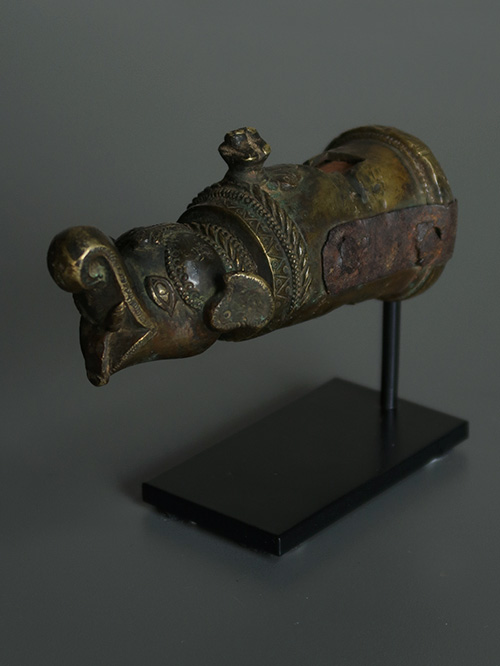
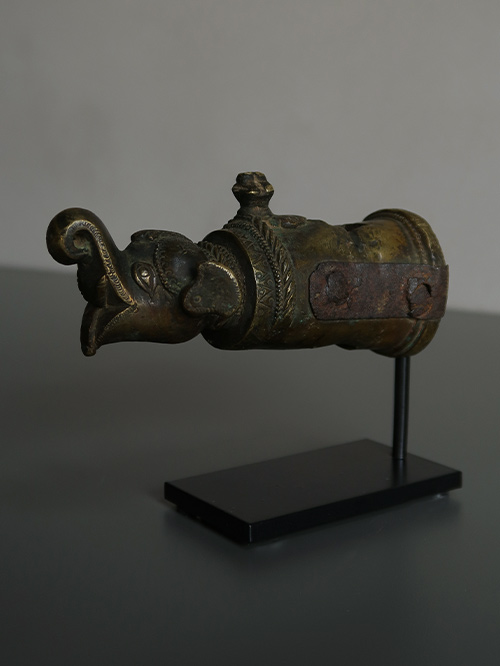
A brass palanquin pole finial taking the sculptural form of a makara head with an elephantine trunk, with bulbous eyes, pointed ears and a gaping mouth. The emotive expression of the makara, with his open mouth is powerful yet unthreatening, underlying its protective function, benign in character though capable of potential ferocity when attacked. It is almost as if he is showing off, displaying his power and status, probably reflecting that of the palanquin’s grand passenger.
Palanquins or sedan chairs were used throughout India, the larger ones to transport people and the smaller ones for religious deities to be taken around the temple complex on festival days. The present example is from the latter category. It was fitted to the wooden forward pole of the palanquin; the rear pole was usually covered with a simple metal cover or cylinder.
Size (cms): 11.5(H with stand) x 13.5(W) x 5(D)
Size (inches): 4.5(H with stand) x 5.5(W) x 2(D)
-
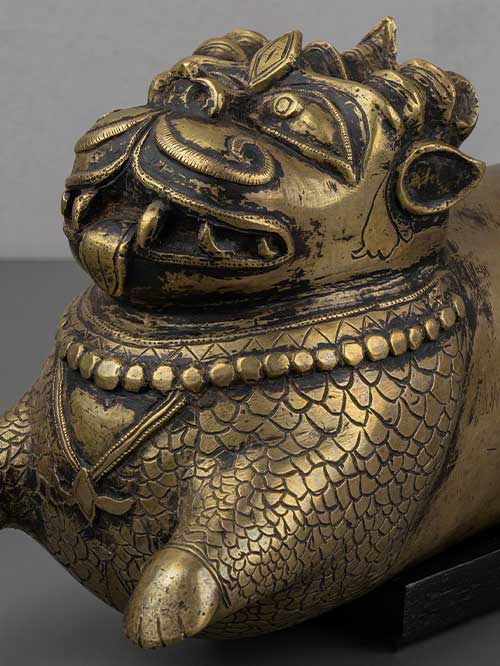
Karnataka
Brass alloy
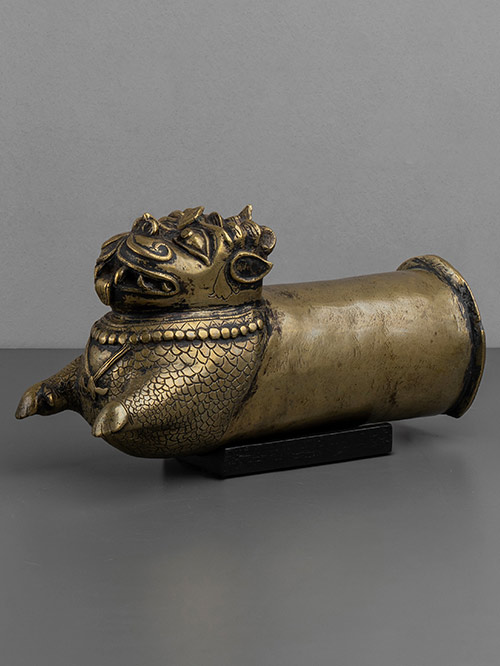
An ornamental palanquin pole finial in the sculptural form of a vyali with a pointed nose, wavy brows culminating in small protruding ears and ovular eyes. The vyali is open-mouthed, exposing large teeth and a small extended tongue. A collar in the form of a festooned necklace with a central medallion hangs on his scaly torso, in between the vyali’s outstretched paws.
Palanquins or sedan chairs were used throughout India, the larger ones to transport people and the smaller ones for religious deities to be taken around the temple complex on festival days. The present example is from the latter category. It was fitted to the wooden forward pole of the palanquin; the rear pole was usually covered with a simple metal cover or cylinder.
Size (cms): 17(H) x 31(W) x 11(D)
Size (inches): 6.5(H) x 12(W) x 4.5(D)