“Pair of Horse Brackets” has been added to your cart.
View cart
-
Tamil Nadu
Wood
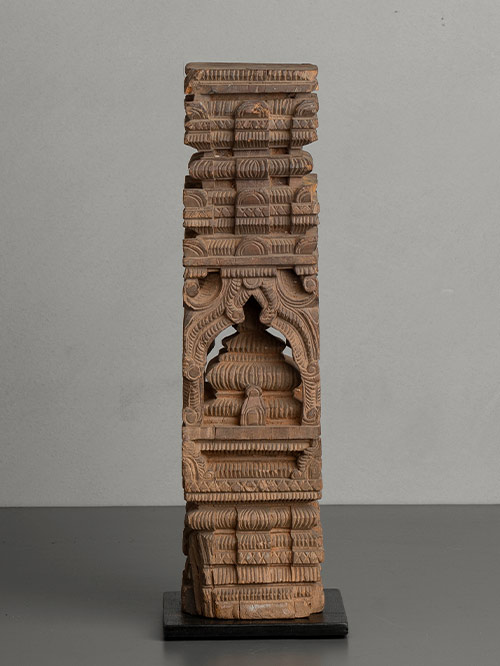
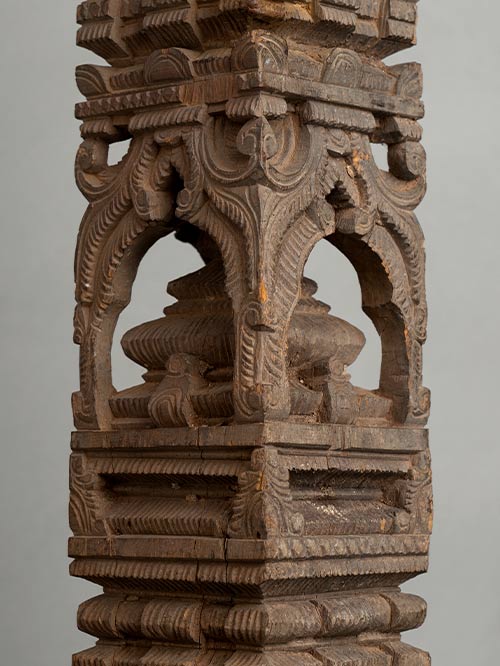
An attractive candlestand which is unusually inspired by the temple pillars found in traditional Indian temples.
Indian temple pillars exhibit a rich diversity of designs, styles, and intricate carvings that reflect the cultural and artistic heritage of the country. Different regions and time periods in India have produced distinct styles of temple architecture, and the pillars play a significant role in supporting the temple structures while also serving as platforms for artistic expression. The design of these pillars was influenced by architectural styles such as the Nagara and Dravidian, with careful consideration given to structural engineering principles, mathematical precision, and adherence to Vastu Shastra.
Size (cms): 38(H) x 12(W) x 12(D)
Size (inches): 15(H) x 4.5(W) x 4.5(D)
-
TEAK
c. 1920
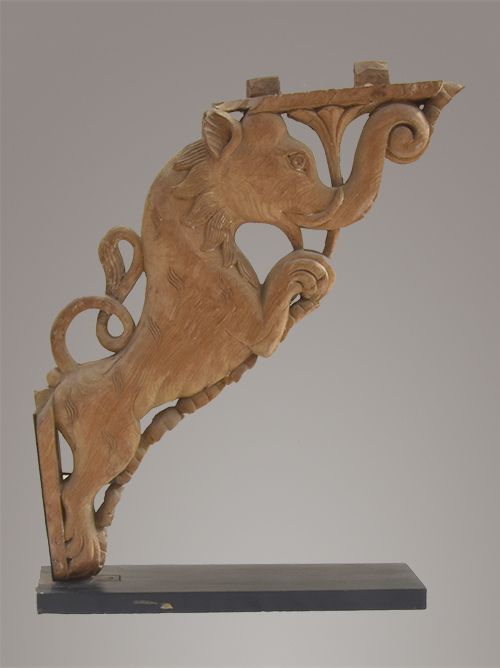
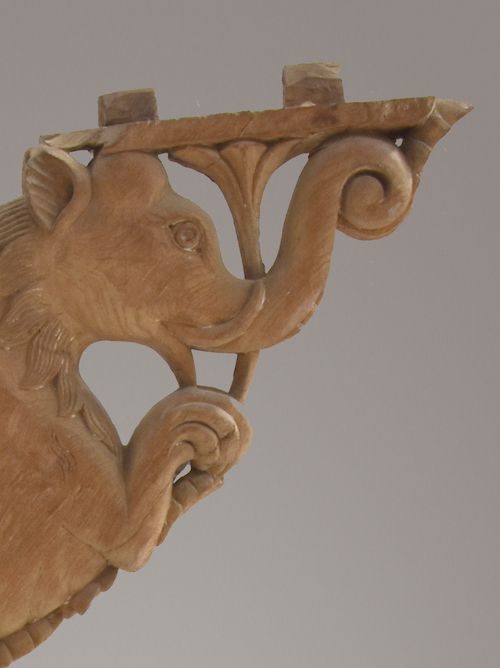
The Makara is a mythical aquatic creature that combines the body of a crocodile with the head of a lion and the trunk of an elephant. One of India’s most ancient symbols, harking back more than two thousand years to a time when the natural world was seen as both symbol and reality, and fantastic creatures were invented to express the complexity of nature. The Makara is considered auspicious and purifying by Hindus and related to fertility. he is the vehicle (vahana) of Varuna, god of the waters of heaven and earth, and the emblem of Kama, the god of love.
Sizes (cms): 80 (H) x 62 (W) x 20 (D)
Sizes (inches): 31.4 (H) x 24.4 (W) x 7.9 (D)
-
Patan (Gujarat)
Wood
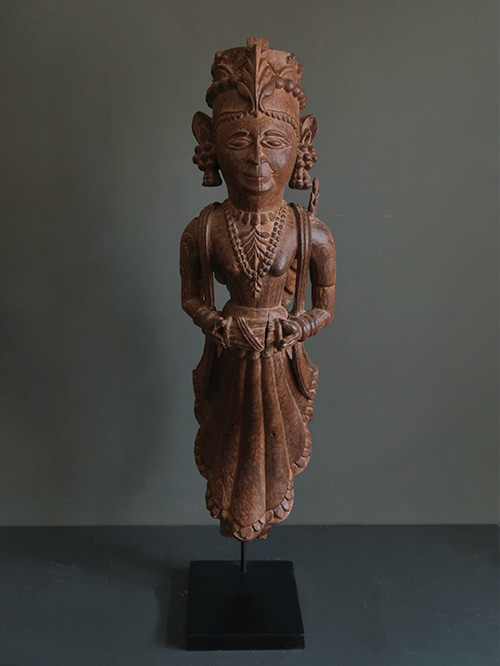
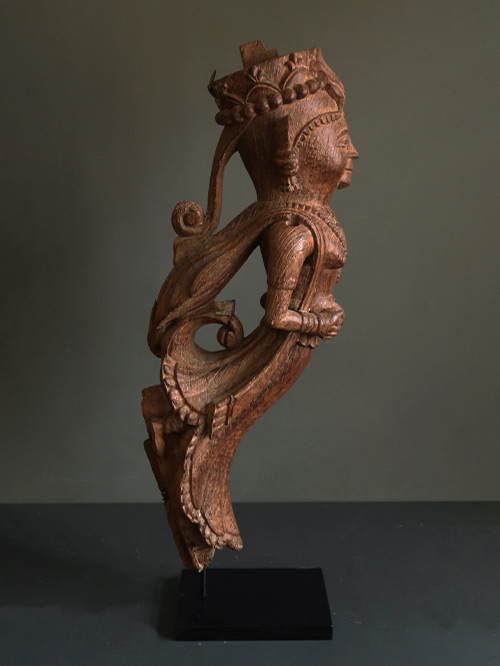
A fine figural strut formed as a crowned celestial musician (Vidyadhara). She holds a small drum and wears a patterned blouse and a flowing pleated skirt standing in a typical curved posture. Her long veil drapes behind her shoulders resembling wings. The appearance of wings on figures is a very old tradition in Indian art. Although seen in many parts of Gujarat the treatment his novel : the robes of the figure turn up at the ends and the veil cross the shoulders and turns into wings.
The ancestral occupation of the Hindu Suthar community, the craft of wood carving was practiced in several districts of Gujarat including Patan, Kadi, Ahmedabad and Nadiad, although the legacy of exquisite wood carving seen in the traditional havelis, mansions, is evident in all the districts of Gujarat. Patan district is renowned for the intricately carved Bohra haveli or mansions at Siddhpur; these structures are characterised by their eclectic use of geometric or floral patterns as well as motifs inspired by European and West Asian decorative elements on the woodwork of the balconies and ceilings.The wooden architecture of Ahmedabad on the other hand, acquires its distinctive aesthetic through the use of patterns borrowed from block printing and textiles.
Size (cms): 72.5(H) x 20(W) x 28(D)
Size (inches): 28.5(H) x 8(W) x 11(D)
-
Gujarat (Western India)
Wood with traces of polychrome
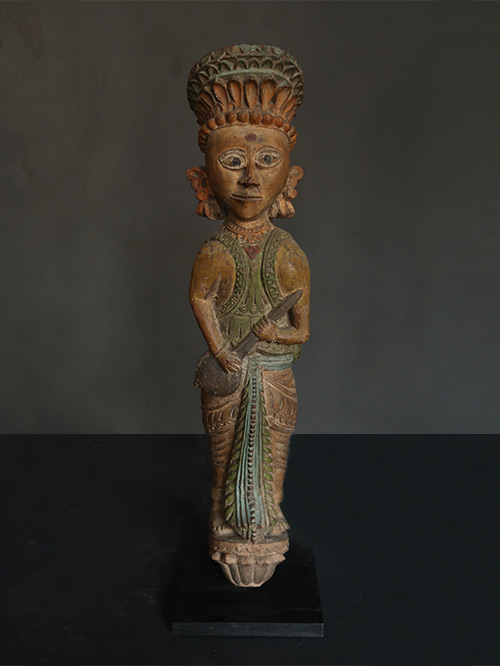
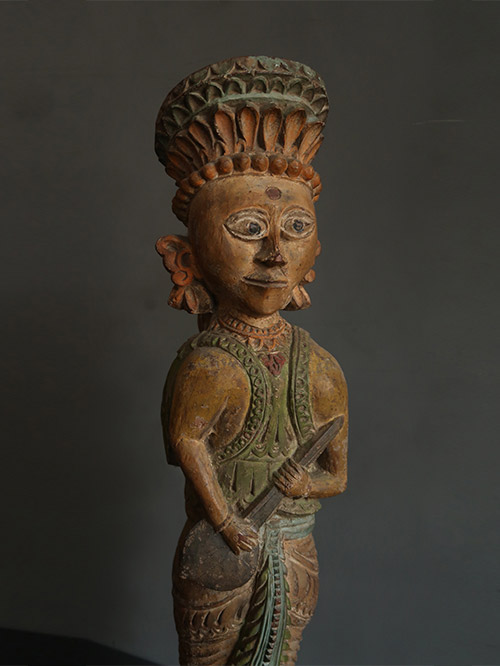
An attractive architectural bracket with original colour depicting a figure holding an instrument, possibly a Tanpura. The figure wears a decorated crown and has a stylised face with large ovular eyes pressing into a pointed nose and ears in the shape of swirling foliage. He is dressed in a pleated dhoti and a patterned vest. A stylised stole that is draped across his shoulders, turn into wings that emerge from either end of his body. A tilak is marked on his forehead.
Dwarapalas or ‘door guardians’ are placed at the entrance of every temple, shrine or sacred precinct. Two or four-handed, they sometimes carry in their hands the emblem of the deity enshrined in the sanctuary. Their countenance may sometimes be fierce and occasionally fangs protrude from their mouths. Temples dedicated to goddesses have female guardians – the Dwarapalikas.
Size (cms): 75 (H) x 20 (W) x 19 (D)
Size (inches): 29.5 (H) x 8 (W) x 7.5 (D)
-
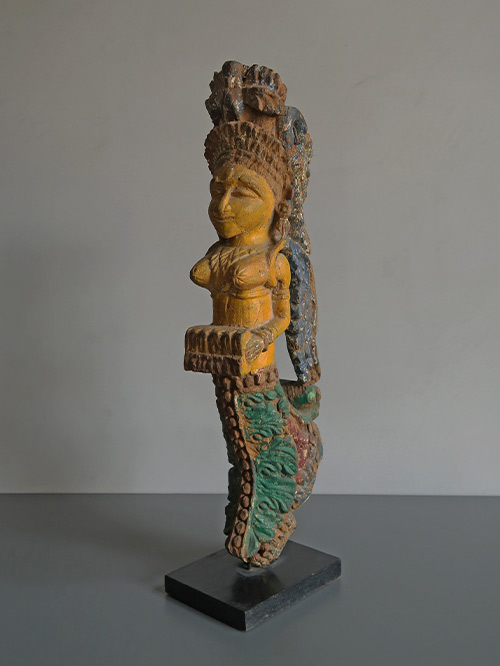
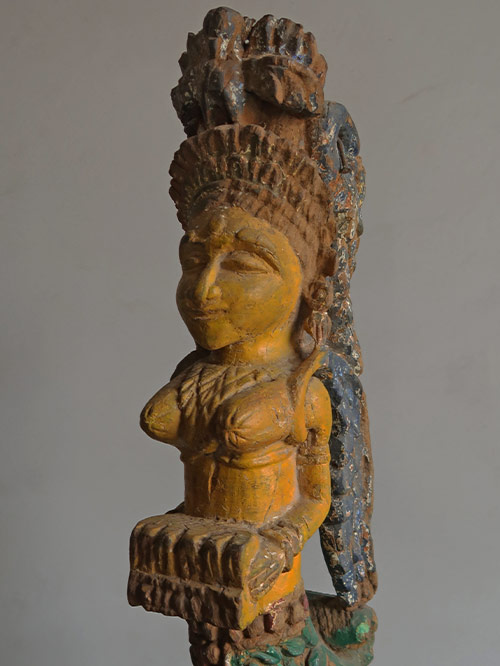
Patan (Gujarat)
Wood, polychromed
A decorative winged musician bracket, the figure who is crowned holds a percussion instrument. She wears a patterned blouse and a pleated skirt.
The ancestral occupation of the Hindu Suthar community, the craft of wood carving was practiced in several districts of Gujarat including Patan, Kadi, Ahmedabad and Nadiad, although the legacy of exquisite wood carving seen in the traditional havelis, mansions, is evident in all the districts of Gujarat. Patan district is renowned for the intricately carved Bohra haveli or mansions at Siddhpur; these structures are characterised by their eclectic use of geometric or floral patterns as well as motifs inspired by European and West Asian decorative elements on the woodwork of the balconies and ceilings.The wooden architecture of Ahmedabad on the other hand, acquires its distinctive aesthetic through the use of patterns borrowed from block printing and textiles.
Size (cms): 64(H) x 14(W) x 21(D)
Size (inches): 25(H) x 5.5(W) x 8.5(D)
-
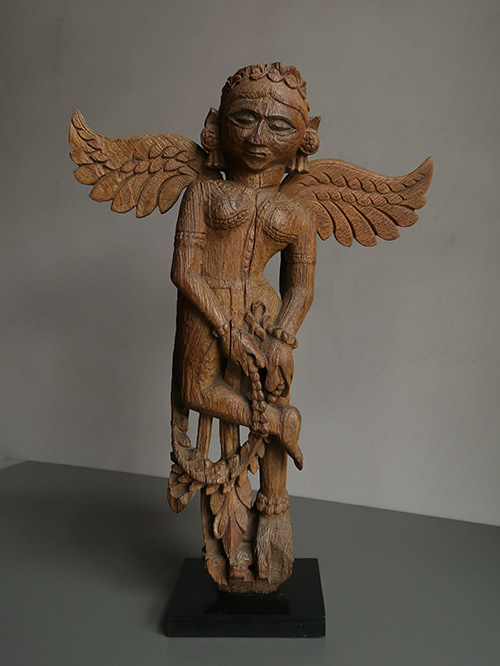
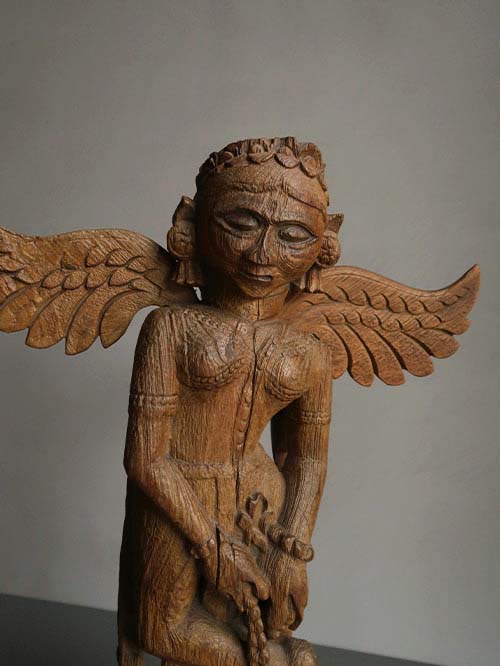
Patan (Gujarat)
Wood
An attractive wooden winged apsara bracket. The crowned figure has patterned wings and holds a long garland which is looped around her leg.
The ancestral occupation of the Hindu Suthar community, the craft of wood carving was practiced in several districts of Gujarat including Patan, Kadi, Ahmedabad and Nadiad, although the legacy of exquisite wood carving seen in the traditional havelis, mansions, is evident in all the districts of Gujarat. Patan district is renowned for the intricately carved Bohra haveli or mansions at Siddhpur; these structures are characterised by their eclectic use of geometric or floral patterns as well as motifs inspired by European and West Asian decorative elements on the woodwork of the balconies and ceilings.The wooden architecture of Ahmedabad on the other hand, acquires its distinctive aesthetic through the use of patterns borrowed from block printing and textiles.
Size (cms): 77(H) x 55(W) x 18(D)
Size (inches): 30.5(H) x 21.5(W) x 7(D)
-
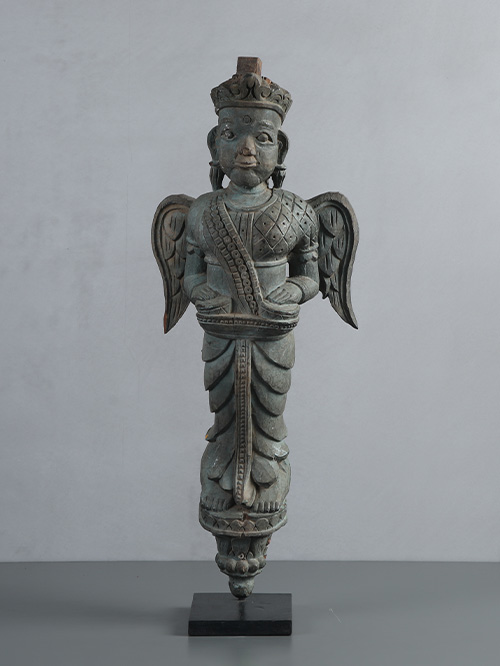
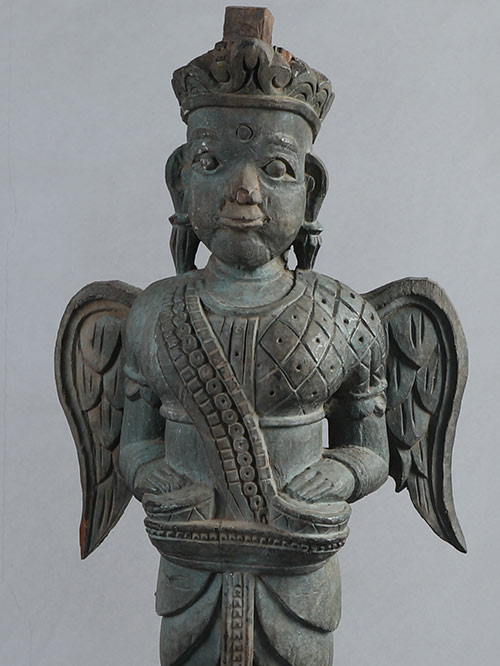
Patan (Gujarat)
Wood, polychromed
A fine figure of a winged angel, crowned, holding a pair of small cymbals. She wears a patterned blouse and a pleated skirt and stands on a lotus shaped base.
The ancestral occupation of the Hindu Suthar community, the craft of wood carving was practiced in several districts of Gujarat including Patan, Kadi, Ahmedabad and Nadiad, although the legacy of exquisite wood carving seen in the traditional havelis, mansions, is evident in all the districts of Gujarat. Patan district is renowned for the intricately carved Bohra haveli or mansions at Siddhpur; these structures are characterised by their eclectic use of geometric or floral patterns as well as motifs inspired by European and West Asian decorative elements on the woodwork of the balconies and ceilings.The wooden architecture of Ahmedabad on the other hand, acquires its distinctive aesthetic through the use of patterns borrowed from block printing and textiles.
Size including the stand (cms): 80 (H) x 28 (W) x 19 (D)
Size including the stand (inches): 31.5 (H) x 11 (W) x 7.5 (D)
-
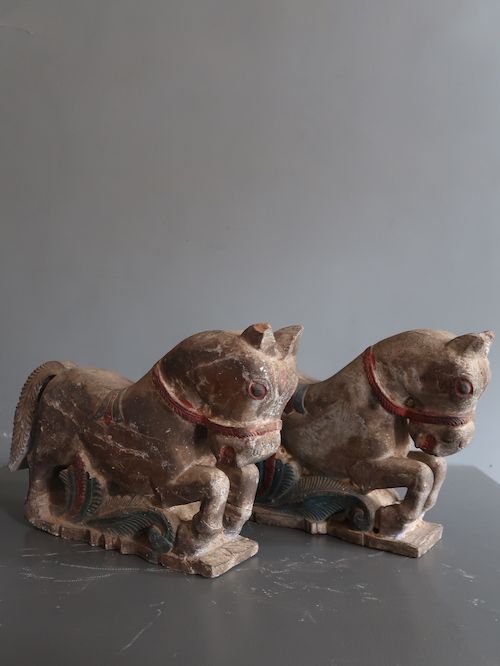
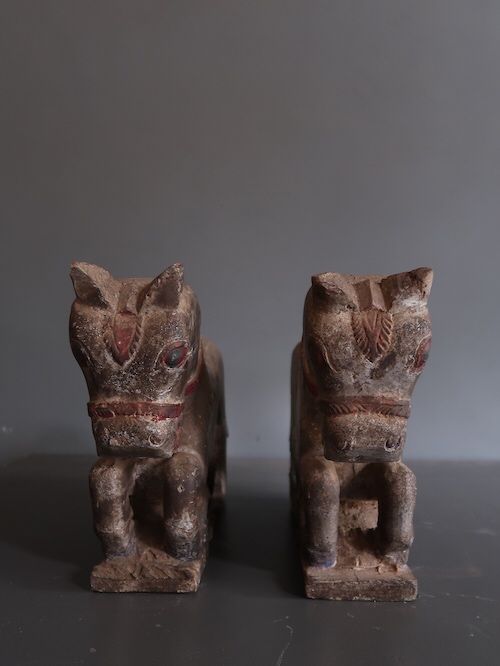
Andhra Pradesh (South India)
Wood, polychromed
These horse brackets once formed the two ends of a door lintel. The horse or ashva was a very popular motif in architectural wood carvings in South India. Its prototype, the divine Uchchaihshravas emerged from the churning of the ocean. It was white and endowed with wings. The god Indra appropriated it and, after cutting its wings to ensure that it would remain on earth, donated it to mankind.
The horse played a pivotal role in establishing the supremacy of kings, as demonstrated, for instance by the great horse sacrifice, the Ashvamedha, which might have been established in the course of the Vedic period. Equestrian motifs appear prominently in Indian art, for example in Orissan sculpture of the 12th and 13th centuries, and in that of the late Vijaynagara and Nayak periods (early 16th to early 18th century) in southern India. There is a branch of literature specialising in the training of horses, which contains detailed passages on colouring, proportions, gait, auspicious and inauspicious marks and lists of appropriate names for horses.
Size(cms): 27 (H) x 41 (W) x 9 (D)
Size(inches): 10.5 (H) x 16 (W) x 3.5 (D)
-
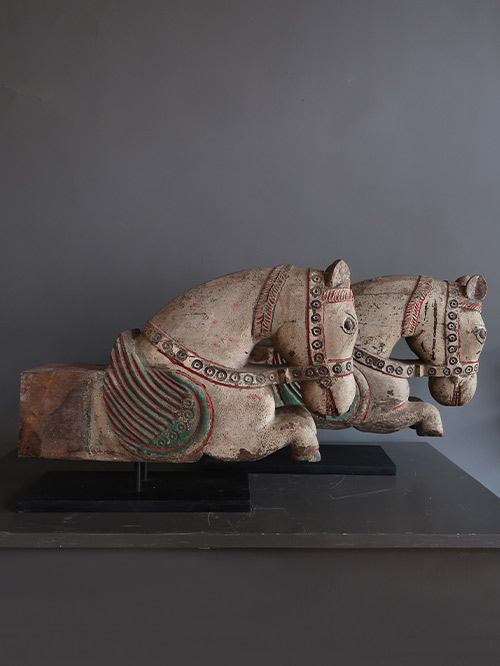
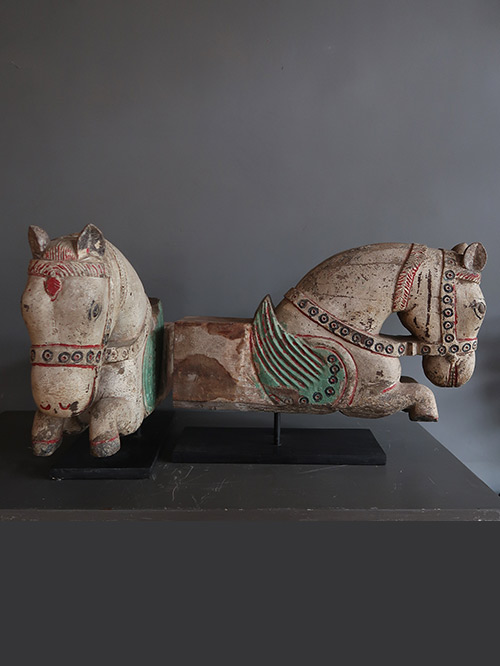
Andhra Pradesh (South India)
Wood
These horse brackets once formed the two ends of a door lintel. The horse or ashva was a very popular motif in architectural wood carvings in South India. Its prototype, the divine Uchchaihshravas emerged from the churning of the ocean. It was white and endowed with wings. The god Indra appropriated it and, after cutting its wings to ensure that it would remain on earth, donated it to mankind.
The horse played a pivotal role in establishing the supremacy of kings, as demonstrated, for instance by the great horse sacrifice, the Ashvamedha, which might have been established in the course of the Vedic period. Equestrian motifs appear prominently in Indian art, for example in Orissan sculpture of the 12th and 13th centuries, and in that of the late Vijaynagara and Nayak periods (early 16th to early 18th century) in southern India. There is a branch of literature specialising in the training of horses, which contains detailed passages on colouring, proportions, gait, auspicious and inauspicious marks and lists of appropriate names for horses.
Individual Sizes (cms): 36 (H) x 61 (W) x 15 (D)
Individual Sizes (inches): 14.2 (H) x 24 (W) x 5.9 (D)
-
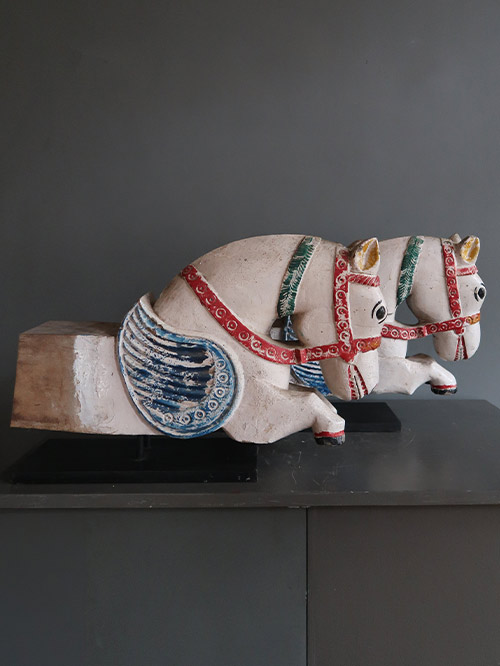
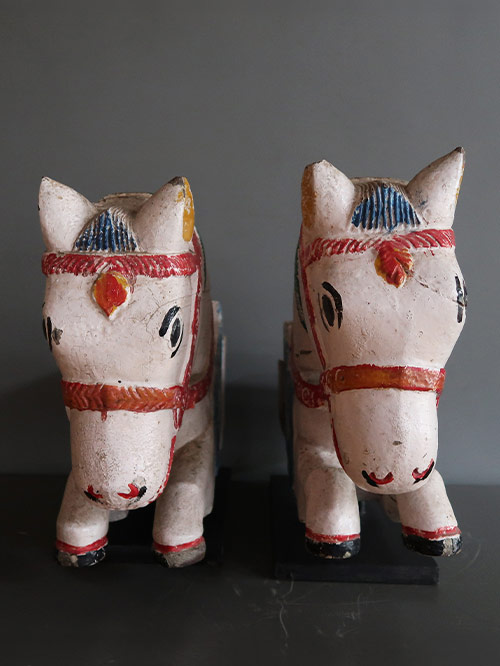
Andhra Pradesh (South India)
Wood
These horse brackets once formed the two ends of a door lintel. The horse or ashva was a very popular motif in architectural wood carvings in South India. Its prototype, the divine Uchchaihshravas emerged from the churning of the ocean. It was white and endowed with wings. The god Indra appropriated it and, after cutting its wings to ensure that it would remain on earth, donated it to mankind.
The horse played a pivotal role in establishing the supremacy of kings, as demonstrated, for instance by the great horse sacrifice, the Ashvamedha, which might have been established in the course of the Vedic period. Equestrian motifs appear prominently in Indian art, for example in Orissan sculpture of the 12th and 13th centuries, and in that of the late Vijaynagara and Nayak periods (early 16th to early 18th century) in southern India. There is a branch of literature specialising in the training of horses, which contains detailed passages on colouring, proportions, gait, auspicious and inauspicious marks and lists of appropriate names for horses.
Individual Size (cms): 40(H) x 64(W) x 18(D)
Individual Size (inches): 15.5(H) x 25(W) x 7(D)
-
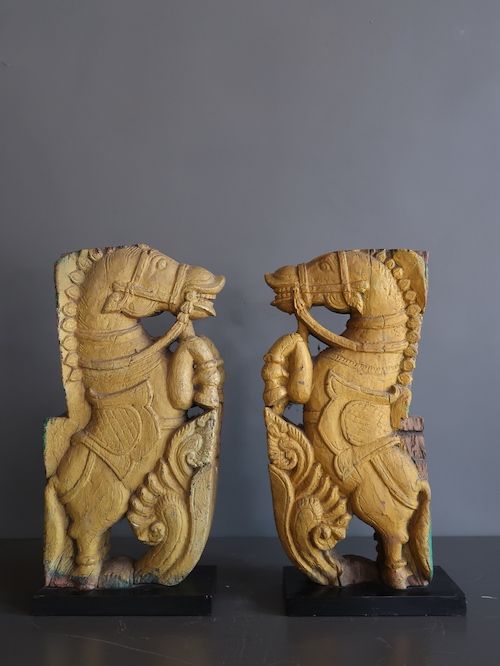
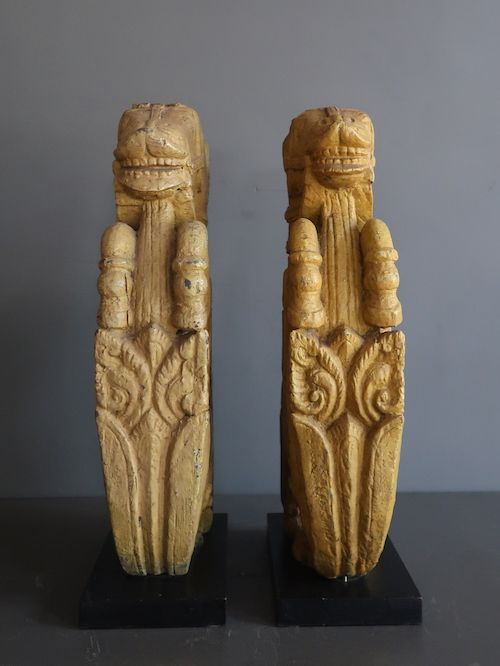
Andhra Pradesh (South India)
Wood, polychromed
These horse brackets once formed the two ends of a door lintel. The horse or ashva was a very popular motif in architectural wood carvings in South India. Its prototype, the divine Uchchaihshravas emerged from the churning of the ocean. It was white and endowed with wings. The god Indra appropriated it and, after cutting its wings to ensure that it would remain on earth, donated it to mankind.
The horse played a pivotal role in establishing the supremacy of kings, as demonstrated, for instance by the great horse sacrifice, the Ashvamedha, which might have been established in the course of the Vedic period. Equestrian motifs appear prominently in Indian art, for example in Orissan sculpture of the 12th and 13th centuries, and in that of the late Vijaynagara and Nayak periods (early 16th to early 18th century) in southern India. There is a branch of literature specialising in the training of horses, which contains detailed passages on colouring, proportions, gait, auspicious and inauspicious marks and lists of appropriate names for horses.
Size individual (cms): 47 (H) x 10 (W) x 23 (D)
Size individual (inches): 18.5 (H) x 4 (W) x 9 (D)
-
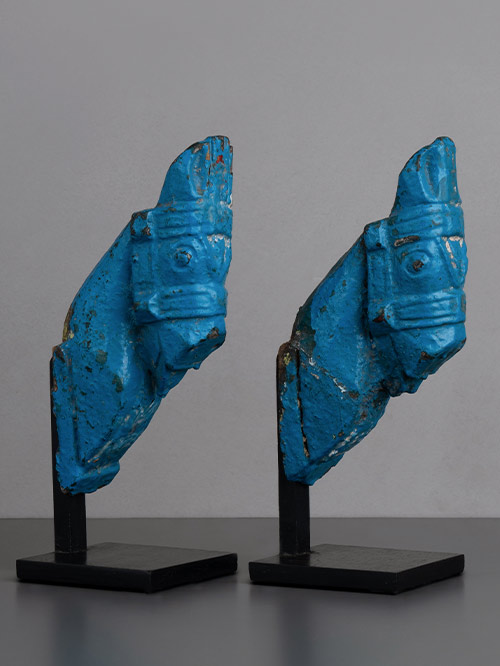
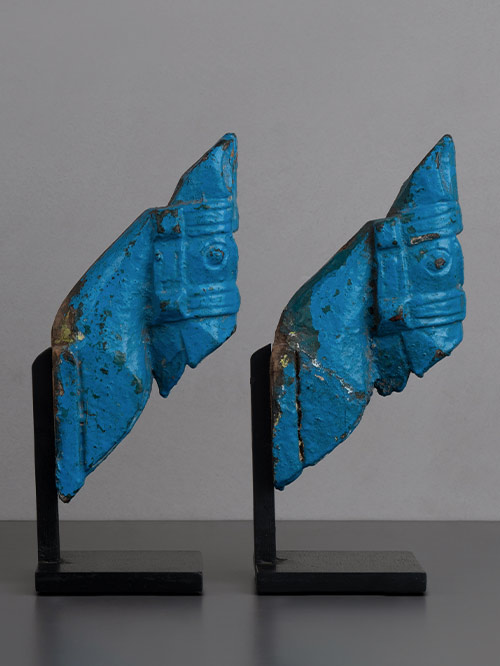
Andhra Pradesh (South India)
Wood, extensively polychromed
These horse brackets once formed the two ends of a door lintel. The horse or ashva was a very popular motif in architectural wood carvings in South India. Its prototype, the divine Uchchaihshravas emerged from the churning of the ocean. It was white and endowed with wings. The god Indra appropriated it and, after cutting its wings to ensure that it would remain on earth, donated it to mankind.
The horse played a pivotal role in establishing the supremacy of kings, as demonstrated, for instance by the great horse sacrifice, the Ashvamedha, which might have been established in the course of the Vedic period. Equestrian motifs appear prominently in Indian art, for example in Orissan sculpture of the 12th and 13th centuries, and in that of the late Vijaynagara and Nayak periods (early 16th to early 18th century) in southern India. There is a branch of literature specialising in the training of horses, which contains detailed passages on colouring, proportions, gait, auspicious and inauspicious marks and lists of appropriate names for horses.
Individual Sizes (cms):28(H) x 10(W) x 13(D)
Individual Sizes (inches): 11(H) x 4(W) x 5(D)
-
Tamil Nadu
Wood
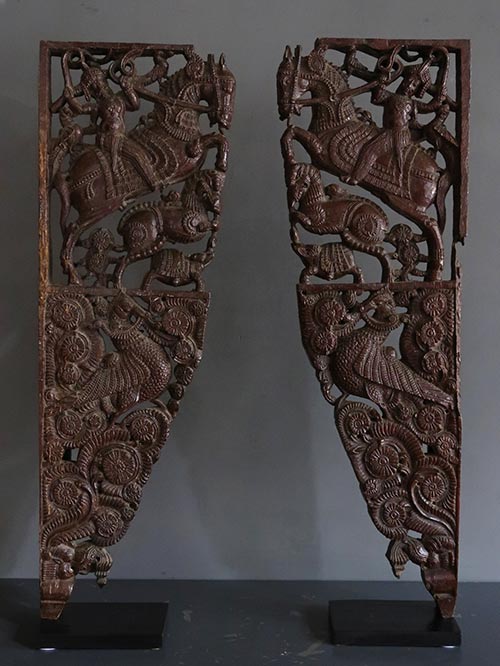
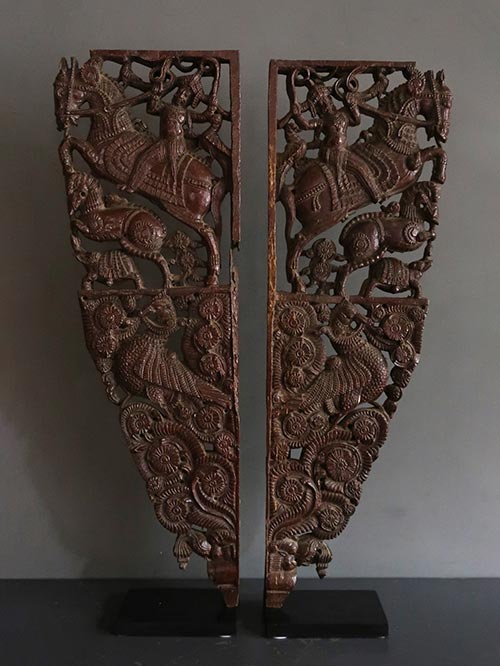
A pair of extremely fine and large carved and pierced doorway brackets, from the entrance door of a Chettinad mansion. They depict a dense arrangement comprising elaborately caparisoned rearing horses with turbaned and ornamented riders holding whips in the upper register. The pointed turbans worn by these riders is an indication of their royal status. The raised forelegs of the horses rest on the heads of rearing Vyalis – open mouthed and with bulging eyes, who in turn are supported by the trunks of diminutive elephants. At the lower end are parrots perched vertically. The remarkable density of the composition is achieved by filling almost every available space with swirling foliage.
Size individual (cms): 96 (H) x 31 (W) x 15 (D)
Size individual (inches): 37.8 (H) x 12.2 (W) x 6 (D)
-
Gujarat (Western India)
Wood with polychrome
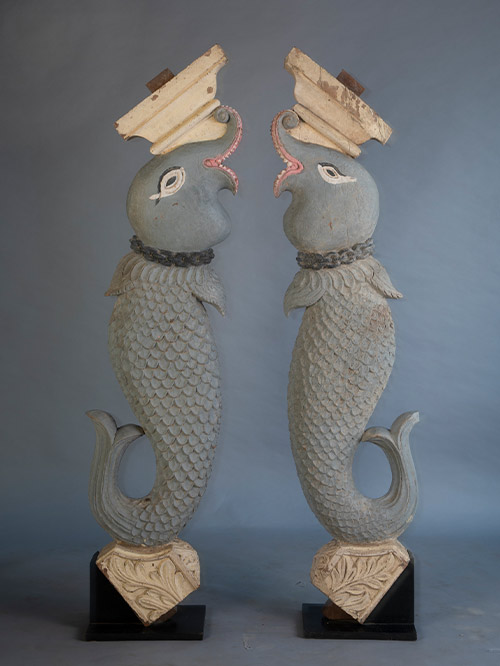
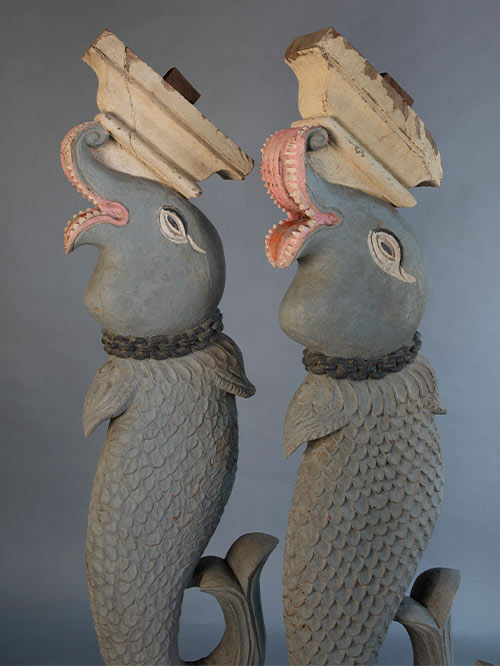
An unusual and impressive set of carved makara brackets (architectural struts) probably originally from the upper pavilion of a mansion or temple. Their open mouths reveal rows of prominent teeth, the upper jaw is formed as a short upturned trunk. The necks have a linked chain, the lower body is encompassed by scales resembling a fish and have an upturned tail.
The Makara is a mythical aquatic creature that is said to combine the body of a crocodile with the head of a lion and the trunk of an elephant. One of India’s most ancient symbols, harking back more than two thousand years to a time when the natural world was seen as both symbol and reality, and fantastic creatures were invented to express the complexity of nature. The Makara is considered auspicious and purifying by Hindus and related to fertility. He is the vehicle (vahana) of Varuna, god of the waters of heaven and earth, and the emblem of Kama, the god of love.
Individual Sizes (cms): 155(H) x 38(W) x 21(D)
Individual Sizes (inches): 61(H) x 15(W) x 8.5(D)
-
Karnataka
Wood, polychromed
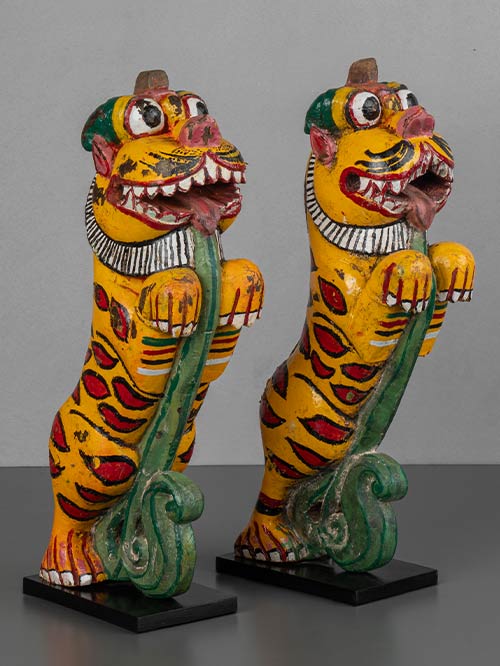
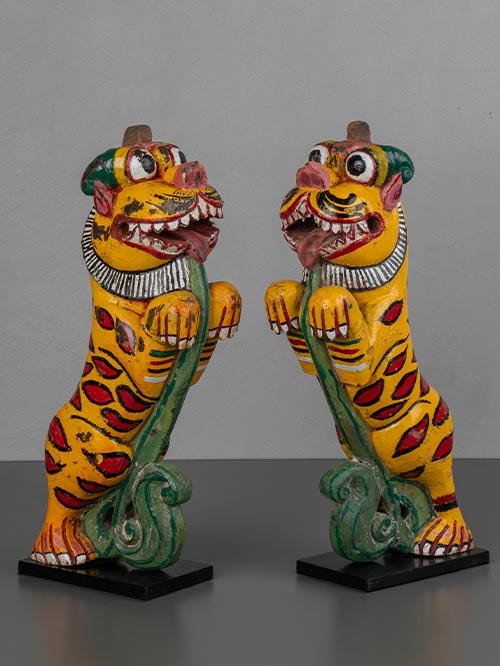
A delightful, richly polychromed pair of rearing tiger brackets. The wide-eyed tigers have large open mouths, exposing their fangs and long, protruding tongues. They stand on their hind legs, and their muscular torsos are painted with red and black bubris (stripes). Their forelegs are raised, as if poised to pounce, and swirling foliage sprouts from their raised paws.
The tiger is the vehicle of, and sacred to, the Hindu goddess, Durga. From a certain perspective she is India’s Mother Nature, for she is the deification of Energy. Her consort, Shiva, sometimes evoked as Shambo, wears a tiger skin to indicate that he is beyond the bounds of the natural world.
Individual Sizes (cms): 44.5(H) x 22(W) x 10(D) each
Individual Sizes (inches): 17.5(H) x 8.5(W) x 4(D) each
-
Karnataka
Wood
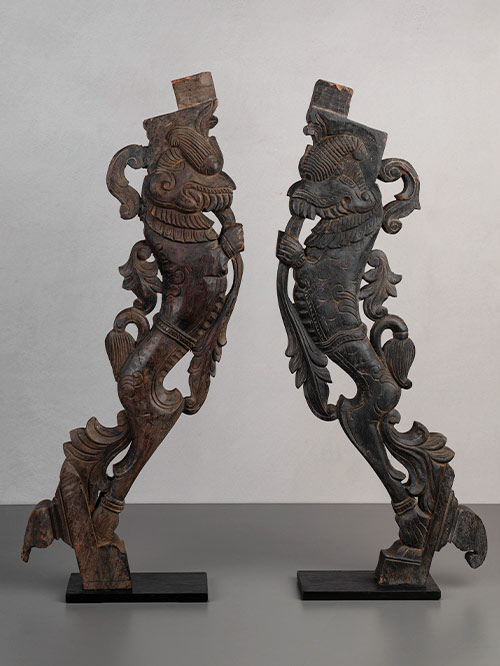
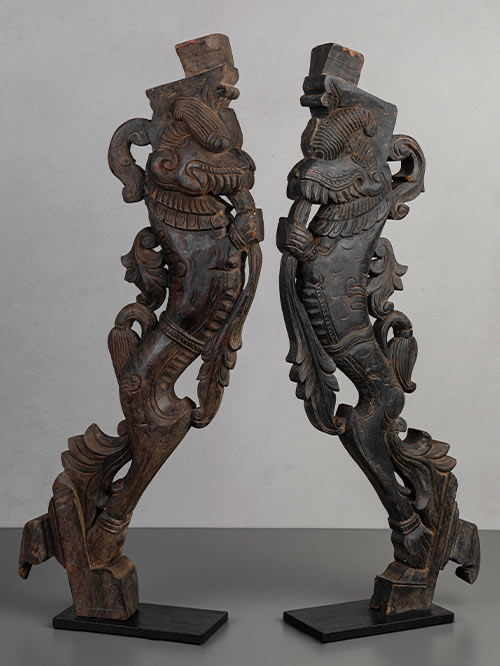
A finely carved pair of double sided yali architectural brackets. The rearing lions with muscular torso’s have swirling foliage spouting from their open mouths.
‘Yali’ or ‘Vyala’ denotes a mythical lion faced animal that appears on carved friezes on temple walls. They are fierce, leonine beasts with curvaceous bodies and enlarged heads surrounded by flame-like manes. They rear up on hind legs, the forelegs held out with clenched claws as if to pounce. Sometimes they are shown standing on human heads presumably of the demons that they have vanquished. In southern Indian sculpture from the 16th century onwards figures of rearing, almost three dimensional vyalis bearing heads either of horned lions or elephants and feline bodies guard the entrances of temples and line the approaches leading to sanctuaries.
Individual Sizes (cms): 74.5(H) x 31(W) x 10(D) each
Individual Sizes (inches): 29.5(H) x 12(W) x 4(D) each