“Makara Bracket” has been added to your cart.
View cart
-
Konkan Region
Wood with polychroming
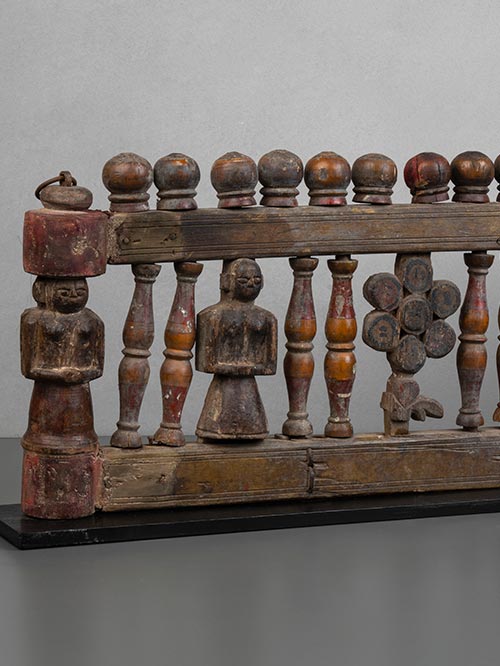
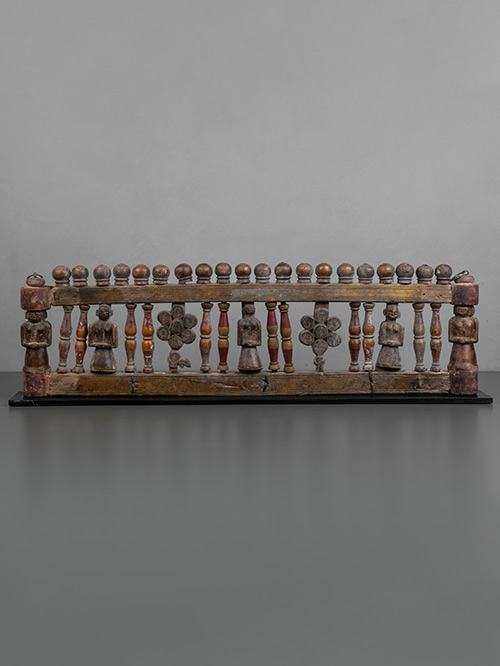
A rare cradle railing with five carved wooden fertility votive dolls, alternating with flower head sprays and turned wooden spindles.
Votive dolls, integral to folk rituals, served as devotional offerings within home shrines to the Goddess Mauli or Mariyai. Revered as a fertility deity, Mauli holds a central role in the spiritual lives of many, particularly childless women seeking her blessings. Rituals often involve adorning her image with turmeric, red kumkum, and oil, emphasising her sacredness. Known for her protective powers against devastating illnesses like smallpox and cholera, the Goddess also demands consistent devotion, as neglect is believed to provoke her anger. These offerings typically take the form of simple wooden carvings depicting women in worship, pregnant figures, mothers, or water carriers—symbolising the life and sustenance she governs.
Size (cms): 31(H) x 102(W) x 12(D)
Size (inches): 12(H) x 40(W) x 4.5(D)
-
Western India
Wood
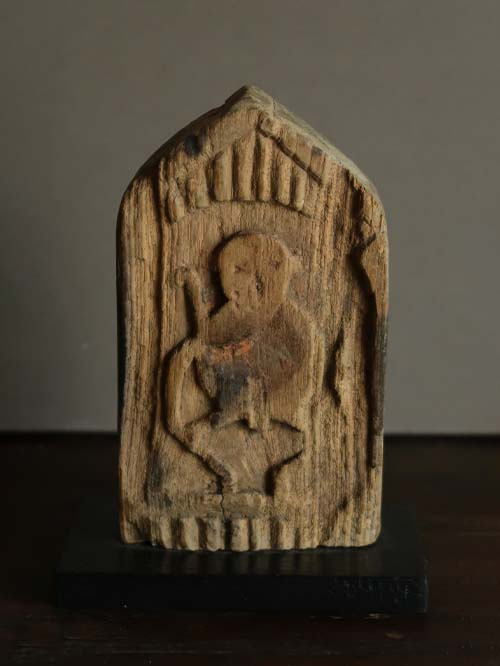
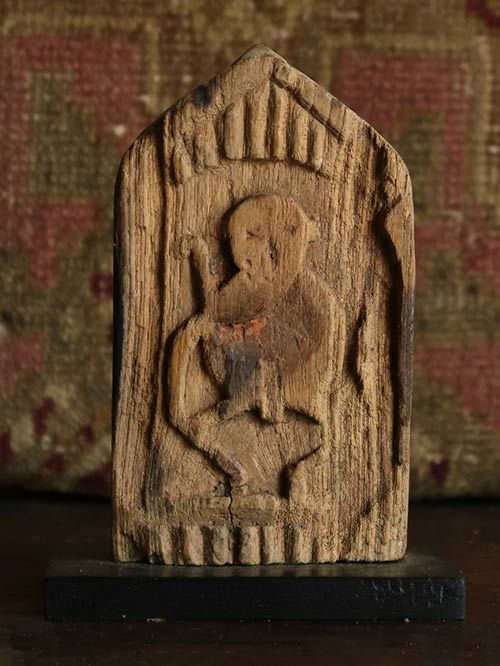
A primitive door panel with a central figure of a two-armed Ganesha. An arch frames the central figure forming a ritual throne around the deity.
Size(cms): 13.5 (H) x 10 (W) x 6.5 (D)
Size(inches): 5.3 (H) x 4 (W) x 2.5 (D)
-
Deccan
Wood
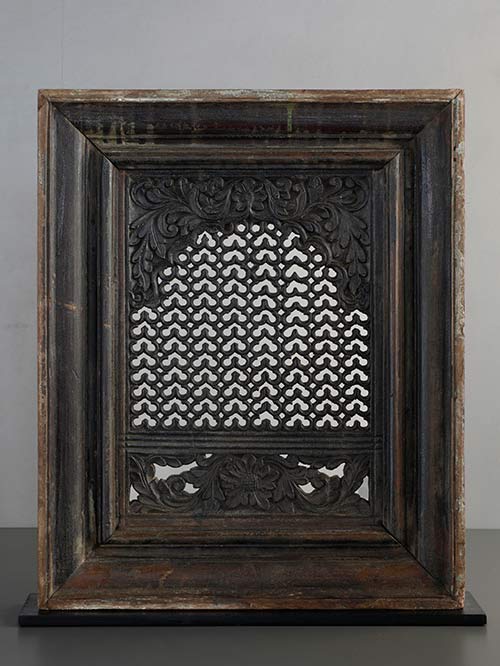
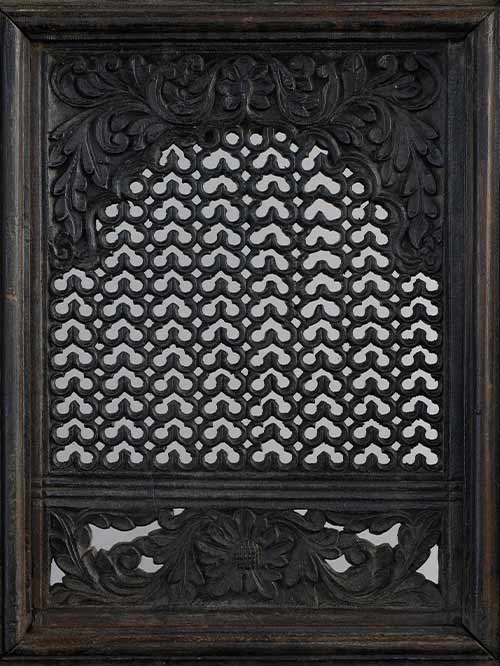
An enchanting play of light and shadow is created from this jali or lattice window. Ideal during the hot humid Indian summer, the jalis dispel the harsh rays of the sun and allow a cool breeze to circulate indoors. Moreover, the purdah- conscious women used the jalis of their balconies and terraces to enjoy an outside view, without being seen themselves by the public.
Wooden construction was once widespread throughout most of Southern India, but the intense heat and the severe monsoonal rains have meant that a large proportion of the wooden buildings in private and public use have now disappeared. The typical southern Indian wooden building, was supported on a framework of columns, with an elaborate system of interlocking brackets and beams to support the floors and roofs. Carved doors, windows, and screens and panels filter light and ventilate the interiors, creating an environment that is both comfortable and richly detailed. The scale and shape of houses was dictated by the maximum height and span of timber beams, resulting in a modular system of construction. The woodwork was deeply cut and naturalistic, the intention of the artisans was to capture the forms and energies of the natural world.
Size (cms): 63(H) x 54(W) x 11(D)
Size (inches): 25(H) x 21.5(W) x 4.5(D)
-
Rajasthan
Wood, polychromed
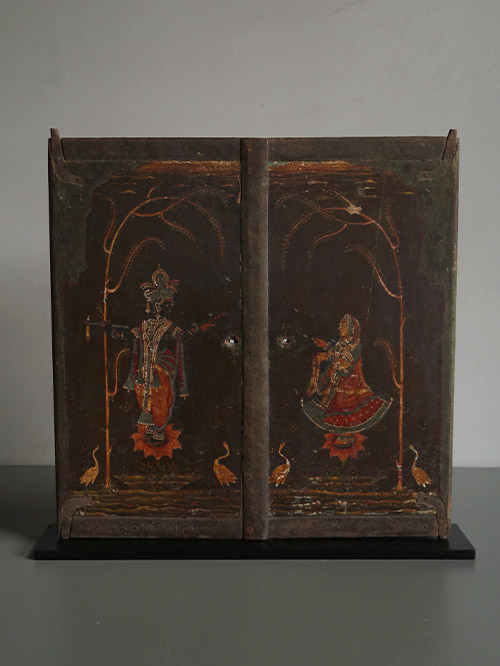
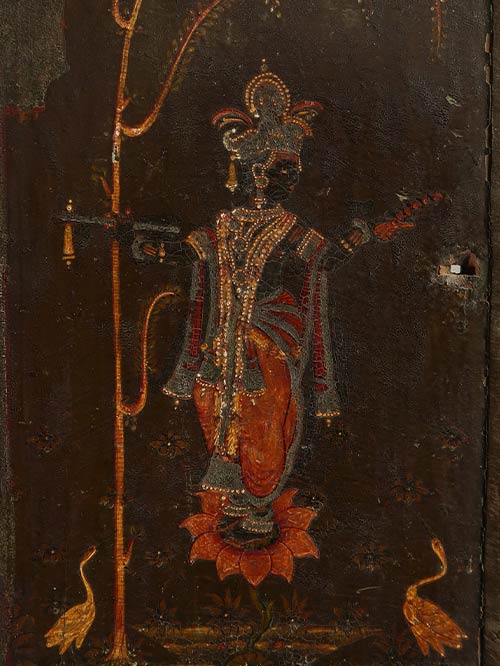
A beautiful pair of painted shutters from a household shrine. The shutter on the left depicts Krishna as Venugopala, standing on a lotus blossom upon a lake. Opposite him, Radha stands upon her own lotus, heavily bejewelled. She offers Krishna the floral garland which she holds. The nearby swans look upon the resplendent figures.
One of the most abiding images in Indian art is that of Krishna the flautist standing with his legs crossed at the ankles and playing the flute. He wears a tall decorative mukuta or crown, a dhoti and various necklaces, bangles and anklets. While other cowherders f Braj hold a shepherd’s staff, Krishna’s staff is also his flute. He, however does not play upon it to please the cows, but to charm the gopis or cowherdesses. Radha is of the Gopis of Vrindavan, who became a central figure of Vaishnava theology and she is considered to be Krishna’s favourite gopi. Radha’s selfless devotion to Krishna is regarded as a model for devotees, and she is also seen as the intermediary between man and God. According to other interpretations, Radha’s love for Krishna symbolizes the human soul’s yearning for God.
Size (cms): 51(H) x 53(W) x 10(D)
Size (inches): 20(H) x 21(W) x 4(D)
-
Jharkhand (Central India)
Wood
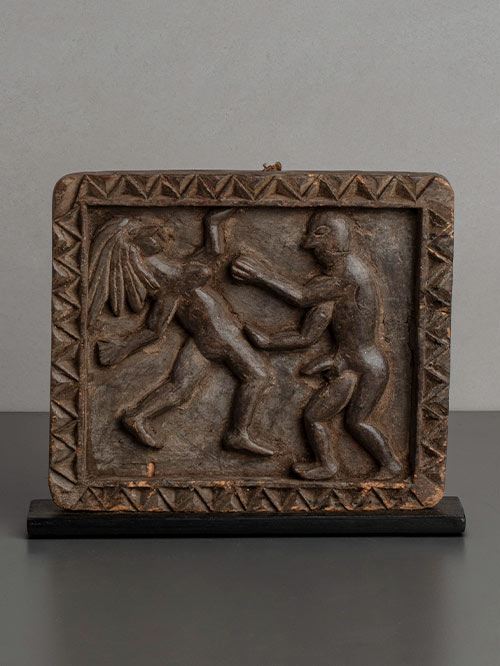
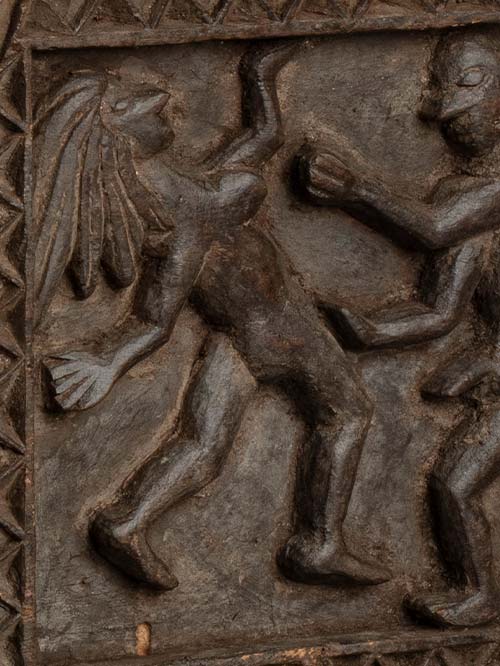
A stylised wooden panel depicting an erotic scene from the side of a Santhal Wedding Palanquin (Rahi).
The Santhals are the largest tribal community living in the Indian states of Bihar, Orissa, and West Bengal, with a minority in neighboring Bangladesh and Nepal. Marriage holds significant importance in the Santhal tribe, marked by elaborate religious and social rituals that reflect the bride and groom’s social status. A traditional aspect of the Santhal wedding ceremony involves the bride being carried in a large wicker basket or, in wealthier families, a palanquin known as a rahi.
Size (cms): 18(H) x 22(W) x 5(D)
Size (inches): 7(H) x 8.5(W) x 2(D)
-
Mysore (Karnataka)
Wood
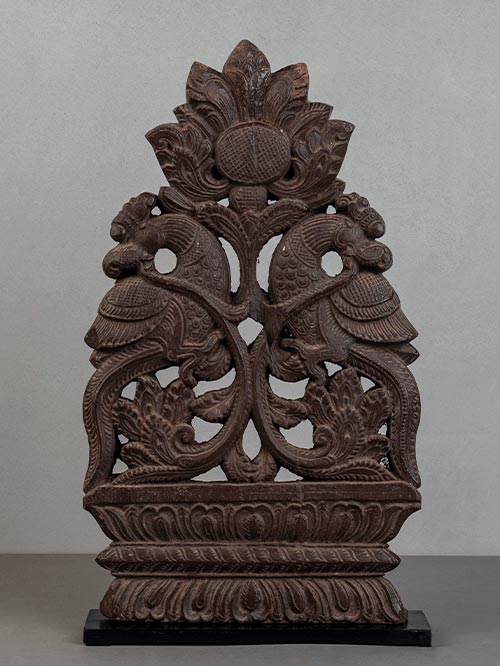
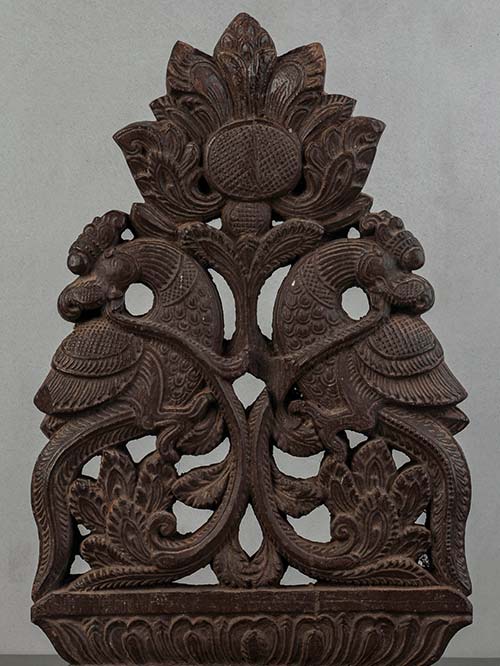
This unusual pierced panel portrays a pair of mythical Sharabhas perched atop swirling foliage, resting on a double lotus base. The mythical creatures, half-lion and half-bird, are delicately carved with scaly bodies and attractive patterned plumage. Their mouths are depicted spewing vegetation.
In Hindu mythology, Sharabha’s are a composite beast, part-lion and part-bird. Within Sanskrit literature, it initially appeared as an aggressive beast that roamed hilly and forest areas, clearing entire valley’s with a single jump. The mythological creature was later associated with Shaivism, appearing within some Puranic texts as a powerful incarnation of Shiva who assumes the form to pacify Narasimha – the fierce man-lion avatar of Vishnu worshipped by Vaishnava sect. Within Buddhist theology, Sharabha appears in Jataka Tales as a previous birth of the Buddha.
Size (cms): 50(H) x 29(W) x 9(D)
Size (inches): 19.5(H) x 11.5(W) x 3.5(D)
-
Chettinad (Tamil Nadu)
Wood
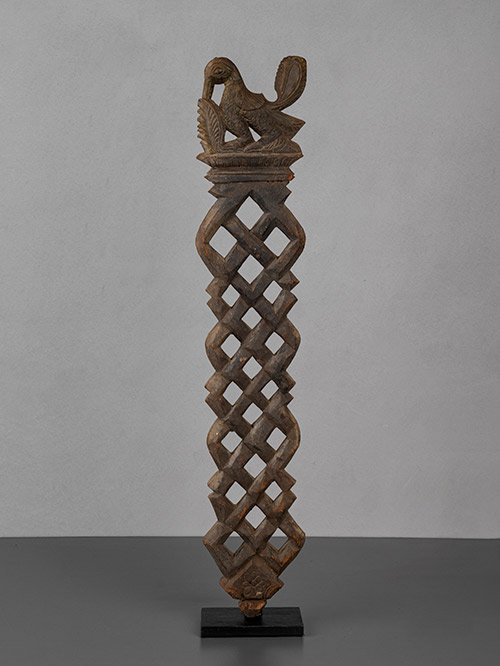
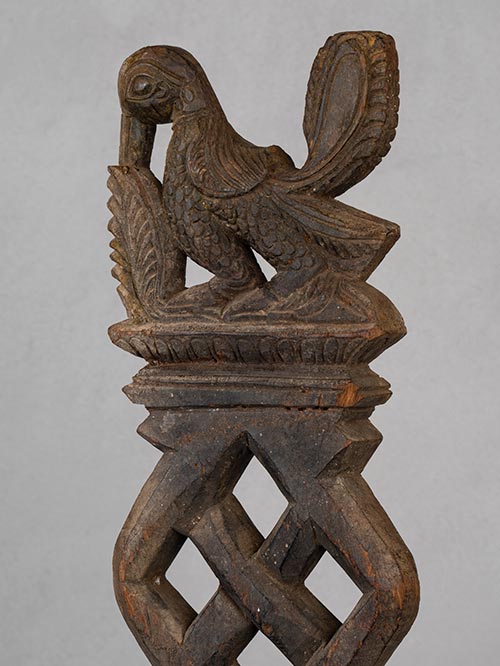
A decorative wooden spoon and ladle holder (agapai koodu) from the Chettinad region of Tamil Nadu. The knotted spoon holder has a latticed design with diamond shaped cutouts to balance the utensils. The panel is crowned with a finial depicting a hamsa bird gracefully pecking on a leafy stem
Chettinad is an area situated near the temple town of Madurai, where are large number of ornate mansions were constructed in the mid-nineteenth and early twentieth century by the Nattukottai or Nagarathar Chettiars, a traditional merchant group of traders and financiers. The Chettiars made their fortune as traders and agents of credit in Burma, Malaysia and Indonesia during the nineteenth century and returned with their profits to India, where they began constructing the elaborate mansions to proclaim their position within society. By 1945, with the rise of Nationalism through South-east Asia and looming Indian independence, the Chettiars sold their foreign interests, and returned to India to try their luck in business. As a result many of the families established new residences across the country, leaving many of their ancestral properties unused. Consequently by the 1960s and 70s, many of the Chettinad mansions, unable to raise sufficient funds for repairs, fell into decay. Many of the mansions were sold or dismantled as a result.
Size (cms): 71(H) x 14(W) x 9(D)
Size (inches): 28(H) x 5.5(W) x 3.5(D)
-
Chettinad (Tamil Nadu)
Wood
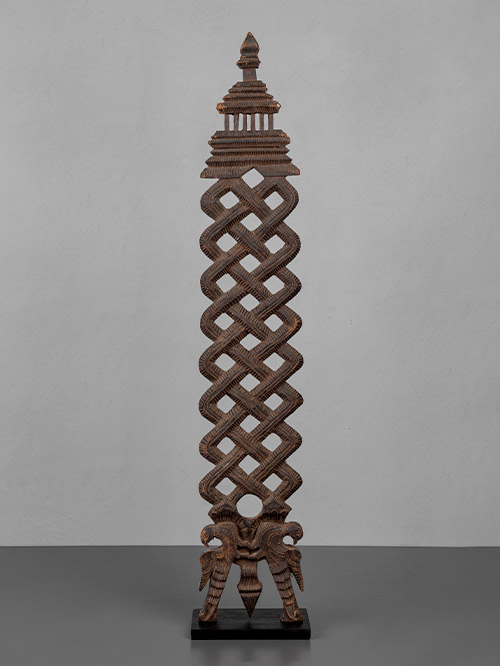
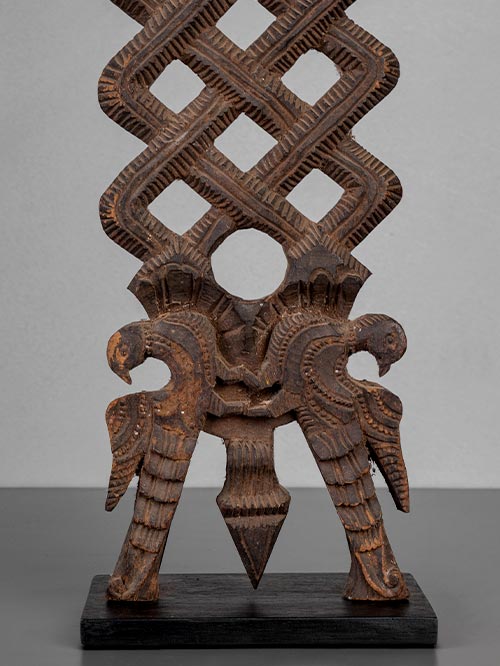
A decorative wooden spoon and ladle holder (agapai koodu) from the Chettinad region of Tamil Nadu. The knotted spoon holder has a latticed design with diamond shaped cutouts to balance the utensils. The panel is crowned with a finial shaped like a miniature temple complex, while at the bottom, a pair of parrots form an arched support.
Chettinad is an area situated near the temple town of Madurai, where are large number of ornate mansions were constructed in the mid-nineteenth and early twentieth century by the Nattukottai or Nagarathar Chettiars, a traditional merchant group of traders and financiers. The Chettiars made their fortune as traders and agents of credit in Burma, Malaysia and Indonesia during the nineteenth century and returned with their profits to India, where they began constructing the elaborate mansions to proclaim their position within society. By 1945, with the rise of Nationalism through South-east Asia and looming Indian independence, the Chettiars sold their foreign interests, and returned to India to try their luck in business. As a result many of the families established new residences across the country, leaving many of their ancestral properties unused. Consequently by the 1960s and 70s, many of the Chettinad mansions, unable to raise sufficient funds for repairs, fell into decay. Many of the mansions were sold or dismantled as a result.
Size (cms): 83(H) x 16.5(W) x 11(D)
Size (inches): 32.5(H) x 6.5(W) x 4.5(D)
-
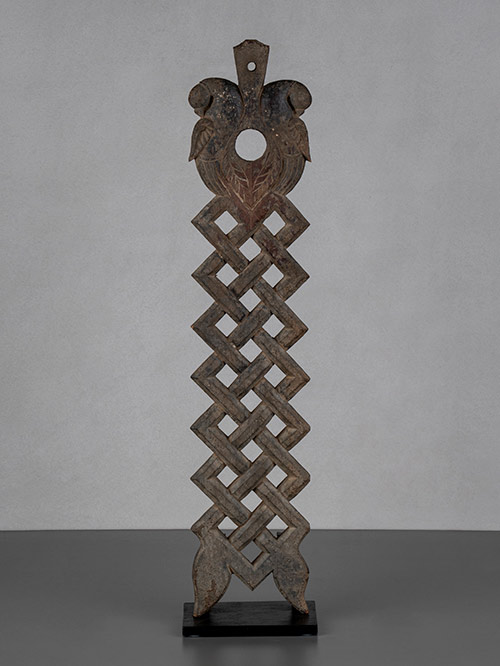
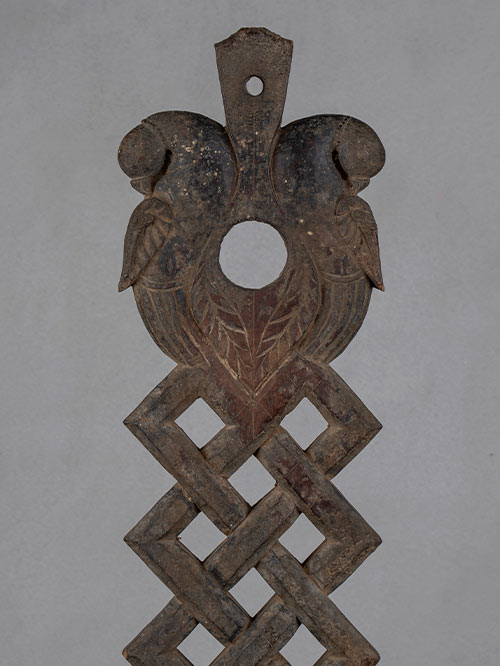
Chettinad (Tamil Nadu)
Wood
A decorative wooden spoon and ladle holder (agapai koodu) from the Chettinad region of Tamil Nadu. The knotted spoon holder has a latticed design with diamond shaped cutouts to balance the utensils. The panel is crowned with a finial depicting a pair of symmetrical parrots.
Chettinad is an area situated near the temple town of Madurai, where are large number of ornate mansions were constructed in the mid-nineteenth and early twentieth century by the Nattukottai or Nagarathar Chettiars, a traditional merchant group of traders and financiers. The Chettiars made their fortune as traders and agents of credit in Burma, Malaysia and Indonesia during the nineteenth century and returned with their profits to India, where they began constructing the elaborate mansions to proclaim their position within society. By 1945, with the rise of Nationalism through South-east Asia and looming Indian independence, the Chettiars sold their foreign interests, and returned to India to try their luck in business. As a result many of the families established new residences across the country, leaving many of their ancestral properties unused. Consequently by the 1960s and 70s, many of the Chettinad mansions, unable to raise sufficient funds for repairs, fell into decay. Many of the mansions were sold or dismantled as a result.
Size (cms): 71(H) x 16.5(W) x 12(D)
Size (inches): 28(H) x 6.5(W) x 4.5(D)
-
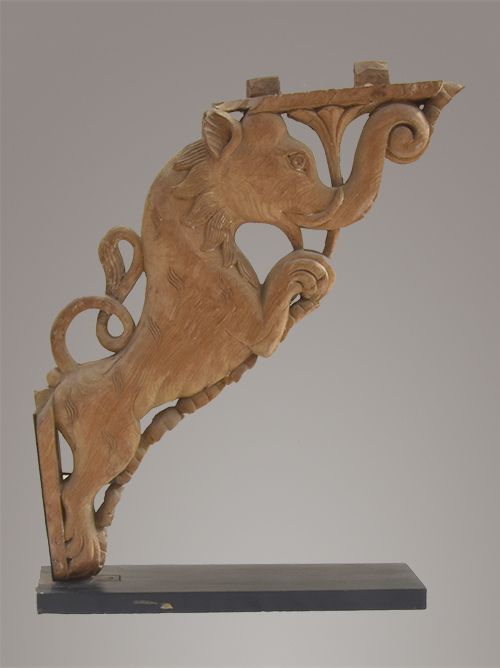
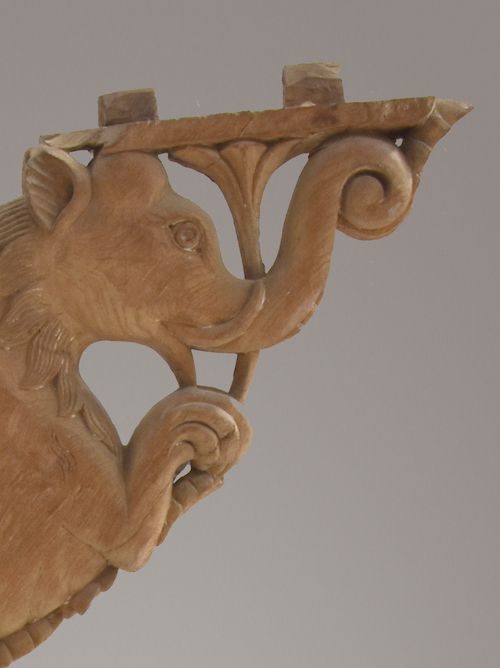
TEAK
c. 1920
The Makara is a mythical aquatic creature that combines the body of a crocodile with the head of a lion and the trunk of an elephant. One of India’s most ancient symbols, harking back more than two thousand years to a time when the natural world was seen as both symbol and reality, and fantastic creatures were invented to express the complexity of nature. The Makara is considered auspicious and purifying by Hindus and related to fertility. he is the vehicle (vahana) of Varuna, god of the waters of heaven and earth, and the emblem of Kama, the god of love.
Sizes (cms): 80 (H) x 62 (W) x 20 (D)
Sizes (inches): 31.4 (H) x 24.4 (W) x 7.9 (D)
-
Patan (Gujarat)
Wood
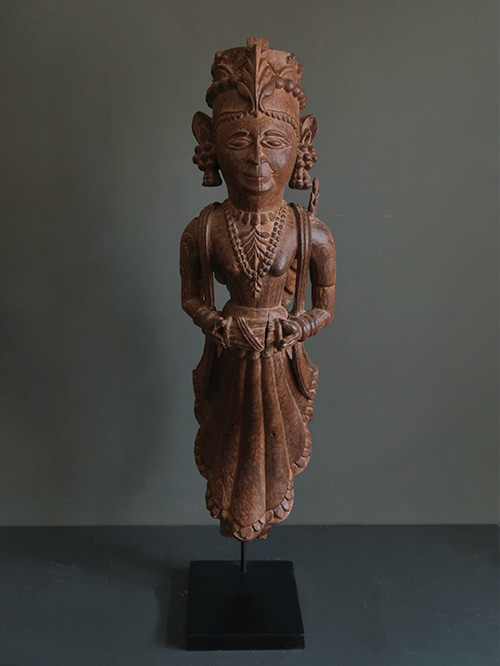
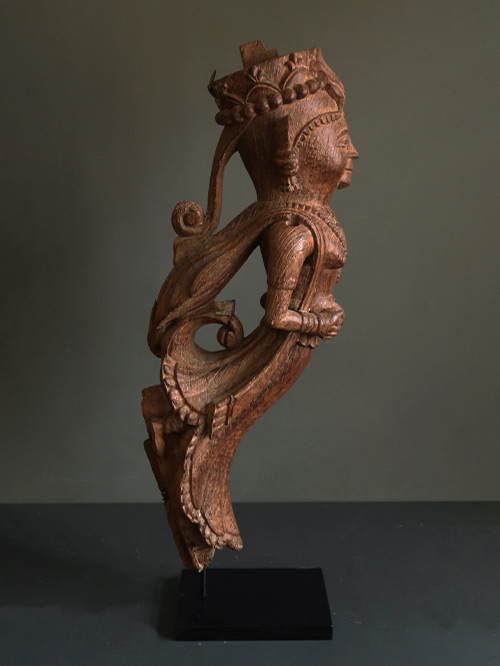
A fine figural strut formed as a crowned celestial musician (Vidyadhara). She holds a small drum and wears a patterned blouse and a flowing pleated skirt standing in a typical curved posture. Her long veil drapes behind her shoulders resembling wings. The appearance of wings on figures is a very old tradition in Indian art. Although seen in many parts of Gujarat the treatment his novel : the robes of the figure turn up at the ends and the veil cross the shoulders and turns into wings.
The ancestral occupation of the Hindu Suthar community, the craft of wood carving was practiced in several districts of Gujarat including Patan, Kadi, Ahmedabad and Nadiad, although the legacy of exquisite wood carving seen in the traditional havelis, mansions, is evident in all the districts of Gujarat. Patan district is renowned for the intricately carved Bohra haveli or mansions at Siddhpur; these structures are characterised by their eclectic use of geometric or floral patterns as well as motifs inspired by European and West Asian decorative elements on the woodwork of the balconies and ceilings.The wooden architecture of Ahmedabad on the other hand, acquires its distinctive aesthetic through the use of patterns borrowed from block printing and textiles.
Size (cms): 72.5(H) x 20(W) x 28(D)
Size (inches): 28.5(H) x 8(W) x 11(D)
-
Patan (Gujarat)
Wood, polychromed
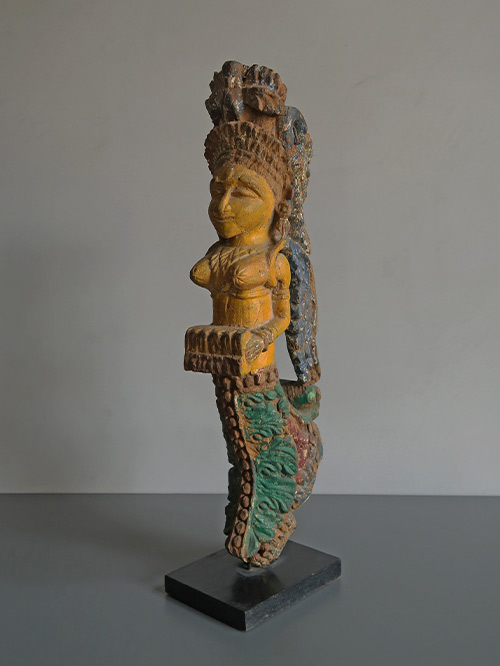
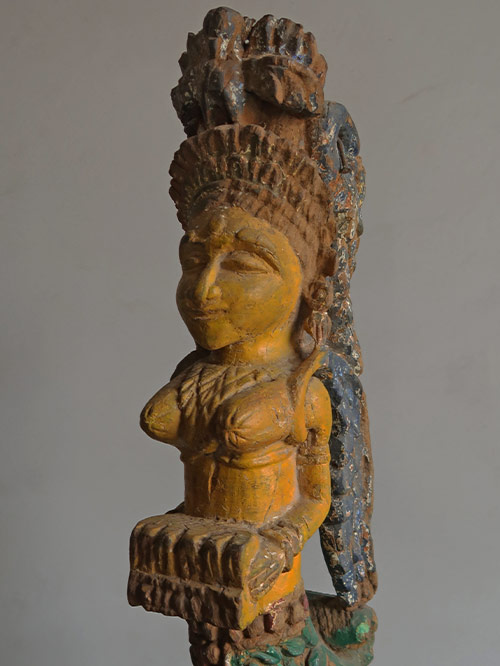
A decorative winged musician bracket, the figure who is crowned holds a percussion instrument. She wears a patterned blouse and a pleated skirt.
The ancestral occupation of the Hindu Suthar community, the craft of wood carving was practiced in several districts of Gujarat including Patan, Kadi, Ahmedabad and Nadiad, although the legacy of exquisite wood carving seen in the traditional havelis, mansions, is evident in all the districts of Gujarat. Patan district is renowned for the intricately carved Bohra haveli or mansions at Siddhpur; these structures are characterised by their eclectic use of geometric or floral patterns as well as motifs inspired by European and West Asian decorative elements on the woodwork of the balconies and ceilings.The wooden architecture of Ahmedabad on the other hand, acquires its distinctive aesthetic through the use of patterns borrowed from block printing and textiles.
Size (cms): 64(H) x 14(W) x 21(D)
Size (inches): 25(H) x 5.5(W) x 8.5(D)
-
Gujarat (Western India)
Wood with traces of polychrome
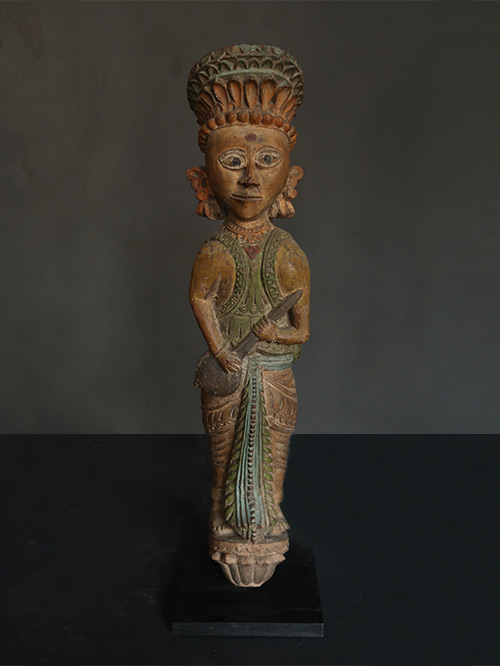
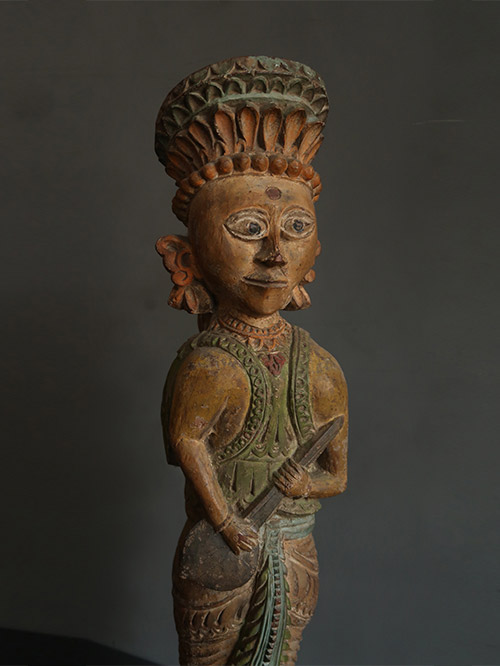
An attractive architectural bracket with original colour depicting a figure holding an instrument, possibly a Tanpura. The figure wears a decorated crown and has a stylised face with large ovular eyes pressing into a pointed nose and ears in the shape of swirling foliage. He is dressed in a pleated dhoti and a patterned vest. A stylised stole that is draped across his shoulders, turn into wings that emerge from either end of his body. A tilak is marked on his forehead.
Dwarapalas or ‘door guardians’ are placed at the entrance of every temple, shrine or sacred precinct. Two or four-handed, they sometimes carry in their hands the emblem of the deity enshrined in the sanctuary. Their countenance may sometimes be fierce and occasionally fangs protrude from their mouths. Temples dedicated to goddesses have female guardians – the Dwarapalikas.
Size (cms): 75 (H) x 20 (W) x 19 (D)
Size (inches): 29.5 (H) x 8 (W) x 7.5 (D)
-
Patan (Gujarat)
Wood
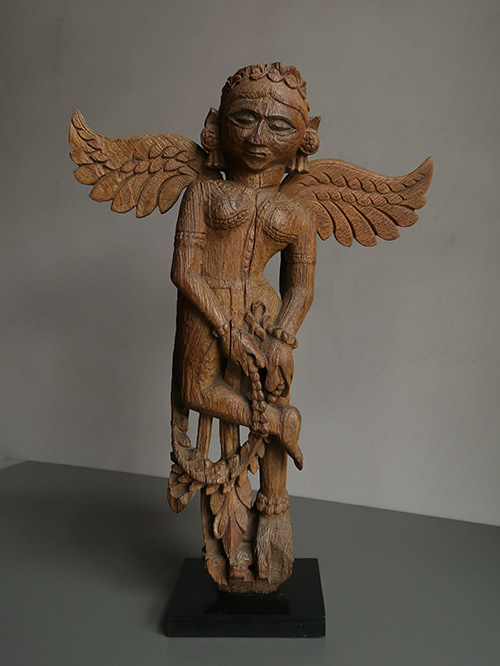
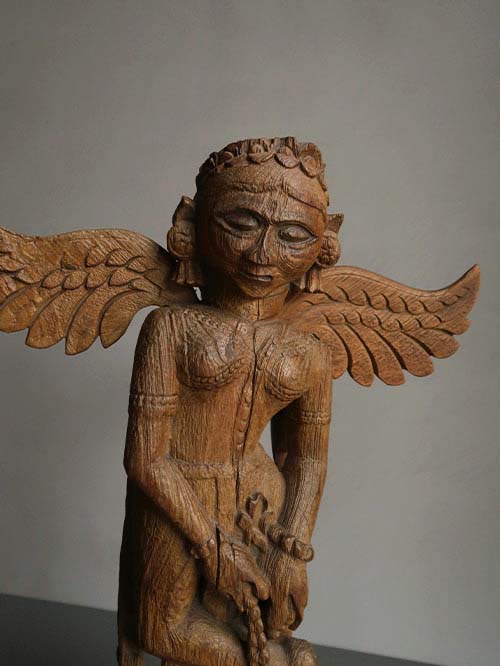
An attractive wooden winged apsara bracket. The crowned figure has patterned wings and holds a long garland which is looped around her leg.
The ancestral occupation of the Hindu Suthar community, the craft of wood carving was practiced in several districts of Gujarat including Patan, Kadi, Ahmedabad and Nadiad, although the legacy of exquisite wood carving seen in the traditional havelis, mansions, is evident in all the districts of Gujarat. Patan district is renowned for the intricately carved Bohra haveli or mansions at Siddhpur; these structures are characterised by their eclectic use of geometric or floral patterns as well as motifs inspired by European and West Asian decorative elements on the woodwork of the balconies and ceilings.The wooden architecture of Ahmedabad on the other hand, acquires its distinctive aesthetic through the use of patterns borrowed from block printing and textiles.
Size (cms): 77(H) x 55(W) x 18(D)
Size (inches): 30.5(H) x 21.5(W) x 7(D)
-
Patan (Gujarat)
Wood, polychromed
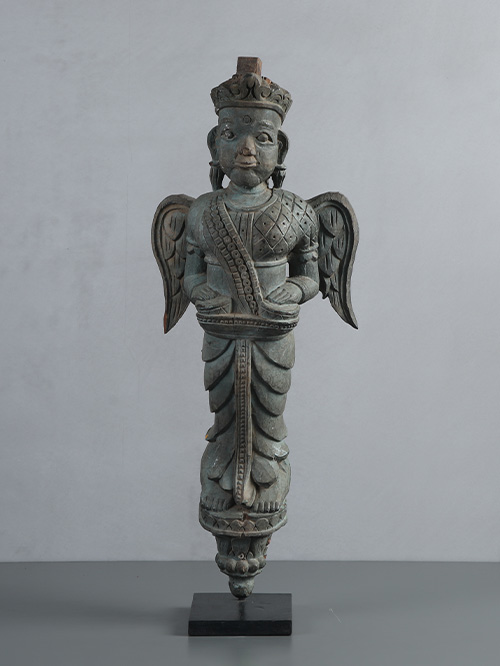
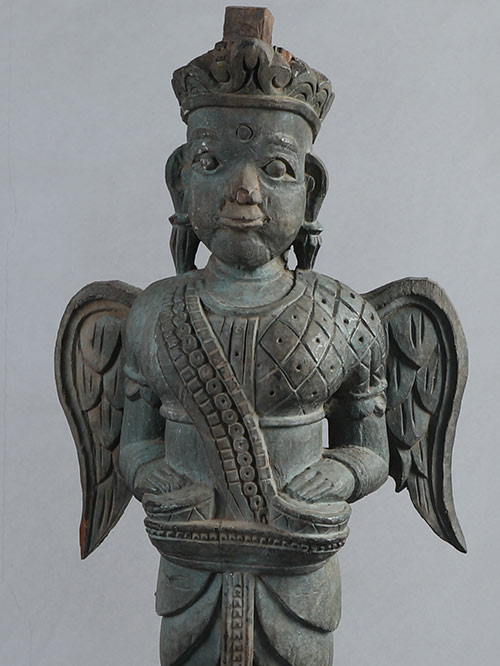
A fine figure of a winged angel, crowned, holding a pair of small cymbals. She wears a patterned blouse and a pleated skirt and stands on a lotus shaped base.
The ancestral occupation of the Hindu Suthar community, the craft of wood carving was practiced in several districts of Gujarat including Patan, Kadi, Ahmedabad and Nadiad, although the legacy of exquisite wood carving seen in the traditional havelis, mansions, is evident in all the districts of Gujarat. Patan district is renowned for the intricately carved Bohra haveli or mansions at Siddhpur; these structures are characterised by their eclectic use of geometric or floral patterns as well as motifs inspired by European and West Asian decorative elements on the woodwork of the balconies and ceilings.The wooden architecture of Ahmedabad on the other hand, acquires its distinctive aesthetic through the use of patterns borrowed from block printing and textiles.
Size including the stand (cms): 80 (H) x 28 (W) x 19 (D)
Size including the stand (inches): 31.5 (H) x 11 (W) x 7.5 (D)
-
Andhra Pradesh (South India)
Wood, polychromed
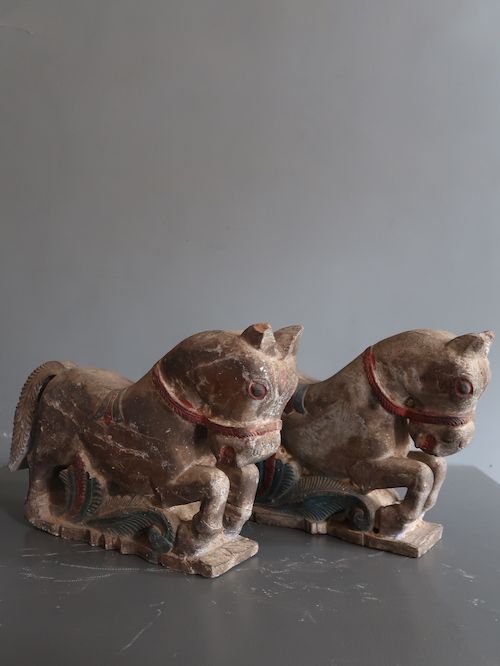
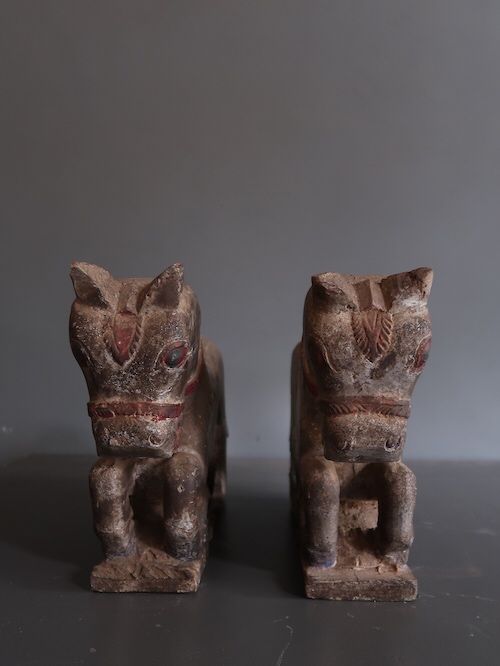
These horse brackets once formed the two ends of a door lintel. The horse or ashva was a very popular motif in architectural wood carvings in South India. Its prototype, the divine Uchchaihshravas emerged from the churning of the ocean. It was white and endowed with wings. The god Indra appropriated it and, after cutting its wings to ensure that it would remain on earth, donated it to mankind.
The horse played a pivotal role in establishing the supremacy of kings, as demonstrated, for instance by the great horse sacrifice, the Ashvamedha, which might have been established in the course of the Vedic period. Equestrian motifs appear prominently in Indian art, for example in Orissan sculpture of the 12th and 13th centuries, and in that of the late Vijaynagara and Nayak periods (early 16th to early 18th century) in southern India. There is a branch of literature specialising in the training of horses, which contains detailed passages on colouring, proportions, gait, auspicious and inauspicious marks and lists of appropriate names for horses.
Size(cms): 27 (H) x 41 (W) x 9 (D)
Size(inches): 10.5 (H) x 16 (W) x 3.5 (D)