“Horse Utsav Murti” has been added to your cart.
View cart
-
Orissa
brass alloy
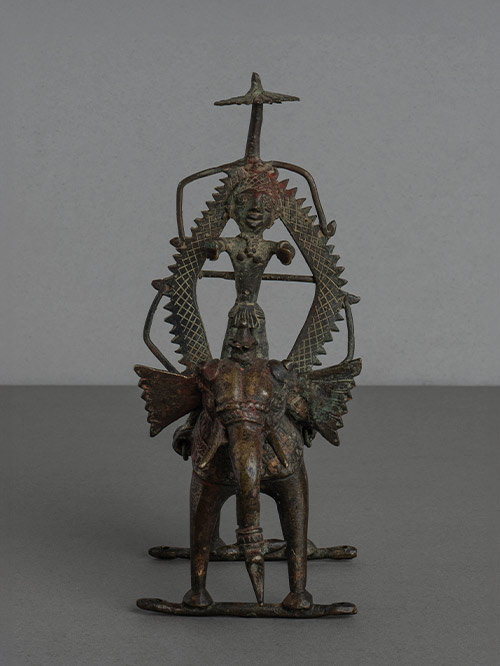
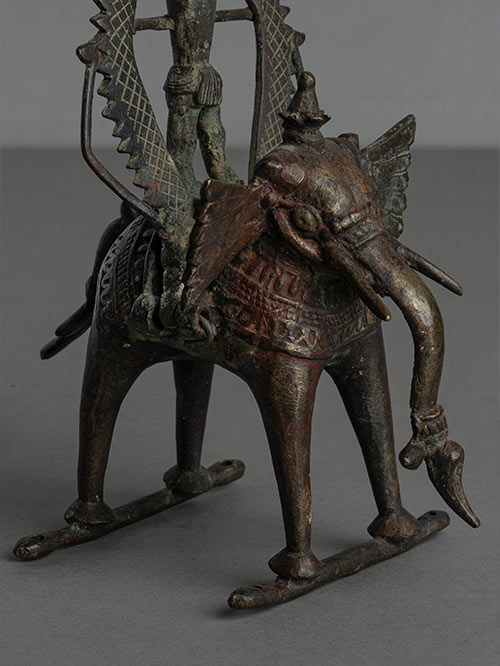
A finely crafted figure of an elephant with its mahout. The caparisoned elephant is adorned with head and neck ornaments and a decorated saddle cloth, and it has a lovely curled trunk. Atop the elephant stands the Goddess Danteshwari, enclosed in a howdah shaped like a prabhavali, forming a ritual arch around the deity.
The elephant was the vahana or vehicle of god Indra. Later it became associated with deities such as Lakshmi and Danteshwari (Durga). In art and literature it became a symbol of power and might and was associated with royalty and deities. Danteshwari Mata who is a form of the powerful Goddess Durga and is also the family goddess of the princes of Bastar. The last ruler of Bastar who died in 1966 was considered her incarnation. The goddess was brought to Bastar in the 15th century by Annamdeo, an ancestor of the princely dynasty. On the run from the advancing Muslims, he had sought refuge in the impassable mountainous region of Bastar. Legend has it that the goddess appeared to him in through his royal sword and showed him the way. The sword represents the power of the victorious goddess and bestows military prowess upon its owner.
Size (cms): 19(H) x 12(W) x 8.5(D)
Size (inches): 7.5(H) x 4.5(W) x 3.5(D)
-
Central India
brass alloy
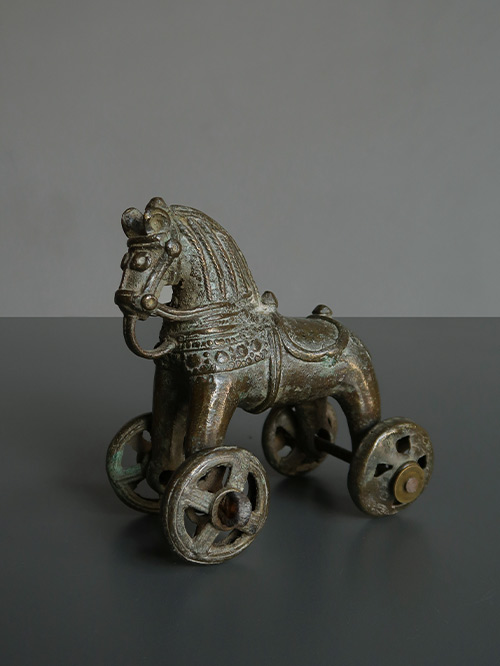
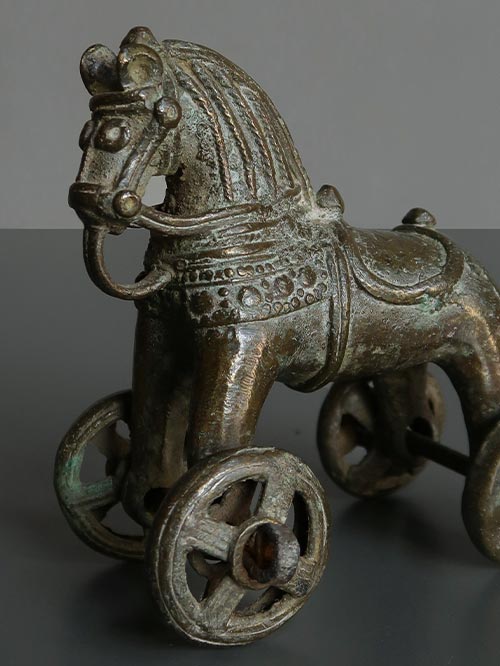
A lovely diminutive figure of a horse on wheels adorned with trappings and a decorated saddle cloth secured by ropes. Temple toys were used as ritual display in temples during important festivals such as Holi, Shivaratri and Durga Puja.
The horse played a pivotal role in establishing the supremacy of kings, as demonstrated, for instance by the great horse sacrifice, the Ashvamedha, which might have been established in the course of the Vedic period. Equestrian motifs appear prominently in Indian art, for example in Orissan sculpture of the 12th and 13th centuries, and in that of the late Vijaynagara and Nayak periods (early 16th to early 18th century) in southern India. There is a branch of literature specialising in the training of horses, which contains detailed passages on colouring, proportions, gait, auspicious and inauspicious marks and lists of appropriate names for horses.
Size (cms): 16.5(H) x 15.25(W) x 11(D)
Size (inches):6.5(H) x 6(W) x 4.5(D)
-
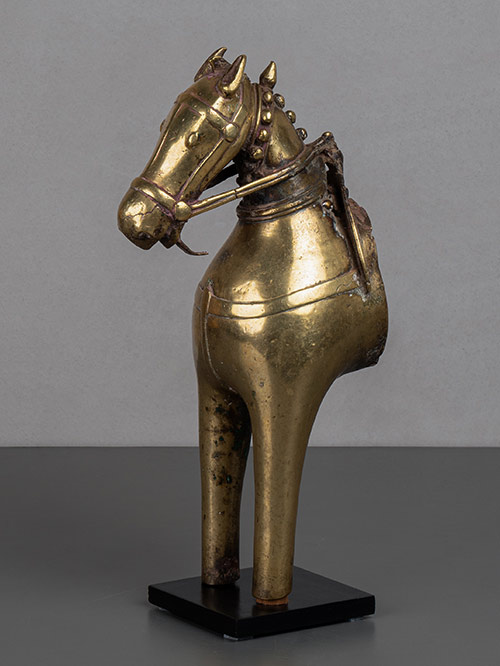
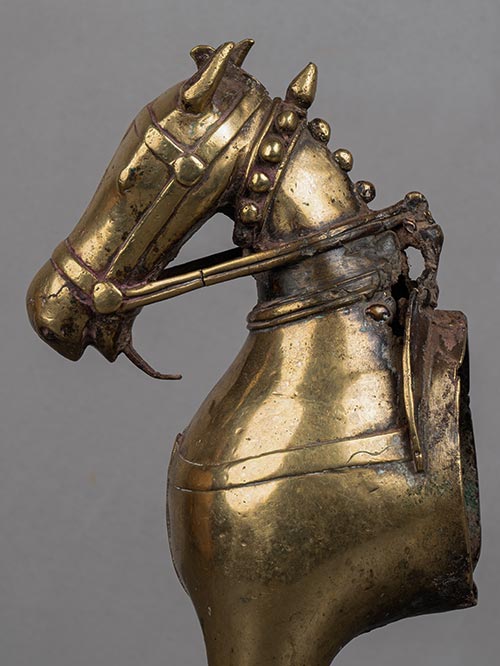
Maharashtra/ Karnataka
brass alloy
This finely modelled brass horse is most likely a procession image or Utsav Murti. Its primary function was to be used in festivals and processions outside the temple. The ‘half horse’ would have been kept against a backdrop adorned with floral garlands and vermillion.
Shiva was, and still is, the tutelary deity of Maharashtra, originally being a tribal protective deity. As Khandoba, he was widely worshipped throughout this region and contiguous areas of Karnataka, Rajasthan and Andra Pradesh where he is also called Mallanna and Khanderao. The traditional vahana (vehicle) of Shiva is Nandi, the bull, however in the form of Khandoba he is usually portrayed on horseback and occasionally on a camel or elephant.
Size (cms): 35(H) x 10.5(W) x 18(D)
Size (inches): 14(H) x 4(W) x 7(D)
-
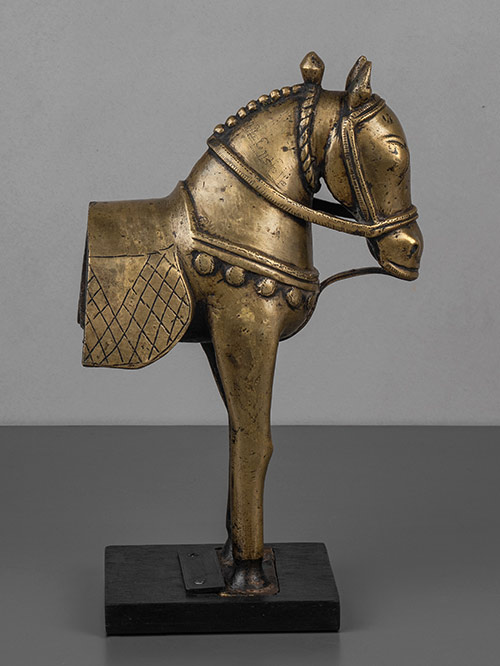
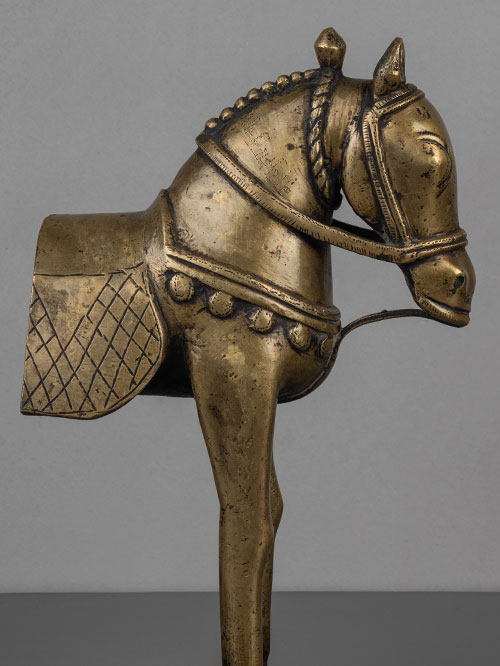
Maharashtra/ Karnataka
brass alloy
This finely modelled brass horse is most likely a procession image or Utsav Murti. Its primary function was to be used in festivals and processions outside the temple. The ‘half horse’ would have been kept against a backdrop adorned with floral garlands and vermillion.
Shiva was, and still is, the tutelary deity of Maharashtra, originally being a tribal protective deity. As Khandoba, he was widely worshipped throughout this region and contiguous areas of Karnataka, Rajasthan and Andra Pradesh where he is also called Mallanna and Khanderao. The traditional vahana (vehicle) of Shiva is Nandi, the bull, however in the form of Khandoba he is usually portrayed on horseback and occasionally on a camel or elephant.
Size (cms): 38(H) x 22.5(W) x 14(D)
Size (inches): 15(H) x 9(W) x 5.5(D)
-
Coastal Karnataka (South India)
brass alloy
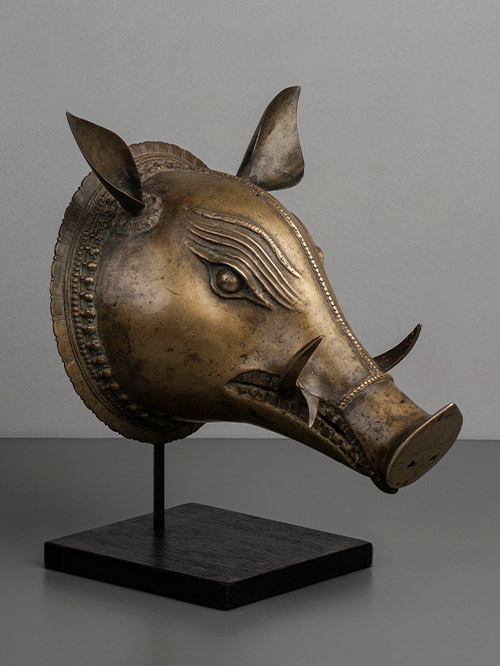
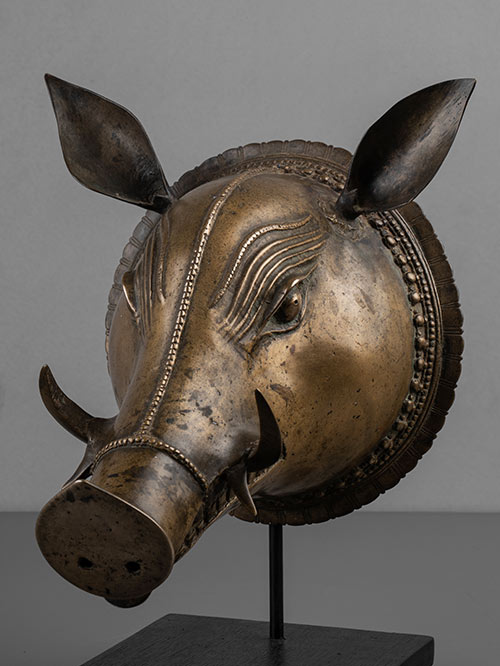
A finely detailed Panjurli (boar) mask with a symmetric conical shape, attractive colour, and rich patina. The head is adorned with a central vertical beaded rope that encircles the snout at one end and the head at its widest point. Features such as the eyes, ears, tusks, and snout are meticulously crafted.
This mask comes from the bhuta tradition on the Malabar coast. The bhuta and daiva, local divine or deified beings are highly prevalent in the southern parts of the Kannara district. Though now largely confined to south Kannara, certain areas of north Kannara and even Sri Lanka, bhuta cults once existed all over India under different names and forms. These cults, which are of considerable antiquity, have much in common with those of the yakshas, for instance. Like bhutas, yakshas are a ‘queer blend of what is sublime and mundane, profound and profane.’⠀
In Tulu Nadu, hordes of boars often invaded and destroyed the cultivated lands so the farmers started worshipping and giving offerings to Panjurli, the spirit in the form of a boar, thinking that this would appease his mood and thus keep the wild animals away from their fields.
Mask Size (cms): 27(H) x 26(W) x 33(D), 35(H with stand)
Mask Size (inches): 10.5(H) x 10(W) x 13(D), 14(H with stand)
-
Bastar (Chhattisgarh, Central India)
Brass, Dokra work
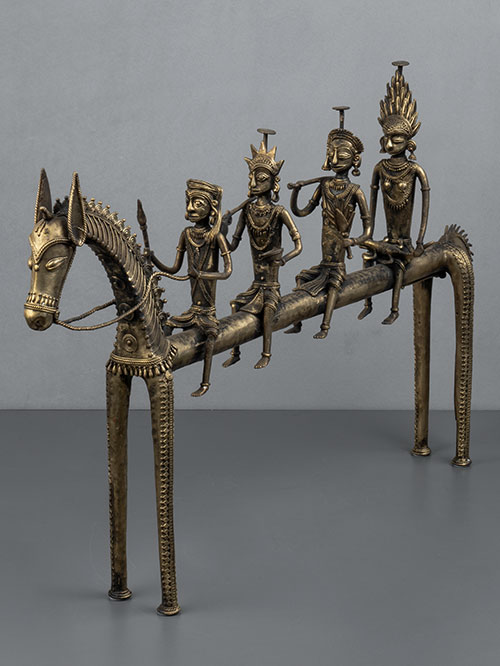
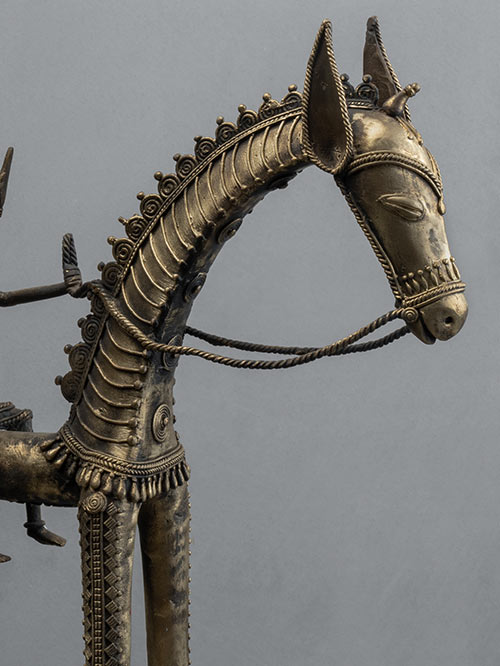
A fine sculpture of a horse and four riders (hunters). The figures carry a spear, mace, club and a crocodile.
Suresh Waghmare (signed)
Born in 1970 in a Maharashtrian family in Bastar district, he began to study the technique of Bell Metal Casting with Guru Phool Singh Bisara when he was twelve. Since then he has been working as a member of the co-operative of craftsmen. He is a master craftsman in the art of metal casting and has participated in many international exhibitions.
Size (cms): 51(H) x 84.5(W) x 9(D)
Size (inches): 20(H) x 33.5(W) x 3.5(D)
-
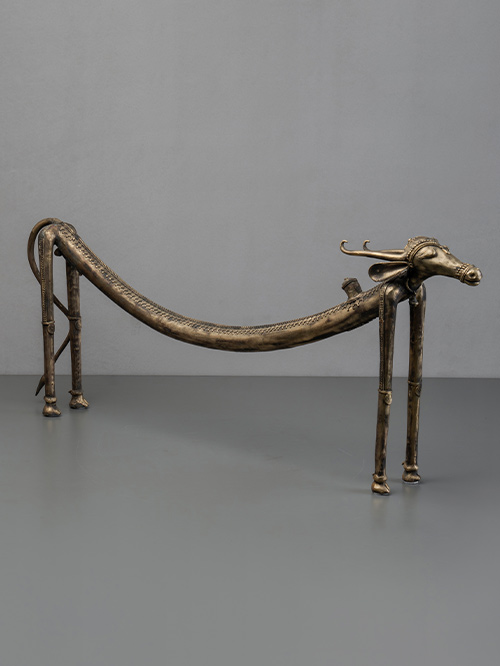
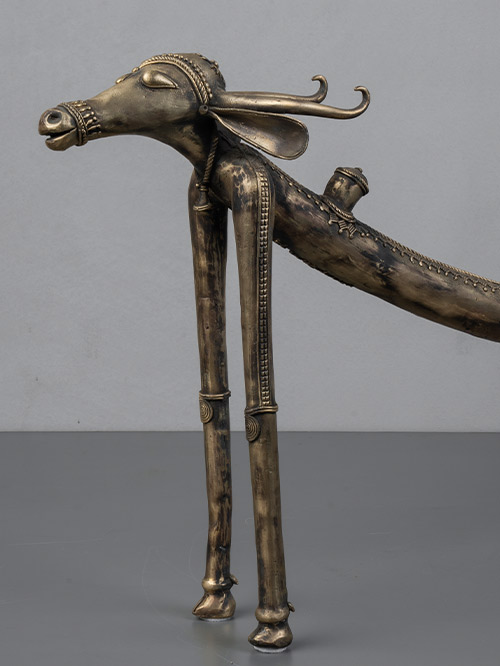
Bastar (Chhattisgarh, Central India)
Brass, Dokra work
Nandi or nandin means rejoicing, gladdening. It is the name of shivas conveyance (vahana) the white bull, son of kashyapa and of surabhi. Nandii was probably a folk deity later incorporated into the brahamanic lore. Nandi symbolises on the one hand moral and religious duty (dharma) , and on the other, virility, fertility and strength. Apart from being shivas vehicle, nandi in his form as nandikeshvara, depicted as a human with a bulls head, is believed to be one of the great masters of music and dancing. In southern India his recumbent image is placed either opposite the main sanctuary or in the hall leading to it, facing the linga.
Suresh Waghmare (signed)
Born in 1970 in a Maharashtrian family in Bastar district, he began to study the technique of Bell Metal Casting with Guru Phool Singh Bisara when he was twelve. Since then he has been working as a member of the co-operative of craftsmen. He is a master craftsman in the art of metal casting and has participated in many international exhibitions.
Size (cms): 38(H) x 81(W) x 10(D)
Size (inches): 15(H) x 32(W) x 4(D)
-
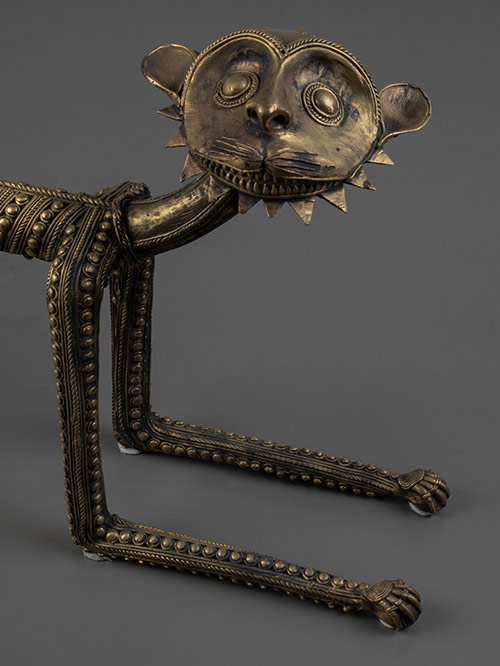
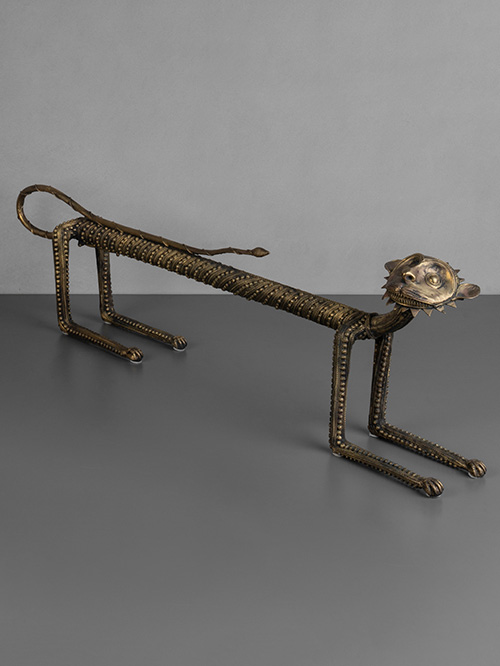
Bastar (Chhattisgarh, Central India)
Brass, Dokra work
The tiger is the vehicle of, and sacred to, Danteshwari Mata who is a form of the powerful Goddess Durga and is also the family goddess of the princes of Bastar.
Suresh Waghmare (signed)
Born in 1970 in a Maharashtrian family in Bastar district, he began to study the technique of Bell Metal Casting with Guru Phool Singh Bisara when he was twelve. Since then he has been working as a member of the co-operative of craftsmen. He is a master craftsman in the art of metal casting and has participated in many international exhibitions.
Size (cms): 29.5(H) x 106(W) x 11(D)
Size (inches): 11.5(H) x 41.5(W) x 4.5(D)
-
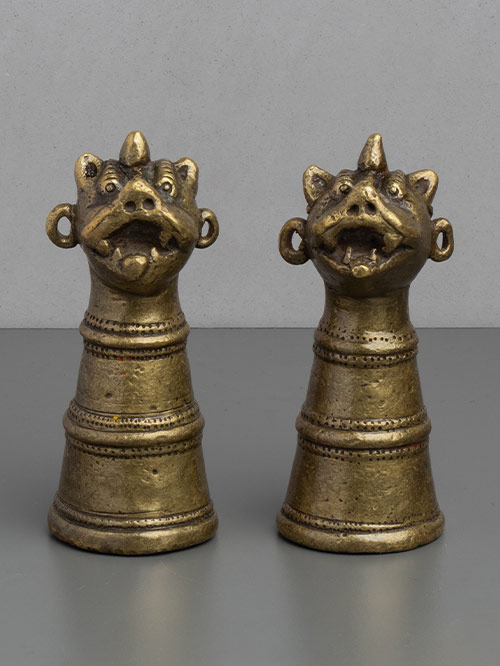

Karnataka
Brass
A decorative pair of horn cap ornaments with vyali (lion) finials. They would have been fixed to nandi (bull) horn ends as a decorations for the Pola festival, during which draft animals are thanked for their help in plowing the fields.
Nandi or nandin, the bull vahana of Shiva has always been noted for his strength and virility. Usually depicted in a life-like naturalistic manner, Nandi is present in every Shaivite temple, often with his own temple enclosure but facing the Shiva lingam. Figures like this of Nandi on a platform base with a cobra canopy are common objects of worship, especially found in home shrines.
Indiv. Sizes (cms): 12(H) x 5(W) x 5(D) each
Indiv. Sizes (inches): 4.5(H) x 2(W) x 2(D) each
-
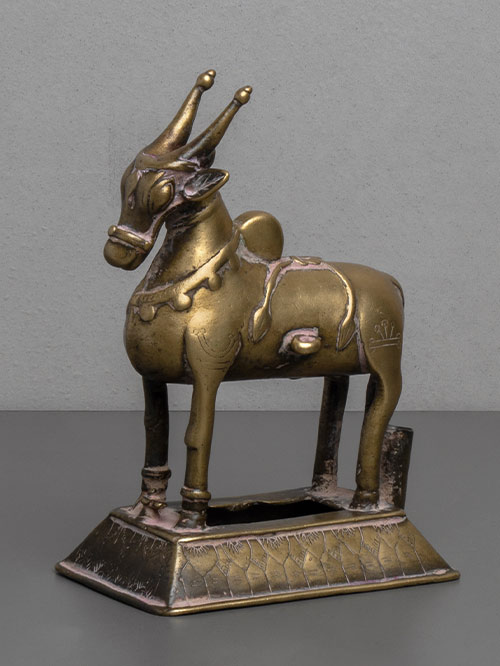
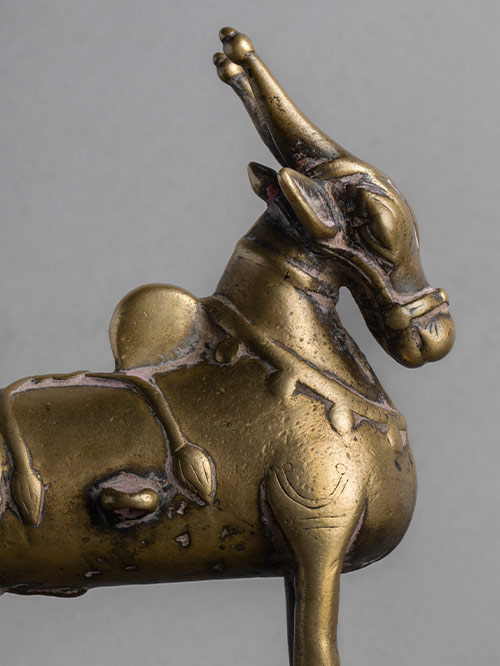
Karnataka (South India)
brass alloy
This gracefully proportioned standing Nandi is delicately incised with head and neck ornaments and stands on a trapezoidal base.
Nandi or nandin, the bull vahana of Shiva has always been noted for his strength and virility. Usually depicted in a life-like naturalistic manner, Nandi is present in every Shaivite temple, often with his own temple enclosure but facing the Shiva lingam. Figures like this of Nandi on a platform base with a cobra canopy are common objects of worship, especially found in home shrines.
Size (cms): 16.5(H) x 10.8(W) x 7.6(D)
Size (inches): 6.5(H) x 4.5(W) x 3(D)
-
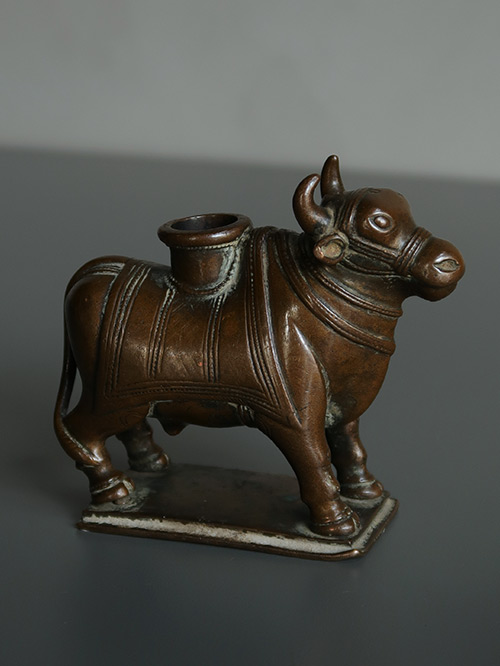

Karnataka (South India)
copper alloy
A beautifully caparisoned copper Nandi standing on a rectangular plinth. The Nandi wears an engraved saddle blanket which is surmounted by a bowl-like structure which would have held an incense burner or an oil reservoir. He is bridled and decorated with necklaces around his neck.
Nandi or nandin means rejoicing, gladdening. It is the name of Shiva’s conveyance (vahana) the white bull. Nandi was probably a folk deity later incorporated into the Brahmanic lore. Nandi symbolises on the one hand moral and religious duty (dharma), and on the other, virility, fertility and strength. Apart from being Shiva’s vehicle, nandi in his form as nandikeshvara, depicted as a human with a bulls head, is believed to be one of the great masters of music and dancing. In southern India his recumbent image is placed either opposite the main sanctuary or in the hall leading to it, facing the linga.
Size (cms): 10.8(H) x 11.5(W) x 4.7(D)
Size (inches): 4.5(H) x 4.5(W) x 2(D)
-
Karnataka
Brass alloy
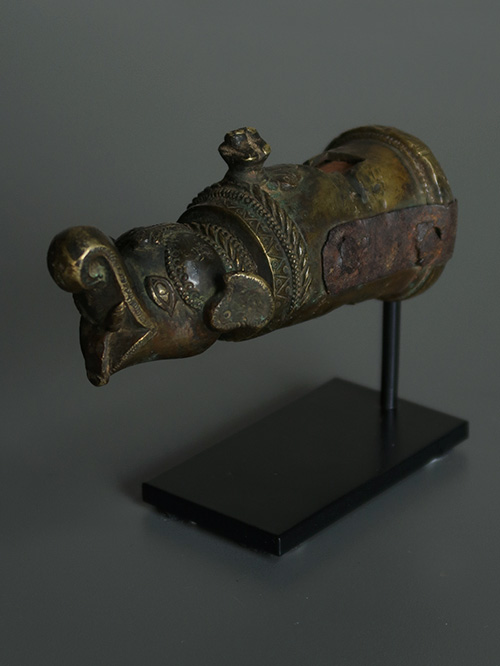
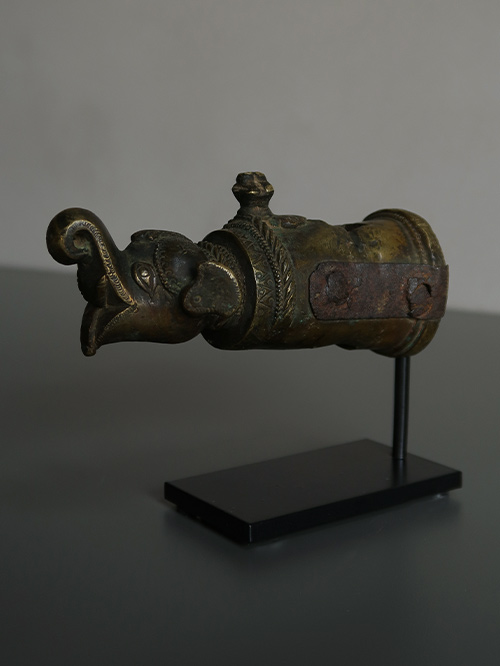
A brass palanquin pole finial taking the sculptural form of a makara head with an elephantine trunk, with bulbous eyes, pointed ears and a gaping mouth. The emotive expression of the makara, with his open mouth is powerful yet unthreatening, underlying its protective function, benign in character though capable of potential ferocity when attacked. It is almost as if he is showing off, displaying his power and status, probably reflecting that of the palanquin’s grand passenger.
Palanquins or sedan chairs were used throughout India, the larger ones to transport people and the smaller ones for religious deities to be taken around the temple complex on festival days. The present example is from the latter category. It was fitted to the wooden forward pole of the palanquin; the rear pole was usually covered with a simple metal cover or cylinder.
Size (cms): 11.5(H with stand) x 13.5(W) x 5(D)
Size (inches): 4.5(H with stand) x 5.5(W) x 2(D)
-
Karnataka
Brass alloy
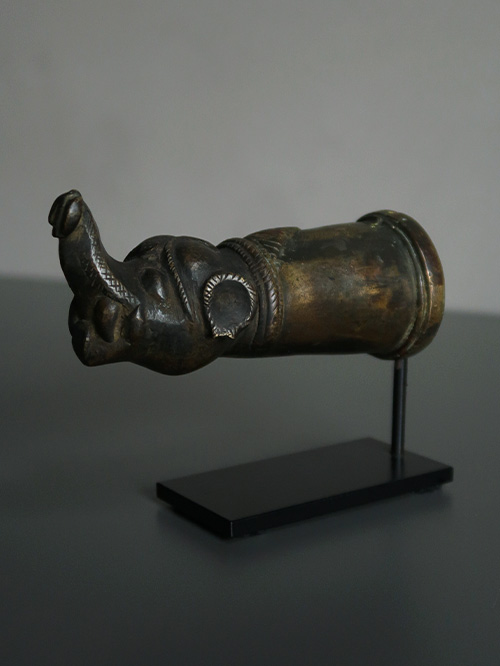
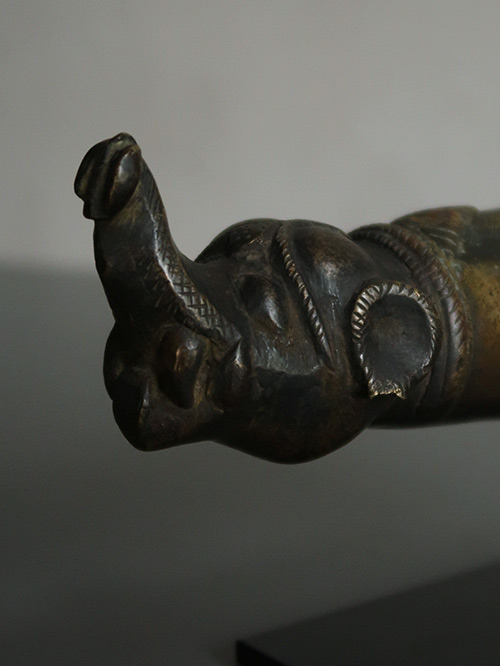
A diminutive palanquin pole finial taking the sculptural form of a makara head with large pointed ears, beady eyes and a gaping mouth. The emotive expression of the makara, with his open mouth is powerful yet unthreatening, underlying its protective function, benign in character though capable of potential ferocity when attacked. It is almost as if he is showing off, displaying his power and status, probably reflecting that of the palanquin’s grand passenger.
Palanquins or sedan chairs were used throughout India, the larger ones to transport people and the smaller ones for religious deities to be taken around the temple complex on festival days. The present example is from the latter category. It was fitted to the wooden forward pole of the palanquin; the rear pole was usually covered with a simple metal cover or cylinder.
Size (cms): 13(H with stand) x 14.5(W) x 6.5(D)
Size (inches): 5(H with stand) x 5.5(W) x 2.5(D)
-
Karnataka
Brass alloy
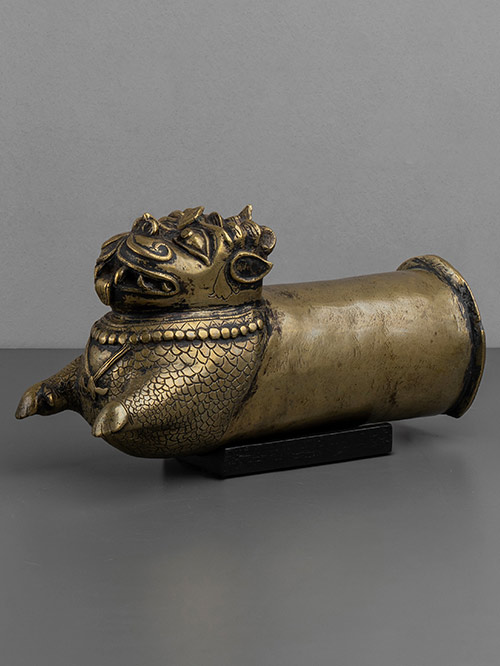
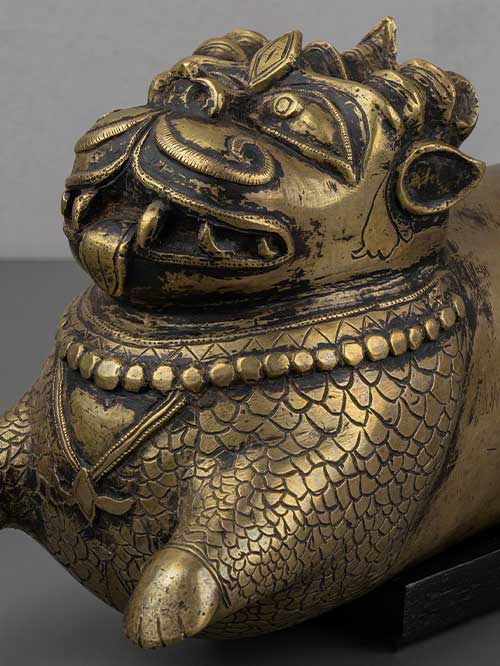
An ornamental palanquin pole finial in the sculptural form of a vyali with a pointed nose, wavy brows culminating in small protruding ears and ovular eyes. The vyali is open-mouthed, exposing large teeth and a small extended tongue. A collar in the form of a festooned necklace with a central medallion hangs on his scaly torso, in between the vyali’s outstretched paws.
Palanquins or sedan chairs were used throughout India, the larger ones to transport people and the smaller ones for religious deities to be taken around the temple complex on festival days. The present example is from the latter category. It was fitted to the wooden forward pole of the palanquin; the rear pole was usually covered with a simple metal cover or cylinder.
Size (cms): 17(H) x 31(W) x 11(D)
Size (inches): 6.5(H) x 12(W) x 4.5(D)