“Vyali Palanquin Finial” has been added to your cart.
View cart
-
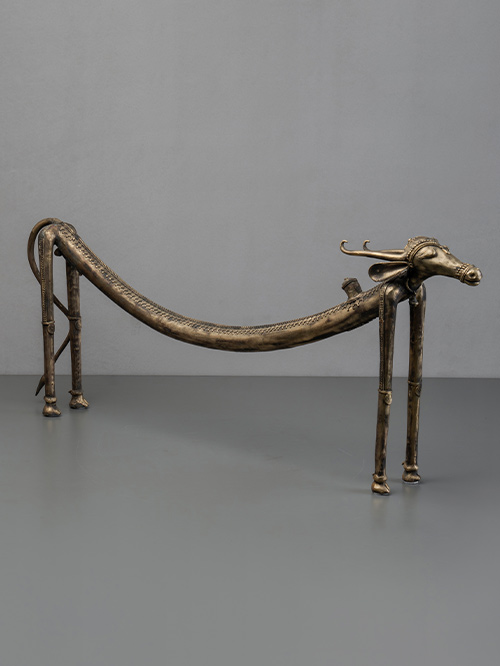
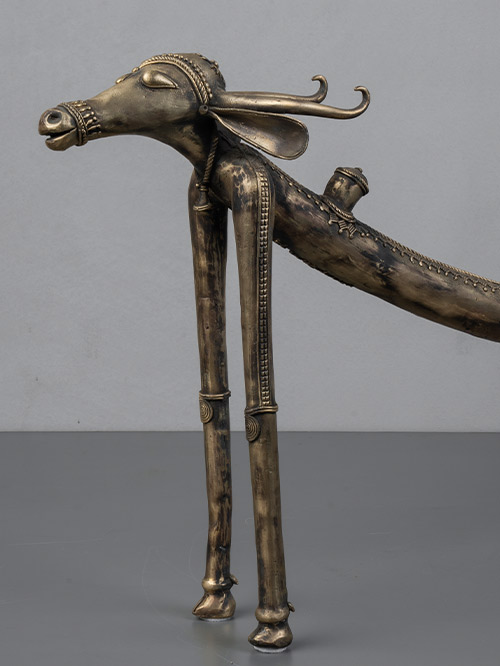
Bastar (Chhattisgarh, Central India)
Brass, Dokra work
Nandi or nandin means rejoicing, gladdening. It is the name of shivas conveyance (vahana) the white bull, son of kashyapa and of surabhi. Nandii was probably a folk deity later incorporated into the brahamanic lore. Nandi symbolises on the one hand moral and religious duty (dharma) , and on the other, virility, fertility and strength. Apart from being shivas vehicle, nandi in his form as nandikeshvara, depicted as a human with a bulls head, is believed to be one of the great masters of music and dancing. In southern India his recumbent image is placed either opposite the main sanctuary or in the hall leading to it, facing the linga.
Suresh Waghmare (signed)
Born in 1970 in a Maharashtrian family in Bastar district, he began to study the technique of Bell Metal Casting with Guru Phool Singh Bisara when he was twelve. Since then he has been working as a member of the co-operative of craftsmen. He is a master craftsman in the art of metal casting and has participated in many international exhibitions.
Size (cms): 38(H) x 81(W) x 10(D)
Size (inches): 15(H) x 32(W) x 4(D)
-
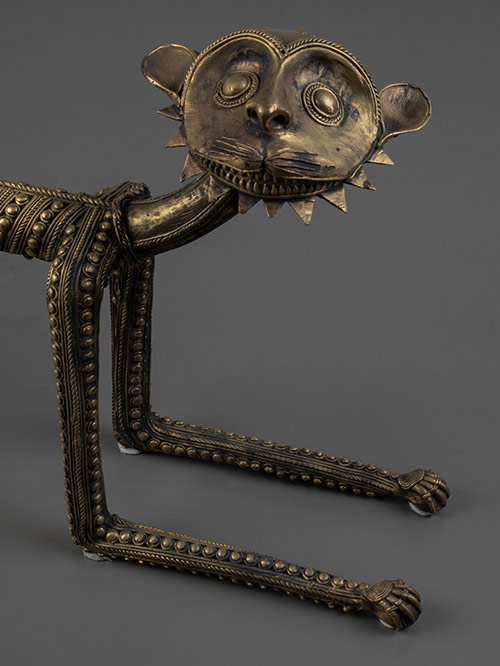
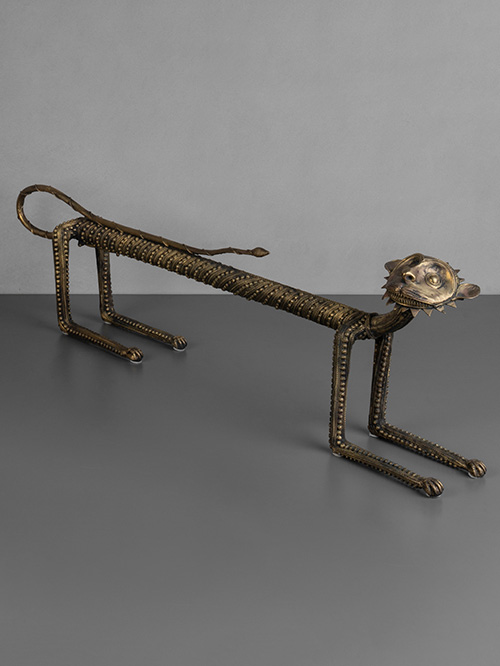
Bastar (Chhattisgarh, Central India)
Brass, Dokra work
The tiger is the vehicle of, and sacred to, Danteshwari Mata who is a form of the powerful Goddess Durga and is also the family goddess of the princes of Bastar.
Suresh Waghmare (signed)
Born in 1970 in a Maharashtrian family in Bastar district, he began to study the technique of Bell Metal Casting with Guru Phool Singh Bisara when he was twelve. Since then he has been working as a member of the co-operative of craftsmen. He is a master craftsman in the art of metal casting and has participated in many international exhibitions.
Size (cms): 29.5(H) x 106(W) x 11(D)
Size (inches): 11.5(H) x 41.5(W) x 4.5(D)
-
Burma (Myanmar)
Bronze
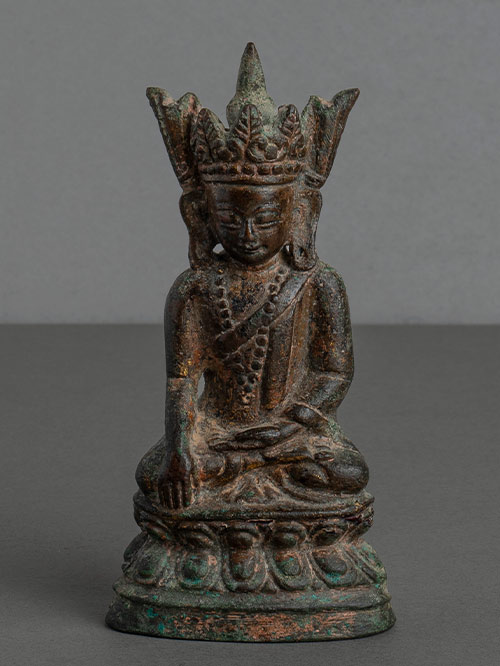
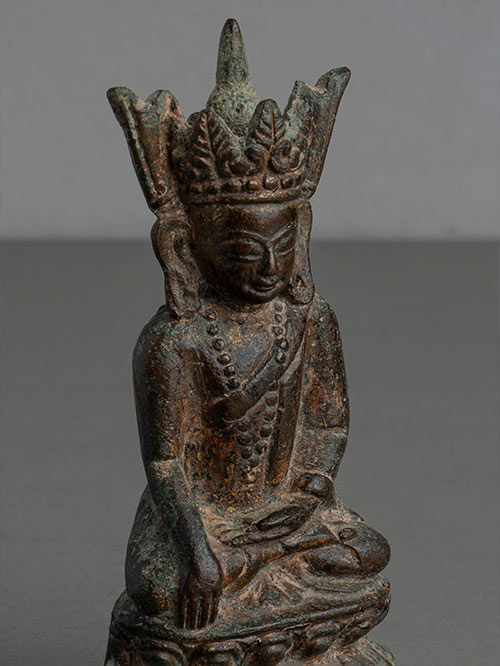
This charming figure of Buddha depicts him seated in bhumispara mudra (‘calling the earth to witness’). The image wears a sanghati with a long sash that reaches to the waist. The cranial protuberance or usnisha is surrounded by a crown on top of his head.
The posture in which the monks are seated is usually known as the ‘earth-witness’ attitude. This represents the moment when Buddha was seated in meditation under the Bodhi tree during the night before he achieved enlightenment. When he was asked by Mara to name anyone who would give evidence that he had given alms, the Buddha moved his right hand and touched the earth and said that the earth would bear witness that, in a previous existence in the form of Vessantara, he had given alms to such an extent as to cause the earth to quake. Immediately before this incident his right hand was folded in his lap in precisely the same way as his left; here he has moved it in order to touch the earth in front of him in the gesture of calling the earth to witness (bhumisparsha mudra). This is one of the three most popular ways of showing the Buddha in Burmese art; the other two represent him standing and at the moment of his Mahaparinibbana.
Size (cms): 12(H) x 6(W) x 4(D)
Size (inches): 4.5(H) x 2.5(W) x 1.5(D)
-
Bihar (East India)
Brass Alloy
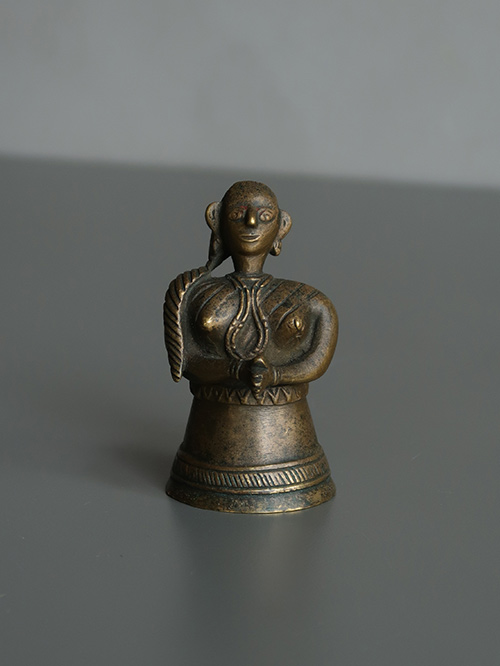
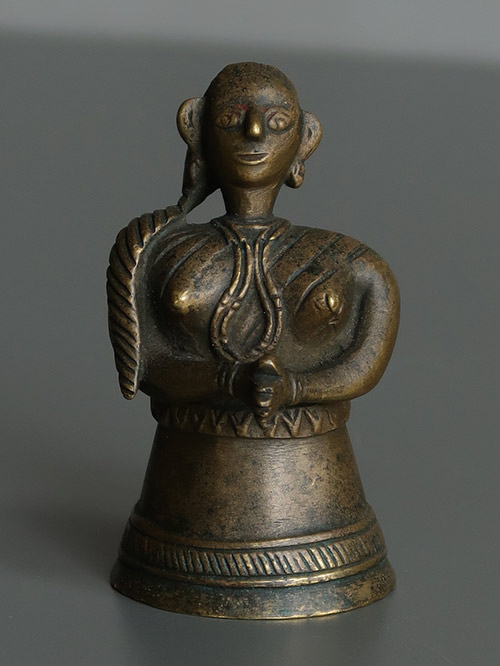
An unusual bell cast in the form a girl with her hands held in anjali mudra with her long braided hair resting across her shoulder. Such figures were made using the cire-perdue technique (lost-wax) using dhuna, a black wax-like substance.
Bells play in an important role in anu puja (worship), especially when offering aarati ( waving a camphor or oil lamp before the deity to ward off evil); the worshipper rings the bell with the right hand, holding the lamp in the left hand.
Size (cms): 8.5(H) x 4.6(W) x 5.6(D)
Size (inches): 3.5(H) x 2(W) x 2(D)
-
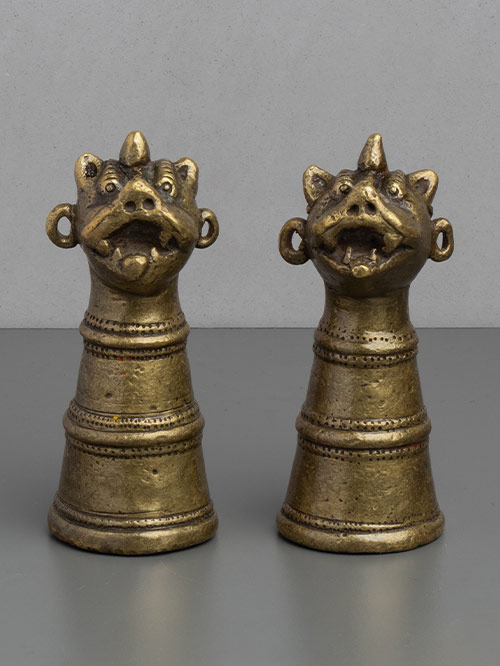

Karnataka
Brass
A decorative pair of horn cap ornaments with vyali (lion) finials. They would have been fixed to nandi (bull) horn ends as a decorations for the Pola festival, during which draft animals are thanked for their help in plowing the fields.
Nandi or nandin, the bull vahana of Shiva has always been noted for his strength and virility. Usually depicted in a life-like naturalistic manner, Nandi is present in every Shaivite temple, often with his own temple enclosure but facing the Shiva lingam. Figures like this of Nandi on a platform base with a cobra canopy are common objects of worship, especially found in home shrines.
Indiv. Sizes (cms): 12(H) x 5(W) x 5(D) each
Indiv. Sizes (inches): 4.5(H) x 2(W) x 2(D) each
-
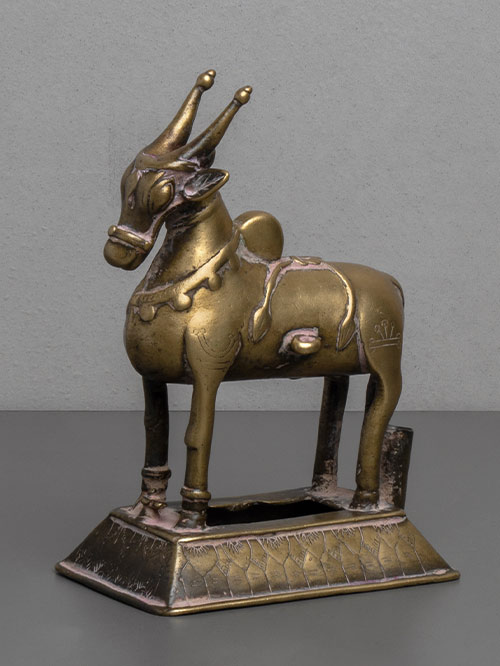
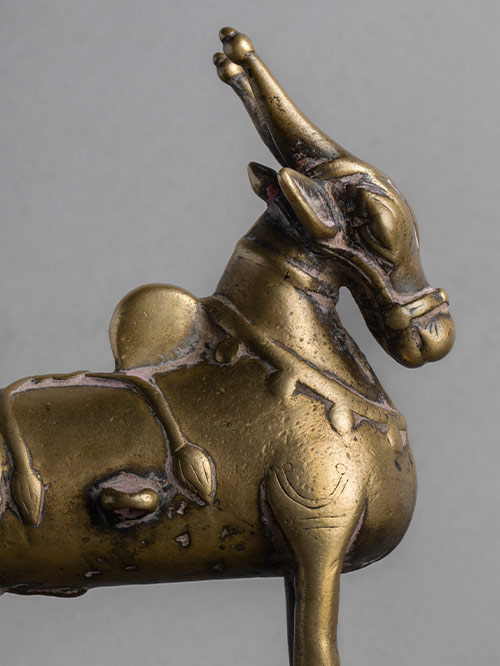
Karnataka (South India)
brass alloy
This gracefully proportioned standing Nandi is delicately incised with head and neck ornaments and stands on a trapezoidal base.
Nandi or nandin, the bull vahana of Shiva has always been noted for his strength and virility. Usually depicted in a life-like naturalistic manner, Nandi is present in every Shaivite temple, often with his own temple enclosure but facing the Shiva lingam. Figures like this of Nandi on a platform base with a cobra canopy are common objects of worship, especially found in home shrines.
Size (cms): 16.5(H) x 10.8(W) x 7.6(D)
Size (inches): 6.5(H) x 4.5(W) x 3(D)
-
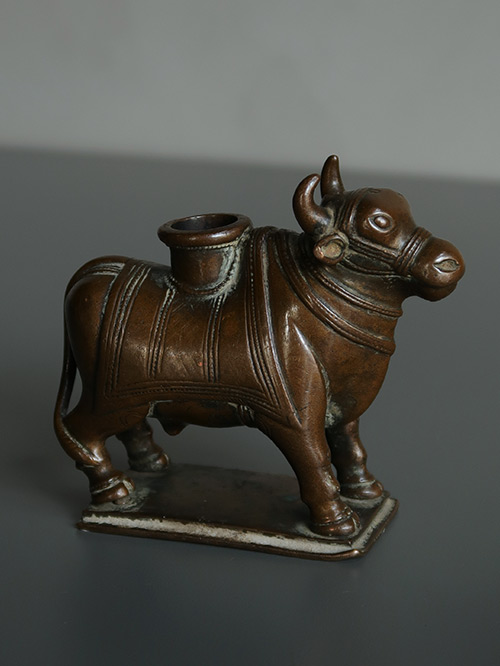

Karnataka (South India)
copper alloy
A beautifully caparisoned copper Nandi standing on a rectangular plinth. The Nandi wears an engraved saddle blanket which is surmounted by a bowl-like structure which would have held an incense burner or an oil reservoir. He is bridled and decorated with necklaces around his neck.
Nandi or nandin means rejoicing, gladdening. It is the name of Shiva’s conveyance (vahana) the white bull. Nandi was probably a folk deity later incorporated into the Brahmanic lore. Nandi symbolises on the one hand moral and religious duty (dharma), and on the other, virility, fertility and strength. Apart from being Shiva’s vehicle, nandi in his form as nandikeshvara, depicted as a human with a bulls head, is believed to be one of the great masters of music and dancing. In southern India his recumbent image is placed either opposite the main sanctuary or in the hall leading to it, facing the linga.
Size (cms): 10.8(H) x 11.5(W) x 4.7(D)
Size (inches): 4.5(H) x 4.5(W) x 2(D)
-
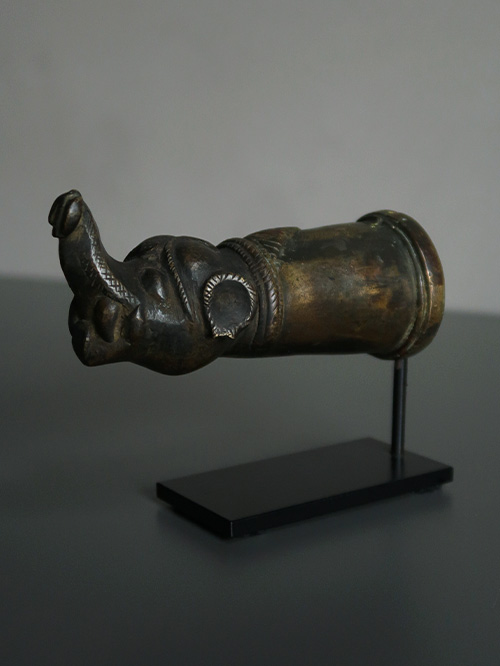
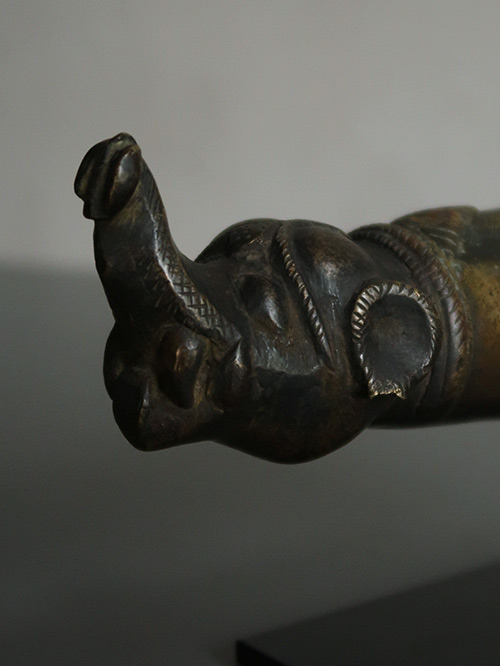
Karnataka
Brass alloy
A diminutive palanquin pole finial taking the sculptural form of a makara head with large pointed ears, beady eyes and a gaping mouth. The emotive expression of the makara, with his open mouth is powerful yet unthreatening, underlying its protective function, benign in character though capable of potential ferocity when attacked. It is almost as if he is showing off, displaying his power and status, probably reflecting that of the palanquin’s grand passenger.
Palanquins or sedan chairs were used throughout India, the larger ones to transport people and the smaller ones for religious deities to be taken around the temple complex on festival days. The present example is from the latter category. It was fitted to the wooden forward pole of the palanquin; the rear pole was usually covered with a simple metal cover or cylinder.
Size (cms): 13(H with stand) x 14.5(W) x 6.5(D)
Size (inches): 5(H with stand) x 5.5(W) x 2.5(D)
-
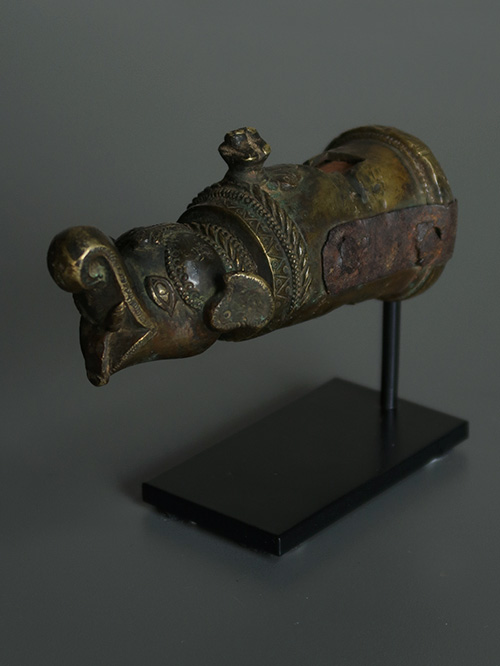
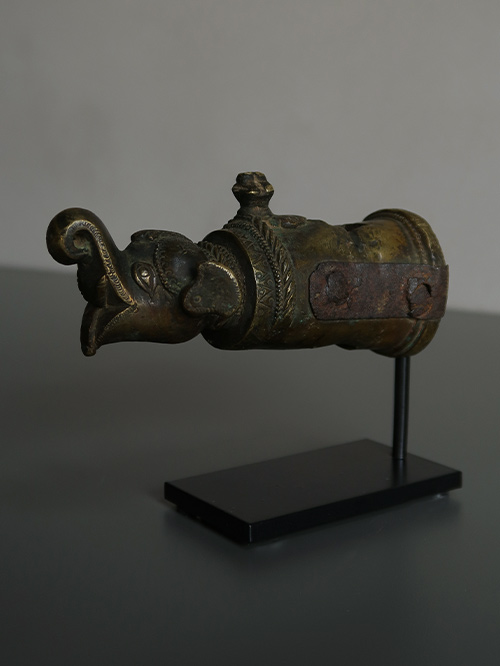
Karnataka
Brass alloy
A brass palanquin pole finial taking the sculptural form of a makara head with an elephantine trunk, with bulbous eyes, pointed ears and a gaping mouth. The emotive expression of the makara, with his open mouth is powerful yet unthreatening, underlying its protective function, benign in character though capable of potential ferocity when attacked. It is almost as if he is showing off, displaying his power and status, probably reflecting that of the palanquin’s grand passenger.
Palanquins or sedan chairs were used throughout India, the larger ones to transport people and the smaller ones for religious deities to be taken around the temple complex on festival days. The present example is from the latter category. It was fitted to the wooden forward pole of the palanquin; the rear pole was usually covered with a simple metal cover or cylinder.
Size (cms): 11.5(H with stand) x 13.5(W) x 5(D)
Size (inches): 4.5(H with stand) x 5.5(W) x 2(D)
-
Karnataka
Brass alloy
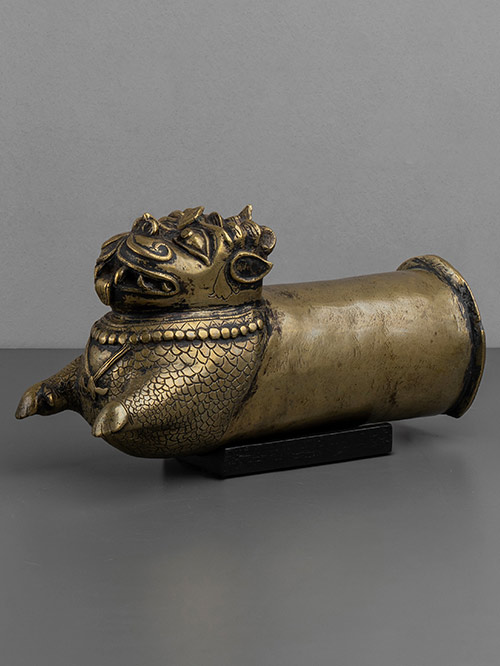
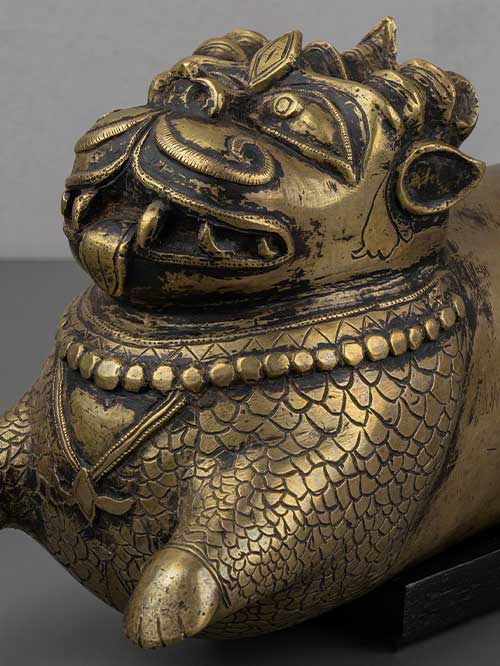
An ornamental palanquin pole finial in the sculptural form of a vyali with a pointed nose, wavy brows culminating in small protruding ears and ovular eyes. The vyali is open-mouthed, exposing large teeth and a small extended tongue. A collar in the form of a festooned necklace with a central medallion hangs on his scaly torso, in between the vyali’s outstretched paws.
Palanquins or sedan chairs were used throughout India, the larger ones to transport people and the smaller ones for religious deities to be taken around the temple complex on festival days. The present example is from the latter category. It was fitted to the wooden forward pole of the palanquin; the rear pole was usually covered with a simple metal cover or cylinder.
Size (cms): 17(H) x 31(W) x 11(D)
Size (inches): 6.5(H) x 12(W) x 4.5(D)