“Hanuman Cheriyal Mask” has been added to your cart.
View cart
-
Konkan region (Karnataka)
Wood
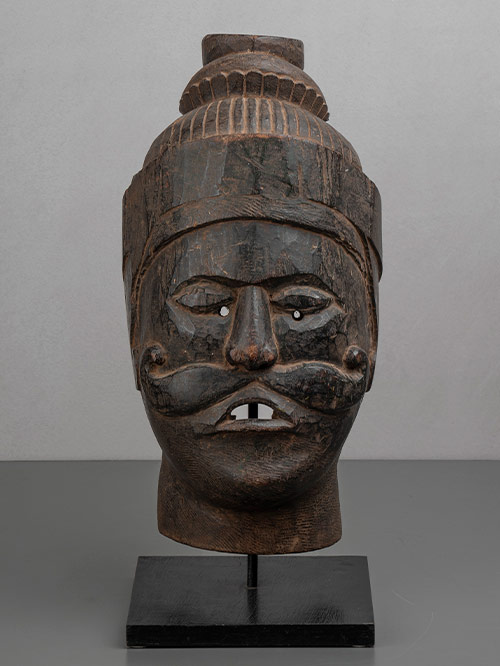
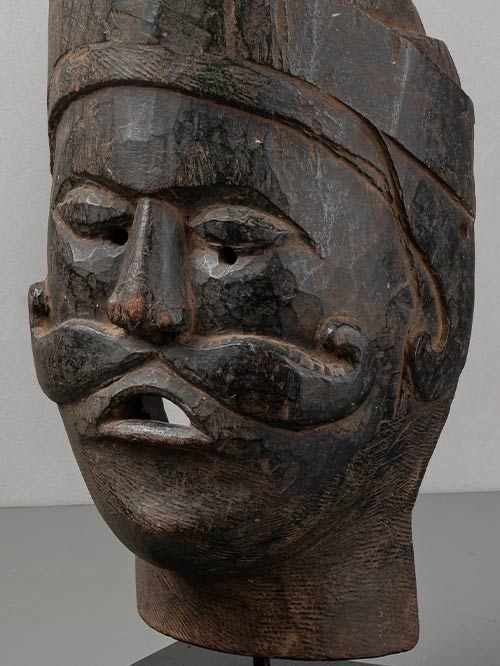
An unusual unpainted dancing mask of a male figure worn during performances by members of the Kokna tribe. The stylised face wears a tiered crown and has a prominent upturned moustache sitting over its open mouth. Tiny circular eye holes have been cut out beneath the eyes to help the dancer navigate while wearing the mask.
The Kokna are a major tribe found in Gujarat, Maharashtra, Karnataka, Rajasthan. The tribe carve masks representing mythological characters for the Bhavada festival. This festival is a combination of dance and drama, celebrated during March and April. The masks were carved from soft wood which allows an intricate detailing of various facial expressions. Modern masks are now made from Papier-mâché as they are lighter and more durable.
The characters of the tribal masks represent either deities including Vishnu, Ravana and Ganesha, ancestral spirits, totem, mythological character, animals and birds. Every dancer enacts steps typical of the character whose mask he wears, as he dances to the tune of musical instruments like the Sur, Kahali and Sambal. During the festival procession, masked dancers enact myths from tribal folklore as well as Hindu epics such as the Ramayana and Mahabharata.
Mask Size(cms): 43 (H) x 22 (W) x 15 (D), 48 (H with stand)
Mask Size(inches): 16.9 (H) x 8.7 (W) x 5.9 (D), 18.9 (H with stand)
-
Konkan region (Karnataka)
Wood with traces of polychroming
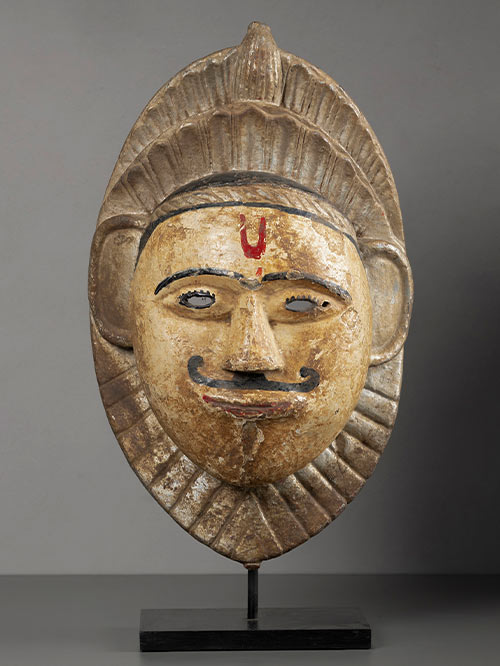
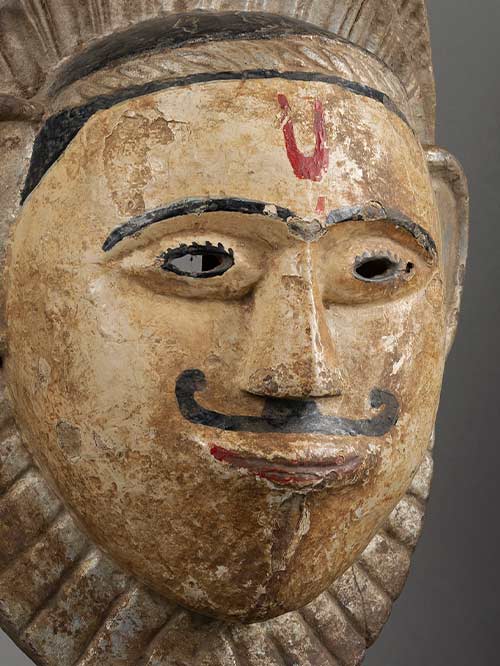
An unusual painted dancing mask with excellent patina. It has pierced eye openings, protruding ears and large upturned moustache over a simpering grin. A brilliant red Vaishnavite tilak marks his the forehead. The figure wears an extremely unusual tiered and recessed crown that encircles the head and forms a stylised beard.
The Kokna are a major tribe found in Gujarat, Maharashtra, Karnataka, Rajasthan. The tribe carve masks representing mythological characters for the Bhavada festival. This festival is a combination of dance and drama, celebrated during March and April. The masks were carved from soft wood which allows an intricate detailing of various facial expressions. Modern masks are now made from Papier-mâché as they are lighter and more durable.
The characters of the tribal masks represent either deities including Vishnu, Ravana and Ganesha, ancestral spirits, totem, mythological character, animals and birds. Every dancer enacts steps typical of the character whose mask he wears, as he dances to the tune of musical instruments like the Sur, Kahali and Sambal. During the festival procession, masked dancers enact myths from tribal folklore as well as Hindu epics such as the Ramayana and Mahabharata.
Mask Size (cms): 58 (H) x 34 (W) x 19(D), 64 (H with stand)
Mask Size (inches): 14 (H) x 8.25 (W) x 6.5 (D), 25 (H with stand)
-
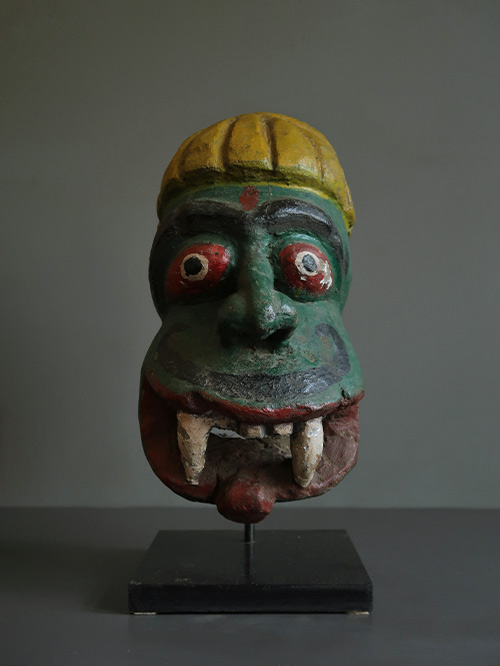
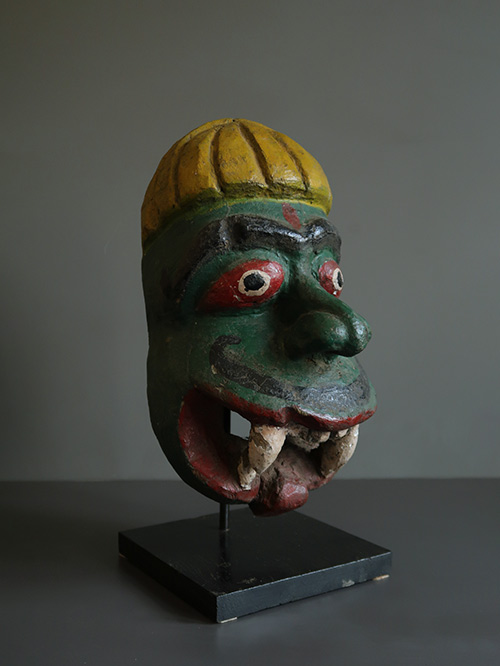
Maharashtra
wood, polychromed
Masks are very popular among the Kukanas and the Warlis of Gujarat and Maharashtra. They are used on ceremonial occasions when dramas are performed to the accompaniment of music and dance. During the festivals of Holi and Diwali mask-shows are organised by itinerant tribal artists in different villages. They serve the purpose of tribal unity and stability and to inculcate respect for tribal traditions and ancestors. When wearing a mask, the tribal artist first decides on the size of the mask—generally larger than the human face— and the fills in details. Painting on the mask is done not as part of the enrichment of the sculpture, but as a means by which the spirit is infused into the mask and thus it comes to life. Traditionally, masks were created out of fear of the natural power around them. People copied the world of animals and birds through symbols, paintings and sketches around them. The fear of the dynamism of nature within and outside, propelled them to create mask as a linkage between his world and the one unknown to him. Masks were treated as instruments of revelations- a pathway to the world of gods and other invisible powers- by giving form to the formless.
Mask Size (cms): 37 (H) x 18 (W) x 22 (D), 45 (H with stand)
Mask Size (inches): 14.6 (H) x 7 (W) x 8.7 (D), 17.7 (H with stand)
-
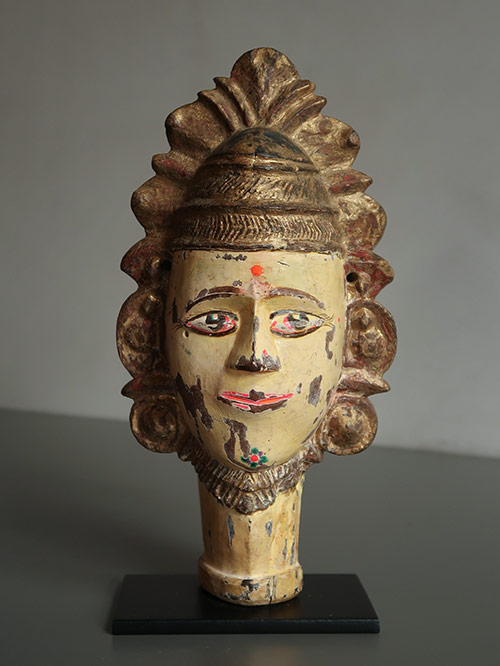
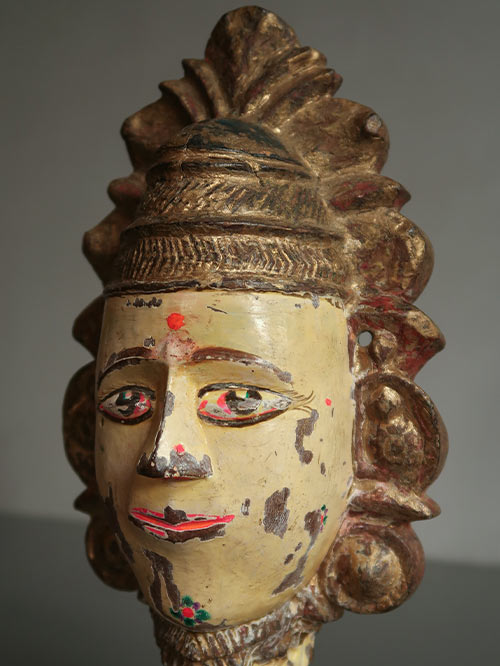
Konkan region (Karnataka)
Wood, polychromed
Gauri is the name of a benevolent goddess, consort of Shiva or Varuna. Connected with the rains, she is reputed to be the source of the world and the embodiment of motherhood. She is depicted as a two-or four-armed woman of fair complexion, carrying in her upper arms prayer beads and a water pot, while the lower hands are in Abhaya and Varadamudra. She may also carry a mirror, a fish, a lotus, a trident and a floral wreath. Her mount is the godhika (iguana). Occasionally she is shown riding either a lion, a wolf, a pig or a goose.
Size with stand (cms): 29.5(H) x 16(W) x 7.5(D)
Size with stand (inches): 11.5(H) x 6.5(W) x 3(D)
-
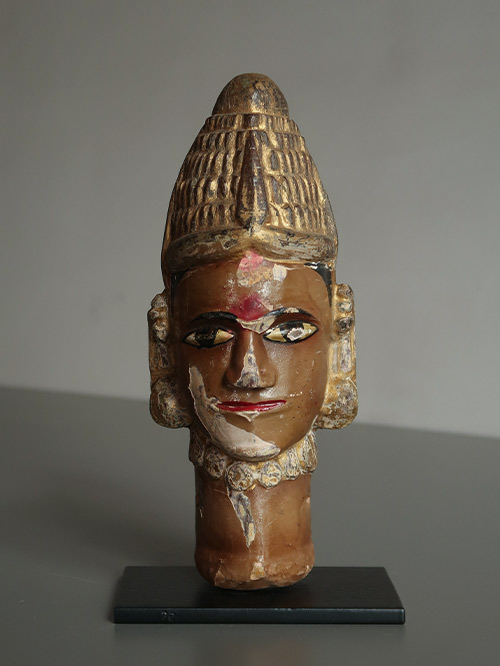
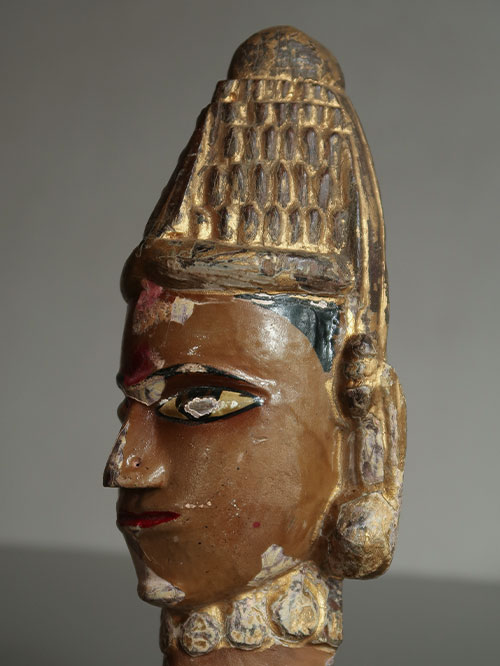
Konkan region (Karnataka)
Wood, polychromed
Gauri is the name of a benevolent goddess, consort of Shiva or Varuna. Connected with the rains, she is reputed to be the source of the world and the embodiment of motherhood. She is depicted as a two-or four-armed woman of fair complexion, carrying in her upper arms prayer beads and a water pot, while the lower hands are in Abhaya and Varadamudra. She may also carry a mirror, a fish, a lotus, a trident and a floral wreath. Her mount is the godhika (iguana). Occasionally she is shown riding either a lion, a wolf, a pig or a goose.
Size with stand (cms): 9.5(H) x 5(W) x 3(D)
Size with stand (inches): 24.5(H) x 13(W) x 7.5(D)
-
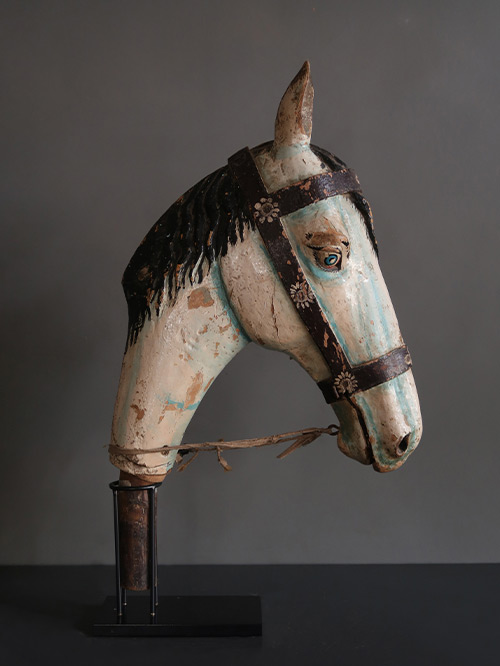
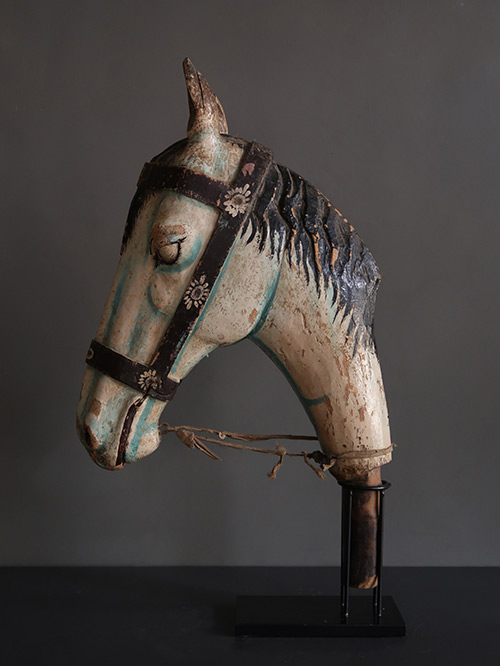
Konkan Region (Western India)
wood, polychromed
A painted wooden horse dancing mask with an articulated jaw. The head is worn through use but still shows its typical trappings.
This is a tribal dancing masks from the Konkan region used in the Perni Zagor, a folk play danced by Christian Gaud tribals. Perni Zagor is an indigenous dance-drama form of the Perni community of Goa. This is an ancient art form and is believed to have evolved on the banks of the Zuari river. It has its origins in fertility rites related to Neolithic shamanism. The dancers don wooden masks while performing the musical drama. The masks represent deities, animals, birds and demons. The characters are derived from various episodes in Hindu mythology. Perni Zagor is currently performed by only a few families in the community and is almost on the verge of extinction.
Size (cms): 77(H) x 44(W) x 17(D)
Size (inches): 30.5(H) x 17.5(W) x 6.5(D)
-
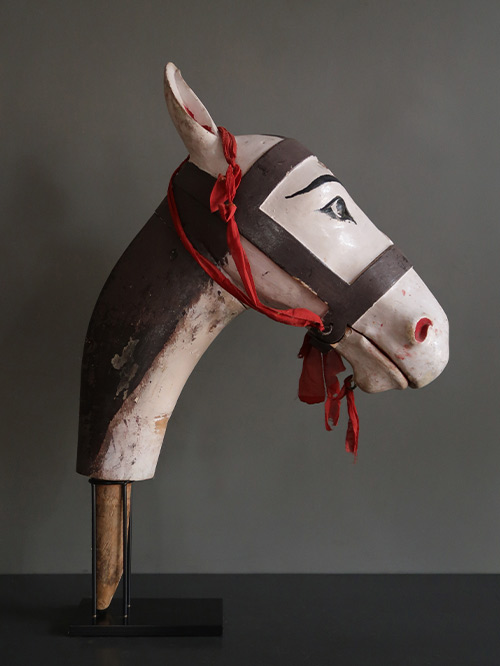
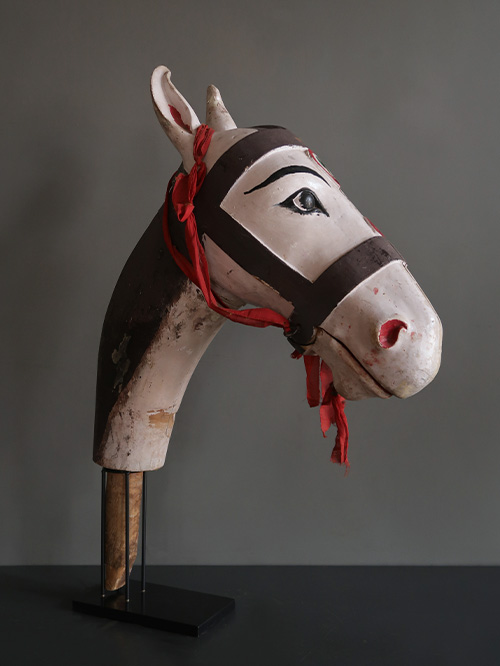
Konkan Region (Western India)
wood, polychromed
A painted wooden horse dancing mask with an articulated jaw. The head is worn through use but still shows its typical trappings.
This is a tribal dancing masks from the Konkan region used in the Perni Zagor, a folk play danced by Christian Gaud tribals. Perni Zagor is an indigenous dance-drama form of the Perni community of Goa. This is an ancient art form and is believed to have evolved on the banks of the Zuari river. It has its origins in fertility rites related to Neolithic shamanism. The dancers don wooden masks while performing the musical drama. The masks represent deities, animals, birds and demons. The characters are derived from various episodes in Hindu mythology. Perni Zagor is currently performed by only a few families in the community and is almost on the verge of extinction.
Size (cms): 86.5(H) x 57(W) x 17(D)
Size (inches): 34(H) x 22.5(W) x 6.5(D)
-
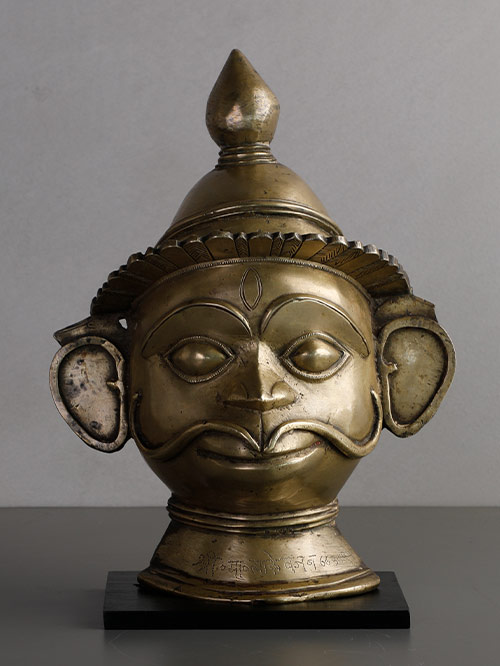
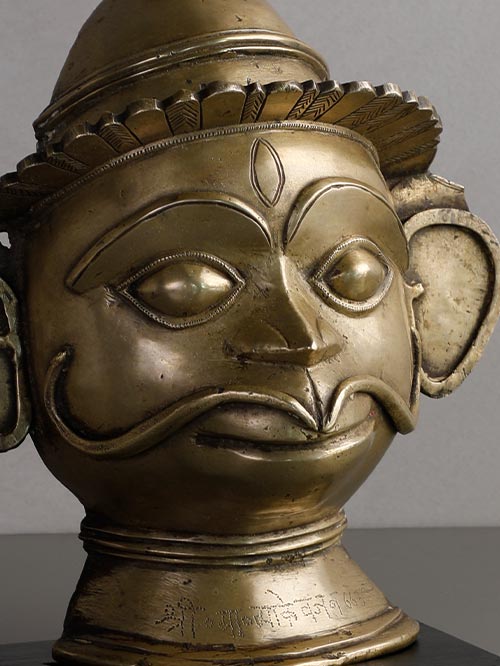
Karnataka (South India)
brass alloy
A striking Hanuman face with a protruding mouth and nose, curving moustache, bulging eyes and forehead tilaka. He wears a necklace and a rimmed and pointed crown.
Mukhavata or facial masks are two-dimensional metal castings of the crowned or turbaned heads of various deities, mostly manifestations of Shiva and Parvati. Included in this group are Khandoba, Mallanna, Gauri and Hanuman and their regional variants who are worshipped under different names.
Hindu devotees believe that when an icon is consecrated and its eyes anointed by the priest, the figure becomes a living god. In household shrines in Maharastra and Karnataka, the deity was considered a privileged house guest and treated accordingly. Images of the god were bathed, clothed, bejeweled and nourished in preparation for puja and darshan. Often elaborate turbans were placed on the head of the mukha-vata and bound by the finest cloths usually in the auspicious deep red colour. In some cases the masks were mounted on a wooden framework and covered with cloths. Sometimes separate metal cast arms and legs were attached to the figure, thus providing a more realistic depiction of the deity.
Size (cms): 35.5(H) x 26(W) x 11.5(D)
Size (inches): 14(H) x 10(W) x 4.5(D)
-

Orissa
Wood, polychromed
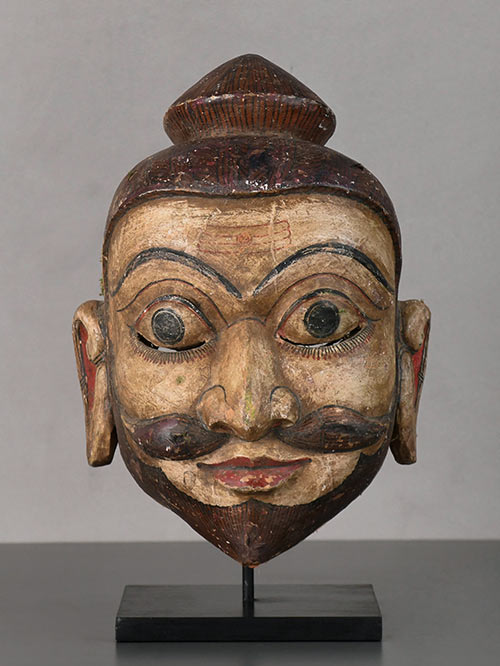
This striking festival mask unusually depicts an ascetic. The moustached and bearded ascetic wears a characteristic topknot. Exquisitely carved, the Ascetic has a serene expression with almond-shaped eyes below elegantly arched eyebrows, and his full lips form a subtle smile. A prominent Shaivite Tripundra marks his forehead. Tiny ovular slits have been cut out beneath the eyes to assist the dancer in navigating while wearing the mask.
Shahi Jatras (royal processions) of Orissa present different episodes from the Ramayana during the spring season, usually lasting for for one week. Actors, carrying huge wooden masks and gorgeous costumes, walk on the streets with stylised gait and mime with the accompaniment of loud drumming. The Desia Nata of Koraput, Orissa, also uses masks for representing gods, goddesses, animals, birds and demons. These themes are also taken from Ramayana.
Mask Size (cms): 48(H) x 33(W) x 20(D), 51(H with Stand)
Mask Size (inches): 19(H) x 13(W) x 8(D), 20(H with Stand)
-
Orissa
Wood, polychromed
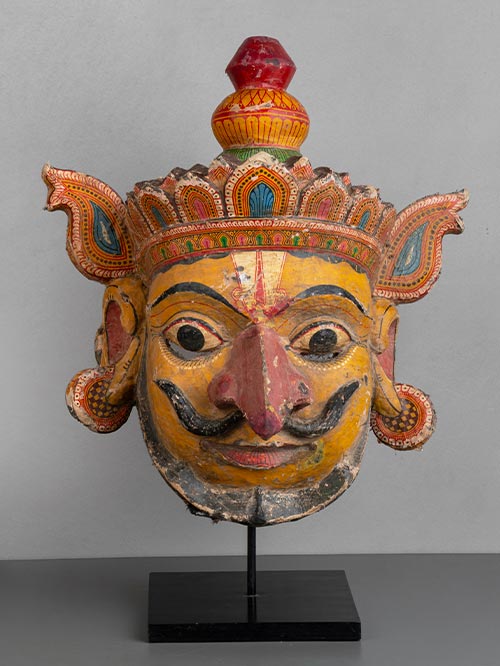
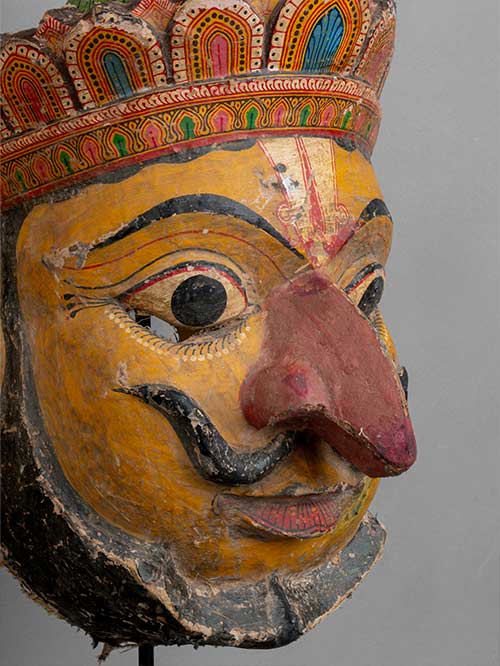
A magnificent and rare Ramlila festival mask from Orissa, in excellent condition with original colour and patina. Notable features include a Vaishnavite tilak (mark), a tiered crown with geometric and floral motifs and an upturned moustache emanating from a large beaked nose. Two large earrings with decorative swirls hang from his elongated ears and tiny ovular slits have been cut out beneath the eyes to help the dancer navigate while wearing the mask.
Garuda is often shown as the mount of Vishnu. He was originally (in the Rig Veda) regarded as the sun in the form of a bird but this association was taken over by Surya. His earliest appearance in Indian sculpture was as a mythical bird forming part of the animal kingdom paying homage to the Buddha. The necessity of emphasising its mythological aspect resulted in characteristic distortions of its form combining sometimes a parrot like beak and human elements and wearing ear-rings. By the end of the Pallava period the bird element in his appearance had shrunk to a beak-like nose and wings attached to an otherwise human body. In this form he is usually shown with two hands (often in anjali mudra).
Shahi Jatras (royal processions) of Orissa present different episodes from the Ramayana during the spring season, usually lasting for for one week. Actors, carrying huge wooden masks and gorgeous costumes, walk on the streets with stylized gait and mime with the accompaniment of loud drumming. The Desia Nata of Koraput, Orissa, also uses masks for representing gods, goddesses, animals, birds and demons. These themes are also taken from Ramayana.
Mask Size (cms): 55(H) x 48(W) x 28(D), 66(H with stand)
Mask Size (inches): 21.5(H) x 19(W) x 11(D), 26(H with stand)
-

Cheriyal, Warangal (Telangana)
Pigment painting and lacquer on cloth and wood
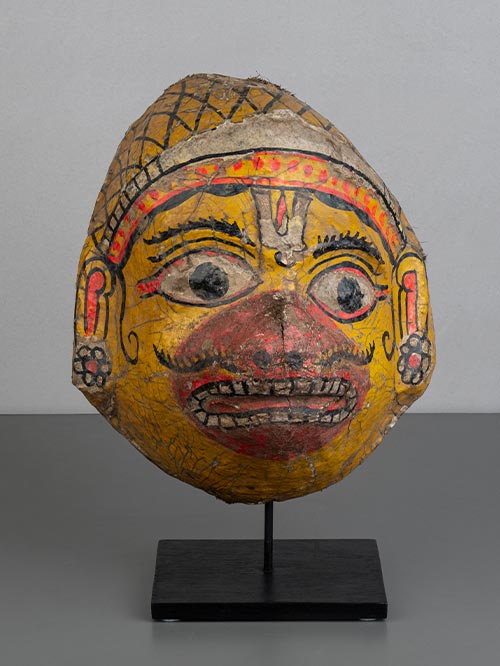
This decorative mask depicts Hanuman, who is a popular deity who is worshipped all over India. This mask would have been a part of a set employed in the narration of myths and legends by the Yadavs or Dhangars, a community which is generally pastoral. These itinerant performers traveled from village to village, providing a welcome storytelling break for farmers. Their performances allowed marginalized castes to hear tales of the gods. They commissioned painted cloth panels, models, and masks from Cheriyal scroll painters to aid their storytelling.
Cheriyal masks, typically made from Ankudu wood and sawdust, undergo an intricate crafting process. The wood is shaped, smoothed, and treated with khadi cotton mixed with rice starch, white mud, tamarind seed paste, and gum water. Artists then sketch and paint using natural dyes. After drying, a lacquer layer is applied for a glossy finish and paint protection
Mask Size (cms): 30(H) x 15.5(W) x 20(D), 37(H with stand)
Mask Size (inches): 12(H) x 6(W) x 8(D), 14.5(H with stand)
-

Orissa
Wood, polychromed
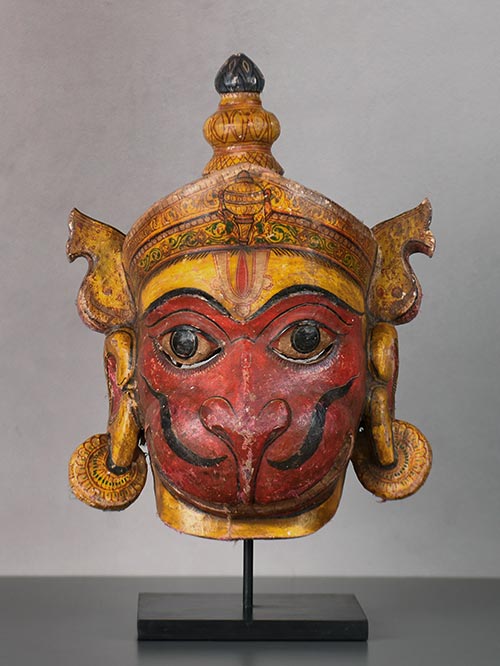
A decorative Hanuman festival mask from Orissa in good condition, retaining its original color and patina. The mask features a tiered crown, intricately detailed and painted, with a pair of makaras on either edge. At the center of the crown, amidst floral and geometric decorations, is a painted mace, Hanuman’s weapon of choice. The mask is marked with a prominent Vaishnavite tilak on Hanuman’s forehead. The anthropomorphic Hanuman is depicted with a prominent mandrill, rows of exposed teeth, and a long curling moustache. Tiny ovular slits beneath the eyes facilitate navigation for the dancer while wearing the mask.
Hanuman is a popular deity who is worshipped all over India, particularly in villages and in the South. His story is found in the Ramayana where he is the ubiquitous servant of Rama, the epitome of devoted service and loyalty. His search for the heroine Sita, captured by Ravana, illustrates his superhuman powers and zealous performance of the tasks that were given to him.
Shahi Jatras (royal processions) of Orissa present different episodes from the Ramayana during the spring season, usually lasting for for one week. Actors, carrying huge wooden masks and gorgeous costumes, walk on the streets with stylized gait and mime with the accompaniment of loud drumming. The Desia Nata of Koraput, Orissa, also uses masks for representing gods, goddesses, animals, birds and demons. These themes are also taken from Ramayana.
Mask Size (cms): 51(H) x 38(W) x 20(D), 58.5(H with Stand)
Mask Size (inches): 20(H) x 15(W) x 8(D), 23(H with Stand)
-

Cheriyal, Warangal (Telangana)
Pigment painting and lacquer on cloth and wood
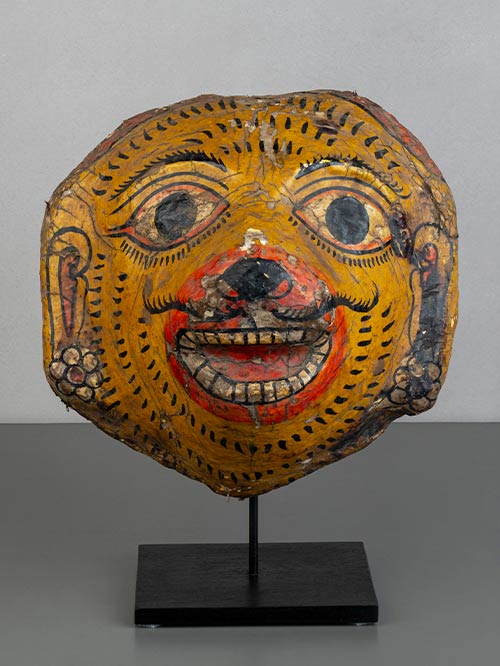
This decorative mask depicts Jambavan, the King of the bears and an ally of Lord Rama in the battle of Lanka. This mask would have been a part of a set employed in the narration of myths and legends by the Yadavs or Dhangars, a community which is generally pastoral. These itinerant performers traveled from village to village, providing a welcome storytelling break for farmers. Their performances allowed marginalized castes to hear tales of the gods. They commissioned painted cloth panels, models, and masks from Cheriyal scroll painters to aid their storytelling.
Cheriyal masks, typically made from Ankudu wood and sawdust, undergo an intricate crafting process. The wood is shaped, smoothed, and treated with khadi cotton mixed with rice starch, white mud, tamarind seed paste, and gum water. Artists then sketch and paint using natural dyes. After drying, a lacquer layer is applied for a glossy finish and paint protection
Mask Size (cms): 28(H) x 18(W) x 21(D), 34(H with stand)
Mask Size (inches): 11(H) x 7(W) x 8.5(D), 13.5(H with stand)
-
Orissa
Wood, polychromed
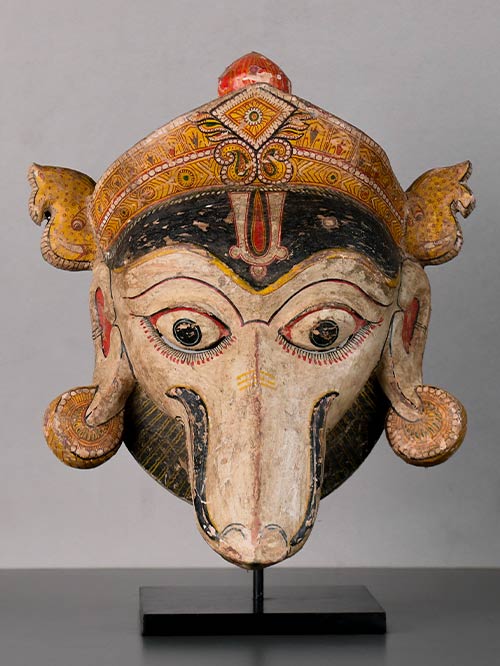
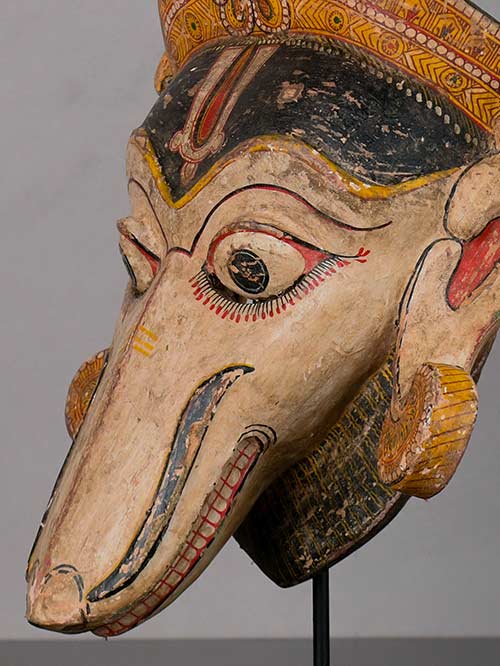
This delicately painted dancing mask of Jambavan. Jambavan was the King of the bears and an ally of Lord Rama in the battle of Lanka His wears an elaborate painted crown and a pairs of ear ornaments. A prominent vaishnavite naman adorns his forehead and his elongated curly moustache runs along his snout. The mask would have been used during folk performances of the Ramalila in Orissa.
Shahi Jatras (royal processions) of Orissa present different episodes from the Ramayana during the spring season, usually lasting for for one week. Actors, carrying huge wooden masks and gorgeous costumes, walk on the streets with stylised gait and mime with the accompaniment of loud drumming. The Desia Nata of Koraput, Orissa, also uses masks for representing gods, goddesses, animals, birds and demons. These themes are also taken from Ramayana.
Mask Size (cms): 54.6(H) x 45.7(W) x 26(D)
Mask Size (inches): 21.5(H) x 18(W) x 10(D)
-
Kerala
Wood, polychromed
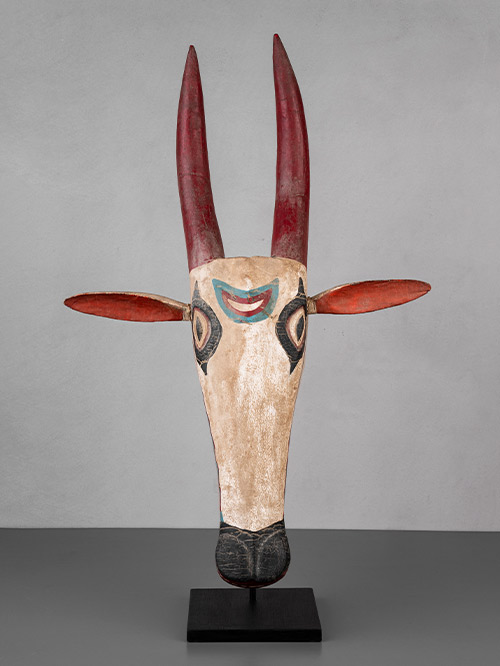
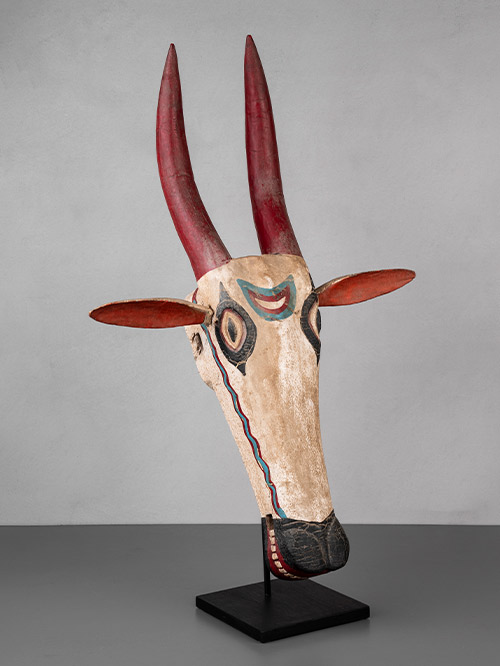
A finely painted Nandi festival head.
These heads are used in bull festivals known as kala velas. Bull festivals originated out of people’s desire to keep their bulls, bullocks and oxen healthy as they were used for ploughing and other work. In a society whose well-being was linked to good and bountiful crops and who therefore sought the benevolence of nature, these animals played a major role. The idea was to make an offering of them to their local deity- Bhagavathi. Their importance can be realised by the fact that at Mulayankavu there are forty pairs of these effigies at both the main festival in the Malayalam month of Medam (mid-April to mid-May) and their other festival in Meenam (mid-March to mid-April). The difference is that in Meenam there are also eleven single bullocks belonging to particular families in the area. These festivals are exclusive to the region of northern Kerala known as Valluvanad, formerly a small kingdom.
Mask Size (cms): 86.5(H) x 59(W) x 14(D), 92.5 (H with stand)
Mask Size (inches): 34(H) x 23(W) x 5.5(D), 36.5 (H with stand)
-

Orissa
Wood, traces of polychroming
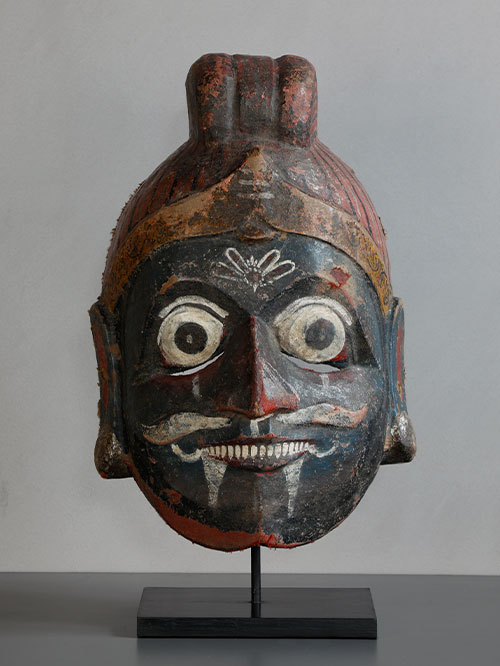
An impressive Rakshasa mask painted with bulging eyes and a fanged mouth. His hair is tied in the characteristic topknot worn by Rishis indicating that the demon is in a disguised form to lure in unsuspecting victims. This mask would have been used during folk reenactments of the Ramlila in Orissa.
‘Rakshasa or demon is a generic term for a malevolent spirit. The Rakshasas roam at night, preferably in the dark half of the month or on the night of the new moon, assuming many forms at will. They were powerful warriors, expert magicians and illusionists. As shape-changers, they could assume various physical forms, and it was not always clear whether they had a true or natural form.
Shahi Jatras (royal processions) of Orissa present different episodes from the Ramayana during the spring season, usually lasting for for one week. Actors, carrying huge wooden masks and gorgeous costumes, walk on the streets with stylized gait and mime with the accompaniment of loud drumming. The Desia Nata of Koraput, Orissa, also uses masks for representing gods, goddesses, animals, birds and demons. These themes are also taken from Ramayana.
Size(cms): 49.5H) x 33(W) x 23(D), 56(H with stand)
Size(inches): 19.5(H) x 13(W) x 9(D), 22(H with stand)