“Dipalakshmi” has been added to your cart.
View cart
-
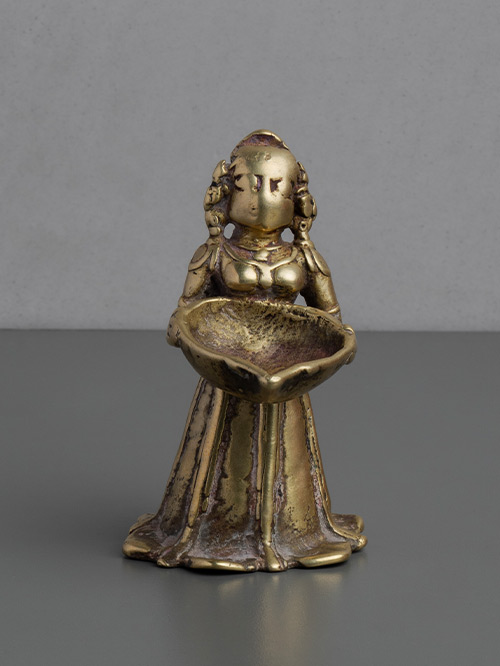
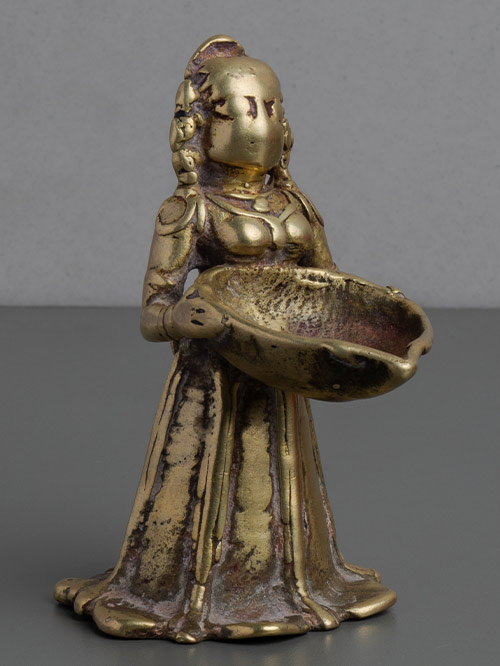
Karnataka
Brass alloy
This attractive and patinated Lakshmi of diminutive proportions stands proudly, holding a deep reservoir burner in her outstretched hands. She wears a long, flowing skirt that touches the floor. Her features, once delicately carved, have been partially worn by years of ritual use. Her hair is tied in a long braid that hangs along her back.
Dipalakshmi or Deepalakshmi is identifiable with Lakshmi, the Goddess of light and wealth. Dipalakshmi is usually shown holding the lamp bowl in her hands cupped in the gesture of anjali or offering of the flame of ‘divine light’ which, when lit kindles light into the image. The lamp is conceived as the vehicle through which the divine can be accessed. Lamps are used in rituals within the domestic realm, as well as religious or temple settings, in order to propitiate the gods.
Size (cms): 9.5(H) x 6(W) x 7.5(D)
Size (inches): 3.5(H) x 2.5(W) x 3(D)
-
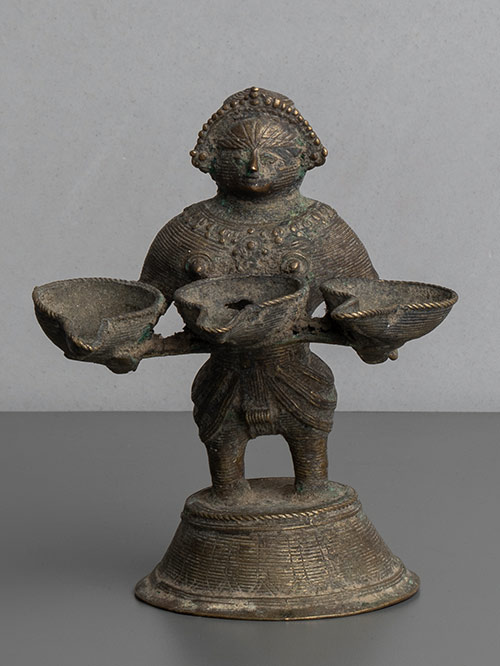
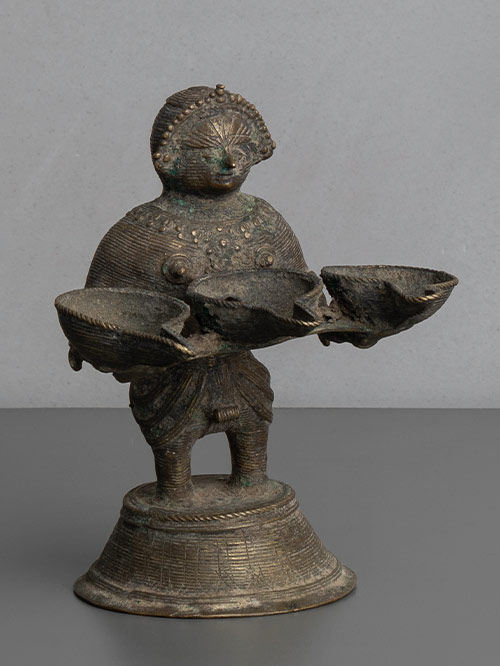
Bastar (Chhattisgarh, Central India)
Brass, Dokra work
An unusual Dipalakshmi lamp from the Bastar region, in the form of a female figure standing holding three teardrop-shaped lamp bowls in her hands. The fine cross-hatching and details are typical of Bastar casting. Dipalakshmi, the Goddess of light and wealth, is usually shown holding the lamp bowl in her hands cupped in the gesture of anjali or offering of the flame of ‘divine light’ which, when lit, kindles light into the image.
Dhokra is non–ferrous metal casting using the lost-wax casting technique. This sort of metal casting has been used in India for over 4,000 years and is still used. One of the earliest known lost wax artefacts is the dancing girl of Mohenjo-Daro. The product of dhokra artisans is in great demand in domestic and foreign markets because of primitive simplicity, enchanting folk motifs and forceful form. Dhokra horses, elephants, peacocks, owls, religious images, measuring bowls, and lamp caskets, etc., are highly appreciated.
Size (cms): 14(H) x 12(W) x 12.5(D)
Size (inches): 5.5(H) x 4.5(W) x 5(D)
-
Bastar (Chhattisgarh, Central India)
Brass, Dokra work
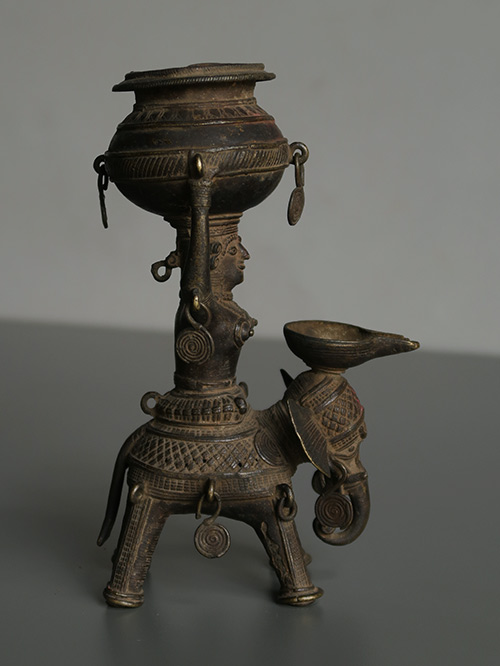
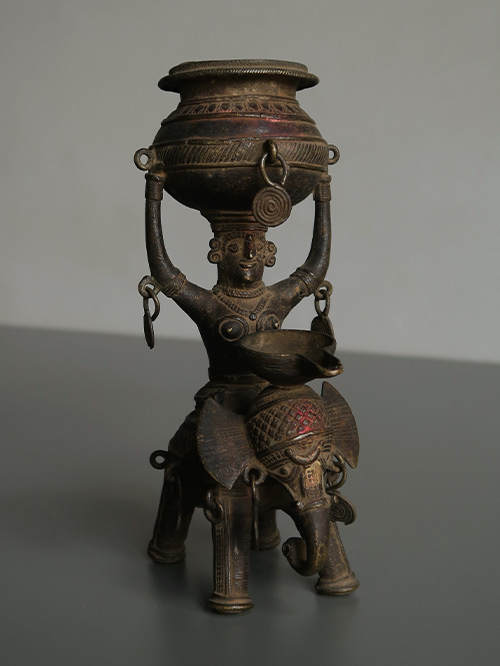
An oil lamp depicting Panchdipa, the Goddess of Light who is depicted riding an elephant and bearing a kalasha, or pitcher for oil, on her head. The Goddess and elephant also provide support to a singular oil burner. The fine cross-hatching and details are typical of Bastar casting.
Dhokra is non–ferrous metal casting using the lost-wax casting technique. This sort of metal casting has been used in India for over 4,000 years and is still used. One of the earliest known lost wax artefacts is the dancing girl of Mohenjo-Daro. The product of dhokra artisans is in great demand in domestic and foreign markets because of primitive simplicity, enchanting folk motifs and forceful form. Dhokra horses, elephants, peacocks, owls, religious images, measuring bowls, and lamp caskets, etc., are highly appreciated.
Size (cms): 20(H) x 12.5(W) x 8.3(D)
Size (inches): 8(H) x 5(W) x 3.5(D)
-
Bastar (Chhattisgarh, Central India)
Brass, Dokra work
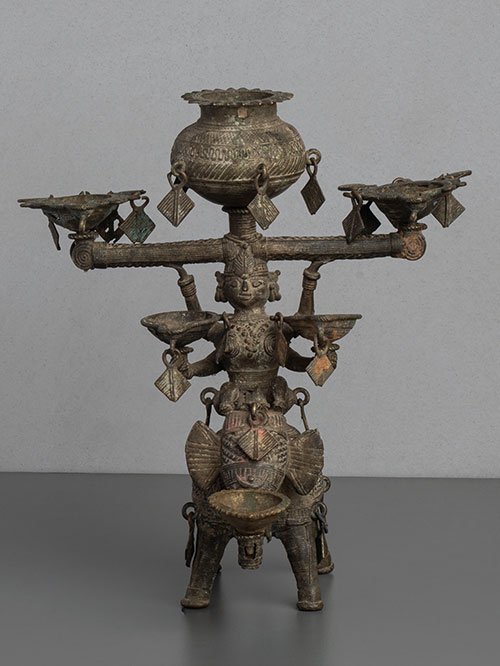
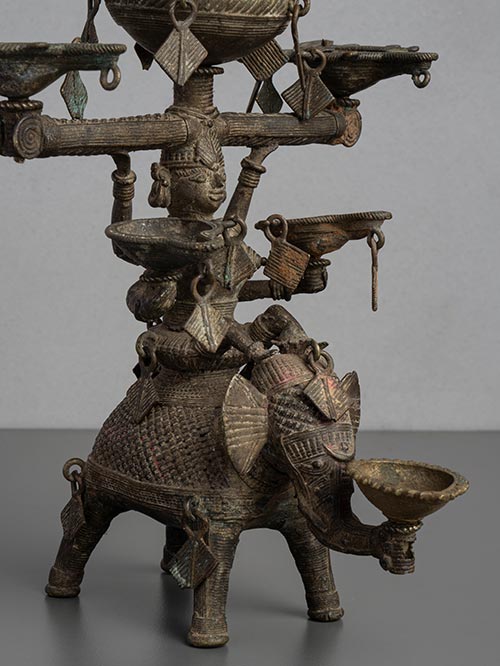
An oil lamp depicting Panchdipa, the Goddess of Light who is depicted riding an elephant and bearing a kalasha, or pitcher for oil, on her head. The Goddess also provides support to four oil burners and the elephant holds an additional burner with his trunk. The fine cross-hatching and details are typical of Bastar casting.
Dhokra is non–ferrous metal casting using the lost-wax casting technique. This sort of metal casting has been used in India for over 4,000 years and is still used. One of the earliest known lost wax artefacts is the dancing girl of Mohenjo-Daro. The product of dhokra artisans is in great demand in domestic and foreign markets because of primitive simplicity, enchanting folk motifs and forceful form. Dhokra horses, elephants, peacocks, owls, religious images, measuring bowls, and lamp caskets, etc., are highly appreciated.
Size (cms): 23(H) x 21(W) x 17(D)
Size (inches): 9(H) x 8.5(W) x 6.5(D)