“Nanuk-Punthys by Solvyns” has been added to your cart.
View cart
-
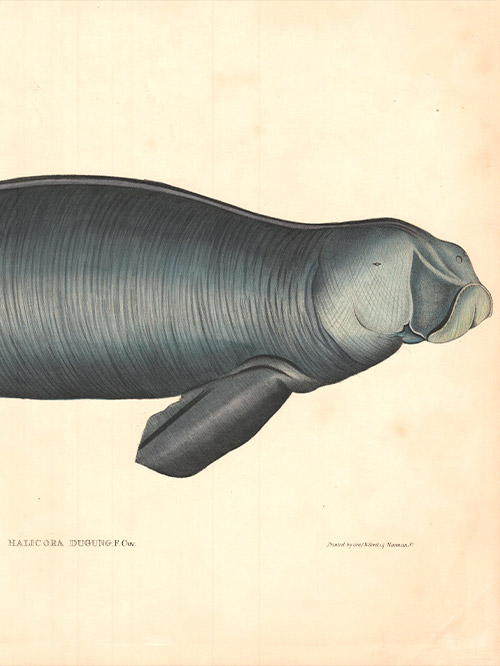

by John Edward Gray’s
From ‘Illustrations of Indian Zoology’
original hand coloured lithograph
Captioned ‘Indian Dugong. Halicora Dugung‘
John Edward Gray of the British Museum had collaborated with Maj.-Gen. Hardwicke in producing Illustrations of Indian Zoology between 1830 and 1834. He was also the author of several major illustrated works on natural history and commissioned the best artists and printers of the day to illustrate his work. The Illustrations of Indian Zoology is his major work, dedicated to the East India Company, and with the striking plates of bird and animal life in the sub-continent drawn by Waterhouse Hawkins, the noted sporting artist.
Maj.-Gen. Thomas Hardwicke of the Bengal Artillery whilst serving in India from 1778 to 1823 assembled a truly impressive collection of natural history drawings by Indian and European artists whom he engaged to draw flora and fauna. On his retirement he brought the collection with him to England and a thousand of these in many volumes are now in the British library and in the British Museum (Natural History). Bird portraiture predominates in Illustrations of Indian Zoology with a token representation of mammals, reptiles and fishes.
Size (cms): 34 (H) x 48 (L)
Size (inches): 13.5 (H) x 19 (L)
-
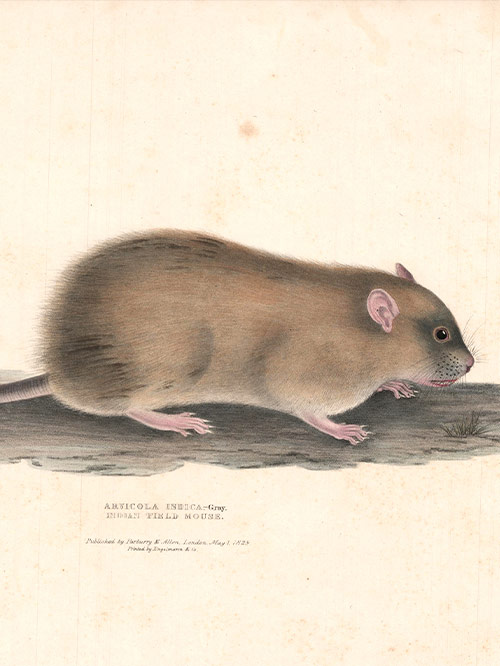

by John Edward Gray’s
From ‘Illustrations of Indian Zoology’
original hand coloured lithograph
Captioned ‘Ahvicola Indica. Indian Field Mouse.’
John Edward Gray of the British Museum had collaborated with Maj.-Gen. Hardwicke in producing Illustrations of Indian Zoology between 1830 and 1834. He was also the author of several major illustrated works on natural history and commissioned the best artists and printers of the day to illustrate his work. The Illustrations of Indian Zoology is his major work, dedicated to the East India Company, and with the striking plates of bird and animal life in the sub-continent drawn by Waterhouse Hawkins, the noted sporting artist.
Maj.-Gen. Thomas Hardwicke of the Bengal Artillery whilst serving in India from 1778 to 1823 assembled a truly impressive collection of natural history drawings by Indian and European artists whom he engaged to draw flora and fauna. On his retirement he brought the collection with him to England and a thousand of these in many volumes are now in the British library and in the British Museum (Natural History). Bird portraiture predominates in Illustrations of Indian Zoology with a token representation of mammals, reptiles and fishes.
Size (cms): 34 (H) x 48 (L)
Size (inches): 13.5 (H) x 19 (L)
-
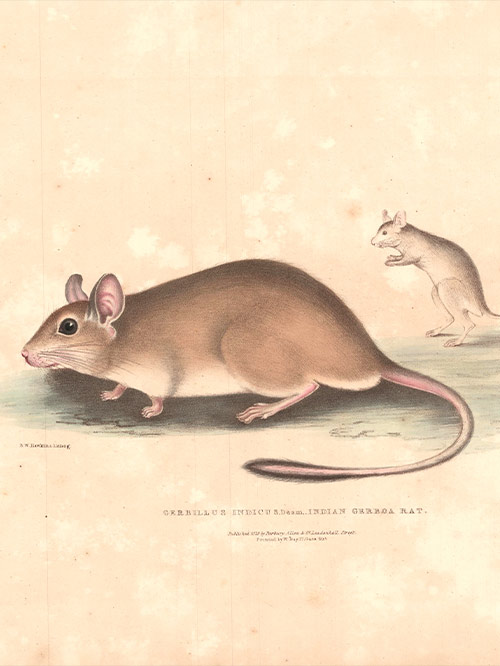

by John Edward Gray’s
From ‘Illustrations of Indian Zoology’
original hand coloured lithograph
Captioned ‘Gerbillus Indicus. Indian Gerboa Rat‘
John Edward Gray of the British Museum had collaborated with Maj.-Gen. Hardwicke in producing Illustrations of Indian Zoology between 1830 and 1834. He was also the author of several major illustrated works on natural history and commissioned the best artists and printers of the day to illustrate his work. The Illustrations of Indian Zoology is his major work, dedicated to the East India Company, and with the striking plates of bird and animal life in the sub-continent drawn by Waterhouse Hawkins, the noted sporting artist.
Maj.-Gen. Thomas Hardwicke of the Bengal Artillery whilst serving in India from 1778 to 1823 assembled a truly impressive collection of natural history drawings by Indian and European artists whom he engaged to draw flora and fauna. On his retirement he brought the collection with him to England and a thousand of these in many volumes are now in the British library and in the British Museum (Natural History). Bird portraiture predominates in Illustrations of Indian Zoology with a token representation of mammals, reptiles and fishes.
Size (cms): 34 (H) x 48 (L)
Size (inches): 13.5 (H) x 19 (L)
-
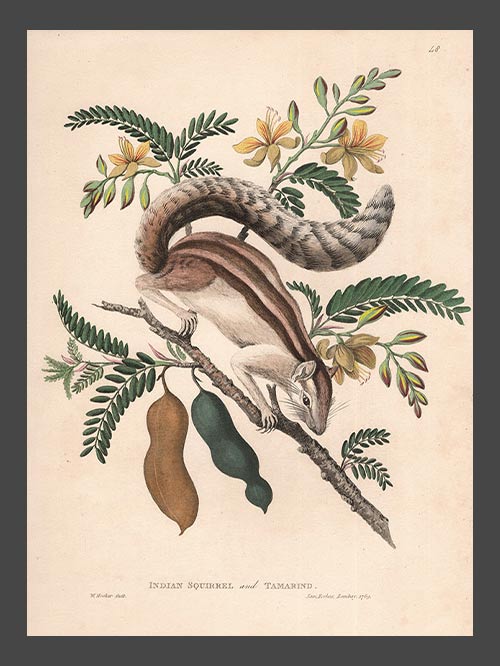
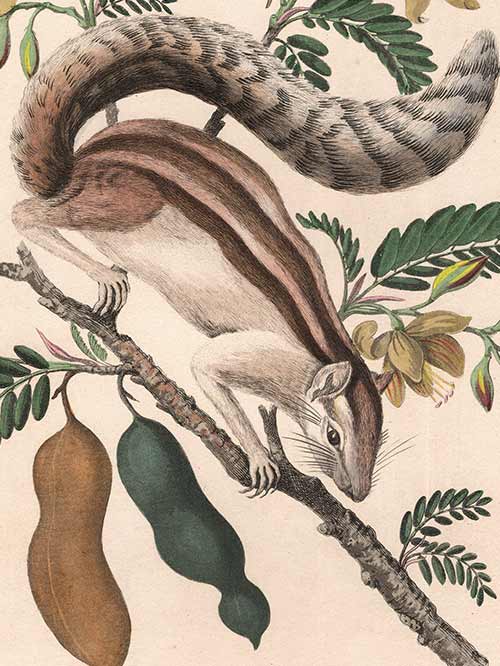
by William Hooker after James Forbes⠀
original hand coloured aquatint
Captioned ‘Indian Squirrel and Tamarind’
Forbes arrived in Bombay in 1766 as a Writer in the East India Company and spent his first five years in Bombay, living in the Fort area. At that time Bombay was developing as the premier port and commercial centre on the west coast and there were many oppoIntunities for young Company servants stationed there. The marshland between the seven islands was being filled up and eventually the islands were joined to form the Bombay peninsula. Forbes was adventurous and independent. He was an amateur artist, who sketched the Indian environment with no other training, as he himself stated, except encouragement from his friends. Forbes lived in India for 17 years after which he produced his Oriental Memoirs. Its narrative was based on a series of his letters from India and the contents of about 150 notebooks, which returned to England with him. William Hooker was a botanist and executed the superb natural history plates for James Forbes monumental work on Western India, ‘Oriental Memoirs’, in 1812.
Size (cms): 30 (H) x 23.5 (L)
Size (inches): 12 (H) x 9.5 (L)
-
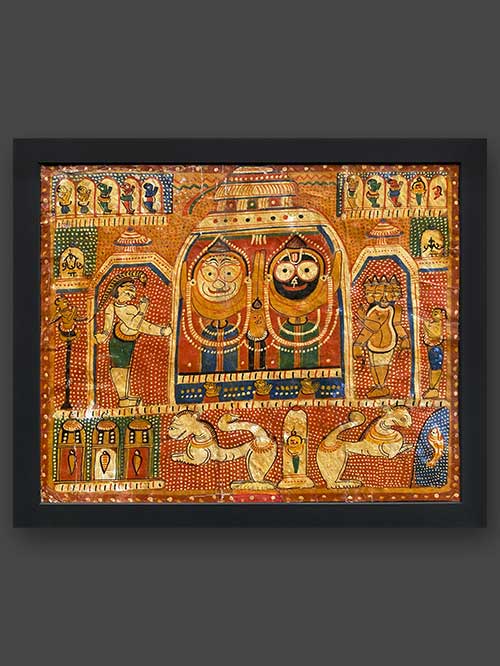
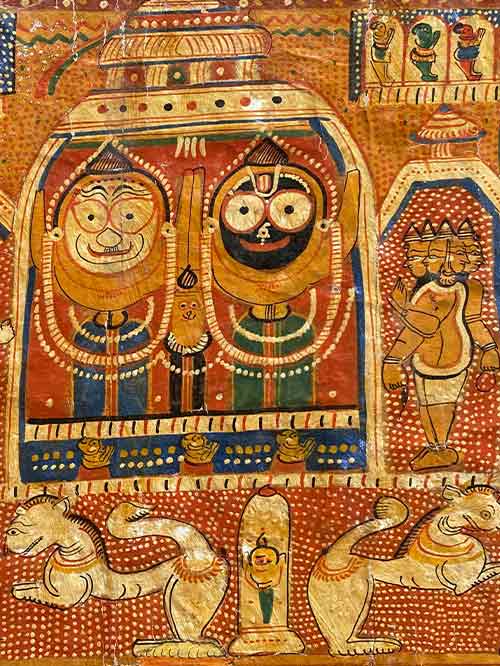
Orissa, Puri district
Gouache and lacquer on cotton cloth
The Jagannatha temple complex dominates the diagram, featuring the central shrine within a towering shikhara. Two male figures, Jagannatha and Balabhadra, are depicted dancing with raised yellow wing-like ‘arms’, while the female Subhadra stands between them. Below the central shrine, panels show priests with hands joined in prayer. To the left of the central trio is Shiva, portrayed in white with a serpent crown, also in a prayerful pose. On the right, multi-headed Brahma is depicted, offering reverence to the central deities. At the base of the temple, a pair of leogryphs forms the Lion Gate, with a small image of Jagannatha enclosed in a shrine inbetween. Flanking the temple shikhara at the top are the ten avatars of Vishnu, with Jagannatha replacing Buddha as the ninth avatar.
Puri painting, one of India’s oldest popular iconic traditions, is associated with the regional cult of Jagannatha, a manifestation of the god Vishnu, and with the ancient pilgrimage centre of Puri in Orissa on the eastern coast of India on the Bay of Bengal, where the cult took hold. The painting tradition evolved to serve the cult, with painters playing an important role. This type of painting was produced for pilgrims to carry home for display and private worship of the Jagannatha trinity. The image also provides pilgrims with a visual aid to remembering and renewing the entire pilgrimage experience, that is, visiting not only Jagannatha temple but also other shrines in the environs and being present for various daily or festival ritual activities.
Size (cms): 33.5(H) x 41(W)
Size (inches): 13(H) x 16(W)
-
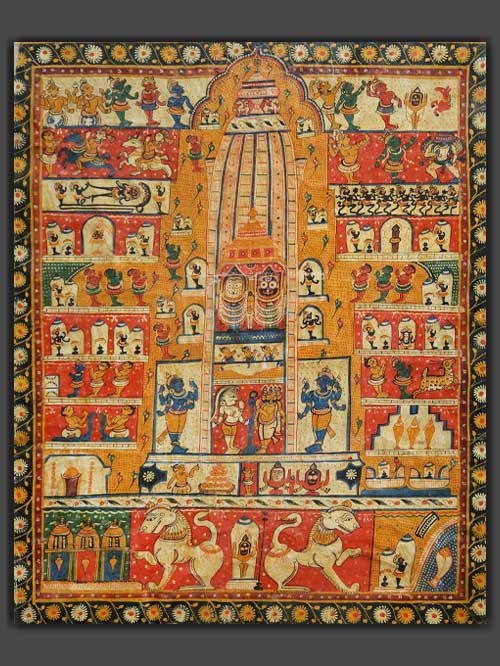
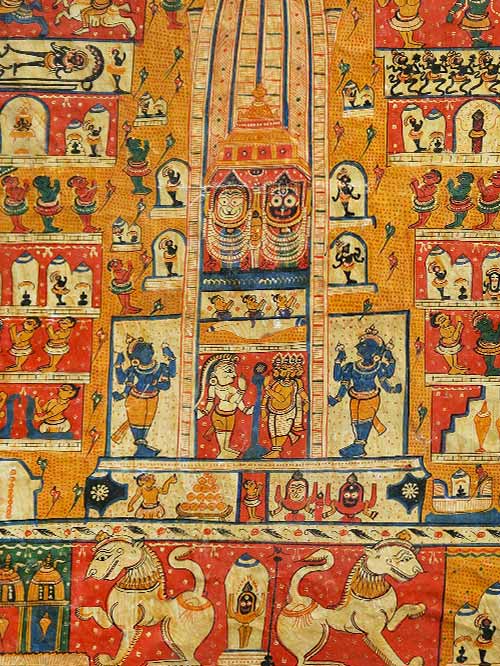
Orissa, Puri district
Opaque water-based pigments and lacquer on cotton cloth
This exceptional, large pilgrimage pattachitra depicts the Puri temple complex, sacred sites in the temple town and mythological themes and scenes. The Jagannatha temple complex dominates the diagram, showing the central shrine midway up a slender shikhara or tower. The two male figures, Jagannatha and Balabhadra are shown dancing with raised yellow wing-like ‘arms’ and the female Subhadra standing between them. Within the temple complex are a variety of small shrines. A pair of prancing leogryphs form the Lions Gate at the bottom of the temple structure. The other sacred sites and shrines in Puri which are divided into registers, are illustrated on either side of the temple compound. These include a temple dedicated to Shiva and Brahma. Also illustrated are many mythological themes related to the god Vishnu, including his ten incarnations (dashavatara) arranged in a line above the sanctuary. Shown in a panel at the top left are Jagannatha and Balabhadra on horseback being given curds by the milkmaid Manika as they ride to the aid of the Raja of Puri. On the right is the hero Rama, another avatar of Vishnu, and his brother Lakshmana defeating the demon Ravana.
Puri painting, one of India’s oldest popular iconic traditions, is associated with the regional following of Jagannatha, a manifestation of the god Vishnu, and with the ancient pilgrimage centre of Puri in Orissa on the eastern coast of India on the Bay of Bengal, where the cult took hold. The cult evolved from a synthesis of local tribal gods and Hindu deities worshipped today as Jagannatha, Balabhadra, and Subhadra. Jagannatha, literally meaning “Lord of the World” is a form of Krishna, the eighth incarnation of Vishnu. Balabhadra is Balarama, the seventh incarnation of Vishnu and Subhadra is Krishna’s sister. The painting tradition evolved to serve the cult, with painters playing an important role by performing certain tasks at particular times in the elaborate cycle of rituals.
Size (cms): 54.6(H) x 43.2(W)
Size (inches): 21.5(H) x 17(W)
-
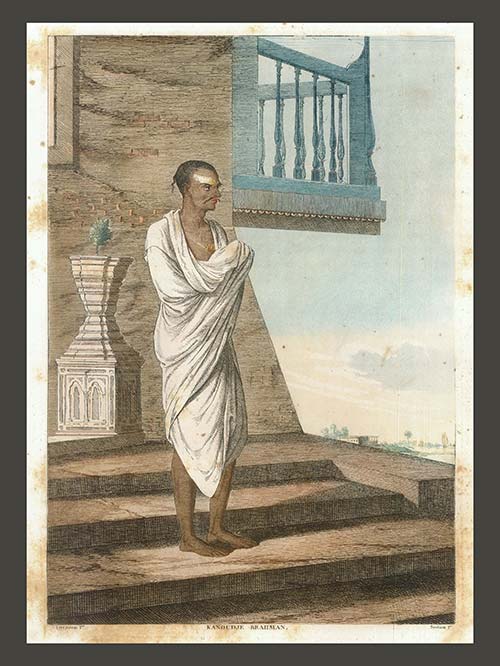
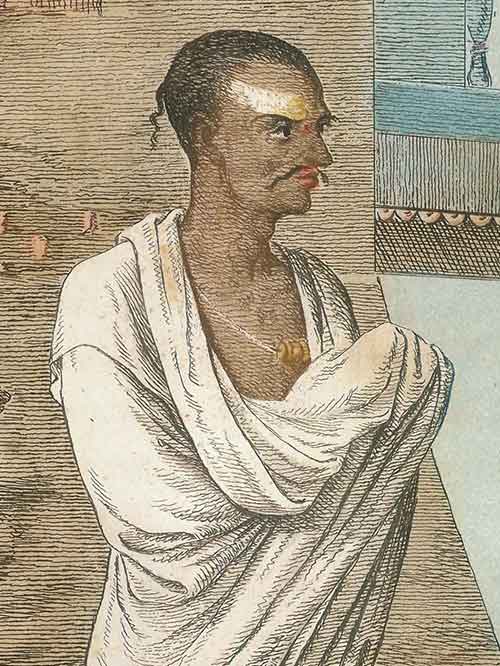
by Francois-Balthazar Solvyns (1760-1824)
Original coloured etching
from Les Hindous
Pub. Paris
Frans Balthazar Solvyns, was a skilled engraver and painter hailing from Antwerp, embarked on a transformative journey to India in 1790. Settling in Calcutta, Solvyns immersed himself in the intricacies of Indian life, studying Hindi and forging relationships with Brahmins and pundits. Inspired by his surroundings, he commenced his ambitious project in 1791, aiming to depict the diverse facets of Indian society, from occupations to customs which he published in a series of engravings. Despite its sensitive portrayal, the venture encountered little success initially, prompting Solvyns’ departure from India in 1803. However, his legacy endured through subsequent publications, notably “The Costume of Hindoostan” and the expanded edition of “Les Hindous,” offering an intimate and detailed glimpse into 18th-century Indian life across professions, festivals, and daily rituals, immortalising a unique historical moment with both reverence and curiosity.
Image Size (cms): 35(H) x 24(W)
Image Size (inches): 14(H) x 9.5(W)
Mount Size (cms): 51(H) x 41(W)
Mount Size (inches): 20(H) x 16(W)
-
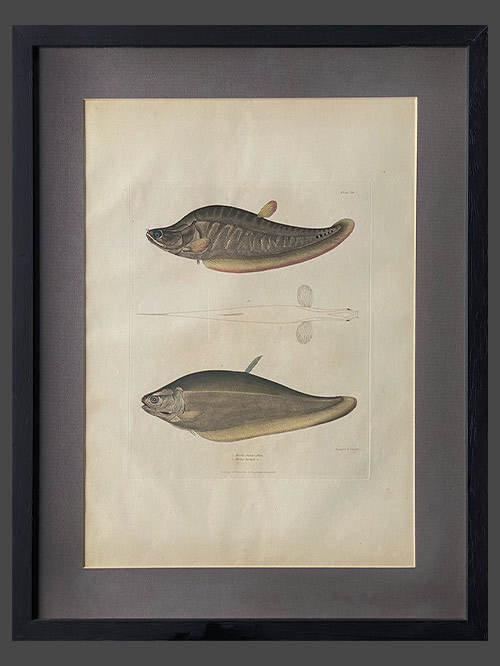
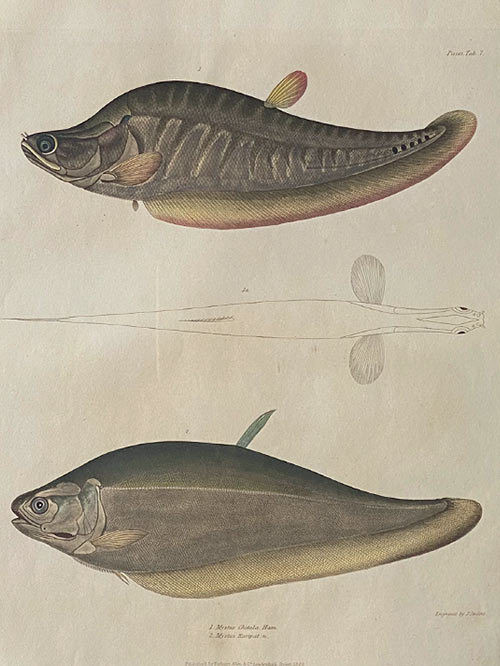
by John Edward Gray
from Illustrations of Indian Zoology
original hand coloured lithograph
Captioned ‘1. Mystus Chitala; 2. Mystus Kapirat ‘
John Edward Gray of the British Museum had collaborated with Maj.-Gen. Hardwicke in producing Illustrations of Indian Zoology between 1830 and 1834. He was also the author of several major illustrated works on natural history and commissioned the best artists and printers of the day to illustrate his work. The Illustrations of Indian Zoology is his major work, dedicated to the East India Company, and with the striking plates of bird and animal life in the sub-continent drawn by Waterhouse Hawkins, the noted sporting artist. The subscription amounted to thirty-nine home and thirteen foreign.
Size framed (cms): 56.5 (H) x 44 (W)
Size framed (inches): 22 (H) x 17.5 (W)
-
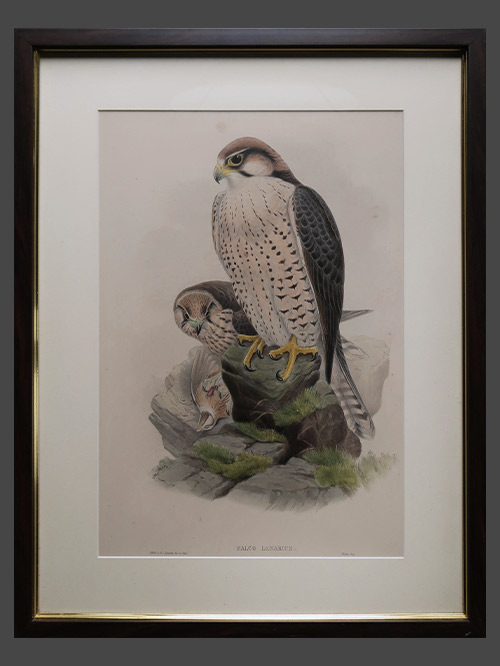
by John Gould and H.C.Richter
from ‘Birds of Asia’
original hand coloured lithograph
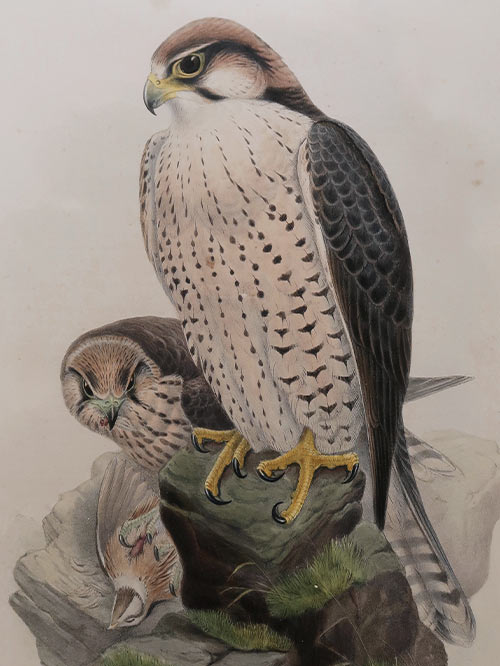
The Lanner falcon (Falco Lanarius) breeds in Africa, southeast Europe and just into Asia. A large falcon, it preys on birds and bats. It is also bred in captivity for falconry. They have a dark grey to bluish plumage with a lighter underside generally streaked with brown. The Lanner Falcon has a characteristic dashing moustache in the form of dark streaks down both cheeks.
The intended geographical range of “The Birds of Asia” was enormous, and very much in keeping with the seemingly limitless self-belief of the 19th-century’s best known ornithologist. In his all-encompassing work John Gould includes species from all corners of the eastern world, as Richard Bowdler Sharpe noted the work covers “Species from Palestine to the eastward, and from the Moluccas to the west.” Gould chose to record the bird life from an area which, with the exception of the tropical areas of the American continent, includes the widest, and most colourful variety of bird life to be found anywhere in the world.
John Gould (1804 – 1881) remains one of the most significant figures in 19th century bird art, both in his prolific output and the aesthetic beauty of his plates. He is credited with the publication of more than 3,100 coloured lithographs of bird species from various parts of the world and is associated with vibrant and carefully executed folio volumes created in partnership with some of the period’s most respected bird artists, among them, Edward Lear, Joseph Wolf and William Hart. This dual expertise in both science and art heightened his prominence.
Size framed (cms): 71 (H) x 52 (L)
Size framed (inches): 28.5 (H) x 20.5 (L)
-
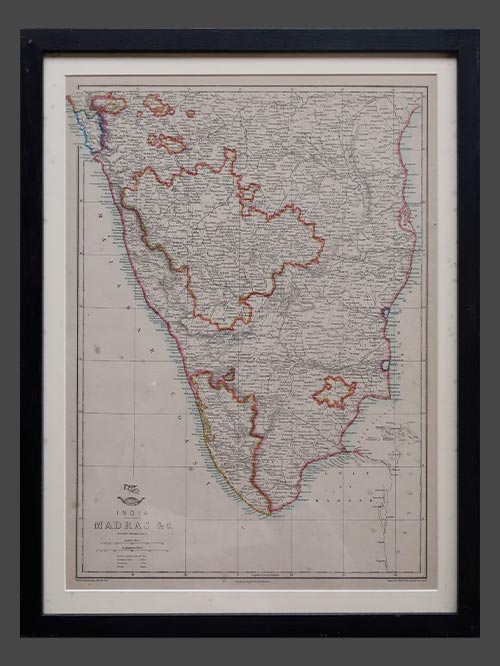
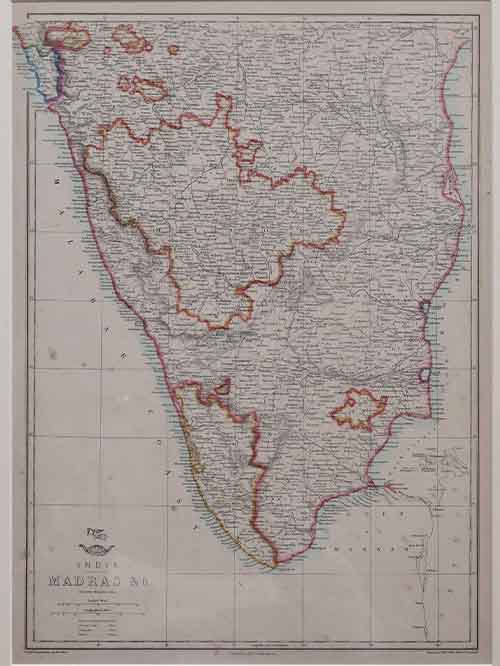
by Edward Weller
from Weekly Dispatch Atlas
original engraved map
Edward Weller was a cartographer and engraver based in London. His best known work appears in Cassell’s Weekly Dispatch Atlas, published in monthly segments for subscribers of the “Weekly Dispatch” newspaper. The maps are characterised by their detail and attractive outline colour and up to date information. The majority have an emblematical design of the upper half of a globe with a scroll “the Dispatch atlas” wrapped round it and above is the flying figure of Mercury (messenger of the Gods) .
Size of print (cms): 45 (H) x 32 (L)
Size of print (inches): 17.7 (H) x 12.6 (L)
Size framed (cms): 53 (H) x 40 (L)
Size framed (inches): 20.8 (H) x 15.7 (L)
-
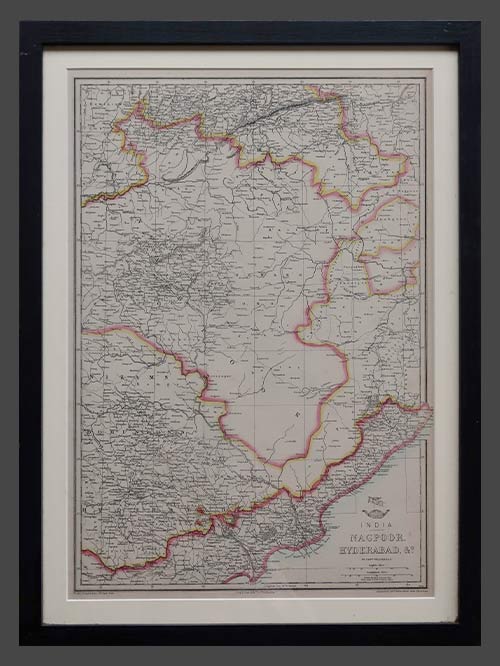
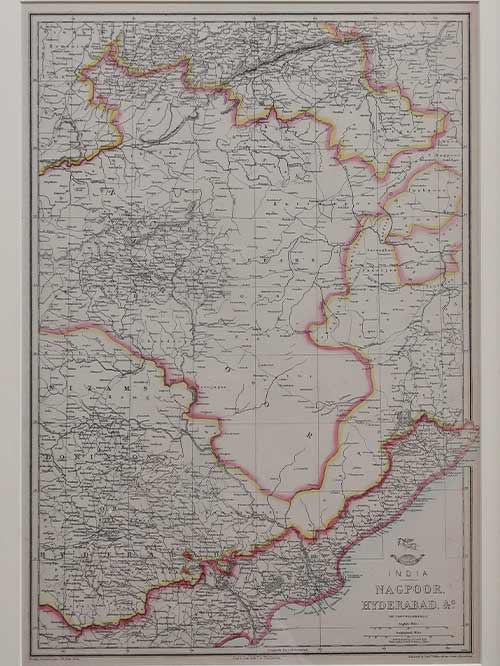
by Edward Weller
from Weekly Dispatch Atlas
original engraved map
Edward Weller was a cartographer and engraver based in London. His best known work appears in Cassell’s Weekly Dispatch Atlas, published in monthly segments for subscribers of the “Weekly Dispatch” newspaper. The maps are characterised by their detail and attractive outline colour and up to date information. The majority have an emblematical design of the upper half of a globe with a scroll “the Dispatch atlas” wrapped round it and above is the flying figure of Mercury (messenger of the Gods) .
Size of print (cms): 45 (H) x 32 (L)
Size of print (inches): 17.7 (H) x 12.6 (L)
Size framed (cms): 53 (H) x 40 (L)
Size framed (inches): 20.8 (H) x 15.7 (L)
-
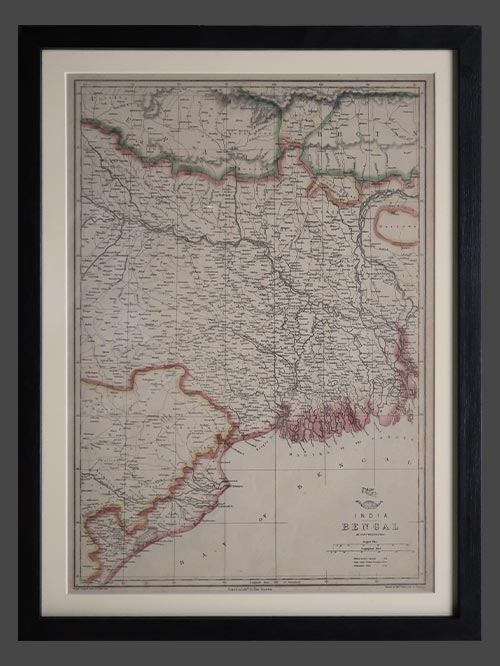
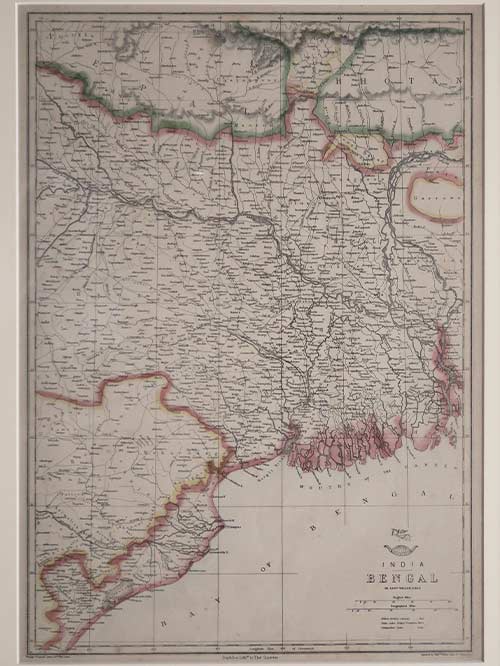
by Edward Weller from Weekly Dispatch Atlas
original engraved map
Edward Weller was a cartographer and engraver based in London. His best known work appears in Cassell’s Weekly Dispatch Atlas, published in monthly segments for subscribers of the “Weekly Dispatch” newspaper. The maps are characterised by their detail and attractive outline colour and up to date information. The majority have an emblematical design of the upper half of a globe with a scroll “the Dispatch atlas” wrapped round it and above is the flying figure of Mercury (messenger of the Gods) .
Size of print (cms): 45 (H) x 32 (L)
Size of print (inches): 17.7 (H) x 12.6 (L)
Size framed (cms): 53 (H) x 40 (L)
Size framed (inches): 20.8 (H) x 15.7 (L)
-
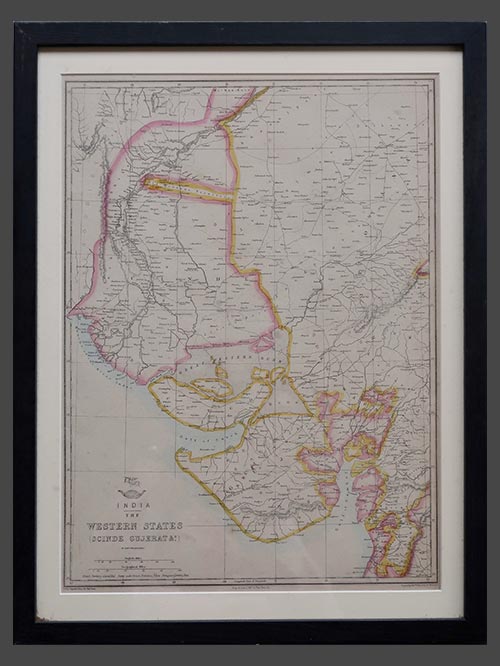
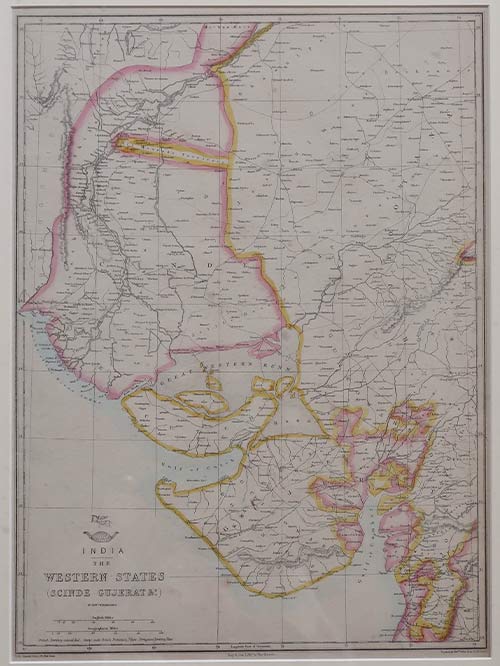
by Edward Weller
from Weekly Dispatch Atlas
original engraved map
Edward Weller was a cartographer and engraver based in London. His best known work appears in Cassell’s Weekly Dispatch Atlas, published in monthly segments for subscribers of the “Weekly Dispatch” newspaper. The maps are characterised by their detail and attractive outline colour and up to date information. The majority have an emblematical design of the upper half of a globe with a scroll “the Dispatch atlas” wrapped round it and above is the flying figure of Mercury (messenger of the Gods) .
Size of print (cms): 45 (H) x 32 (L)
Size of print (inches): 17.7 (H) x 12.6 (L)
Size framed (cms): 53 (H) x 40 (L)
Size framed (inches): 20.8 (H) x 15.7 (L)
-
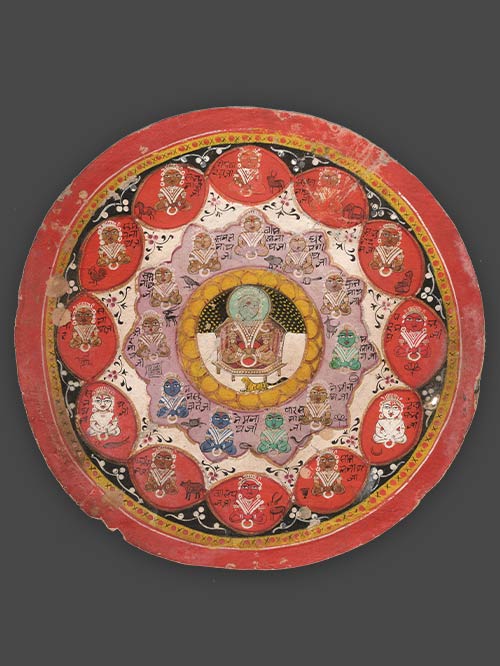
Rajasthan
Opaque watercolour on paper
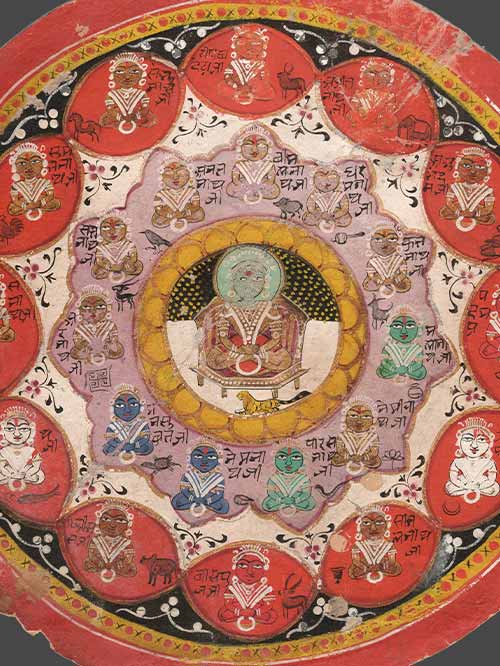
A beautiful roundel in the shape of a stylised lotus flower. At its center rests Lord Mahavira sitting on an octagonal throne. A group of eleven jinas surround him. The outer border depicts the remaining twelve jinas. Each jina is depicted with a symbol and writing identifying them. This is most probably an insert from a portable prayer box used by the Jain community while travelling.
Size (cms): 14.5(H) x 14.5(W)
Size (inches): 5.5(H) x 5.5(W)
-
Lucknow (North India)
Opaque watercolour on European paper
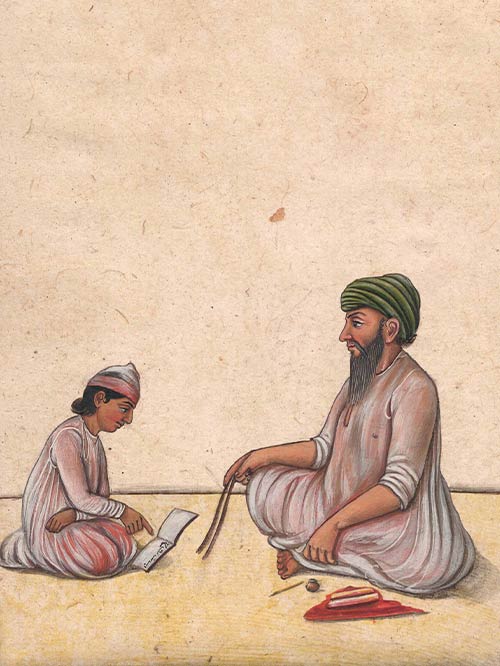
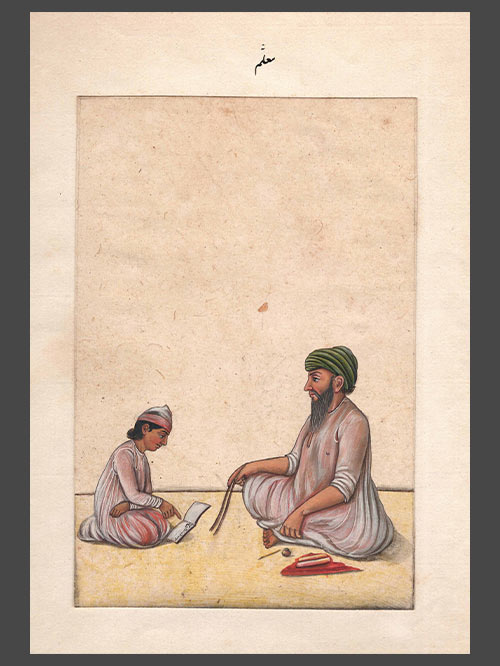
Company painting in Oudh developed on individual lines. This was largely because the European communities in Faizabad and later in Lucknow differed greatly from those in cities which came under direct British rule. Apart from the British Resident and his staff, and the British garrison, the Europeans who flocked to Oudh in the late eighteenth and early nineteenth centuries were adventurers and tradesmen looking for quick fortunes. They were not the serious-minded soldiers and administrators who, in other parts of India, were purchasing paintings of ‘manners and customs’ to paste in their scrapbooks or to send home to relatives in England. It followed that there was little demand in Oudh, until later in the nineteenth century, for paintings of this kind. There were undoubtedly a few cultivated Europeans – Colonel Gentil, General Claude Martin, Colonel Polier and Richard Johnson – but they were interested either in European work of good quality or in oriental culture. They patronised the British professional painters who visited Oudh or collected Indian and Persian manuscripts and miniatures. Oudh was a flourishing centre for acquiring oriental works for, with the break-up of the Mughal libraries at Delhi, many Persian manuscripts had found their way to it. The Nawabs and their courtiers were also lavish patrons of Indian artists. With the decline of patronage at Delhi, Mughal artists had moved to Faizabad and later to Lucknow, and a school of painting had arisen which was marked by feverish brilliance, a fitting expression of Oudh society under Nawab Shuja-ud-daula (1753-75) and Nawab Asaf-ud-daula (1775-97). Many portraits and paintings of musical or literary themes with a semi-erotic flavour were made at this time. The artists were well patronised and felt confident in the traditional character of their work.
Painting Size (cms): 15(H) x 10(W)
Painting Size (inches): 6(H) x 4(W)
-

by Francois-Balthazar Solvyns (1760-1824)
Original coloured etching
from Les Hindous
Pub. Paris
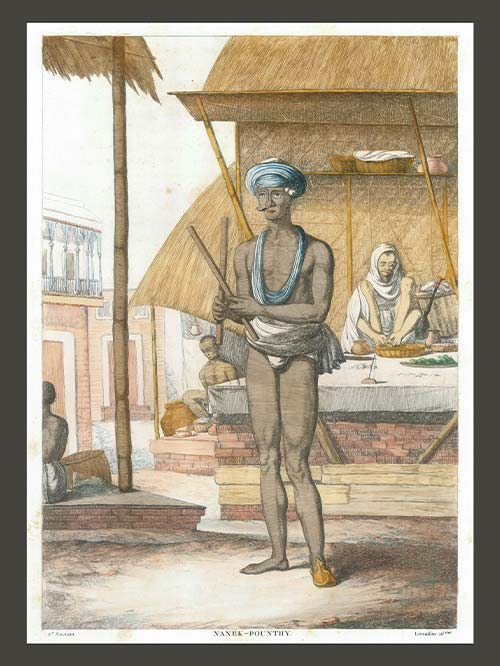
Solvyns describes the Nanuk-Punthys as a unique and relatively peaceful group of Faquirs, distinguished by their peculiar appearance, including wearing only half a moustache and one shoe. They adorn their turbans with silver bells, and carry sticks which they continuously strike together while reciting prayers and legends with remarkable speed. Some Nanuk-Punthys roam markets and public places, while others visit houses and shops, engaging in perpetual harangues. Despite their eccentricities, they are generally treated with respect, particularly among Sikhs and Marathas. Solvyns’ portrayal of the Nanuk-Punthys presents a puzzling depiction that doesn’t neatly align with known religious sects or orders of the time. While the term “Nanak Panthi” typically refers to followers of Guru Nanak, the lack of clear identification in Solvyns’ description leaves scholars and historians uncertain about their exact classification within the religious landscape of the period.
Frans Balthazar Solvyns, was a skilled engraver and painter hailing from Antwerp, embarked on a transformative journey to India in 1790. Settling in Calcutta, Solvyns immersed himself in the intricacies of Indian life, studying Hindi and forging relationships with Brahmins and pundits. Inspired by his surroundings, he commenced his ambitious project in 1791, aiming to depict the diverse facets of Indian society, from occupations to customs which he published in a series of engravings. Despite its sensitive portrayal, the venture encountered little success initially, prompting Solvyns’ departure from India in 1803. However, his legacy endured through subsequent publications, notably “The Costume of Hindoostan” and the expanded edition of “Les Hindous,” offering an intimate and detailed glimpse into 18th-century Indian life across professions, festivals, and daily rituals, immortalising a unique historical moment with both reverence and curiosity.
Image Size (cms): 35(H) x 24(W)
Image Size (inches): 14(H) x 9.5(W)
Mount Size (cms): 51(H) x 41(W)
Mount Size (inches): 20(H) x 16(W)