“Saker Falcon” has been added to your cart.
View cart
-


by John Edward Gray’s
From ‘Illustrations of Indian Zoology’
original hand coloured lithograph
Captioned ‘The Bonder. Paradoxurus Bonder.’
John Edward Gray of the British Museum had collaborated with Maj.-Gen. Hardwicke in producing Illustrations of Indian Zoology between 1830 and 1834. He was also the author of several major illustrated works on natural history and commissioned the best artists and printers of the day to illustrate his work. The Illustrations of Indian Zoology is his major work, dedicated to the East India Company, and with the striking plates of bird and animal life in the sub-continent drawn by Waterhouse Hawkins, the noted sporting artist.
Maj.-Gen. Thomas Hardwicke of the Bengal Artillery whilst serving in India from 1778 to 1823 assembled a truly impressive collection of natural history drawings by Indian and European artists whom he engaged to draw flora and fauna. On his retirement he brought the collection with him to England and a thousand of these in many volumes are now in the British library and in the British Museum (Natural History). Bird portraiture predominates in Illustrations of Indian Zoology with a token representation of mammals, reptiles and fishes.
Size (cms): 34 (H) x 48 (L)
Size (inches): 13.5 (H) x 19 (L)
-
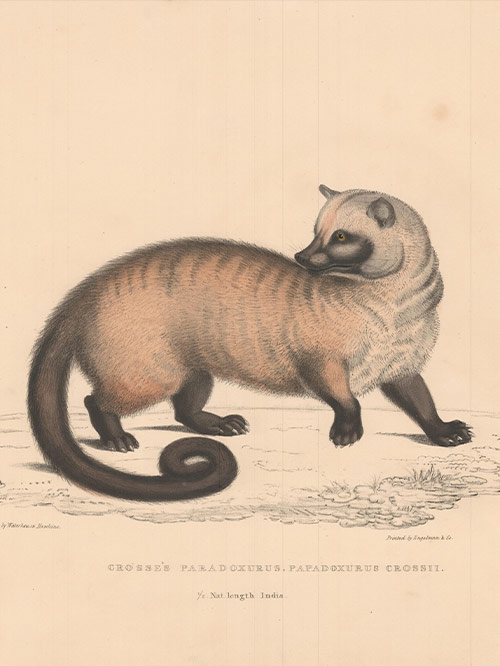
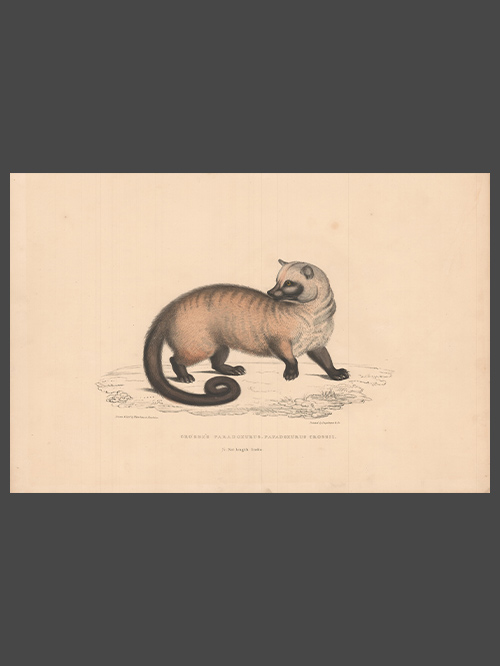
by John Edward Gray’s
From ‘Illustrations of Indian Zoology’
original hand coloured lithograph
Captioned ‘Crosse’s Paradoxurus. Papadoxurus Crossii.’
John Edward Gray of the British Museum had collaborated with Maj.-Gen. Hardwicke in producing Illustrations of Indian Zoology between 1830 and 1834. He was also the author of several major illustrated works on natural history and commissioned the best artists and printers of the day to illustrate his work. The Illustrations of Indian Zoology is his major work, dedicated to the East India Company, and with the striking plates of bird and animal life in the sub-continent drawn by Waterhouse Hawkins, the noted sporting artist.
Maj.-Gen. Thomas Hardwicke of the Bengal Artillery whilst serving in India from 1778 to 1823 assembled a truly impressive collection of natural history drawings by Indian and European artists whom he engaged to draw flora and fauna. On his retirement he brought the collection with him to England and a thousand of these in many volumes are now in the British library and in the British Museum (Natural History). Bird portraiture predominates in Illustrations of Indian Zoology with a token representation of mammals, reptiles and fishes.
Size (cms): 34 (H) x 48 (L)
Size (inches): 13.5 (H) x 19 (L)
-
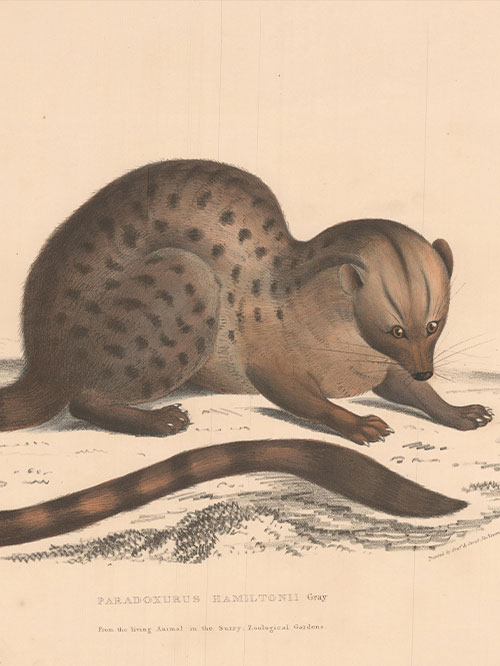
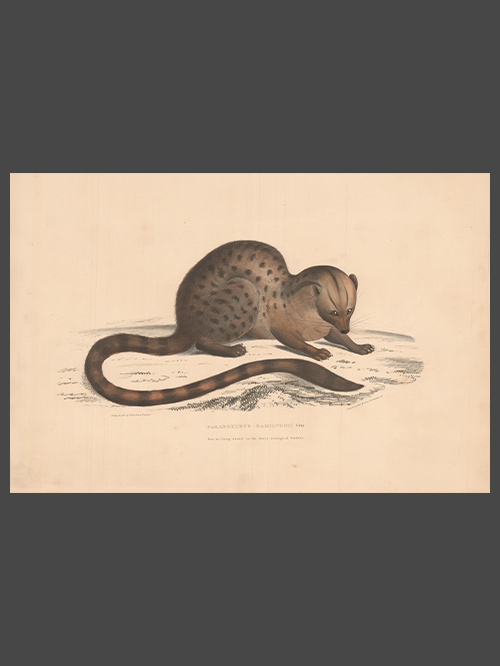
by John Edward Gray’s
From ‘Illustrations of Indian Zoology’
original hand coloured lithograph
Captioned ‘Paradoxurus Hamiltonii‘
John Edward Gray of the British Museum had collaborated with Maj.-Gen. Hardwicke in producing Illustrations of Indian Zoology between 1830 and 1834. He was also the author of several major illustrated works on natural history and commissioned the best artists and printers of the day to illustrate his work. The Illustrations of Indian Zoology is his major work, dedicated to the East India Company, and with the striking plates of bird and animal life in the sub-continent drawn by Waterhouse Hawkins, the noted sporting artist.
Maj.-Gen. Thomas Hardwicke of the Bengal Artillery whilst serving in India from 1778 to 1823 assembled a truly impressive collection of natural history drawings by Indian and European artists whom he engaged to draw flora and fauna. On his retirement he brought the collection with him to England and a thousand of these in many volumes are now in the British library and in the British Museum (Natural History). Bird portraiture predominates in Illustrations of Indian Zoology with a token representation of mammals, reptiles and fishes.
Size (cms): 34 (H) x 48 (L)
Size (inches): 13.5 (H) x 19 (L)
-


by John Edward Gray’s
From ‘Illustrations of Indian Zoology’
original hand coloured lithograph
Captioned ‘Viverra Fusca. Brown Long Nosed Civet.’
John Edward Gray of the British Museum had collaborated with Maj.-Gen. Hardwicke in producing Illustrations of Indian Zoology between 1830 and 1834. He was also the author of several major illustrated works on natural history and commissioned the best artists and printers of the day to illustrate his work. The Illustrations of Indian Zoology is his major work, dedicated to the East India Company, and with the striking plates of bird and animal life in the sub-continent drawn by Waterhouse Hawkins, the noted sporting artist.
Maj.-Gen. Thomas Hardwicke of the Bengal Artillery whilst serving in India from 1778 to 1823 assembled a truly impressive collection of natural history drawings by Indian and European artists whom he engaged to draw flora and fauna. On his retirement he brought the collection with him to England and a thousand of these in many volumes are now in the British library and in the British Museum (Natural History). Bird portraiture predominates in Illustrations of Indian Zoology with a token representation of mammals, reptiles and fishes.
Size (cms): 34 (H) x 48 (L)
Size (inches): 13.5 (H) x 19 (L)
-

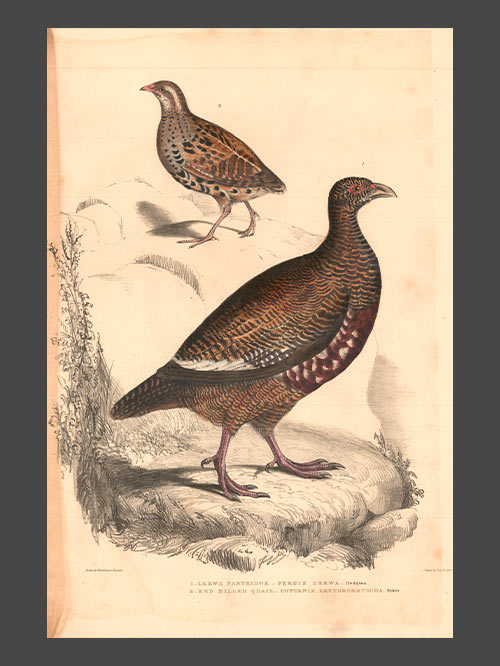
by John Edward Gray’s
From ‘Illustrations of Indian Zoology’
original hand coloured lithograph
Captioned ‘1. Lerwa Partridge. Perdix Lerwa. 2. Red Billed Quail. Coturnix Erythrorhyncha.‘
John Edward Gray of the British Museum had collaborated with Maj.-Gen. Hardwicke in producing Illustrations of Indian Zoology between 1830 and 1834. He was also the author of several major illustrated works on natural history and commissioned the best artists and printers of the day to illustrate his work. The Illustrations of Indian Zoology is his major work, dedicated to the East India Company, and with the striking plates of bird and animal life in the sub-continent drawn by Waterhouse Hawkins, the noted sporting artist.
Maj.-Gen. Thomas Hardwicke of the Bengal Artillery whilst serving in India from 1778 to 1823 assembled a truly impressive collection of natural history drawings by Indian and European artists whom he engaged to draw flora and fauna. On his retirement he brought the collection with him to England and a thousand of these in many volumes are now in the British library and in the British Museum (Natural History). Bird portraiture predominates in Illustrations of Indian Zoology with a token representation of mammals, reptiles and fishes.
Size (cms): 48 (H) x 34 (L)
Size (inches): 19 (H) x 13.5 (L)
-

by John Edward Gray’s
From ‘Illustrations of Indian Zoology’
original hand coloured lithograph
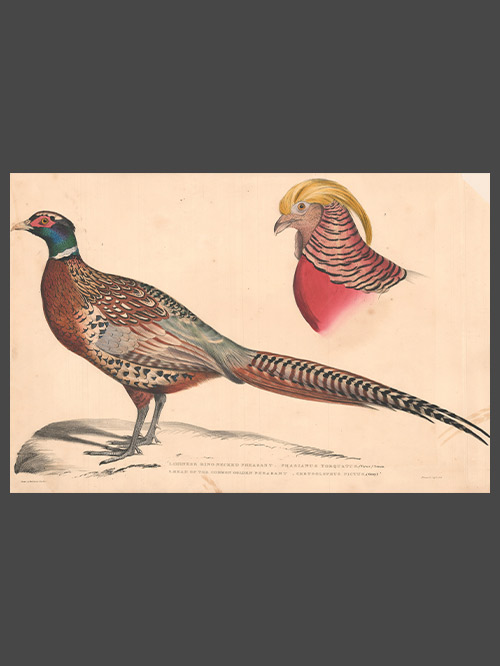
Captioned ‘1. Chinese Ring Necked Pheasant. Phasianus Torquatus. 2. Head of the Common Golden Pheasant. Chrysolophus Pictus.’
John Edward Gray of the British Museum had collaborated with Maj.-Gen. Hardwicke in producing Illustrations of Indian Zoology between 1830 and 1834. He was also the author of several major illustrated works on natural history and commissioned the best artists and printers of the day to illustrate his work. The Illustrations of Indian Zoology is his major work, dedicated to the East India Company, and with the striking plates of bird and animal life in the sub-continent drawn by Waterhouse Hawkins, the noted sporting artist.
Maj.-Gen. Thomas Hardwicke of the Bengal Artillery whilst serving in India from 1778 to 1823 assembled a truly impressive collection of natural history drawings by Indian and European artists whom he engaged to draw flora and fauna. On his retirement he brought the collection with him to England and a thousand of these in many volumes are now in the British library and in the British Museum (Natural History). Bird portraiture predominates in Illustrations of Indian Zoology with a token representation of mammals, reptiles and fishes.
Size (cms): 34 (H) x 48 (L)
Size (inches): 13.5 (H) x 19 (L)
-
by John Edward Gray’s
From ‘Illustrations of Indian Zoology’
original hand coloured lithograph
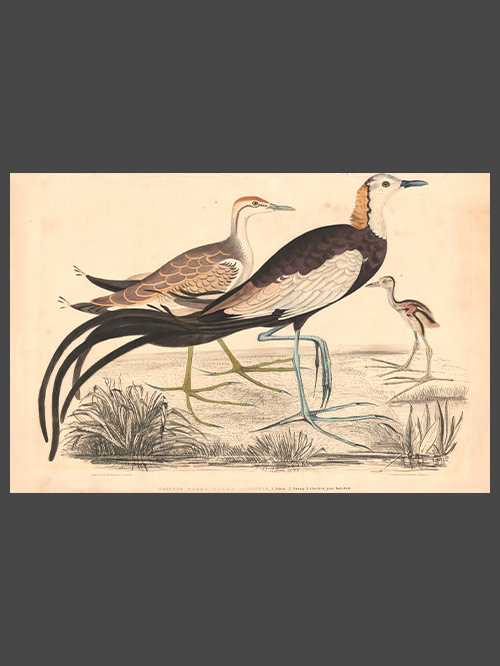
Captioned ‘Chinese Parra . Parra Sinensis.‘
John Edward Gray of the British Museum had collaborated with Maj.-Gen. Hardwicke in producing Illustrations of Indian Zoology between 1830 and 1834. He was also the author of several major illustrated works on natural history and commissioned the best artists and printers of the day to illustrate his work. The Illustrations of Indian Zoology is his major work, dedicated to the East India Company, and with the striking plates of bird and animal life in the sub-continent drawn by Waterhouse Hawkins, the noted sporting artist.
Maj.-Gen. Thomas Hardwicke of the Bengal Artillery whilst serving in India from 1778 to 1823 assembled a truly impressive collection of natural history drawings by Indian and European artists whom he engaged to draw flora and fauna. On his retirement he brought the collection with him to England and a thousand of these in many volumes are now in the British library and in the British Museum (Natural History). Bird portraiture predominates in Illustrations of Indian Zoology with a token representation of mammals, reptiles and fishes.
Size (cms): 34 (H) x 48 (L)
Size (inches): 13.5 (H) x 19 (L)
-
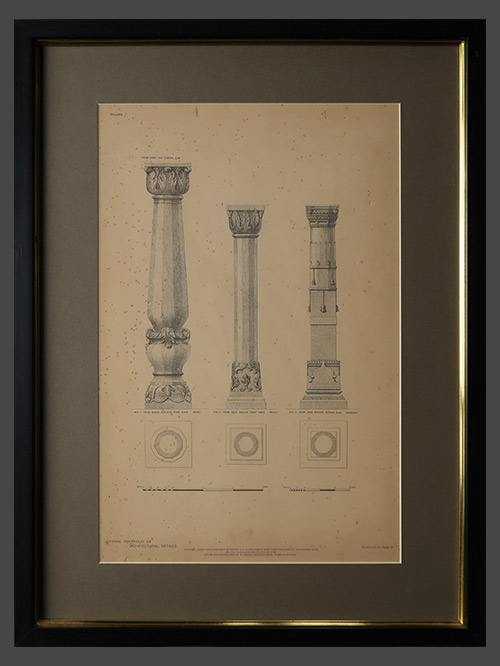
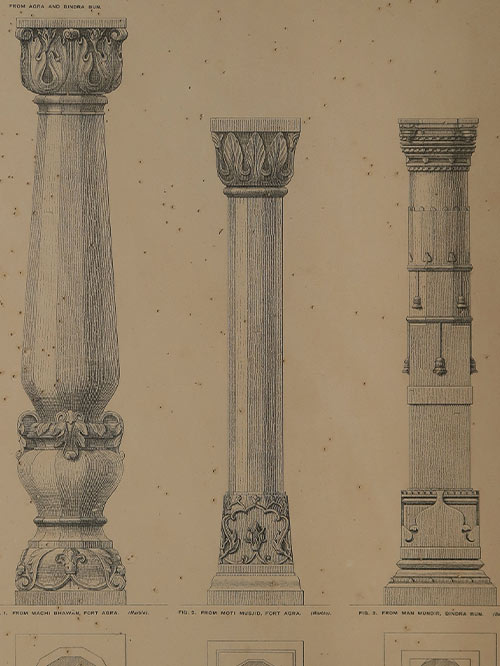
by Samuel Swinton Jacob
from Jeypore Portfolio of Architectural Details
original lithograph
Original lithographs from the Jeypore Portfolio of Architectural Details prepared with the guidance of Col. S.S. Jacob CIE, Indian Army. It compares the designs of two marble pillars from the Agra fort with a sandstone pillar from Bindra Bun (Punjab). The Portfolio was issued under the patronage of H.H.Maharaja Sawai Madhu Singh, G.C.S.I. of Jeypore.
The collection of drawings were executed by local draftsmen, all natives of Jeypore, trained first in the School of Art and then in the office of the Executive Engineer. They were supervised by Lala Ram Baksh, head draftsmen and teacher in the Jeypore school of Art. The architectural details depicted are mostly from mosques, tombs, palaces and other buildings in or near Delhi and Agra and parts of Rajputana. They have been arranged together in sections- each sheet loose – so that the different examples of architectural details may be compared and selections readily made. The plates would have served as working drawings for the architect and artisan.
Size Framed (cms): 68.6 (H) x 50.8 (L)
Size Framed (inches): 27 (H) x 20 (L)
-
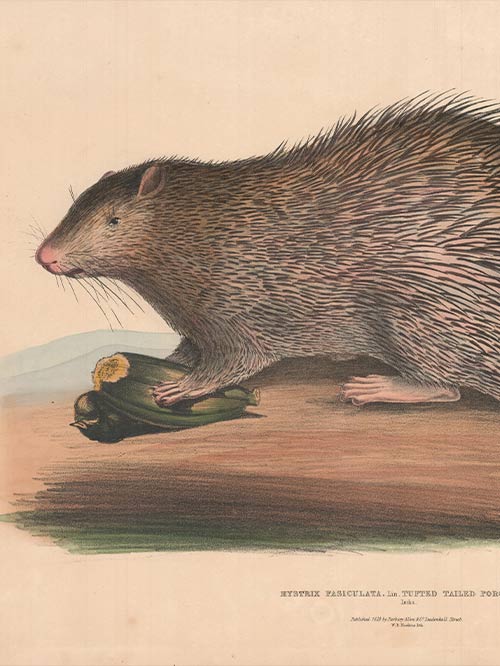
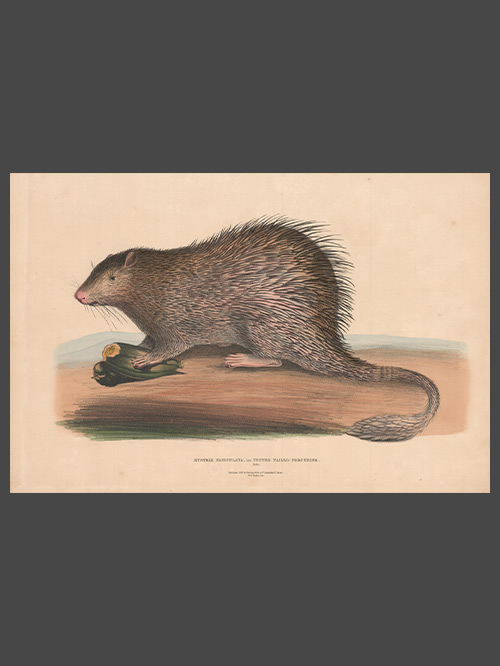
by John Edward Gray’s
From ‘Illustrations of Indian Zoology’
original hand coloured lithograph
Captioned ‘Hystrix Fasiculata. Tufted Tailed Porcupine.’
John Edward Gray of the British Museum had collaborated with Maj.-Gen. Hardwicke in producing Illustrations of Indian Zoology between 1830 and 1834. He was also the author of several major illustrated works on natural history and commissioned the best artists and printers of the day to illustrate his work. The Illustrations of Indian Zoology is his major work, dedicated to the East India Company, and with the striking plates of bird and animal life in the sub-continent drawn by Waterhouse Hawkins, the noted sporting artist.
Maj.-Gen. Thomas Hardwicke of the Bengal Artillery whilst serving in India from 1778 to 1823 assembled a truly impressive collection of natural history drawings by Indian and European artists whom he engaged to draw flora and fauna. On his retirement he brought the collection with him to England and a thousand of these in many volumes are now in the British library and in the British Museum (Natural History). Bird portraiture predominates in Illustrations of Indian Zoology with a token representation of mammals, reptiles and fishes.
Size (cms): 34 (H) x 48 (L)
Size (inches): 13.5 (H) x 19 (L)
-
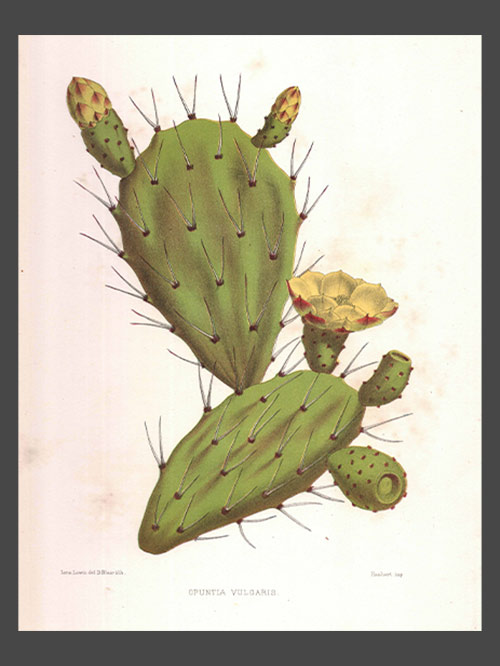
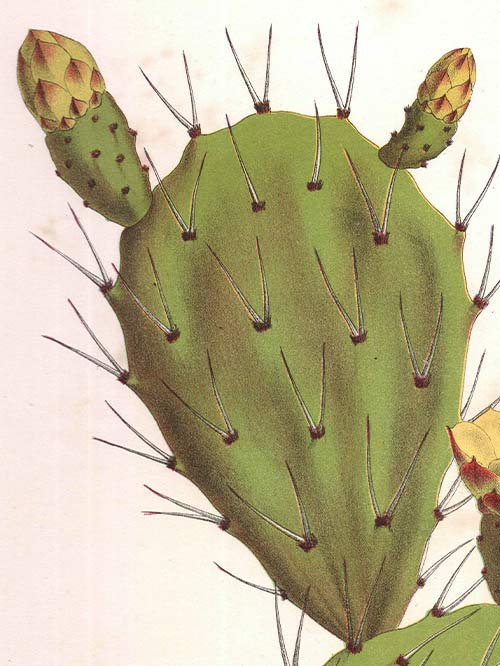
by Lena Lowis
original hand coloured lithograph
Captioned ‘Opuntia vulgaris’
Lena Lowis (1845- 1919) was the daughter of Sir Richmond Campbell Shakespear (1812-1861), an Indian-born British Indian Army officer who helped abolish the capture and selling of Russian slaves in Khiva. She was born in India and later educated and married in England where she lived with her husband and five children.
The artist chronicled many of the flowers commonly cultivated in Indian gardens, some of which were indigenous to the region, while others were introduced by gardeners. Her illustrations are not meant to be taken treatise on botany or as a manual of gardening, rather to convey a fair idea of the colour and texture of the original, to those who have not seen them.
Size (cms): 25.5(H) x 20(W)
Size (inches): 10(H) x 8(W)
Size with Mount (cms): 42(H) x 36(W)
Size with Mount (inches): 16.5(H) x 14(W)
-
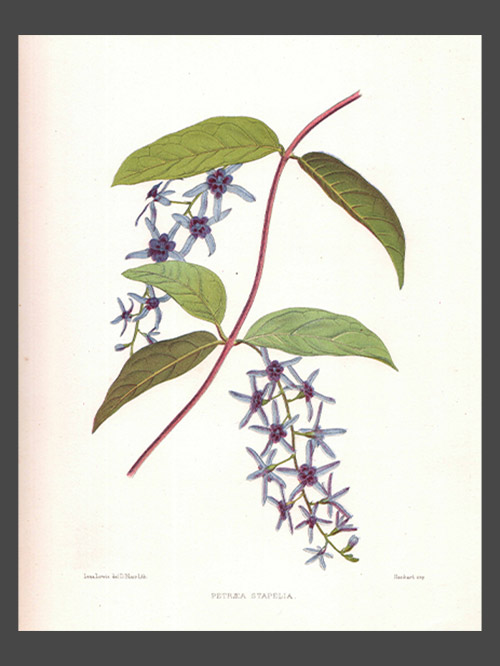
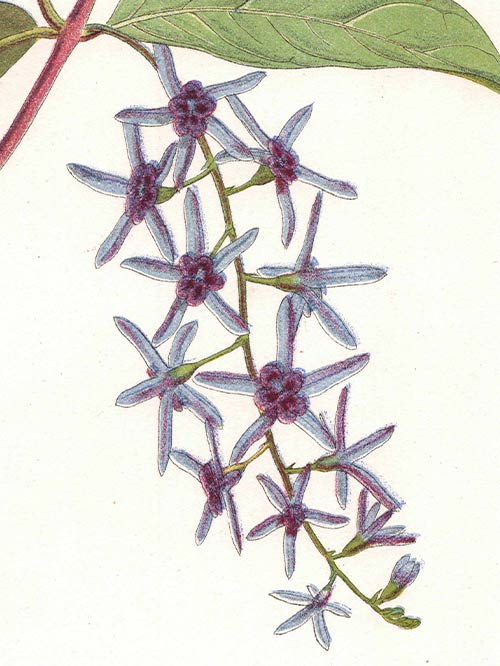
by Lena Lowis
original hand coloured lithograph
Captioned ‘Petrea stapeliae’
Lena Lowis (1845- 1919) was the daughter of Sir Richmond Campbell Shakespear (1812-1861), an Indian-born British Indian Army officer who helped abolish the capture and selling of Russian slaves in Khiva. She was born in India and later educated and married in England where she lived with her husband and five children.
The artist chronicled many of the flowers commonly cultivated in Indian gardens, some of which were indigenous to the region, while others were introduced by gardeners. Her illustrations are not meant to be taken treatise on botany or as a manual of gardening, rather to convey a fair idea of the colour and texture of the original, to those who have not seen them.
Size (cms): 25.5(H) x 20(W)
Size (inches): 10(H) x 8(W)
Size with Mount (cms): 42(H) x 36(W)
Size with Mount (inches): 16.5(H) x 14(W)
-
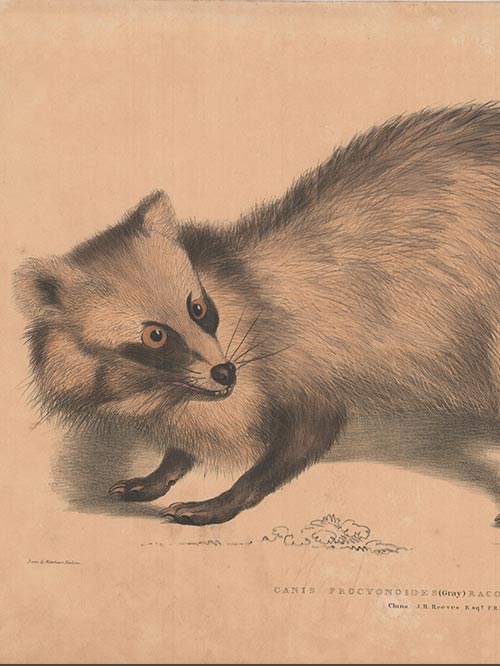
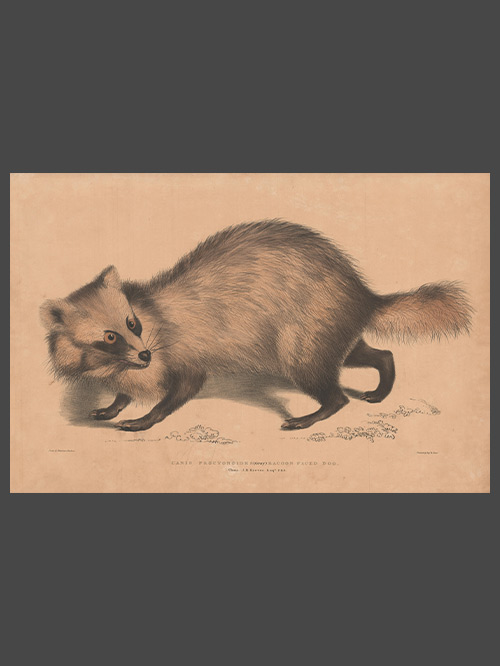
by John Edward Gray’s
From ‘Illustrations of Indian Zoology’
original hand coloured lithograph
Captioned ‘Canis Procyonoides, Racoon Faced Dog.‘
John Edward Gray of the British Museum had collaborated with Maj.-Gen. Hardwicke in producing Illustrations of Indian Zoology between 1830 and 1834. He was also the author of several major illustrated works on natural history and commissioned the best artists and printers of the day to illustrate his work. The Illustrations of Indian Zoology is his major work, dedicated to the East India Company, and with the striking plates of bird and animal life in the sub-continent drawn by Waterhouse Hawkins, the noted sporting artist.
Maj.-Gen. Thomas Hardwicke of the Bengal Artillery whilst serving in India from 1778 to 1823 assembled a truly impressive collection of natural history drawings by Indian and European artists whom he engaged to draw flora and fauna. On his retirement he brought the collection with him to England and a thousand of these in many volumes are now in the British library and in the British Museum (Natural History). Bird portraiture predominates in Illustrations of Indian Zoology with a token representation of mammals, reptiles and fishes.
Size (cms): 34 (H) x 48 (L)
Size (inches): 13.5 (H) x 19 (L)
-

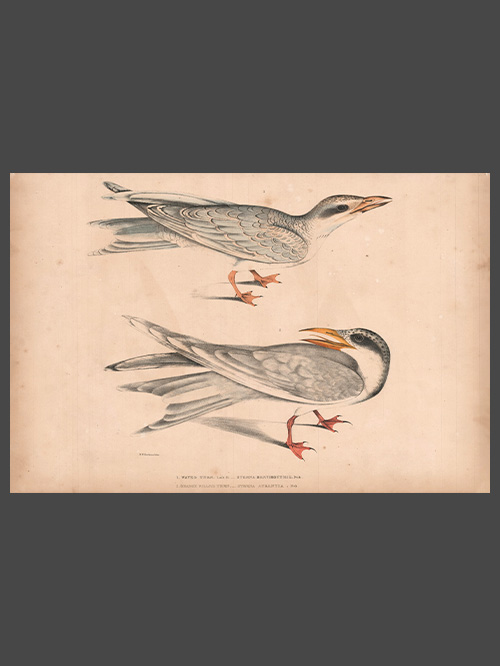
by John Edward Gray’s
From ‘Illustrations of Indian Zoology’
original hand coloured lithograph
Captioned ‘1. Waved Tern. Sterna Brevirostri. 2. Orange Billed Tern. Sterna Aurantia‘
John Edward Gray of the British Museum had collaborated with Maj.-Gen. Hardwicke in producing Illustrations of Indian Zoology between 1830 and 1834. He was also the author of several major illustrated works on natural history and commissioned the best artists and printers of the day to illustrate his work. The Illustrations of Indian Zoology is his major work, dedicated to the East India Company, and with the striking plates of bird and animal life in the sub-continent drawn by Waterhouse Hawkins, the noted sporting artist.
Maj.-Gen. Thomas Hardwicke of the Bengal Artillery whilst serving in India from 1778 to 1823 assembled a truly impressive collection of natural history drawings by Indian and European artists whom he engaged to draw flora and fauna. On his retirement he brought the collection with him to England and a thousand of these in many volumes are now in the British library and in the British Museum (Natural History). Bird portraiture predominates in Illustrations of Indian Zoology with a token representation of mammals, reptiles and fishes.
Size (cms): 34 (H) x 48 (L)
Size (inches): 13.5 (H) x 19 (L)
-
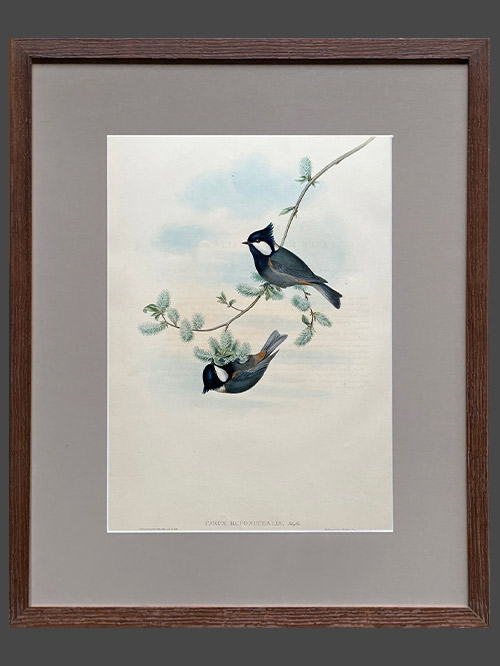
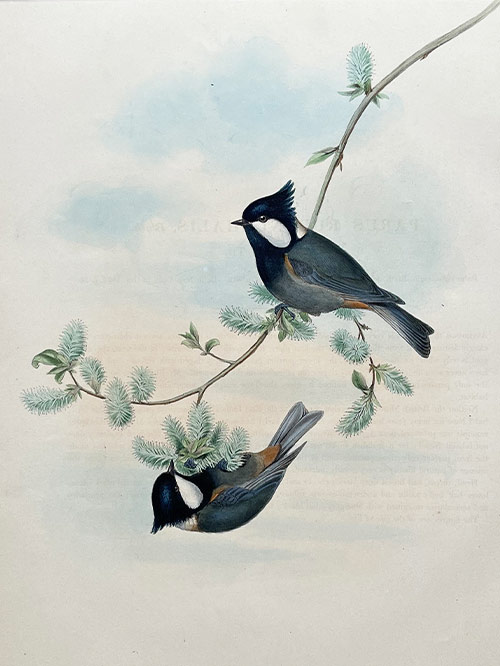
by John Gould and H.C.Richter
From ‘Birds of Asia’
original hand coloured lithograph
Captioned ‘Parus Rufonuchalis’
This small bird from mountainous South and Southeast Asia has a rufous-colored nape and back. Distinct from Parus rubidiventris, it is larger, with a unique nuchal spot. Found in the Tyne range north of Simla, it forages for insects and seeds in tree canopies.
John Gould (1804 – 1881) was one of the most significant figures in 19th century bird art, both in his prolific output and the aesthetic beauty of his plates. He is credited with the publication of more than 3,100 coloured lithographs of bird species from various parts of the world. In his all-encompassing work, “The Birds of Asia,” John Gould includes species from all corners of the eastern world. Gould chose to record the bird life from an area which, with the exception of the tropical areas of the American continent, includes the widest, and most colourful variety of bird life to be found anywhere in the world.
Framed Size (cms): 66(H) x 54.5(W)
Framed Inches (cms): 26(H) x 21.5(W)
Print Size (cms): 53.5(H) x 35.5(W)
Print Size (inches): 21(H) x 14(W)
-
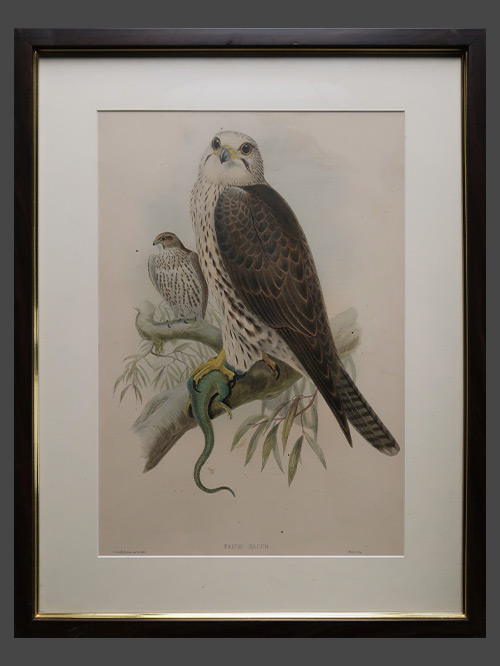
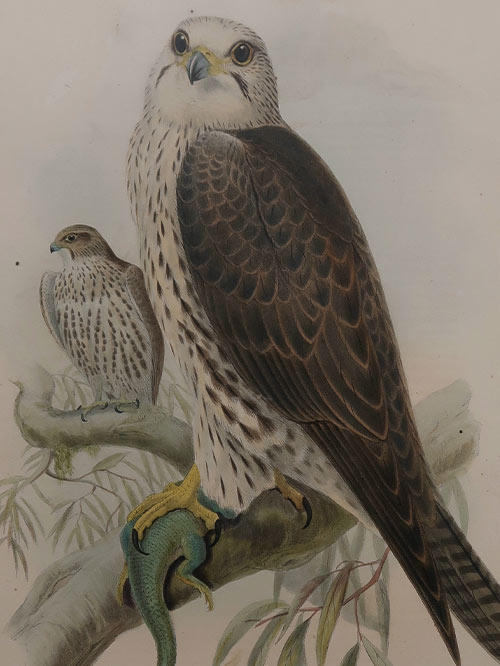
by John Gould and H.C.Richter
from ‘Birds of Asia’
original hand coloured lithograph
The Saker Falcon (Falco Sacer) is a large species of falcon. This species breeds from central Europe eastwards across Asia to East China.
The intended geographical range of “The Birds of Asia” was enormous, and very much in keeping with the seemingly limitless self-belief of the 19th-century’s best known ornithologist. In his all-encompassing work John Gould includes species from all corners of the eastern world, as Richard Bowdler Sharpe noted the work covers “Species from Palestine to the eastward, and from the Moluccas to the west.” Gould chose to record the bird life from an area which, with the exception of the tropical areas of the American continent, includes the widest, and most colourful variety of bird life to be found anywhere in the world.
John Gould (1804 – 1881) remains one of the most significant figures in 19th century bird art, both in his prolific output and the aesthetic beauty of his plates. He is credited with the publication of more than 3,100 coloured lithographs of bird species from various parts of the world and is associated with vibrant and carefully executed folio volumes created in partnership with some of the period’s most respected bird artists, among them, Edward Lear, Joseph Wolf and William Hart. This dual expertise in both science and art heightened his prominence.
Size framed (cms): 71 (H) x 52 (L)
Size framed (inches): 28.5 (H) x 20.5 (L)
-
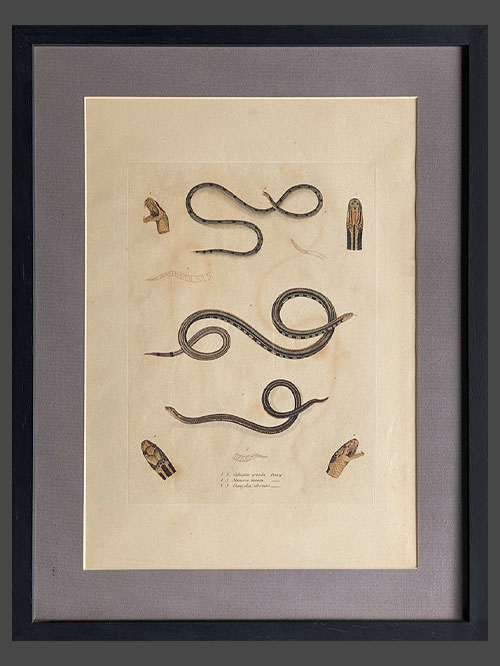
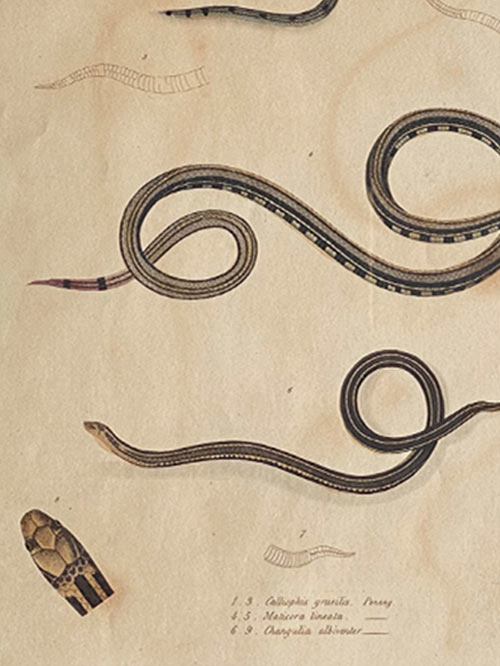
by John Edward Gray
from Illustrations of Indian Zoology
original hand coloured lithograph
Captioned ‘1.3. Calliophis Gracilis. Penang
4.5. Malicora Lineata. Penang
6.9. Changulia Albiventer. Penang‘
John Edward Gray of the British Museum had collaborated with Maj.-Gen. Hardwicke in producing Illustrations of Indian Zoology between 1830 and 1834. He was also the author of several major illustrated works on natural history and commissioned the best artists and printers of the day to illustrate his work. The Illustrations of Indian Zoology is his major work, dedicated to the East India Company, and with the striking plates of bird and animal life in the sub-continent drawn by Waterhouse Hawkins, the noted sporting artist. The subscription amounted to thirty-nine home and thirteen foreign.
Size framed (cms): 56.5 (H) x 44 (W)
Size framed (inches): 22 (H) x 17.5 (W)