“Map of Hindoostan” has been added to your cart.
View cart
-
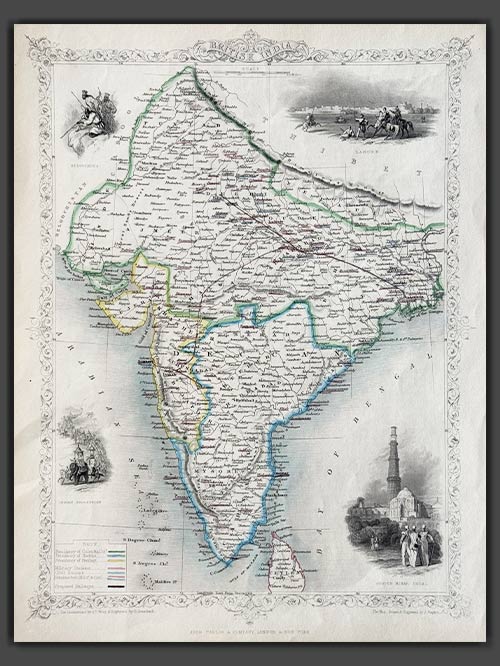
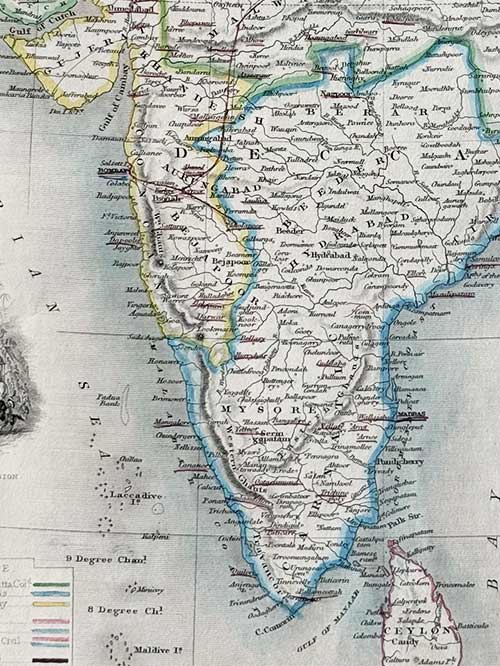
Pub. London
Original engraved map by J.Rapkin
This decorative map of British India, published in 1851 by John Tallis and Company, is a stunning example of 19th-century cartography. Engraved by John Rapkin, with vignettes by A.H. Wray and G. Greenbach, the map highlights the Madras, Calcutta, and Bombay Presidencies, as well as planned railway lines throughout the region. The decorative vignettes depict iconic landmarks such as Lahore, the Qutub Minar in Delhi, an Indian procession, and the Beloochees, all framed by an ornate flowered border.
Tallis and Company were map publishers based in London. They traded under various names including L.Tallis, John Tallis and John Tallis & Co.between 1838 and 1850. In 1851 their maps were published by the ‘London Printing and Publishing Co’., in both London and New York. Although he only issued one World Atlas, John Tallis, the founder of the firm, is among the best known of all map makers. The maps with small vignettes issued between 1850 and 1851 to commemorate the Great Exhibition in London are considered the last great series of decorative maps. They combine fine cartographical detail within an attractive border. Around the map there are several small but decorative vignettes depicting particular views, buildings, local inhabitants or the flora and fauna of that region.
Size (cms): 36(H) x 26(W)
Size (inches): 14(H) x 10(W)
-
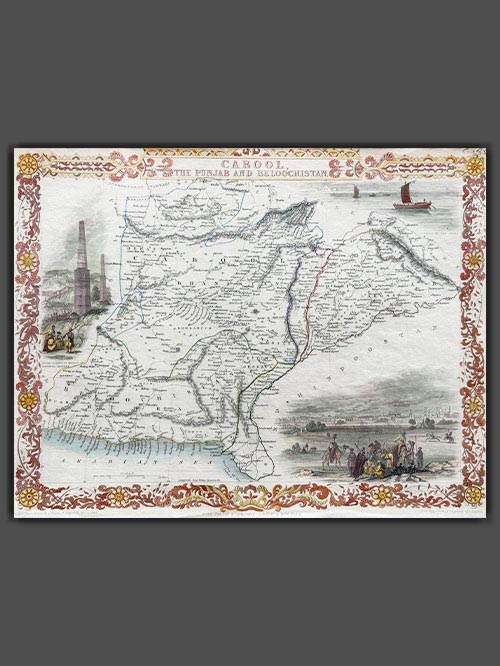
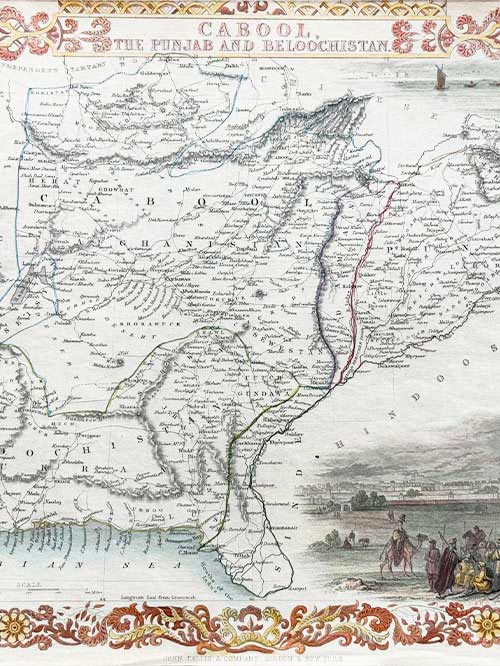
Pub. London
Original engraved map by J.Rapkin
This decorative engraved map by John Tallis, drawn by John Rapkin and published in 1851 for Tallis’s Illustrated Atlas and Modern History of the World, depicts present-day Afghanistan and Pakistan. Renowned for its artistic details, the map features decorative vignettes of regional landmarks, including boats on the Indus River, the city of Lahore, and the fortress and minarets of Ghazni, showcasing the cultural and architectural heritage of the region. Created during the era of the First Anglo-Afghan War (1839–1842) and the “Great Game” rivalry between Britain and Russia, this map highlights the geopolitical significance of the region.
Tallis and Company were map publishers based in London. They traded under various names including L.Tallis, John Tallis and John Tallis & Co.between 1838 and 1850. In 1851 their maps were published by the ‘London Printing and Publishing Co’., in both London and New York. Although he only issued one World Atlas, John Tallis, the founder of the firm, is among the best known of all map makers. The maps with small vignettes issued between 1850 and 1851 to commemorate the Great Exhibition in London are considered the last great series of decorative maps. They combine fine cartographical detail within an attractive border. Around the map there are several small but decorative vignettes depicting particular views, buildings, local inhabitants or the flora and fauna of that region.
Size (cms): 26.5(H) x 35(W)
Size (inches): 10.5(H) x 14(W)
-
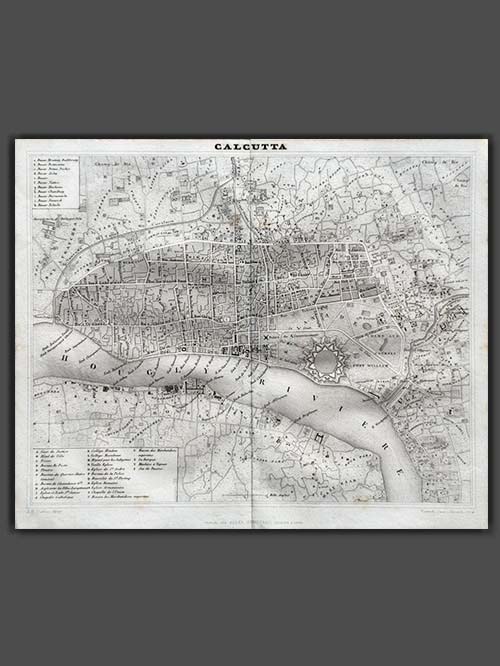
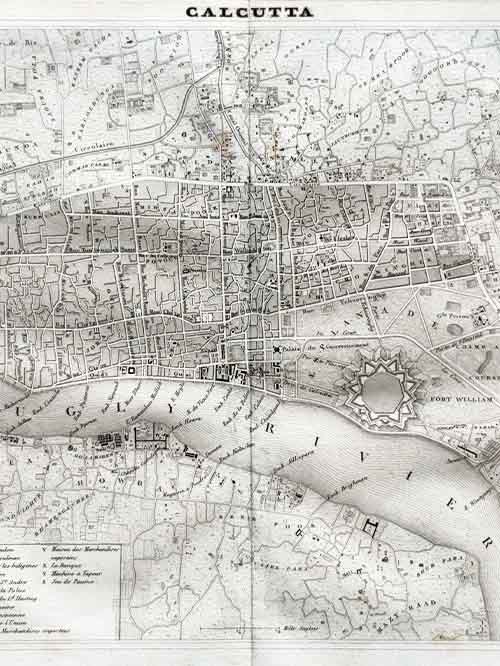
Original engraved map by Jules Renouard
Finely engraved Map of Calcutta by Jules Renouard, published in Paris circa 1839, showcasing a detailed city plan with Fort William on the Hooghly River and its surrounding areas. The map includes two inset keys identifying prominent historical buildings.
Jules Renouard (1798–1854) was a prominent French book dealer, editor, publisher, and bibliographer. Born in Paris to revolutionary and book dealer Antoine-Augustin Renouard, he studied at the Lycée Louis-le-Grand before briefly pursuing banking in London. In 1826, he inherited his father’s book business and became a key figure in the trade. Renouard co-founded the Cercle de la Librairie (Book Dealers’ Association) in 1847.
Image Size (cms): 22.5(H) x 26.5(W)
Image Size (inches): 9(H) x 10.5(W)
-
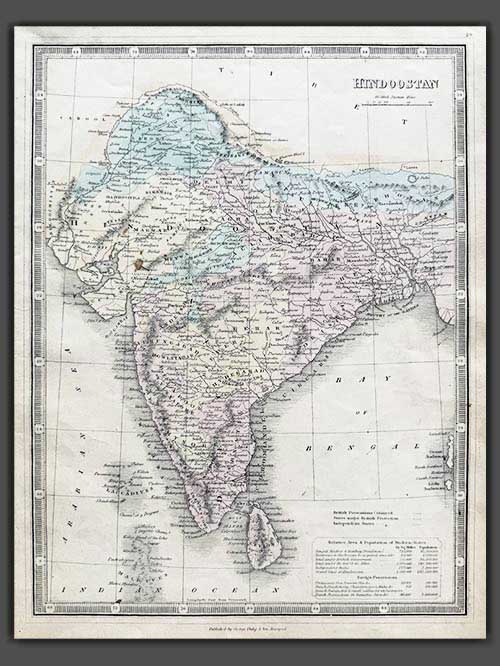
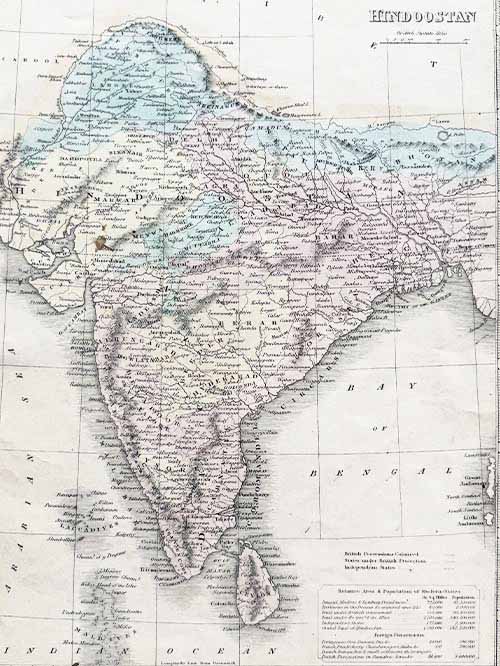
Original engraved map by George Philip & Son
Detailed map of India with two inset cartouches of area and population of the British states and the foreign possessions namely the Portuguese, Dutch, French and Danish. It was published by George Philip & Son in Liverpool circa 1858.
George Philip (1800–1882) was a Scottish map publisher and cartographer who founded his own firm in Liverpool in 1834 after apprenticing with a printer and bookseller. Initially focusing on educational materials, he collaborated with noted cartographers like John Bartholomew Sr. and August Petermann. In 1848, he brought his son, George Philip Jr. (1823–1902), into the business, renaming it George Philip & Son Ltd. Under George Jr., the company became a major publishing house and later established the London Geographical Institute, embracing modern printing techniques to produce high-quality, affordable maps on a large scale.
Image Size (cms): 32(H) x 24.5(W)
Image Size (inches): 12.5(H) x 9.5(W)
-

Pub. London
Original engraved map by J.Rapkin
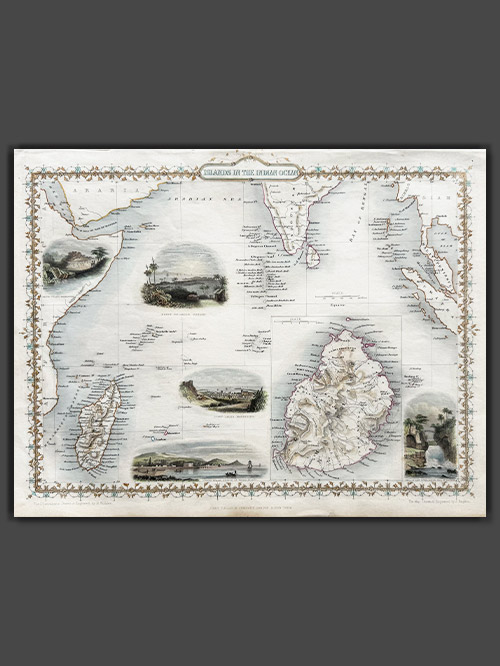
This striking map of the Islands in the Indian Ocean, created by John Tallis, drawn by John Rapkin, and published in 1851 for Tallis’s Illustrated Atlas and Modern History of the World, offers a detailed depiction of the region. It showcases the Seycelles, the Maldives, Bourbon, and Mauritius, with an inset detailing the Island of Mauritius. The map features decorative vignettes including of Point De Gall, Ceylon, and Port Louis in Mauritius, capturing the essence of these exotic locations.
Tallis and Company were map publishers based in London. They traded under various names including L.Tallis, John Tallis and John Tallis & Co.between 1838 and 1850. In 1851 their maps were published by the ‘London Printing and Publishing Co’., in both London and New York. Although he only issued one World Atlas, John Tallis, the founder of the firm, is among the best known of all map makers. The maps with small vignettes issued between 1850 and 1851 to commemorate the Great Exhibition in London are considered the last great series of decorative maps. They combine fine cartographical detail within an attractive border. Around the map there are several small but decorative vignettes depicting particular views, buildings, local inhabitants or the flora and fauna of that region.
Size (cms): 27.5(H) x 36(W)
Size (inches): 11(H) x 14(W)
-
Pub. London
Original engraved map by J.Rapkin
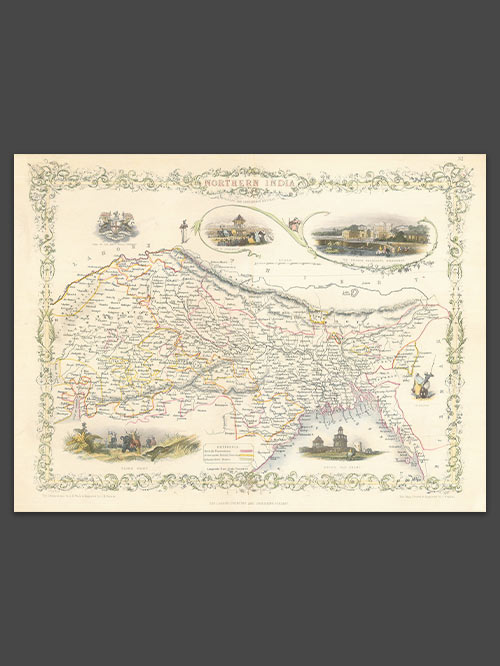
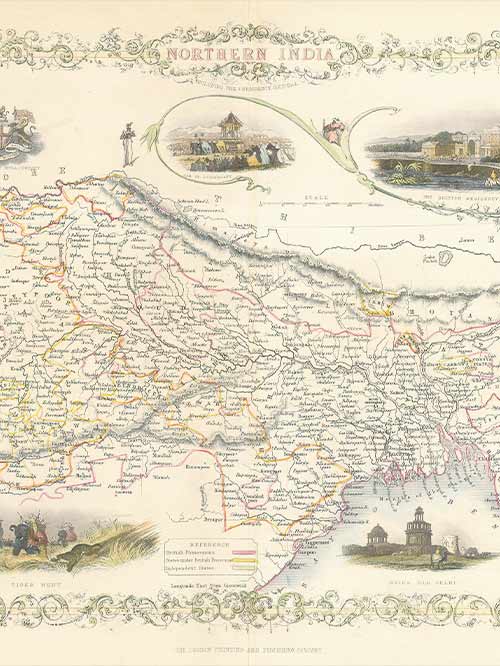
An appealing map of Northern India covering the region from Surat on the west coast to Puri on the east coast, extending to the borders of Tibet, Burma, and Pakistan (Lahore). It features several vignettes, including a Tiger Hunt, Ruins of Old Delhi, the Car of Juggernaut (Jagannatha), the British Residency at Hyderabad, and a seal of the East India Company. The map is bordered by a decorative floral design.
Tallis and Company were map publishers based in London. They traded under various names including L.Tallis, John Tallis and John Tallis & Co.between 1838 and 1850. In 1851 their maps were published by the ‘London Printing and Publishing Co’., in both London and New York. Although he only issued one World Atlas, John Tallis, the founder of the firm, is among the best known of all map makers. The maps with small vignettes issued between 1850 and 1851 to commemorate the Great Exhibition in London are considered the last great series of decorative maps. They combine fine cartographical detail within an attractive border. Around the map there are several small but decorative vignettes depicting particular views, buildings, local inhabitants or the flora and fauna of that region.
Size (cms): 26(H) x 34(W)
Size (inches): 10(H) x 13.5(W)
-
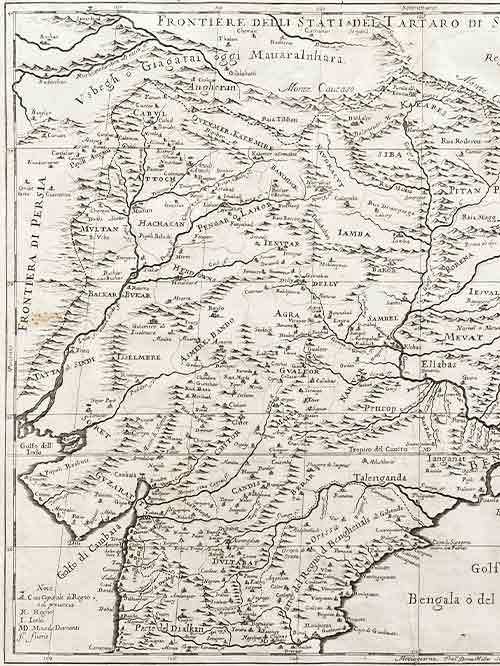
Pub. Rome by Giacomo Giovanni Rossi
Original engraved map
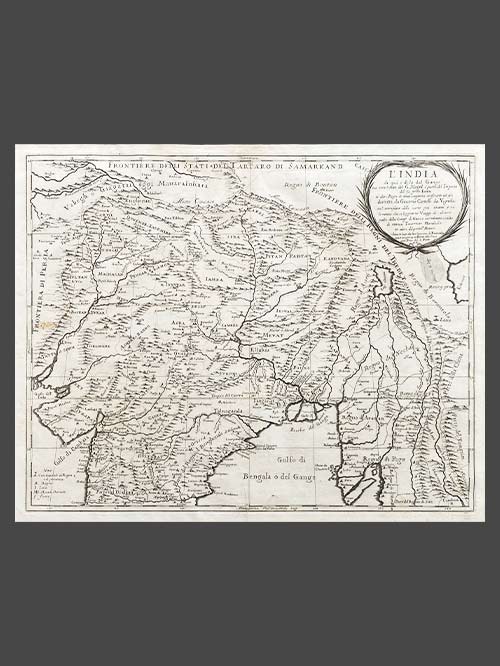
This is a fine representation of the Cantelli-Rossi map showcasing Northern India, Pakistan, Afghanistan, and Tibet. The map’s title includes a dedication to Jean-Baptiste Tavernier. It covers the northern frontier, reaching up to Cabul, Samarkand, Nupal, Boutan, and Lassa. Notably, the sources of the Indus and Ganges Rivers are accurately depicted on the map.
Cantelli (1643-1695), a geographer and cartographer from Montorsello near Vignola, began his journey in Bologna, where he pursued humanistic studies. In 1669, he became the secretary to Marquis Obizzo da Ferrara before traveling to Venice and eventually Paris. There, he established connections with prominent French geographers of the time, including Du Val, Nicola Sanson, and Michel Antoine Baudrand. Cantelli collaborated with the renowned De Rossi cartographic workshop, which published most of his maps. With a growing reputation as a skilled cartographer, Cantelli caught the attention of Pope Innocent XI and the Duke of Modena and Reggio Francesco II d’Este, both of whom sought him as their official cartographer. He chose to work for Francesco II and was appointed court geographer in November 1685. Over the following years, he produced numerous maps of European countries and territories. The majority of his maps were featured in the well-known Mercurio Geografico atlas, published in Rome by the De Rossi family.
Size (cms): 44(H) x 55(W)
Size (inches): 17.5(H) x 21.5(W)
Mounted Size (cms): 64(H) x 75(W)
Mounted Size (inches): 25(H) x 29.5(W)
-
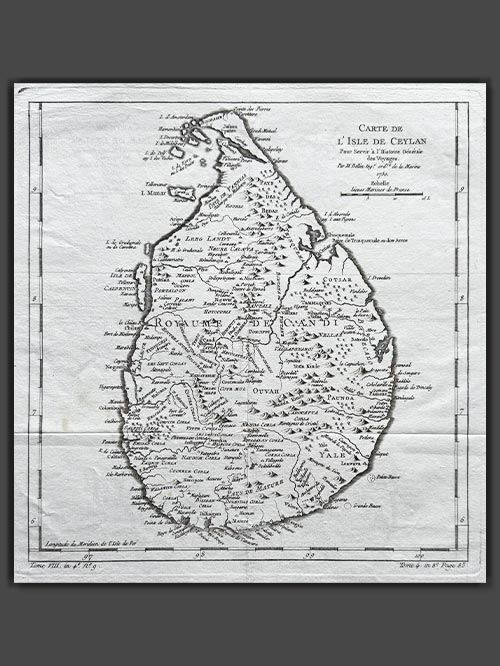
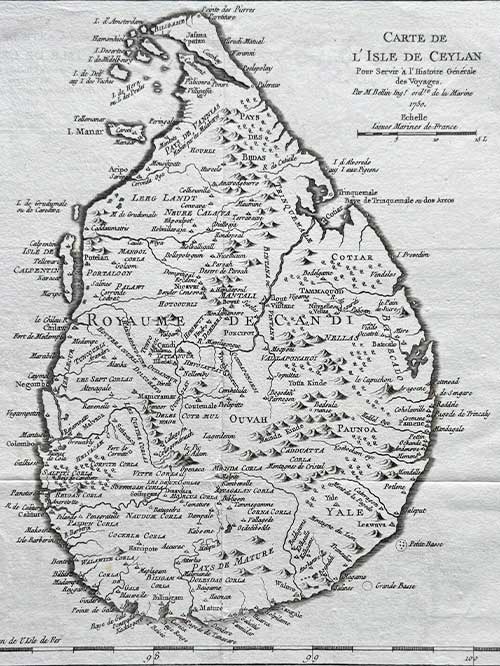
Original engraved plan by Jacques-Nicolas Bellin (1703–1772)
This finely engraved map, titled “Carte de L’Isle de Ceylon,” showcases Sri Lanka and originates from Jacques-Nicolas Bellin’s renowned Le Petit Atlas Maritime, first published in Paris in 1764.
Jacques-Nicolas Bellin was a pivotal figure in 18th-century cartography, serving as Hydrographer to the French Navy and the first Ingénieur Hydrographe at the French Dépôt des cartes et plans de la Marine. Over a 50-year career, Bellin produced hundreds of maps and charts celebrated for their accuracy and functionality, setting a high standard in European cartography. His works included major sea atlases such as Neptune François (1753), Hydrographie Française (1756), and the comprehensive Petit Atlas Maritime (1764), featuring 580–581 finely detailed charts. Bellin also contributed extensively to Diderot’s Encyclopédie and Abbé Prévost’s Histoire Générale des Voyages. A child of the Enlightenment, Bellin prioritized scholarly precision and cited his sources diligently, distinguishing his work from the more decorative styles of earlier mapmakers. His contributions cemented France’s dominance in cartography and influenced his student, Rigobert Bonne, who succeeded him at the Dépôt.
Image Size (cms): 28(H) x 26(W)
Image Size (inches): 11(H) x 10(W)
-
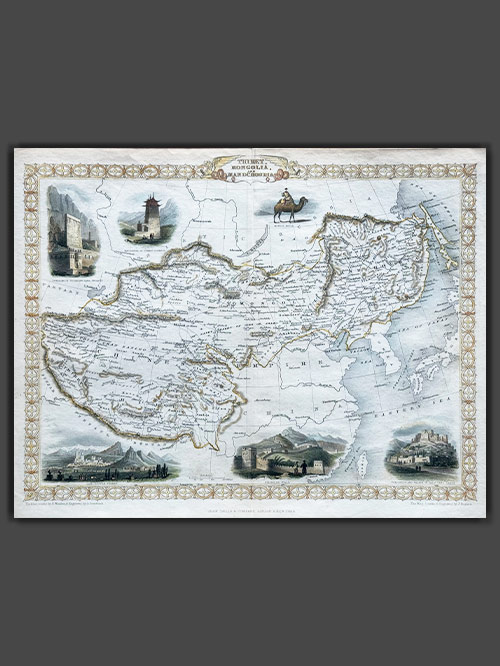
Pub. London
Original engraved map by J.Rapkin
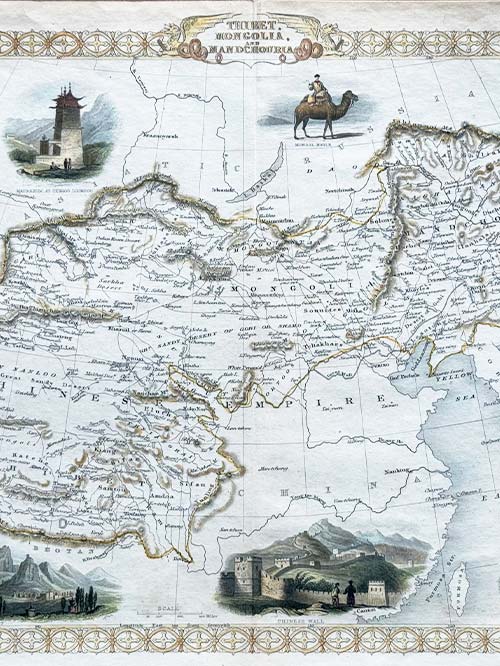
This decorative map of Tibet, Mongolia and Manchuria was published in 1851 by John Tallis and Company and is a stunning example of 19th-century cartography. Engraved by John Rapkin, with vignettes depicting Leh in Ladakh, a stretch of the Great Wall of China and Llhasa all framed by an ornate geometric border.
Tallis and Company were map publishers based in London. They traded under various names including L.Tallis, John Tallis and John Tallis & Co.between 1838 and 1850. In 1851 their maps were published by the ‘London Printing and Publishing Co’., in both London and New York. Although he only issued one World Atlas, John Tallis, the founder of the firm, is among the best known of all map makers. The maps with small vignettes issued between 1850 and 1851 to commemorate the Great Exhibition in London are considered the last great series of decorative maps. They combine fine cartographical detail within an attractive border. Around the map there are several small but decorative vignettes depicting particular views, buildings, local inhabitants or the flora and fauna of that region.
Size (cms): 26.5(H) x 34(W)
Size (inches): 10.5(H) x 13.5(W)
-
Gujarat
Mordants, painted and printed, and dyes on cotton cloth
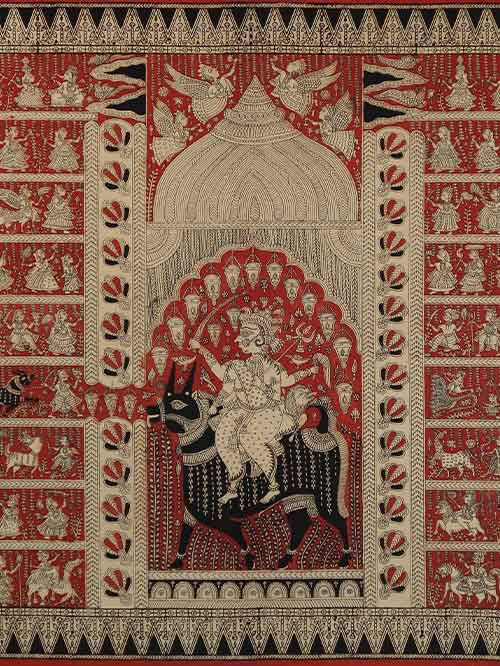
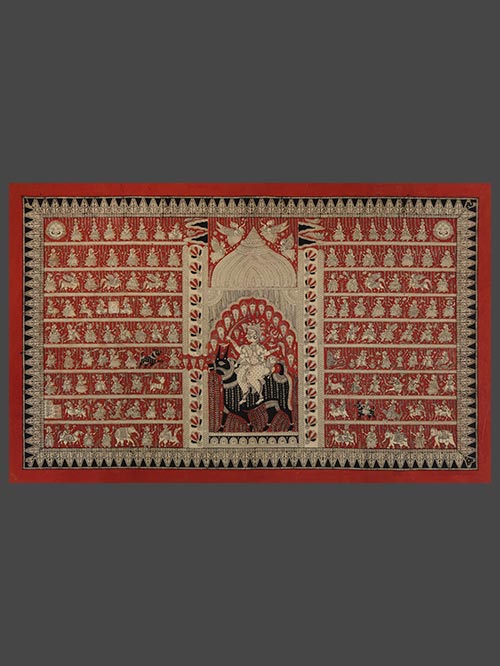
The cloth features a prominent, centrally placed iconic image of Meladi Mata enshrined within a pavilion. A folk goddess worshiped by the Vaghri community of Gujarat, Meladi Mata is identified by her mount, the black goat. The four armed Goddess is sitting astride a goat carrying various weapons and implements. Around the central form on either side, are horizontal registers demarcated with lines. These registers are filled with rows of small hand-printed figures; some, portraying devotees, while others are singular images representing mythological characters or deities. On the left side in the middle register, a priest is depicted leading a buffalo to the central pavilion. On the right side, one row depicts various manifestations of the mother-goddess such as Ambika on a Tiger and Khodiar on a crocodile. Above them are depictions from the Hindu Epics, Mahabharata and Ramayana including Rama and Lakshman hunting the two-headed deer Maricha. The overall composition with its rows of devotees replicates the grand religious ceremony that would take place. The pictorial area of the composition is framed by geometric and floral bands.
In many regions of India, various types of imaged temple cloths, executed with different materials and techniques, have originated to serve narrative, iconic, or ritual ends for diverse groups of believers. One such tradition is found in Gujarat, where temple cloths painted and printed with mordants that combine with dyes to fix their colors are a component in goddess worship. The cloths, which were formerly made in villages in the areas surrounding Ahmedabad but now probably are produced only in the city proper, honour the Great Goddess under the aspect of Mother Goddess (Mata) one or more of several manifestations peculiar to Gujarat, such as Ambika on tiger, Bahuchara on a cock, Meladi on a billy goat, Khodiar on a crocodile, and Vihat on a water buffalo.
Size (cms): 99(H) x 159(W)
Size (inches): 39(H) x 62.5(W)
-
Chettinad (Tamil Nadu)
cross stitch embroidery
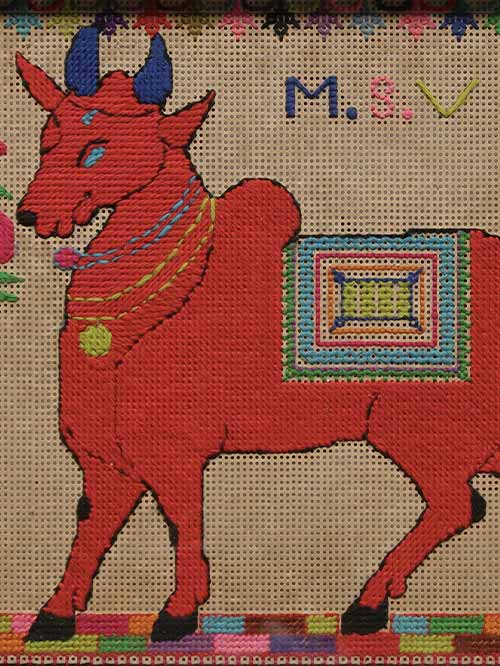
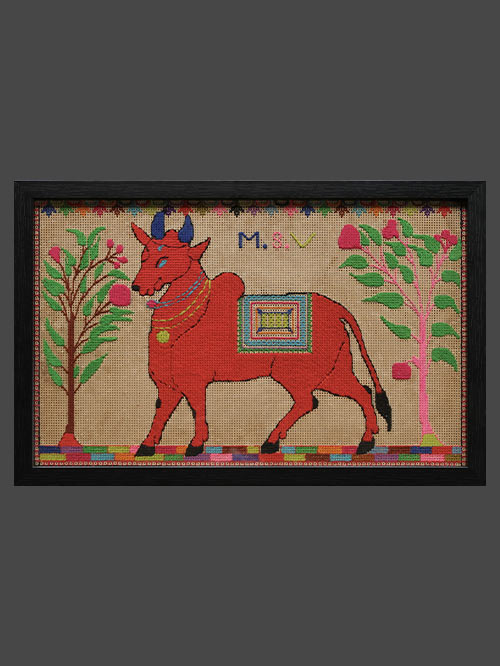
This whimsical cross stitch embroidery artwork depicts a bright orange caparisoned Nandi with blue horns stands facing left between two trees.
Framed Size (cms): 32(H) x 49(W)
Framed Size (inches): 12.5(H) x 19.5(W)
-
Pub. Rome by Giacomo Giovanni Rossi
Original engraved map
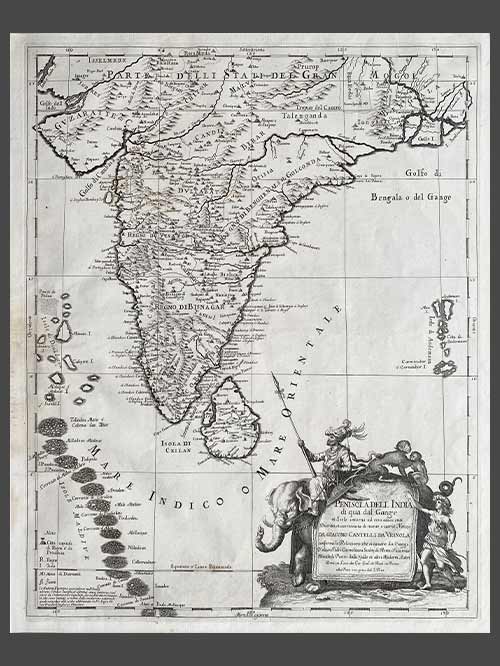
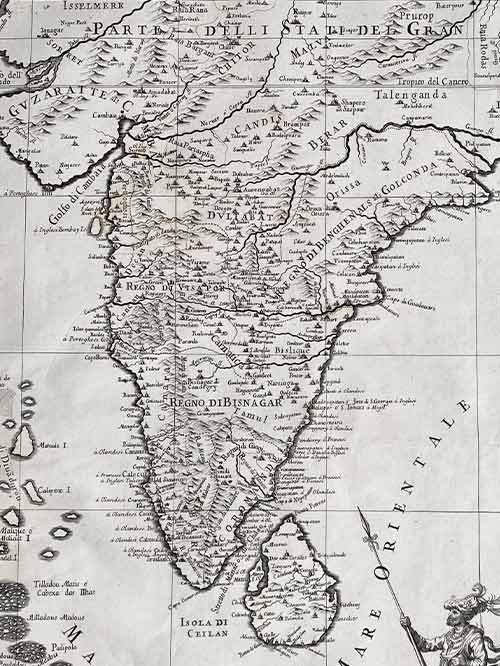
The scarce decorative map of India, Ceylon, the Maldives, and neighbouring regions, created by Cantelli da Vignola and published in Rome by Rossi, offers one of the most detailed depictions of the area from that period. It features an ornate cartouche adorned with an elephant. The map was published in the ‘Mercurio geografico’ collection of maps, published between 1660 and 1730 by the De Rossi typography. The maps in the collection are exquisitely copied and engraved by renowned artisans of the time and also include works of esteemed cartographers such as Michele Antonio Baudrand, Nicolas Sanson and Giovanni Antonio Magini.
Cantelli, a geographer and cartographer from Montorsello near Vignola, began his journey in Bologna, where he pursued humanistic studies. In 1669, he became the secretary to Marquis Obizzo da Ferrara before traveling to Venice and eventually Paris. There, he established connections with prominent French geographers of the time, including Du Val, Nicola Sanson, and Michel Antoine Baudrand. Cantelli collaborated with the renowned De Rossi cartographic workshop, which published most of his maps. With a growing reputation as a skilled cartographer, Cantelli caught the attention of Pope Innocent XI and the Duke of Modena and Reggio Francesco II d’Este, both of whom sought him as their official cartographer. He chose to work for Francesco II and was appointed court geographer in November 1685. Over the following years, he produced numerous maps of European countries and territories. The majority of his maps were featured in the well-known Mercurio Geografico atlas, published in Rome by the De Rossi family.
Size (cms): 55(H) x 44(W)
Size (inches): 21.5(H) x 17.5(W)
Mounted Size (cms): 75(H) x 64(W)
Mounted Size (inches): 29.5(H) x 25(W)
-
Nathdwara (Rajasthan)
Cotton, painted on pigments
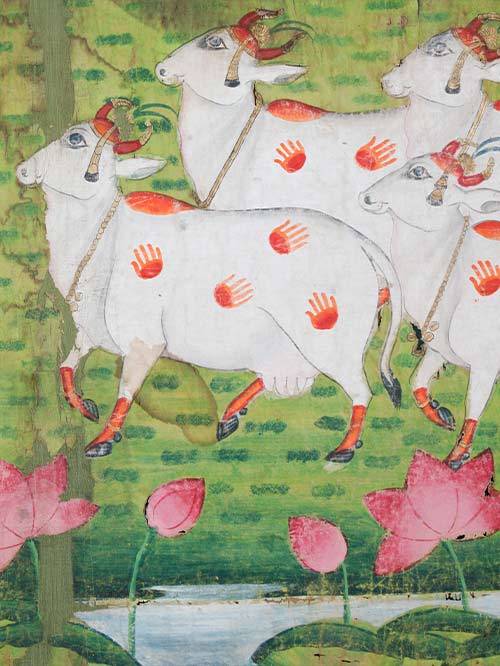
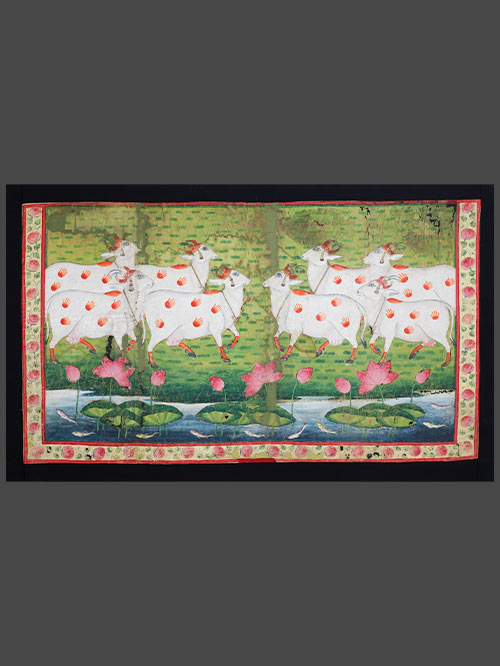
An attractive small Pichhwai depicting eight white cows grouped in a meadow with a lotus and fish filled stream in the foreground. The cows are bedecked and have henna on their horns and hooves. Large handprints painted in saffron henna cover bodies. A floral border surrounds the panel. This pichhwai would have either accompanied a larger pichhwai in a prominent shrine or constituted part of a small domestic shrine.
Gopashtami is a festival that commemorates Krishna’s elevation from a young herder of calves to full cowherd. Krishna grows into the perfect cowherd, the one all the cows heed, answering to the golden strains of his flute. At Nathdwara the cows, decked in their finest, are brought into the haveli. There is a playful spirit about this festival that is well expressed in this pichhwai. The cows, gentle creatures with limpid eyes and expressive ears, are constant reminders of Vraja and Krishna’s childhood occupation as cowherd.
Size (cms): 75(H) x 124(W)
Size (inches): 29.5(H) x 49(W)
-
Nathdwara (Rajasthan)
Cotton, painted on pigments
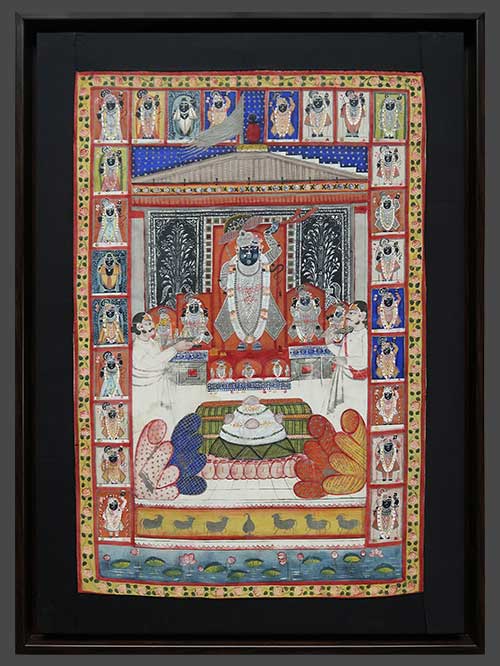
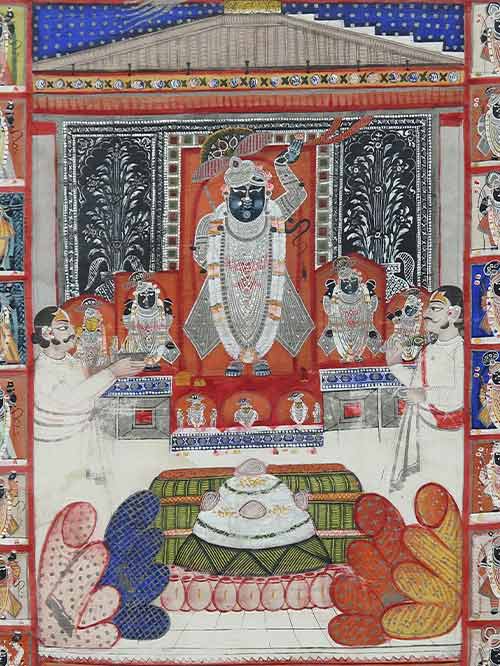
A scarce small Pichhwai celebrating Sapta Swarupa Annakutotsava, with the central figure of Srinathji accompanied by his seven forms (Sapta Swarupa) and attended by two goswamis. Srinathji and the sath swarupa, are all richly adorned and bejewelled and they stand upon an elevated altar in front of a saffron covered thada vastra. A richly embroidered tree-of-life hanging encrusted with jewels and pearls is placed behind the shrine.
A veritable feast of chhappan bhoga (fifty-six offerings) in the form of large mounds of rice and curd, festooned with pink sweet meats are laid out in front of Srinathji. These offering commemorate the grand festival of Annakuta, the largest yearly festival celebrated at Nathdwara, which is held the day after Diwali. The festival is celebrated in recognition of an episode in the life of Krishna when he persuaded the villagers of Vraj to present their harvest offerings to the spirit of Mount Govardhana, instead of Indra. The mountains of rice symbolically represent Mount Govardhana which are topped by a sweet cake called gunja representing the head of Vishnu flanked by four more signifying the four ayudhyas or weapons of Vishnu.
The pichhwai is bordered by bands depicting Srinatji in twenty-four different Darshan attires on its sides and top and a row of nandis (cows) above a lotus filled lake below.
Size (cms): 81(H) x 59(W)
Size (inches): 32(H) x 23(W)
-
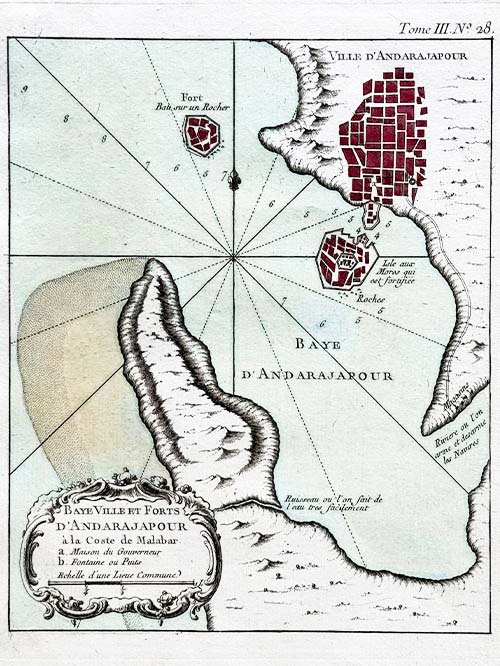
Original engraved plan by Jacques-Nicolas Bellin (1703–1772)
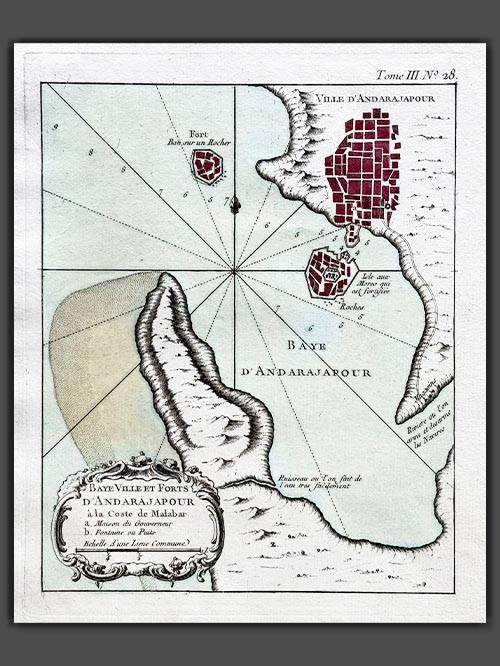
This finely engraved map depicts Andarajapour (also known as Rajapur), taken from Jacques-Nicolas Bellin’s Le Petit Atlas Maritime, first published in Paris in 1764. Rajapur, a small yet historically significant port on Maharashtra’s Konkan coast, was a vital maritime center during the Bijapur Sultanate, benefiting from a navigable creek that connected it to the Arabian Sea. In 1668, under Shivaji’s reign, the French East India Company was granted permission to establish a factory in Rajapur, aiming to capitalize on the export of spices and textiles.
Jacques-Nicolas Bellin was a pivotal figure in 18th-century cartography, serving as Hydrographer to the French Navy and the first Ingénieur Hydrographe at the French Dépôt des cartes et plans de la Marine. Over a 50-year career, Bellin produced hundreds of maps and charts celebrated for their accuracy and functionality, setting a high standard in European cartography. His works included major sea atlases such as Neptune François (1753), Hydrographie Française (1756), and the comprehensive Petit Atlas Maritime (1764), featuring 580–581 finely detailed charts. Bellin also contributed extensively to Diderot’s Encyclopédie and Abbé Prévost’s Histoire Générale des Voyages. A child of the Enlightenment, Bellin prioritized scholarly precision and cited his sources diligently, distinguishing his work from the more decorative styles of earlier mapmakers. His contributions cemented France’s dominance in cartography and influenced his student, Rigobert Bonne, who succeeded him at the Dépôt.
Image Size (cms): 24(H) x 19(W)
Image Size (inches): 9.5(H) x 7.5(W)
-
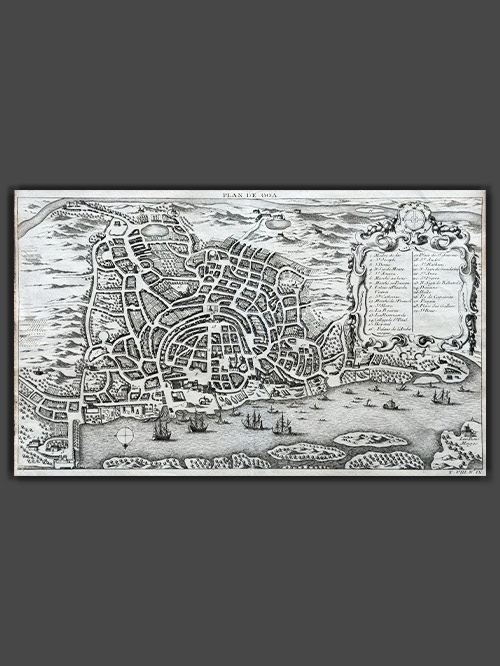
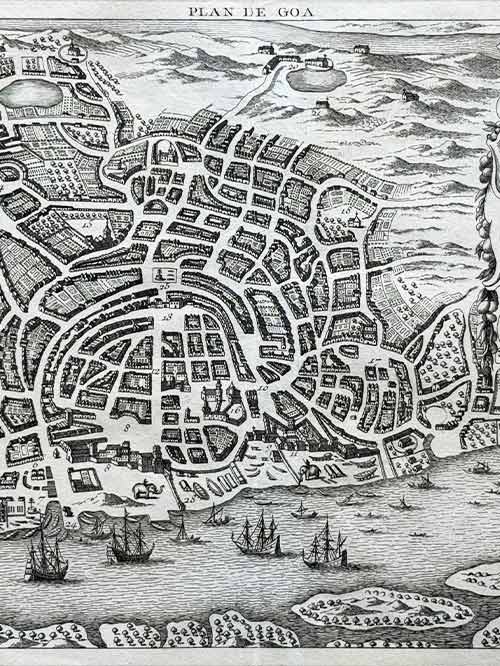
Original engraved plan by Jacques-Nicolas Bellin (1703–1772)
A detailed city map of Old Goa, situated on the banks of the Mandovi River in India. The map features a decorative cartouche, a coat of arms, and ships offshore, reflecting Goa’s historical significance as a maritime and cultural hub during the Portuguese era. Goa was seized by Afonso de Albuquerque in 1510 and became a key hub for maritime trade with Africa, the Persian Gulf, and Asia, forming part of a triangular trade network with Macau and Nagasaki. It also served as the Jesuit Order’s eastern headquarters under St. Francis Xavier. Renowned for its architecture, including the Viceroy’s Palace and Se Cathedral, Goa flourished as a commercial and religious center. Despite challenges from rising Dutch power, Goa remained the “Golden City” of Portuguese controlled Asia.
Jacques-Nicolas Bellin was a pivotal figure in 18th-century cartography, serving as Hydrographer to the French Navy and the first Ingénieur Hydrographe at the French Dépôt des cartes et plans de la Marine. Over a 50-year career, Bellin produced hundreds of maps and charts celebrated for their accuracy and functionality, setting a high standard in European cartography. His works included major sea atlases such as Neptune François (1753), Hydrographie Française (1756), and the comprehensive Petit Atlas Maritime (1764), featuring 580–581 finely detailed charts. Bellin also contributed extensively to Diderot’s Encyclopédie and Abbé Prévost’s Histoire Générale des Voyages. A child of the Enlightenment, Bellin prioritized scholarly precision and cited his sources diligently, distinguishing his work from the more decorative styles of earlier mapmakers. His contributions cemented France’s dominance in cartography and influenced his student, Rigobert Bonne, who succeeded him at the Dépôt.
Image Size (cms): 23(H) x 35.5(W)
Image Size (inches): 9(H) x 14(W)