“Horse Utsav Murti” has been added to your cart.
View cart
-


Karnataka
brass alloy
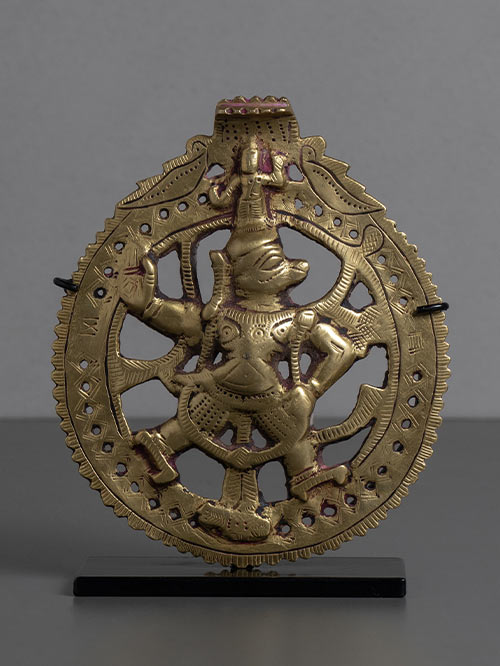
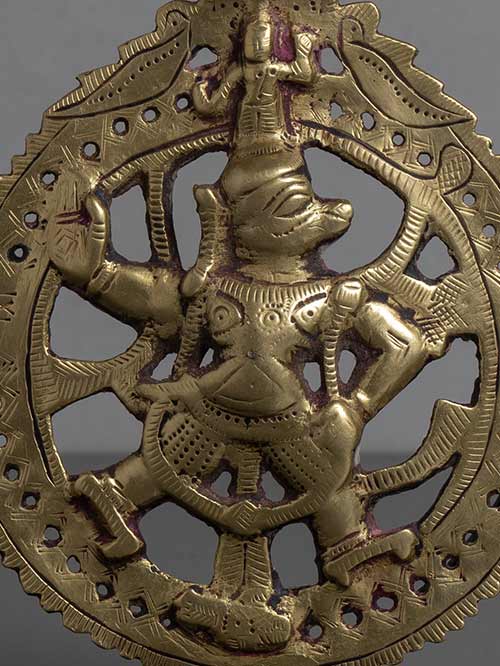
A stylised repoussé circular plaque depicting striding Hanuman carrying a diminutive Rama on his head. Hanuman has his right hand raised in the Abhaya Mudra, a gesture of reassurance and safety, while his left hand he carries the magic plant which will cure Lakshmana (brother of Rama) who was wounded on the field of battle. Hanuman wears a pair of padukas on his feet beneath which lies a slain enemy. Two parrots and a five headed snake (naga) forms a canopy above the group. Such pendants would have been worn by itinerant Vaishnava mendicants.
Hanuman is a popular deity who is worshipped all over India, particularly in villages and in the South. His story is found in the Ramayana where he is the ubiquitous servant of Rama, the epitome of devoted service and loyalty. His search for the heroine Sita, captured by Ravana, illustrates his superhuman powers and zealous performance of the tasks that were given to him.
Size (cms): 13.5(H) x 11.5(W) x 4(D)
Size (inches): 5.5(H) x 4.5(W) x 1.5(D)
-
Karnataka
brass alloy
A stylised repoussé circular plaque depicting striding Hanuman carrying a diminutive Rama on his head. Hanuman has his right hand raised in the Abhaya Mudra, a gesture of reassurance and safety, while his left hand he carries the magic plant which will cure Lakshmana (brother of Rama) who was wounded on the field of battle. Hanuman wears a pair of padukas on his feet beneath which lies a slain enemy. Two parrots and a five headed snake (naga) forms a canopy above the group. Such pendants would have been worn by itinerant Vaishnava mendicants.
Hanuman is a popular deity who is worshipped all over India, particularly in villages and in the South. His story is found in the Ramayana where he is the ubiquitous servant of Rama, the epitome of devoted service and loyalty. His search for the heroine Sita, captured by Ravana, illustrates his superhuman powers and zealous performance of the tasks that were given to him.
Size (cms): 13.5(H) x 11(W) x 4(D)
Size (inches): 5.5(H) x 4.5(W) x 1.5(D)
-
Central India
brass alloy
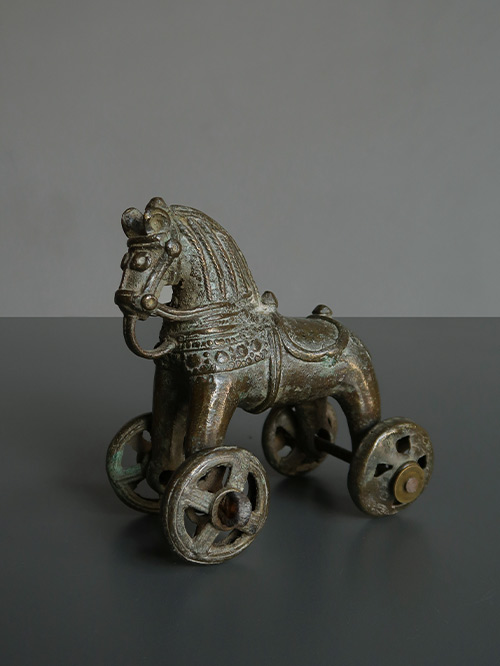
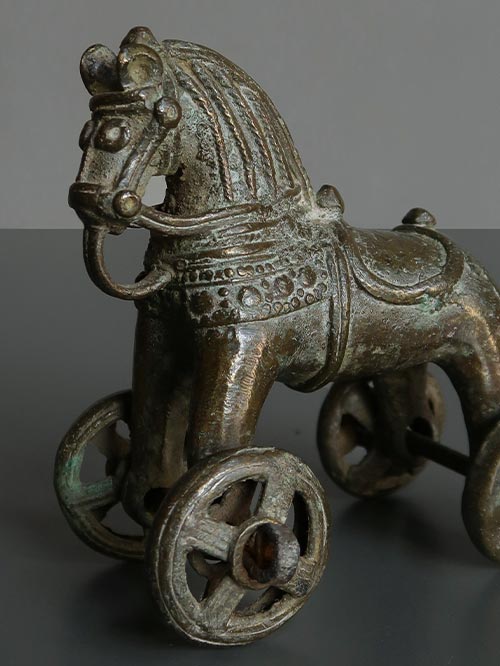
A lovely diminutive figure of a horse on wheels adorned with trappings and a decorated saddle cloth secured by ropes. Temple toys were used as ritual display in temples during important festivals such as Holi, Shivaratri and Durga Puja.
The horse played a pivotal role in establishing the supremacy of kings, as demonstrated, for instance by the great horse sacrifice, the Ashvamedha, which might have been established in the course of the Vedic period. Equestrian motifs appear prominently in Indian art, for example in Orissan sculpture of the 12th and 13th centuries, and in that of the late Vijaynagara and Nayak periods (early 16th to early 18th century) in southern India. There is a branch of literature specialising in the training of horses, which contains detailed passages on colouring, proportions, gait, auspicious and inauspicious marks and lists of appropriate names for horses.
Size (cms): 16.5(H) x 15.25(W) x 11(D)
Size (inches):6.5(H) x 6(W) x 4.5(D)
-
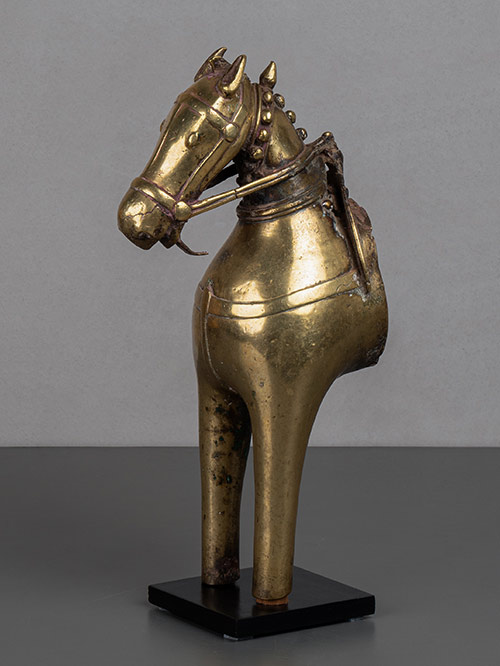
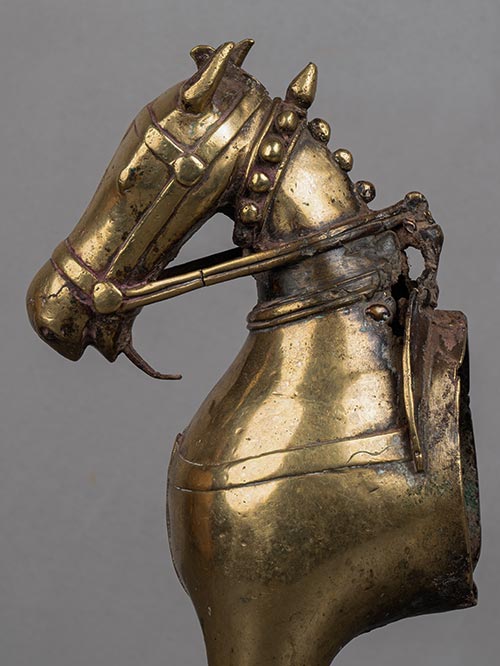
Maharashtra/ Karnataka
brass alloy
This finely modelled brass horse is most likely a procession image or Utsav Murti. Its primary function was to be used in festivals and processions outside the temple. The ‘half horse’ would have been kept against a backdrop adorned with floral garlands and vermillion.
Shiva was, and still is, the tutelary deity of Maharashtra, originally being a tribal protective deity. As Khandoba, he was widely worshipped throughout this region and contiguous areas of Karnataka, Rajasthan and Andra Pradesh where he is also called Mallanna and Khanderao. The traditional vahana (vehicle) of Shiva is Nandi, the bull, however in the form of Khandoba he is usually portrayed on horseback and occasionally on a camel or elephant.
Size (cms): 35(H) x 10.5(W) x 18(D)
Size (inches): 14(H) x 4(W) x 7(D)
-
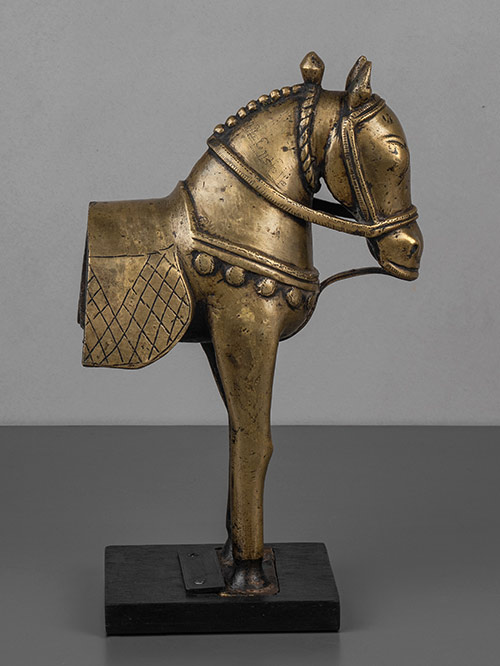
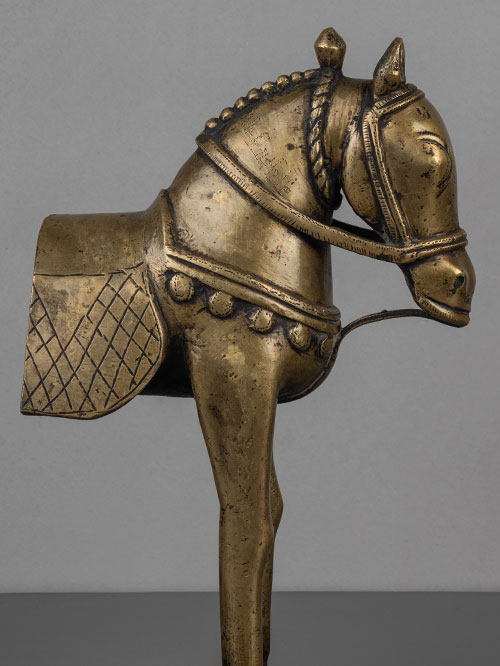
Maharashtra/ Karnataka
brass alloy
This finely modelled brass horse is most likely a procession image or Utsav Murti. Its primary function was to be used in festivals and processions outside the temple. The ‘half horse’ would have been kept against a backdrop adorned with floral garlands and vermillion.
Shiva was, and still is, the tutelary deity of Maharashtra, originally being a tribal protective deity. As Khandoba, he was widely worshipped throughout this region and contiguous areas of Karnataka, Rajasthan and Andra Pradesh where he is also called Mallanna and Khanderao. The traditional vahana (vehicle) of Shiva is Nandi, the bull, however in the form of Khandoba he is usually portrayed on horseback and occasionally on a camel or elephant.
Size (cms): 38(H) x 22.5(W) x 14(D)
Size (inches): 15(H) x 9(W) x 5.5(D)
-
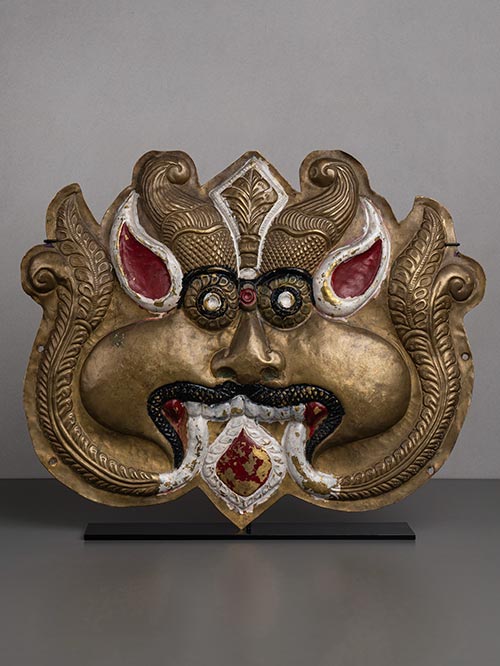
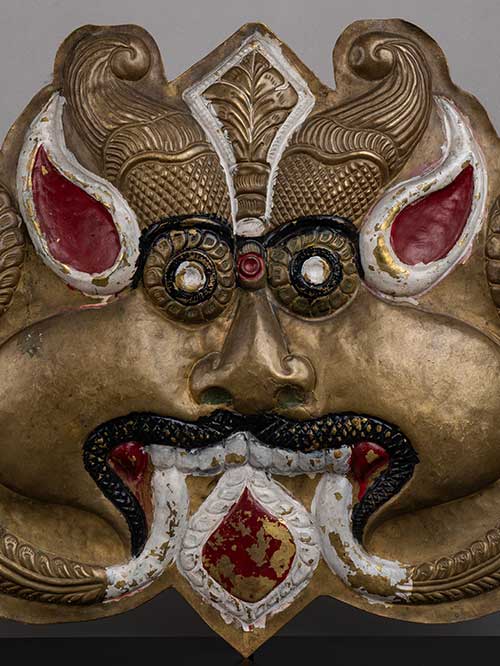
Karnataka
Brass alloy with pigments
An exceptional, large Kirtimukha ‘ face of glory,’ plaque with bulbous eyes, small pointed ears and flaring nostrils. The Kirtimukha’s open mouth with large exposed fangs and exposed tongue gives it a mischievous appearance. Two floral sprigs emerge from either side of the kirtimukha’s face.
Kirtimukha is the name given to the grimacing face of a lion or Yali face depicted above the doorways of sacred precincts and on the aureole (prabhamandala) behind divine images. Its redoubtable aspect is supposed to avert malignant influences and to protect the devotees. This motif is also used in jewellery, eg on girdle clasps.
Size (cms): 46(H) x 55(W) x 7.5(D)
Size (inches): 18(H) x 21.5(W) x 3(D)
-
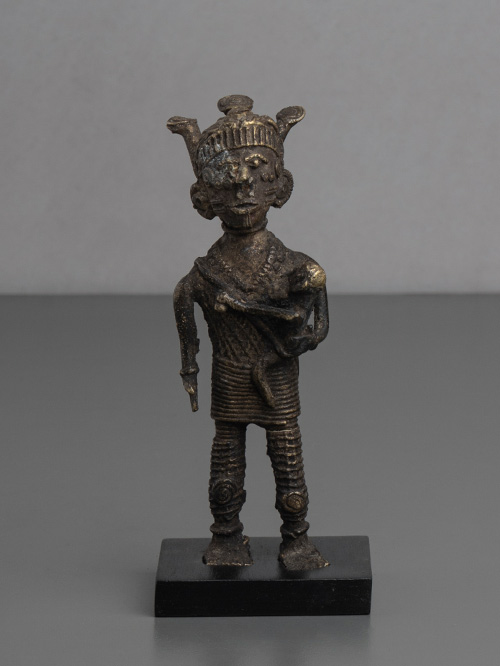
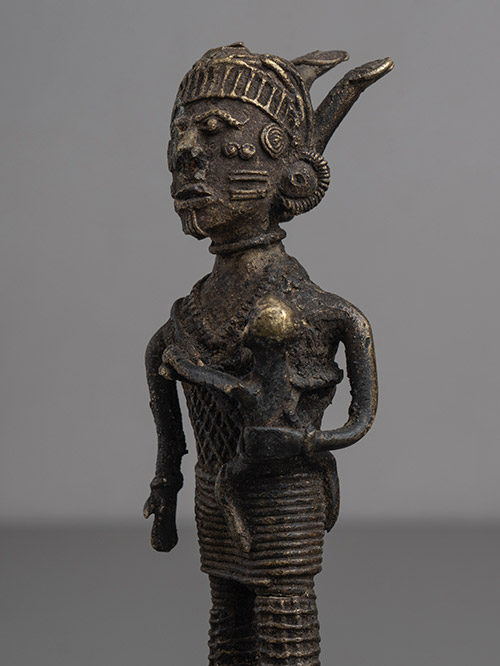
Orissa (Kondh Tribe)
bronze
Within the hill and forest-dwelling Kondh tribes of India, figurative bronze sculptures of humans served as memorials to ancestors. Female figures were often depicted carrying children or with water vessels on their heads, while men were fashioned as musicians, hunters, or farmers. These sculptures were kept in baskets (burka) in adjacent rooms of the house (kodongijo) for use in rituals involving ancestor veneration and memory.
The Kondh tribes, indigenous to eastern India, possess a rich cultural heritage deeply rooted in their close connection to the land. Primarily agrarian, they cultivate crops like millet and rice while engaging in hunting and gathering. The Kondh people believe in building a vast community with the deceased, viewing death as a transition from one form of life to another invisible one. The involvement of ancestor figures in daily life expresses the clan’s desire for continuity, harmony, and solidarity between the material and immaterial worlds. As such, these figures were utilized in all social and religious activities.
Size (cms): 14(H) x 6(W) x 6(D)
Size (inches): 5.5(H) x 2.5(W) x 2.5(D)
-
Karnataka
brass alloy
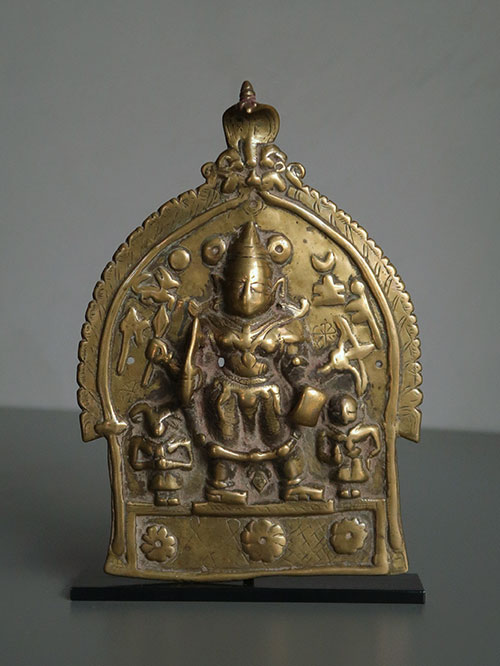
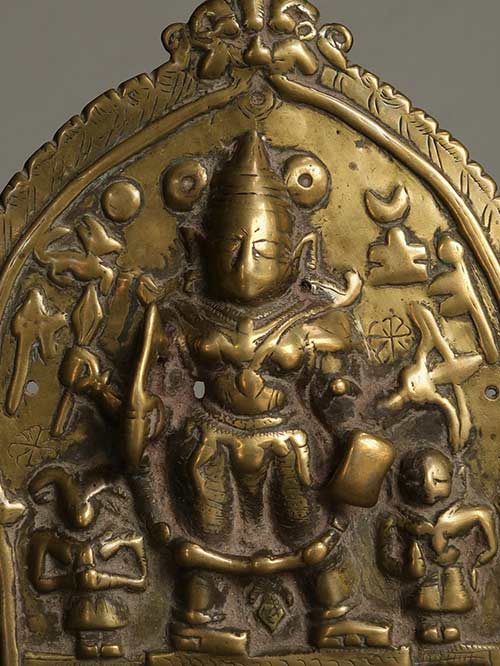
A fine brass repousse plaque. The central standing figure of Virabhadra is flanked by the diminutive figures of Bhadrakali and the goat headed Daksha. He is shown with fours arms in which he carries his usual attributes of bow, arrow, sword and shield. He wears a tall crown, a collar, two necklaces and sandals. A garland of skulls decorates the bottom of his dhoti (loincloth). The figures are placed within an arch or prabhavali at the centre of which is a kirtimukha (face of glory). A naga (serpent) forms a canopy above Virabhadra’s head. Symbols of the sun, moon, nandi and lingam are depicted on the plaque. This deity is a form of Shiva who created him to act as his henchman in his quarrel with Daksha. Virabhadra is worshipped especially in southern Maharashtra and Karnataka.
Size (cms): 24 (H) x 16 (W)
Size (inches): 9.5 (H) x 6.5 (W)
-
Coastal Karnataka (Bhuta culture)
Wood
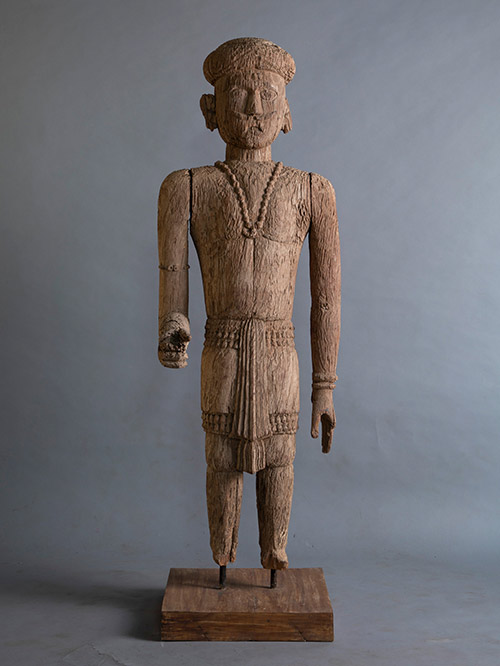
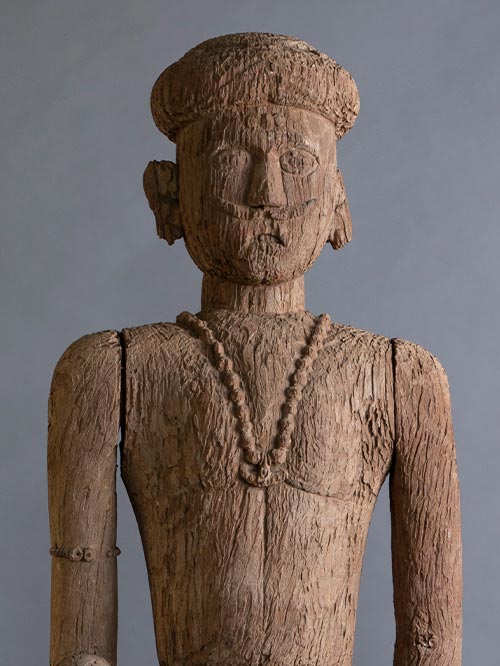
A rare figure of a male donor chief. He wears a turban, has a prominent moustache and is decked with typical jewellery including a single strand necklace with a pendant, armlet and earrings. He wears an unstitched garment tied at the waist with pleats at the front, called a mundu.
The bhuta tradition is popular on the Malabar coast. Bounded by the dramatic sweep of the forested ghats to the east and the Arabian sea to the west, and encircled by rivers, the South Kanara district of coastal Karnataka has enjoyed relative geographic isolation until recent years. This has enabled the region to retain specific pre-Hindu belief systems and associated rituals, virtually intact, over several hundred years. These practices have a distinct identity of their own, although they have become linked in a variety of ways with mainstream Hinduism. Though now primarily confined to Coastal Karnataka, Bhuta cults once existed all over India under different names and forms. The factions, which are of considerable antiquity, have much in common with those of the yakshas (mysterious semi-divine beings), for instance.
Size (cms): 147(H) x 44(W) x 54(D)
Size (inches): 58(H) x 17.5(W) x 21.5(D)
-
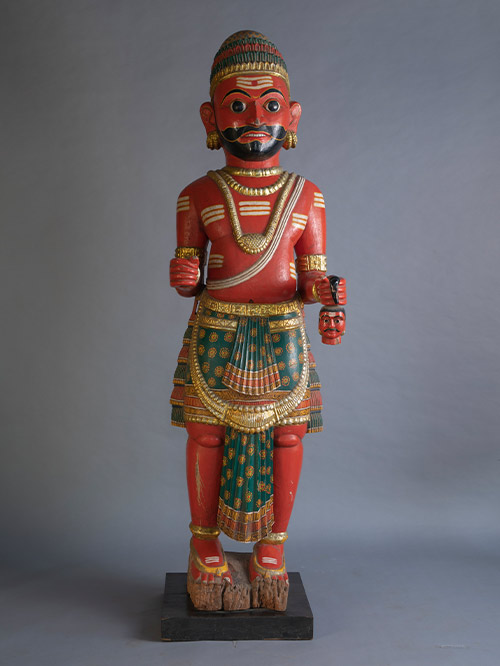
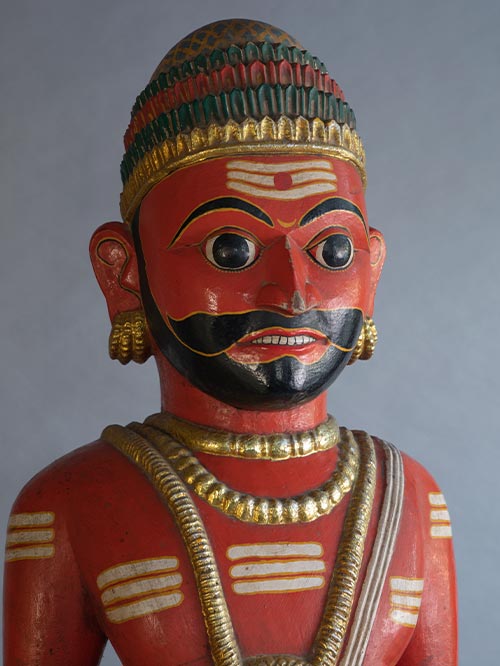
Coastal Karnataka (Bhuta culture)
Wood
A rare figure of a Virabhadra in the form of a Bhuta. He wears a turban, has a prominent moustache and beard and is decked with typical jewellery including a single strand necklace with a pendant, armlet and earrings. He wears an unstitched garment tied at the waist with pleats at the front, called a mundu. He carries in one hand the head of a slain enemy and in the other, he would have held a sword.
The bhuta tradition is popular on the Malabar coast. Bounded by the dramatic sweep of the forested ghats to the east and the Arabian sea to the west, and encircled by rivers, the South Kanara district of coastal Karnataka has enjoyed relative geographic isolation until recent years. This has enabled the region to retain specific pre-Hindu belief systems and associated rituals, virtually intact, over several hundred years. These practices have a distinct identity of their own, although they have become linked in a variety of ways with mainstream Hinduism. Though now primarily confined to Coastal Karnataka, Bhuta cults once existed all over India under different names and forms.
Size (cms): 188(H) x 56(W) x 56(D)
Size (inches): 74(H) x 22(W) x 22(D)
-
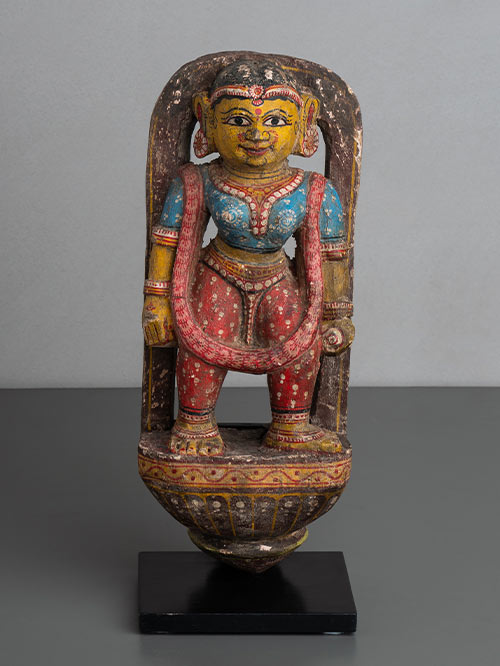
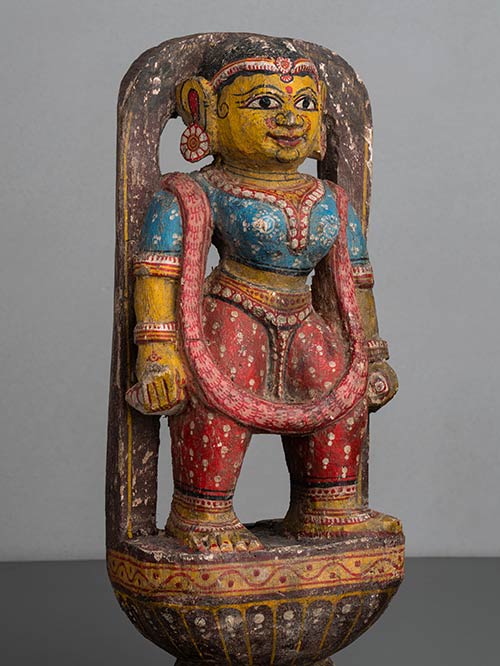
Orissa
Wood, polychromed
An elegant figure of an apsara wearing a patterned blouse. The apsara wears extensive jewellery; including multiple hand and leg ornaments. She has a stylised form with a narrow waist and large breasts and carries a conch in either hand. She has a full face with a pronounced chin, large arched eyebrows over bulbous eyes and a gentle smile.
Apsaras means ‘essence of the waters’ or ‘moving in or between the waters’. The Apsaras are divine beauties, the dancers of the gods, who dwell in Indra’s paradise, svarga (heaven). Mistresses of the Gandharva’s (semi divine beings) and, occasionally, of men, they can assume any form at will. Generally they are believed to have originated from the churning of the ocean, alone with the wish fulfilling Parijata, their favoured tree. They are often sent by the gods to seduce Rishis (holy men) and ascetics. Heroes who fall in battle are swept away to Svarga by the Apsaras. They are reputed to dwell in trees along with the Gandharvas. The chief of the Apsaras is Urvashi.
Size (cms): 33.5(H) x 13(W) x 10(D)
Size (inches): 13(H) x 5(W) x 4(D)
-
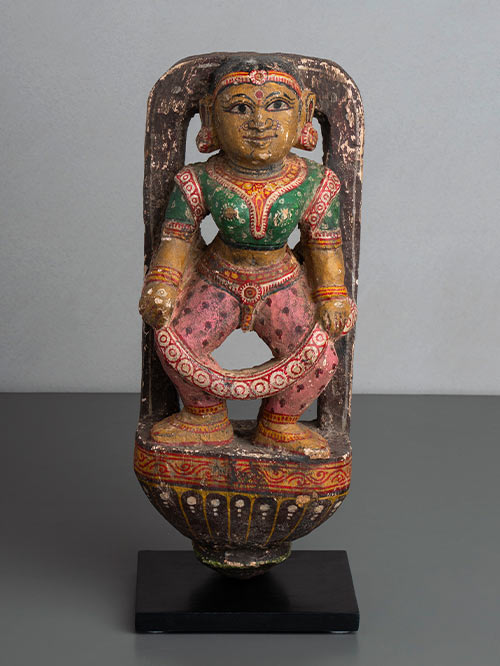
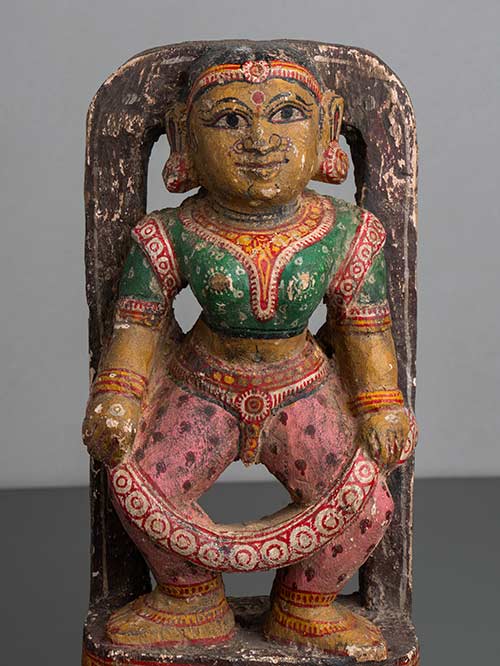
Orissa
Wood, polychromed
An elegant figure of an apsara wearing a patterned blouse. The apsara is adorned with extensive jewelry, including multiple hand and leg ornaments. She has a stylised form with a narrow waist and large breasts, and she holds a floral garland in front of her. Her full face features a pronounced chin, large arched eyebrows over bulbous eyes, and a gentle smile.
Apsaras means ‘essence of the waters’ or ‘moving in or between the waters’. The Apsaras are divine beauties, the dancers of the gods, who dwell in Indra’s paradise, svarga (heaven). Mistresses of the Gandharva’s (semi divine beings) and, occasionally, of men, they can assume any form at will. Generally they are believed to have originated from the churning of the ocean, alone with the wish fulfilling Parijata, their favoured tree. They are often sent by the gods to seduce Rishis (holy men) and ascetics. Heroes who fall in battle are swept away to Svarga by the Apsaras. They are reputed to dwell in trees along with the Gandharvas. The chief of the Apsaras is Urvashi.
Size (cms): 33.5(H) x 13(W) x 10(D)
Size (inches): 13(H) x 5(W) x 4(D)
-
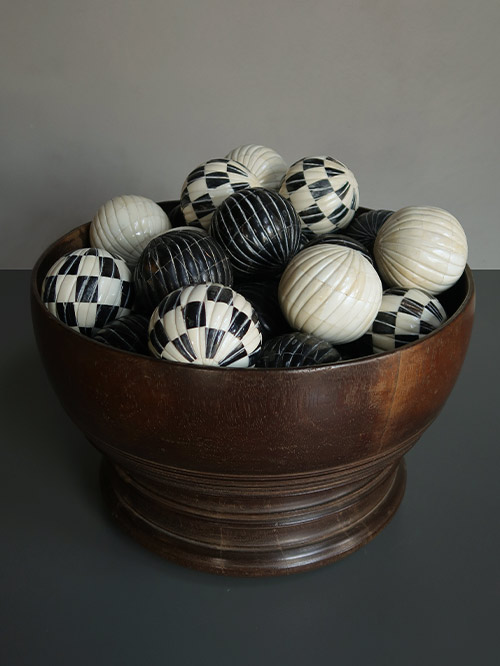
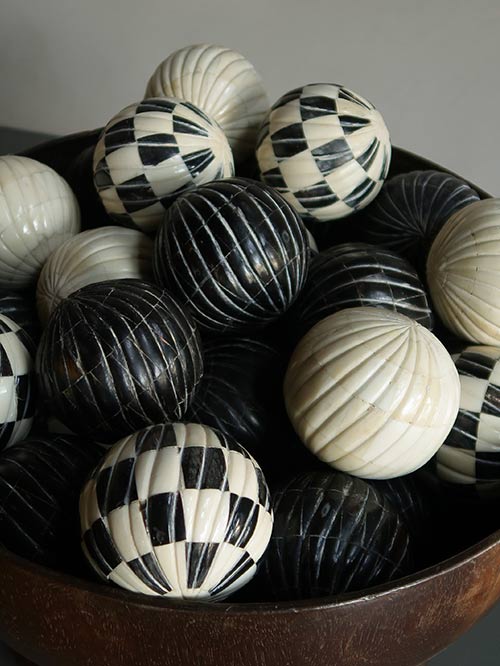
Rajasthan
Bone and horn
A group of decorative coloured balls, some black, some white, and others checkered.
Size (cms): 7.5(H) x 7.5(Diam)
Size (inches): 3(H) x 3(Diam)
-
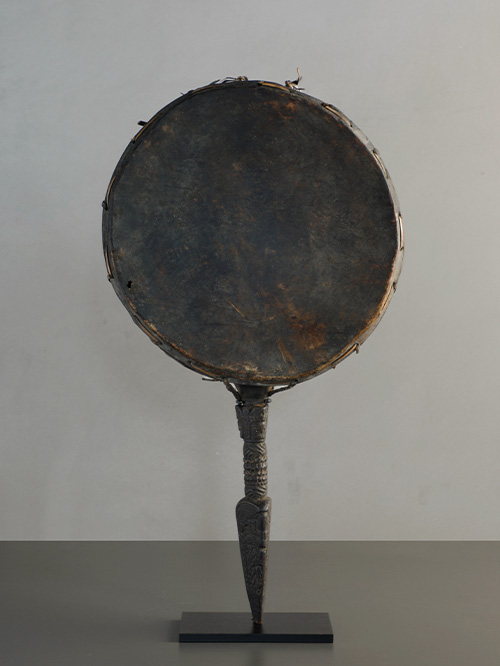
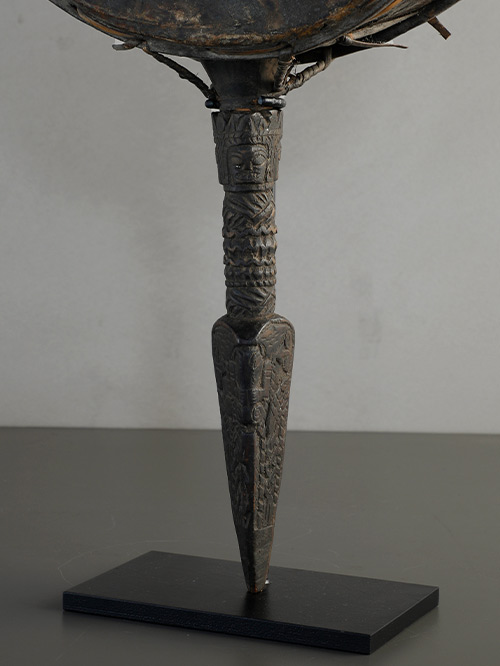
Nepal
Wood, hide and cane
The dhyangro is a double-headed frame drum used by jhakris (tribal shamans), especially those of the Magars, the Kirati, and the Tamang, in the Middle Hills region of the Himalayas in Nepal. It is considered an ancient tool of magic and has been used by shamans for centuries to enter a trance and channel benevolent helping deities. The drum is played by holding the handle in the left hand, with the frame level with the face, and striking the outer head with the right hand holding a curved stick.
The drum has hide drumheads stretched over a circular wooden rim, secured with rattan strips. The handle is elongated and carved to resemble a phurba or esoteric dagger found in Tibetan Buddhist ritual. The handle features ornate relief carving depicting three deity heads and many shamanistic symbols, such as endless knots and caduceus-like symbols, that encircle it.
Size (cms): 65(H) x 35(W) x 14(D)
Size (inches): 25.5(H) x 14(W) x 5.5(D)
-
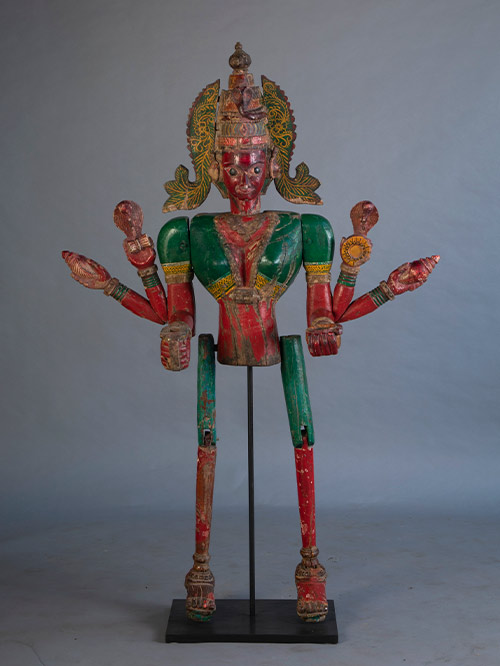
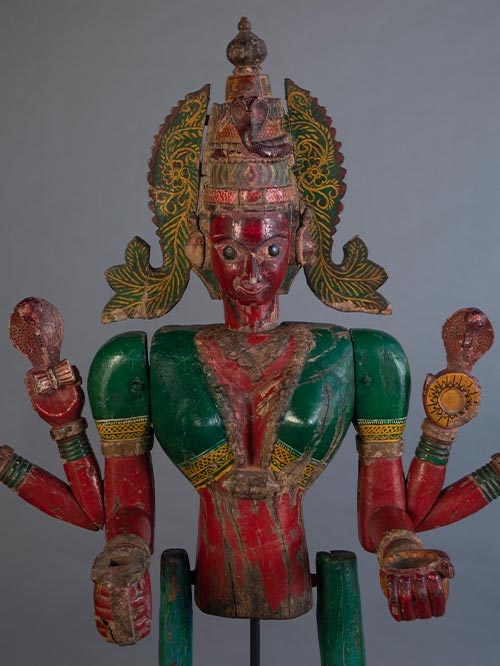
Karnataka
Wood, polychromed
An attractive multi-armed articulated standing figure of the Goddess Durga. Painted in a deep red, she wears a patterned green and yellow blouse. Her hands are adorned with multiple bangles and she carries a pair of nagas and conches in her upper hands with a blood bowl and sword in her lower two hands. An elaborate tiered crown sits on her head, decorated with geometric symbols and a serpent (naga).
Durga – “The Unconquerable form of Devi” – Durga is the most splendid manifestation of Devi. Virginal and sublime, contain within her the power of all the gods combined, she is the invincible power of Nature who triumphs over those who seek to subjugate her.
Size (cms): 132(H) x 88(W) x 31(D)
Size (inches): 52(H) x 34.5(W) x 12(D)
-
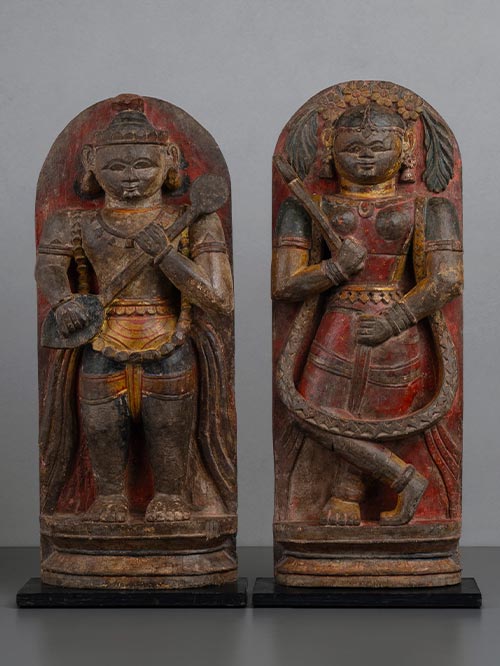
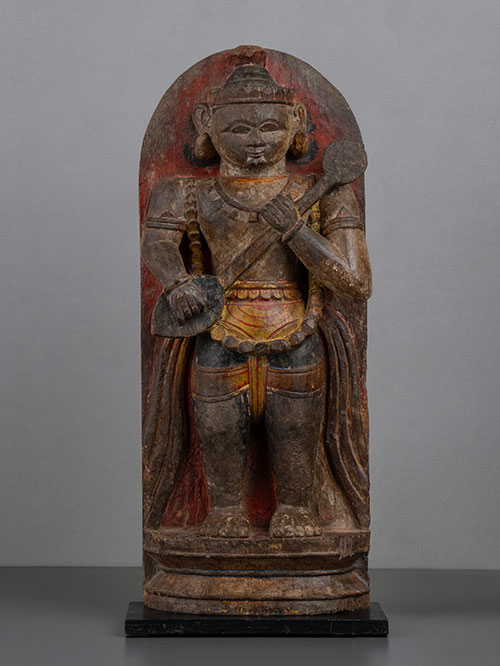
Orissa
Wood, polychromed
This beautiful pair of richly polychromed brackets depicts a musician carrying a string instrument and an attendant figure holding a chauri (fly-whisk). Standing on stepped bases, both figures are adorned with rich garments and wear long floral garlands. These figures likely originated from a natamandir, an addition to the shrine often adorned with sculptures of Devadasis and musicians.
Size (cms): 50(H) x 21(W) x 10(D)
Size (inches): 19.5(H) x 8.5(W) x 4(D)