“Carved Ceiling Panel” has been added to your cart.
View cart
-
Tamil Nadu
Wood
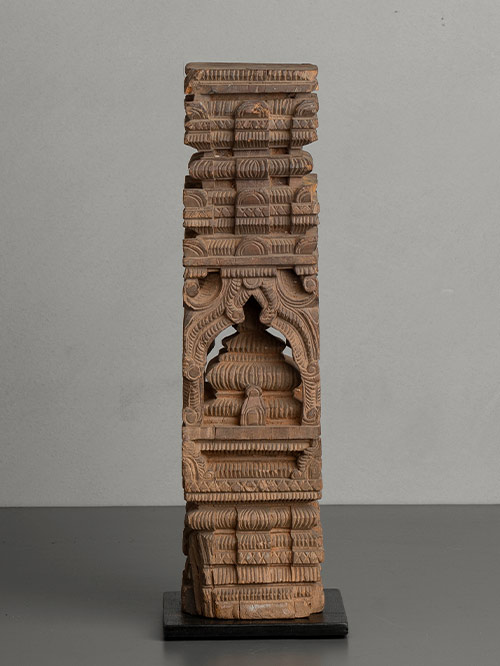
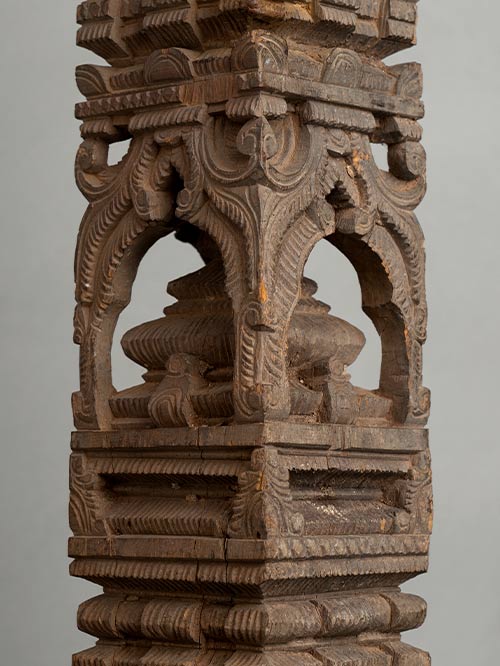
An attractive candlestand which is unusually inspired by the temple pillars found in traditional Indian temples.
Indian temple pillars exhibit a rich diversity of designs, styles, and intricate carvings that reflect the cultural and artistic heritage of the country. Different regions and time periods in India have produced distinct styles of temple architecture, and the pillars play a significant role in supporting the temple structures while also serving as platforms for artistic expression. The design of these pillars was influenced by architectural styles such as the Nagara and Dravidian, with careful consideration given to structural engineering principles, mathematical precision, and adherence to Vastu Shastra.
Size (cms): 38(H) x 12(W) x 12(D)
Size (inches): 15(H) x 4.5(W) x 4.5(D)
-
Maharashtra
Signed by the artist ‘Hemant T., Bombay’
Opaque watercolour on paper
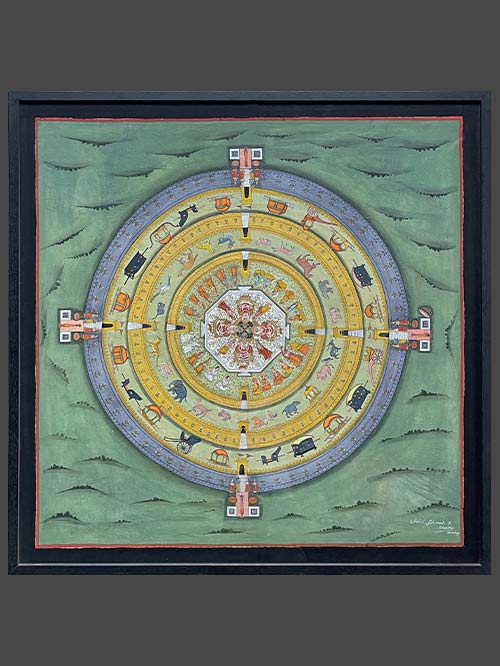
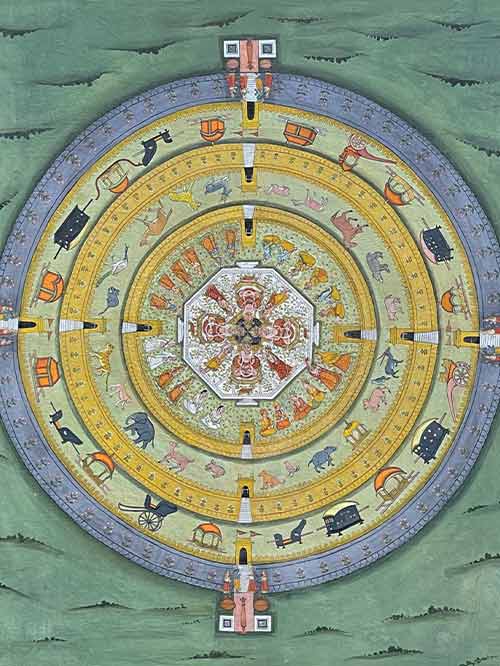
Samavasarana symbolises the Jina’s deliverance of his first teachings after attaining enlightenment during which he is said to be miraculously visible simultaneously in every direction. This particular example provides an unusual presentation of the theme.
The entire enclosure is placed on a vast plain painted in green and covered with tufts of vegetation. The outermost enclosure, said to be made of silver, is filled with numerous vehicles, including European carriages and coaches, carts, sedan chairs, and various kinds of palanquins. Presumably they are conveyances of the dignitaries who have come to hear the sermon. In the second enclosure, made of gold, a wide variety of animals is represented. Even though they are not paired, the mix clearly indicates the tranquil atmosphere of the place. The third enclosure, made of gems, is occupied by divinities, monks, and lay personages. Curiously, each quarter segment includes six figures. All of the women stand, while the men are shown seated. On the octagonal crystal pedestal in the center are four identical Jina images facing in the cardinal directions. The idea is to demonstrate the Jinas simultaneous visibility from all sides.
Framed Size (cms): 94(H) x 94(W)
Framed Size (inches): 37(H) x 37(W)
-
Tamil Nadu
Wood
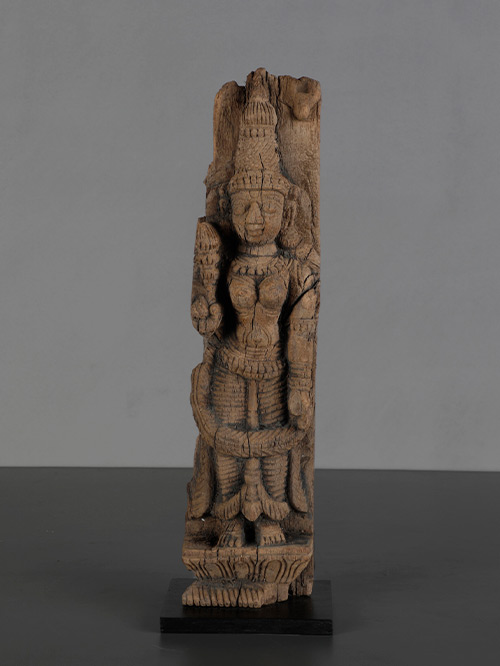
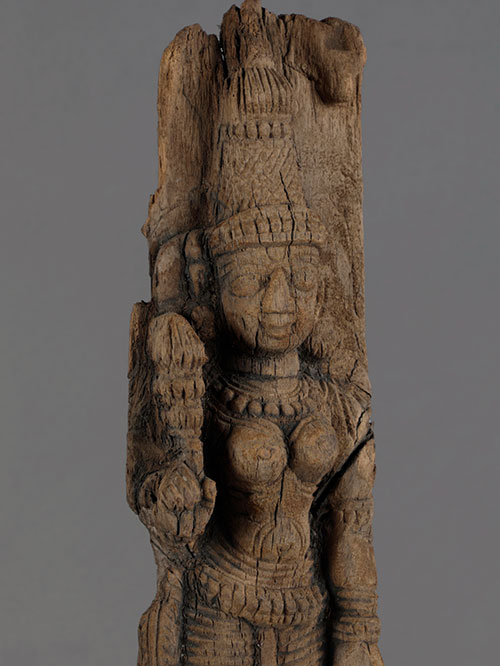
Maha Devi or the Great Goddess was the female energy of Shiva. The Devis are generally seen as wives of the gods or river goddesses. In the post Vedic era, the generic term Devi assumed a new meaning, designating the great goddess ie Shiva’s cosmic energy (Shakti), the essence of all things. The concept of Devi developed over a long period of time, in which many local fertility and nature goddesses were absorbed into the Shaiva tradition to constitute Devi’s many facets. Bountiful goddesses, such as Parvati and Gauri, and destructive deities, such as Durga and Kali, merged into her complex personality, but despite their different names and functions, each of them is Devi, and she in turn represents their totality.
Chariots of Tamil Nadu, locally called ter, are intricate wooden structures of monumental size. The lower portion of the chariots are completely covered with timber panels carved with a wide range of figural and animal sculptures. These friezes, which constitute the finest wooden sculptures in the region, can be viewed only during the chariot festival; for the remainder of the year the chariots are parked in shelters to protect them from the sun and rain.
Size (cms): 43(H) x 13(W) x 10(D)
Size (inches): 17(H) x 5(W) x 4(D)
-
Tamil Nadu
Wood
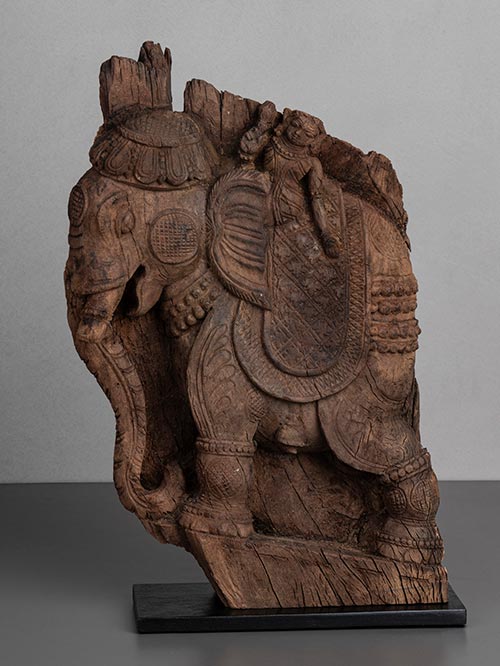
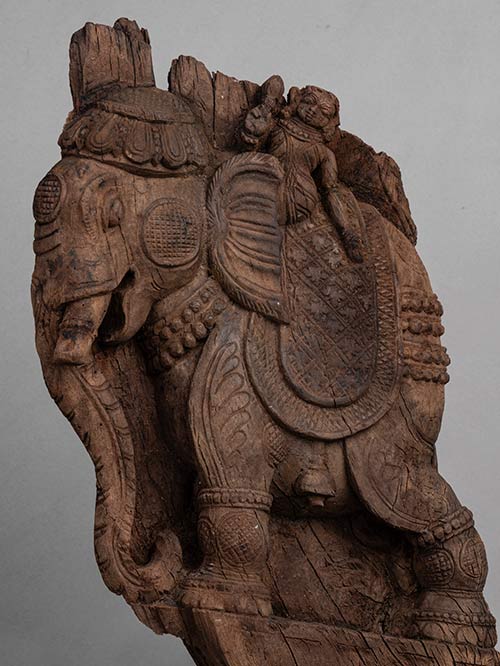
A finely detailed chariot panel of caparisoned elephant with a mahout holding a chauri (fly-whisk).
The elephant is an auspicious symbol in Indian and Southeast Asian cultures, embodying cosmic splendor and fertility. In mythology, Indra’s divine mount Airavata emerged from the ocean during its churning, linking elephants to life-giving rains. Revered in Buddhism as well, Siddhartha was conceived as a white elephant, and the welfare of elephants remained central to Indian rulers, including the Mughals.
Chariots of Tamil Nadu, locally called ter, are intricate wooden structures of monumental size. The lower portion of the chariots are completely covered with timber panels carved with a wide range of figural and animal sculptures. These friezes, which constitute the finest wooden sculptures in the region, can be viewed only during the chariot festival; for the remainder of the year the chariots are parked in shelters to protect them from the sun and rain.
Size (cms): 45(H) x 32(W) x 10(D)
Size (inches): 17.5(H) x 12.5(W) x 4(D)
-
Tamil Nadu
Wood
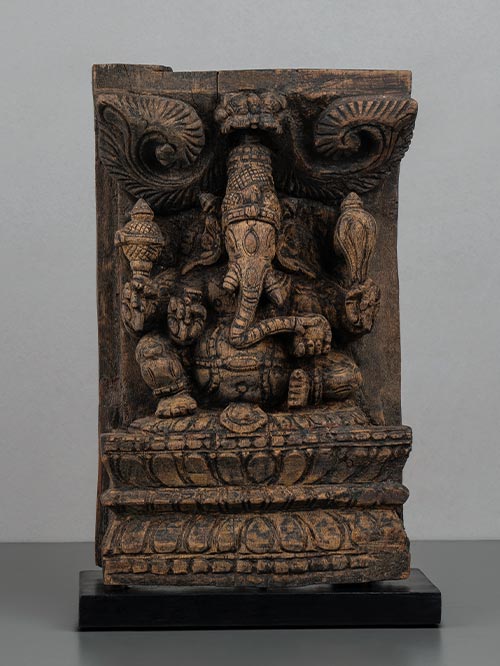
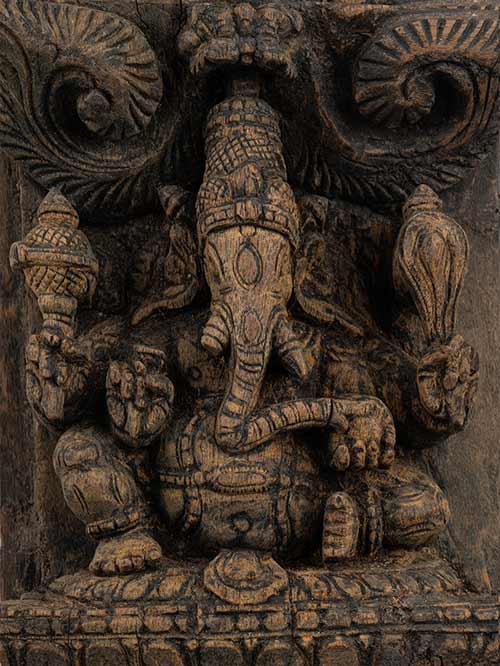
A decorative carved panel with a central figure of a four-armed Ganesha seated atop a double lotus base in Padmasana (lotus posture), with one leg folded up and the other resting on the ground. The leg on the ground symbolises his connection to the earthly realm while the other is rooted in single-pointed concentration upon supreme reality. He holds a pasha noose in his upper left hand and an ankusa (mace) in his upper right. His broken tusk is gripped within his lower right hand and in his lower left, he holds his characteristic sweet modaka (sweet rice or wheat cake) and is depicted eating the modaka with his trunk. Ganesha’s fondness of modak can be traced back to his childhood. A winged kirtimukha (face of glory) forms a stylised prabhavali above deity.
Chariots of Tamil Nadu, locally called ter, are intricate wooden structures of monumental size. The lower portion of the chariots are completely covered with timber panels carved with a wide range of figural and animal sculptures. These friezes, which constitute the finest wooden sculptures in the region, can be viewed only during the chariot festival; for the remainder of the year the chariots are parked in shelters to protect them from the sun and rain.
Size (cms): 33.5(H) x 21.5(W) x 11(D)
Size (inches): 13(H) x 8.5(W) x 4.5(D)
-
Tamil Nadu
Wood with traces of polychroming
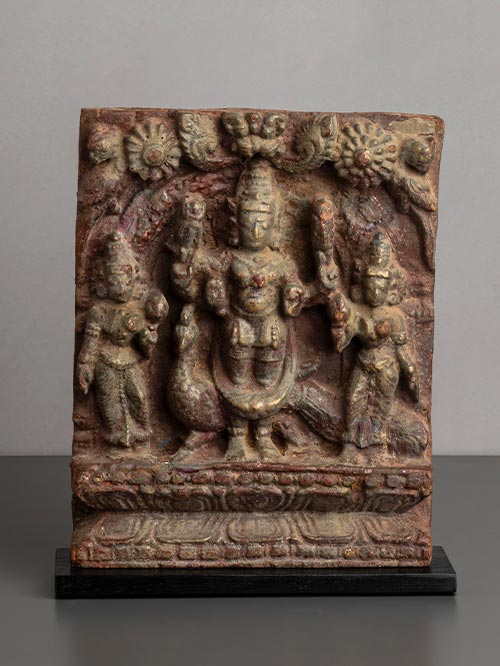
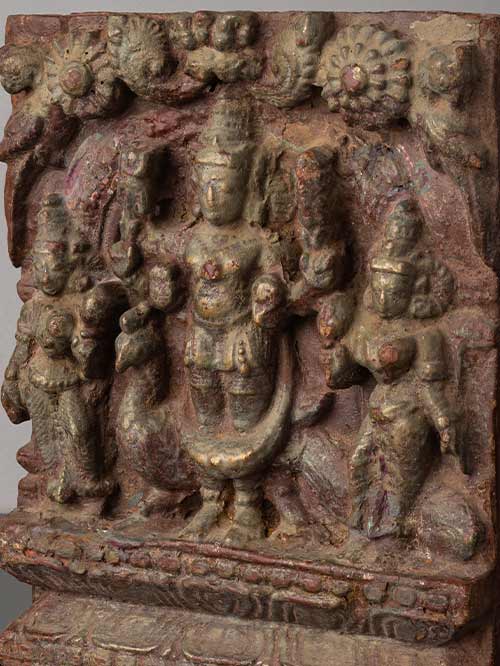
A decorative, small chariot panel depicting Kartikeya (also known as Subrahmanyam, Murugan or Skanda). His consorts Devasena and Valli stand on either side and his peacock vahana stands by his feet. A prabhavali topped by a kirtimukha (face of glory) surrounds the deity.
Karttikeya is the god of war and ruler of the planet Mars. Generally thought of as the son of Shiva and Parvati. He is shown riding or standing near his peacock, a symbol of immortality, carrying various weapons, such as a club, battle-axe and chisel, and his typical weapon, the spear.
Chariots of Tamil Nadu, locally called ter, are intricate wooden structures of monumental size. The lower portion of the chariots are completely covered with timber panels carved with a wide range of figural and animal sculptures. These friezes, which constitute the finest wooden sculptures in the region, can be viewed only during the chariot festival; for the remainder of the year the chariots are parked in shelters to protect them from the sun and rain.
Size (cms): 29(H) x 34(W) x 8.5(D)
Size (inches): 11.5(H) x 13.5(W) x 3.5(D)
-
Deccan
Wood with polychroming
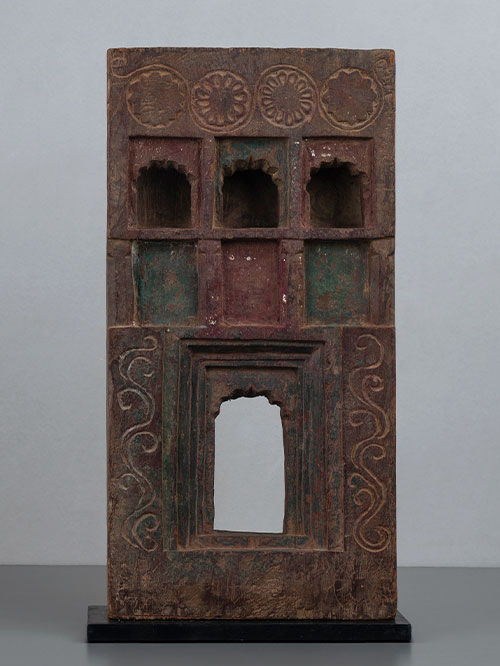
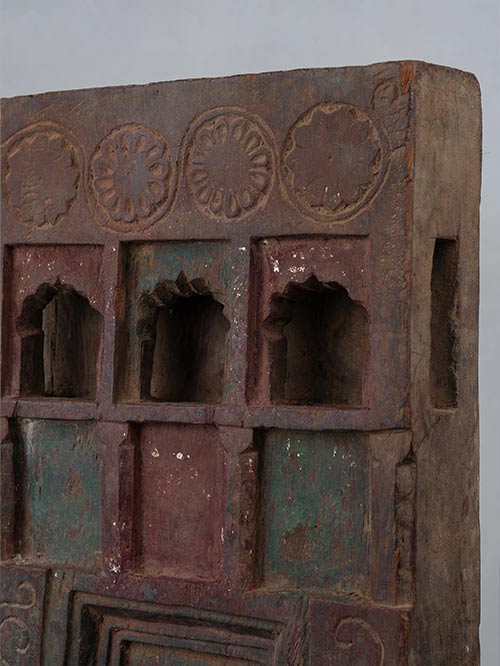
A lovely miniature window in the shape of an entrance gateway to a building. The window uses an eclectic mix of Indic and Islamic architectural elements such as the multiple sakhas (door jambs) traditionally found in North Indian Temple architecture. Above the door, the upper story is decorated with jharokas which are painted in alternating red and green. Floral swirls and geometric roundels surround the architectural elements of this charming panel.
Size (cms): 40.5(H) x 20.5(W) x 6(D)
Size (inches): 16(H) x 8(W) x 2.5(D)
-
Tamil Nadu
Wood
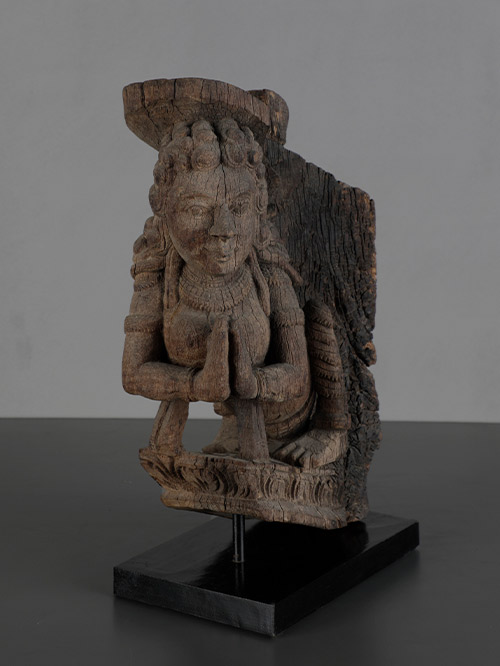
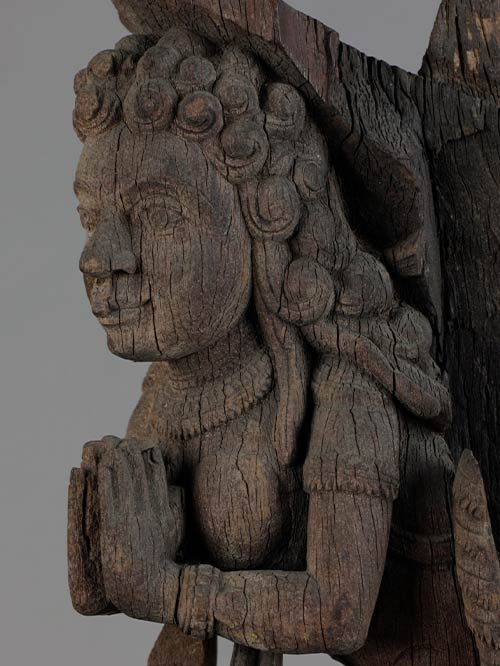
A fine and rare Chariot chariot panels of Mohini, the enchantress. Finely detailed, Mohini wears elaborate jewellery and her hair is in curled locks displaying a markedly European influence. She is depicted kneeling with her hands folded in anjali mudra. Remnants of the supporting wooden tenons are still attached.
Mohini is the only female avatar of the Hindu god Vishnu. She is portrayed as a femme fatale, an enchantress, who maddens lovers, sometimes leading them to their doom. Mohini is introduced into the Hindu theology in the narrative epic of the Mahabharata. Here, she appears as a form of Vishnu, acquires the pot of Amrita (an elixir of immortality) from thieving asuras (demons), and gives it back to the devas (gods), helping them retain their immortality.
Chariots of Tamil Nadu, locally called ter, are intricate wooden structures of monumental size. The lower portion of the chariots are completely covered with timber panels carved with a wide range of figural and animal sculptures. These friezes, which constitute the finest wooden sculptures in the region, can be viewed only during the chariot festival; for the remainder of the year the chariots are parked in shelters to protect them from the sun and rain.
Size (cms): 40(H) x 23(W) x 15(D)
Size (inches): 15.5(H) x 9(W) x 6(D)
-
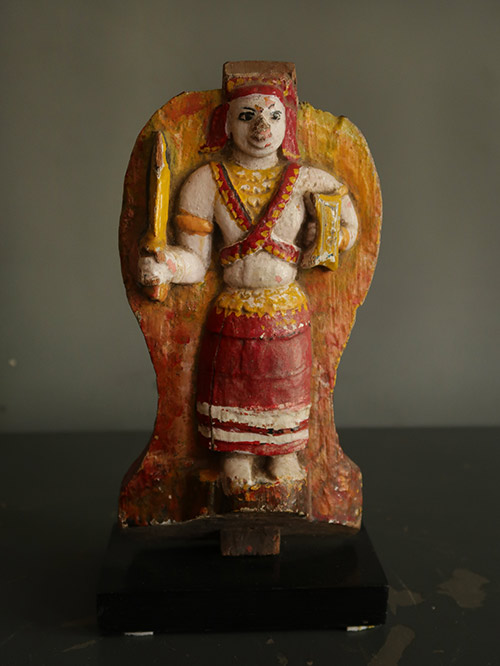
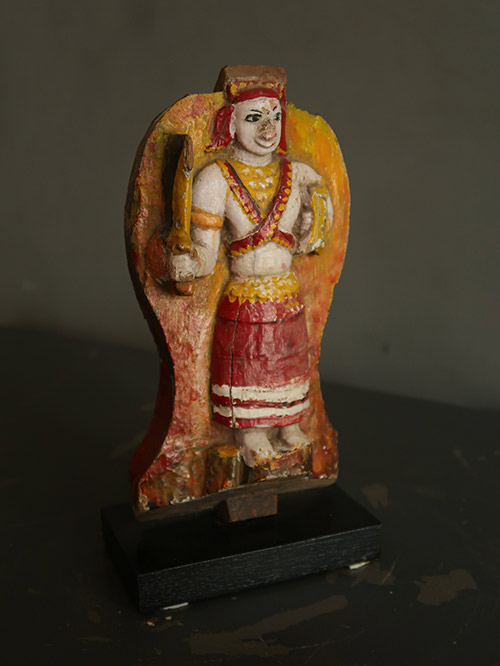
Northern Kerala (South India)
polychromed Wood
A finely carved panel depicting Karim Kutty Sasthan.
Karim Kutty Sasthan is one of the five so-called “magical” deities. He is a deity whose ambiguous and complex myth describes him as the unruly son of a Brahmin exorcist. After his father savagely beats him for sacrificing a favourite red bull, the boy leaves home and goes on a bloodthirsty rampage. Despite this seemingly ungodly behaviour, he is a mysterious god of tremendous powers possessing the attributes of both Lord Shiva and Lord Vishnu.
Theyyam is the ancient Malabar performance-ritual in which empowered men, after suitable mental, physical and spiritual preparations ‘become’ the deities. Wearing spectacular costumes and headdresses and with their human features hidden behind mask-like make-up, they enter the shrine’s precincts to make the final transference from one state of consciousness to another. The defining moment comes when they gaze into a mirror and see not their own made-up face but a reflection of the deity. Once this line has been crossed, devotees can directly approach, honour and question a deity belonging to an extraordinary pantheon of divine beings, consisting not only of gods and goddesses but deified ancestors, warrior heroes, animals, ghosts and spirits.
Size(cms): 26.5 (H) x 13,5 (W)
Size(inches): 10.5 (H) x 5 (W)
-
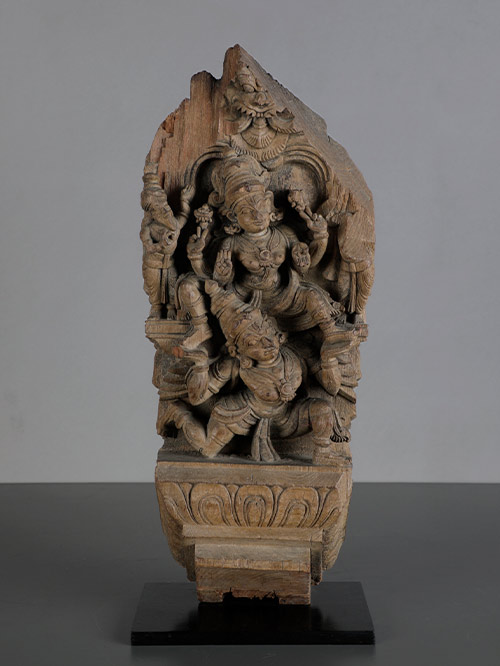
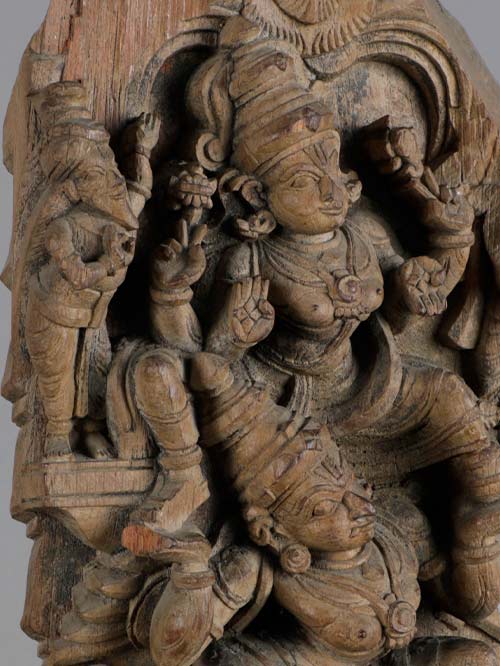
Tamil Nadu
Wood
A finely carved and rare chariot panel depicting Vishnu seated on the shoulders of Garuda. The four-armed Vishnu carries a discus (chakra) and conch shell (shankha) in his upper hands while his lower hands are in abhaya and varada mudra. The kneeling Garuda holds up Vishnu in an act of devotion. A prabhavali, formed by a pair of rishis (sages) on columns holding up a Kirtimukha, creates a ceremonial arch around Vishnu and his vahana.
Chariots of Tamil Nadu, locally called ter, are intricate wooden structures of monumental size. The lower portion of the chariots are completely covered with timber panels carved with a wide range of figural and animal sculptures. These friezes, which constitute the finest wooden sculptures in the region, can be viewed only during the chariot festival; for the remainder of the year the chariots are parked in shelters to protect them from the sun and rain.
Size (cms): 51(H) x 20(W) x 11.5(D)
Size (inches): 20(H) x 8(W) x 4.5(D)
-
Deccan
Wood
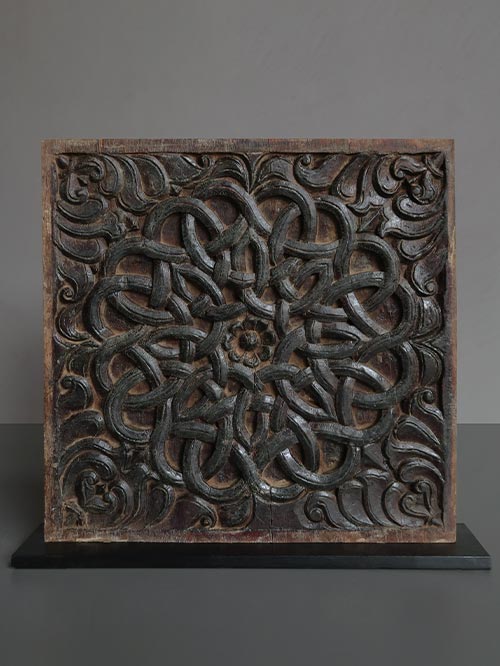
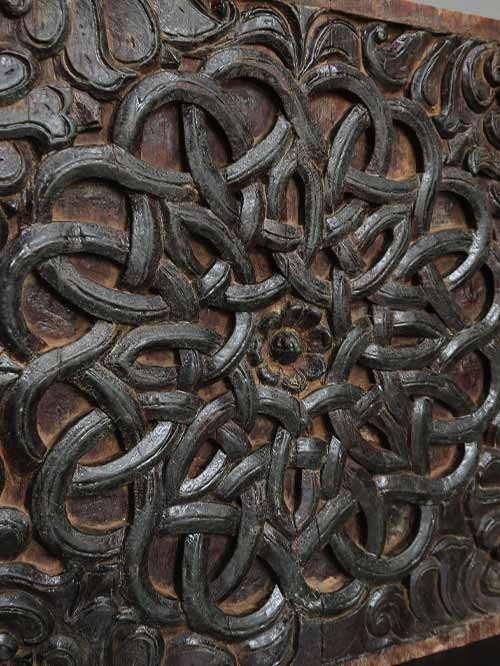
An attractive ceiling panel with a polished patina. The elegant design is comprised of swirling, interlocking leafy sprigs around a central flowerhead. The floral medallion is surrounded with mirrored scrolls and palmettes creating an almost kaleidoscopic effect.
Wooden construction was once widespread throughout most of Southern India, but the intense heat and the severe monsoonal rains have meant that a large proportion of the wooden buildings in private and public use have now disappeared. The typical southern Indian wooden building, was supported on a framework of columns, with an elaborate system of interlocking brackets and beams to support the floors and roofs. Carved doors, windows, and screens and panels filter light and ventilate the interiors, creating an environment that is both comfortable and richly detailed. The scale and shape of houses was dictated by the maximum height and span of timber beams, resulting in a modular system of construction. The woodwork was deeply cut and naturalistic, the intention of the artisans was to capture the forms and energies of the natural world. Panels such as these, with floral medallions radiating in full bloom or others with elaborate geometric modelling, ornamented the ceilings of palaces, houses and mosques.
Size (cms): 42(H) x 47(W) x 9(D)
Size (inches): 16.5(H) x 18.5(W) x 3.5(D)
-
Deccan
Wood
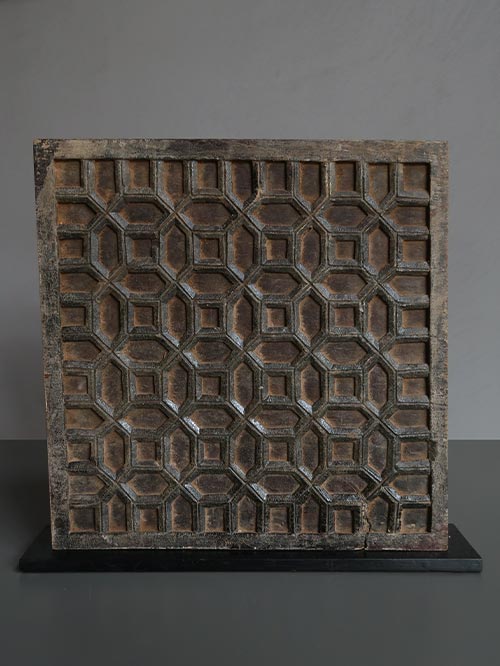
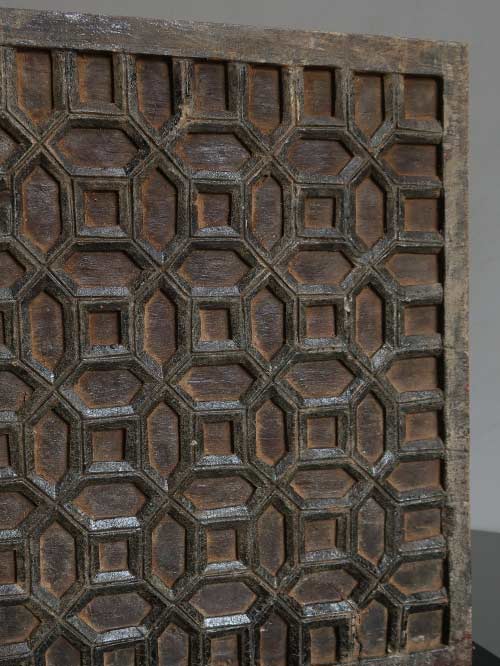
An attractive ceiling panel with a polished patina. The elegant design is consists of interlocking rectangles and octagons creating an almost kaleidoscopic effect.
Wooden construction was once widespread throughout most of Southern India, but the intense heat and the severe monsoonal rains have meant that a large proportion of the wooden buildings in private and public use have now disappeared. The typical southern Indian wooden building, was supported on a framework of columns, with an elaborate system of interlocking brackets and beams to support the floors and roofs. Carved doors, windows, and screens and panels filter light and ventilate the interiors, creating an environment that is both comfortable and richly detailed. The scale and shape of houses was dictated by the maximum height and span of timber beams, resulting in a modular system of construction. The woodwork was deeply cut and naturalistic, the intention of the artisans was to capture the forms and energies of the natural world. Panels such as these, with floral medallions radiating in full bloom or others with elaborate geometric modelling, ornamented the ceilings of palaces, houses and mosques.
Size (cms): 40(H) x 44.5(W) x 9(D)
Size (inches): 15.5(H) x 17.5(W) x 3.5(D)
-
Deccan
Wood
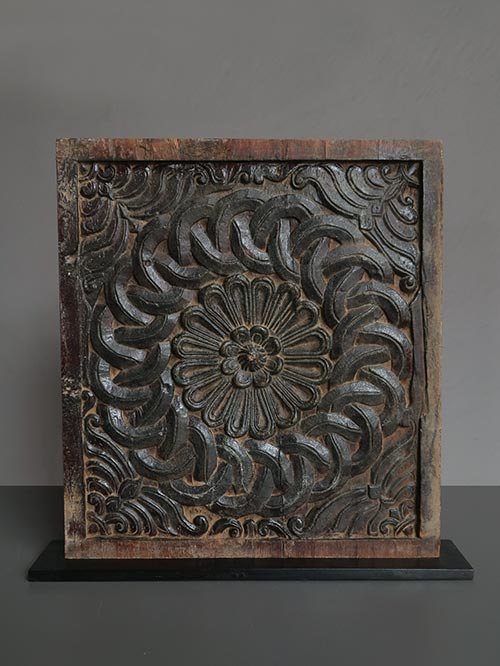
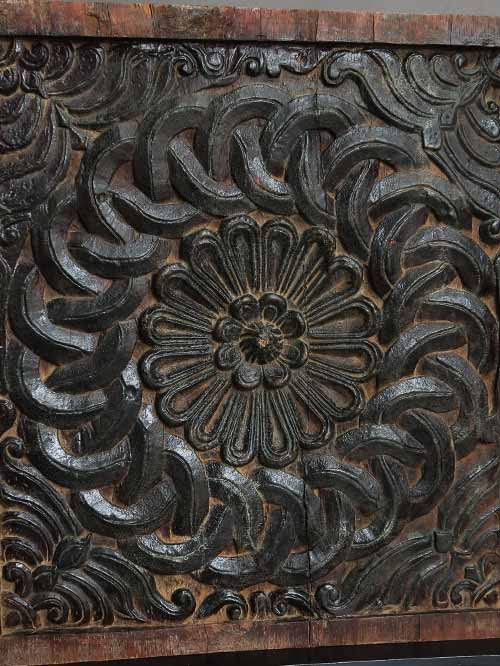
An attractive ceiling panel with a polished patina. The elegant design is comprised of swirling, interlocking leafy sprigs around a central flowerhead. The floral medallion is surrounded with mirrored scrolls and palmettes creating an almost kaleidoscopic effect.
Wooden construction was once widespread throughout most of Southern India, but the intense heat and the severe monsoonal rains have meant that a large proportion of the wooden buildings in private and public use have now disappeared. The typical southern Indian wooden building, was supported on a framework of columns, with an elaborate system of interlocking brackets and beams to support the floors and roofs. Carved doors, windows, and screens and panels filter light and ventilate the interiors, creating an environment that is both comfortable and richly detailed. The scale and shape of houses was dictated by the maximum height and span of timber beams, resulting in a modular system of construction. The woodwork was deeply cut and naturalistic, the intention of the artisans was to capture the forms and energies of the natural world. Panels such as these, with floral medallions radiating in full bloom or others with elaborate geometric modelling, ornamented the ceilings of palaces, houses and mosques.
Size (cms): 46(H) x 47(W) x 9(D)
Size (inches): 18(H) x 18.5(W) x 3.5(D)
-
Deccan
Wood
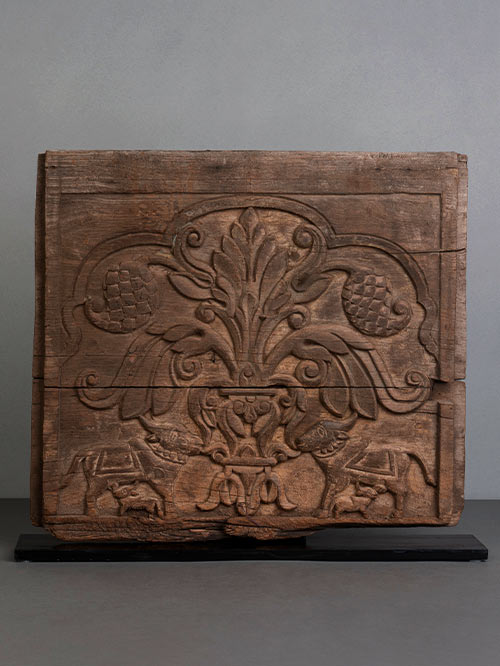
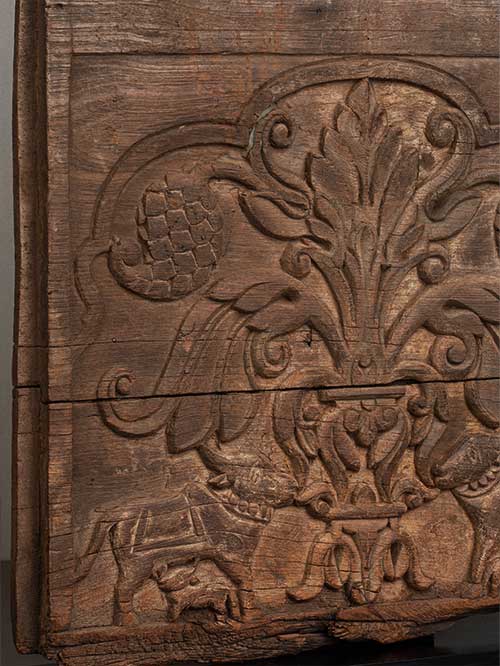
This exemplary carved panel is delicately adorned with a central floral sprig, from which two custard apples (sitaphal) gracefully sprout. Beneath them, a pair of domesticated bulls graze on the low-hanging leaves, while a pair of diminutive calves suckle at their teats. The scene is enclosed within a trefoil archway.
Wooden construction was once widespread throughout most of Southern India, but the intense heat and the severe monsoonal rains have meant that a large proportion of the wooden buildings in private and public use have now disappeared. The typical southern Indian wooden building, was supported on a framework of columns, with an elaborate system of interlocking brackets and beams to support the floors and roofs. Carved doors, windows, and screens and panels filter light and ventilate the interiors, creating an environment that is both comfortable and richly detailed. The scale and shape of houses was dictated by the maximum height and span of timber beams, resulting in a modular system of construction. The woodwork was deeply cut and naturalistic, the intention of the artisans was to capture the forms and energies of the natural world. Panels such as these, with floral medallions radiating in full bloom or others with elaborate geometric modelling, ornamented of palaces, houses and temples.
Size (cms): 43(H) x 51(W) x 9(D)
Size (inches): 17(H) x 20(W) x 3.5(D)
-
Deccan
Wood
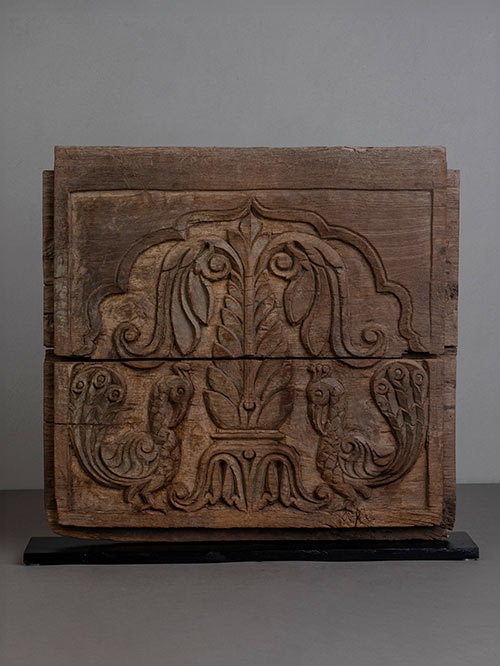
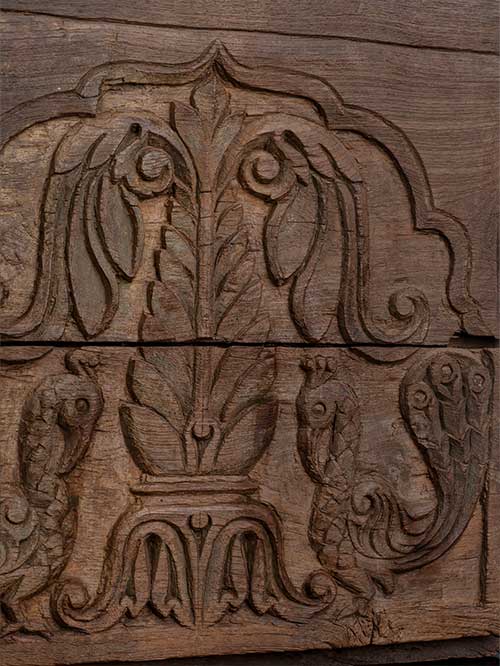
This exemplary carved panel is delicately adorned with a central floral sprig beneath which a pair of peacocks stand gracefully. The scene is enclosed within a multifoil archway, adding to its elegance.
Wooden construction was once widespread throughout most of Southern India, but the intense heat and the severe monsoonal rains have meant that a large proportion of the wooden buildings in private and public use have now disappeared. The typical southern Indian wooden building, was supported on a framework of columns, with an elaborate system of interlocking brackets and beams to support the floors and roofs. Carved doors, windows, and screens and panels filter light and ventilate the interiors, creating an environment that is both comfortable and richly detailed. The scale and shape of houses was dictated by the maximum height and span of timber beams, resulting in a modular system of construction. The woodwork was deeply cut and naturalistic, the intention of the artisans was to capture the forms and energies of the natural world. Panels such as these, with floral medallions radiating in full bloom or others with elaborate geometric modelling, ornamented of palaces, houses and temples.
Size (cms): 45(H) x 49(W) x 9(D)
Size (inches): 17.5(H) x 19.5(W) x 3.5(D)
-
Southern India
Wood
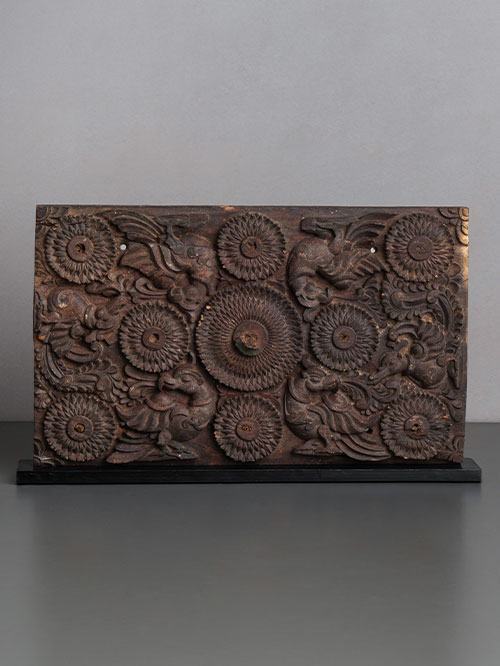
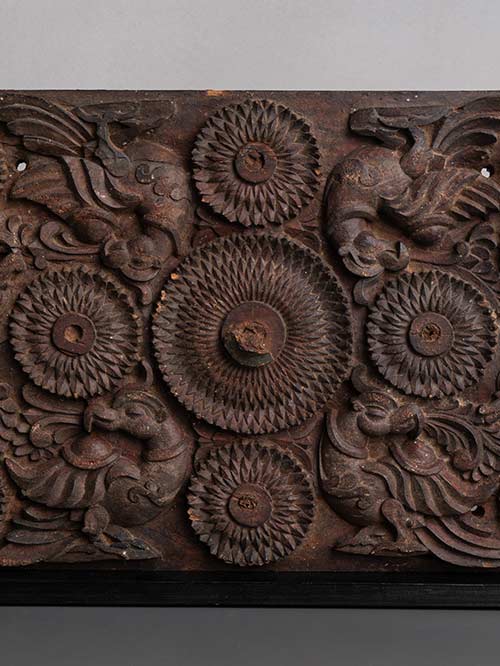
This intricately carved ceiling panel is rich in detail, with a group of parrots perched between floral medallions in perfect symmetry.
Wooden construction was once widespread throughout most of Southern India, but the intense heat and the severe monsoonal rains have meant that a large proportion of the wooden buildings in private and public use have now disappeared. The typical southern Indian wooden building, was supported on a framework of columns, with an elaborate system of interlocking brackets and beams to support the floors and roofs. Carved doors, windows, and screens and panels filter light and ventilate the interiors, creating an environment that is both comfortable and richly detailed. The scale and shape of houses was dictated by the maximum height and span of timber beams, resulting in a modular system of construction. The woodwork was deeply cut and naturalistic, the intention of the artisans was to capture the forms and energies of the natural world. Panels such as these, with floral medallions radiating in full bloom or others with elaborate geometric modelling, ornamented of palaces, houses and temples.
Size (cms): 26(H) x 44(W) x 6(D)
Size (inches): 10(H) x 17.5(W) x 2.5(D)