“Calisaya Javanica” has been added to your cart.
View cart
-
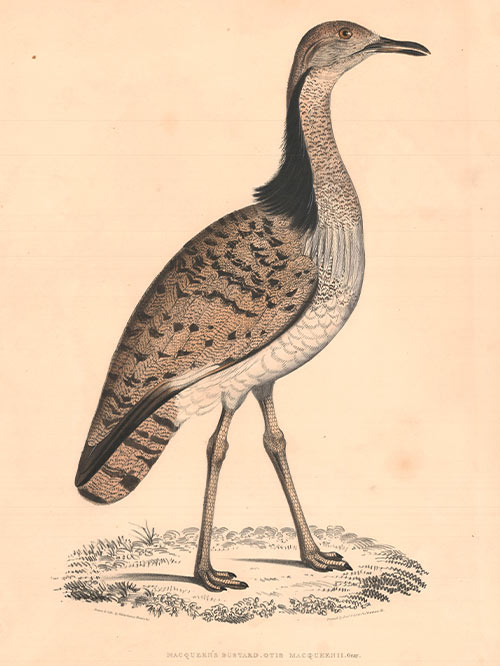
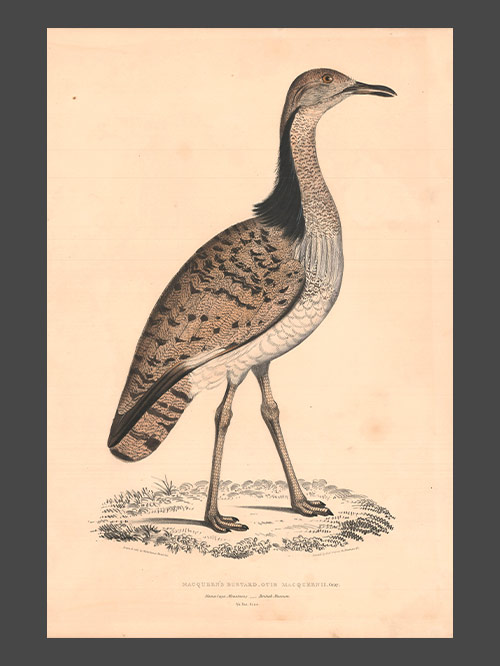
by John Edward Gray’s
From ‘Illustrations of Indian Zoology’
original hand coloured lithograph
Captioned ‘Mac Queen’s Bustard . Otis Macqueen II‘
John Edward Gray of the British Museum had collaborated with Maj.-Gen. Hardwicke in producing Illustrations of Indian Zoology between 1830 and 1834. He was also the author of several major illustrated works on natural history and commissioned the best artists and printers of the day to illustrate his work. The Illustrations of Indian Zoology is his major work, dedicated to the East India Company, and with the striking plates of bird and animal life in the sub-continent drawn by Waterhouse Hawkins, the noted sporting artist.
Maj.-Gen. Thomas Hardwicke of the Bengal Artillery whilst serving in India from 1778 to 1823 assembled a truly impressive collection of natural history drawings by Indian and European artists whom he engaged to draw flora and fauna. On his retirement he brought the collection with him to England and a thousand of these in many volumes are now in the British library and in the British Museum (Natural History). Bird portraiture predominates in Illustrations of Indian Zoology with a token representation of mammals, reptiles and fishes.
Size (cms): 48 (H) x 34 (L)
Size (inches): 19 (H) x 13.5 (L)
-


by W H Fitch from John Eliot Howard’s
‘The Quinology of the East Indian Plantations’
original hand coloured lithograph
The tree bark of the Cinchona tree contains quinine, an alkaloid used to treat malaria. Malaria was a major health concern for the colonial administration in India and the first cinchona plantation was established in 1860 in the Nilgiri Hills due to its suitable climate and soil. Over the next few years, several other plantations were established in the region, including at Coonoor, Kotagiri, and Ooty. By the early 20th century, the Indian cinchona plantations had become one of the largest producers of quinine in the world, supplying not only India but also other parts of the British Empire.
‘The Quinology of the East Indian Plantations’ by John Eliot Howard (1807-1883) is a continuation of Benjamin Moseley’s earlier book on the same subject, and provides an updated account of the cultivation and use of quinine in the East Indian plantations during the 19th century and its introduction into India. Howard’s book includes detailed descriptions of the different species of cinchona trees, as well as the various methods used to extract and prepare quinine. He also discusses the economic and political implications of the quinine trade, which had become a major industry in the region by the mid-19th century. Howard received the thanks of Her Majesty’s Government in 1873 for The Quinology of the East Indian Plantations.
Framed Size (cms): 65(H) x 54(W)
Framed Size (inches): 25.5(H) x 21.5(W)
Print Size (cms): 45.75(H) x 34.25(W)
Print Size (inches): 18(H) x 13.5(W)
-
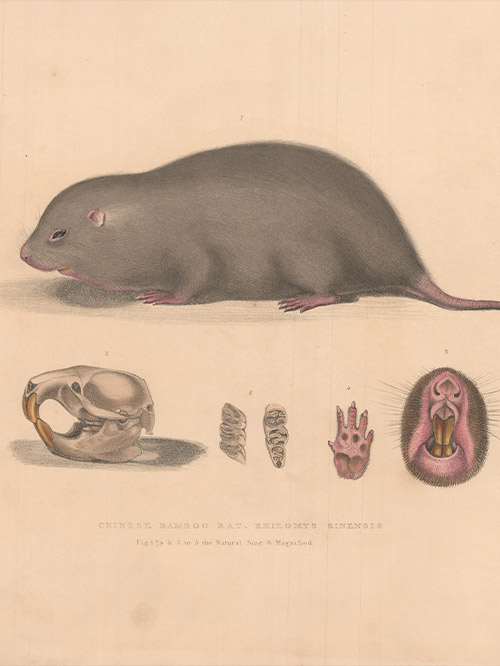
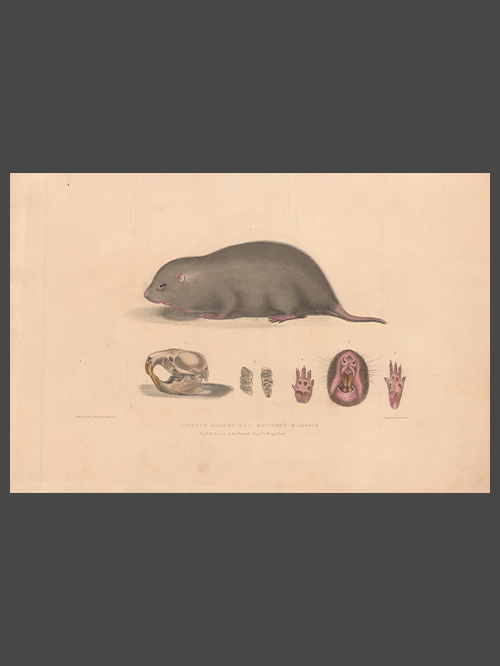
by John Edward Gray’s
From ‘Illustrations of Indian Zoology’
original hand coloured lithograph
Captioned ‘Chinese Bamboo Rat. Rhizomys Sinensis‘
John Edward Gray of the British Museum had collaborated with Maj.-Gen. Hardwicke in producing Illustrations of Indian Zoology between 1830 and 1834. He was also the author of several major illustrated works on natural history and commissioned the best artists and printers of the day to illustrate his work. The Illustrations of Indian Zoology is his major work, dedicated to the East India Company, and with the striking plates of bird and animal life in the sub-continent drawn by Waterhouse Hawkins, the noted sporting artist.
Maj.-Gen. Thomas Hardwicke of the Bengal Artillery whilst serving in India from 1778 to 1823 assembled a truly impressive collection of natural history drawings by Indian and European artists whom he engaged to draw flora and fauna. On his retirement he brought the collection with him to England and a thousand of these in many volumes are now in the British library and in the British Museum (Natural History). Bird portraiture predominates in Illustrations of Indian Zoology with a token representation of mammals, reptiles and fishes.
Size (cms): 34 (H) x 48 (L)
Size (inches): 13.5 (H) x 19 (L)
-


by John Edward Gray’s
From ‘Illustrations of Indian Zoology’
original hand coloured lithograph
Captioned ‘Chinese Hare. Lepus Sinensis‘
John Edward Gray of the British Museum had collaborated with Maj.-Gen. Hardwicke in producing Illustrations of Indian Zoology between 1830 and 1834. He was also the author of several major illustrated works on natural history and commissioned the best artists and printers of the day to illustrate his work. The Illustrations of Indian Zoology is his major work, dedicated to the East India Company, and with the striking plates of bird and animal life in the sub-continent drawn by Waterhouse Hawkins, the noted sporting artist.
Maj.-Gen. Thomas Hardwicke of the Bengal Artillery whilst serving in India from 1778 to 1823 assembled a truly impressive collection of natural history drawings by Indian and European artists whom he engaged to draw flora and fauna. On his retirement he brought the collection with him to England and a thousand of these in many volumes are now in the British library and in the British Museum (Natural History). Bird portraiture predominates in Illustrations of Indian Zoology with a token representation of mammals, reptiles and fishes.
Size (cms): 34 (H) x 48 (L)
Size (inches): 13.5 (H) x 19 (L)
-


by John Edward Gray’s
From ‘Illustrations of Indian Zoology’
original hand coloured lithograph
Captioned ‘Chinese Owl Strix Sinensis‘
John Edward Gray of the British Museum had collaborated with Maj.-Gen. Hardwicke in producing Illustrations of Indian Zoology between 1830 and 1834. He was also the author of several major illustrated works on natural history and commissioned the best artists and printers of the day to illustrate his work. The Illustrations of Indian Zoology is his major work, dedicated to the East India Company, and with the striking plates of bird and animal life in the sub-continent drawn by Waterhouse Hawkins, the noted sporting artist.
Maj.-Gen. Thomas Hardwicke of the Bengal Artillery whilst serving in India from 1778 to 1823 assembled a truly impressive collection of natural history drawings by Indian and European artists whom he engaged to draw flora and fauna. On his retirement he brought the collection with him to England and a thousand of these in many volumes are now in the British library and in the British Museum (Natural History). Bird portraiture predominates in Illustrations of Indian Zoology with a token representation of mammals, reptiles and fishes.
Size (cms): 34 (H) x 48 (L)
Size (inches): 13.5 (H) x 19 (L)
-


by W H Fitch from John Eliot Howard’s
‘The Quinology of the East Indian Plantations’
original hand coloured lithograph
The tree bark of the Cinchona tree contains quinine, an alkaloid used to treat malaria. Malaria was a major health concern for the colonial administration in India and the first cinchona plantation was established in 1860 in the Nilgiri Hills due to its suitable climate and soil. Over the next few years, several other plantations were established in the region, including at Coonoor, Kotagiri, and Ooty. By the early 20th century, the Indian cinchona plantations had become one of the largest producers of quinine in the world, supplying not only India but also other parts of the British Empire.
‘The Quinology of the East Indian Plantations’ by John Eliot Howard (1807-1883) is a continuation of Benjamin Moseley’s earlier book on the same subject, and provides an updated account of the cultivation and use of quinine in the East Indian plantations during the 19th century and its introduction into India. Howard’s book includes detailed descriptions of the different species of cinchona trees, as well as the various methods used to extract and prepare quinine. He also discusses the economic and political implications of the quinine trade, which had become a major industry in the region by the mid-19th century. Howard received the thanks of Her Majesty’s Government in 1873 for The Quinology of the East Indian Plantations.
Framed Size (cms): 65(H) x 54(W)
Framed Size (inches): 25.5(H) x 21.5(W)
Print Size (cms): 45.75(H) x 34.25(W)
Print Size (inches): 18(H) x 13.5(W)
-


by John Edward Gray’s
From ‘Illustrations of Indian Zoology’
original hand coloured lithograph
Captioned ‘Mydaus Collaris. Collared Civet Bear.‘
John Edward Gray of the British Museum had collaborated with Maj.-Gen. Hardwicke in producing Illustrations of Indian Zoology between 1830 and 1834. He was also the author of several major illustrated works on natural history and commissioned the best artists and printers of the day to illustrate his work. The Illustrations of Indian Zoology is his major work, dedicated to the East India Company, and with the striking plates of bird and animal life in the sub-continent drawn by Waterhouse Hawkins, the noted sporting artist.
Maj.-Gen. Thomas Hardwicke of the Bengal Artillery whilst serving in India from 1778 to 1823 assembled a truly impressive collection of natural history drawings by Indian and European artists whom he engaged to draw flora and fauna. On his retirement he brought the collection with him to England and a thousand of these in many volumes are now in the British library and in the British Museum (Natural History). Bird portraiture predominates in Illustrations of Indian Zoology with a token representation of mammals, reptiles and fishes.
Size (cms): 34 (H) x 48 (L)
Size (inches): 13.5 (H) x 19 (L)
-
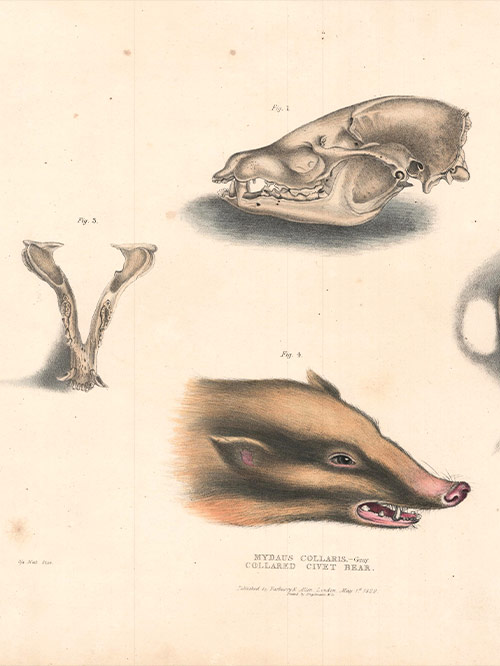

by John Edward Gray’s
From ‘Illustrations of Indian Zoology’
original hand coloured lithograph
Captioned ‘Mydaus Collaris. Collared Civet Bear.’
John Edward Gray of the British Museum had collaborated with Maj.-Gen. Hardwicke in producing Illustrations of Indian Zoology between 1830 and 1834. He was also the author of several major illustrated works on natural history and commissioned the best artists and printers of the day to illustrate his work. The Illustrations of Indian Zoology is his major work, dedicated to the East India Company, and with the striking plates of bird and animal life in the sub-continent drawn by Waterhouse Hawkins, the noted sporting artist.
Maj.-Gen. Thomas Hardwicke of the Bengal Artillery whilst serving in India from 1778 to 1823 assembled a truly impressive collection of natural history drawings by Indian and European artists whom he engaged to draw flora and fauna. On his retirement he brought the collection with him to England and a thousand of these in many volumes are now in the British library and in the British Museum (Natural History). Bird portraiture predominates in Illustrations of Indian Zoology with a token representation of mammals, reptiles and fishes.
Size (cms): 34 (H) x 48 (L)
Size (inches): 13.5 (H) x 19 (L)
-
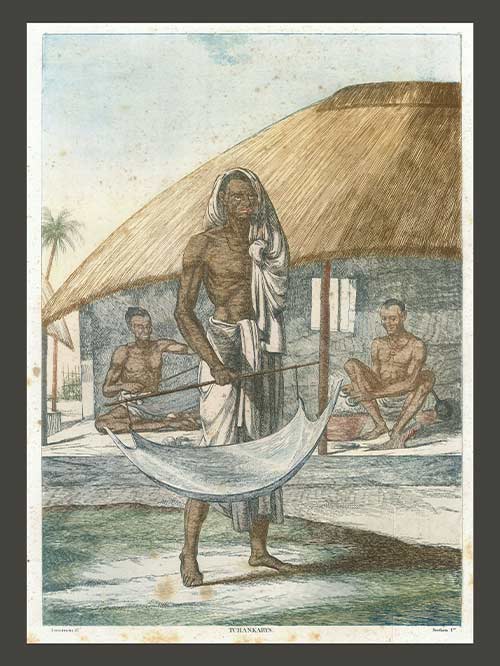

by Francois-Balthazar Solvyns (1760-1824)
Original coloured etching
from Les Hindous
Pub. Paris
Solvyns’ portrayal of a craftsman wielding the distinctive sankha-karat saw, encapsulates the specialised craftsmanship of the Sakhari caste of conch shell bangles cutters in Calcutta. Occupying their own neighborhood, or tola, within the city, Sakhari artisans use the three-foot-long crescent-shaped saw to intricately cut and shape conch shells. Utilising an iron saw without teeth, akin to those used for marble, the craftsman achieves precise cuts through sustained friction, anchoring the shell between his feet for stability, as depicted in the background. Following cutting, the shells undergo refinement through rubbing against a hard stone with sand and water to ensure smooth surfaces. Subsequently, the rings are meticulously adjusted, adorned with red gum or wax to conceal joints, and polished or engraved as required, culminating in the creation of finished bangles. These red conch shell bangles symbolise marriage for Bengali women of “respectable castes,” akin to the red streak in their hair part, and are preferred over glass and metal alternatives.
Frans Balthazar Solvyns, was a skilled engraver and painter hailing from Antwerp, embarked on a transformative journey to India in 1790. Settling in Calcutta, Solvyns immersed himself in the intricacies of Indian life, studying Hindi and forging relationships with Brahmins and pundits. Inspired by his surroundings, he commenced his ambitious project in 1791, aiming to depict the diverse facets of Indian society, from occupations to customs which he published in a series of engravings. Despite its sensitive portrayal, the venture encountered little success initially, prompting Solvyns’ departure from India in 1803. However, his legacy endured through subsequent publications, notably “The Costume of Hindoostan” and the expanded edition of “Les Hindous,” offering an intimate and detailed glimpse into 18th-century Indian life across professions, festivals, and daily rituals, immortalising a unique historical moment with both reverence and curiosity.
Image Size (cms): 35(H) x 24(W)
Image Size (inches): 14(H) x 9.5(W)
Mount Size (cms): 51(H) x 41(W)
Mount Size (inches): 20(H) x 16(W)
-
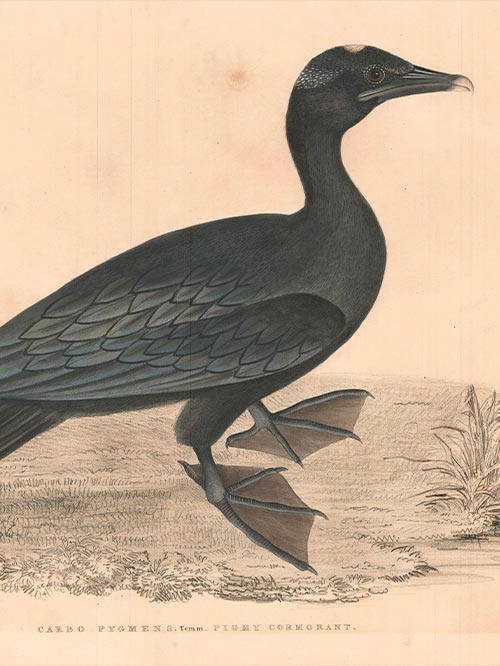

by John Edward Gray’s
From ‘Illustrations of Indian Zoology’
original hand coloured lithograph
Captioned ‘Carbo Pygmens. Pigmy Cormorant.‘
John Edward Gray of the British Museum had collaborated with Maj.-Gen. Hardwicke in producing Illustrations of Indian Zoology between 1830 and 1834. He was also the author of several major illustrated works on natural history and commissioned the best artists and printers of the day to illustrate his work. The Illustrations of Indian Zoology is his major work, dedicated to the East India Company, and with the striking plates of bird and animal life in the sub-continent drawn by Waterhouse Hawkins, the noted sporting artist.
Maj.-Gen. Thomas Hardwicke of the Bengal Artillery whilst serving in India from 1778 to 1823 assembled a truly impressive collection of natural history drawings by Indian and European artists whom he engaged to draw flora and fauna. On his retirement he brought the collection with him to England and a thousand of these in many volumes are now in the British library and in the British Museum (Natural History). Bird portraiture predominates in Illustrations of Indian Zoology with a token representation of mammals, reptiles and fishes.
Size (cms): 34 (H) x 48 (L)
Size (inches): 13.5 (H) x 19 (L)
-
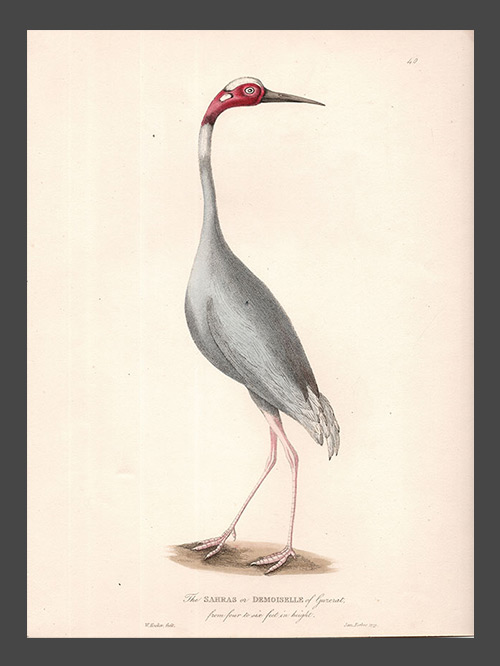
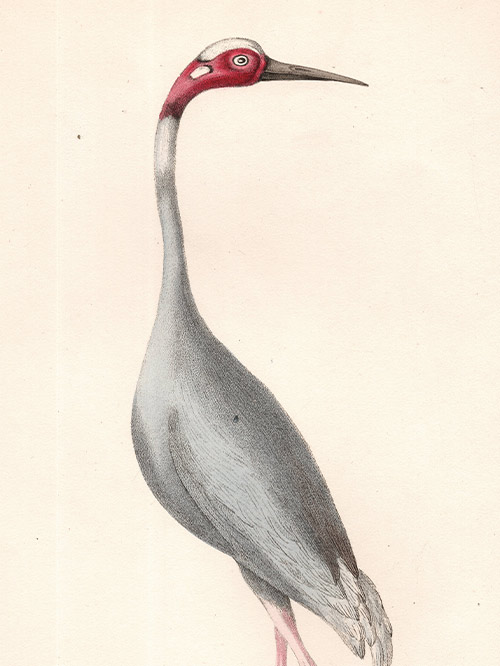
by William Hooker after James Forbes⠀
original hand coloured aquatint
Captioned ‘The Sahras or Demoiselle of Guzerat, from four to six feet in height’
Forbes arrived in Bombay in 1766 as a Writer in the East India Company and spent his first five years in Bombay, living in the Fort area. At that time Bombay was developing as the premier port and commercial centre on the west coast and there were many oppoIntunities for young Company servants stationed there. The marshland between the seven islands was being filled up and eventually the islands were joined to form the Bombay peninsula. Forbes was adventurous and independent. He was an amateur artist, who sketched the Indian environment with no other training, as he himself stated, except encouragement from his friends. Forbes lived in India for 17 years after which he produced his Oriental Memoirs. Its narrative was based on a series of his letters from India and the contents of about 150 notebooks, which returned to England with him. William Hooker was a botanist and executed the superb natural history plates for James Forbes monumental work on Western India, ‘Oriental Memoirs’, in 1812.
Size (cms): 30 (H) x 23.5 (L)
Size (inches): 12 (H) x 9.5 (L)
-
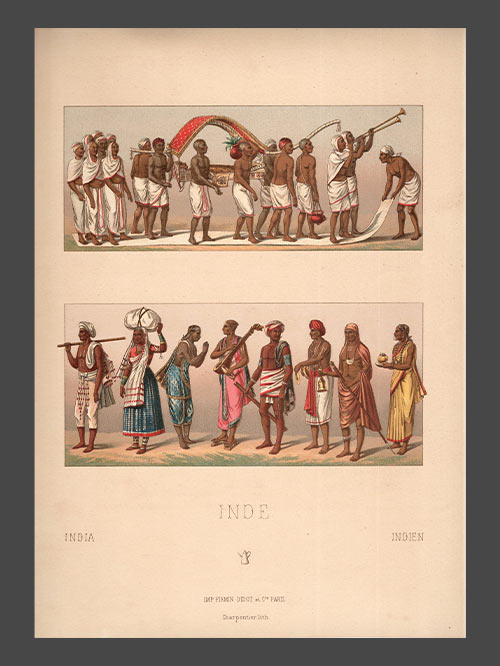
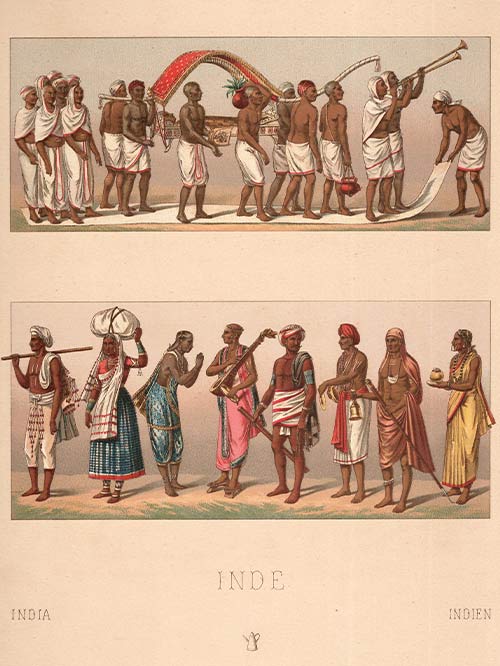
by A Racinet
from Le Costume Historique
original chromolithograph
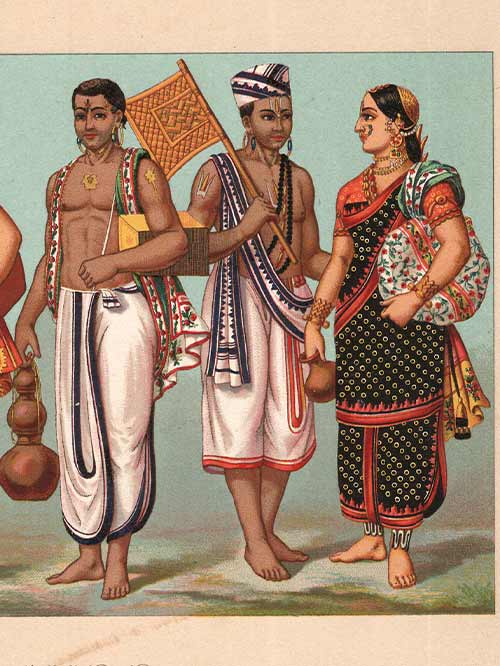
Racinet’s ‘Le Costume Historique’ is the most famous of the 19th-century books on dress, and the first fashion book to use colour lithography. It is a wide-ranging survey of costumes through time. Publication was made possible by significant developments in colour printing technology, and a resurgence of interest in ‘the other’ as a new period of European colonialism gathered pace from the mid-19th century. The emphasis here is on recognising continuity in traditional dress, rather than innovation in fashion, and linking costume to local history, custom and social organisation. Racinet was keen to produce a visually appealing book that deployed chromolithography to full effect; in his enthusiasm he sometimes toyed with authenticity by adding colour to some of his sources. His representations of Indian fashion are largely inspired by miniature paintings from the collection of French lithographer Firmin Didot.
Image Size (cms): 17.5 (H) x 15.5 (W)
Image Size (inches): 7 (H) x 6 (W)
Print Size (cms): 30 (H) x 21.5 (W)
Print Size (inches): 11.8 (H) x 8.5 (W)
-
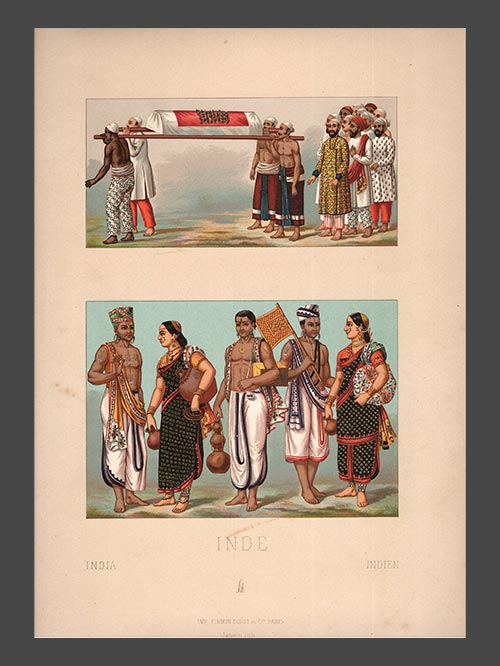
by A Racinet
from Le Costume Historique
original chromolithograph
Racinet’s ‘Le Costume Historique’ is the most famous of the 19th-century books on dress, and the first fashion book to use colour lithography. It is a wide-ranging survey of costumes through time. Publication was made possible by significant developments in colour printing technology, and a resurgence of interest in ‘the other’ as a new period of European colonialism gathered pace from the mid-19th century. The emphasis here is on recognising continuity in traditional dress, rather than innovation in fashion, and linking costume to local history, custom and social organisation. Racinet was keen to produce a visually appealing book that deployed chromolithography to full effect; in his enthusiasm he sometimes toyed with authenticity by adding colour to some of his sources. His representations of Indian fashion are largely inspired by miniature paintings from the collection of French lithographer Firmin Didot.
Image Size (cms): 17.5 (H) x 15.5 (W)
Image Size (inches): 7 (H) x 6 (W)
Print Size (cms): 30 (H) x 21.5 (W)
Print Size (inches): 11.8 (H) x 8.5 (W)
-


Udaipur (Rajasthan)
Opaque watercolour and gold on paper
A striking painting depicting the four headed krishnamurti at the centre of the composition. A temple priest dressed in customary robes and headgear standing to the left performs puja holding an arti lamp and a temple bell. The interior has three marble niches each with a four-armed standing goddess holding lotuses. A three tiered golden lamp suspended overhead and a silver container in the foreground.
Eklingji is a temple complex in the Udaipur District of Rajasthan in western India. Originally built in the 8th century by the ruler Bappa Rawal. It is situated in Kailashpuri village near the former capital of Mewar. Eklingji is believed to be the ruling god of Mewar Princely State and the Maharana rules as his Dewan. Constructions undertaken by the State Engineer Mr Williams during the reign of Maharana Sajjan Singh ( 1874-84) included a new road to Eklingji, allowing the Maharana to travel there by carriage for the first time.
Painting Size (cms): 55(H) x 42.5(W)
Painting Size (inches): 21.5(H) x 16.5(W)
-
by John Edward Gray
from Illustrations of Indian Zoology
original hand coloured lithograph
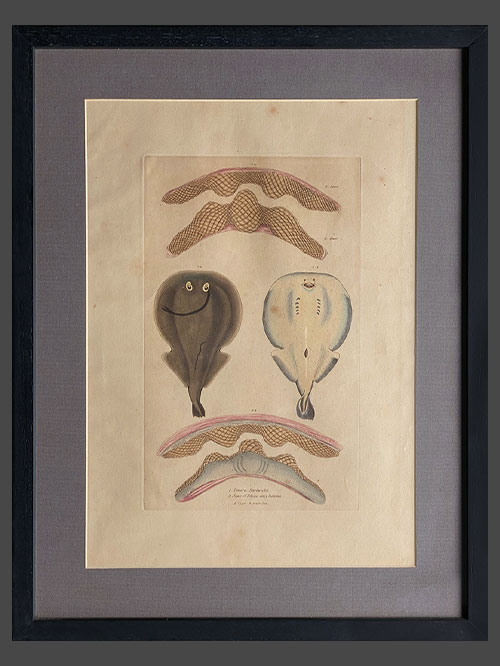
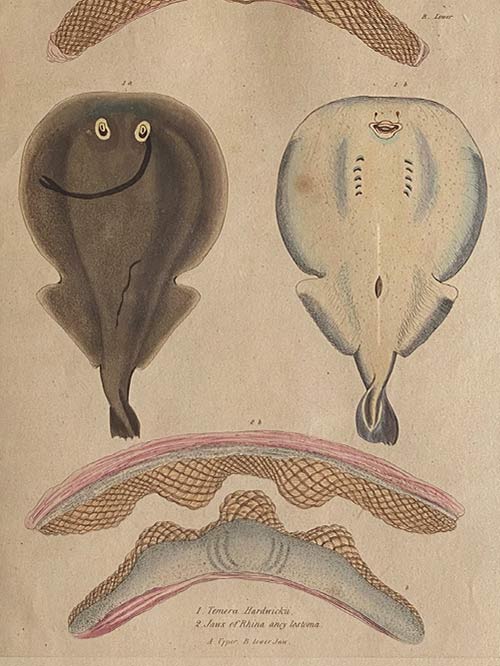
Captioned ‘1. Temera Hardwickii, 2. Jaws Of Rhina Ancy Lostoma.‘
This lithograph features a Temera hardwickii (Finless Sleeper Ray) which is commonly found in the continental shelf of South East Asia. The species was named by zoologist John Edward Gray after General Thomas Hardwicke presented two specimens of the species. Also depicted are two cross sectional views comparing the mouth of a Finless Sleeper Ray and a Shark Ray (Rhina ancylostoma)
John Edward Gray of the British Museum had collaborated with Maj.-Gen. Hardwicke in producing Illustrations of Indian Zoology between 1830 and 1834. He was also the author of several major illustrated works on natural history and commissioned the best artists and printers of the day to illustrate his work. The Illustrations of Indian Zoology is his major work, dedicated to the East India Company, and with the striking plates of bird and animal life in the sub-continent drawn by Waterhouse Hawkins, the noted sporting artist. The subscription amounted to thirty-nine home and thirteen foreign.
Size framed (cms): 56.5 (H) x 44 (W)
Size framed (inches): 22 (H) x 17.5 (W)
-
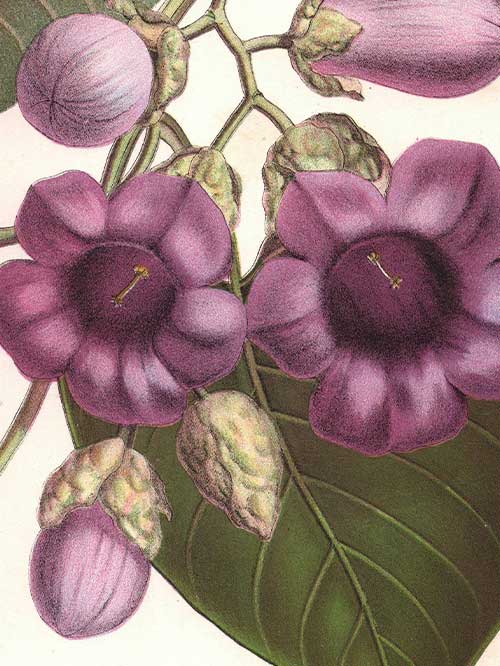
by Lena Lowis
original hand coloured lithograph
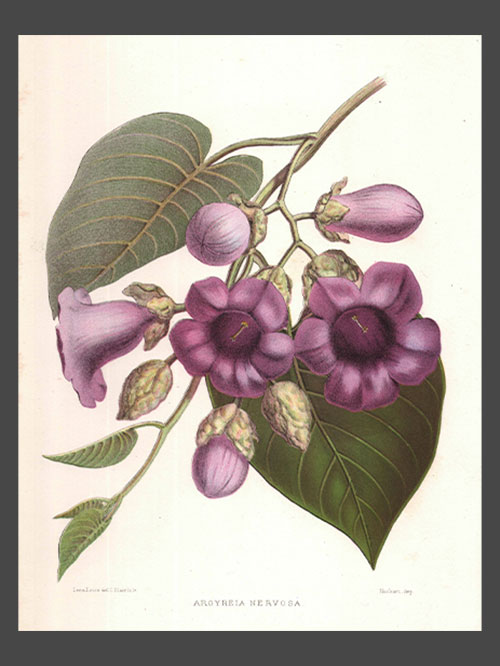
Captioned ‘Argyreia nervosa’
Lena Lowis (1845- 1919) was the daughter of Sir Richmond Campbell Shakespear (1812-1861), an Indian-born British Indian Army officer who helped abolish the capture and selling of Russian slaves in Khiva. She was born in India and later educated and married in England where she lived with her husband and five children.
The artist chronicled many of the flowers commonly cultivated in Indian gardens, some of which were indigenous to the region, while others were introduced by gardeners. Her illustrations are not meant to be taken treatise on botany or as a manual of gardening, rather to convey a fair idea of the colour and texture of the original, to those who have not seen them.
Size (cms): 25.5(H) x 20(W)
Size (inches): 10(H) x 8(W)
Size with Mount (cms): 42(H) x 36(W)
Size with Mount (inches): 16.5(H) x 14(W)