“Halwai Confectioner by Solvyns” has been added to your cart.
View cart
-
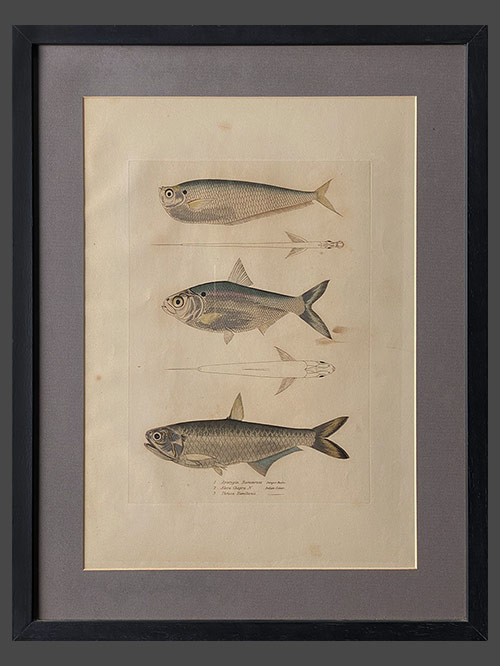
by John Edward Gray
from Illustrations of Indian Zoology
original hand coloured lithograph
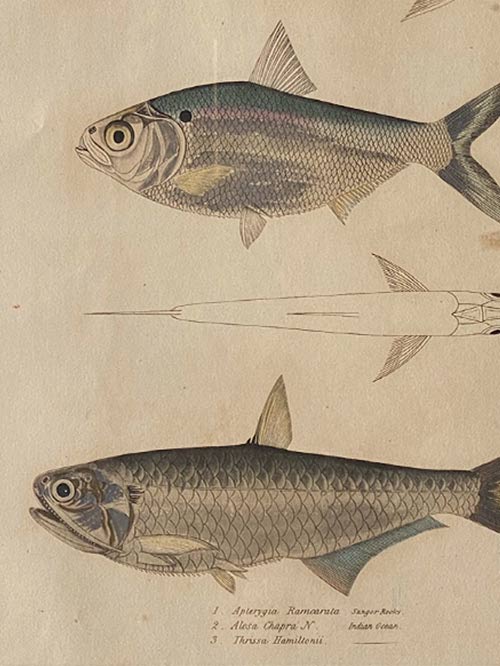
Captioned ‘1. Apterygia Ramcarata Sangor Rocks
2. Alosa Chapra N. Indian Ocean.
3. Thryssa Hamiltonii. Indian Ocean.’
John Edward Gray of the British Museum had collaborated with Maj.-Gen. Hardwicke in producing Illustrations of Indian Zoology between 1830 and 1834. He was also the author of several major illustrated works on natural history and commissioned the best artists and printers of the day to illustrate his work. The Illustrations of Indian Zoology is his major work, dedicated to the East India Company, and with the striking plates of bird and animal life in the sub-continent drawn by Waterhouse Hawkins, the noted sporting artist. The subscription amounted to thirty-nine home and thirteen foreign.
Size framed (cms): 56.5 (H) x 44 (W)
Size framed (inches): 22 (H) x 17.5 (W)
-
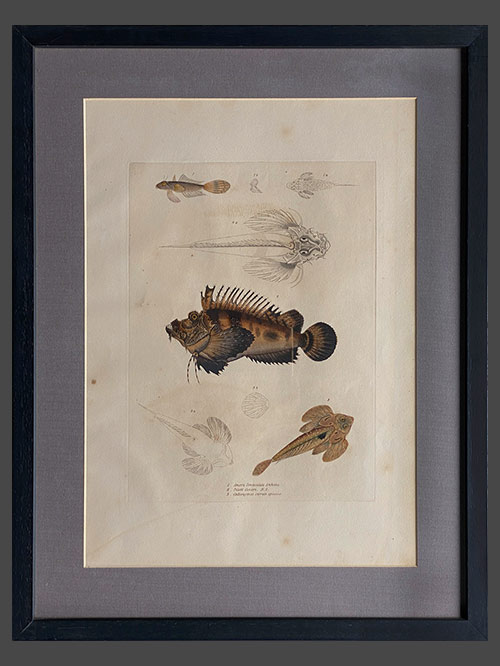
by John Edward Gray
from Illustrations of Indian Zoology
original hand coloured lithograph
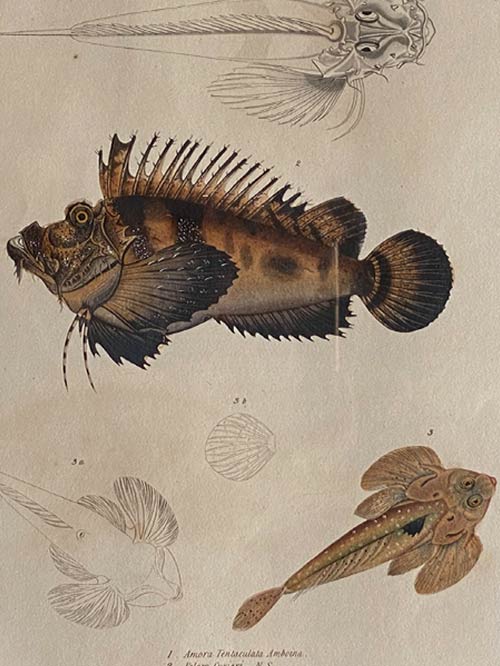
Captioned ‘1. Amora Tentaculata Amboina
2. Pelors Cuvieri. N.s.
3. Callionymus Serrado Spinosus‘
John Edward Gray of the British Museum had collaborated with Maj.-Gen. Hardwicke in producing Illustrations of Indian Zoology between 1830 and 1834. He was also the author of several major illustrated works on natural history and commissioned the best artists and printers of the day to illustrate his work. The Illustrations of Indian Zoology is his major work, dedicated to the East India Company, and with the striking plates of bird and animal life in the sub-continent drawn by Waterhouse Hawkins, the noted sporting artist. The subscription amounted to thirty-nine home and thirteen foreign.
Size framed (cms): 56.5 (H) x 44 (W)
Size framed (inches): 22 (H) x 17.5 (W)
-
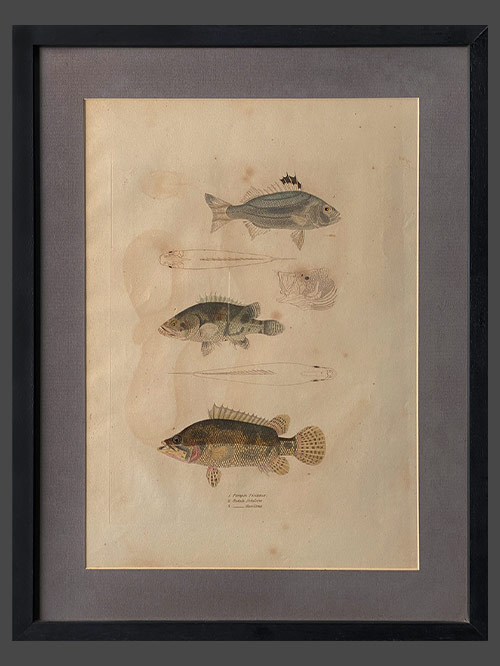
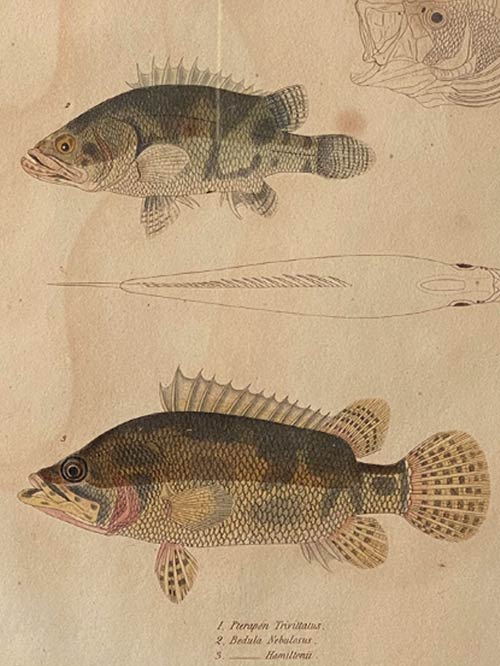
by John Edward Gray
from Illustrations of Indian Zoology
original hand coloured lithograph
Captioned ‘1. Purapon Trivittatus.
2. Bedula Nebulosus.
3. Bedula Hamiltonii.‘
John Edward Gray of the British Museum had collaborated with Maj.-Gen. Hardwicke in producing Illustrations of Indian Zoology between 1830 and 1834. He was also the author of several major illustrated works on natural history and commissioned the best artists and printers of the day to illustrate his work. The Illustrations of Indian Zoology is his major work, dedicated to the East India Company, and with the striking plates of bird and animal life in the sub-continent drawn by Waterhouse Hawkins, the noted sporting artist. The subscription amounted to thirty-nine home and thirteen foreign.
Size framed (cms): 56.5 (H) x 44 (W)
Size framed (inches): 22 (H) x 17.5 (W)
-
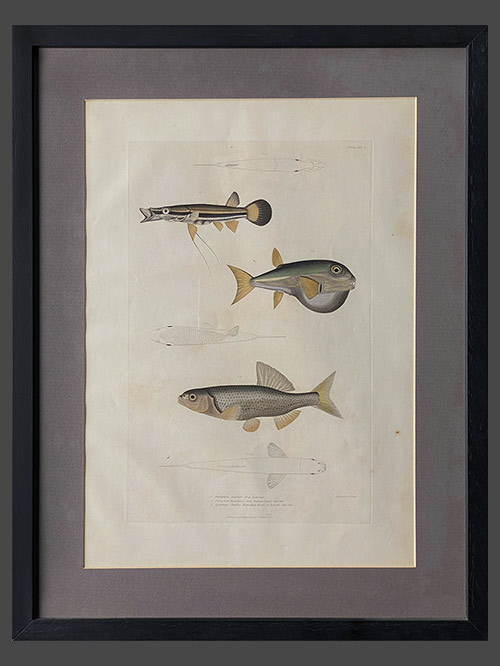
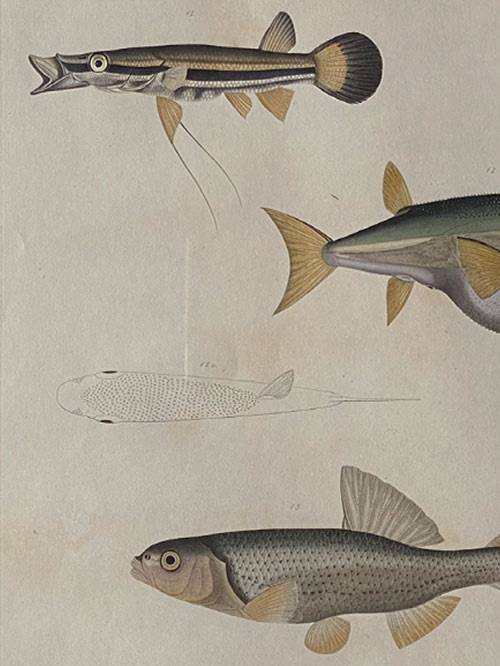
by John Edward Gray
from Illustrations of Indian Zoology
original hand coloured lithograph
Captioned ‘1. Diploptarus Pulchor Graynat. Size
2. Ietrasdon Loioptara Gray Indian Occean Nat. Size
3. Cyprinus Chedra Hamilton Rivers of Bengal Nat. Size‘
John Edward Gray of the British Museum had collaborated with Maj.-Gen. Hardwicke in producing Illustrations of Indian Zoology between 1830 and 1834. He was also the author of several major illustrated works on natural history and commissioned the best artists and printers of the day to illustrate his work. The Illustrations of Indian Zoology is his major work, dedicated to the East India Company, and with the striking plates of bird and animal life in the sub-continent drawn by Waterhouse Hawkins, the noted sporting artist. The subscription amounted to thirty-nine home and thirteen foreign.
Size framed (cms): 56.5 (H) x 44 (W)
Size framed (inches): 22 (H) x 17.5 (W)
-
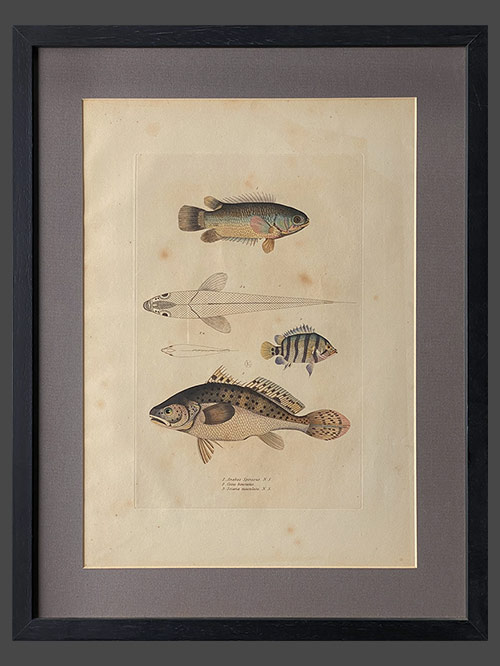
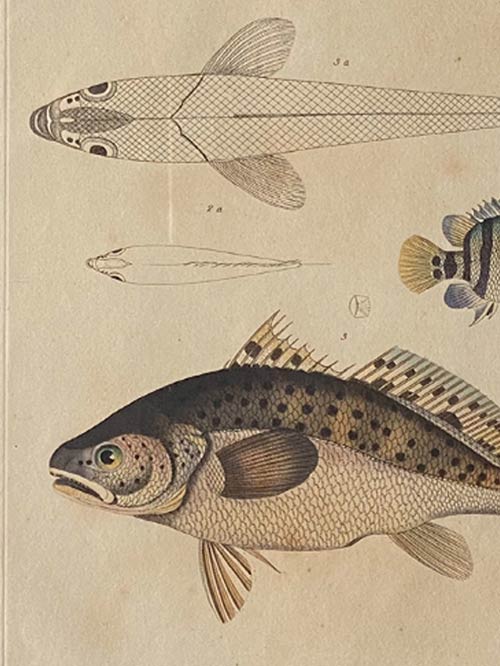
by John Edward Gray
from Illustrations of Indian Zoology
original hand coloured lithograph
Captioned ‘1. Anabas Spinosus. N.s.
2. Coius Binotatus.
3. Sciana Maculata. N.s.‘
John Edward Gray of the British Museum had collaborated with Maj.-Gen. Hardwicke in producing Illustrations of Indian Zoology between 1830 and 1834. He was also the author of several major illustrated works on natural history and commissioned the best artists and printers of the day to illustrate his work. The Illustrations of Indian Zoology is his major work, dedicated to the East India Company, and with the striking plates of bird and animal life in the sub-continent drawn by Waterhouse Hawkins, the noted sporting artist. The subscription amounted to thirty-nine home and thirteen foreign.
Size framed (cms): 56.5 (H) x 44 (W)
Size framed (inches): 22 (H) x 17.5 (W)
-
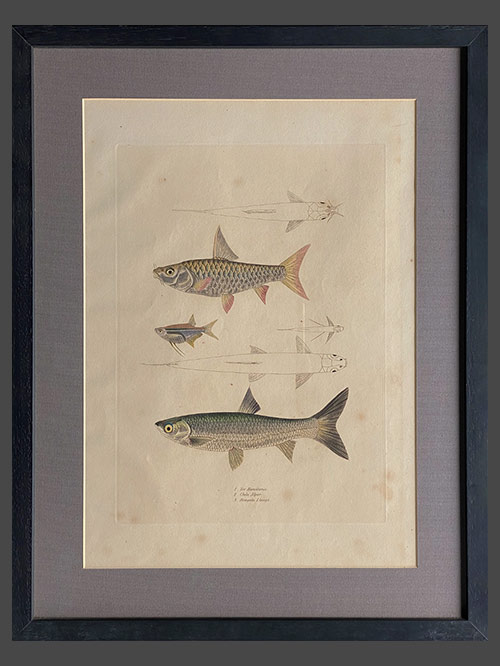
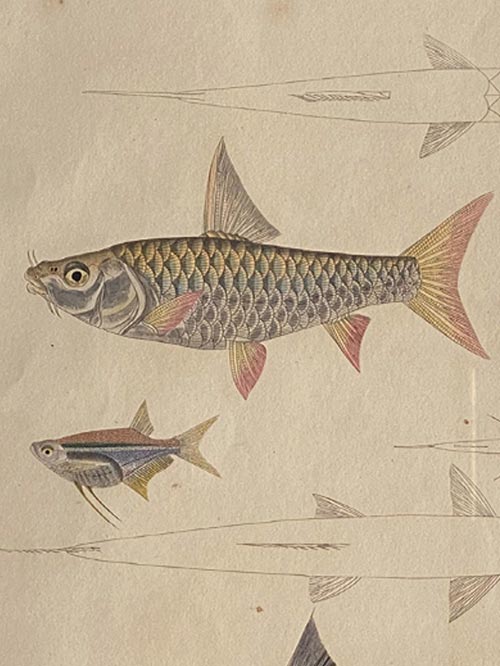
by John Edward Gray
from Illustrations of Indian Zoology
original hand coloured lithograph
Captioned ‘1. Tor Hamiltonii.
2. Chela Alpar.
3. Bengala Elanga.‘
John Edward Gray of the British Museum had collaborated with Maj.-Gen. Hardwicke in producing Illustrations of Indian Zoology between 1830 and 1834. He was also the author of several major illustrated works on natural history and commissioned the best artists and printers of the day to illustrate his work. The Illustrations of Indian Zoology is his major work, dedicated to the East India Company, and with the striking plates of bird and animal life in the sub-continent drawn by Waterhouse Hawkins, the noted sporting artist. The subscription amounted to thirty-nine home and thirteen foreign.
Size framed (cms): 56.5 (H) x 44 (W)
Size framed (inches): 22 (H) x 17.5 (W)
-


by John Edward Gray’s
From ‘Illustrations of Indian Zoology’
original hand coloured lithograph
Captioned ‘Vivrine Cat . Felis Vivirinus‘
John Edward Gray of the British Museum had collaborated with Maj.-Gen. Hardwicke in producing Illustrations of Indian Zoology between 1830 and 1834. He was also the author of several major illustrated works on natural history and commissioned the best artists and printers of the day to illustrate his work. The Illustrations of Indian Zoology is his major work, dedicated to the East India Company, and with the striking plates of bird and animal life in the sub-continent drawn by Waterhouse Hawkins, the noted sporting artist.
Maj.-Gen. Thomas Hardwicke of the Bengal Artillery whilst serving in India from 1778 to 1823 assembled a truly impressive collection of natural history drawings by Indian and European artists whom he engaged to draw flora and fauna. On his retirement he brought the collection with him to England and a thousand of these in many volumes are now in the British library and in the British Museum (Natural History). Bird portraiture predominates in Illustrations of Indian Zoology with a token representation of mammals, reptiles and fishes.
Size (cms): 34 (H) x 48 (L)
Size (inches): 13.5 (H) x 19 (L)
-
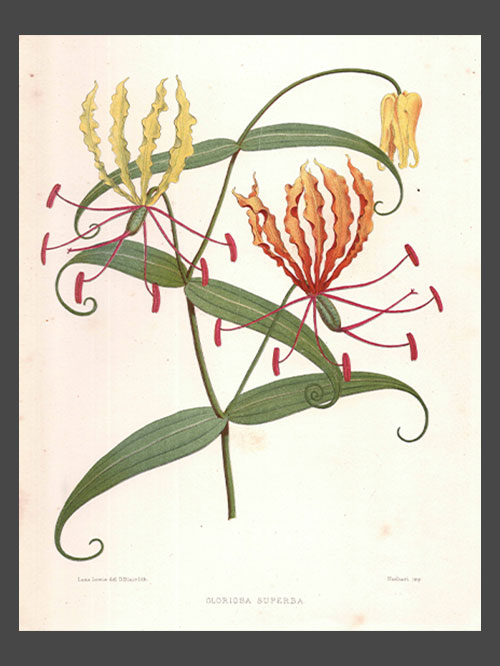
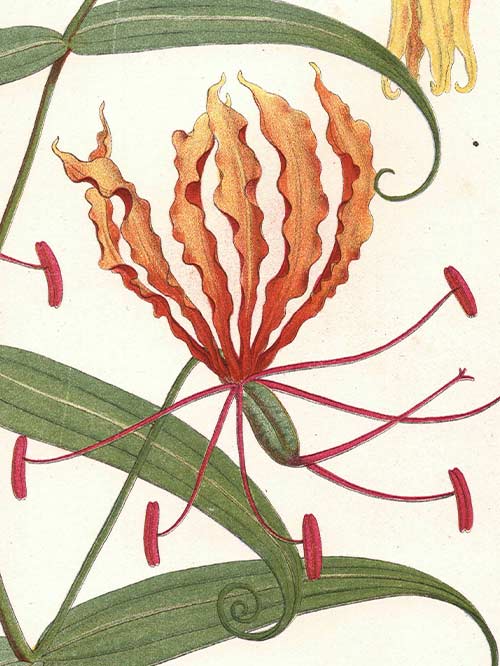
by Lena Lowis
original hand coloured lithograph
Captioned ‘Gloriosa superba’
Lena Lowis (1845- 1919) was the daughter of Sir Richmond Campbell Shakespear (1812-1861), an Indian-born British Indian Army officer who helped abolish the capture and selling of Russian slaves in Khiva. She was born in India and later educated and married in England where she lived with her husband and five children.
The artist chronicled many of the flowers commonly cultivated in Indian gardens, some of which were indigenous to the region, while others were introduced by gardeners. Her illustrations are not meant to be taken treatise on botany or as a manual of gardening, rather to convey a fair idea of the colour and texture of the original, to those who have not seen them.
Size (cms): 25.5(H) x 20(W)
Size (inches): 10(H) x 8(W)
Size with Mount (cms): 42(H) x 36(W)
Size with Mount (inches): 16.5(H) x 14(W)
-
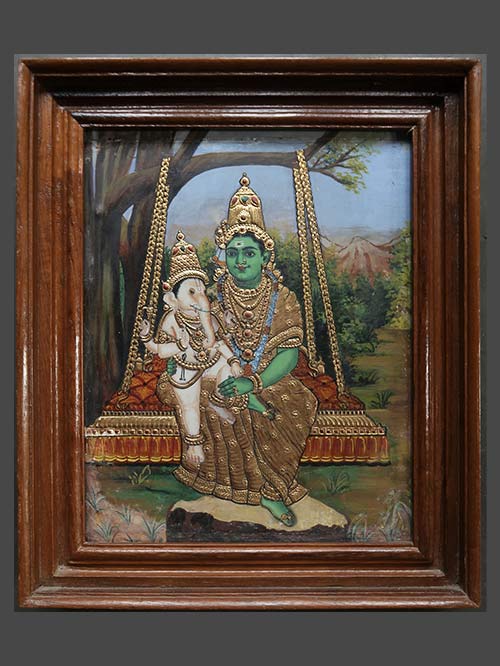
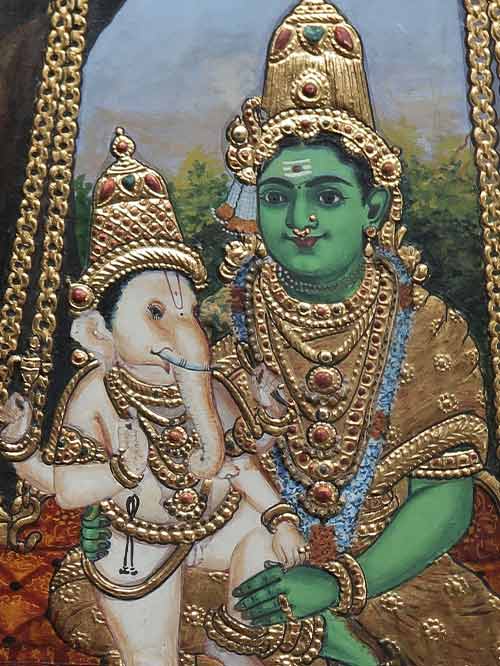
Tanjore (Tamil Nadu)
Opaque pigments and gold on panel
Parvati, crowned and dressed is an ostentatious golden sari, is seated on a plush swing balanced on a tree within a forest. On her lap sits her son Ganesha depicted as a child. Ganesha, naked but for his sumptuous jewellery carries an Ankusa (goad) and a Pasha (noose) in his hands.
Traditional Tanjore paintings were done on wooden panels which were typically seasoned teak wood or jack wood whose narrow strips were joined together. In some exceptional paintings precious stones were used as insets, but usually it was paste and strips of pure gold foil in which exquisite patterns were etched. Colours were prepared from natural extracts. There was a complete absence of light and shade effects except sometimes on the faces of the main figures. Strong bright and flat colours such as red, white, yellow, green and blue were used. Figures were often rotund, suggesting prosperity. Background colours were typically red, blue or green. The themes were predominantly religious but also included portraits of rulers and courtesans. Figures were usually placed within a pavilion with arches, curtains, pillars etc.
Painting Size (cms): 34 (H) x 28.5 (W)
Painting Size (inches): 13.4 (H) x 11.2 (W)
Framed Size (cms): 45.5(H) x 38.5(W)
Framed Size (inches): 18(H) x 15(W)
-
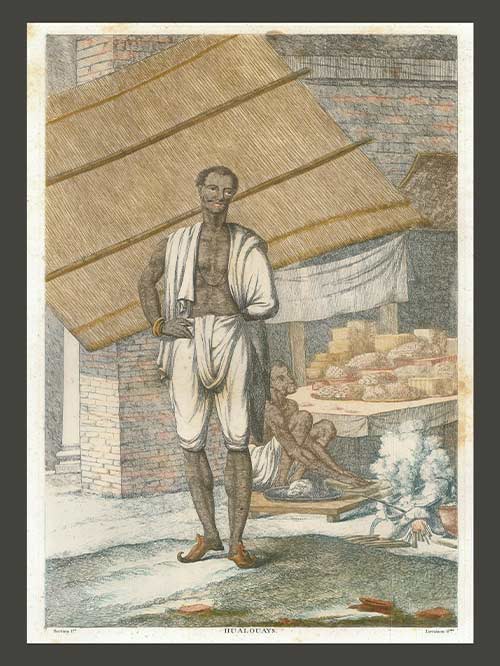

by Francois-Balthazar Solvyns (1760-1824)
Original coloured etching
from Les Hindous
Pub. Paris
Halwais confectioners, specialise in making a variety of sweets using a flour base, distinctive to North India, unlike the milk and sugar-based Bengali sweets prepared by Mayaras. Their name derives from “halwa,” a sweet made of flour, ghee, sugar, and often flavoured with cardamom and almonds, sometimes coloured with saffron and mixed with raisins or pistachio nuts. The confections are prepared through various methods, such as frying flour in ghee, boiling it in milk and sugar, or baking in earthen pans. Puddings, including those with grated vegetables like carrots, are popular, while delicate varieties use cream, demanding skill in preparation. Despite the Arabic origin of the term “halwa,” Halwais are Hindu Sudras, not Muslims, and they play a significant role in Hindu festivities and ceremonies, supplying sweetmeats for various occasions.
Frans Balthazar Solvyns, was a skilled engraver and painter hailing from Antwerp, embarked on a transformative journey to India in 1790. Settling in Calcutta, Solvyns immersed himself in the intricacies of Indian life, studying Hindi and forging relationships with Brahmins and pundits. Inspired by his surroundings, he commenced his ambitious project in 1791, aiming to depict the diverse facets of Indian society, from occupations to customs which he published in a series of engravings. Despite its sensitive portrayal, the venture encountered little success initially, prompting Solvyns’ departure from India in 1803. However, his legacy endured through subsequent publications, notably “The Costume of Hindoostan” and the expanded edition of “Les Hindous,” offering an intimate and detailed glimpse into 18th-century Indian life across professions, festivals, and daily rituals, immortalising a unique historical moment with both reverence and curiosity.
Image Size (cms): 35(H) x 24(W)
Image Size (inches): 14(H) x 9.5(W)
Mount Size (cms): 51(H) x 41(W)
Mount Size (inches): 20(H) x 16(W)
-
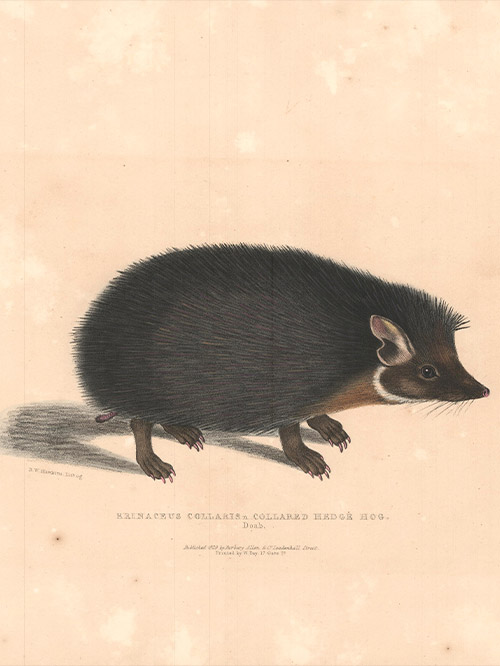

by John Edward Gray’s
From ‘Illustrations of Indian Zoology’
original hand coloured lithograph
Captioned ‘Erinaceus Collaris. Collared Hedge Hog‘
John Edward Gray of the British Museum had collaborated with Maj.-Gen. Hardwicke in producing Illustrations of Indian Zoology between 1830 and 1834. He was also the author of several major illustrated works on natural history and commissioned the best artists and printers of the day to illustrate his work. The Illustrations of Indian Zoology is his major work, dedicated to the East India Company, and with the striking plates of bird and animal life in the sub-continent drawn by Waterhouse Hawkins, the noted sporting artist.
Maj.-Gen. Thomas Hardwicke of the Bengal Artillery whilst serving in India from 1778 to 1823 assembled a truly impressive collection of natural history drawings by Indian and European artists whom he engaged to draw flora and fauna. On his retirement he brought the collection with him to England and a thousand of these in many volumes are now in the British library and in the British Museum (Natural History). Bird portraiture predominates in Illustrations of Indian Zoology with a token representation of mammals, reptiles and fishes.
Size (cms): 34 (H) x 48 (L)
Size (inches): 13.5 (H) x 19 (L)
-

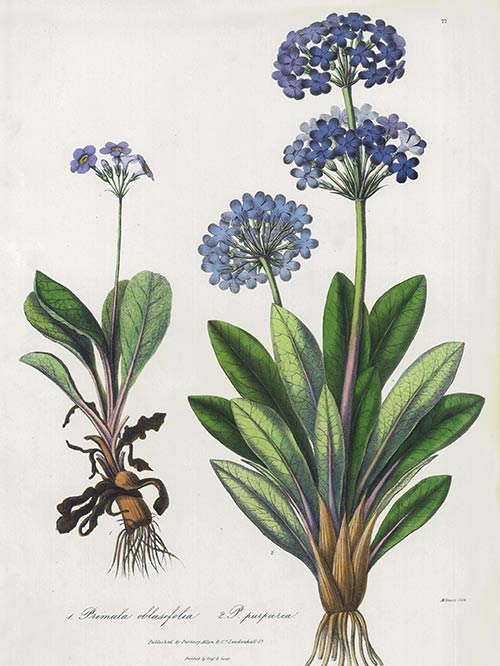
by John Forbes Royle (1798-1858)
Original hand-coloured lithograph
Pub. London
This decorative botanical lithograph depicts two flowering plants, the Primula obtusifolia, commonly known as “Blunt-leaved Primrose,” and the Primula purpurea, commonly known as Purple Himalayan Primrose.” Both are native to the Himalayan region, particularly found in parts of India, Nepal, Bhutan, and Tibet. They grow in alpine meadows and rocky slopes, thriving in cooler, mountainous climates. It is often cultivated as an ornamental plant for its charming flowers and attractive foliage.
John Forbes Royle was a prominent British botanist, physician, and pharmacologist during the 19th century. Royle received his medical education at St. Thomas’s Hospital in London and later served as a surgeon in the British East India Company’s army. During his time in India, Royle became deeply interested in the country’s flora and medicinal plants. He collected a vast number of plant specimens and meticulously documented their medicinal properties. One of Royle’s most notable works was the ‘‘Illustrations of the botany and other branches of the natural history of the Himalayan Mountains and of the flora of Cashmere’. This comprehensive work provided detailed descriptions and illustrations of numerous plant species found in the Himalayan region. It remains an important reference for botanical research in the area.
Image Size (cms): 36.5(H) x 26(W)
Image Size (inches): 14.5(H) x 10(W)
Mount Size (cms): 51(H) x 41(W)
Mount Size (inches): 20(H) x 16(W)
-
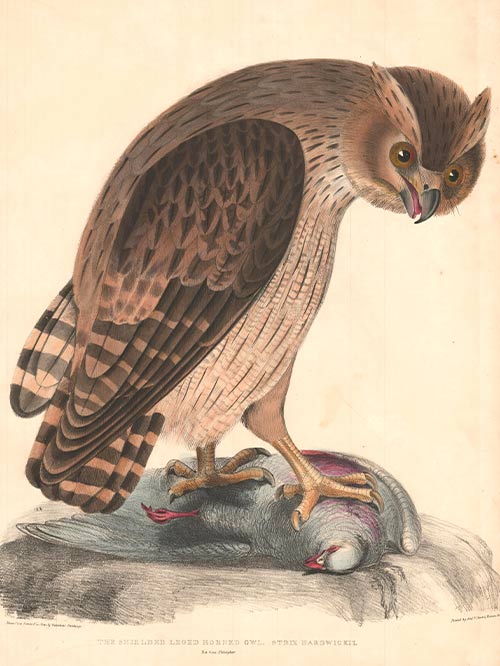
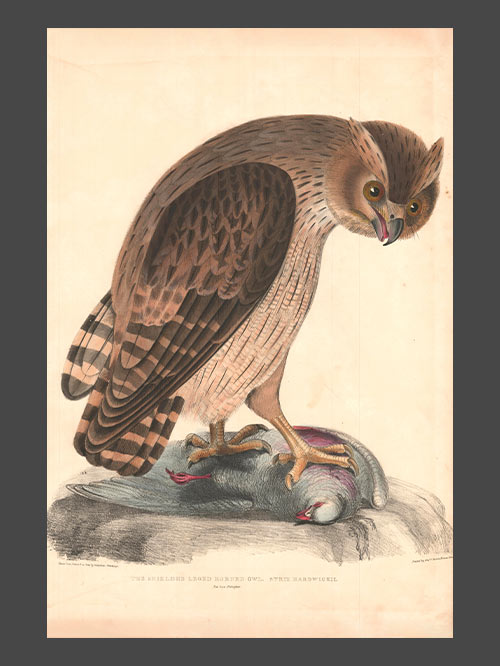
by John Edward Gray’s
From ‘Illustrations of Indian Zoology’
original hand coloured lithograph
Captioned ‘The Shielded Leged Horned Owl. Strix Hardwickii‘
John Edward Gray of the British Museum had collaborated with Maj.-Gen. Hardwicke in producing Illustrations of Indian Zoology between 1830 and 1834. He was also the author of several major illustrated works on natural history and commissioned the best artists and printers of the day to illustrate his work. The Illustrations of Indian Zoology is his major work, dedicated to the East India Company, and with the striking plates of bird and animal life in the sub-continent drawn by Waterhouse Hawkins, the noted sporting artist.
Maj.-Gen. Thomas Hardwicke of the Bengal Artillery whilst serving in India from 1778 to 1823 assembled a truly impressive collection of natural history drawings by Indian and European artists whom he engaged to draw flora and fauna. On his retirement he brought the collection with him to England and a thousand of these in many volumes are now in the British library and in the British Museum (Natural History). Bird portraiture predominates in Illustrations of Indian Zoology with a token representation of mammals, reptiles and fishes.
Size (cms): 48 (H) x 34 (L)
Size (inches): 19 (H) x 13.5 (L)
-


by John Edward Gray’s
From ‘Illustrations of Indian Zoology’
original hand coloured lithograph
Captioned ‘Sorex Myosurus. – Pallas. Musk Shrew.’
John Edward Gray of the British Museum had collaborated with Maj.-Gen. Hardwicke in producing Illustrations of Indian Zoology between 1830 and 1834. He was also the author of several major illustrated works on natural history and commissioned the best artists and printers of the day to illustrate his work. The Illustrations of Indian Zoology is his major work, dedicated to the East India Company, and with the striking plates of bird and animal life in the sub-continent drawn by Waterhouse Hawkins, the noted sporting artist.
Maj.-Gen. Thomas Hardwicke of the Bengal Artillery whilst serving in India from 1778 to 1823 assembled a truly impressive collection of natural history drawings by Indian and European artists whom he engaged to draw flora and fauna. On his retirement he brought the collection with him to England and a thousand of these in many volumes are now in the British library and in the British Museum (Natural History). Bird portraiture predominates in Illustrations of Indian Zoology with a token representation of mammals, reptiles and fishes.
Size (cms): 34 (H) x 48 (L)
Size (inches): 13.5 (H) x 19 (L)
-
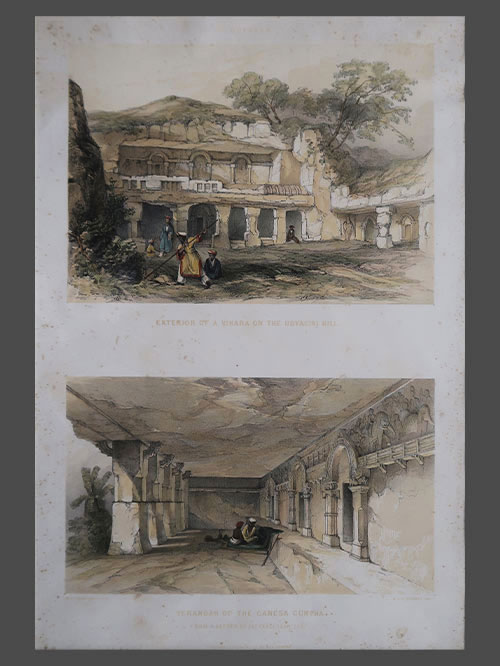
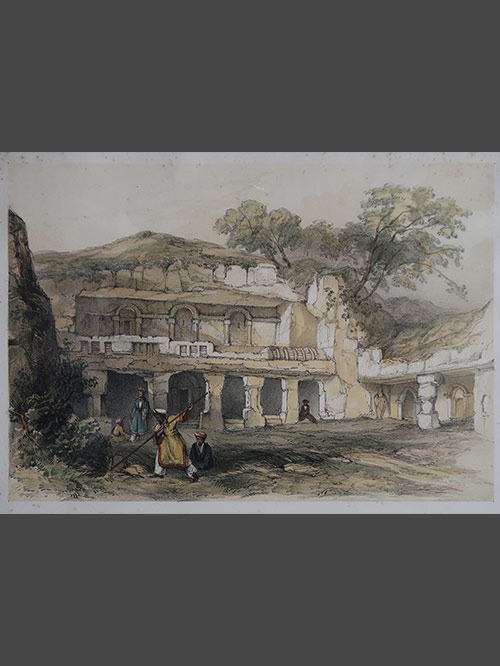
by Thomas Colman Dibdin
from James Fergusson’s ‘Illustrations of the Rock Cut Temples of India’
original hand coloured lithograph
Plate 2 and 3 from James Fergusson’s ‘Illustrations of the Rock Cut Temples of India’.
Plate 2 depicts the Exterior of a Vihara on the Udayagiri Hill. Udayagiri, near Bhubaneshwar in Orissa, is the site of 18 sandstone caves carved for Jain monks that date from the first century BC. There are 18 caves, of which the most famous are the Ranigumpha, the Ganeshagumpha, the Hathigumpha and the Manchipuri. Plate 3 depicts the verandah of the Ganeshagumpha cave. Five pillars delineated the verandah. Three remain. They have square sections at the base and at the top, octagonal sections in the middle, and bracket capitals. A long frieze depicting groups of musicians, scenes from the royal court, and hunting scenes with people astride elephants decorates the verandah wall over the cells’ entrances.
Size of print (cms): 49 (H) x 34 (L)
Size of print (inches): 19.3 (H) x 13.4 (L)
-
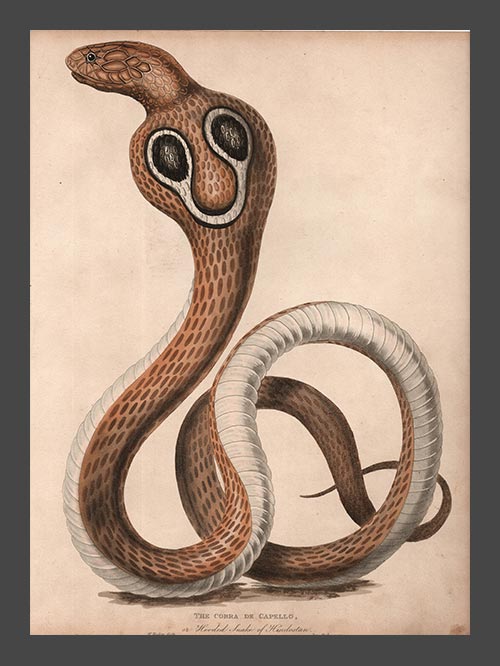
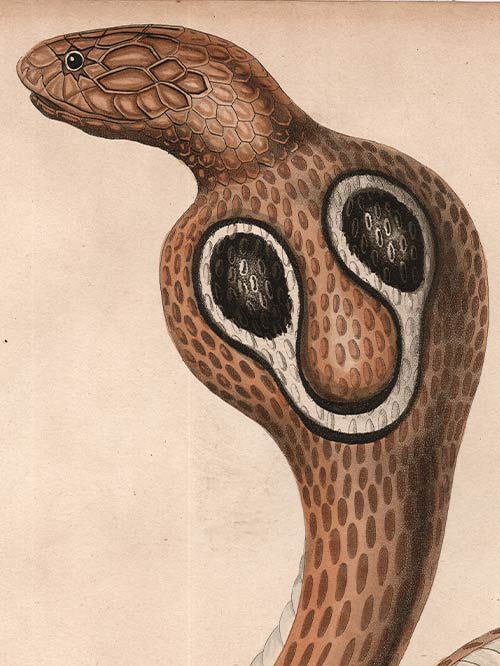
by William Hooker after James Forbes⠀
original hand coloured aquatint
Captioned ‘The Cobra de Capello, or Hooded Snake of Hindostan’
Forbes arrived in Bombay in 1766 as a Writer in the East India Company and spent his first five years in Bombay, living in the Fort area. At that time Bombay was developing as the premier port and commercial centre on the west coast and there were many oppoIntunities for young Company servants stationed there. The marshland between the seven islands was being filled up and eventually the islands were joined to form the Bombay peninsula. Forbes was adventurous and independent. He was an amateur artist, who sketched the Indian environment with no other training, as he himself stated, except encouragement from his friends. Forbes lived in India for 17 years after which he produced his Oriental Memoirs. Its narrative was based on a series of his letters from India and the contents of about 150 notebooks, which returned to England with him. William Hooker was a botanist and executed the superb natural history plates for James Forbes monumental work on Western India, ‘Oriental Memoirs’, in 1812.
Size (cms): 30 (H) x 23.5 (L)
Size (inches): 12 (H) x 9.5 (L)