“Venomous Snakes” has been added to your cart.
View cart
-
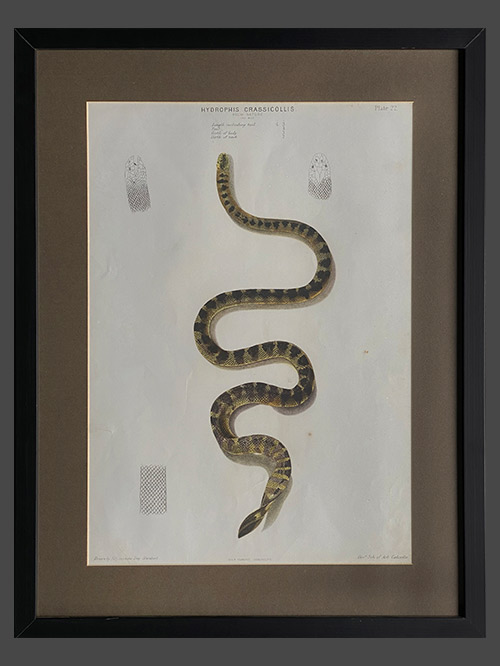
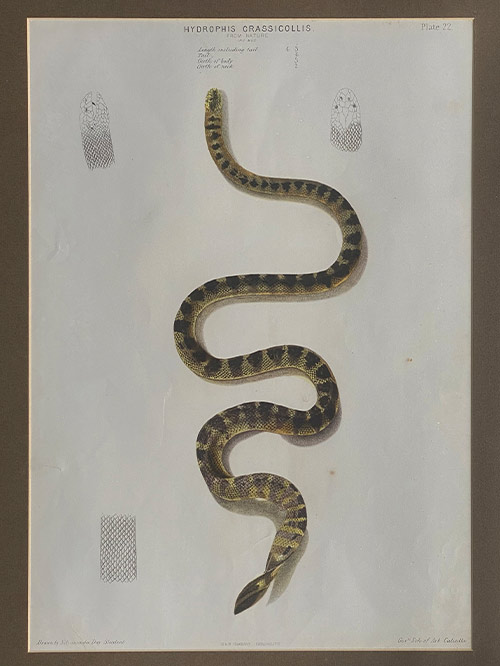
by Sir Joseph Fayrer
from The Thanatophidia of India
original hand coloured chromolithograph
Captioned ‘Hydrophis Crassicollis’
Sir Joseph Fayrer, 1st Baronet (6 December 1824 – 21 May 1907) was an English physician noted for his writings on medicine in India. After studying medicine at Charing Cross Hospital, London and completing his medical degree in 1849, he was appointed as an assistant surgeon in Bengal in 1850. Fayrer, who became a fellow of the Royal Society in 1877, wrote much on subjects connected with the practice of medicine in India, and was especially known for his studies on the poisonous snakes of that country and on the physiological effects produced by their venom. He set up a zoological society and the zoo at Calcutta. He was President of the Asiatic Society of Bengal in 1867.
The Thanatophidia of India is a description of the venomous snakes of the Indian Peninsula and the physiological effects produced by their venom. These plates were drawn by students from the Govt. School of Art in Calcutta.
Size framed (cms): 57 (H) x 44 (L)
Size framed (inches): 22 (H) x 17.5 (L)
-
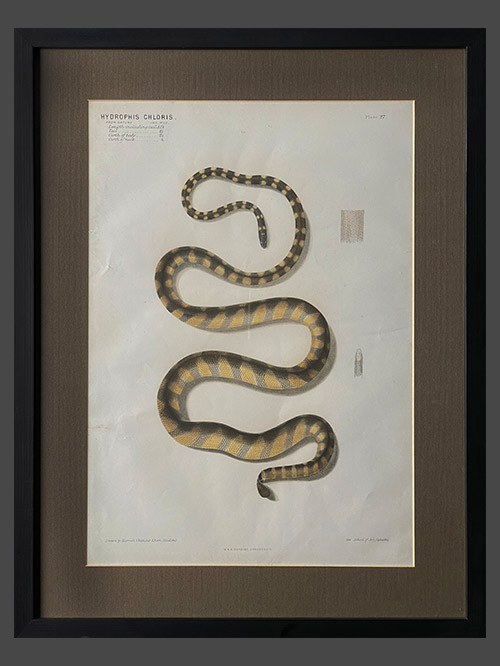
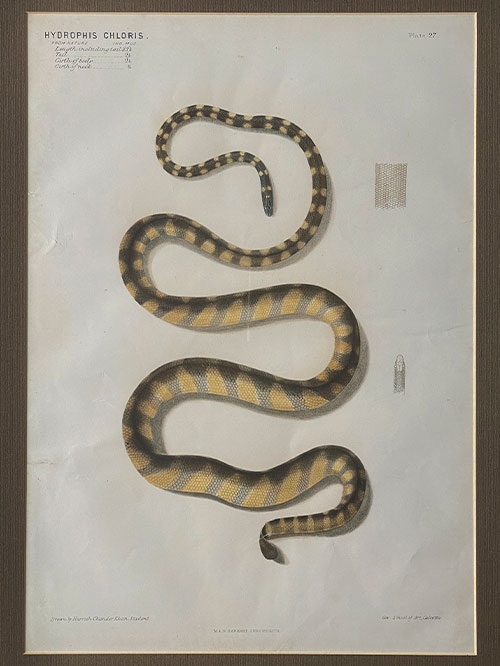
by Sir Joseph Fayrer
from The Thanatophidia of India
original hand coloured chromolithograph
Captioned ‘Hydrophis Chloris’
Sir Joseph Fayrer, 1st Baronet (6 December 1824 – 21 May 1907) was an English physician noted for his writings on medicine in India. After studying medicine at Charing Cross Hospital, London and completing his medical degree in 1849, he was appointed as an assistant surgeon in Bengal in 1850. Fayrer, who became a fellow of the Royal Society in 1877, wrote much on subjects connected with the practice of medicine in India, and was especially known for his studies on the poisonous snakes of that country and on the physiological effects produced by their venom. He set up a zoological society and the zoo at Calcutta. He was President of the Asiatic Society of Bengal in 1867.
The Thanatophidia of India is a description of the venomous snakes of the Indian Peninsula and the physiological effects produced by their venom. These plates were drawn by students from the Govt. School of Art in Calcutta.
Size framed (cms): 57 (H) x 44 (L)
Size framed (inches): 22 (H) x 17.5 (L)
-
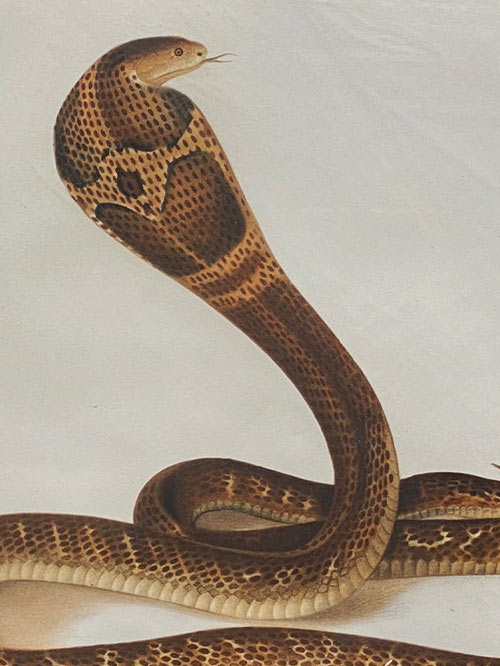
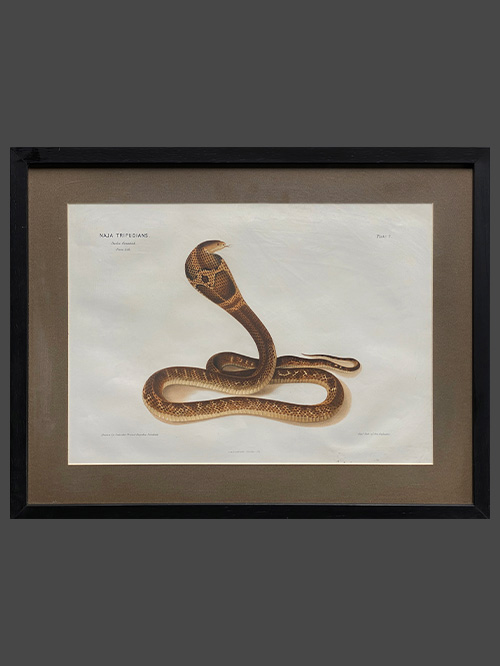
by Sir Joseph Fayrer
from The Thanatophidia of India
original hand coloured chromolithograph
Captioned ‘Naja Tripudians’
Sir Joseph Fayrer, 1st Baronet (6 December 1824 – 21 May 1907) was an English physician noted for his writings on medicine in India. After studying medicine at Charing Cross Hospital, London and completing his medical degree in 1849, he was appointed as an assistant surgeon in Bengal in 1850. Fayrer, who became a fellow of the Royal Society in 1877, wrote much on subjects connected with the practice of medicine in India, and was especially known for his studies on the poisonous snakes of that country and on the physiological effects produced by their venom. He set up a zoological society and the zoo at Calcutta. He was President of the Asiatic Society of Bengal in 1867.
The Thanatophidia of India is a description of the venomous snakes of the Indian Peninsula and the physiological effects produced by their venom. These plates were drawn by students from the Govt. School of Art in Calcutta.
Size framed (cms): 44 (H) x 57 (L)
Size framed (inches): 17.5 (H) x 22 (L)
-
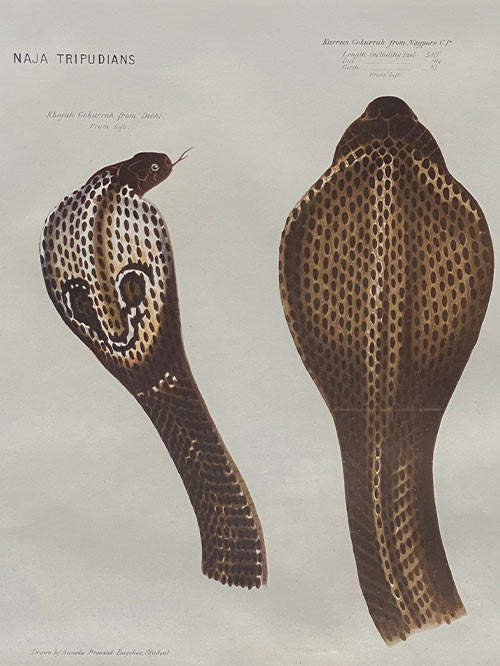
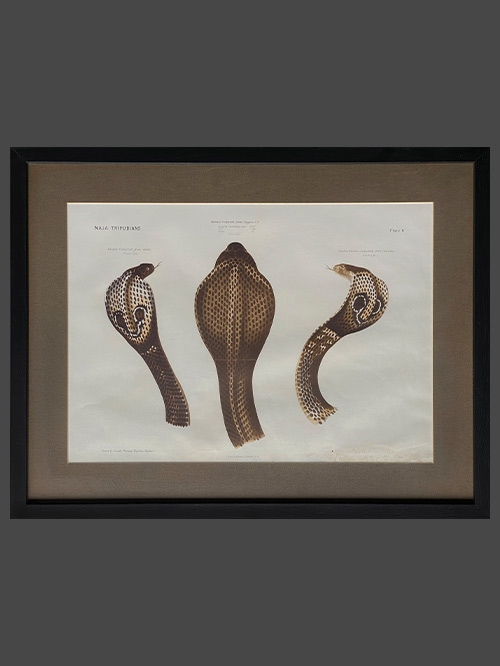
by Sir Joseph Fayrer
from The Thanatophidia of India
original hand coloured chromolithograph
Captioned ‘Naja Tripudians’
Sir Joseph Fayrer, 1st Baronet (6 December 1824 – 21 May 1907) was an English physician noted for his writings on medicine in India. After studying medicine at Charing Cross Hospital, London and completing his medical degree in 1849, he was appointed as an assistant surgeon in Bengal in 1850. Fayrer, who became a fellow of the Royal Society in 1877, wrote much on subjects connected with the practice of medicine in India, and was especially known for his studies on the poisonous snakes of that country and on the physiological effects produced by their venom. He set up a zoological society and the zoo at Calcutta. He was President of the Asiatic Society of Bengal in 1867.
The Thanatophidia of India is a description of the venomous snakes of the Indian Peninsula and the physiological effects produced by their venom. These plates were drawn by students from the Govt. School of Art in Calcutta.
Size framed (cms): 44 (H) x 57 (L)
Size framed (inches): 17.5 (H) x 22 (L)
-
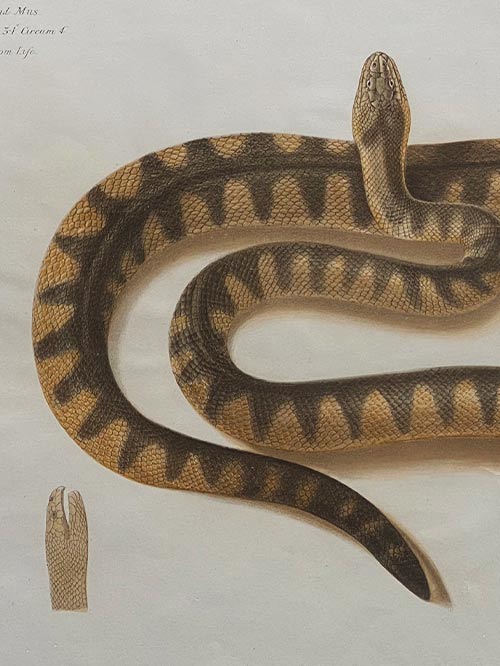
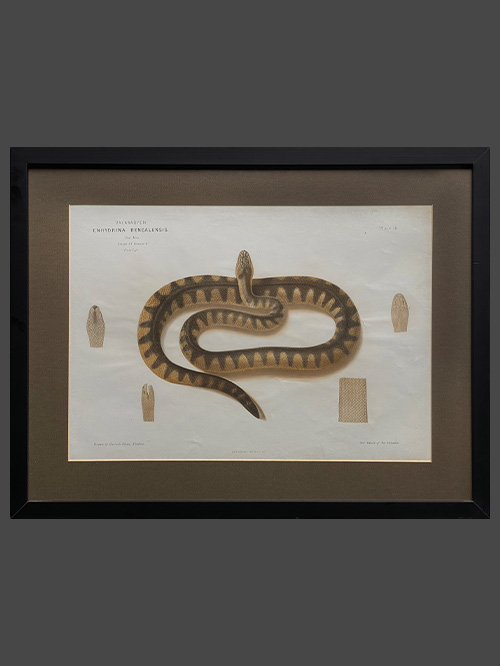
by Sir Joseph Fayrer
from The Thanatophidia of India
original hand coloured chromolithograph
Captioned ‘Enhydrina Bengalensis’
Sir Joseph Fayrer, 1st Baronet (6 December 1824 – 21 May 1907) was an English physician noted for his writings on medicine in India. After studying medicine at Charing Cross Hospital, London and completing his medical degree in 1849, he was appointed as an assistant surgeon in Bengal in 1850. Fayrer, who became a fellow of the Royal Society in 1877, wrote much on subjects connected with the practice of medicine in India, and was especially known for his studies on the poisonous snakes of that country and on the physiological effects produced by their venom. He set up a zoological society and the zoo at Calcutta. He was President of the Asiatic Society of Bengal in 1867.
The Thanatophidia of India is a description of the venomous snakes of the Indian Peninsula and the physiological effects produced by their venom. These plates were drawn by students from the Govt. School of Art in Calcutta.
Size framed (cms): 44 (H) x 57 (L)
Size framed (inches): 17.5 (H) x 22 (L)
-
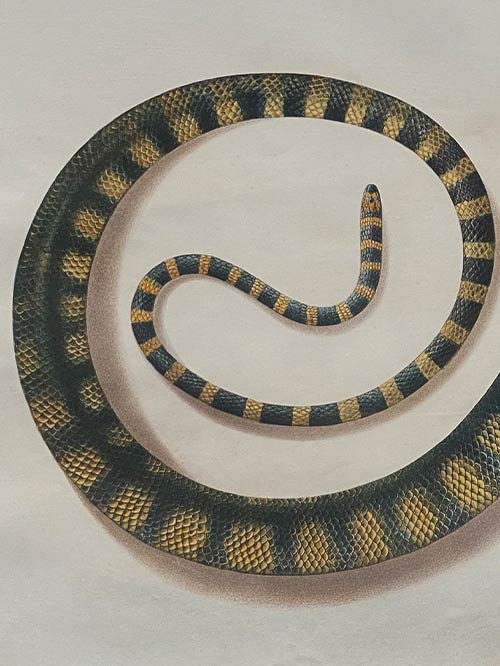
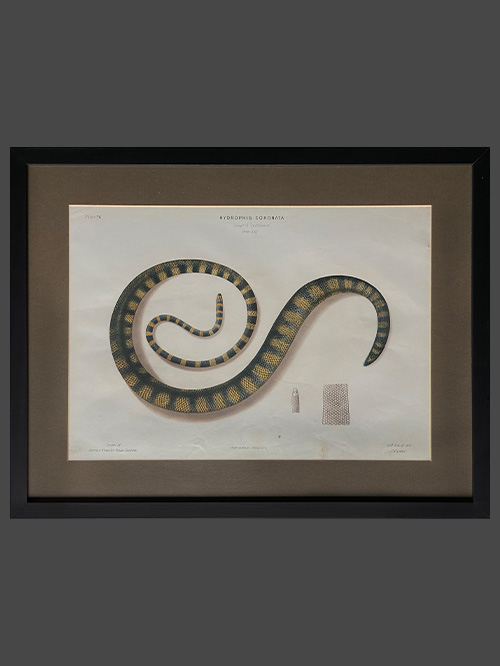
by Sir Joseph Fayrer
from The Thanatophidia of India
original hand coloured chromolithograph
Captioned ‘Hydrophis Coronata’
Sir Joseph Fayrer, 1st Baronet (6 December 1824 – 21 May 1907) was an English physician noted for his writings on medicine in India. After studying medicine at Charing Cross Hospital, London and completing his medical degree in 1849, he was appointed as an assistant surgeon in Bengal in 1850. Fayrer, who became a fellow of the Royal Society in 1877, wrote much on subjects connected with the practice of medicine in India, and was especially known for his studies on the poisonous snakes of that country and on the physiological effects produced by their venom. He set up a zoological society and the zoo at Calcutta. He was President of the Asiatic Society of Bengal in 1867.
The Thanatophidia of India is a description of the venomous snakes of the Indian Peninsula and the physiological effects produced by their venom. These plates were drawn by students from the Govt. School of Art in Calcutta.
Size framed (cms): 44 (H) x 57 (L)
Size framed (inches): 17.5 (H) x 22 (L)
-
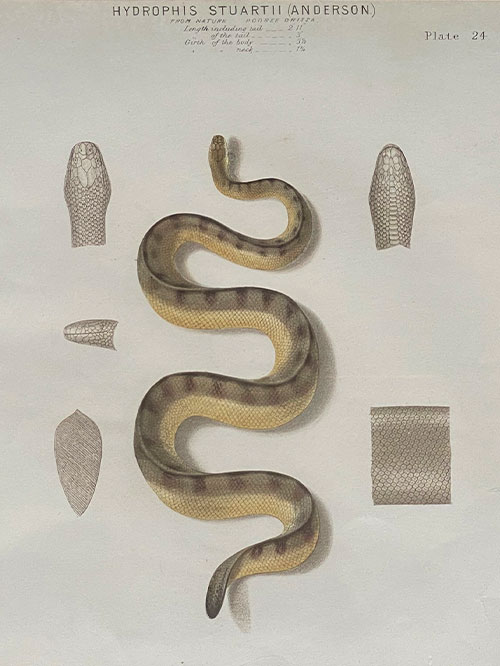
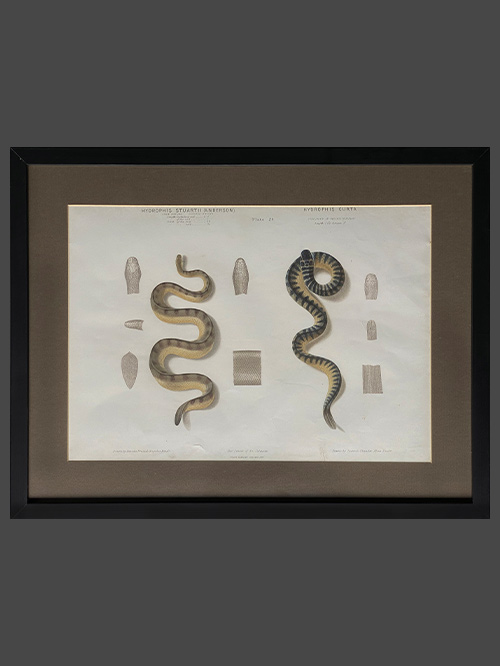
by Sir Joseph Fayrer
from The Thanatophidia of India
original hand coloured chromolithograph
Captioned ‘Hydrophis Stuartii and Hydrophis Curta’
Sir Joseph Fayrer, 1st Baronet (6 December 1824 – 21 May 1907) was an English physician noted for his writings on medicine in India. After studying medicine at Charing Cross Hospital, London and completing his medical degree in 1849, he was appointed as an assistant surgeon in Bengal in 1850. Fayrer, who became a fellow of the Royal Society in 1877, wrote much on subjects connected with the practice of medicine in India, and was especially known for his studies on the poisonous snakes of that country and on the physiological effects produced by their venom. He set up a zoological society and the zoo at Calcutta. He was President of the Asiatic Society of Bengal in 1867.
The Thanatophidia of India is a description of the venomous snakes of the Indian Peninsula and the physiological effects produced by their venom. These plates were drawn by students from the Govt. School of Art in Calcutta.
Size framed (cms): 44 (H) x 57 (L)
Size framed (inches): 17.5 (H) x 22 (L)
-
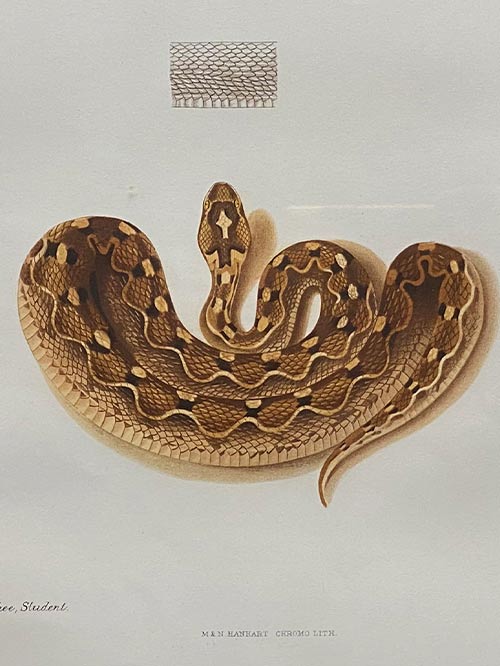
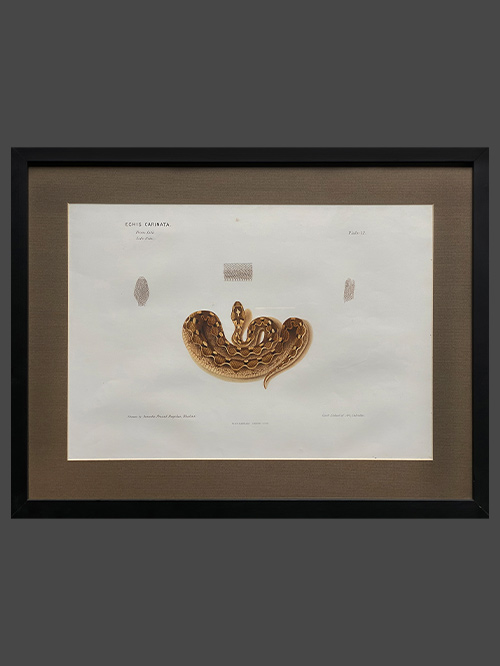
by Sir Joseph Fayrer
from The Thanatophidia of India
original hand coloured chromolithograph
Captioned ‘Echis Carinata’
Sir Joseph Fayrer, 1st Baronet (6 December 1824 – 21 May 1907) was an English physician noted for his writings on medicine in India. After studying medicine at Charing Cross Hospital, London and completing his medical degree in 1849, he was appointed as an assistant surgeon in Bengal in 1850. Fayrer, who became a fellow of the Royal Society in 1877, wrote much on subjects connected with the practice of medicine in India, and was especially known for his studies on the poisonous snakes of that country and on the physiological effects produced by their venom. He set up a zoological society and the zoo at Calcutta. He was President of the Asiatic Society of Bengal in 1867.
The Thanatophidia of India is a description of the venomous snakes of the Indian Peninsula and the physiological effects produced by their venom. These plates were drawn by students from the Govt. School of Art in Calcutta.
Size framed (cms): 44 (H) x 57 (L)
Size framed (inches): 17.5 (H) x 22 (L)
-
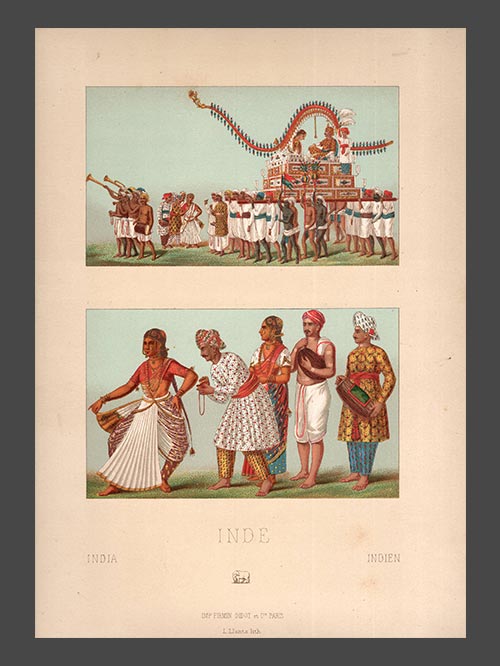
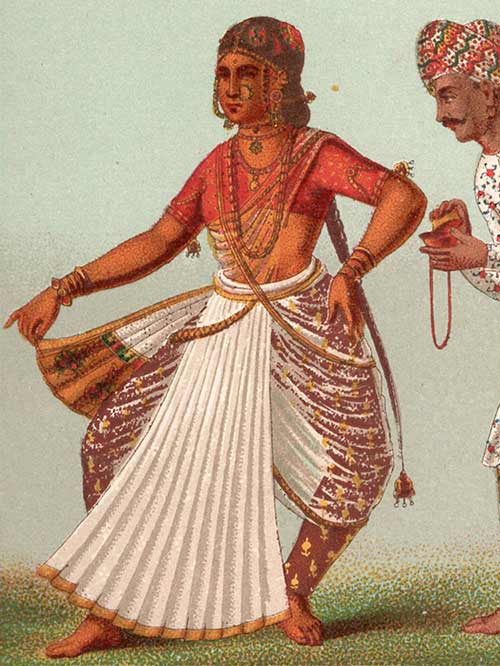
by A Racinet
from Le Costume Historique
original chromolithograph
Racinet’s ‘Le Costume Historique’ is the most famous of the 19th-century books on dress, and the first fashion book to use colour lithography. It is a wide-ranging survey of costumes through time. Publication was made possible by significant developments in colour printing technology, and a resurgence of interest in ‘the other’ as a new period of European colonialism gathered pace from the mid-19th century. The emphasis here is on recognising continuity in traditional dress, rather than innovation in fashion, and linking costume to local history, custom and social organisation. Racinet was keen to produce a visually appealing book that deployed chromolithography to full effect; in his enthusiasm he sometimes toyed with authenticity by adding colour to some of his sources. His representations of Indian fashion are largely inspired by miniature paintings from the collection of French lithographer Firmin Didot.
Image Size (cms): 17.5 (H) x 15.5 (W)
Image Size (inches): 7 (H) x 6 (W)
Print Size (cms): 30 (H) x 21.5 (W)
Print Size (inches): 11.8 (H) x 8.5 (W)
-
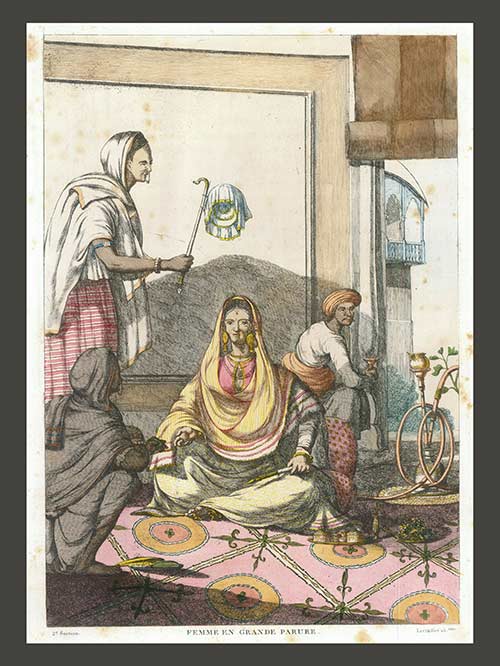
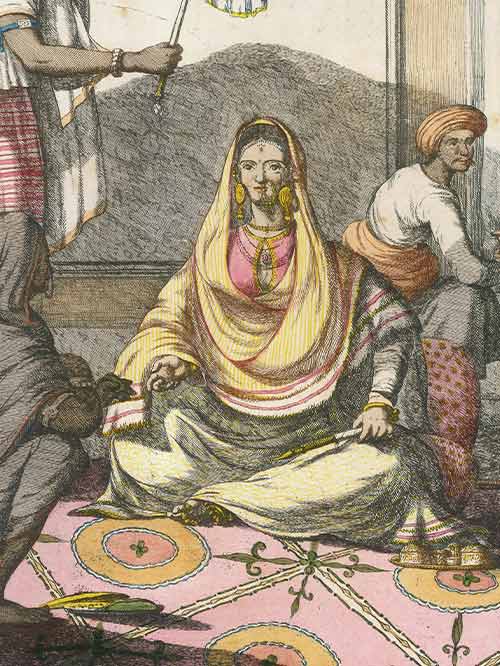
by Francois-Balthazar Solvyns (1760-1824)
Original coloured etching
from Les Hindous
Pub. Paris
Solvyns provides a vivid portrayal of a wealthy Hindu woman in full dress, emphasising both the magnificence of her attire and the richness of her surroundings. The woman is seated on a luxurious carpet, with her legs and arms supported by embroidered silk cushions. She is attended by two ayahs (maid servants). One maid offers her paan while another fans her with a hand pankh to refresh the air around her face. In the background, a hookah-bearer prepares the hookah for her to smoke. The lady’s appearance is meticulously described: her hair, made shiny with cocoa oil, is plaited and adorned with pearls or precious stones, with the largest gem positioned in the middle. Solvyns highlights her isolation and idle life, noting that women of her rank live in seclusion, removed from both labor and society, their lives marked by a lack of purpose and contribution, engaging in minimal activities such as playing the tom-tom.
Frans Balthazar Solvyns, was a skilled engraver and painter hailing from Antwerp, embarked on a transformative journey to India in 1790. Settling in Calcutta, Solvyns immersed himself in the intricacies of Indian life, studying Hindi and forging relationships with Brahmins and pundits. Inspired by his surroundings, he commenced his ambitious project in 1791, aiming to depict the diverse facets of Indian society, from occupations to customs which he published in a series of engravings. Despite its sensitive portrayal, the venture encountered little success initially, prompting Solvyns’ departure from India in 1803. However, his legacy endured through subsequent publications, notably “The Costume of Hindoostan” and the expanded edition of “Les Hindous,” offering an intimate and detailed glimpse into 18th-century Indian life across professions, festivals, and daily rituals, immortalising a unique historical moment with both reverence and curiosity.
Image Size (cms): 35(H) x 24(W)
Image Size (inches): 14(H) x 9.5(W)
Mount Size (cms): 51(H) x 41(W)
Mount Size (inches): 20(H) x 16(W)
-
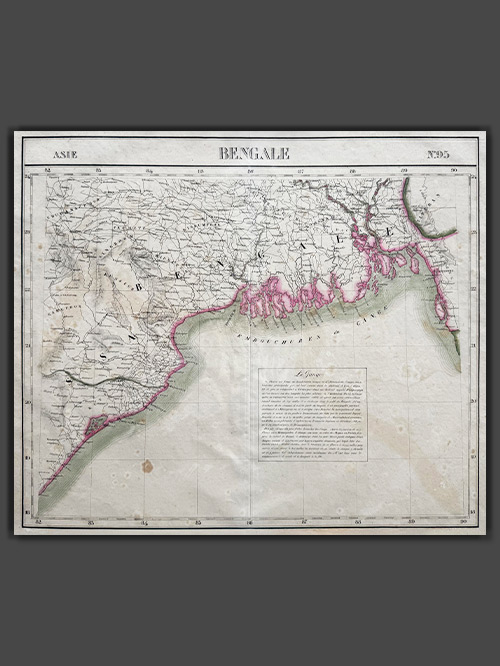
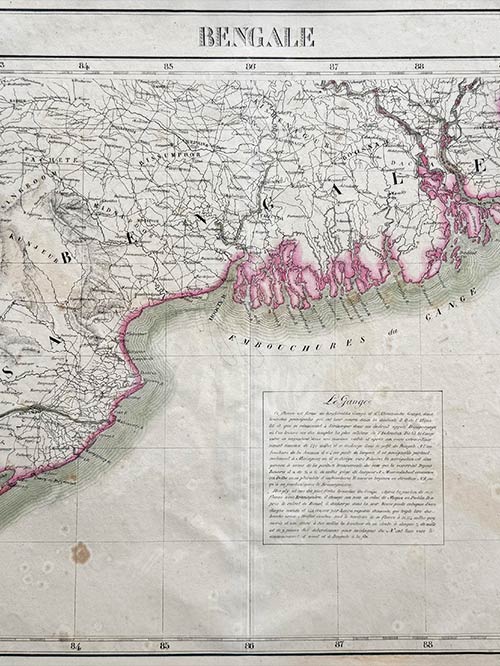
Original lithographed map by Philippe Vandermaelen (1795-1869)
An attractive map from Atlas Universel de Geographie depicts parts of present-day Bangladesh, Bihar, Orissa, West Bengal, and Tripura. This atlas was groundbreaking as the first to present all maps on a uniform scale of 1:1,641,836, with each map covering approximately 20 degrees of longitude (from Paris) and 6 degrees of latitude. Published between 1825 and 1827 in a single edition with 810 copies sold, it offered unprecedented detail for many regions, particularly the American West. The maps were hand-painted in outline colour, showcasing remarkable craftsmanship.
Philippe Marie Guillaume Vandermaelen (1795–1869), the Flemish cartographer behind this monumental work, was a native of Brussels and initially trained as a globe maker. His innovative vision of mapping on a universal scale was likely influenced by this early training. Beyond the Atlas Universel, Vandermaelen created globes, regional maps, a 250-sheet map of Belgium, and other significant works, establishing himself as a key figure in 19th-century cartography.
Image Size (cms): 49.5(H) x 57(W)
Image Size (inches): 19.5(H) x 22.5(W)
-
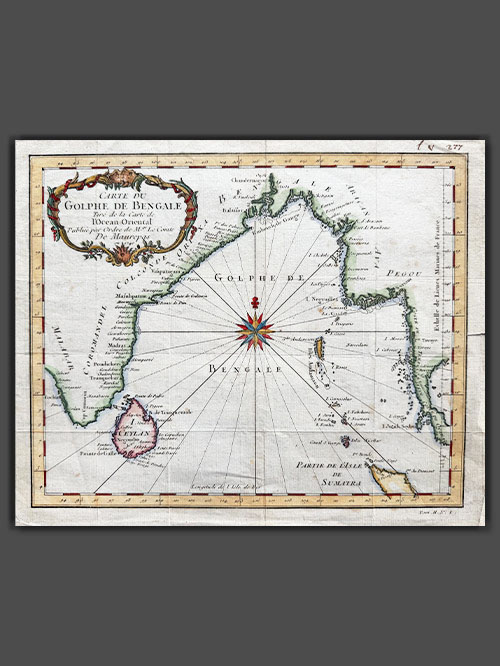

Original engraved plan by Jacques Nicholas Bellin (1703-1772)
This exquisite map by Jacques-Nicolas Bellin illustrates the Bay of Bengal during the height of French influence in India. Published in 1740, the map showcases coastal cities, islands, and regions of strategic and economic importance during a period when France nearly rivaled Britain as the dominant European power on the subcontinent.
The map highlights key coastal cities along the Bay of Bengal, including Pondicherry (Pondicheri) marked with a star, the capital of French India, which was central to French administration and trade. While overshadowed by British dominance, France’s influence in India was notable, with territories like Pondicherry, Yanam, Mahe, and Karikal. French ambitions, driven by competition with Britain, escalated in the mid-18th century under Joseph François Dupleix, leading to conflicts like the War of the Austrian Succession and the Seven Years’ War. Though the British defeated the French at the Battle of Plassey in 1757, France retained control of its coastal territories until India’s independence in 1947 and the formal transfer in 1962.
This map was meticulously crafted by Jacques-Nicolas Bellin and published as plate No. 1 in Volume 2 of the 1740 edition of Abbé Prévost’s L’Histoire Générale des Voyages. Bellin’s work, renowned for its precision and detail, is preserved in several libraries across Europe and North America, either as an individual map or as part of Prévost’s celebrated publication.
Image Size (cms): 23.5(H) x 28.5(W)
Image Size (inches): 9.5(H) x 11(W)
-
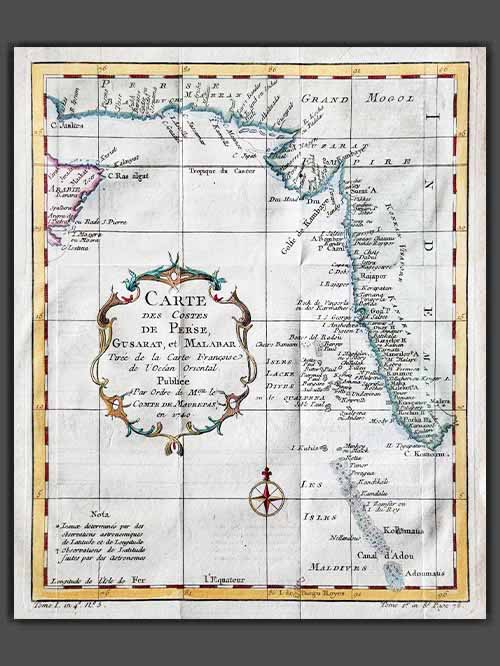
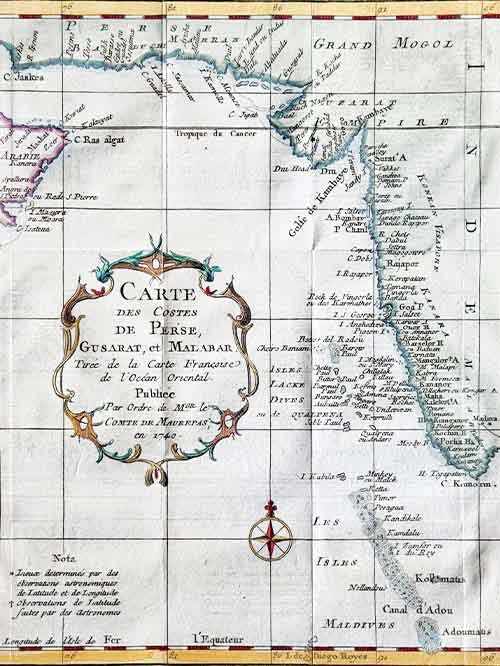
Original engraved plan by Jacques-Nicolas Bellin (1703–1772)
This decorative engraved map by Jacques-Nicolas Bellin appears in Abrégé de l’histoire générale des voyages, published in Paris in 1780. It depicts the region from the mouth of the Persian Gulf to the Maldives, showcasing all major ports and towns along this strategically significant area.
Jacques-Nicolas Bellin was a pivotal figure in 18th-century cartography, serving as Hydrographer to the French Navy and the first Ingénieur Hydrographe at the French Dépôt des cartes et plans de la Marine. Over a 50-year career, Bellin produced hundreds of maps and charts celebrated for their accuracy and functionality, setting a high standard in European cartography. His works included major sea atlases such as Neptune François (1753), Hydrographie Française (1756), and the comprehensive Petit Atlas Maritime (1764), featuring 580–581 finely detailed charts. Bellin also contributed extensively to Diderot’s Encyclopédie and Abbé Prévost’s Histoire Générale des Voyages. A child of the Enlightenment, Bellin prioritized scholarly precision and cited his sources diligently, distinguishing his work from the more decorative styles of earlier mapmakers. His contributions cemented France’s dominance in cartography and influenced his student, Rigobert Bonne, who succeeded him at the Dépôt.
Image Size (cms): 26(H) x 21(W)
Image Size (inches): 10(H) x 8.5(W)
-
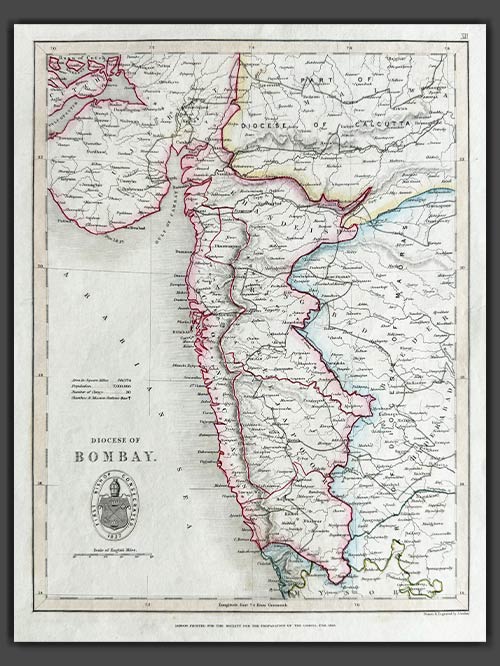
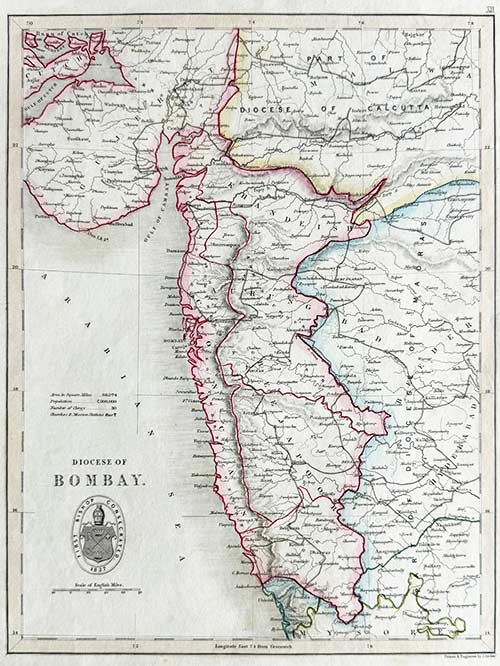
Original engraved map by J. Archer
from The Colonial Church Atlas
The Roman Catholic Archdiocese of Bombay is one of the most prominent Catholic jurisdictions in India, serving as the metropolitan see for the province of Bombay. Established as a vicariate in 1637 and elevated to an archdiocese in 1886, it encompasses Bombay and its surrounding areas. The Cathedral of the Holy Name in Colaba stands as its mother church.
The archdiocese is central to the spiritual, educational, and social fabric of the region’s Catholic community. Its extensive network includes parishes, schools, colleges, hospitals, and charitable organizations, which cater to people of all faiths. Known for its cultural and liturgical events, the Archdiocese of Bombay reflects the vibrancy and diversity of Mumbai’s Catholic population.
Size (cms): 30.5(H) x 23(W)
Size (inches): 12(H) x 9(W)
-
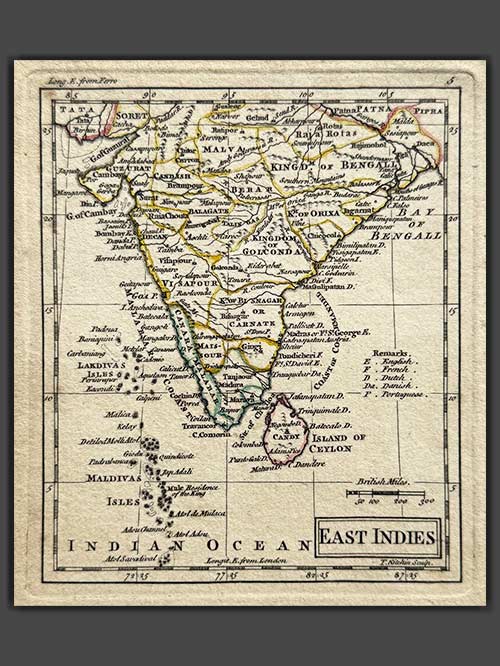
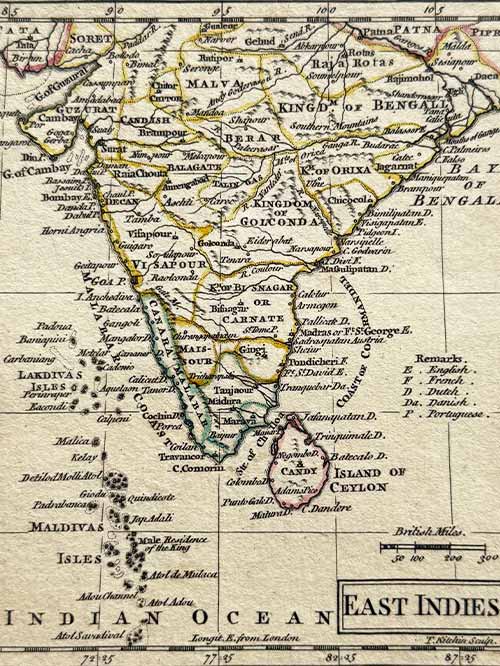
Original engraved map by A Dury (1766-1777)
This original, rare map of India, engraved by A. Dury (fl. 1766–1777), was published in 1761 as part of the A New General and Universal Atlas.
Dury was a British map and print publisher based in Duke’s Court on St. Martin’s Lane in London. Although he was a skilled mapmaker, he achieved less success than his contemporaries, such as Thomas Jefferys and William Faden, making his maps relatively rare. Dury is most commonly associated with the large Indian maps by James Rennell, one of his key collaborations. In addition, he produced notable maps during the Revolutionary War, including plans of Boston and Philadelphia, as well as a series related to the Russo-Turkish War of 1768–74. Despite his limited commercial success, Dury’s works remain valuable for their historical and cartographic significance.
Size (cms): 14.5(H) x 12.5(W)
Size (inches): 5.5(H) x 5(W)
-
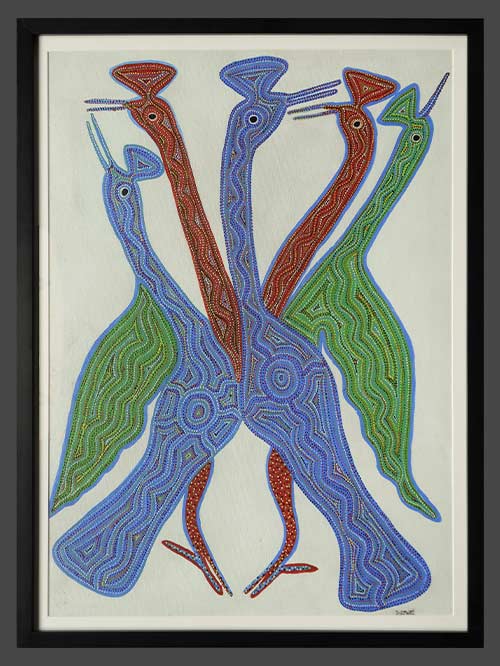
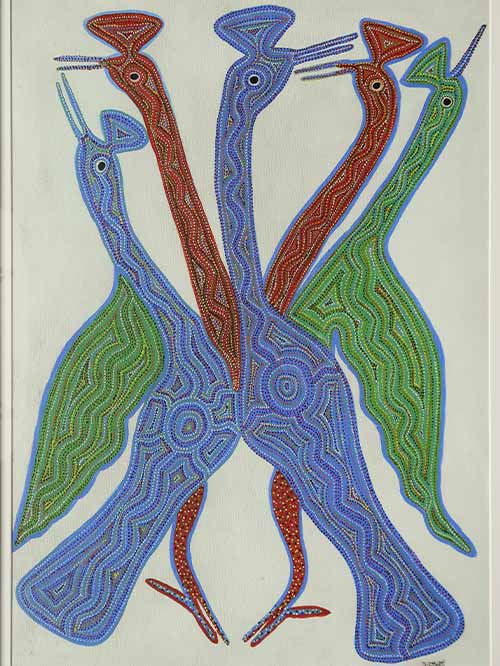
Bhil Tribes (Central India)
by Bhuri Bai
watercolour on canvas
Bhuri Bai grew up in the Jhabua district on the Madhya Pradesh-Gujarat border. J Swaminathan identified her as a potential artist nearly three decades ago, when she was a 20-year-old daily wage labourer. She picks up clues from the arts of embroidery as well as ritual narratives; her images shuttle between the intimate and the cosmic. This is especially evident in paintings where she depicts stags whose antlers grow into forests, their bodies distinctively patterned after desert dunes or river wavelets. She returns, often, to variations on the Tree of Life motif, playfully annotating its mythic presence with owls that stand on stilt-legs, timid snakes, and high-spirited elephants. Bhuri Bai demonstrates a lively and witty eye for observed detail, veining her observations with allegorical or parabolic intent.
Painting Size (cms): 74(H) x 54(W)
Painting Size (inches): 29(H) x 21.5(W)
Framed Size (cms): 79(H) x 59(W)
Framed Size (inches): 31(H) x 23(W)