“A Pandarom” has been added to your cart.
View cart
-
Pub. London
original hand-coloured aquatint
Captain Charles Gold (d. 1842) served in the military campaigns against Tipu Sultan, the ruler of the Kingdom of Mysore and during 1791-98 he sketched a series of images later published as aquatints in “Oriental Drawings.” He was fascinated with the concept of religious begging and documented all manners of mendicants and zealots that he met on his travel, often detailing their unique trials and tribulations.While these prints cannot be divorced from the orientalist roots from which they came, they are a compelling visual memoir of a time and people that may have otherwise been lost to time.
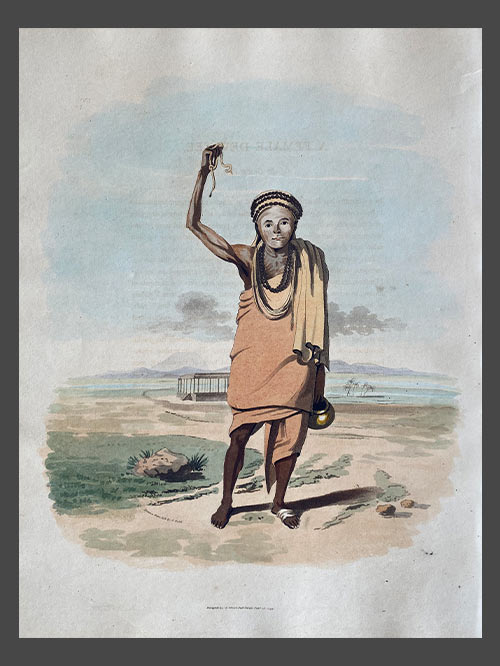
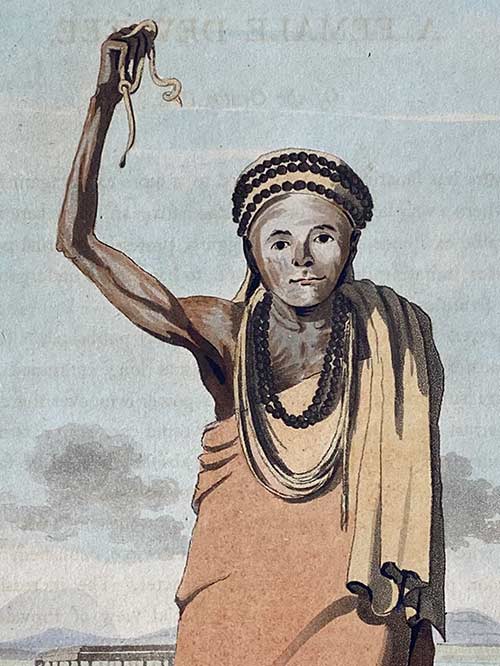
The devotee drawn by the artist, “made a vow, in order to gain favour with the gods, to keep her right arm uplifted, and let the finger nails of that hand grow for twelve years. The cord worn round her neck she used for the purpose of tying up her arm at night when going to rest. Her hand being nearly closed, the thumb nail arched directly over it, the fore finger nail assumed a spiral or cork-screw form, that of the middle took an extraordinary direction, encircling the little finger nail, which grew more regularly than the others, and descended about half way to her elbow, the remaining or fourth nail being broken off half an inch from the finger end. She had adopted the orange coloured dress usually worn by the religious orders in India; and being subsisted entirely by the liberality of the devout, who regarded her as a saint, travelled the country with a brass pot, to receive their pious donations in. Her face, right arm, and neck, were smeared over with a white powder. The ornaments round her head and neck are seeds of a fruit which grows in the north of India, called the nut of Rouderin. The cloth round her right foot was merely to cover a hurt received in travelling, as she did not indulge with shoes. In the distance is a Choultry, built at the expence of some charitable Gentoo, for the accommodation of travellers.”
Size (cms): 33(H) x 25(W)
Size (inches): 13(H) x 10(W)
-
Pub. London
original hand-coloured aquatint
Captain Charles Gold (d. 1842) served in the military campaigns against Tipu Sultan, the ruler of the Kingdom of Mysore and during 1791-98 he sketched a series of images later published as aquatints in “Oriental Drawings.” He was fascinated with the concept of religious begging and documented all manners of mendicants and zealots that he met on his travel, often detailing their unique trials and tribulations.While these prints cannot be divorced from the orientalist roots from which they came, they are a compelling visual memoir of a time and people that may have otherwise been lost to time.
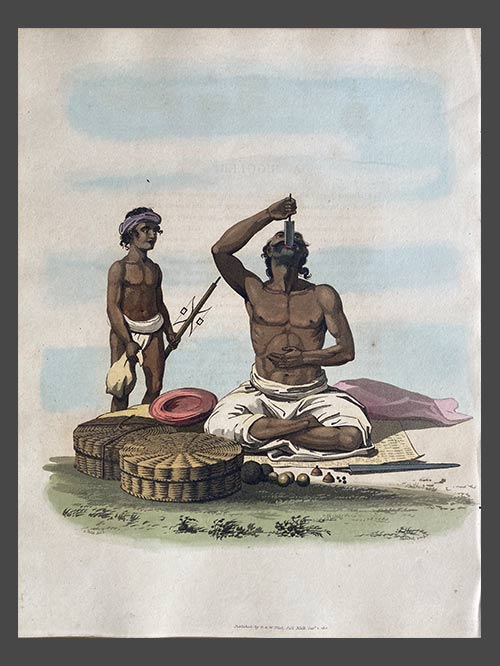
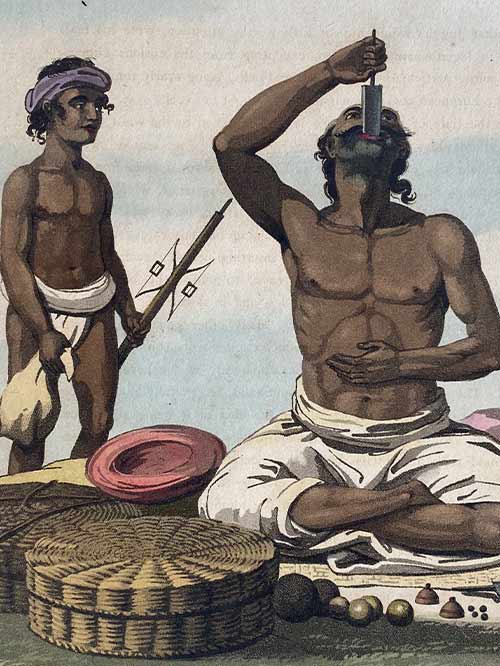
Fascinated by his encounter, the artist recounts “the Juggler in the usual attitude of putting the sword-blade down his throat; is seated on a mat, with his cups and balls before him; also two heavy stone balls, which he throws alternately to a great height, and catches on his bare back. The baskets contain his various apparatus, and the little fellow, his son and apprentice, holds a small whirling instrument, which he balances and plays various tricks with. His dress and turban lay on the ground behind. The most surprising of his performances, which consist of various distortions of his person, is to raise by the strength of his eyelids, two baskets containing his apparatus, being of several pounds weight. That which excites wonder in the greatest degree is the swallowing a sword blade, apparently at the hazard of his existence. The practicability of this experiment, is generally doubted by those who have not witnessed it; under the idea of it being performed with a spring sword. He swallowed to the very hilt the blade of a broad-sword, blunted in the edges and point, and about eighteen inches long, which I absolutely felt in his stomach. As may be supposed, the exertion and straining affects the poor fellow a good deal at the time, but a glass or two of arrack or brandy which he never fails to ask for, soon refreshes him.”
Size (cms): 33(H) x 25(W)
Size (inches): 13(H) x 10(W)
-
Pub. London
original hand-coloured aquatint
Captain Charles Gold (d. 1842) served in the military campaigns against Tipu Sultan, the ruler of the Kingdom of Mysore and during 1791-98 he sketched a series of images later published as aquatints in “Oriental Drawings.” He was fascinated with the concept of religious begging and documented all manners of mendicants and zealots that he met on his travel, often detailing their unique trials and tribulations.While these prints cannot be divorced from the orientalist roots from which they came, they are a compelling visual memoir of a time and people that may have otherwise been lost to time.
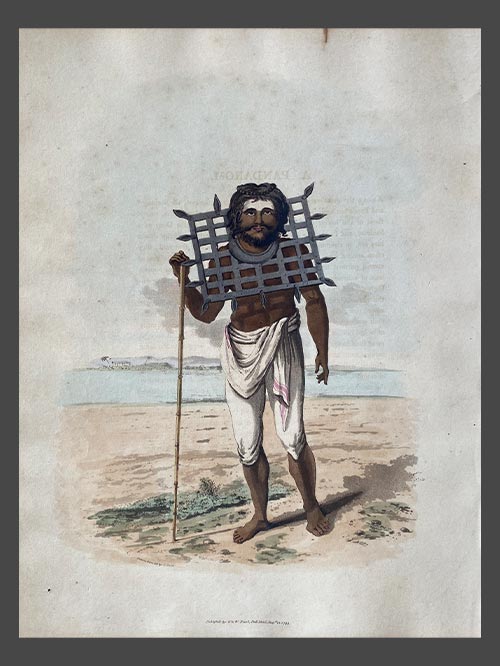
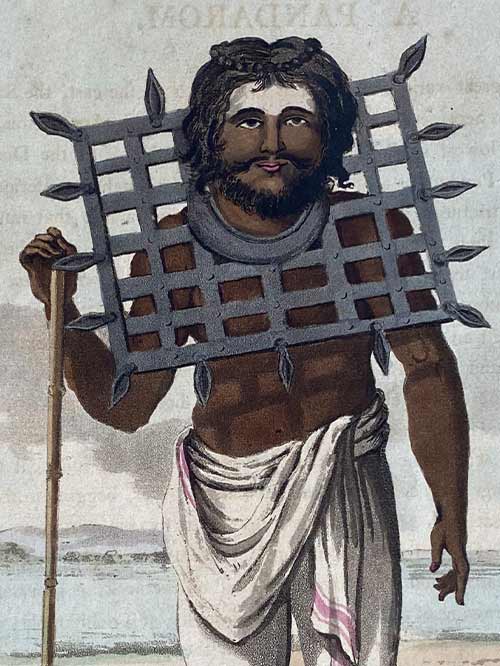
The artist describes his interaction with the mendicant he drew “from life at Trichinopoly; whither he had travelled to attend a grand festival at the celebrated Pagoda on the isle of Seringham. The grate he wore was encompassed by sixteen small lamps, which on particular occasions he caused to be illuminated. He usually wore his grate in an horizontal position, as it then rested on his shoulders with more ease. His forehead was whitened with cow-dung ashes, and his head ornamented with a circular string of the nuts of Rouderin. Among the great variety of religious enthusiasts in the east, the Saniassy and Pandarom Sects are held in the highest veneration. Under the vow of eternal poverty, temperance, and chastity, these people, with every appearance of contentment, lead a wandering and precarious existence, being entirely dependent on alms. There are instances of some, who have vowed never more to speak, others form a resolution to continue in an upright posture, without ever lying down; and to prevent the possibility of sleeping in comfort, wear an iron grate, closely rivetted on the neck,” as represented in this hand-coloured aquatint.
Size (cms): 33(H) x 25(W)
Size (inches): 13(H) x 10(W)
-
Pub. London
original hand-coloured aquatint
Captain Charles Gold (d. 1842) served in the military campaigns against Tipu Sultan, the ruler of the Kingdom of Mysore and during 1791-98 he sketched a series of images later published as aquatints in “Oriental Drawings.” He was fascinated with the concept of religious begging and documented all manners of mendicants and zealots that he met on his travel, often detailing their unique trials and tribulations.While these prints cannot be divorced from the orientalist roots from which they came, they are a compelling visual memoir of a time and people that may have otherwise been lost to time.
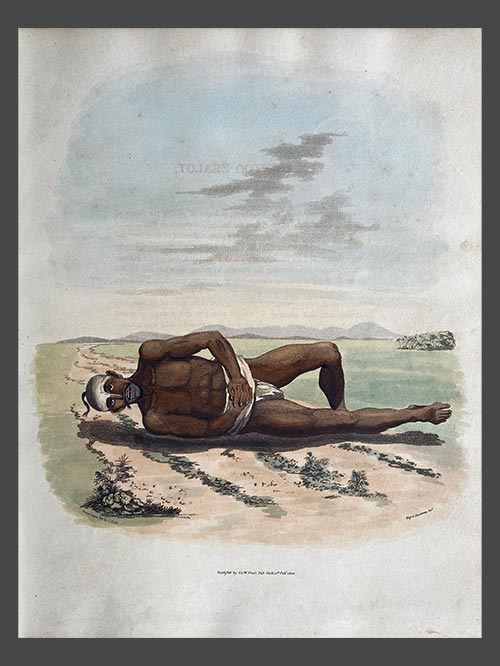
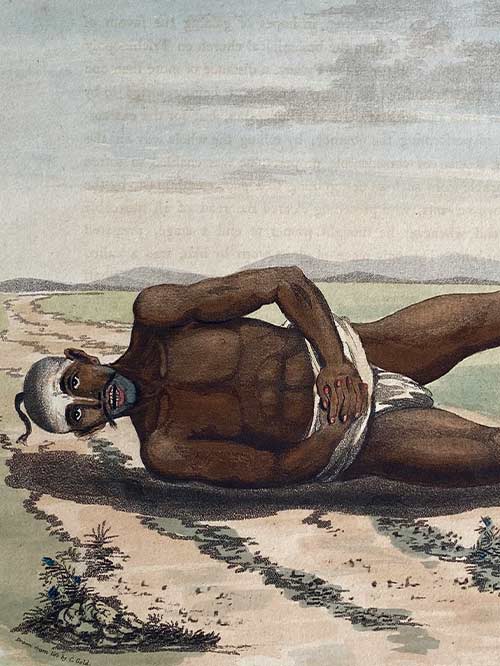
The artist remarked on his encounter with this “Gentoo Zealot,” who was “rolling through the fort of Trichinopoly, in the exact posture this drawing represents, and singing, or rather crying aloud, the praises of his God. The person represented in this drawing, in hopes of gaining the favour of his God, had resolved to travel from the brahminical church on Trichinopoly rock, to the famous temple on the hill of Pylney, a distance of more than one hundred miles, performing the journey, by rolling the whole way on the ground. Being a man of considerable property, he was enabled to soften the toils inseparable from such an undertaking, by the attentions of two servants, who preceding cleared the road of all moreable impediments, and whenever he thought proper to end a stage, prepared refreshments for him. The only piece of dress worn by him, was a calico cloth wrapped about the waist ; his hair was close shaved excepting a small lock on the back part of the crown, and his head entirely exposed to the influence of the sun and reflected heat from the ground, which it nearly touched every revolution he made.”
Size (cms): 33(H) x 25(W)
Size (inches): 13(H) x 10(W)
-
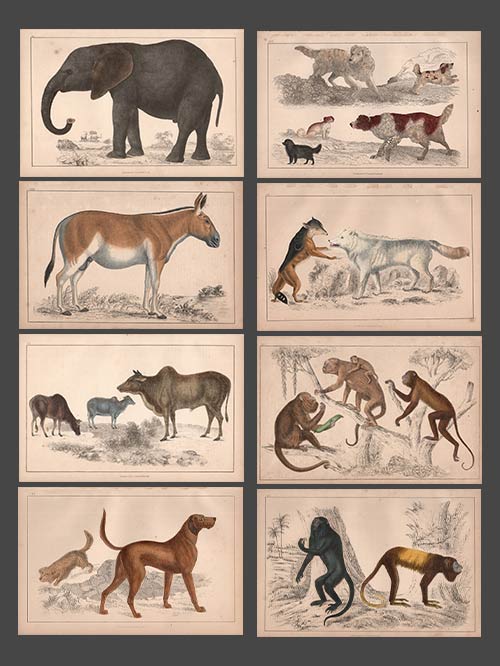
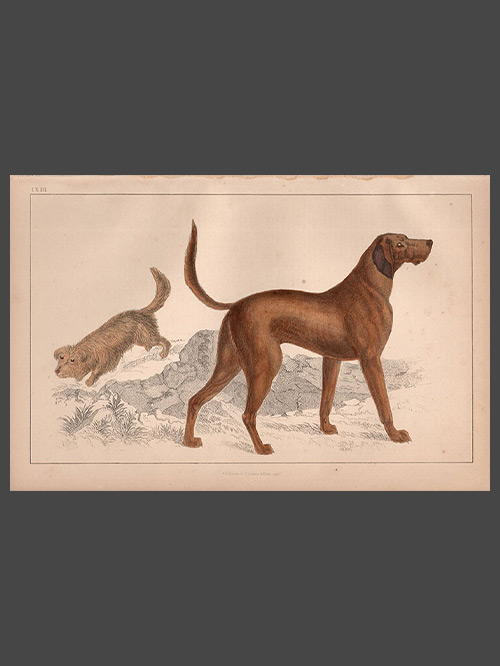
by Oliver Goldsmith
from A History of the Earth and Animated Nature
original hand coloured engravings
A History of the Earth, and Animated Nature is a work of natural history by Oliver Goldsmith that attempts to provide a description of the Earth’s geographic features and species’.
Size (cms): 16.5 (H) x 25 (L)
Size (inches): 6.5 (H) x 10 (L)
-
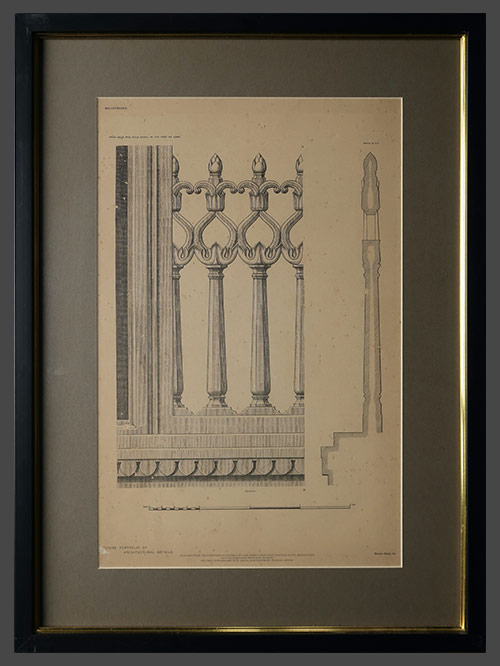
by Samuel Swinton Jacob
from Jeypore Portfolio of Architectural Details
original lithograph
Original lithographs from the Jeypore Portfolio of Architectural Details prepared with the guidance of Col. S.S. Jacob CIE, Indian Army. It depicts a sandstone balustrade from near the Khas Mahal in the Fort at Agra. The Portfolio was issued under the patronage of H.H.Maharaja Sawai Madhu Singh, G.C.S.I. of Jeypore.
The collection of drawings were executed by local draftsmen, all natives of Jeypore, trained first in the School of Art and then in the office of the Executive Engineer. They were supervised by Lala Ram Baksh, head draftsmen and teacher in the Jeypore school of Art. The architectural details depicted are mostly from mosques, tombs, palaces and other buildings in or near Delhi and Agra and parts of Rajputana. They have been arranged together in sections- each sheet loose – so that the different examples of architectural details may be compared and selections readily made. The plates would have served as working drawings for the architect and artisan.
Size Framed (cms): 68.6 (H) x 50.8 (L)
Size Framed (inches): 27 (H) x 20 (L)
-
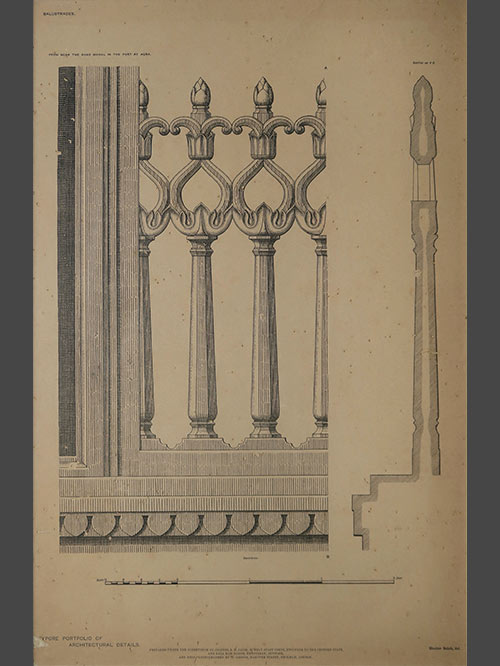
by Samuel Swinton Jacob
from Jeypore Portfolio of Architectural Details
original lithograph
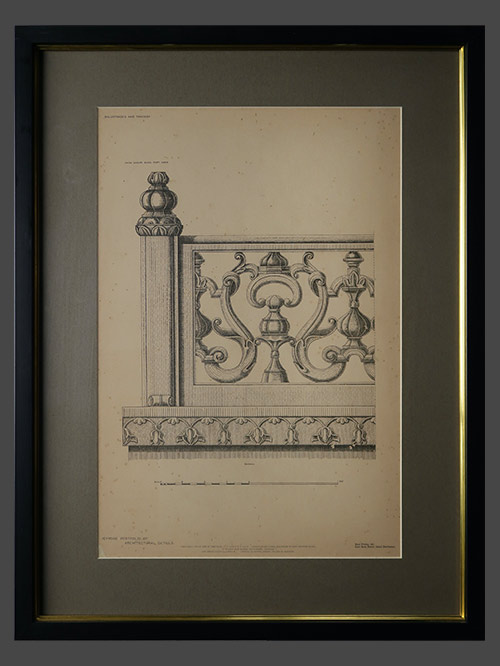
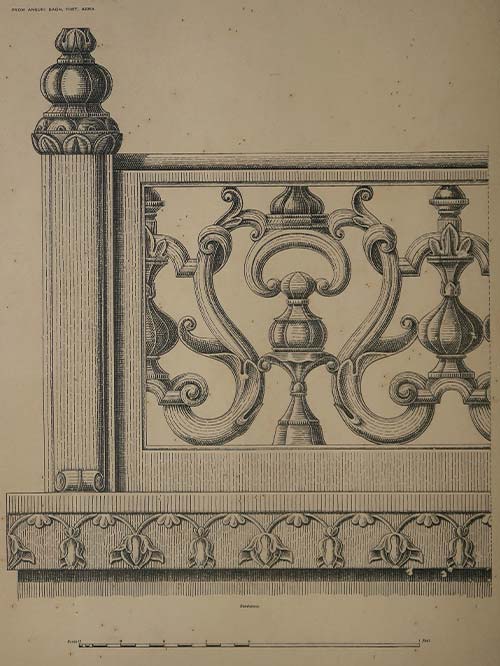
Original lithographs from the Jeypore Portfolio of Architectural Details prepared with the guidance of Col. S.S. Jacob CIE, Indian Army. It depicts a sandstone balustrade from Anguri Bagh, Fort at Agra. The Portfolio was issued under the patronage of H.H.Maharaja Sawai Madhu Singh, G.C.S.I. of Jeypore.
The collection of drawings were executed by local draftsmen, all natives of Jeypore, trained first in the School of Art and then in the office of the Executive Engineer. They were supervised by Lala Ram Baksh, head draftsmen and teacher in the Jeypore school of Art. The architectural details depicted are mostly from mosques, tombs, palaces and other buildings in or near Delhi and Agra and parts of Rajputana. They have been arranged together in sections- each sheet loose – so that the different examples of architectural details may be compared and selections readily made. The plates would have served as working drawings for the architect and artisan.
Size Framed (cms): 68.6 (H) x 50.8 (L)
Size Framed (inches): 27 (H) x 20 (L)
-
by Samuel Swinton Jacob
from Jeypore Portfolio of Architectural Details
original lithograph
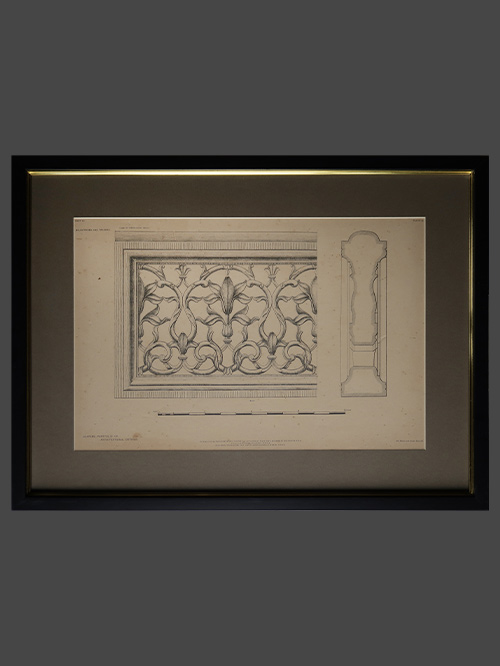
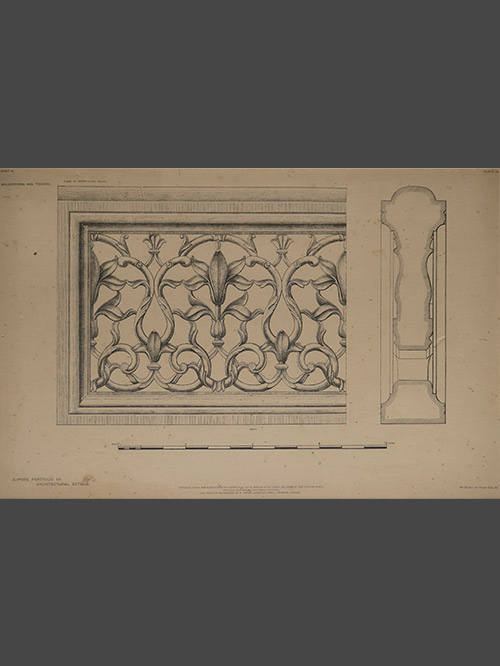
Original lithographs from the Jeypore Portfolio of Architectural Details prepared with the guidance of Col. S.S. Jacob CIE, Indian Army. It depicts a sandstone balustrade from the tomb of Nizam-U-Din, Delhi. The Portfolio was issued under the patronage of H.H.Maharaja Sawai Madhu Singh, G.C.S.I. of Jeypore.
The collection of drawings were executed by local draftsmen, all natives of Jeypore, trained first in the School of Art and then in the office of the Executive Engineer. They were supervised by Lala Ram Baksh, head draftsmen and teacher in the Jeypore school of Art. The architectural details depicted are mostly from mosques, tombs, palaces and other buildings in or near Delhi and Agra and parts of Rajputana. They have been arranged together in sections- each sheet loose – so that the different examples of architectural details may be compared and selections readily made. The plates would have served as working drawings for the architect and artisan.
Size Framed (cms): 68.6 (H) x 50.8 (L)
Size Framed (inches): 27 (H) x 20 (L)
-
by Samuel Swinton Jacob
from Jeypore Portfolio of Architectural Details
original lithograph
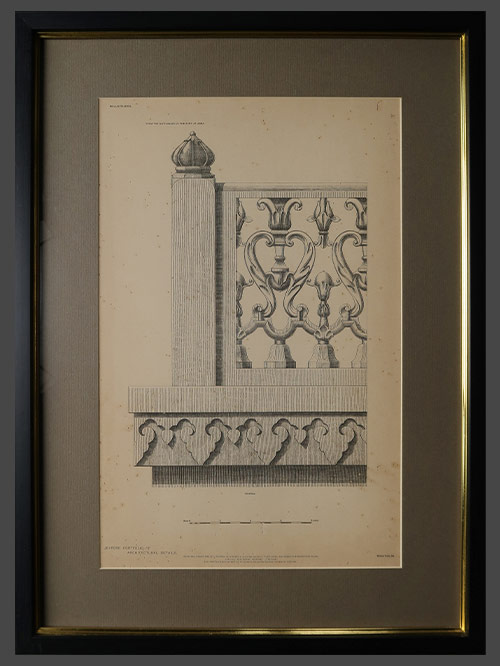
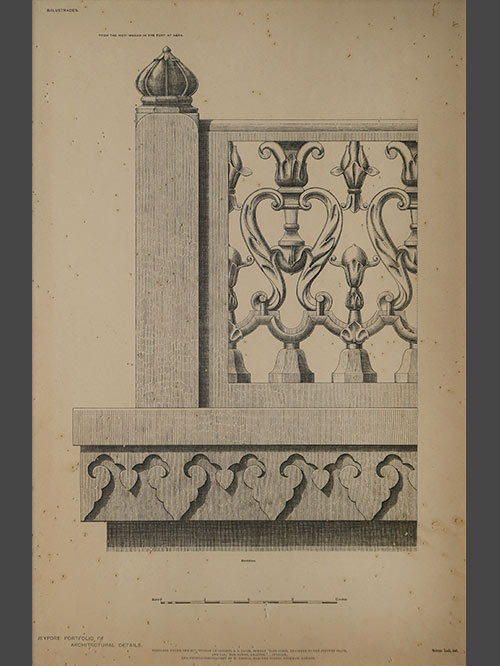
Original lithographs from the Jeypore Portfolio of Architectural Details prepared with the guidance of Col. S.S. Jacob CIE, Indian Army. It depicts a sandstone balustrade from the Motif Masjid in the Fort at Agra. The Portfolio was issued under the patronage of H.H.Maharaja Sawai Madhu Singh, G.C.S.I. of Jeypore.
The collection of drawings were executed by local draftsmen, all natives of Jeypore, trained first in the School of Art and then in the office of the Executive Engineer. They were supervised by Lala Ram Baksh, head draftsmen and teacher in the Jeypore school of Art. The architectural details depicted are mostly from mosques, tombs, palaces and other buildings in or near Delhi and Agra and parts of Rajputana. They have been arranged together in sections- each sheet loose – so that the different examples of architectural details may be compared and selections readily made. The plates would have served as working drawings for the architect and artisan.
Size Framed (cms): 68.6 (H) x 50.8 (L)
Size Framed (inches): 27 (H) x 20 (L)
-
by John Edward Gray’s
From ‘Illustrations of Indian Zoology’
original hand coloured lithograph
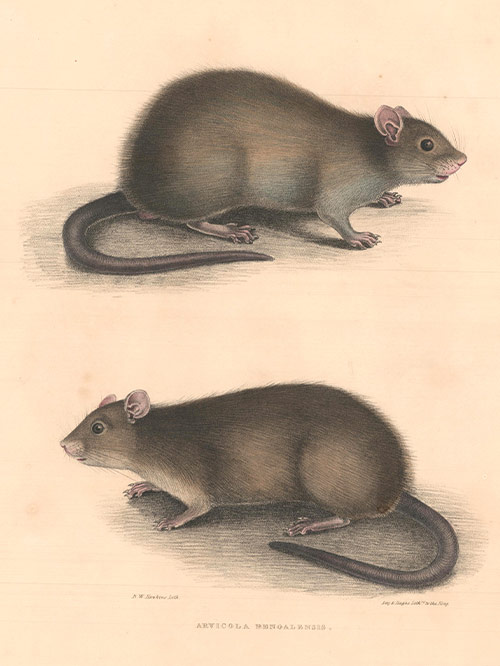
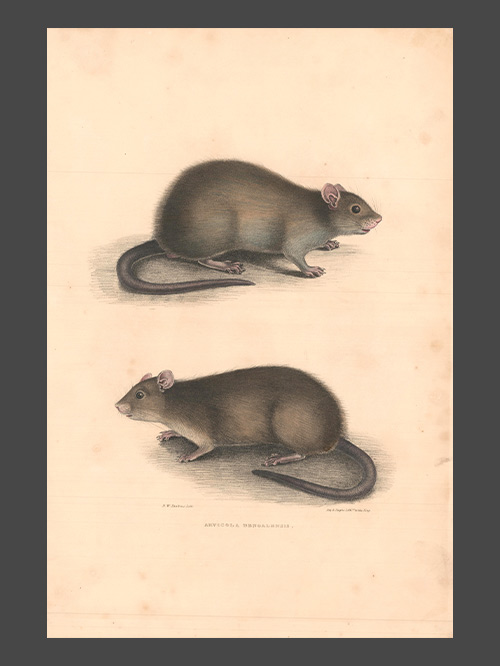
Captioned ‘Arvicola Bengalensis’
John Edward Gray of the British Museum had collaborated with Maj.-Gen. Hardwicke in producing Illustrations of Indian Zoology between 1830 and 1834. He was also the author of several major illustrated works on natural history and commissioned the best artists and printers of the day to illustrate his work. The Illustrations of Indian Zoology is his major work, dedicated to the East India Company, and with the striking plates of bird and animal life in the sub-continent drawn by Waterhouse Hawkins, the noted sporting artist.
Maj.-Gen. Thomas Hardwicke of the Bengal Artillery whilst serving in India from 1778 to 1823 assembled a truly impressive collection of natural history drawings by Indian and European artists whom he engaged to draw flora and fauna. On his retirement he brought the collection with him to England and a thousand of these in many volumes are now in the British library and in the British Museum (Natural History). Bird portraiture predominates in Illustrations of Indian Zoology with a token representation of mammals, reptiles and fishes.
Size (cms): 48 (H) x 34 (L)
Size (inches): 19 (H) x 13.5 (L)
-
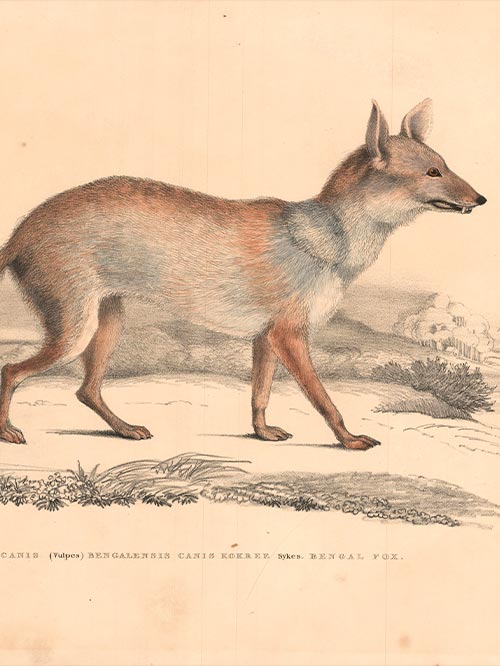
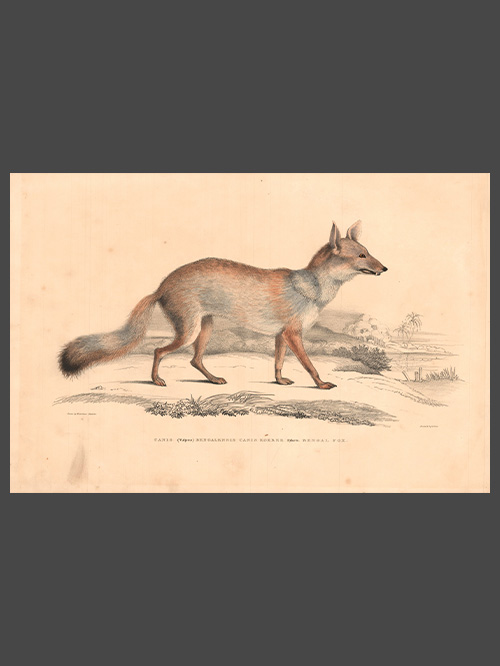
by John Edward Gray’s
From ‘Illustrations of Indian Zoology’
original hand coloured lithograph
Captioned ‘Canis (Vulpes ) Bengalensis Canis Kokree Skyes. Bengal Fox.‘
John Edward Gray of the British Museum had collaborated with Maj.-Gen. Hardwicke in producing Illustrations of Indian Zoology between 1830 and 1834. He was also the author of several major illustrated works on natural history and commissioned the best artists and printers of the day to illustrate his work. The Illustrations of Indian Zoology is his major work, dedicated to the East India Company, and with the striking plates of bird and animal life in the sub-continent drawn by Waterhouse Hawkins, the noted sporting artist.
Maj.-Gen. Thomas Hardwicke of the Bengal Artillery whilst serving in India from 1778 to 1823 assembled a truly impressive collection of natural history drawings by Indian and European artists whom he engaged to draw flora and fauna. On his retirement he brought the collection with him to England and a thousand of these in many volumes are now in the British library and in the British Museum (Natural History). Bird portraiture predominates in Illustrations of Indian Zoology with a token representation of mammals, reptiles and fishes.
Size (cms): 34 (H) x 48 (L)
Size (inches): 13.5 (H) x 19 (L)
-
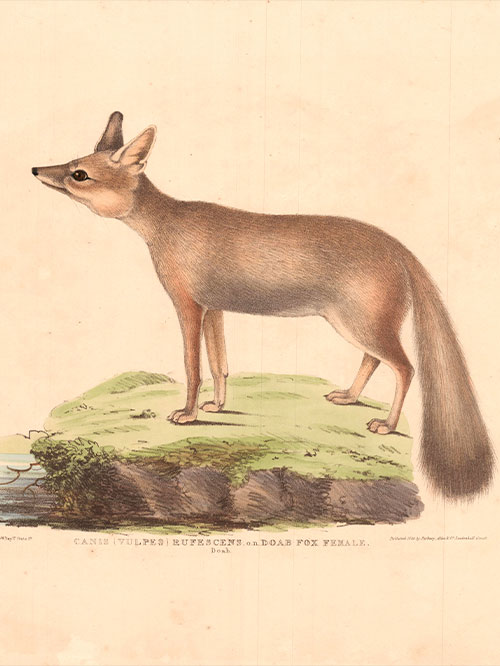
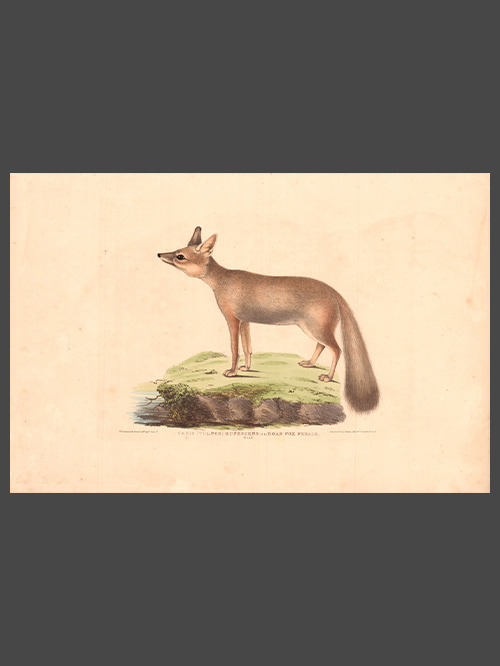
by John Edward Gray’s
From ‘Illustrations of Indian Zoology’
original hand coloured lithograph
Captioned ‘Canis (Vulpes ) Rufescens. Doab Fox Female.‘
John Edward Gray of the British Museum had collaborated with Maj.-Gen. Hardwicke in producing Illustrations of Indian Zoology between 1830 and 1834. He was also the author of several major illustrated works on natural history and commissioned the best artists and printers of the day to illustrate his work. The Illustrations of Indian Zoology is his major work, dedicated to the East India Company, and with the striking plates of bird and animal life in the sub-continent drawn by Waterhouse Hawkins, the noted sporting artist.
Maj.-Gen. Thomas Hardwicke of the Bengal Artillery whilst serving in India from 1778 to 1823 assembled a truly impressive collection of natural history drawings by Indian and European artists whom he engaged to draw flora and fauna. On his retirement he brought the collection with him to England and a thousand of these in many volumes are now in the British library and in the British Museum (Natural History). Bird portraiture predominates in Illustrations of Indian Zoology with a token representation of mammals, reptiles and fishes.
Size (cms): 34 (H) x 48 (L)
Size (inches): 13.5 (H) x 19 (L)
-
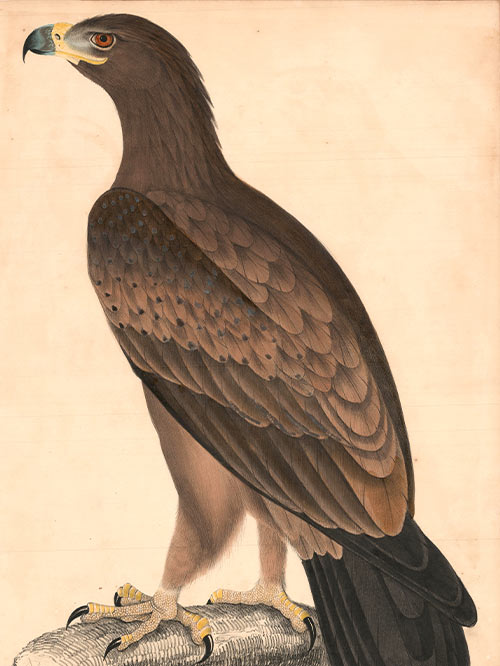
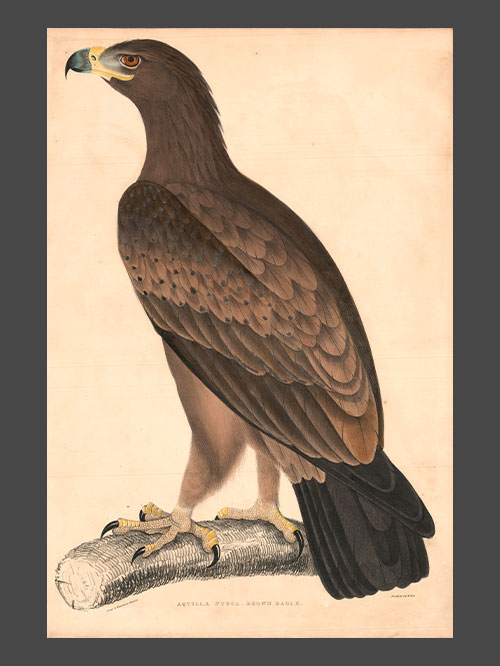
by John Edward Gray’s
From ‘Illustrations of Indian Zoology’
original hand coloured lithograph
Captioned ‘Aquilla Fusca. Brown Eagle.’
John Edward Gray of the British Museum had collaborated with Maj.-Gen. Hardwicke in producing Illustrations of Indian Zoology between 1830 and 1834. He was also the author of several major illustrated works on natural history and commissioned the best artists and printers of the day to illustrate his work. The Illustrations of Indian Zoology is his major work, dedicated to the East India Company, and with the striking plates of bird and animal life in the sub-continent drawn by Waterhouse Hawkins, the noted sporting artist.
Maj.-Gen. Thomas Hardwicke of the Bengal Artillery whilst serving in India from 1778 to 1823 assembled a truly impressive collection of natural history drawings by Indian and European artists whom he engaged to draw flora and fauna. On his retirement he brought the collection with him to England and a thousand of these in many volumes are now in the British library and in the British Museum (Natural History). Bird portraiture predominates in Illustrations of Indian Zoology with a token representation of mammals, reptiles and fishes.
Size (cms): 48 (H) x 34 (L)
Size (inches): 19 (H) x 13.5 (L)
-
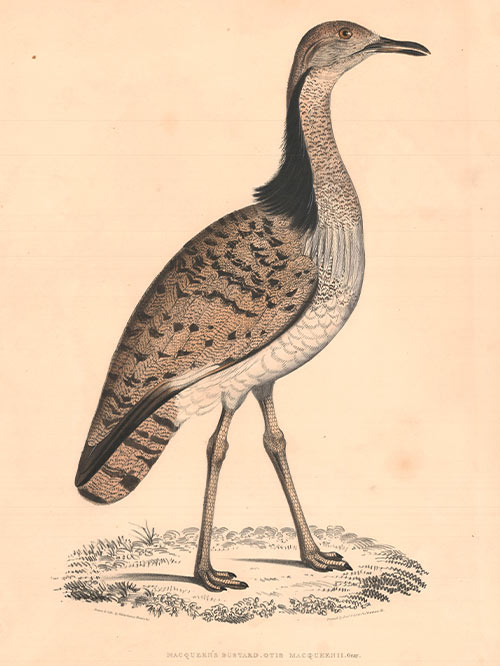
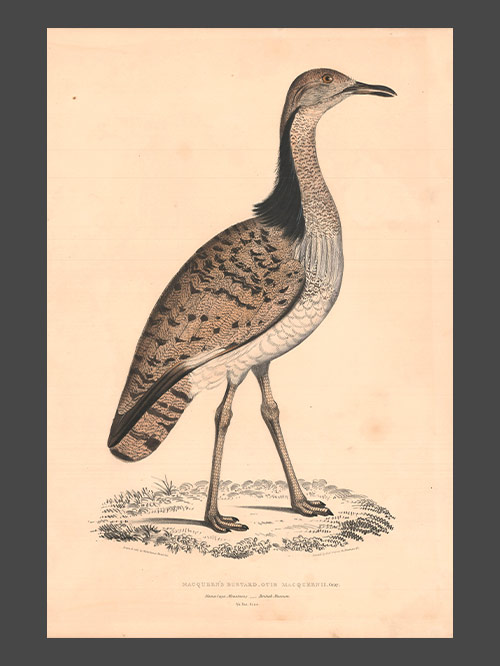
by John Edward Gray’s
From ‘Illustrations of Indian Zoology’
original hand coloured lithograph
Captioned ‘Mac Queen’s Bustard . Otis Macqueen II‘
John Edward Gray of the British Museum had collaborated with Maj.-Gen. Hardwicke in producing Illustrations of Indian Zoology between 1830 and 1834. He was also the author of several major illustrated works on natural history and commissioned the best artists and printers of the day to illustrate his work. The Illustrations of Indian Zoology is his major work, dedicated to the East India Company, and with the striking plates of bird and animal life in the sub-continent drawn by Waterhouse Hawkins, the noted sporting artist.
Maj.-Gen. Thomas Hardwicke of the Bengal Artillery whilst serving in India from 1778 to 1823 assembled a truly impressive collection of natural history drawings by Indian and European artists whom he engaged to draw flora and fauna. On his retirement he brought the collection with him to England and a thousand of these in many volumes are now in the British library and in the British Museum (Natural History). Bird portraiture predominates in Illustrations of Indian Zoology with a token representation of mammals, reptiles and fishes.
Size (cms): 48 (H) x 34 (L)
Size (inches): 19 (H) x 13.5 (L)
-


by W H Fitch from John Eliot Howard’s
‘The Quinology of the East Indian Plantations’
original hand coloured lithograph
The tree bark of the Cinchona tree contains quinine, an alkaloid used to treat malaria. Malaria was a major health concern for the colonial administration in India and the first cinchona plantation was established in 1860 in the Nilgiri Hills due to its suitable climate and soil. Over the next few years, several other plantations were established in the region, including at Coonoor, Kotagiri, and Ooty. By the early 20th century, the Indian cinchona plantations had become one of the largest producers of quinine in the world, supplying not only India but also other parts of the British Empire.
‘The Quinology of the East Indian Plantations’ by John Eliot Howard (1807-1883) is a continuation of Benjamin Moseley’s earlier book on the same subject, and provides an updated account of the cultivation and use of quinine in the East Indian plantations during the 19th century and its introduction into India. Howard’s book includes detailed descriptions of the different species of cinchona trees, as well as the various methods used to extract and prepare quinine. He also discusses the economic and political implications of the quinine trade, which had become a major industry in the region by the mid-19th century. Howard received the thanks of Her Majesty’s Government in 1873 for The Quinology of the East Indian Plantations.
Framed Size (cms): 65(H) x 54(W)
Framed Size (inches): 25.5(H) x 21.5(W)
Print Size (cms): 45.75(H) x 34.25(W)
Print Size (inches): 18(H) x 13.5(W)
-
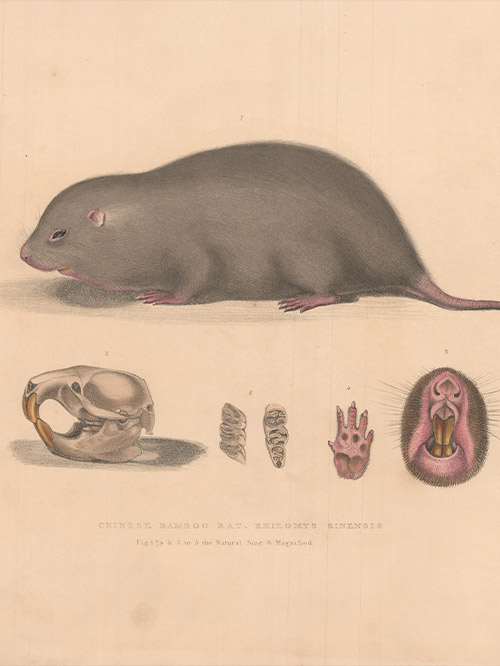
by John Edward Gray’s
From ‘Illustrations of Indian Zoology’
original hand coloured lithograph
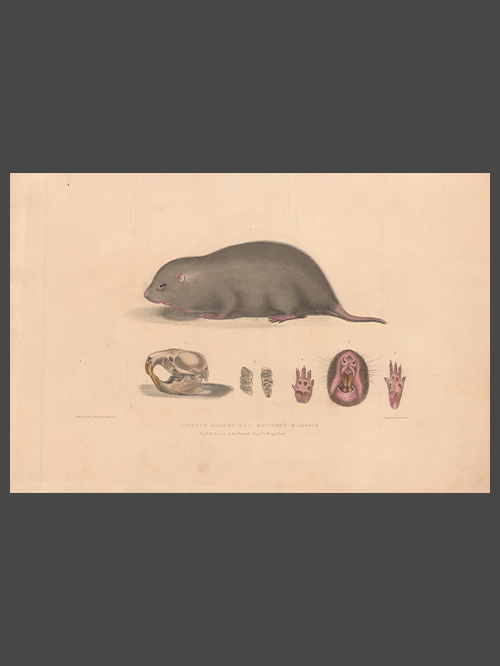
Captioned ‘Chinese Bamboo Rat. Rhizomys Sinensis‘
John Edward Gray of the British Museum had collaborated with Maj.-Gen. Hardwicke in producing Illustrations of Indian Zoology between 1830 and 1834. He was also the author of several major illustrated works on natural history and commissioned the best artists and printers of the day to illustrate his work. The Illustrations of Indian Zoology is his major work, dedicated to the East India Company, and with the striking plates of bird and animal life in the sub-continent drawn by Waterhouse Hawkins, the noted sporting artist.
Maj.-Gen. Thomas Hardwicke of the Bengal Artillery whilst serving in India from 1778 to 1823 assembled a truly impressive collection of natural history drawings by Indian and European artists whom he engaged to draw flora and fauna. On his retirement he brought the collection with him to England and a thousand of these in many volumes are now in the British library and in the British Museum (Natural History). Bird portraiture predominates in Illustrations of Indian Zoology with a token representation of mammals, reptiles and fishes.
Size (cms): 34 (H) x 48 (L)
Size (inches): 13.5 (H) x 19 (L)