“Silvery-throated Tit by John Gould” has been added to your cart.
View cart
-
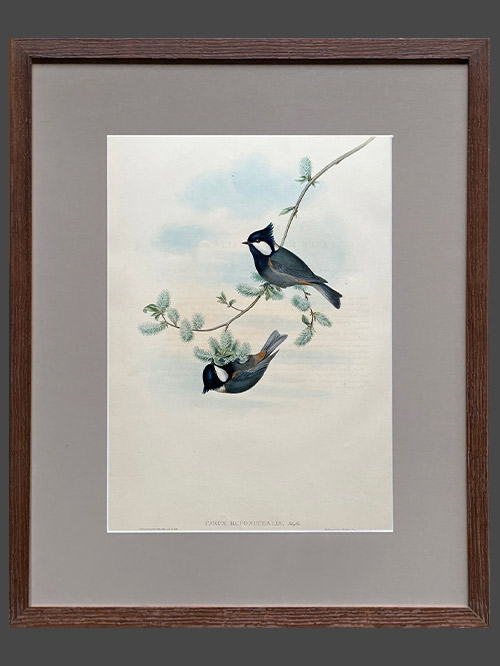
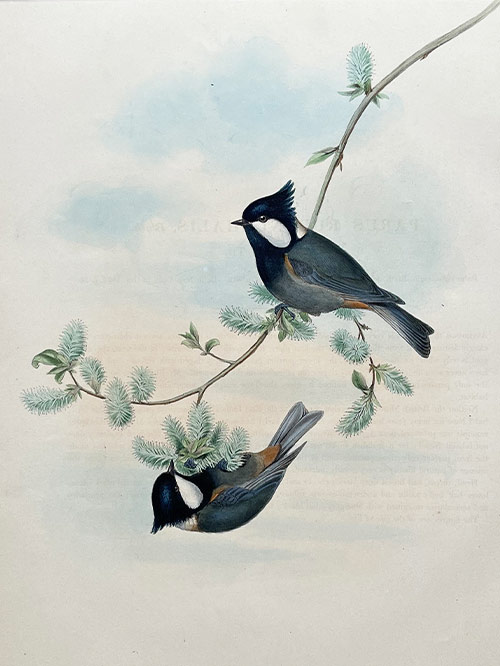
by John Gould and H.C.Richter
From ‘Birds of Asia’
original hand coloured lithograph
Captioned ‘Parus Rufonuchalis’
This small bird from mountainous South and Southeast Asia has a rufous-colored nape and back. Distinct from Parus rubidiventris, it is larger, with a unique nuchal spot. Found in the Tyne range north of Simla, it forages for insects and seeds in tree canopies.
John Gould (1804 – 1881) was one of the most significant figures in 19th century bird art, both in his prolific output and the aesthetic beauty of his plates. He is credited with the publication of more than 3,100 coloured lithographs of bird species from various parts of the world. In his all-encompassing work, “The Birds of Asia,” John Gould includes species from all corners of the eastern world. Gould chose to record the bird life from an area which, with the exception of the tropical areas of the American continent, includes the widest, and most colourful variety of bird life to be found anywhere in the world.
Framed Size (cms): 66(H) x 54.5(W)
Framed Inches (cms): 26(H) x 21.5(W)
Print Size (cms): 53.5(H) x 35.5(W)
Print Size (inches): 21(H) x 14(W)
-
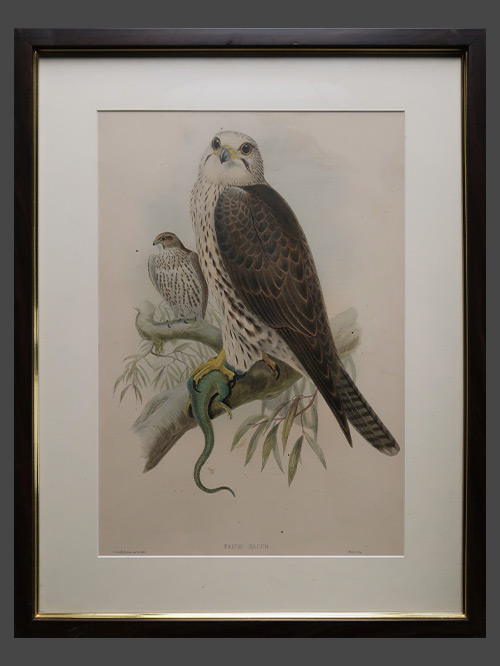
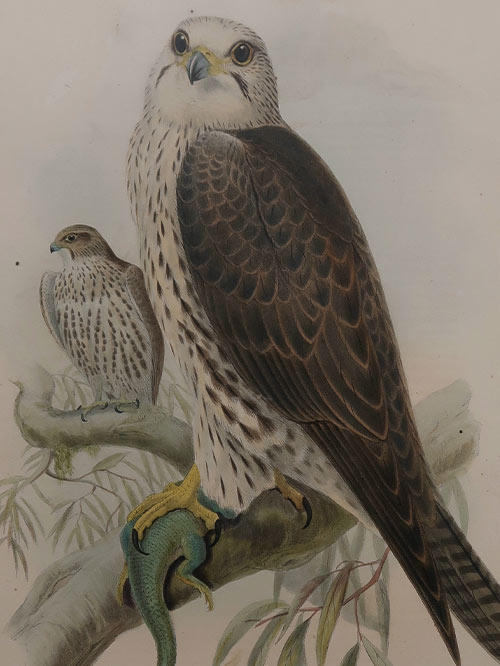
by John Gould and H.C.Richter
from ‘Birds of Asia’
original hand coloured lithograph
The Saker Falcon (Falco Sacer) is a large species of falcon. This species breeds from central Europe eastwards across Asia to East China.
The intended geographical range of “The Birds of Asia” was enormous, and very much in keeping with the seemingly limitless self-belief of the 19th-century’s best known ornithologist. In his all-encompassing work John Gould includes species from all corners of the eastern world, as Richard Bowdler Sharpe noted the work covers “Species from Palestine to the eastward, and from the Moluccas to the west.” Gould chose to record the bird life from an area which, with the exception of the tropical areas of the American continent, includes the widest, and most colourful variety of bird life to be found anywhere in the world.
John Gould (1804 – 1881) remains one of the most significant figures in 19th century bird art, both in his prolific output and the aesthetic beauty of his plates. He is credited with the publication of more than 3,100 coloured lithographs of bird species from various parts of the world and is associated with vibrant and carefully executed folio volumes created in partnership with some of the period’s most respected bird artists, among them, Edward Lear, Joseph Wolf and William Hart. This dual expertise in both science and art heightened his prominence.
Size framed (cms): 71 (H) x 52 (L)
Size framed (inches): 28.5 (H) x 20.5 (L)
-
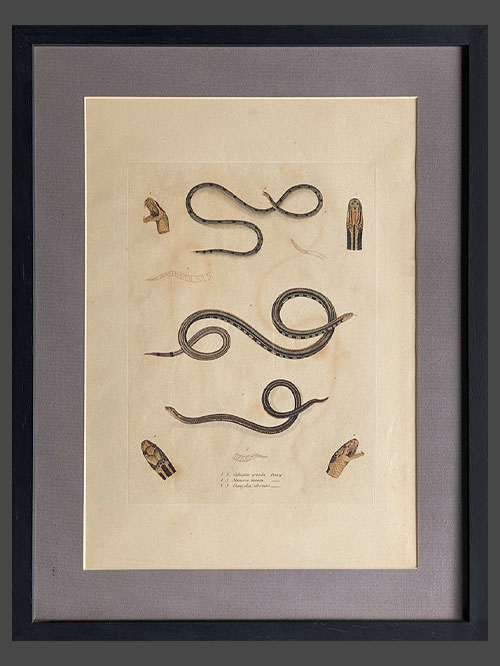
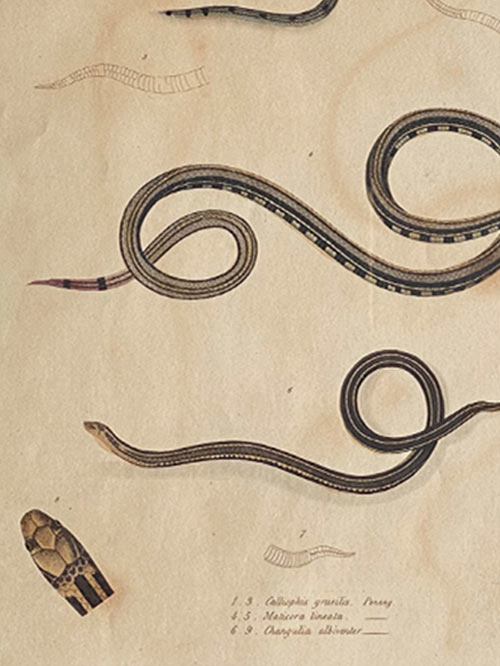
by John Edward Gray
from Illustrations of Indian Zoology
original hand coloured lithograph
Captioned ‘1.3. Calliophis Gracilis. Penang
4.5. Malicora Lineata. Penang
6.9. Changulia Albiventer. Penang‘
John Edward Gray of the British Museum had collaborated with Maj.-Gen. Hardwicke in producing Illustrations of Indian Zoology between 1830 and 1834. He was also the author of several major illustrated works on natural history and commissioned the best artists and printers of the day to illustrate his work. The Illustrations of Indian Zoology is his major work, dedicated to the East India Company, and with the striking plates of bird and animal life in the sub-continent drawn by Waterhouse Hawkins, the noted sporting artist. The subscription amounted to thirty-nine home and thirteen foreign.
Size framed (cms): 56.5 (H) x 44 (W)
Size framed (inches): 22 (H) x 17.5 (W)
-
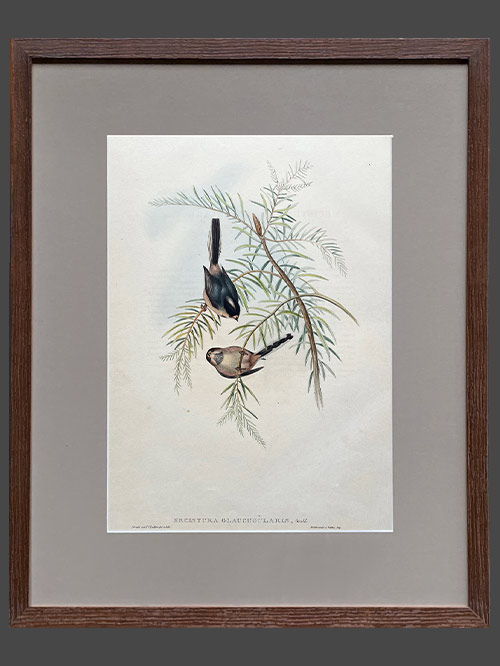
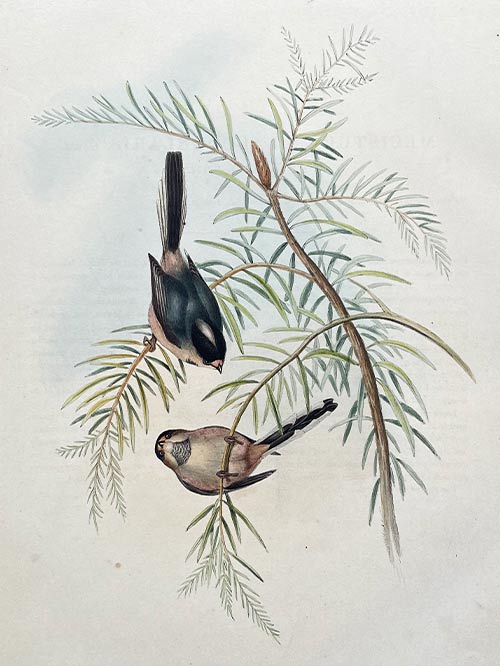
by John Gould and H.C.Richter
From ‘Birds of Asia’
original hand coloured lithograph
Captioned ‘Mecistura Glaucogularis’
This energetic little bird is usually found in small flocks of its own species, foraging noisily and acrobatically in temperate forests and parks.
John Gould (1804 – 1881) was one of the most significant figures in 19th century bird art, both in his prolific output and the aesthetic beauty of his plates. He is credited with the publication of more than 3,100 coloured lithographs of bird species from various parts of the world. In his all-encompassing work, “The Birds of Asia,” John Gould includes species from all corners of the eastern world. Gould chose to record the bird life from an area which, with the exception of the tropical areas of the American continent, includes the widest, and most colourful variety of bird life to be found anywhere in the world.
Framed Size (cms): 66(H) x 54.5(W)
Framed Inches (cms): 26(H) x 21.5(W)
Print Size (cms): 53.5(H) x 35.5(W)
Print Size (inches): 21(H) x 14(W)
-
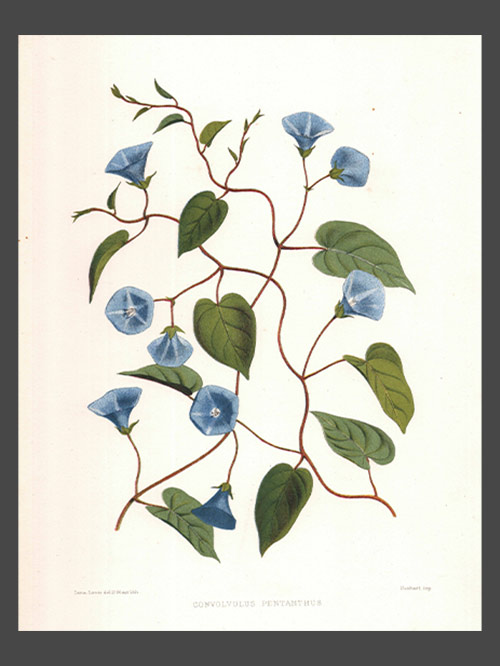
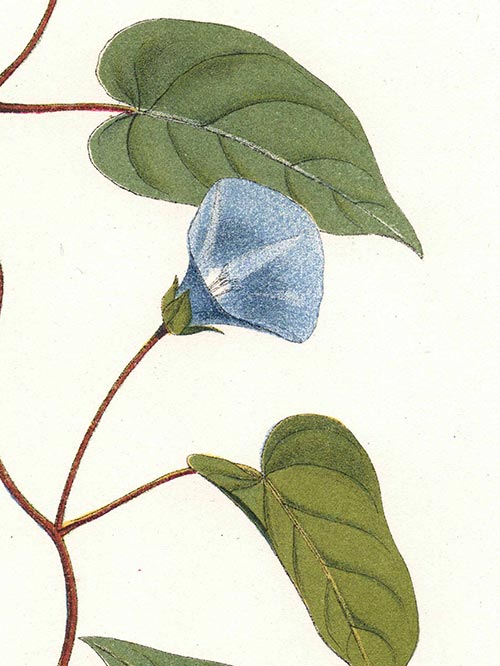
by Lena Lowis
original hand coloured lithograph
Captioned ‘Convolvulus pentanthus’
Lena Lowis (1845- 1919) was the daughter of Sir Richmond Campbell Shakespear (1812-1861), an Indian-born British Indian Army officer who helped abolish the capture and selling of Russian slaves in Khiva. She was born in India and later educated and married in England where she lived with her husband and five children.
The artist chronicled many of the flowers commonly cultivated in Indian gardens, some of which were indigenous to the region, while others were introduced by gardeners. Her illustrations are not meant to be taken treatise on botany or as a manual of gardening, rather to convey a fair idea of the colour and texture of the original, to those who have not seen them.
Size (cms): 25.5(H) x 20(W)
Size (inches): 10(H) x 8(W)
Size with Mount (cms): 42(H) x 36(W)
Size with Mount (inches): 16.5(H) x 14(W)
-

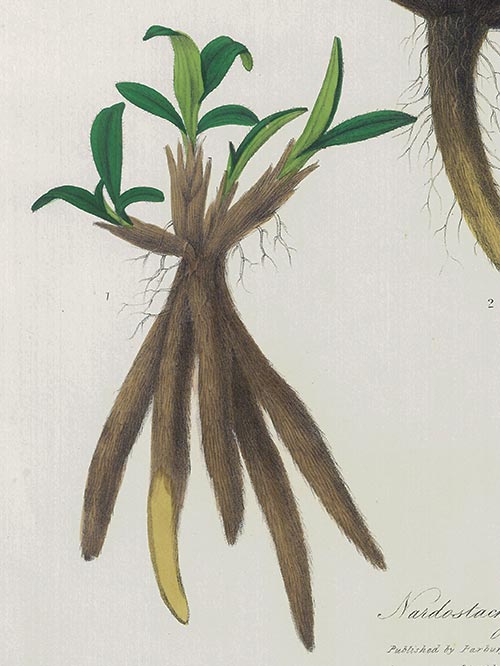
by John Forbes Royle (1798-1858)
Original hand-coloured lithograph
Pub. London
Nardostachys jatamansi, commonly known as “Spikenard” or “Jatamansi,” is a flowering plant in the Valerianaceae family. It is native to the Himalayan region, particularly found in parts of India, Nepal, Bhutan, and Tibet. This perennial herbaceous plant is characterized by its long, slender rhizomes and clusters of small, pink flowers. Spikenard has a long history of traditional medicinal use in Ayurvedic and Tibetan medicine, where it is valued for its calming and sedative properties. It is also used in perfumery and aromatherapy for its unique and earthy fragrance.
John Forbes Royle was a prominent British botanist, physician, and pharmacologist during the 19th century. Royle received his medical education at St. Thomas’s Hospital in London and later served as a surgeon in the British East India Company’s army. During his time in India, Royle became deeply interested in the country’s flora and medicinal plants. He collected a vast number of plant specimens and meticulously documented their medicinal properties. One of Royle’s most notable works was the ‘‘Illustrations of the botany and other branches of the natural history of the Himalayan Mountains and of the flora of Cashmere’. This comprehensive work provided detailed descriptions and illustrations of numerous plant species found in the Himalayan region. It remains an important reference for botanical research in the area.
Image Size (cms): 36.5(H) x 26(W)
Image Size (inches): 14.5(H) x 10(W)
Mount Size (cms): 51(H) x 41(W)
Mount Size (inches): 20(H) x 16(W)
-
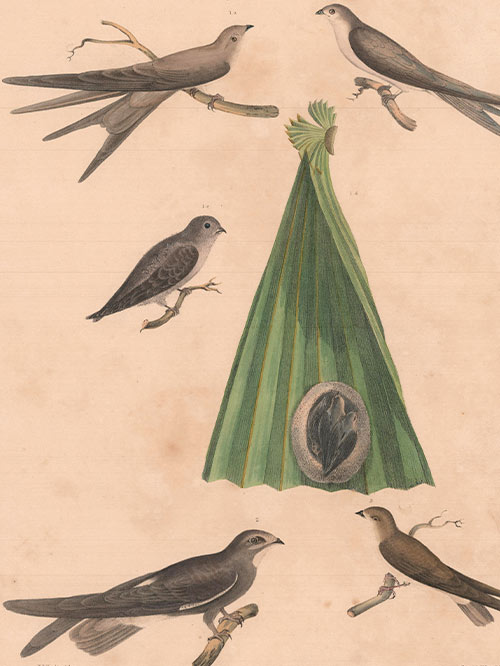
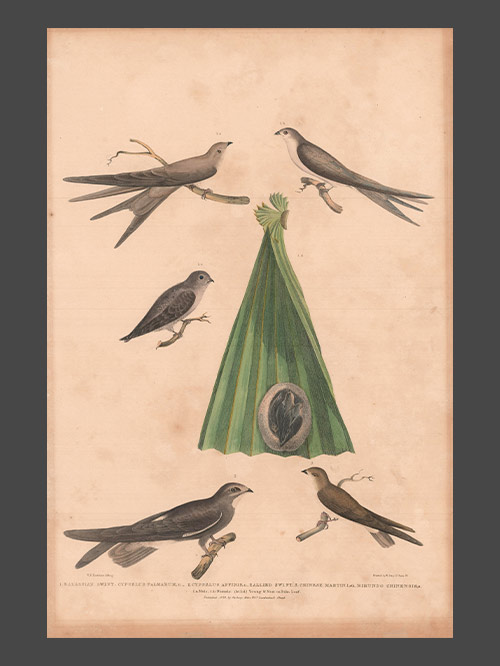
by John Edward Gray’s
From ‘Illustrations of Indian Zoology’
original hand coloured lithograph
Captioned ‘1. Balassian Swift. Cypselus Palmarum. 2. Cypselus Affinis. Allied Swift. 3. Chinese Martin. Hirundo Chinensis.‘
John Edward Gray of the British Museum had collaborated with Maj.-Gen. Hardwicke in producing Illustrations of Indian Zoology between 1830 and 1834. He was also the author of several major illustrated works on natural history and commissioned the best artists and printers of the day to illustrate his work. The Illustrations of Indian Zoology is his major work, dedicated to the East India Company, and with the striking plates of bird and animal life in the sub-continent drawn by Waterhouse Hawkins, the noted sporting artist.
Maj.-Gen. Thomas Hardwicke of the Bengal Artillery whilst serving in India from 1778 to 1823 assembled a truly impressive collection of natural history drawings by Indian and European artists whom he engaged to draw flora and fauna. On his retirement he brought the collection with him to England and a thousand of these in many volumes are now in the British library and in the British Museum (Natural History). Bird portraiture predominates in Illustrations of Indian Zoology with a token representation of mammals, reptiles and fishes.
Size (cms): 48 (H) x 34 (L)
Size (inches): 19 (H) x 13.5 (L)
-
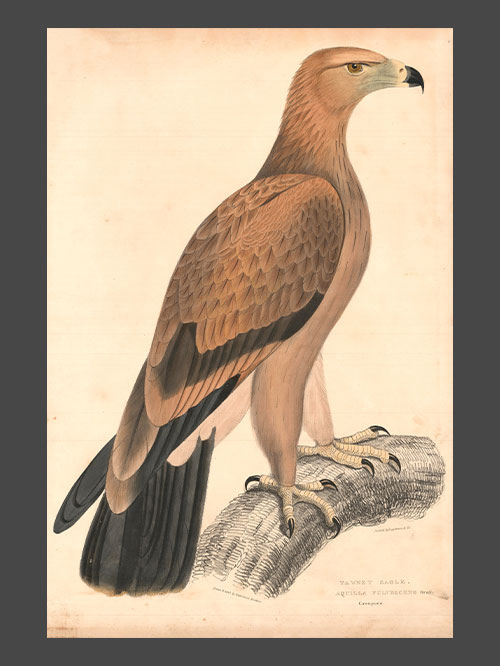
by John Edward Gray’s
From ‘Illustrations of Indian Zoology’
original hand coloured lithograph
Captioned ‘Tawney Eagle. Aquilla Fulvescens‘
John Edward Gray of the British Museum had collaborated with Maj.-Gen. Hardwicke in producing Illustrations of Indian Zoology between 1830 and 1834. He was also the author of several major illustrated works on natural history and commissioned the best artists and printers of the day to illustrate his work. The Illustrations of Indian Zoology is his major work, dedicated to the East India Company, and with the striking plates of bird and animal life in the sub-continent drawn by Waterhouse Hawkins, the noted sporting artist.
Maj.-Gen. Thomas Hardwicke of the Bengal Artillery whilst serving in India from 1778 to 1823 assembled a truly impressive collection of natural history drawings by Indian and European artists whom he engaged to draw flora and fauna. On his retirement he brought the collection with him to England and a thousand of these in many volumes are now in the British library and in the British Museum (Natural History). Bird portraiture predominates in Illustrations of Indian Zoology with a token representation of mammals, reptiles and fishes.
Size (cms): 48 (H) x 34 (L)
Size (inches): 19 (H) x 13.5 (L)
-
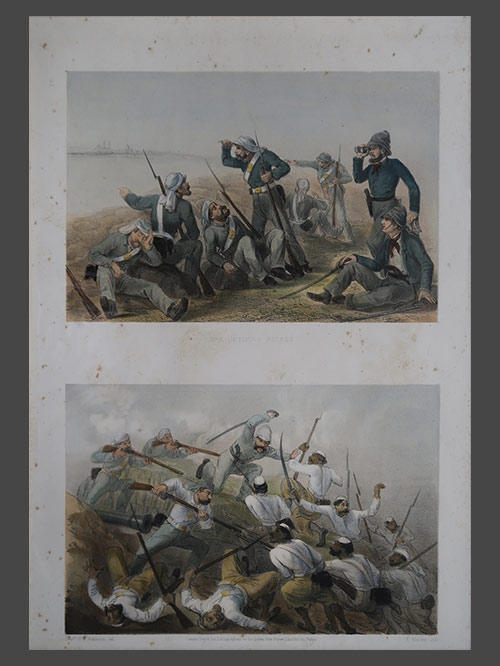
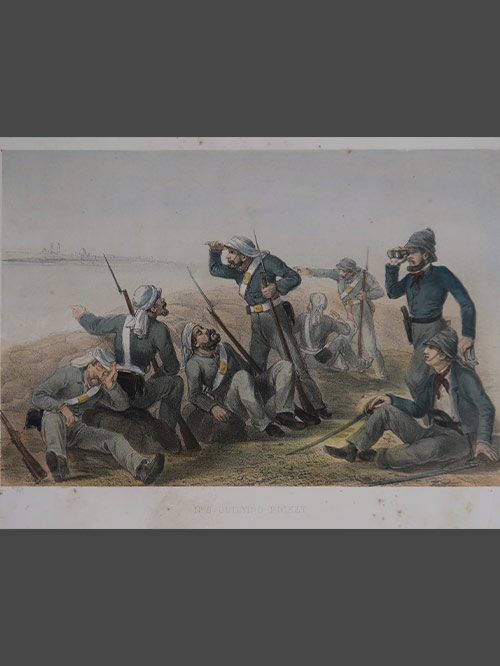
by George Francklin Atkinson
from ‘The Campaign in India 1857-58’
original hand coloured lithograph
Plate 6 from The Campaign in India 1857-58 by George Francklin Atkinson
In The Campaign in India, by Captain G.F. Atkinson of the Bengal Engineers, is a British account of the uprising of 1857. As a result it portrays a biased and often problematic view, depicting the British as brutal victims to the “barbarian” Indians. Modern historians, have dismantled these narratives and the truth of the invasion and oppression has been undisputed for some time. Despite the biased lens, we can still appreciate and evaluate these works as pieces of art.
Size of print (cms): 46.4 (H) x 32.4 (L)
Size of print (inches): 18.3 (H) x 12.8 (L)
-
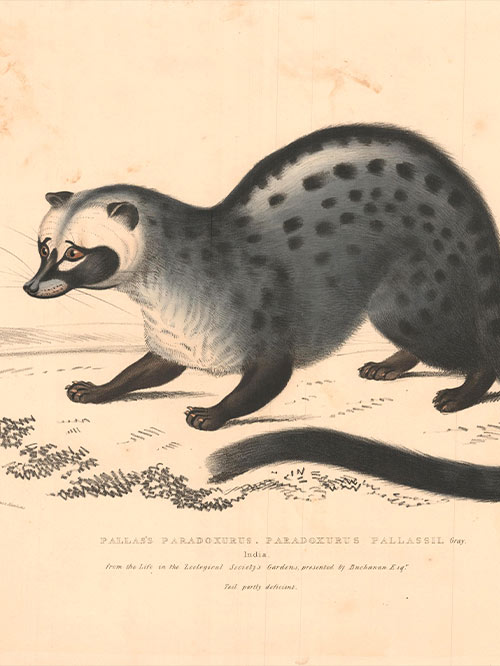
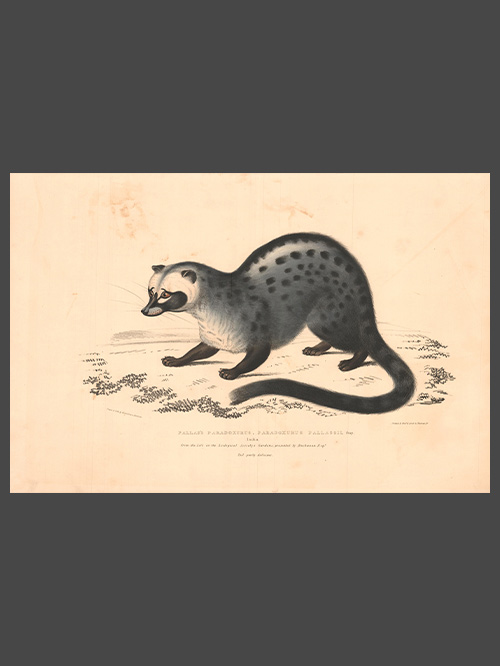
by John Edward Gray’s
From ‘Illustrations of Indian Zoology’
original hand coloured lithograph
Captioned ‘Pallas’s Paradoxurus, Paradoxurus Pallasii.‘
John Edward Gray of the British Museum had collaborated with Maj.-Gen. Hardwicke in producing Illustrations of Indian Zoology between 1830 and 1834. He was also the author of several major illustrated works on natural history and commissioned the best artists and printers of the day to illustrate his work. The Illustrations of Indian Zoology is his major work, dedicated to the East India Company, and with the striking plates of bird and animal life in the sub-continent drawn by Waterhouse Hawkins, the noted sporting artist.
Maj.-Gen. Thomas Hardwicke of the Bengal Artillery whilst serving in India from 1778 to 1823 assembled a truly impressive collection of natural history drawings by Indian and European artists whom he engaged to draw flora and fauna. On his retirement he brought the collection with him to England and a thousand of these in many volumes are now in the British library and in the British Museum (Natural History). Bird portraiture predominates in Illustrations of Indian Zoology with a token representation of mammals, reptiles and fishes.
Size (cms): 34 (H) x 48 (L)
Size (inches): 13.5 (H) x 19 (L)
-
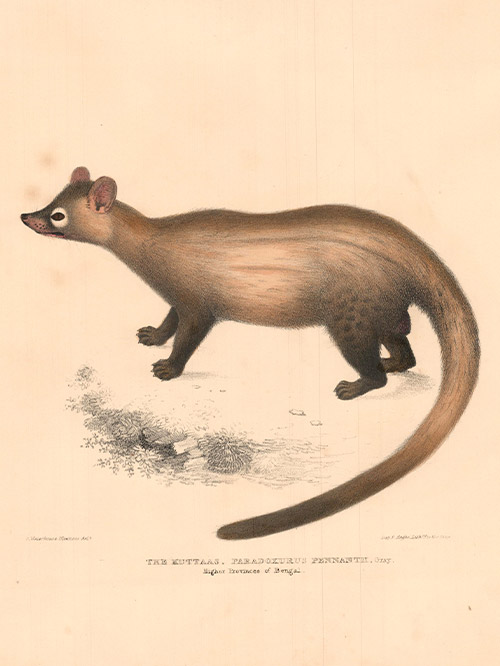
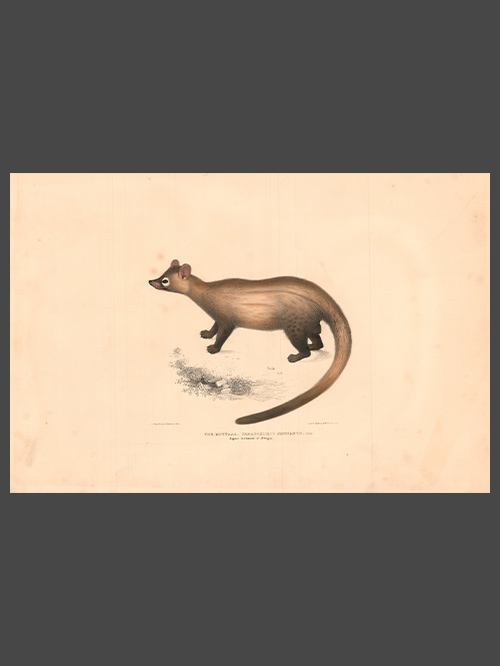
by John Edward Gray’s
From ‘Illustrations of Indian Zoology’
original hand coloured lithograph
Captioned ‘The Kuttaas, Paradoxurus Pennantii‘
John Edward Gray of the British Museum had collaborated with Maj.-Gen. Hardwicke in producing Illustrations of Indian Zoology between 1830 and 1834. He was also the author of several major illustrated works on natural history and commissioned the best artists and printers of the day to illustrate his work. The Illustrations of Indian Zoology is his major work, dedicated to the East India Company, and with the striking plates of bird and animal life in the sub-continent drawn by Waterhouse Hawkins, the noted sporting artist.
Maj.-Gen. Thomas Hardwicke of the Bengal Artillery whilst serving in India from 1778 to 1823 assembled a truly impressive collection of natural history drawings by Indian and European artists whom he engaged to draw flora and fauna. On his retirement he brought the collection with him to England and a thousand of these in many volumes are now in the British library and in the British Museum (Natural History). Bird portraiture predominates in Illustrations of Indian Zoology with a token representation of mammals, reptiles and fishes.
Size (cms): 34 (H) x 48 (L)
Size (inches): 13.5 (H) x 19 (L)
-

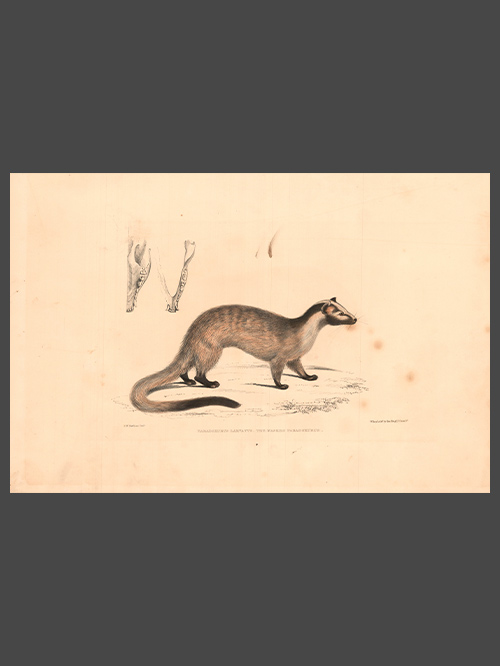
by John Edward Gray’s
From ‘Illustrations of Indian Zoology’
original hand coloured lithograph
Captioned ‘Paradoxurus Larvatus, The Masked Paradoxurus.‘
John Edward Gray of the British Museum had collaborated with Maj.-Gen. Hardwicke in producing Illustrations of Indian Zoology between 1830 and 1834. He was also the author of several major illustrated works on natural history and commissioned the best artists and printers of the day to illustrate his work. The Illustrations of Indian Zoology is his major work, dedicated to the East India Company, and with the striking plates of bird and animal life in the sub-continent drawn by Waterhouse Hawkins, the noted sporting artist.
Maj.-Gen. Thomas Hardwicke of the Bengal Artillery whilst serving in India from 1778 to 1823 assembled a truly impressive collection of natural history drawings by Indian and European artists whom he engaged to draw flora and fauna. On his retirement he brought the collection with him to England and a thousand of these in many volumes are now in the British library and in the British Museum (Natural History). Bird portraiture predominates in Illustrations of Indian Zoology with a token representation of mammals, reptiles and fishes.
Size (cms): 34 (H) x 48 (L)
Size (inches): 13.5 (H) x 19 (L)
-
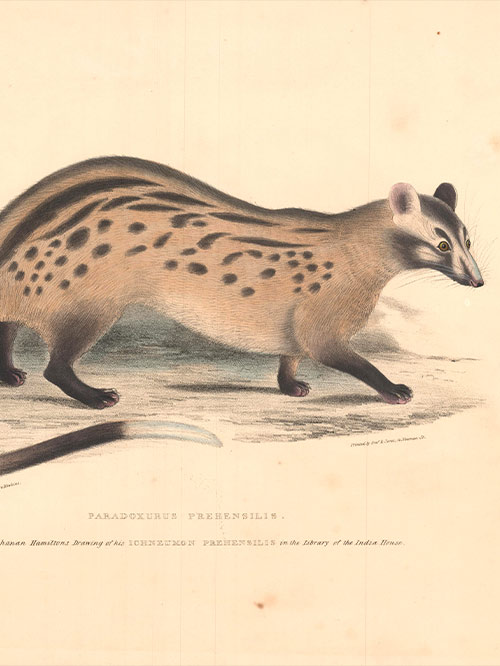
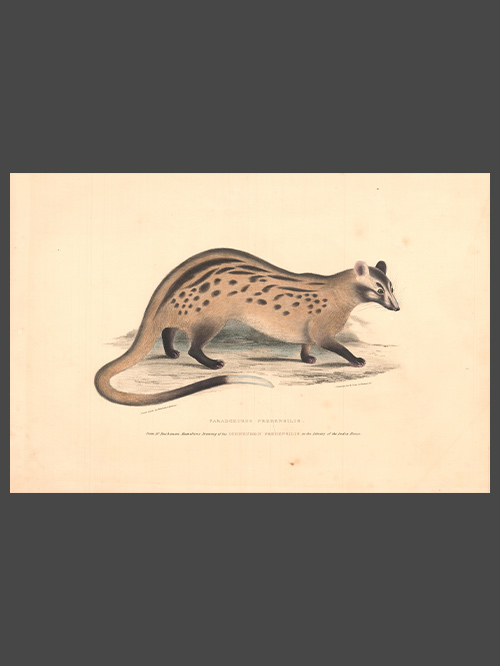
by John Edward Gray’s
From ‘Illustrations of Indian Zoology’
original hand coloured lithograph
Captioned ‘Paradoxurus Prehensilis‘
John Edward Gray of the British Museum had collaborated with Maj.-Gen. Hardwicke in producing Illustrations of Indian Zoology between 1830 and 1834. He was also the author of several major illustrated works on natural history and commissioned the best artists and printers of the day to illustrate his work. The Illustrations of Indian Zoology is his major work, dedicated to the East India Company, and with the striking plates of bird and animal life in the sub-continent drawn by Waterhouse Hawkins, the noted sporting artist.
Maj.-Gen. Thomas Hardwicke of the Bengal Artillery whilst serving in India from 1778 to 1823 assembled a truly impressive collection of natural history drawings by Indian and European artists whom he engaged to draw flora and fauna. On his retirement he brought the collection with him to England and a thousand of these in many volumes are now in the British library and in the British Museum (Natural History). Bird portraiture predominates in Illustrations of Indian Zoology with a token representation of mammals, reptiles and fishes.
Size (cms): 34 (H) x 48 (L)
Size (inches): 13.5 (H) x 19 (L)
-
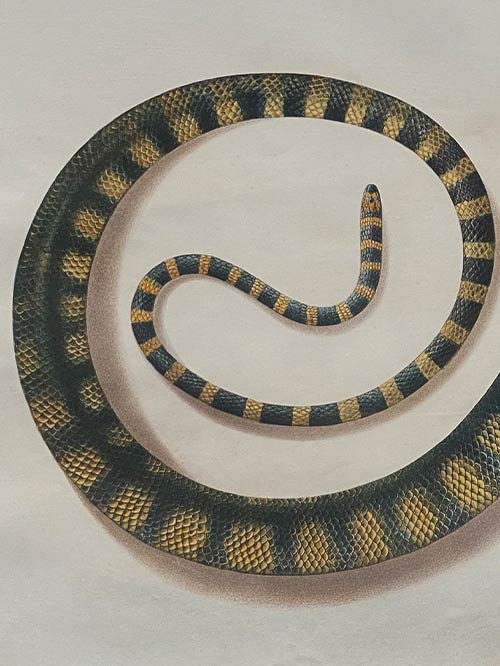
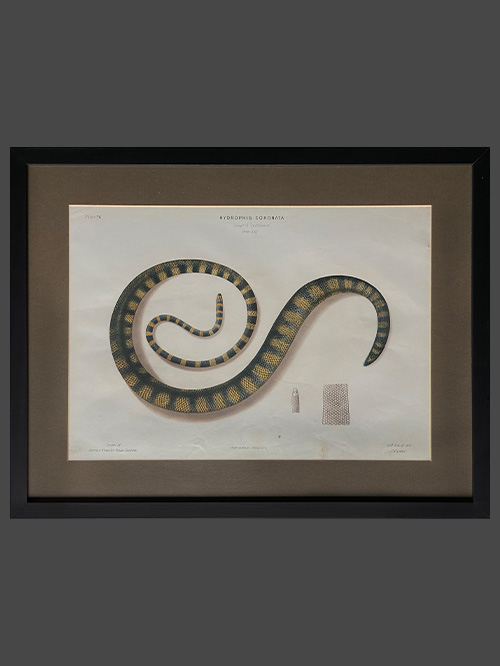
by Sir Joseph Fayrer
from The Thanatophidia of India
original hand coloured chromolithograph
Captioned ‘Hydrophis Coronata’
Sir Joseph Fayrer, 1st Baronet (6 December 1824 – 21 May 1907) was an English physician noted for his writings on medicine in India. After studying medicine at Charing Cross Hospital, London and completing his medical degree in 1849, he was appointed as an assistant surgeon in Bengal in 1850. Fayrer, who became a fellow of the Royal Society in 1877, wrote much on subjects connected with the practice of medicine in India, and was especially known for his studies on the poisonous snakes of that country and on the physiological effects produced by their venom. He set up a zoological society and the zoo at Calcutta. He was President of the Asiatic Society of Bengal in 1867.
The Thanatophidia of India is a description of the venomous snakes of the Indian Peninsula and the physiological effects produced by their venom. These plates were drawn by students from the Govt. School of Art in Calcutta.
Size framed (cms): 44 (H) x 57 (L)
Size framed (inches): 17.5 (H) x 22 (L)
-
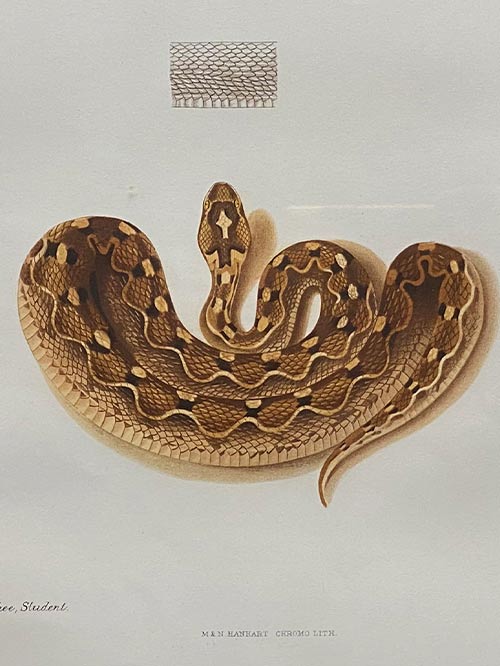
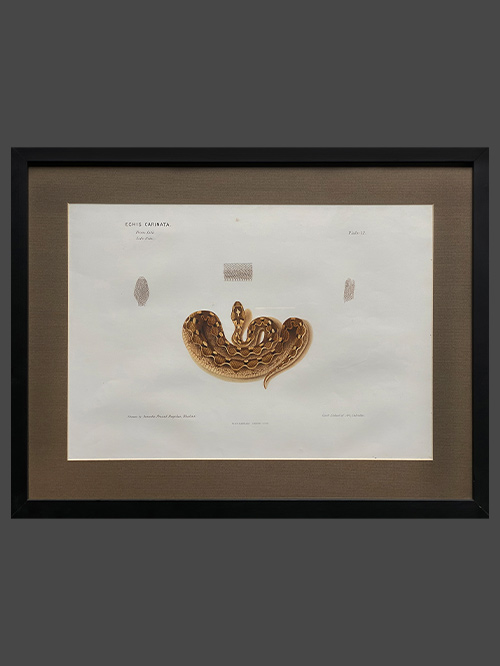
by Sir Joseph Fayrer
from The Thanatophidia of India
original hand coloured chromolithograph
Captioned ‘Echis Carinata’
Sir Joseph Fayrer, 1st Baronet (6 December 1824 – 21 May 1907) was an English physician noted for his writings on medicine in India. After studying medicine at Charing Cross Hospital, London and completing his medical degree in 1849, he was appointed as an assistant surgeon in Bengal in 1850. Fayrer, who became a fellow of the Royal Society in 1877, wrote much on subjects connected with the practice of medicine in India, and was especially known for his studies on the poisonous snakes of that country and on the physiological effects produced by their venom. He set up a zoological society and the zoo at Calcutta. He was President of the Asiatic Society of Bengal in 1867.
The Thanatophidia of India is a description of the venomous snakes of the Indian Peninsula and the physiological effects produced by their venom. These plates were drawn by students from the Govt. School of Art in Calcutta.
Size framed (cms): 44 (H) x 57 (L)
Size framed (inches): 17.5 (H) x 22 (L)
-
by Sir Joseph Fayrer
from The Thanatophidia of India
original hand coloured chromolithograph
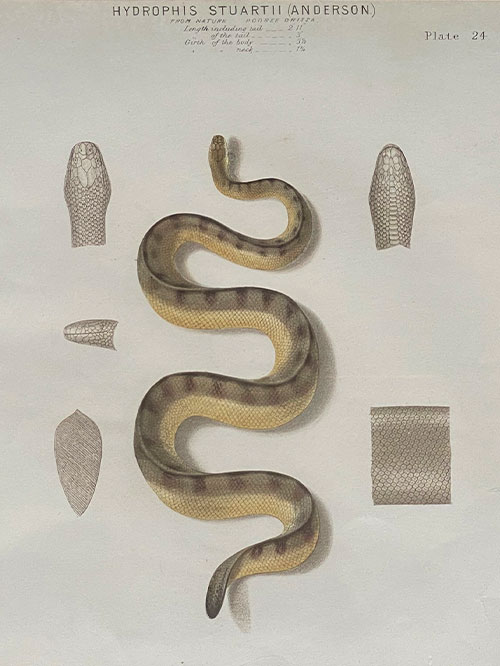
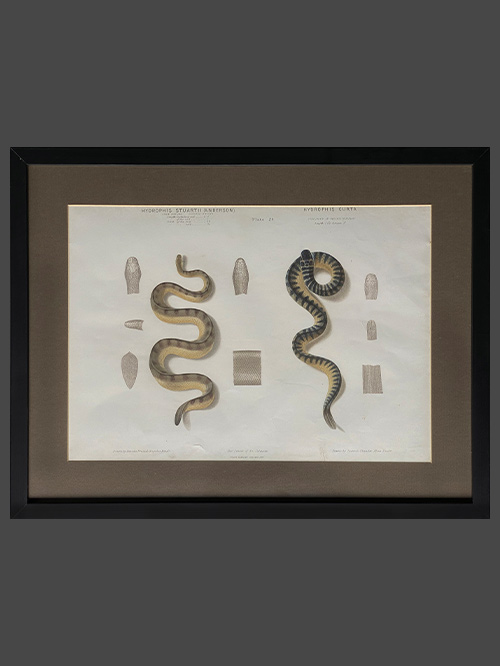
Captioned ‘Hydrophis Stuartii and Hydrophis Curta’
Sir Joseph Fayrer, 1st Baronet (6 December 1824 – 21 May 1907) was an English physician noted for his writings on medicine in India. After studying medicine at Charing Cross Hospital, London and completing his medical degree in 1849, he was appointed as an assistant surgeon in Bengal in 1850. Fayrer, who became a fellow of the Royal Society in 1877, wrote much on subjects connected with the practice of medicine in India, and was especially known for his studies on the poisonous snakes of that country and on the physiological effects produced by their venom. He set up a zoological society and the zoo at Calcutta. He was President of the Asiatic Society of Bengal in 1867.
The Thanatophidia of India is a description of the venomous snakes of the Indian Peninsula and the physiological effects produced by their venom. These plates were drawn by students from the Govt. School of Art in Calcutta.
Size framed (cms): 44 (H) x 57 (L)
Size framed (inches): 17.5 (H) x 22 (L)