“Weddings and Celebrations” has been added to your cart.
View cart
-
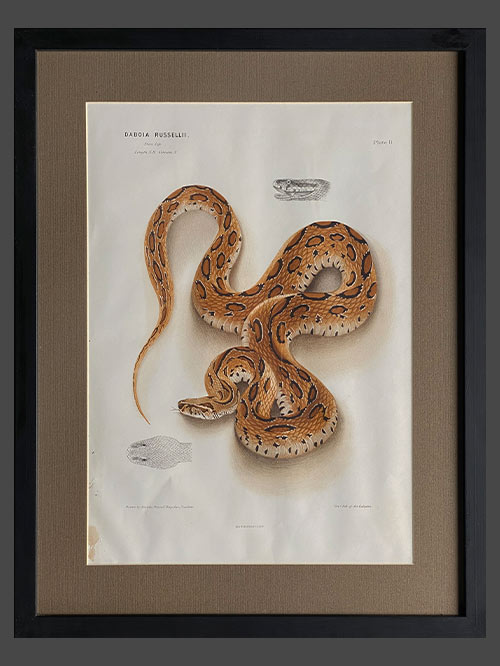
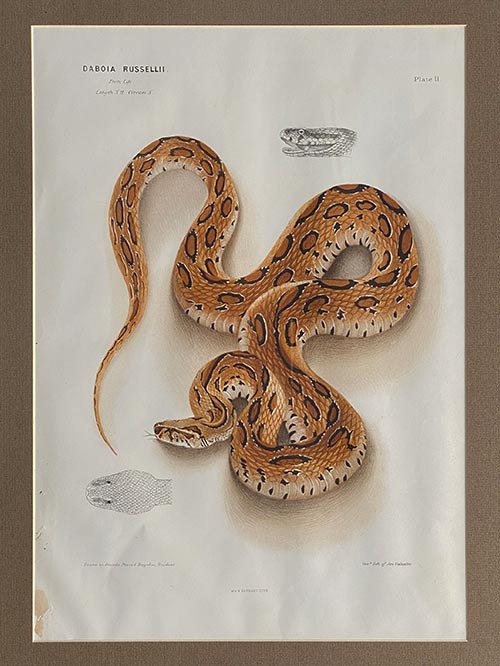
by Sir Joseph Fayrer
from The Thanatophidia of India
original hand coloured chromolithograph
Captioned ‘Daboia Russellii’
The Daboia Russellii (Russel’s Viper) is native to the Indian subcontinent. It was named after Patrick Russell who is considered the Father of Indian herpetology. It is part of the big four snakes that are responsible for causing the most snakebite cases and deaths. The other three snakes are the Indian Cobra, Common Krait and Saw-Scaled Viper. Russel’s Viper is a nocturnal species which remains active from late evening to late nights for foraging and other life activities.
Sir Joseph Fayrer, 1st Baronet (6 December 1824 – 21 May 1907) was an English physician noted for his writings on medicine in India. After studying medicine at Charing Cross Hospital, London and completing his medical degree in 1849, he was appointed as an assistant surgeon in Bengal in 1850. Fayrer, who became a fellow of the Royal Society in 1877, wrote much on subjects connected with the practice of medicine in India, and was especially known for his studies on the poisonous snakes of that country and on the physiological effects produced by their venom. He set up a zoological society and the zoo at Calcutta. He was President of the Asiatic Society of Bengal in 1867.
The Thanatophidia of India is a description of the venomous snakes of the Indian Peninsula and the physiological effects produced by their venom. These plates were drawn by students from the Govt. School of Art in Calcutta.
Size framed (cms): 57 (H) x 44 (L)
Size framed (inches): 22 (H) x 17.5 (L)
-
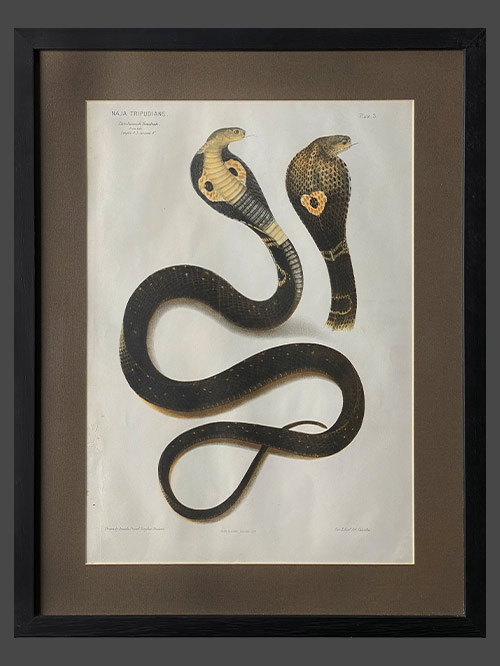
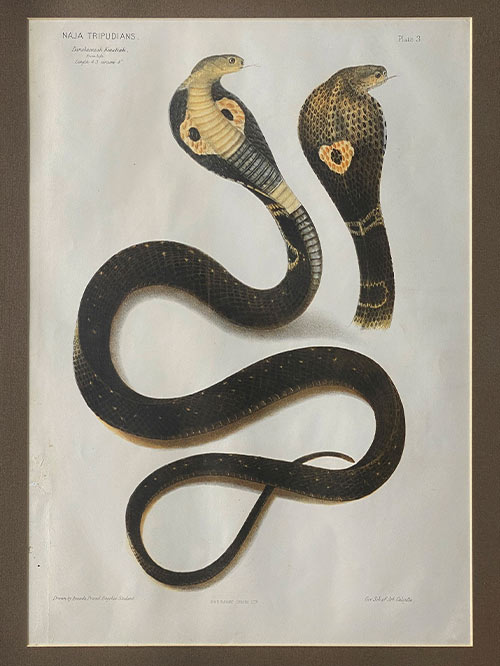
by Sir Joseph Fayrer
from The Thanatophidia of India
original hand coloured chromolithograph
Captioned ‘Naja Tripudians‘
The Naja Tripudians (Indian Cobra) is native to the Indian subcontinent. It is part of the big four snakes that are responsible for causing the most snakebite cases and deaths. The other three snakes are the Russel’s Viper, Common Krait and Saw-Scaled Viper. The Indian cobra is revered in Indian culture and mythology.
Sir Joseph Fayrer, 1st Baronet (6 December 1824 – 21 May 1907) was an English physician noted for his writings on medicine in India. After studying medicine at Charing Cross Hospital, London and completing his medical degree in 1849, he was appointed as an assistant surgeon in Bengal in 1850. Fayrer, who became a fellow of the Royal Society in 1877, wrote much on subjects connected with the practice of medicine in India, and was especially known for his studies on the poisonous snakes of that country and on the physiological effects produced by their venom. He set up a zoological society and the zoo at Calcutta. He was President of the Asiatic Society of Bengal in 1867.
The Thanatophidia of India is a description of the venomous snakes of the Indian Peninsula and the physiological effects produced by their venom. These plates were drawn by students from the Govt. School of Art in Calcutta.
Size framed (cms): 57 (H) x 44 (L)
Size framed (inches): 22 (H) x 17.5 (L)
-
by Sir Joseph Fayrer
from The Thanatophidia of India
original hand coloured chromolithograph
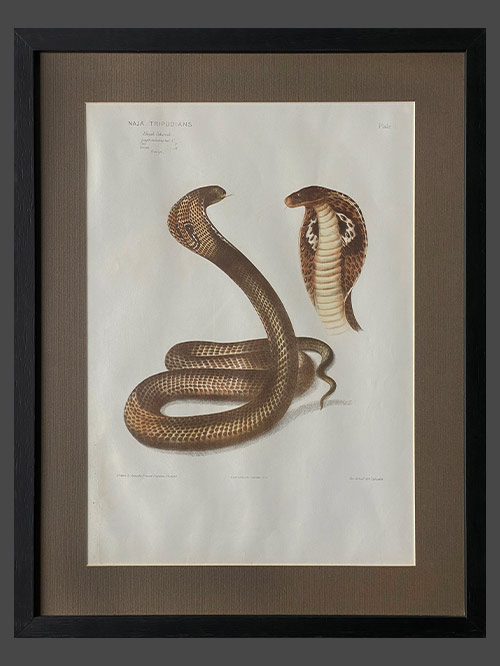
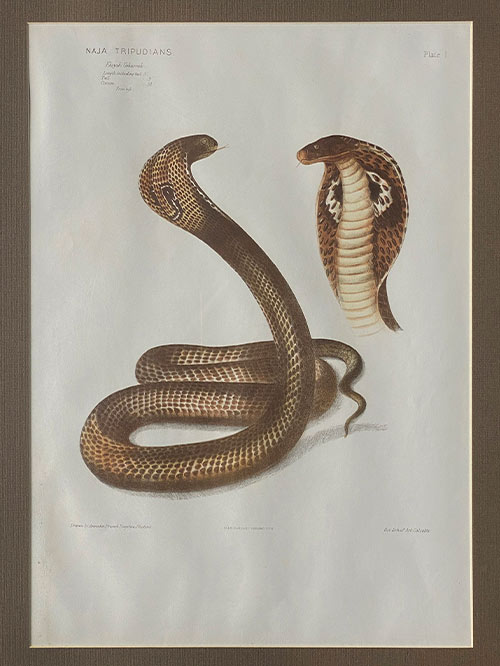
Captioned ‘Naja Tripudians’
The Naja Tripudians (Indian Cobra) is native to the Indian subcontinent. It is part of the big four snakes that are responsible for causing the most snakebite cases and deaths. The other three snakes are the Russel’s Viper, Common Krait and Saw-Scaled Viper. The Indian cobra is revered in Indian culture and mythology.
Sir Joseph Fayrer, 1st Baronet (6 December 1824 – 21 May 1907) was an English physician noted for his writings on medicine in India. After studying medicine at Charing Cross Hospital, London and completing his medical degree in 1849, he was appointed as an assistant surgeon in Bengal in 1850. Fayrer, who became a fellow of the Royal Society in 1877, wrote much on subjects connected with the practice of medicine in India, and was especially known for his studies on the poisonous snakes of that country and on the physiological effects produced by their venom. He set up a zoological society and the zoo at Calcutta. He was President of the Asiatic Society of Bengal in 1867.
The Thanatophidia of India is a description of the venomous snakes of the Indian Peninsula and the physiological effects produced by their venom. These plates were drawn by students from the Govt. School of Art in Calcutta.
Size framed (cms): 57 (H) x 44 (L)
Size framed (inches): 22 (H) x 17.5 (L)
-
by Sir Joseph Fayrer
from The Thanatophidia of India
original hand coloured chromolithograph
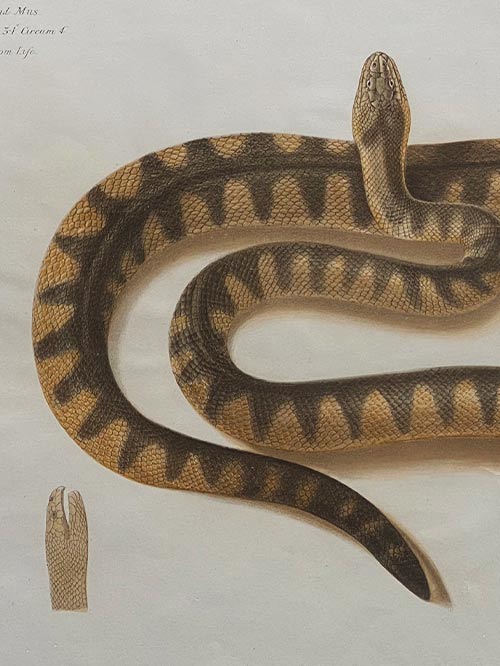
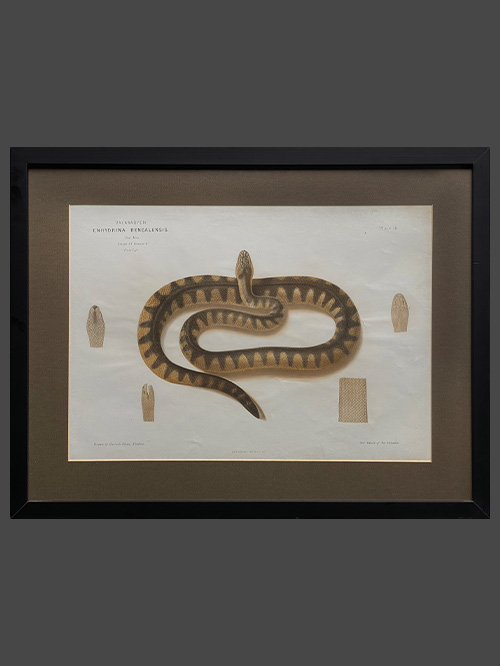
Captioned ‘Enhydrina Bengalensis’
Sir Joseph Fayrer, 1st Baronet (6 December 1824 – 21 May 1907) was an English physician noted for his writings on medicine in India. After studying medicine at Charing Cross Hospital, London and completing his medical degree in 1849, he was appointed as an assistant surgeon in Bengal in 1850. Fayrer, who became a fellow of the Royal Society in 1877, wrote much on subjects connected with the practice of medicine in India, and was especially known for his studies on the poisonous snakes of that country and on the physiological effects produced by their venom. He set up a zoological society and the zoo at Calcutta. He was President of the Asiatic Society of Bengal in 1867.
The Thanatophidia of India is a description of the venomous snakes of the Indian Peninsula and the physiological effects produced by their venom. These plates were drawn by students from the Govt. School of Art in Calcutta.
Size framed (cms): 44 (H) x 57 (L)
Size framed (inches): 17.5 (H) x 22 (L)
-
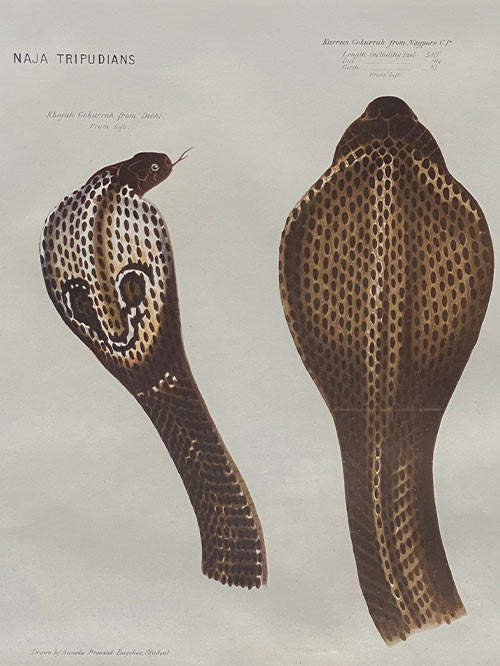
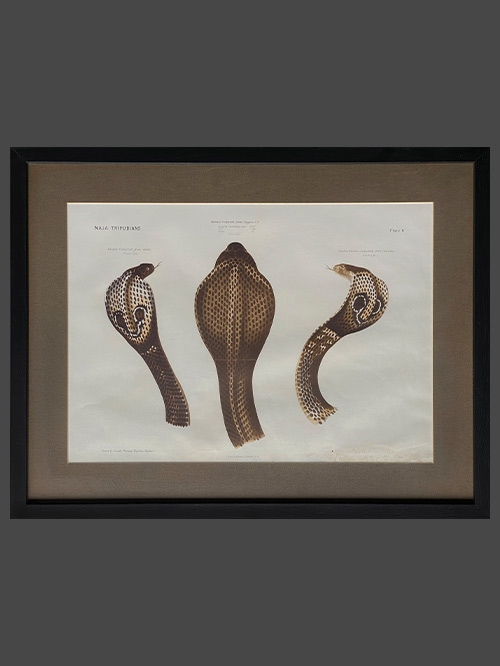
by Sir Joseph Fayrer
from The Thanatophidia of India
original hand coloured chromolithograph
Captioned ‘Naja Tripudians’
Sir Joseph Fayrer, 1st Baronet (6 December 1824 – 21 May 1907) was an English physician noted for his writings on medicine in India. After studying medicine at Charing Cross Hospital, London and completing his medical degree in 1849, he was appointed as an assistant surgeon in Bengal in 1850. Fayrer, who became a fellow of the Royal Society in 1877, wrote much on subjects connected with the practice of medicine in India, and was especially known for his studies on the poisonous snakes of that country and on the physiological effects produced by their venom. He set up a zoological society and the zoo at Calcutta. He was President of the Asiatic Society of Bengal in 1867.
The Thanatophidia of India is a description of the venomous snakes of the Indian Peninsula and the physiological effects produced by their venom. These plates were drawn by students from the Govt. School of Art in Calcutta.
Size framed (cms): 44 (H) x 57 (L)
Size framed (inches): 17.5 (H) x 22 (L)
-
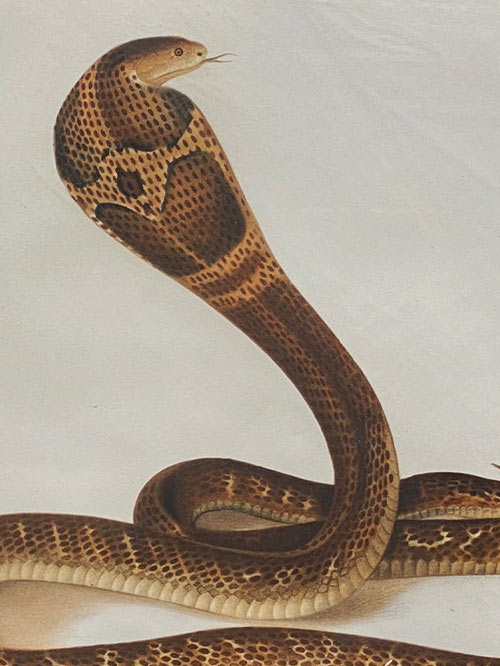
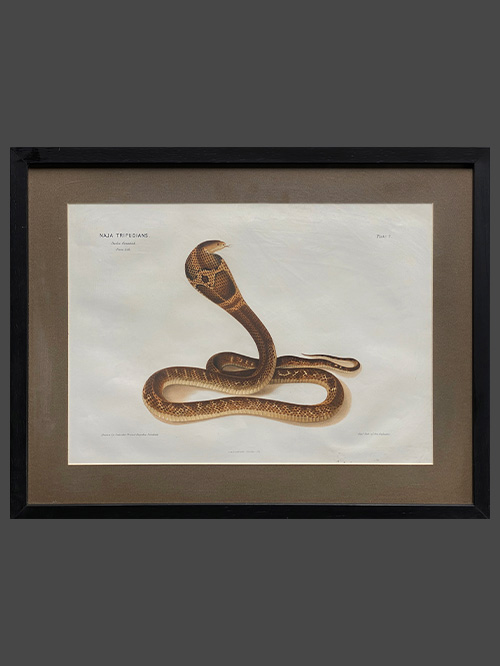
by Sir Joseph Fayrer
from The Thanatophidia of India
original hand coloured chromolithograph
Captioned ‘Naja Tripudians’
Sir Joseph Fayrer, 1st Baronet (6 December 1824 – 21 May 1907) was an English physician noted for his writings on medicine in India. After studying medicine at Charing Cross Hospital, London and completing his medical degree in 1849, he was appointed as an assistant surgeon in Bengal in 1850. Fayrer, who became a fellow of the Royal Society in 1877, wrote much on subjects connected with the practice of medicine in India, and was especially known for his studies on the poisonous snakes of that country and on the physiological effects produced by their venom. He set up a zoological society and the zoo at Calcutta. He was President of the Asiatic Society of Bengal in 1867.
The Thanatophidia of India is a description of the venomous snakes of the Indian Peninsula and the physiological effects produced by their venom. These plates were drawn by students from the Govt. School of Art in Calcutta.
Size framed (cms): 44 (H) x 57 (L)
Size framed (inches): 17.5 (H) x 22 (L)
-
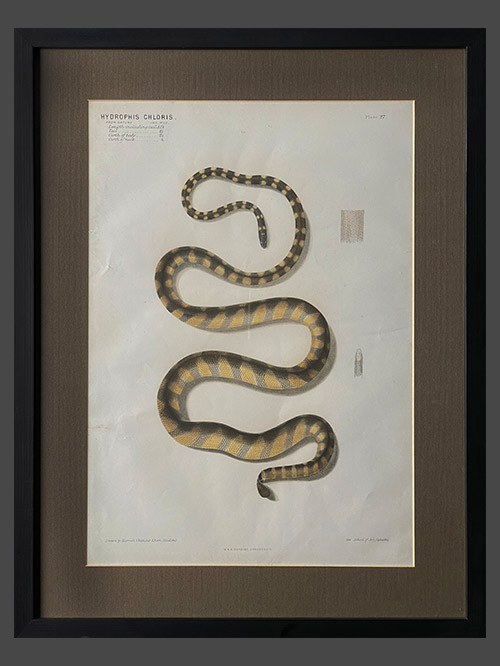
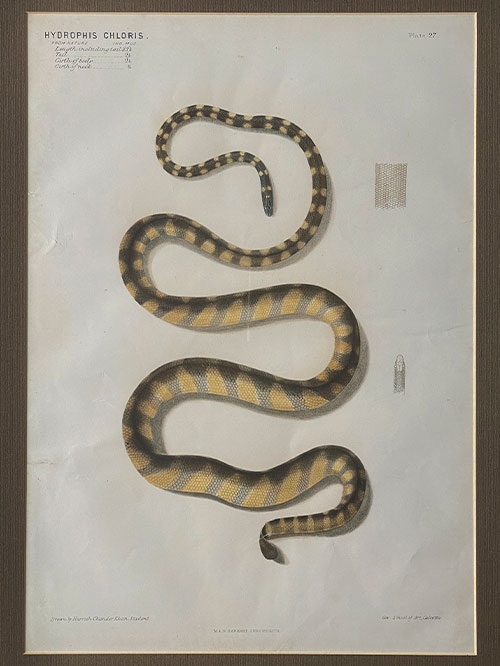
by Sir Joseph Fayrer
from The Thanatophidia of India
original hand coloured chromolithograph
Captioned ‘Hydrophis Chloris’
Sir Joseph Fayrer, 1st Baronet (6 December 1824 – 21 May 1907) was an English physician noted for his writings on medicine in India. After studying medicine at Charing Cross Hospital, London and completing his medical degree in 1849, he was appointed as an assistant surgeon in Bengal in 1850. Fayrer, who became a fellow of the Royal Society in 1877, wrote much on subjects connected with the practice of medicine in India, and was especially known for his studies on the poisonous snakes of that country and on the physiological effects produced by their venom. He set up a zoological society and the zoo at Calcutta. He was President of the Asiatic Society of Bengal in 1867.
The Thanatophidia of India is a description of the venomous snakes of the Indian Peninsula and the physiological effects produced by their venom. These plates were drawn by students from the Govt. School of Art in Calcutta.
Size framed (cms): 57 (H) x 44 (L)
Size framed (inches): 22 (H) x 17.5 (L)
-
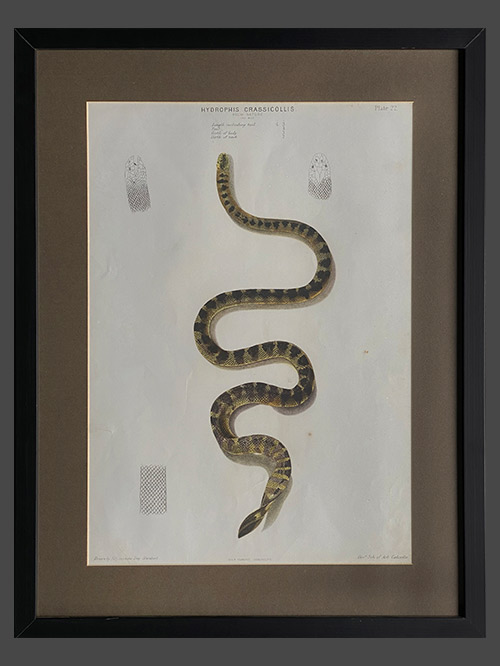
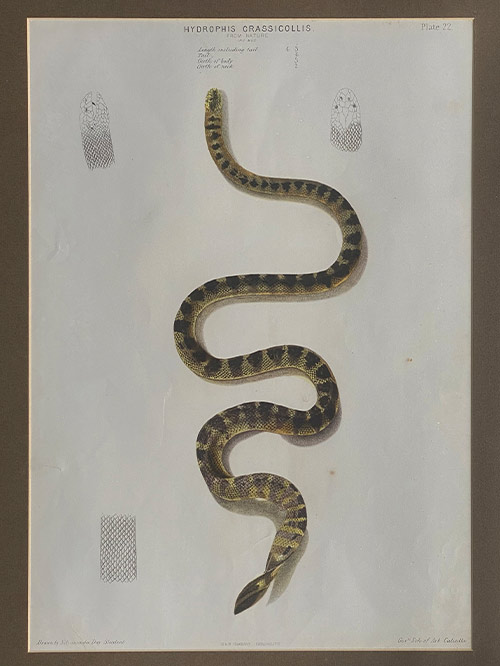
by Sir Joseph Fayrer
from The Thanatophidia of India
original hand coloured chromolithograph
Captioned ‘Hydrophis Crassicollis’
Sir Joseph Fayrer, 1st Baronet (6 December 1824 – 21 May 1907) was an English physician noted for his writings on medicine in India. After studying medicine at Charing Cross Hospital, London and completing his medical degree in 1849, he was appointed as an assistant surgeon in Bengal in 1850. Fayrer, who became a fellow of the Royal Society in 1877, wrote much on subjects connected with the practice of medicine in India, and was especially known for his studies on the poisonous snakes of that country and on the physiological effects produced by their venom. He set up a zoological society and the zoo at Calcutta. He was President of the Asiatic Society of Bengal in 1867.
The Thanatophidia of India is a description of the venomous snakes of the Indian Peninsula and the physiological effects produced by their venom. These plates were drawn by students from the Govt. School of Art in Calcutta.
Size framed (cms): 57 (H) x 44 (L)
Size framed (inches): 22 (H) x 17.5 (L)
-
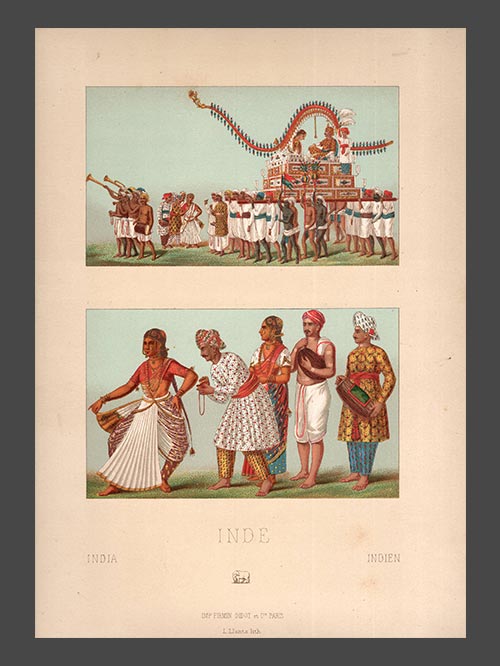
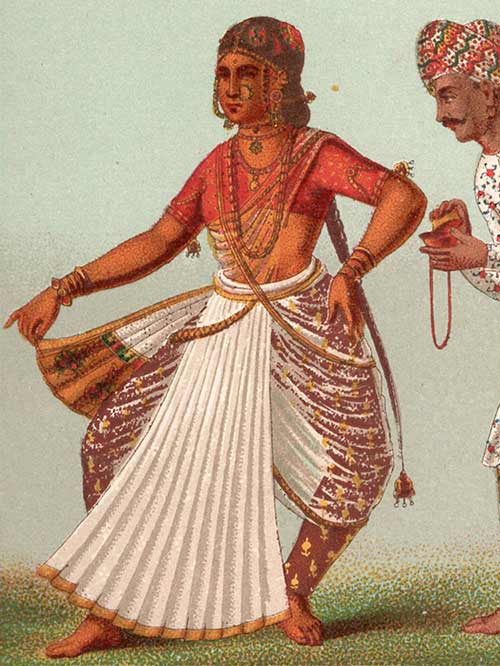
by A Racinet
from Le Costume Historique
original chromolithograph
Racinet’s ‘Le Costume Historique’ is the most famous of the 19th-century books on dress, and the first fashion book to use colour lithography. It is a wide-ranging survey of costumes through time. Publication was made possible by significant developments in colour printing technology, and a resurgence of interest in ‘the other’ as a new period of European colonialism gathered pace from the mid-19th century. The emphasis here is on recognising continuity in traditional dress, rather than innovation in fashion, and linking costume to local history, custom and social organisation. Racinet was keen to produce a visually appealing book that deployed chromolithography to full effect; in his enthusiasm he sometimes toyed with authenticity by adding colour to some of his sources. His representations of Indian fashion are largely inspired by miniature paintings from the collection of French lithographer Firmin Didot.
Image Size (cms): 17.5 (H) x 15.5 (W)
Image Size (inches): 7 (H) x 6 (W)
Print Size (cms): 30 (H) x 21.5 (W)
Print Size (inches): 11.8 (H) x 8.5 (W)
-
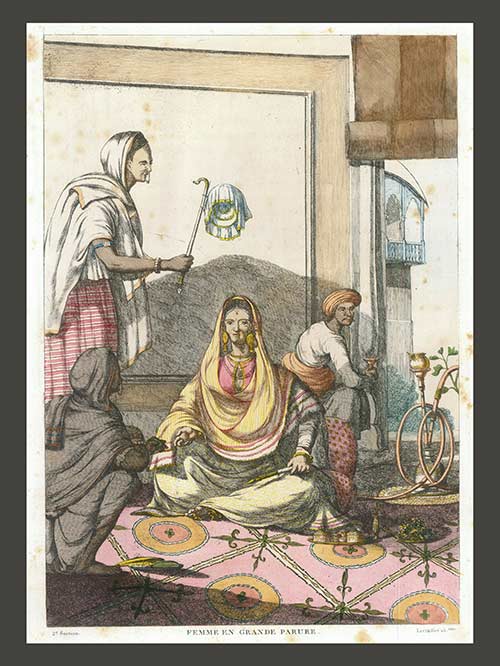
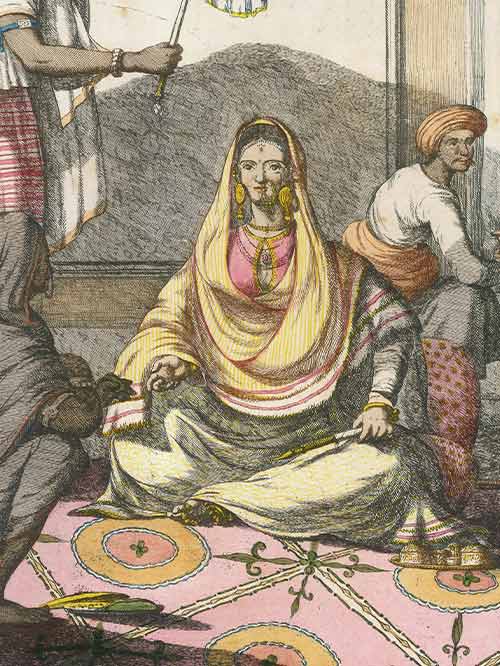
by Francois-Balthazar Solvyns (1760-1824)
Original coloured etching
from Les Hindous
Pub. Paris
Solvyns provides a vivid portrayal of a wealthy Hindu woman in full dress, emphasising both the magnificence of her attire and the richness of her surroundings. The woman is seated on a luxurious carpet, with her legs and arms supported by embroidered silk cushions. She is attended by two ayahs (maid servants). One maid offers her paan while another fans her with a hand pankh to refresh the air around her face. In the background, a hookah-bearer prepares the hookah for her to smoke. The lady’s appearance is meticulously described: her hair, made shiny with cocoa oil, is plaited and adorned with pearls or precious stones, with the largest gem positioned in the middle. Solvyns highlights her isolation and idle life, noting that women of her rank live in seclusion, removed from both labor and society, their lives marked by a lack of purpose and contribution, engaging in minimal activities such as playing the tom-tom.
Frans Balthazar Solvyns, was a skilled engraver and painter hailing from Antwerp, embarked on a transformative journey to India in 1790. Settling in Calcutta, Solvyns immersed himself in the intricacies of Indian life, studying Hindi and forging relationships with Brahmins and pundits. Inspired by his surroundings, he commenced his ambitious project in 1791, aiming to depict the diverse facets of Indian society, from occupations to customs which he published in a series of engravings. Despite its sensitive portrayal, the venture encountered little success initially, prompting Solvyns’ departure from India in 1803. However, his legacy endured through subsequent publications, notably “The Costume of Hindoostan” and the expanded edition of “Les Hindous,” offering an intimate and detailed glimpse into 18th-century Indian life across professions, festivals, and daily rituals, immortalising a unique historical moment with both reverence and curiosity.
Image Size (cms): 35(H) x 24(W)
Image Size (inches): 14(H) x 9.5(W)
Mount Size (cms): 51(H) x 41(W)
Mount Size (inches): 20(H) x 16(W)