“Dancer” has been added to your cart.
View cart
-
Coastal Karnataka (Bhuta culture)
Wood
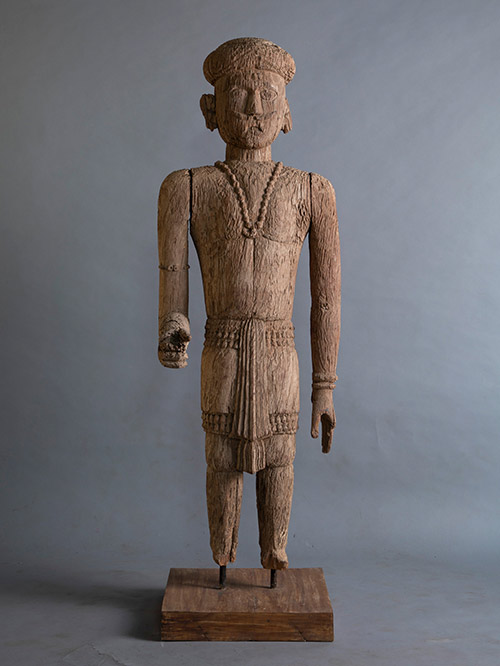
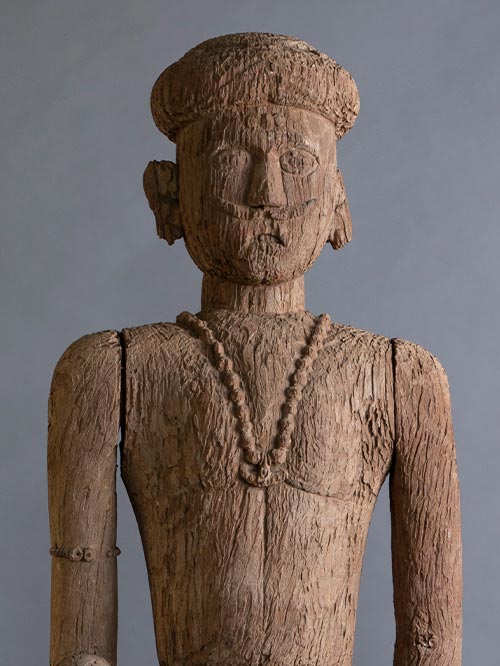
A rare figure of a male donor chief. He wears a turban, has a prominent moustache and is decked with typical jewellery including a single strand necklace with a pendant, armlet and earrings. He wears an unstitched garment tied at the waist with pleats at the front, called a mundu.
The bhuta tradition is popular on the Malabar coast. Bounded by the dramatic sweep of the forested ghats to the east and the Arabian sea to the west, and encircled by rivers, the South Kanara district of coastal Karnataka has enjoyed relative geographic isolation until recent years. This has enabled the region to retain specific pre-Hindu belief systems and associated rituals, virtually intact, over several hundred years. These practices have a distinct identity of their own, although they have become linked in a variety of ways with mainstream Hinduism. Though now primarily confined to Coastal Karnataka, Bhuta cults once existed all over India under different names and forms. The factions, which are of considerable antiquity, have much in common with those of the yakshas (mysterious semi-divine beings), for instance.
Size (cms): 147(H) x 44(W) x 54(D)
Size (inches): 58(H) x 17.5(W) x 21.5(D)
-
Coastal Karnataka (Bhuta culture)
Wood
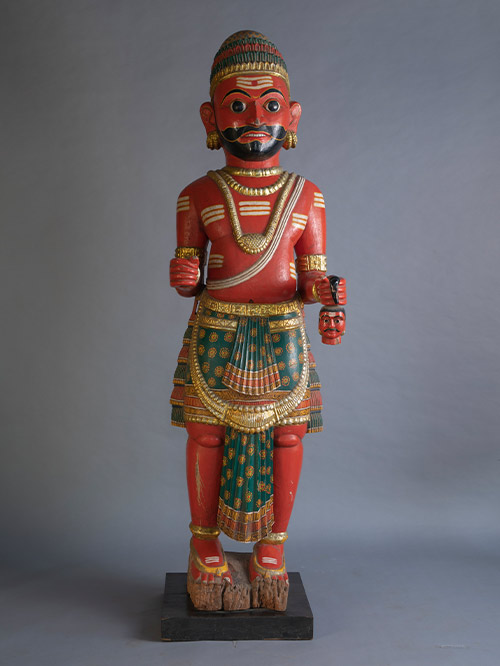
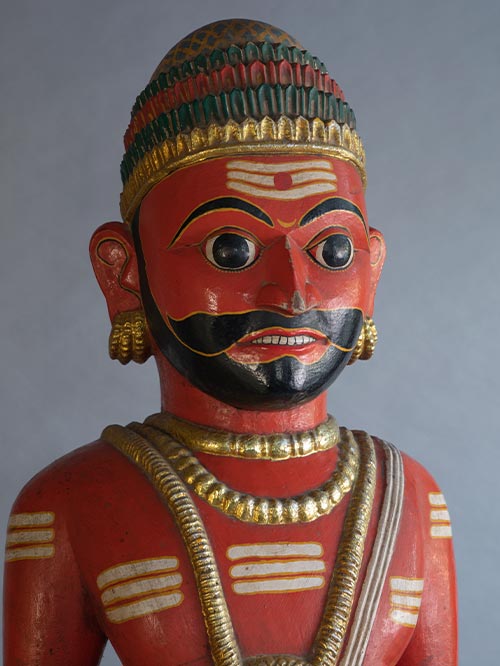
A rare figure of a Virabhadra in the form of a Bhuta. He wears a turban, has a prominent moustache and beard and is decked with typical jewellery including a single strand necklace with a pendant, armlet and earrings. He wears an unstitched garment tied at the waist with pleats at the front, called a mundu. He carries in one hand the head of a slain enemy and in the other, he would have held a sword.
The bhuta tradition is popular on the Malabar coast. Bounded by the dramatic sweep of the forested ghats to the east and the Arabian sea to the west, and encircled by rivers, the South Kanara district of coastal Karnataka has enjoyed relative geographic isolation until recent years. This has enabled the region to retain specific pre-Hindu belief systems and associated rituals, virtually intact, over several hundred years. These practices have a distinct identity of their own, although they have become linked in a variety of ways with mainstream Hinduism. Though now primarily confined to Coastal Karnataka, Bhuta cults once existed all over India under different names and forms.
Size (cms): 188(H) x 56(W) x 56(D)
Size (inches): 74(H) x 22(W) x 22(D)
-
Orissa
Wood, polychromed
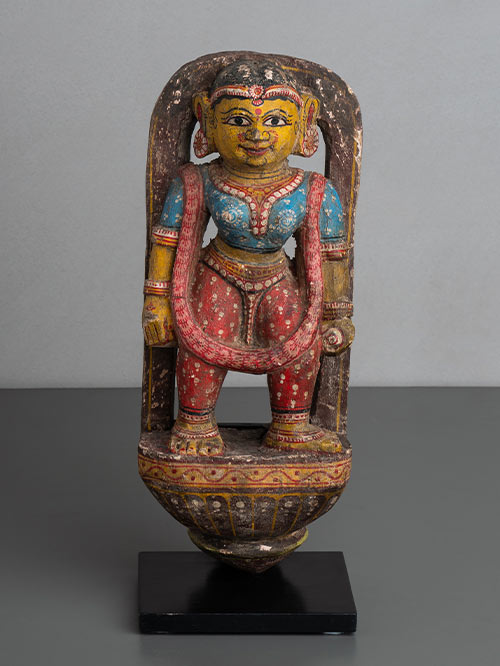
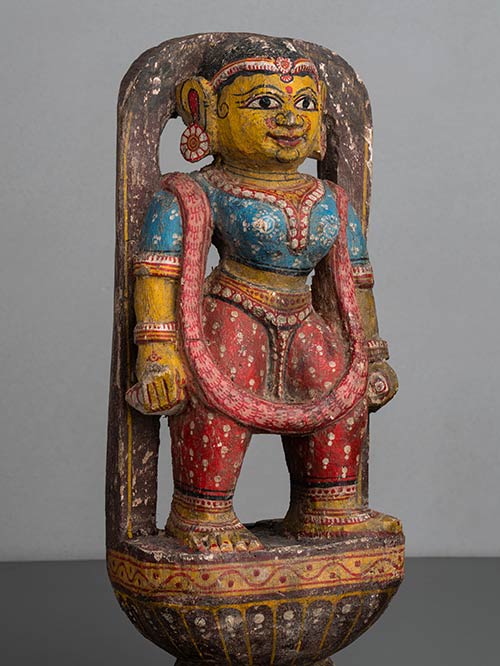
An elegant figure of an apsara wearing a patterned blouse. The apsara wears extensive jewellery; including multiple hand and leg ornaments. She has a stylised form with a narrow waist and large breasts and carries a conch in either hand. She has a full face with a pronounced chin, large arched eyebrows over bulbous eyes and a gentle smile.
Apsaras means ‘essence of the waters’ or ‘moving in or between the waters’. The Apsaras are divine beauties, the dancers of the gods, who dwell in Indra’s paradise, svarga (heaven). Mistresses of the Gandharva’s (semi divine beings) and, occasionally, of men, they can assume any form at will. Generally they are believed to have originated from the churning of the ocean, alone with the wish fulfilling Parijata, their favoured tree. They are often sent by the gods to seduce Rishis (holy men) and ascetics. Heroes who fall in battle are swept away to Svarga by the Apsaras. They are reputed to dwell in trees along with the Gandharvas. The chief of the Apsaras is Urvashi.
Size (cms): 33.5(H) x 13(W) x 10(D)
Size (inches): 13(H) x 5(W) x 4(D)
-
Orissa
Wood, polychromed
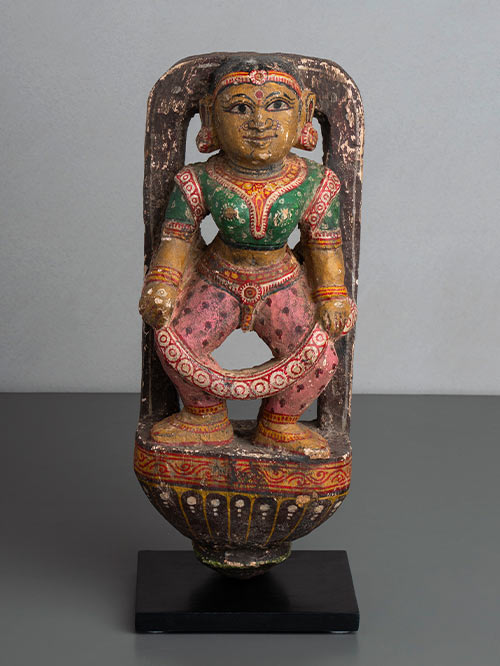
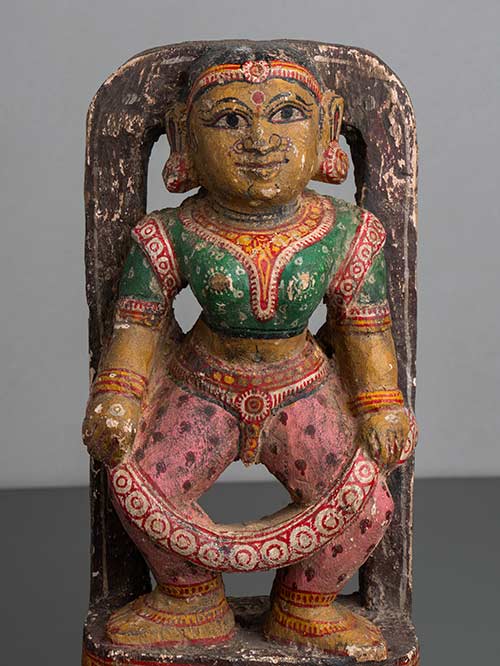
An elegant figure of an apsara wearing a patterned blouse. The apsara is adorned with extensive jewelry, including multiple hand and leg ornaments. She has a stylised form with a narrow waist and large breasts, and she holds a floral garland in front of her. Her full face features a pronounced chin, large arched eyebrows over bulbous eyes, and a gentle smile.
Apsaras means ‘essence of the waters’ or ‘moving in or between the waters’. The Apsaras are divine beauties, the dancers of the gods, who dwell in Indra’s paradise, svarga (heaven). Mistresses of the Gandharva’s (semi divine beings) and, occasionally, of men, they can assume any form at will. Generally they are believed to have originated from the churning of the ocean, alone with the wish fulfilling Parijata, their favoured tree. They are often sent by the gods to seduce Rishis (holy men) and ascetics. Heroes who fall in battle are swept away to Svarga by the Apsaras. They are reputed to dwell in trees along with the Gandharvas. The chief of the Apsaras is Urvashi.
Size (cms): 33.5(H) x 13(W) x 10(D)
Size (inches): 13(H) x 5(W) x 4(D)
-
Rajasthan
Bone and horn
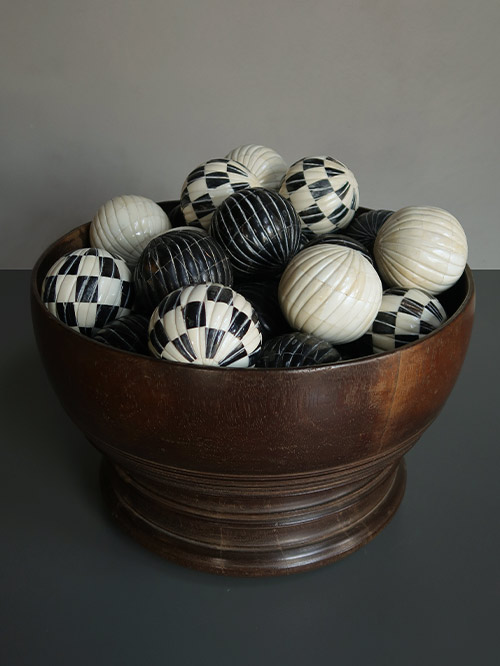
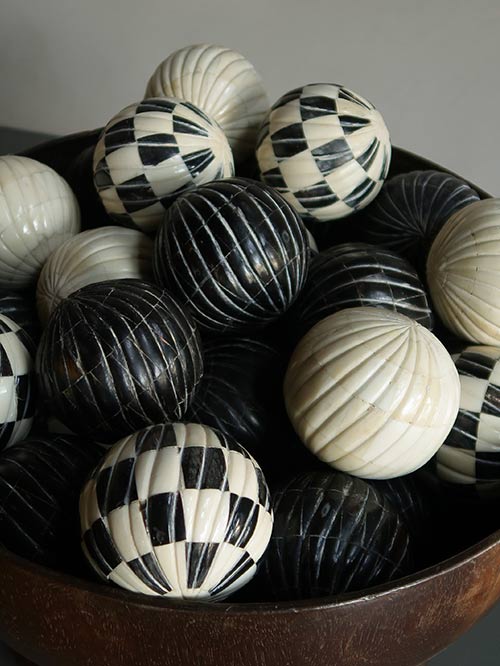
A group of decorative coloured balls, some black, some white, and others checkered.
Size (cms): 7.5(H) x 7.5(Diam)
Size (inches): 3(H) x 3(Diam)
-
Nepal
Wood, hide and cane
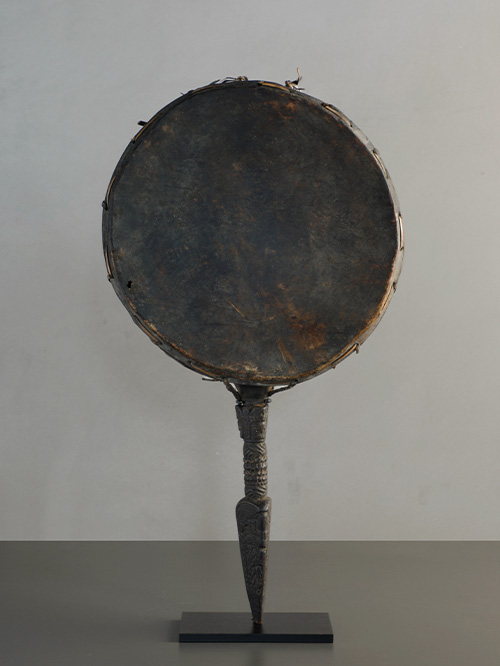
The dhyangro is a double-headed frame drum used by jhakris (tribal shamans), especially those of the Magars, the Kirati, and the Tamang, in the Middle Hills region of the Himalayas in Nepal. It is considered an ancient tool of magic and has been used by shamans for centuries to enter a trance and channel benevolent helping deities. The drum is played by holding the handle in the left hand, with the frame level with the face, and striking the outer head with the right hand holding a curved stick.
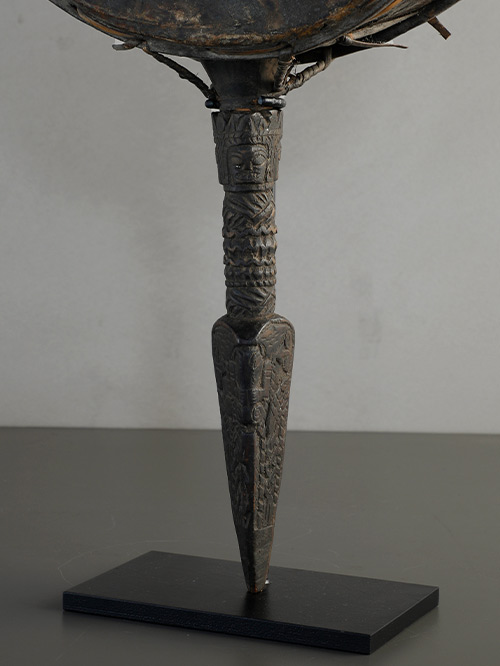
The drum has hide drumheads stretched over a circular wooden rim, secured with rattan strips. The handle is elongated and carved to resemble a phurba or esoteric dagger found in Tibetan Buddhist ritual. The handle features ornate relief carving depicting three deity heads and many shamanistic symbols, such as endless knots and caduceus-like symbols, that encircle it.
Size (cms): 65(H) x 35(W) x 14(D)
Size (inches): 25.5(H) x 14(W) x 5.5(D)
-
Karnataka
Wood, polychromed
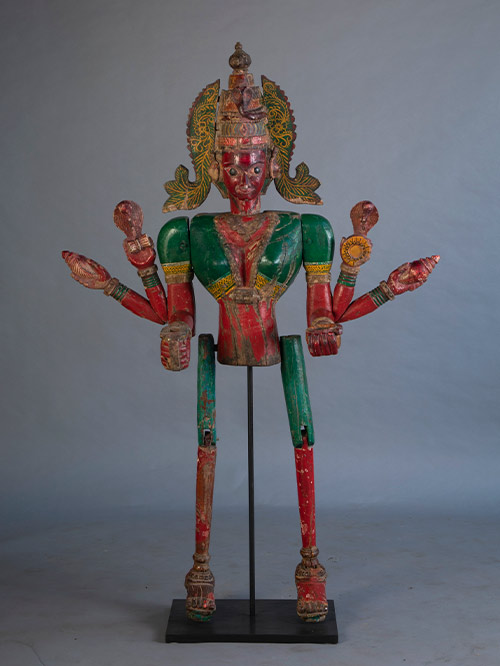
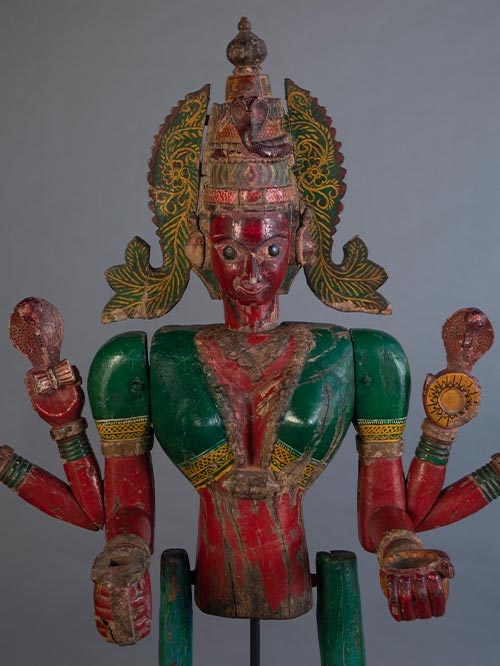
An attractive multi-armed articulated standing figure of the Goddess Durga. Painted in a deep red, she wears a patterned green and yellow blouse. Her hands are adorned with multiple bangles and she carries a pair of nagas and conches in her upper hands with a blood bowl and sword in her lower two hands. An elaborate tiered crown sits on her head, decorated with geometric symbols and a serpent (naga).
Durga – “The Unconquerable form of Devi” – Durga is the most splendid manifestation of Devi. Virginal and sublime, contain within her the power of all the gods combined, she is the invincible power of Nature who triumphs over those who seek to subjugate her.
Size (cms): 132(H) x 88(W) x 31(D)
Size (inches): 52(H) x 34.5(W) x 12(D)
-
Orissa
Wood, polychromed
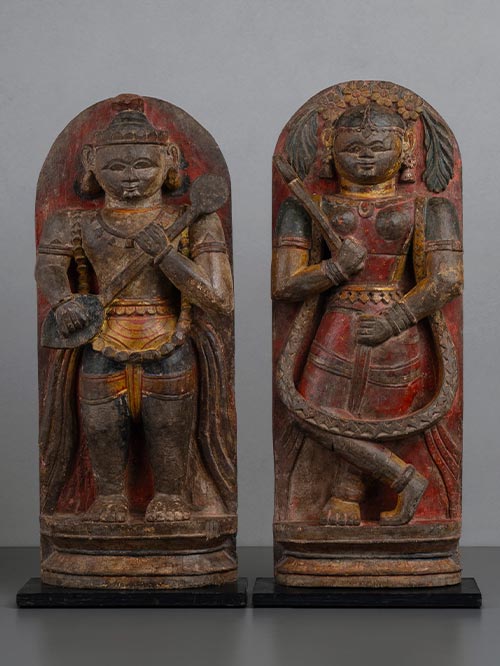
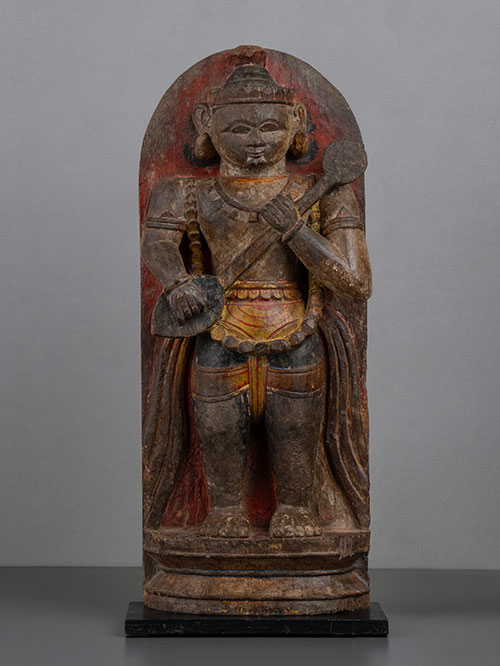
This beautiful pair of richly polychromed brackets depicts a musician carrying a string instrument and an attendant figure holding a chauri (fly-whisk). Standing on stepped bases, both figures are adorned with rich garments and wear long floral garlands. These figures likely originated from a natamandir, an addition to the shrine often adorned with sculptures of Devadasis and musicians.
Size (cms): 50(H) x 21(W) x 10(D)
Size (inches): 19.5(H) x 8.5(W) x 4(D)
-
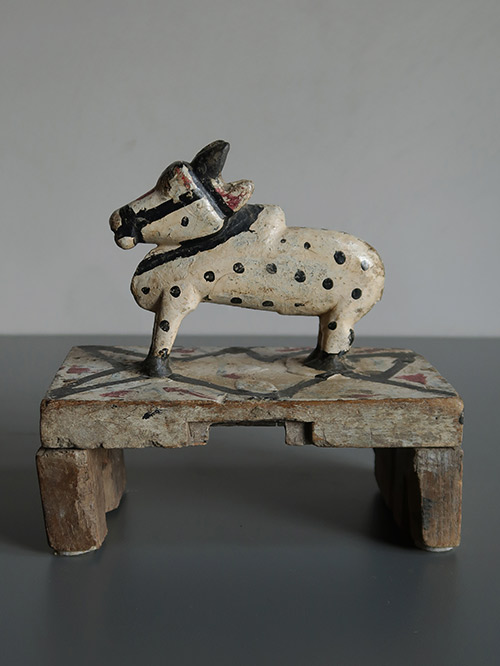
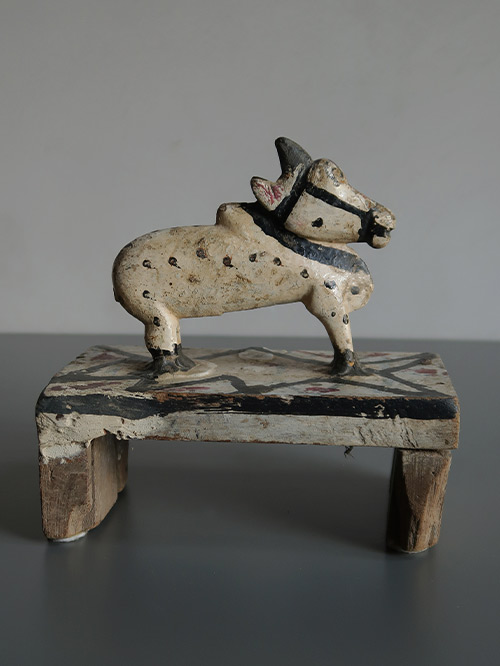
Maharashtra/Karnataka
Wood, polychromed
A decorative Nandi painted in white with black dots and typical trappings including a bridle bit. The Nandi stands on a pedestal painted with a geometric star. Animal festival toys are used for ritual display and celebration during important festivities such as Pola, Holi, Shivaratri and Durga Puja.
Nandi festival toys have a special importance during the festival of Pola. Pola is an ancient thanks giving festival celebrated during the Hindu month of Sharavan during which farmers celebrate their cattle.
Nandi or Nandin means rejoicing, gladdening. It is the name of Shiva’s conveyance (vahana) the white bull, son of Kashyapa and of Surabhi. Nandi was probably a folk deity later incorporated into the Brahmanic lore. Nandi symbolises on the one hand moral and religious duty (dharma), and on the other, virility, fertility and strength. Apart from being Shiva’s vehicle, nandi in his form as nandikeshvara, depicted as a human with a bulls head, is believed to be one of the great masters of music and dancing. In southern India his recumbent image is placed either opposite the main sanctuary or in the hall leading to it, facing the linga.
Size (cms): 21(H) x 20(W) x 12(D)
Size (inches): 8.5(H) x 8(W) x 4.5(D)
-
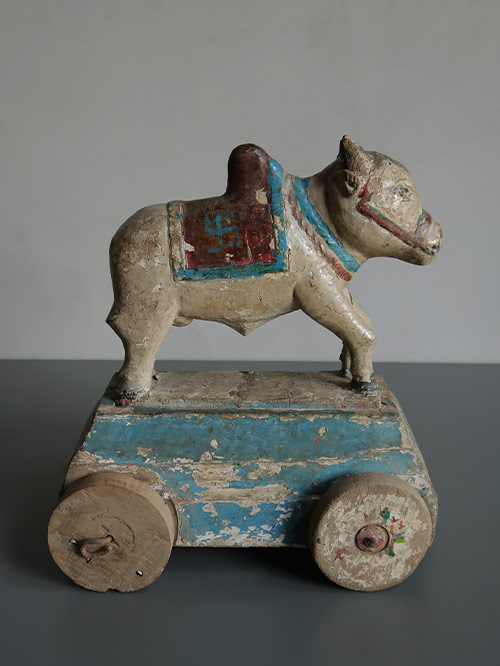
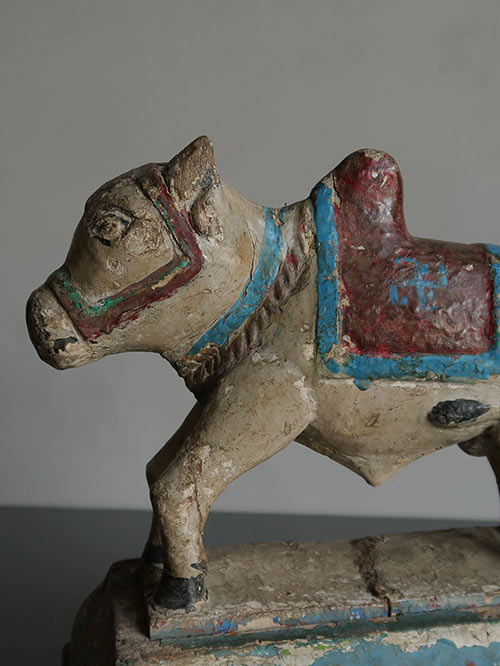
Maharashtra/Karnataka
Wood, polychromed
A decorative Nandi painted with patterns symbolising typical trappings including a saddle and head and neck ornaments. A right-facing swastik is painted on the saddle, symbolizing the sun, prosperity and good luck. The Nandi stands on a pedestal with wheels. Animal festival toys are used for ritual display and celebration during important festivities such as Pola, Holi, Shivaratri and Durga Puja.
Nandi festival toys have a special importance during the festival of Pola. Pola is an ancient thanks giving festival celebrated during the Hindu month of Sharavan during which farmers celebrate their cattle.
Nandi or Nandin means rejoicing, gladdening. It is the name of Shiva’s conveyance (vahana) the white bull, son of Kashyapa and of Surabhi. Nandi was probably a folk deity later incorporated into the Brahmanic lore. Nandi symbolises on the one hand moral and religious duty (dharma), and on the other, virility, fertility and strength. Apart from being Shiva’s vehicle, nandi in his form as nandikeshvara, depicted as a human with a bulls head, is believed to be one of the great masters of music and dancing. In southern India his recumbent image is placed either opposite the main sanctuary or in the hall leading to it, facing the linga.
Size (cms): 33.5(H) x 30(W) x 20(D)
Size (inches): 13(H) x 12(W) x 8(D)
-
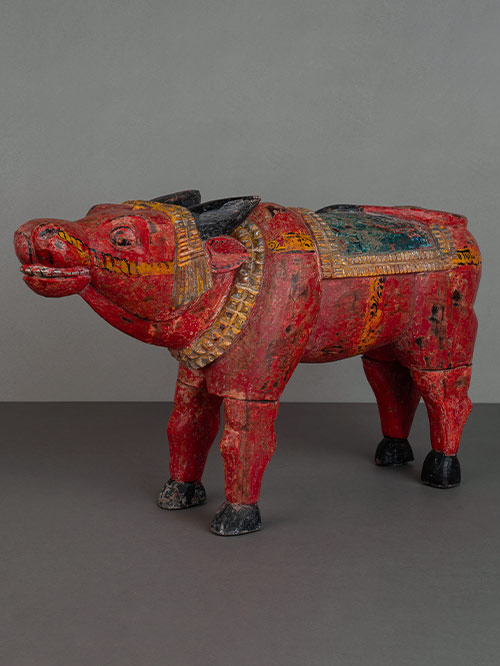
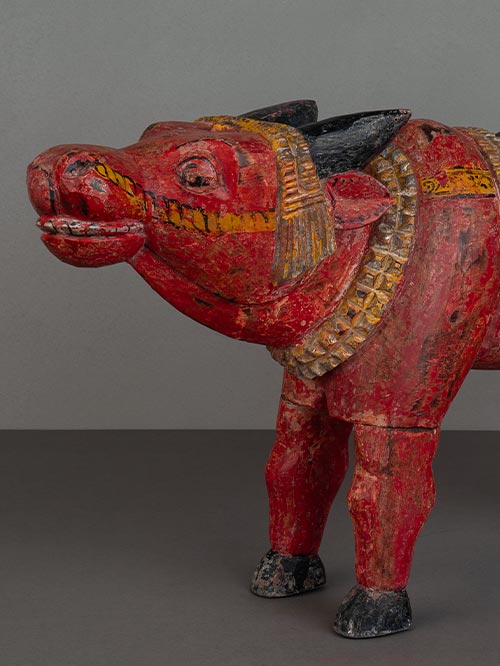
Coastal Karnataka (Bhuta culture)
Wood, polychromed
A fine painted wood figure of a standing nandi. Displaying the typical folk bhuta style of coastal Karnataka, this figure is painted predominantly in red with a painted saddlecloth and a curled back tail resting on its back.
The bhuta tradition is popular on the Malabar coast. Bounded by the dramatic sweep of the forested ghats to the east and the Arabian sea to the west, and encircled by rivers, the South Kanara district of coastal Karnataka has enjoyed relative geographic isolation until recent years. The totemic origin of this bull bhuta is quite obvious in a land of agriculture and farms where ploughs are pulled by bulls and where cow milk is one of the main sources of protein. The link with Hinduism is also easily established through Nandi the vahana (“vehicle”) of god Shiva.
Size (cms): 32(H) x 52(W) x 14(D)
Size (inches): 12.5(H) x 20.5(W) x 5.5(D)
-
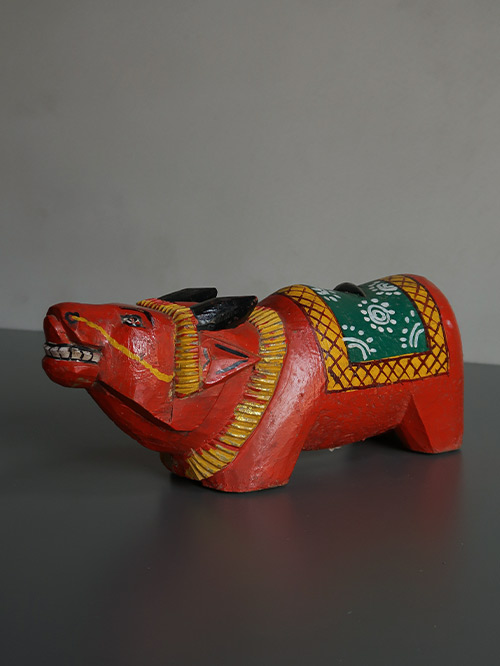
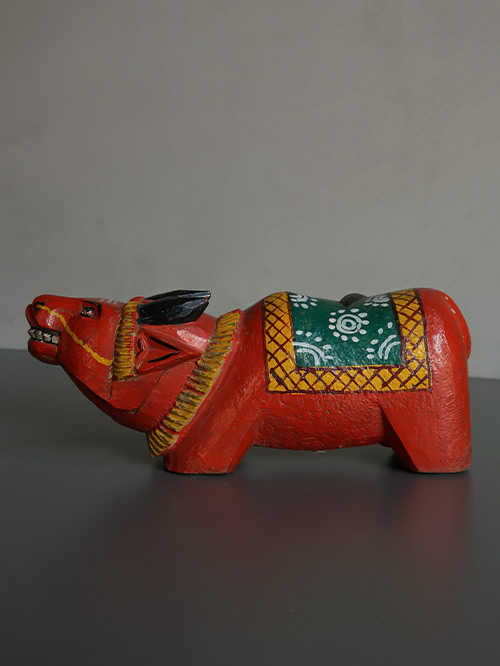
Coastal Karnataka (Bhuta culture)
Wood, polychromed
A fine painted wood figure of a standing nandi. Displaying the typical folk bhuta style of coastal Karnataka, this figure is painted predominantly in red It displays a typical stylised form with a horizontal head with slightly protruding tongue, horns adorned with ornaments, a floral painted saddlecloth and a curled back tail resting on its back.
The bhuta tradition is popular on the Malabar coast. Bounded by the dramatic sweep of the forested ghats to the east and the Arabian sea to the west, and encircled by rivers, the South Kanara district of coastal Karnataka has enjoyed relative geographic isolation until recent years. The totemic origin of this bull bhuta is quite obvious in a land of agriculture and farms where ploughs are pulled by bulls and where cow milk is one of the main sources of protein. The link with Hinduism is also easily established through Nandi the vahana (“vehicle”) of god Shiva.
Size (cms): 14(H) x 35.5(W) x 11(D)
Size (inches): 5.5(H) x 14(W) x 4.5(D)
-
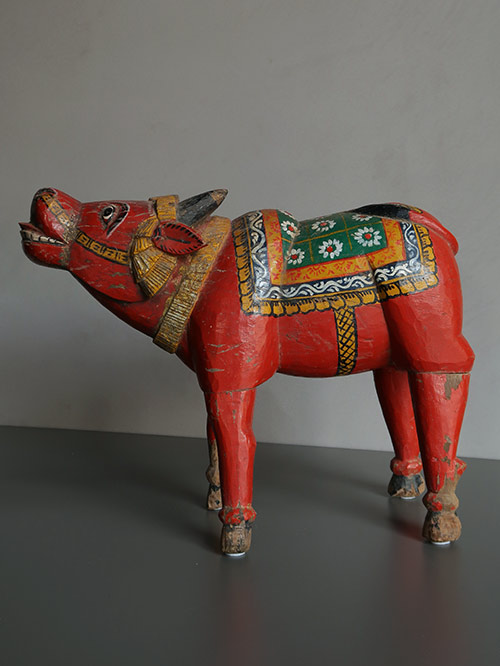
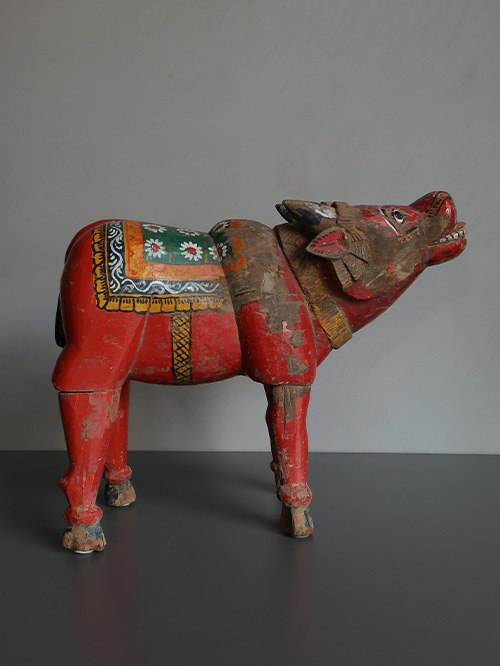
Coastal Karnataka (Bhuta culture)
Wood, polychromed
A large painted wood figure of a standing nandi. Displaying the typical folk bhuta style of coastal Karnataka, this figure is painted predominantly in red with a floral painted saddlecloth and a curled back tail resting on its back.
The bhuta tradition is popular on the Malabar coast. Bounded by the dramatic sweep of the forested ghats to the east and the Arabian sea to the west, and encircled by rivers, the South Kanara district of coastal Karnataka has enjoyed relative geographic isolation until recent years. The totemic origin of this bull bhuta is quite obvious in a land of agriculture and farms where ploughs are pulled by bulls and where cow milk is one of the main sources of protein. The link with Hinduism is also easily established through Nandi the vahana (“vehicle”) of god Shiva.
Size (cms): 36(H) x 46(W) x 16(D)
Size (inches): 14(H) x 18(W) x 6.5(D)
-
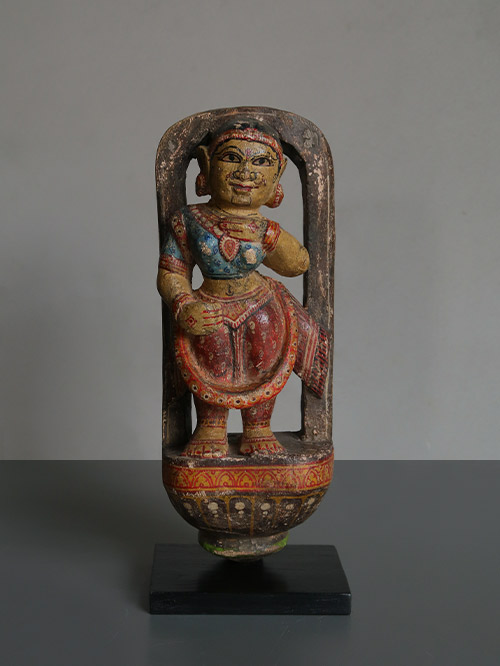
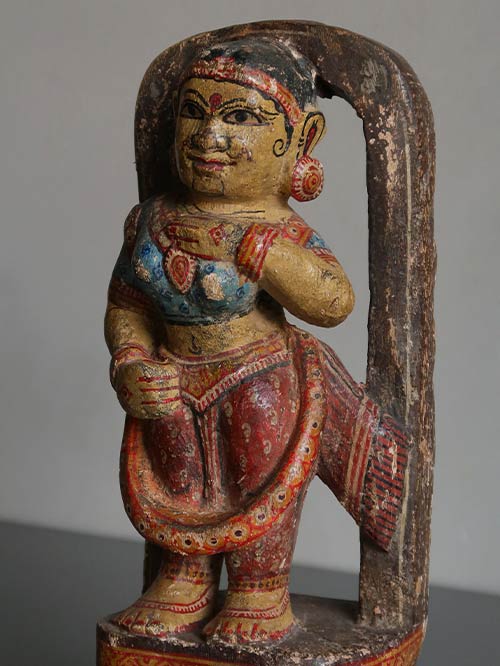
Orissa
Wood, polychromed
An elegant figure of an apsara wearing a patterned blouse. The apsara wears extensive jewellery; including multiple hand and leg ornaments. She has a stylised form with a narrow waist and large breasts and carries a flute in her hands. She has a full face with a pronounced chin, large arched eyebrows over bulbous eyes and a gentle smile.
Apsaras means ‘essence of the waters’ or ‘moving in or between the waters’. The Apsaras are divine beauties, the dancers of the gods, who dwell in Indra’s paradise, svarga (heaven). Mistresses of the Gandharva’s (semi divine beings) and, occasionally, of men, they can assume any form at will. Generally they are believed to have originated from the churning of the ocean, alone with the wish fulfilling Parijata, their favoured tree. They are often sent by the gods to seduce Rishis (holy men) and ascetics. Heroes who fall in battle are swept away to Svarga by the Apsaras. They are reputed to dwell in trees along with the Gandharvas. The chief of the Apsaras is Urvashi.
Size (cms): 33(H) x 13(W) x 10(D)
Size (inches): 13(H) x 5(W) x 4(D)
-
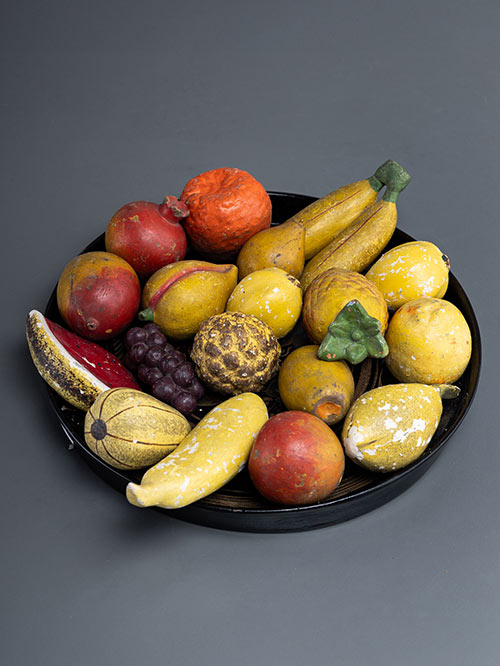
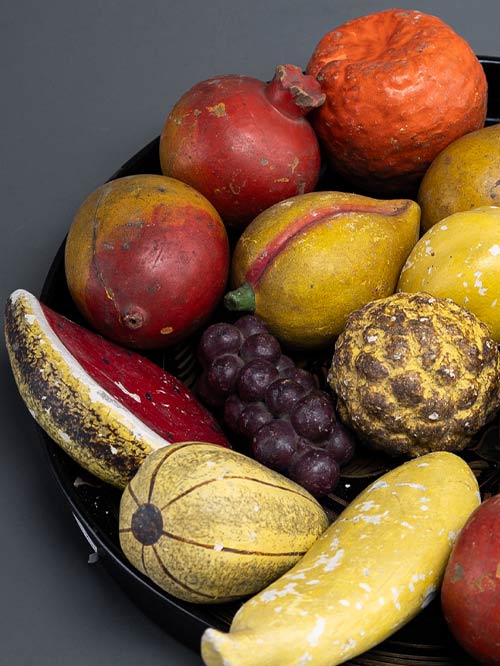
Maharashtra
Polychromed clay fruits and lacquer tray
The decorative group of delicately modelled fruits reflects the skill and creative flair of the ‘karigar’ who crafted them. Among the realistically rendered fruits are a pair of bananas, a diminutive pineapple, a cluster of grapes, a watermelon slice, a custard apple, a pomegranate, and a pear. The fruits sit on a stained black Burmese lacquer tray adorned with floral sprigs.
Fruit offerings, known as “phala” in Sanskrit, hold an auspicious role in Hindu puja rituals. Fresh fruit offerings symbolize respect, gratitude, and devotion to the gods and goddesses. Clay and other artificial fruits were sometimes used as substitutes for these offerings, providing the same ritual merit as their fresh counterparts. These clay offerings were meticulously crafted to closely resemble real fruits in appearance. Unlike fresh fruit, they were considered a more affordable, durable, and accessible alternative in smaller rural villages and towns.
Size (cms): 6(H) x 31(Diam)
Size (inches): 2.5(H) x 12(Diam)
-
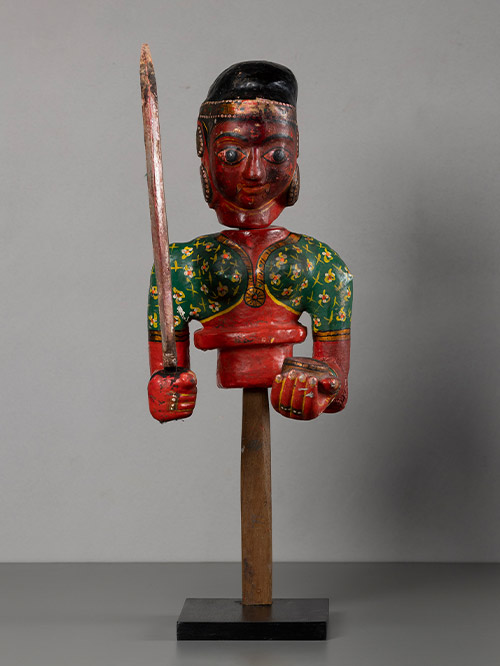
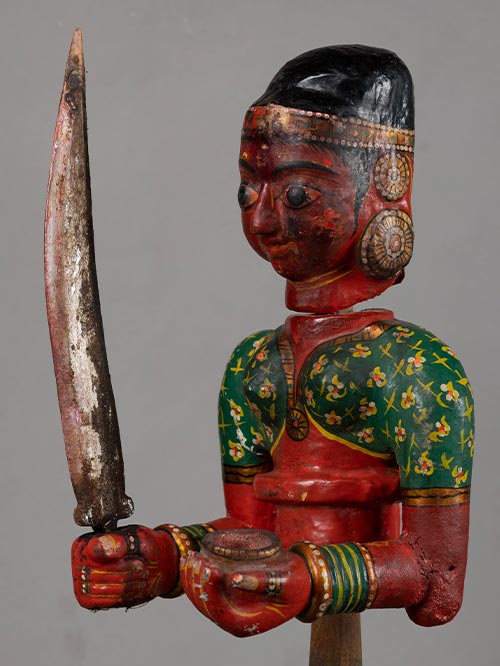
Karnataka
Wood, extensively polychromed
A fine two armed bust of the Goddess Durga wearing a patterned blue blouse. She is adorned with jewelled necklaces and bracelets and wears large globular earrings. In her hands she carries a sword and a bowl.
Durga – “The Unconquerable form of Devi” – Durga is the most splendid manifestation of Devi. Virginal and sublime, contain within her the power of all the gods combined, she is the invincible power of Nature who triumphs over those who seek to subjugate her. Durga is one of the names of the goddess that is the wife of Shiva. Durga has the role of a warrior goddess who destroys demons. She is usually depicted with ten arms that hold the weapons of the various gods. Her vahana is a lion which acts as her means of transportation and one of her many weapons.
During festive occasions, the utsavar (portable figures of deities) are placed on chariots or pedestals in the mandapam (audience hall of a temple) or on their respective vahana (vehicle) and taken out for public viewing or darshana. Darshana refers to the occasion where the devotee is not only able to see the image of the deity but also to sense its omnipresence.
Size (cms): 59(H) x 20(W) x 18(D)
Size (inches): 23(H) x 8(W) x 7(D)