“Male Morung Figure” has been added to your cart.
View cart
-
Karnataka
Wood with traces of polychroming
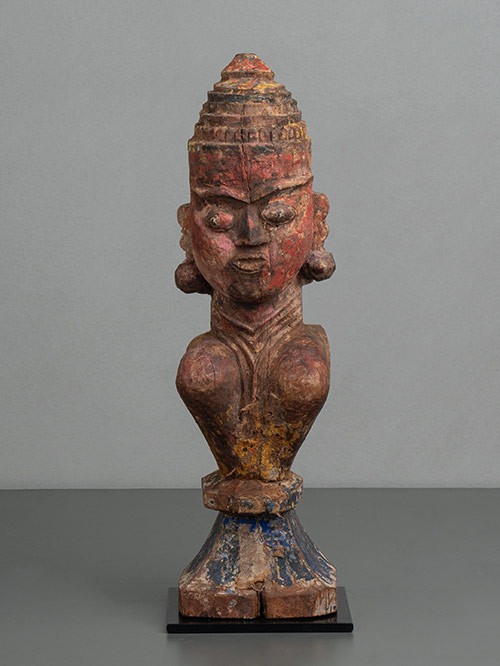
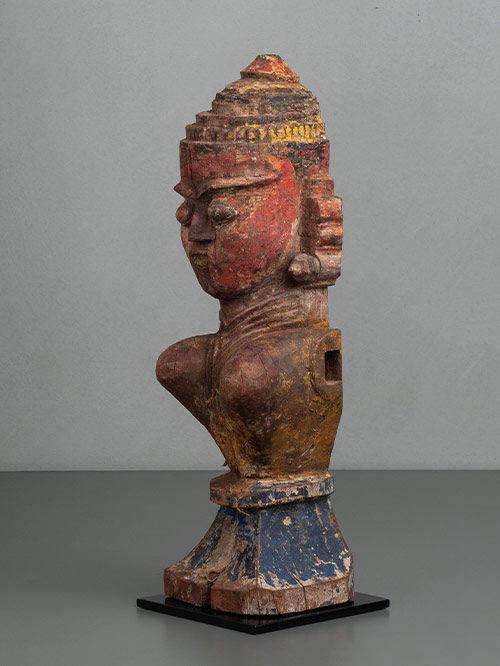
This decorative folk bust of Durga has an austere expression and an exaggeratedly proportioned torso, once painted to resemble a blouse. She is richly adorned with globular earrings, layered necklaces that hang low on her chest, and a striking tiered crown.
Durga – “The Unconquerable form of Devi” – Durga is the most splendid manifestation of Devi. Virginal and sublime, contain within her the power of all the gods combined, she is the invincible power of Nature who triumphs over those who seek to subjugate her. Durga is one of the names of the goddess that is the wife of Shiva. Durga has the role of a warrior goddess who destroys demons. She is usually depicted with ten arms that hold the weapons of the various gods. Her vahana is a lion which acts as her means of transportation and one of her many weapons.
During festive occasions, the utsavar (portable figures of deities) are placed on chariots or pedestals in the mandapam (audience hall of a temple) or on their respective vahana (vehicle) and taken out for public viewing or darshana. Darshana refers to the occasion where the devotee is not only able to see the image of the deity but also to sense its omnipresence.
Size (cms): 39(H) x 13(W) x 13(D)
Size (inches): 15.5(H) x 5(W) x 5(D)
-
Karnataka
Wood, extensively polychromed
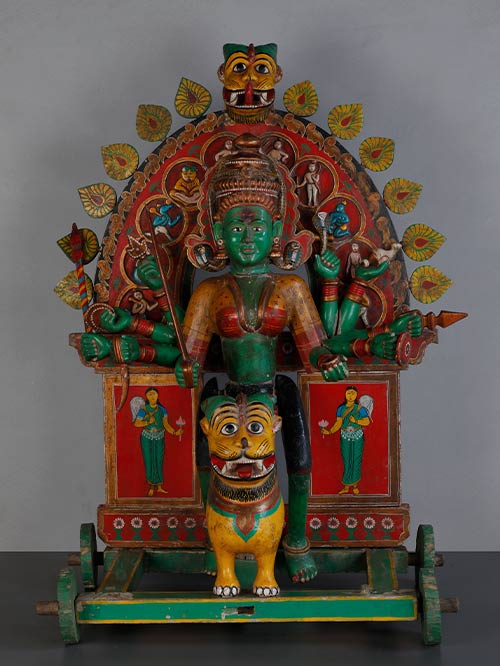
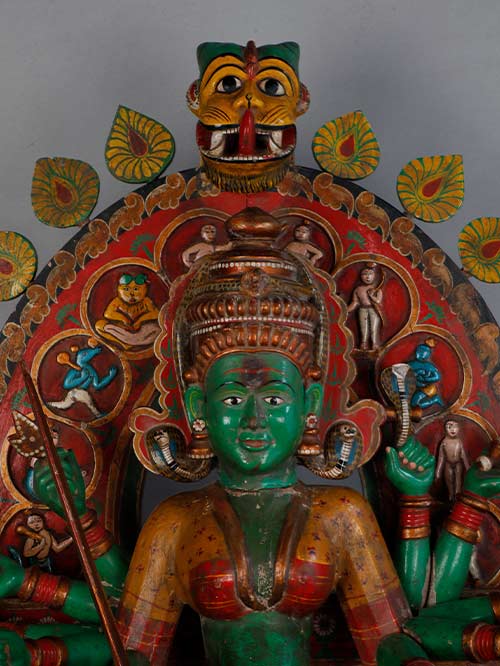
An exceptional multi-armed articulated figure of the Goddess Durga riding her Tiger vahana. She is seated on a complete chariot with a resplendent prabhavali which is painted with chauri bearers and a flaming aureole. Diminutive roundels are placed in an arch within the prabhavali each depicting the ten incarnations of Lord Vishnu starting with Matysa and ending with Kalki. The Goddess wears a patterned red and yellow blouse and an elaborate tiered crown. In her arms she carries various weapons, including a sword, cakra, conch, naga and blood bowl.
Durga – “The Unconquerable form of Devi” – Durga is the most splendid manifestation of Devi. Virginal and sublime, contain within her the power of all the gods combined, she is the invincible power of Nature who triumphs over those who seek to subjugate her. Every year, during Navratri, processional images of the goddess are carried in evocative ceremonies. Depending on the day of the festival, her vahana, the vehicle on which she rides changes, with each of her vehicles holding a different and unique significance. The tiger she rides here signifies her ferociousness and strength.
Size (cms): 95(H) x 69(W) x 44(D)
Size (inches): 37.5(H) x 27(W) x 17.5(D)
-
Puri (Orissa)
Wood, polychromed
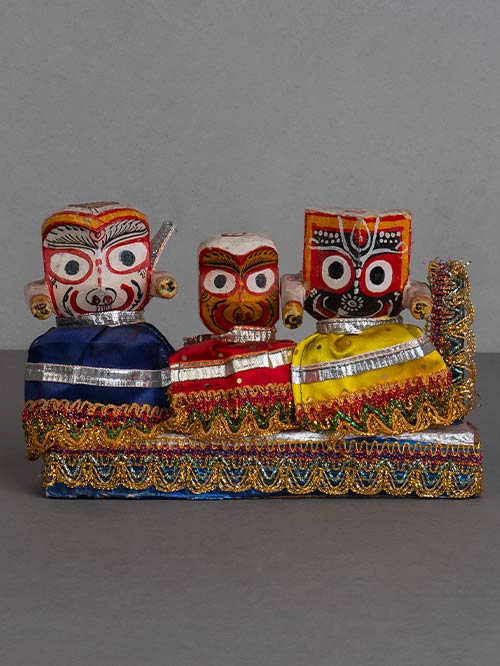
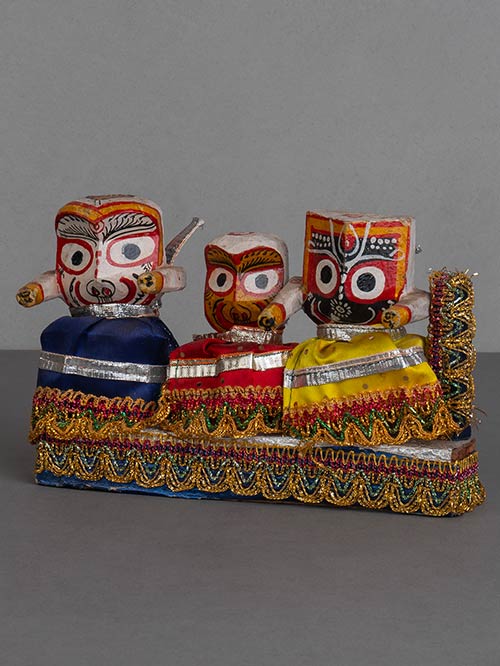
In the heart of Puri lies the ancient pilgrimage centre and temple of the Jagannatha cult. There, Jagannatha, a form of Krishna, the eighth incarnation of Vishnu, is worshipped along with his brother Balabhadra and sister Subhadra. These diminutive portable figures were produced in the markets surrounding the Jagannatha temple and bought by pilgrims on their journey home. The figures are depicted as legless posts surmounted by large heads. Jagannatha (black faced) and Balabhadra (white faced) and the petite Subhadra (yellow faced).
The cult of Jagannatha in Puri is one of India’s oldest popular iconic traditions. Puri lies in Orissa is on the eastern coast of India in the Bay of Bengal. The figures of the gods remain in the temple for most of the year, but in the rainy season (June or July), they are installed in huge chariots and pulled through the streets of Puri to another temple, allowing the public to have Darshan (‘a holy view’) of the deities as they pass. It is from the huge chariots carrying Jaganath and his siblings that the English word ‘Juggernaut’ originates. Smaller figures such as these may have been used in home altars or shrines.
Size (cms): 14(H) x 21(W) x 5(D)
Size (inches): 5.5(H) x 8.5(W) x 2(D)
-
RESERVED
Kerala
Wood, extensively polychromed
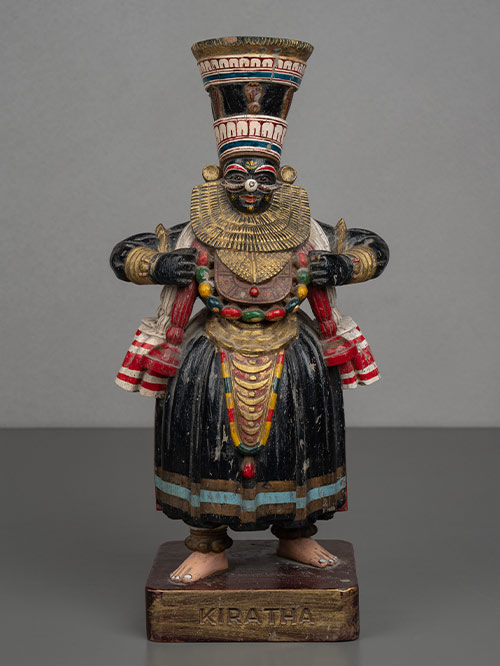
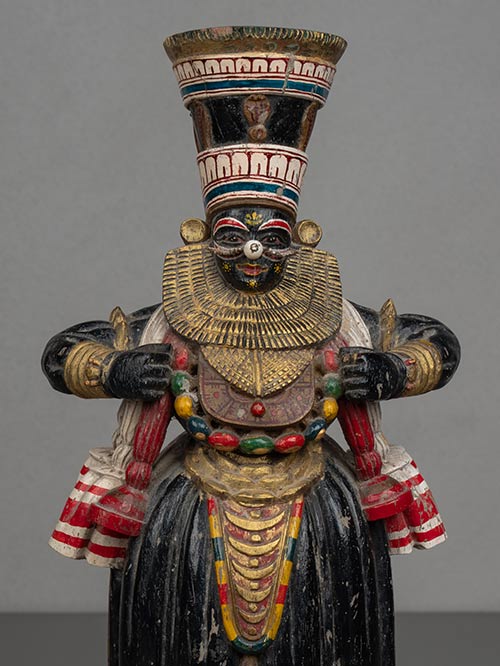
An exceptional carved figure of a Kathakali dancer representing Kiratha (Shiva), with finely detailed headgear and costume.
Kiratham Kathakali is a powerful Kathakali performance based on Kirātārjunīyam, depicting Arjuna’s encounter with Lord Shiva, who appears as a hunter (Kiratha) to test his devotion. A dispute over a slain boar leads to a fierce battle, where Arjuna is ultimately defeated and realizes Shiva’s true identity. Pleased with his perseverance, Shiva grants him the divine Pashupatastra (weapon). Known for its earthy Malayalam verses, Kiratham appeals to both connoisseurs and laymen alike. It is deeply devotional, frequently performed in Shiva temples, and is typically the final story in an all-night Kathakali performance, making it a climactic and spiritually significant act.
Kathakali, a dance drama unique to Kerala, emerged in the 17th century, evolving from ritual theatre traditions and Kutiyattam Sanskrit drama. Rooted in Malayalam adaptations of the Ramayana and Mahabharata, it was traditionally performed in temple courtyards or patrons’ homes from nightfall to sunrise, often during harvest festivals or as summer entertainment. Accompanied by temple music with a unique singing style, bronze gongs, cymbals, and drums enhance the performance’s intensity. Kathakali is distinguished by elaborate costumes, ornate headgear identifying heroes and demons, stylised movements, and striking makeup in green, red, yellow, black, and white.
Size (cms): 28(H) x 14(W) x 10(D)
Size (inches): 11(H) x 5.5(W) x 4(D)
-
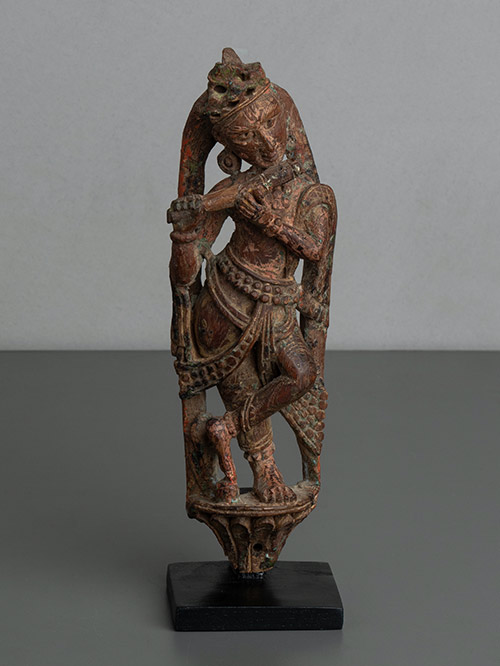
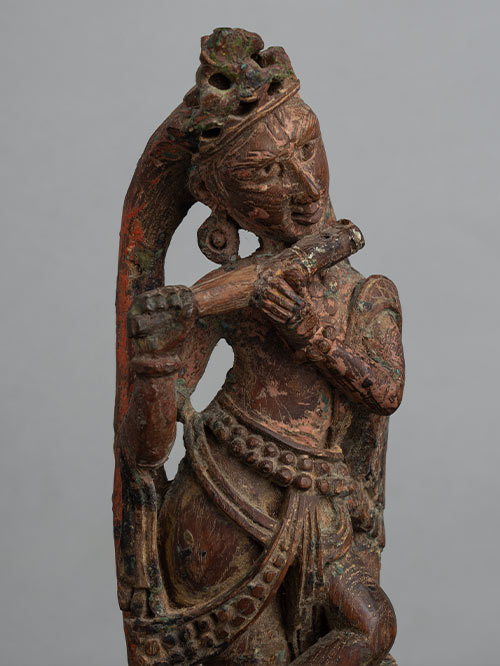
Gujarat
Wood with traces of polychroming
One of the most abiding images in Indian art is that of Krishna the flautist standing with his legs crossed at the ankles and playing the flute. He wears a decorative mukuta or crown, a dhoti and various necklaces, bangles and anklets.
The image of Venugopala rather late in Indian literature and art and it has been suggested that the classical myth of Orpheus may have exerted some influence. The idea derives from the lonely shepherd who plays his bamboo flute (venu) while tending his flock. While other cowherders f Braj hold a shepherd’s staff, Krishna’s staff is also his flute. He, however does not play upon it to please the cows, but to charm the gopis or cowherdesses
Size (cms): 24(H) x 7.5(W) x 6.5(D)
Size (inches): 9.5(H) x 3(W) x 2.5(D)
-
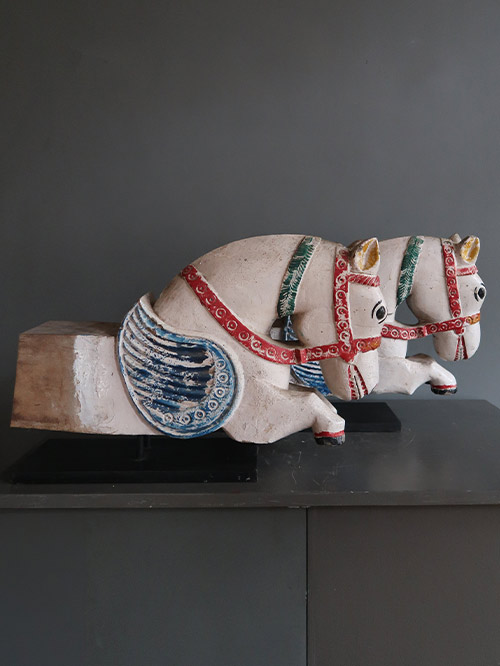
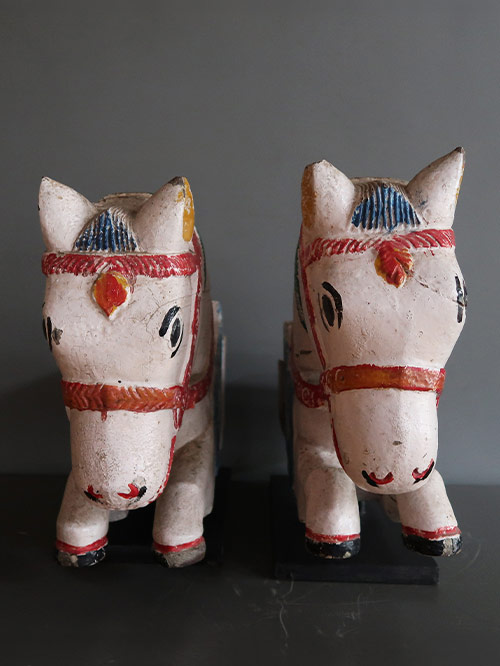
Andhra Pradesh (South India)
Wood
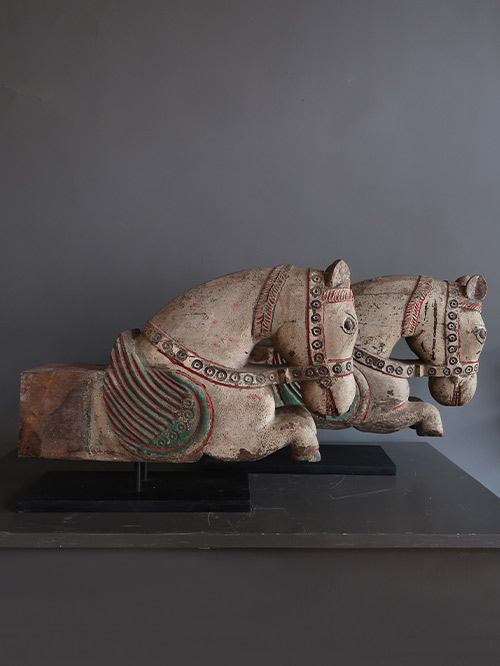
These horse brackets once formed the two ends of a door lintel. The horse or ashva was a very popular motif in architectural wood carvings in South India. Its prototype, the divine Uchchaihshravas emerged from the churning of the ocean. It was white and endowed with wings. The god Indra appropriated it and, after cutting its wings to ensure that it would remain on earth, donated it to mankind.
The horse played a pivotal role in establishing the supremacy of kings, as demonstrated, for instance by the great horse sacrifice, the Ashvamedha, which might have been established in the course of the Vedic period. Equestrian motifs appear prominently in Indian art, for example in Orissan sculpture of the 12th and 13th centuries, and in that of the late Vijaynagara and Nayak periods (early 16th to early 18th century) in southern India. There is a branch of literature specialising in the training of horses, which contains detailed passages on colouring, proportions, gait, auspicious and inauspicious marks and lists of appropriate names for horses.
Individual Size (cms): 40(H) x 64(W) x 18(D)
Individual Size (inches): 15.5(H) x 25(W) x 7(D)
-
Andhra Pradesh (South India)
Wood
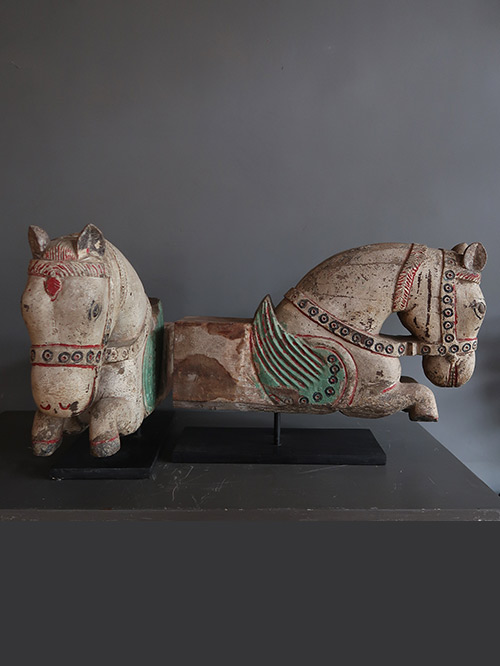
These horse brackets once formed the two ends of a door lintel. The horse or ashva was a very popular motif in architectural wood carvings in South India. Its prototype, the divine Uchchaihshravas emerged from the churning of the ocean. It was white and endowed with wings. The god Indra appropriated it and, after cutting its wings to ensure that it would remain on earth, donated it to mankind.
The horse played a pivotal role in establishing the supremacy of kings, as demonstrated, for instance by the great horse sacrifice, the Ashvamedha, which might have been established in the course of the Vedic period. Equestrian motifs appear prominently in Indian art, for example in Orissan sculpture of the 12th and 13th centuries, and in that of the late Vijaynagara and Nayak periods (early 16th to early 18th century) in southern India. There is a branch of literature specialising in the training of horses, which contains detailed passages on colouring, proportions, gait, auspicious and inauspicious marks and lists of appropriate names for horses.
Individual Sizes (cms): 36 (H) x 61 (W) x 15 (D)
Individual Sizes (inches): 14.2 (H) x 24 (W) x 5.9 (D)
-
Karnataka
Wood, extensively polychromed
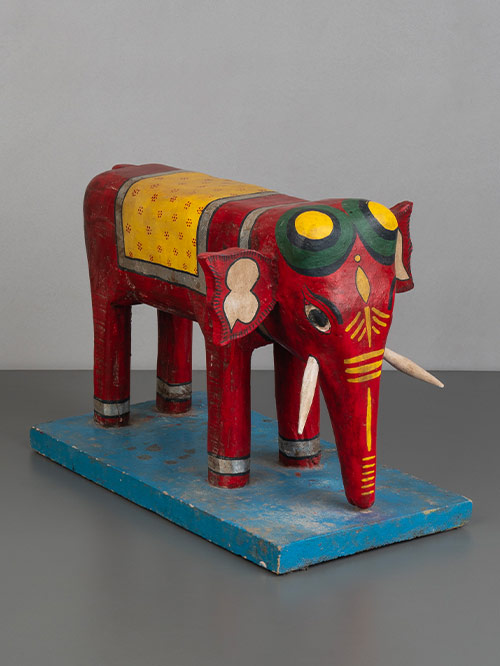
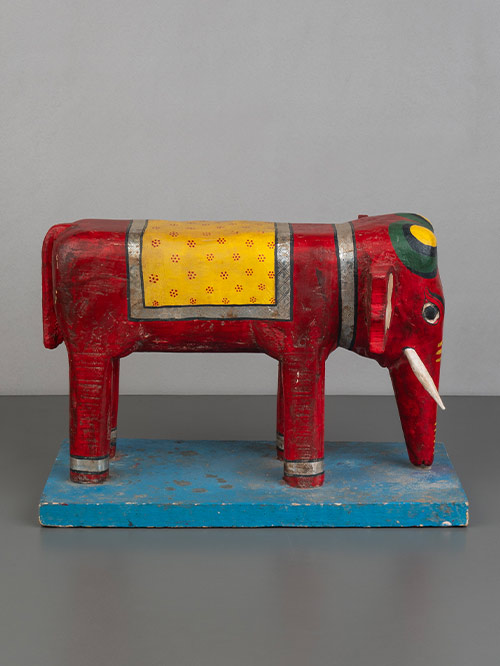
An eye-catching folk elephant vahana that would have been a part of a processional figure depicting the Goddess Durga. The carefully painted frontal features, including the head, trunk, and ears, suggest that the elephant was intended to be displayed headlong, while the back half was designed with functionality in mind, ensuring balance for the deity placed on top.
Every year, during Navratri, processional images of the Goddess are carried in evocative ceremonies. Depending on the day of the festival, her vahana, the vehicle on which she rides changes, with each of her vehicles holding a different and unique significance. The elephant she rides here signifies happiness and prosperity.
Size (cms): 29(H) x 41(W) x 20.5(D)
Size (inches): 11.5(H) x 16(W) x 8(D)
-
Karnataka
Wood, extensively polychromed
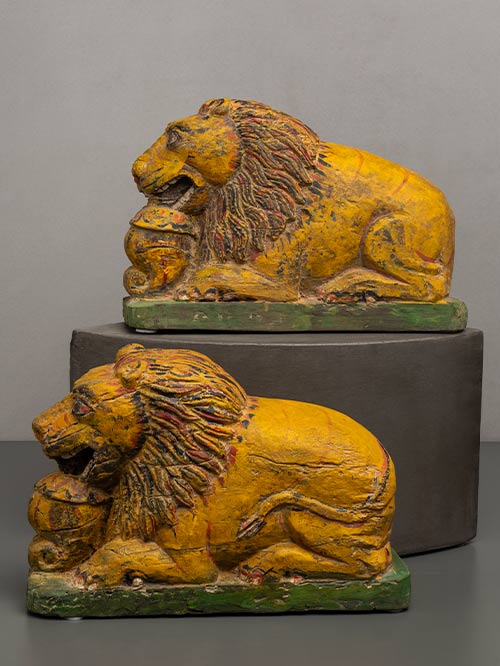
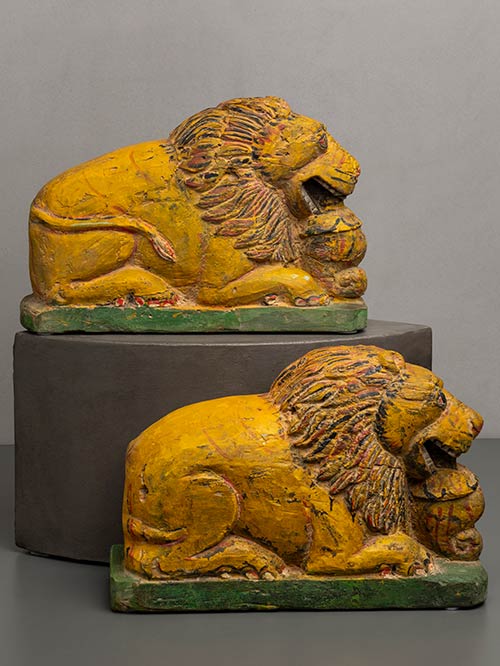
A charming pair of painted wooden lions with bulging eyes and prominent ‘sunburst’ manes. Laying in a prone positions, their fore and hind legs are well carved and terminate in large claws.
The lion holds a special significance in Hindu mythology, being the sacred vehicle of the goddess Durga. Often regarded as India’s embodiment of Mother Nature, Durga symbolizes energy and vitality. Lions, in Hindu iconography, represent attributes like power, royalty, and nobility. They are frequently portrayed as guardians and protectors in various mythological narratives.
Size (cms): 21.5(H) x 32.5(W) x 13(D) each
Size (inches): 8.5(H) x 13(W) x 5(D) each
-

Karnataka
Wood, extensively polychromed
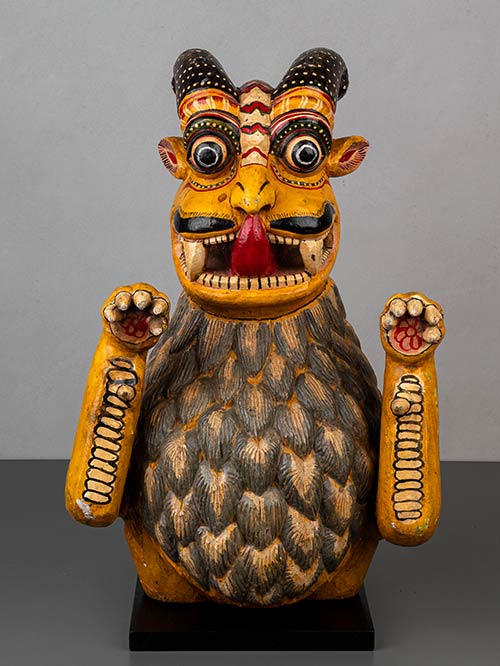
This striking large Tiger Vahana with an unusual, prominent flowing mane. The tiger has wide bulging eyes and an open mouth with large exposed teeth and a long protruding tongue. His fore legs are raised, as if to pounce.
The tiger is the vehicle of, and sacred to, the Hindu goddess, Durga. From a certain perspective she is India’s Mother Nature, for she is the deification of Energy. Her consort, Shiva, sometimes evoked as Shambo, wears a tiger skin to indicate that he is beyond the bounds of the natural world.
Size (cms): 61(H) x 38(W) x 27(D)
Size (inches): 24(H) x 15(W) x 10.5(D)
-
Central India
Wood
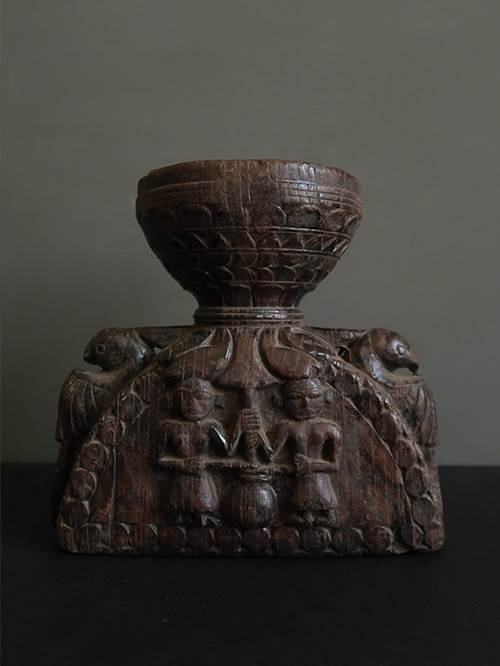
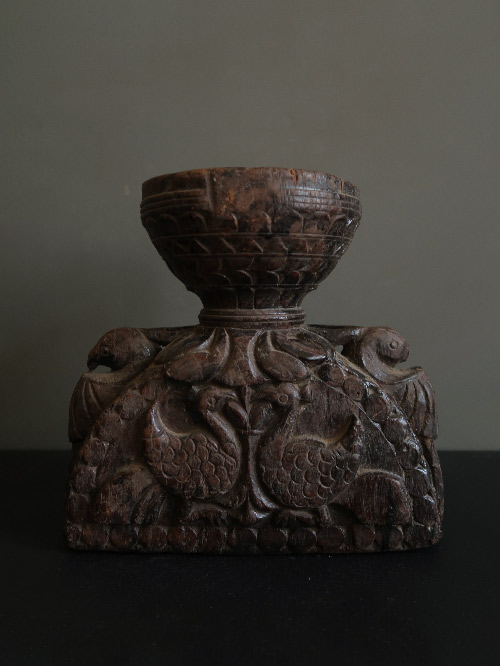
A lovely wooden seeder that is ornately carved and decorated. Displays wear consistent with age and use. It would have once been used by farmers as a sowing tool for sunflower, jowar (sorghum) and groundnuts. The seeders would be connected with pipes to sow seeds in simultaneous rows and would be used along with a plough pulled by a bull. On one side, a couple is depicted using a seeder while on the other, a pair of peacocks are intertwined. On either side of the seeder, parrots are carved in high relief.
Size(cms): 21 (H) x 22.5 (W) x 12.5 (D)
Size(inches): 8.3 (H) x 8.9 (W) x 4.9 (D)
-
Karnataka
Wood, polychromed
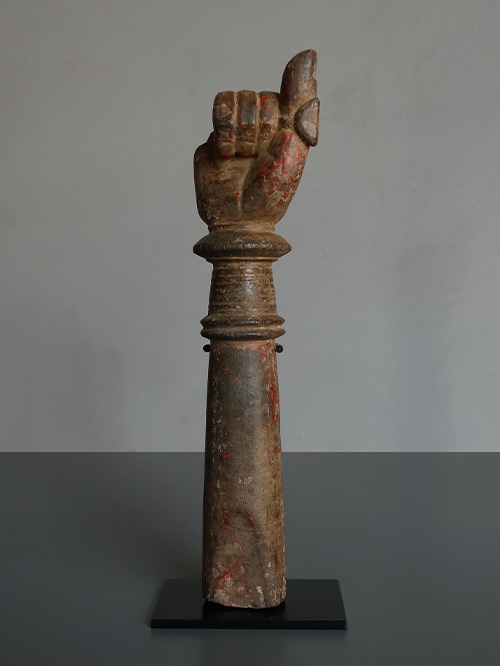
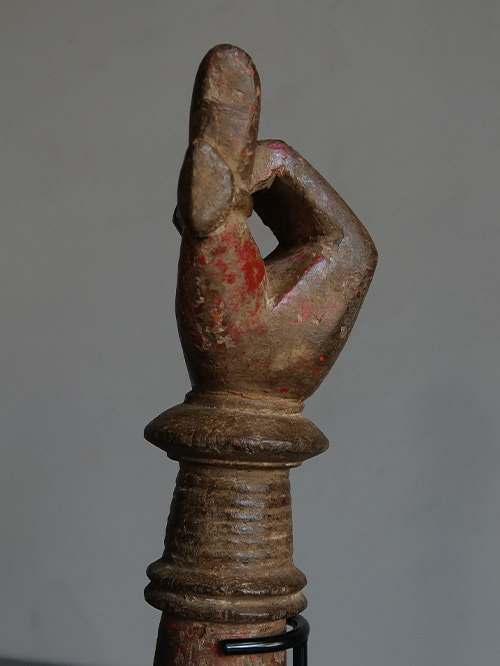
A finely carved wooden hand, with original polychroming wearing bangles and rings. Originally from an articulated multi-armed processional figure of a Devi. During festive occasions, the utsavar (portable figures of deities) are placed on chariots or pedestals in the mandapam (audience hall of a temple) or on their respective vahana (vehicle) and taken out for public viewing or darshana. Darshana refers to the occasion where the devotee is not only able to see the image of the deity but also to sense its omnipresence. To enhance the visibility of the utsavar, they are elaborately dressed in dhoti or sari, garlanded with flowers and decked with the most exquisite jewellery, made of gold and semi-precious stones before being brought out in procession. Sometimes additional hands or legs are added to increase the physical presence of the image. These features may allow the deity to stand, sit or clasp multiple weapons.
Size with the Stand (cms): 34(H) x 13(W) x 7.5(D)
Size with the Stand (inches): 13.5(H) x 5(W) x 3(D)
-
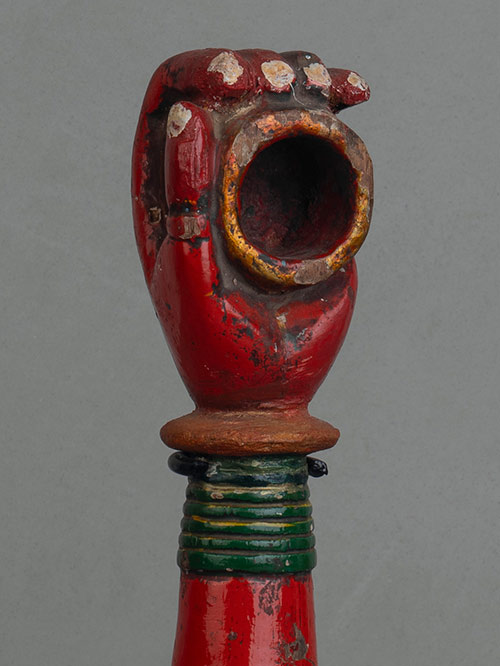
Karnataka
Wood, polychromed
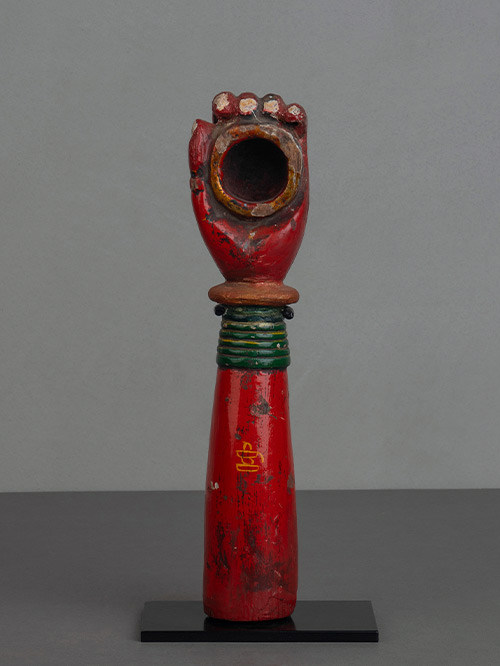
A finely carved wooden hand, with original polychroming wearing bangles. She holds a blood bowl within her clenched fist and a diminutive lingam marks her forearm. Originally from an articulated multi-armed processional figure of a Devi. During festive occasions, the utsavar (portable figures of deities) are placed on chariots or pedestals in the mandapam (audience hall of a temple) or on their respective vahana (vehicle) and taken out for public viewing or darshana. Darshana refers to the occasion where the devotee is not only able to see the image of the deity but also to sense its omnipresence. To enhance the visibility of the utsavar, they are elaborately dressed in dhoti or sari, garlanded with flowers and decked with the most exquisite jewellery, made of gold and semi-precious stones before being brought out in procession. Sometimes additional hands or legs are added to increase the physical presence of the image. These features may allow the deity to stand, sit or clasp multiple weapons.
Size with the Stand (cms):29(H) x 13(W) x 7.5(D)
Size with the Stand (inches): 11.5(H) x 5(W) x 3(D)
-
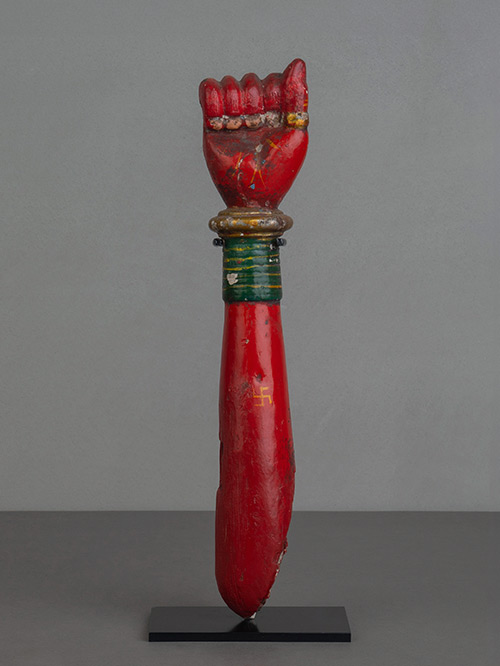
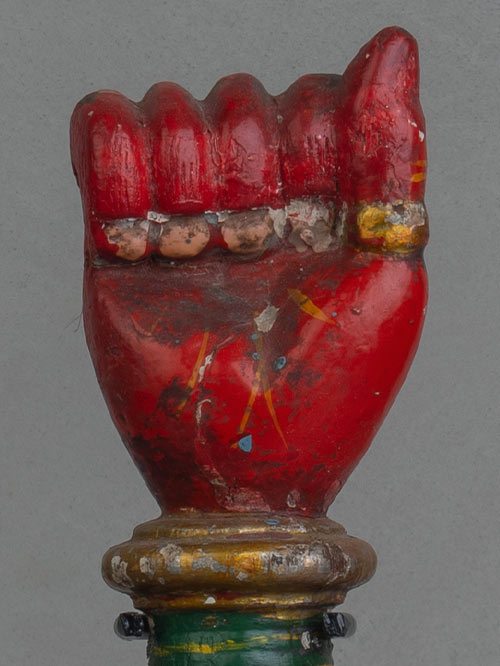
Karnataka
Wood, polychromed
A finely carved wooden hand, with original polychroming wearing bangles. Her hand is held in a clenched fist. Originally from an articulated multi-armed processional figure of a Devi. During festive occasions, the utsavar (portable figures of deities) are placed on chariots or pedestals in the mandapam (audience hall of a temple) or on their respective vahana (vehicle) and taken out for public viewing or darshana. Darshana refers to the occasion where the devotee is not only able to see the image of the deity but also to sense its omnipresence. To enhance the visibility of the utsavar, they are elaborately dressed in dhoti or sari, garlanded with flowers and decked with the most exquisite jewellery, made of gold and semi-precious stones before being brought out in procession. Sometimes additional hands or legs are added to increase the physical presence of the image. These features may allow the deity to stand, sit or clasp multiple weapons.
Size with the Stand (cms): 36.5(H) x 13(W) x 7.5(D)
Size with the Stand (inches):14.5(H) x 5(W) x 3(D)
-
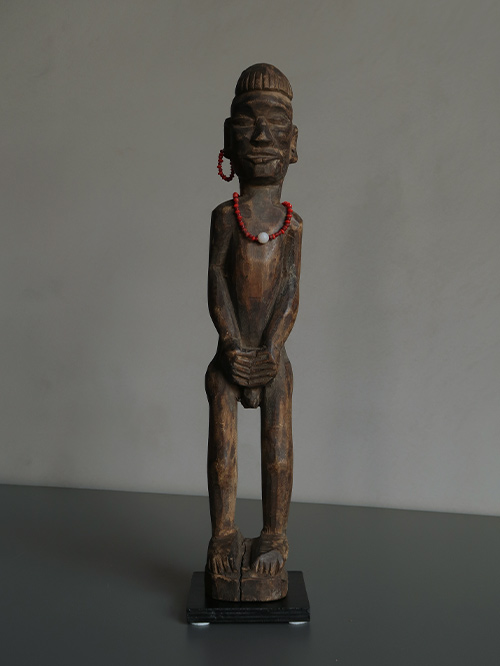
Nagaland (North-East India)
Wood
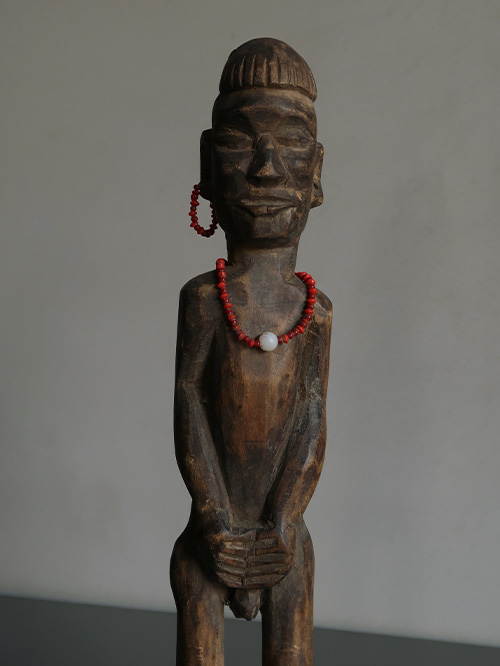
Male standing figure adorned with red and white glass bead necklaces. Carved from solid trunks of trees, the solemn expressions of these wood sculptures sometimes heightened by cowrie shells, bead necklaces or human and animal hair, combined with the blunt tubular carving on dark wood give these Naga figures a silent though persuasive identity.
A key fixture in nearly all Naga settlements was the Morung, or Men’s House, which served as something of a community center. It was usually the biggest and most beautifully furnished building in a village, spacious and decorated with ornate carvings. Numerous wooden sculptures decorated the walls and posts of the farthest end of the innermost space of the Morung. They expressed the narrative traditions of the Naga. Wooden sculpture such as this, depicting would be posted near the walls of the Morung, were not uncommon and thought to relate to fertility.
The Naga are a group of culturally and linguistically linked tribes who live in the mountainous regions of northeastern India and northwestern Burma (Myanmar). As headhunters, they were feared and avoided by their neighbours, allowing them to develop a distinctive material culture—in which objects they created are of impressive aesthetic value and possess great symbolic importance to the community—and a complex system of norms and taboos.
Size (cms): 46(H) x 9(W) x 7(D)
Size (inches): 18(H) x 3.5(W) x 3(D)
-
Nagaland (North-East India)
Wood and glass
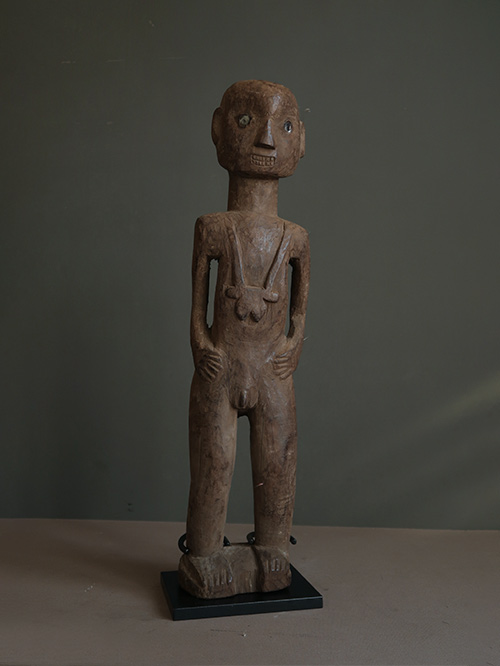
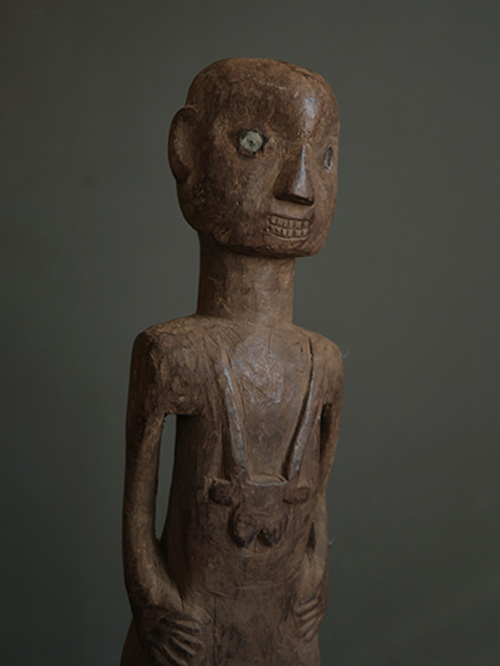
A key fixture in nearly all Naga settlements was the Morung, or Men’s House, which served as something of a community center. It was usually the biggest and most beautifully furnished building in a village, spacious and decorated with ornate carvings. Numerous wooden sculptures decorated the walls and posts of the farthest end of the innermost space of the Morung. They expressed the narrative traditions of the Naga. Wooden sculpture such as this, depicting would be posted near the walls of the Morung, were not uncommon and thought to relate to fertility.
The Naga are a group of culturally and linguistically linked tribes who live in the mountainous regions of northeastern India and northwestern Burma (Myanmar). As headhunters, they were feared and avoided by their neighbours, allowing them to develop a distinctive material culture—in which objects they created are of impressive aesthetic value and possess great symbolic importance to the community—and a complex system of norms and taboos. The main tribal groups of the Naga include the Angami, Sema, Ao, Kalyo- Kengyu, Konyak, Lhota, Rengma, Tangkhul, Chang, Sangtam and Sema.
Size(cms): 53 (H) x 13 (W) x 8 (D)
Size(inches): 20.9 (H) x 5.1 (W) x 3.1 (D)