“Elephant Vahana” has been added to your cart.
View cart
-
Tanjore (South India)
reverse painting on glass
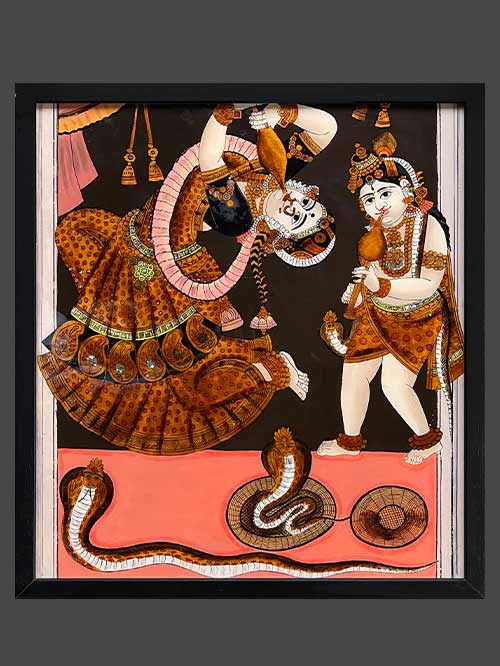
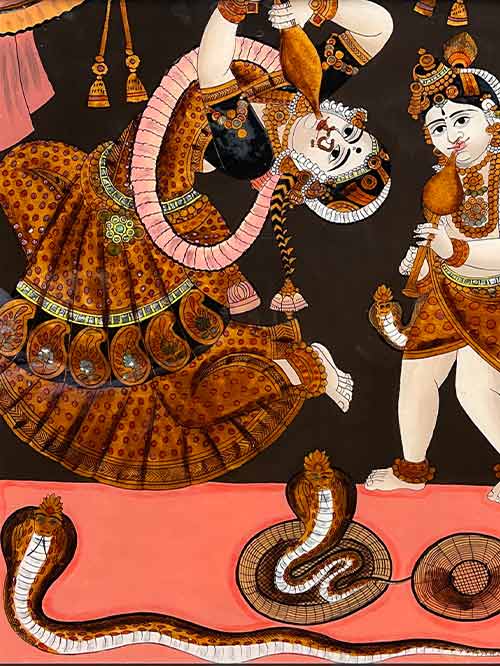
A charming reverse glass painting depicting a Krishna and Yashoda as snake charmers each hypnotising a cobra with the melodic sounds of their fluted instruments called pungis. The adolescent Krishna is bejewelled and splendidly clad in a lower garment with a hip-hugging sash and a garland of flowers around his neck. His foster-mother Yashoda who is also gorgeously robed and jewelled contorts around to befuddle the snakes.
Reverse glass paintings were introduced into India the late 18th century from China by way of the China Trade. Indian artists adopted the technique of reverse glass painting partly on account of its novelty and also because it was a relatively inexpensive medium which could produce rich effects. The technique proved extremely popular and soon spread through western and southern India and even to former provincial Mughal capitals of Oudh, Murshidabad.
In Tanjore – a small state with an old art tradition- a distinctive school of glass painting developed in the early 19th century and continued for more than a hundred years. The style was essential Indian – it tended to repeat patterns of regional painting: images of deities, portraits and themes form the ancient myths, secular themes such as portraits of kings or nobles, courtesans and musicians. The colour was rich and the style bold and defiant. The subjects were clearly presented with a certain opulence and glamour.
Painting Size(cms): 47 (H) x 43.2 (W)
Painting Size(inch): 18.5 (H) x 17 (W)
Framed Size (cms): 49.5(H) x 46(W)
Framed Size (inches): 19.5(H) x 18(W)
-
Karnataka
Wood, extensively polychromed
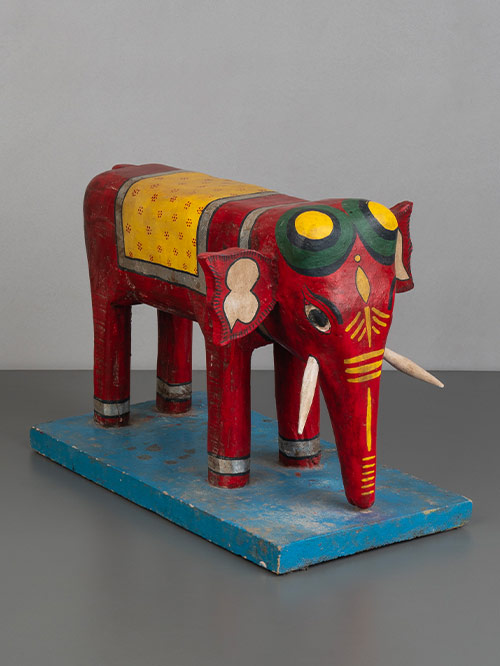
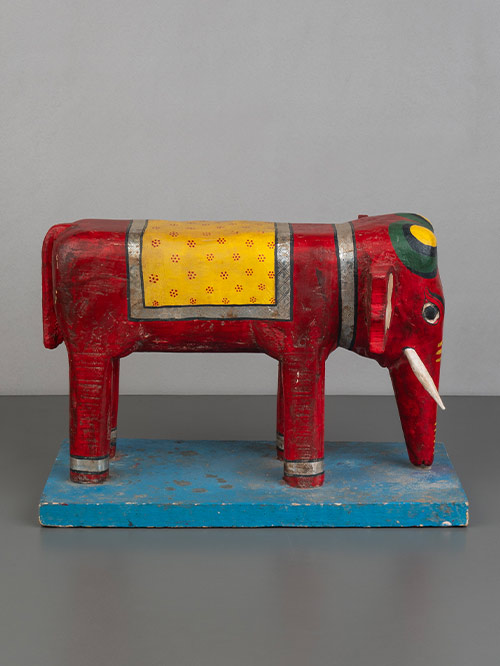
An eye-catching folk elephant vahana that would have been a part of a processional figure depicting the Goddess Durga. The carefully painted frontal features, including the head, trunk, and ears, suggest that the elephant was intended to be displayed headlong, while the back half was designed with functionality in mind, ensuring balance for the deity placed on top.
Every year, during Navratri, processional images of the Goddess are carried in evocative ceremonies. Depending on the day of the festival, her vahana, the vehicle on which she rides changes, with each of her vehicles holding a different and unique significance. The elephant she rides here signifies happiness and prosperity.
Size (cms): 29(H) x 41(W) x 20.5(D)
Size (inches): 11.5(H) x 16(W) x 8(D)
-
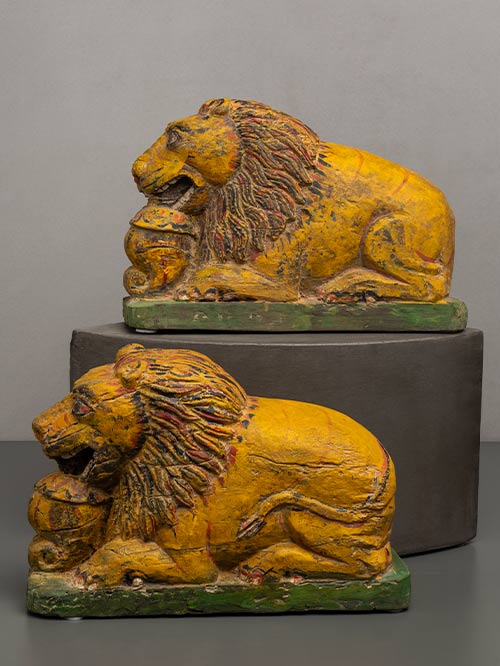
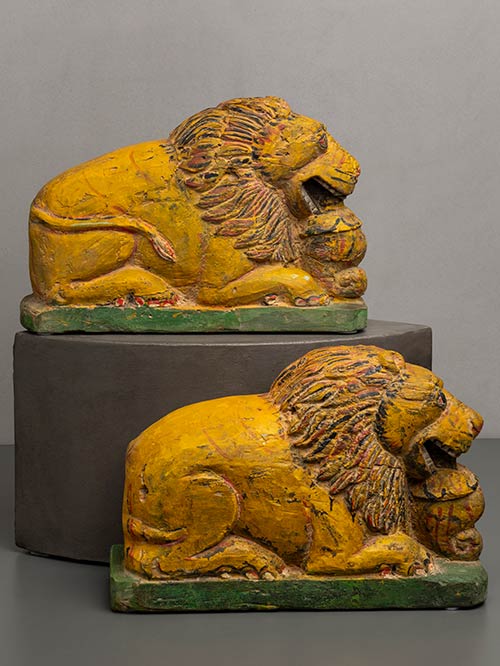
Karnataka
Wood, extensively polychromed
A charming pair of painted wooden lions with bulging eyes and prominent ‘sunburst’ manes. Laying in a prone positions, their fore and hind legs are well carved and terminate in large claws.
The lion holds a special significance in Hindu mythology, being the sacred vehicle of the goddess Durga. Often regarded as India’s embodiment of Mother Nature, Durga symbolizes energy and vitality. Lions, in Hindu iconography, represent attributes like power, royalty, and nobility. They are frequently portrayed as guardians and protectors in various mythological narratives.
Size (cms): 21.5(H) x 32.5(W) x 13(D) each
Size (inches): 8.5(H) x 13(W) x 5(D) each
-
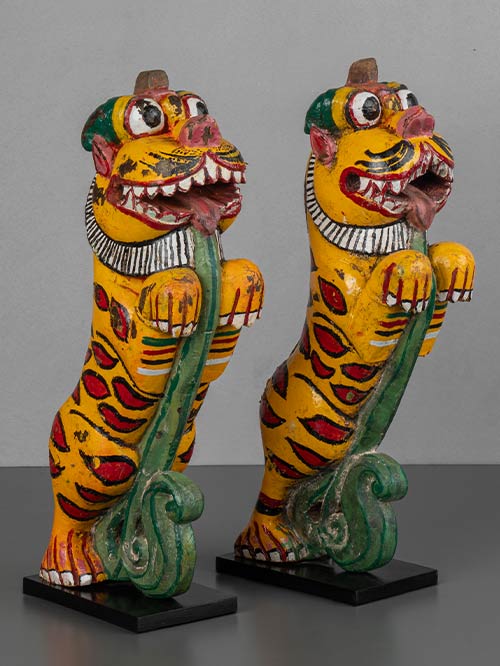
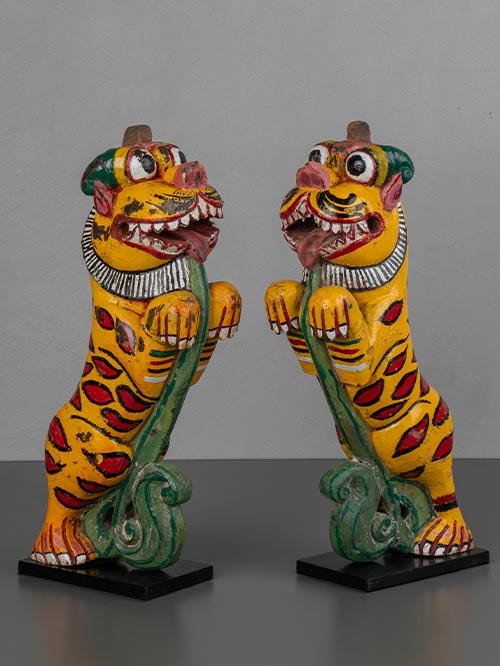
Karnataka
Wood, polychromed
A delightful, richly polychromed pair of rearing tiger brackets. The wide-eyed tigers have large open mouths, exposing their fangs and long, protruding tongues. They stand on their hind legs, and their muscular torsos are painted with red and black bubris (stripes). Their forelegs are raised, as if poised to pounce, and swirling foliage sprouts from their raised paws.
The tiger is the vehicle of, and sacred to, the Hindu goddess, Durga. From a certain perspective she is India’s Mother Nature, for she is the deification of Energy. Her consort, Shiva, sometimes evoked as Shambo, wears a tiger skin to indicate that he is beyond the bounds of the natural world.
Individual Sizes (cms): 44.5(H) x 22(W) x 10(D) each
Individual Sizes (inches): 17.5(H) x 8.5(W) x 4(D) each
-
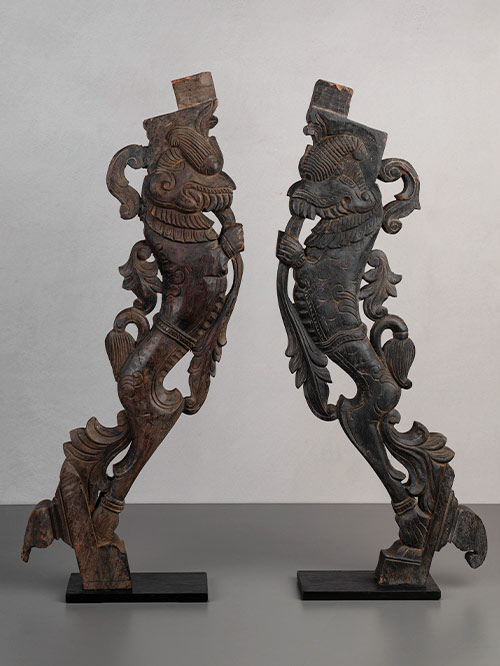
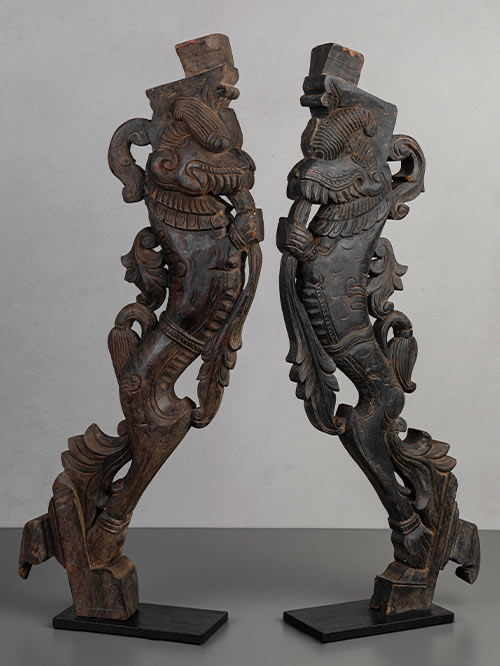
Karnataka
Wood
A finely carved pair of double sided yali architectural brackets. The rearing lions with muscular torso’s have swirling foliage spouting from their open mouths.
‘Yali’ or ‘Vyala’ denotes a mythical lion faced animal that appears on carved friezes on temple walls. They are fierce, leonine beasts with curvaceous bodies and enlarged heads surrounded by flame-like manes. They rear up on hind legs, the forelegs held out with clenched claws as if to pounce. Sometimes they are shown standing on human heads presumably of the demons that they have vanquished. In southern Indian sculpture from the 16th century onwards figures of rearing, almost three dimensional vyalis bearing heads either of horned lions or elephants and feline bodies guard the entrances of temples and line the approaches leading to sanctuaries.
Individual Sizes (cms): 74.5(H) x 31(W) x 10(D) each
Individual Sizes (inches): 29.5(H) x 12(W) x 4(D) each
-
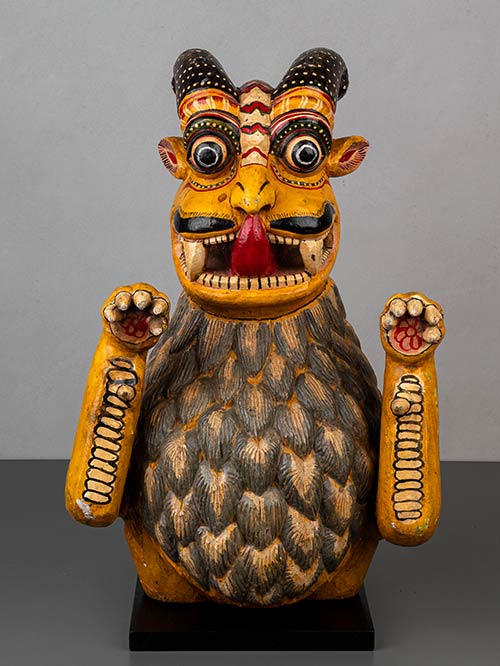

Karnataka
Wood, extensively polychromed
This striking large Tiger Vahana with an unusual, prominent flowing mane. The tiger has wide bulging eyes and an open mouth with large exposed teeth and a long protruding tongue. His fore legs are raised, as if to pounce.
The tiger is the vehicle of, and sacred to, the Hindu goddess, Durga. From a certain perspective she is India’s Mother Nature, for she is the deification of Energy. Her consort, Shiva, sometimes evoked as Shambo, wears a tiger skin to indicate that he is beyond the bounds of the natural world.
Size (cms): 61(H) x 38(W) x 27(D)
Size (inches): 24(H) x 15(W) x 10.5(D)
-
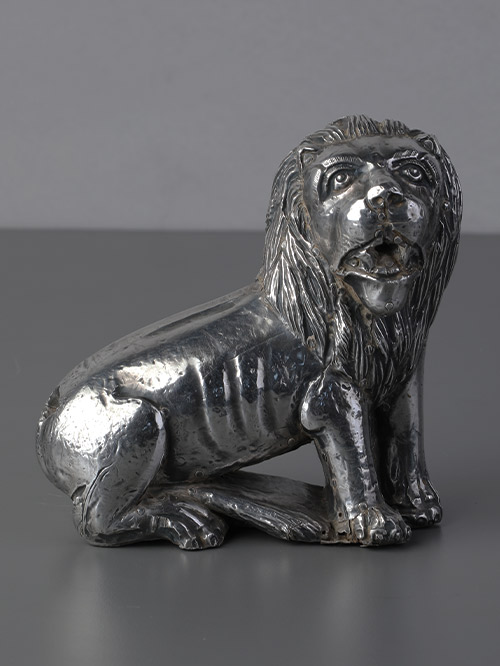
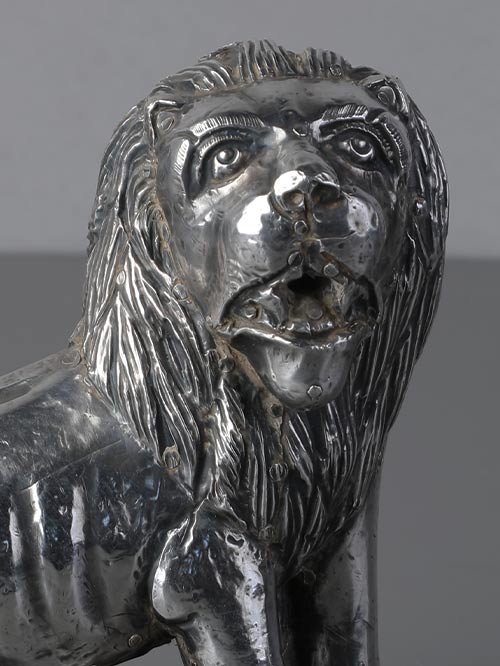
Gujarat
silver on wood
A decorative silver lion with a wooden frame. The ferocious looking lion is seated on its hind legs and is open mouthed, exposing large teeth. These would have served as symbolic supports to the inner sanctum of home shrine.
Among the Jains the lion served as the mount of Mahavira, the 24th and last Jina. Mahavira was the twenty-fourth Tirthankara (ford-maker) of Jainism which was revived and reestablished by him. In the Jain tradition, it is believed that Mahavira was born in the early part of the 6th century BC into a royal family in what is now Bihar, India. At the age of thirty, abandoning all worldly possessions, he left his home in pursuit of spiritual awakening and became an ascetic. For the next twelve and a half years, Mahavira practiced intense meditation and severe austerities, after which he is believed to have attained omniscience.
Size (cms): 15(H) x 14.5(W) x 7.5(D)
Size (inches): 6(H) x 5.5(W) x 3(D)
-
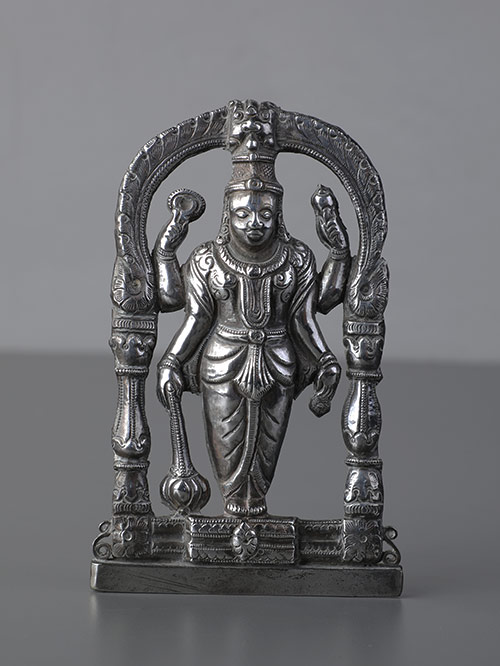
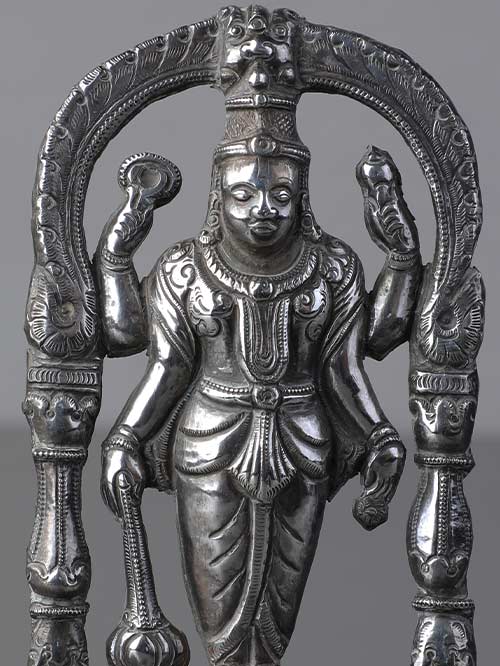
Maharashtra
silver
A finely cast and decorated standing figure of Vishnu. Four-armed, the figure carries a gada (mace), chakra (disc) conch and lotus. He wears multiple ear and neck ornaments and a tall crown surmounted by a Kirtimukha which forms a ritual arch around the figure. Vishnu means ‘All Pervader’, or taking many forms’ is one of the most important Hindu deities along with Shiva and Brahma. He is the sustainer of the universe and sometimes descends to earth assuming various forms (avatars) to redress the balance between good and evil, and hence is known as the Preserver.
Size (cms): 13.5(H) x 8.5(W) x 5(D)
Size (inches): 5.5(H) x 3.5(W) x 2(D)
-
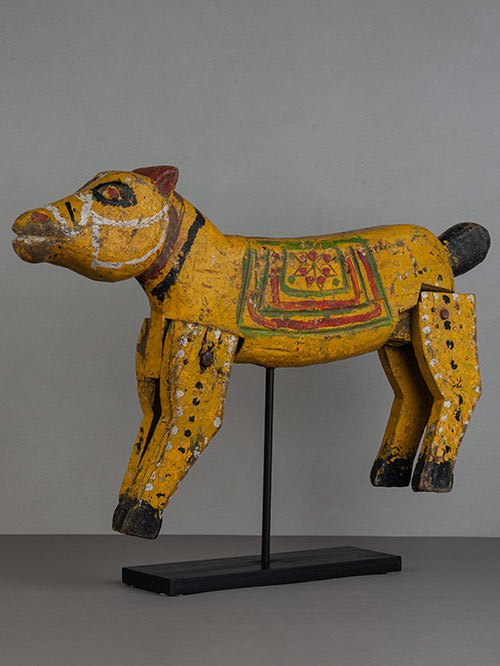
Maharashtra/Karnataka
Wood polychromed
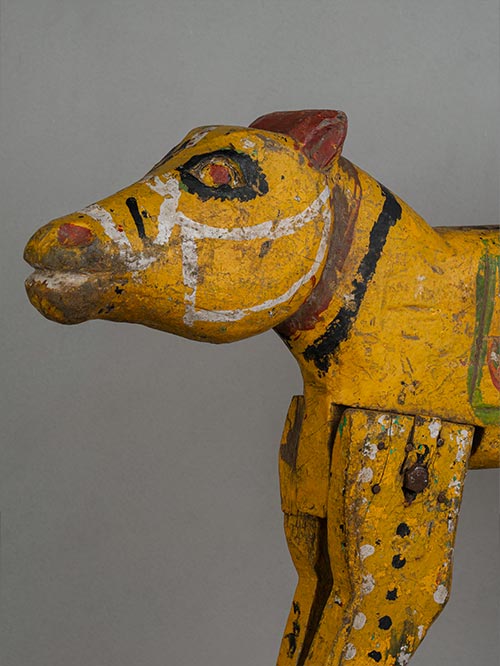
An attractive folk carousel animal in the shape of a dog with original polychroming.
According to Hindu mythology, the dog was originally created by Brahma who then asked him to find and serve the greatest creature on earth. The dog, understandably, settled upon the elephant as his master. However, when he was rebuked for barking at night, lest he attract the attention of a lion, he realised he had made the wrong choice and decided to serve the lion instead. But the lion in turn complained that his bark would attract a hunter. Finally the dog found its right master, the hunter, who abided his barking without fear of a more powerful creature.
Size (cms): 50(H) x 70(W) x 10(D)
Size (inches): 19.5(H) x 27.5(W) x 4(D)
-


Maharashtra/Karnataka
Wood polychromed
An attractive folk carousel animal in the shape of a horse with original polychroming.
The horse played a pivotal role in establishing the supremacy of kings, as demonstrated, for instance by the great horse sacrifice, the Ashvamedha, which might have been established in the course of the Vedic period. Equestrian motifs appear prominently in Indian art, for example in Orissan sculpture of the 12th and 13th centuries, and in that of the late Vijaynagara and Nayak periods (early 16th to early 18th century) in southern India. There is a branch of literature specialising in the training of horses, which contains detailed passages on colouring, proportions, gait, auspicious and inauspicious marks and lists of appropriate names for horses.
Size (cms): 54.5(H) x 71.5(W) x 10.5(D)
Size (inches): 21.5(H) x 28(W) x 4(D)
-
Maharashtra/Karnataka
Wood polychromed
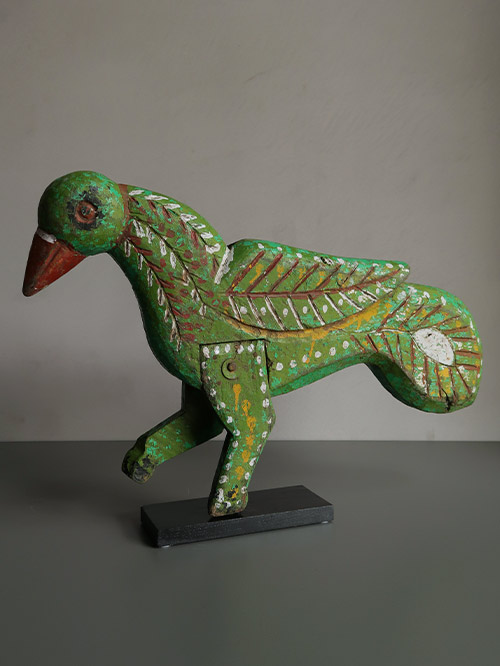
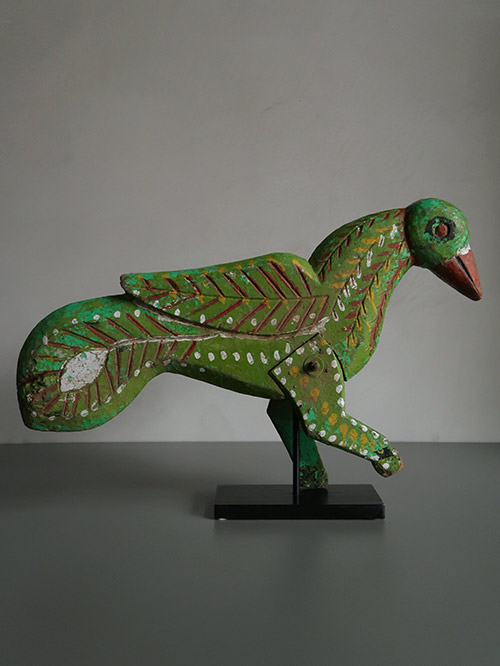
An attractive folk carousel animal in the shape of a parrot with original polychroming. The parrot is the vehicle (vahana) of Kama – the god of love. Generally depicted riding on a parrot, Kama is depicted armed with a bow made of sugar cane (ikshukodanda) bearing a string formed by a row of buzzing bees, five flowertipped arrows, symbolizing the five senses, and on his banner the Makara, an aquatic monster.
Size (cms): 47.5(H) x 70(W) x 10(D)
Size (inches): 18.5(H) x 27.5(W) x 4(D)
-
Karnataka
Wood polychromed
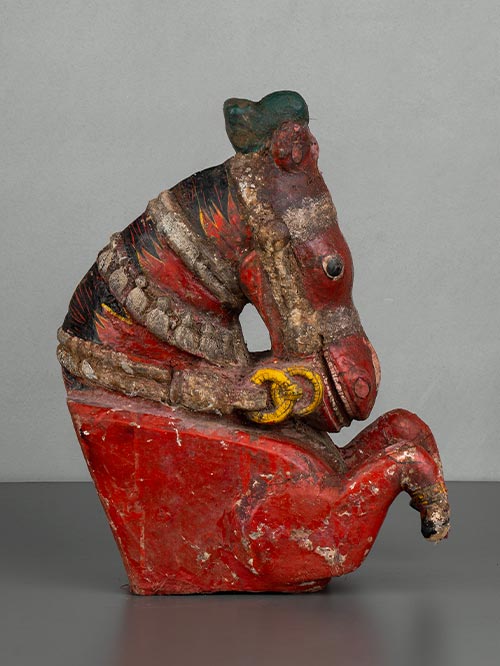
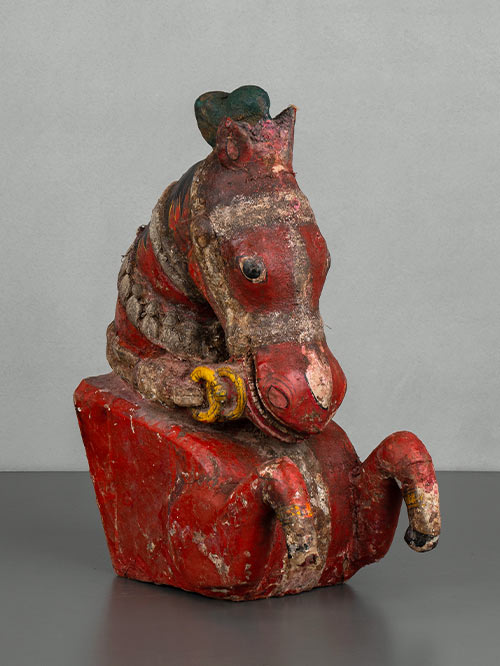
A delightful, richly polychromed horse vahana that would have been a part of a processional figure depicting the Goddess Durga. Every year, during Navratri, processional images of the Goddess are carried in evocative ceremonies. Depending on the day of the festival, her vahana, the vehicle on which she rides changes, with each of her vehicles holding a different and unique significance. The horse she rides here signifies her readiness for battle.
The horse played a pivotal role in establishing the supremacy of kings, as demonstrated, for instance by the great horse sacrifice, the Ashvamedha, which might have been established in the course of the Vedic period. Equestrian motifs appear prominently in Indian art, for example in Orissan sculpture of the 12th and 13th centuries, and in that of the late Vijaynagara and Nayak periods (early 16th to early 18th century) in southern India. There is a branch of literature specialising in the training of horses, which contains detailed passages on colouring, proportions, gait, auspicious and inauspicious marks and lists of appropriate names for horses.
Size (cms): 40(H) x 31(W) x 16(D)
Size (inches): 15.5(H) x 12(W) x 6.5(D)
-
Karnataka
Brass alloy
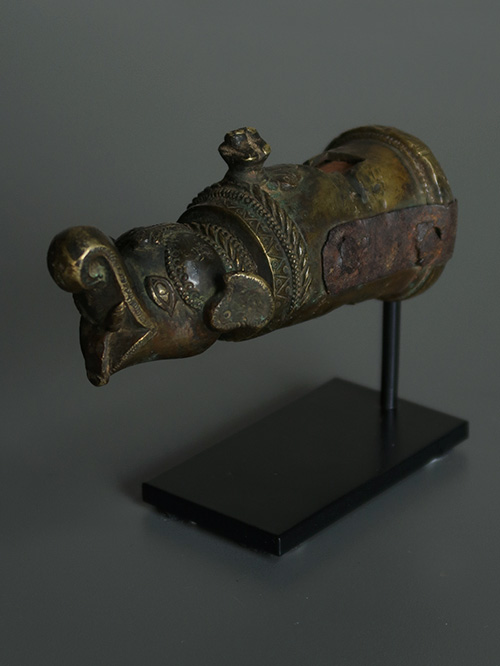
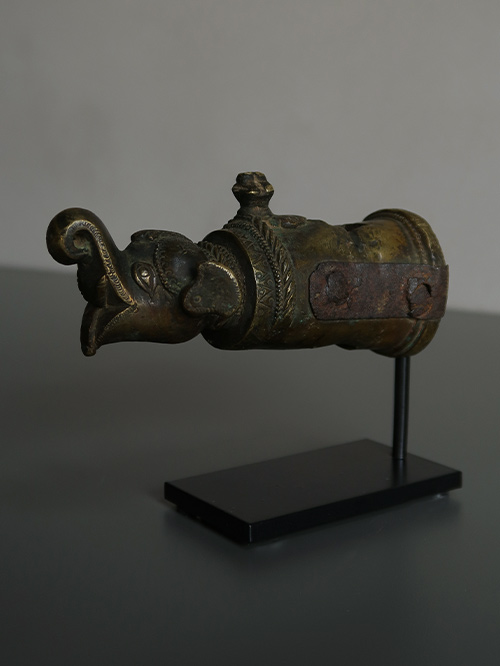
A brass palanquin pole finial taking the sculptural form of a makara head with an elephantine trunk, with bulbous eyes, pointed ears and a gaping mouth. The emotive expression of the makara, with his open mouth is powerful yet unthreatening, underlying its protective function, benign in character though capable of potential ferocity when attacked. It is almost as if he is showing off, displaying his power and status, probably reflecting that of the palanquin’s grand passenger.
Palanquins or sedan chairs were used throughout India, the larger ones to transport people and the smaller ones for religious deities to be taken around the temple complex on festival days. The present example is from the latter category. It was fitted to the wooden forward pole of the palanquin; the rear pole was usually covered with a simple metal cover or cylinder.
Size (cms): 11.5(H with stand) x 13.5(W) x 5(D)
Size (inches): 4.5(H with stand) x 5.5(W) x 2(D)
-
Karnataka
Brass alloy
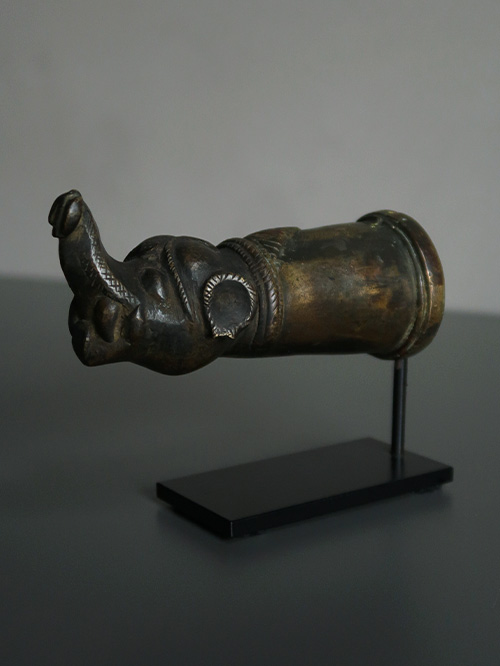
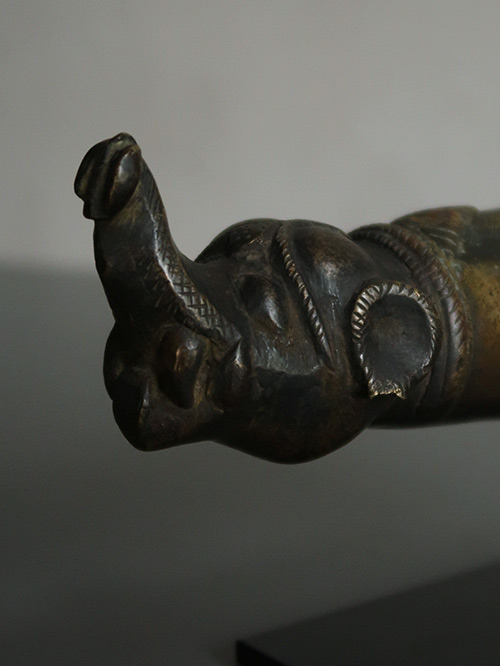
A diminutive palanquin pole finial taking the sculptural form of a makara head with large pointed ears, beady eyes and a gaping mouth. The emotive expression of the makara, with his open mouth is powerful yet unthreatening, underlying its protective function, benign in character though capable of potential ferocity when attacked. It is almost as if he is showing off, displaying his power and status, probably reflecting that of the palanquin’s grand passenger.
Palanquins or sedan chairs were used throughout India, the larger ones to transport people and the smaller ones for religious deities to be taken around the temple complex on festival days. The present example is from the latter category. It was fitted to the wooden forward pole of the palanquin; the rear pole was usually covered with a simple metal cover or cylinder.
Size (cms): 13(H with stand) x 14.5(W) x 6.5(D)
Size (inches): 5(H with stand) x 5.5(W) x 2.5(D)
-
Karnataka
Brass alloy
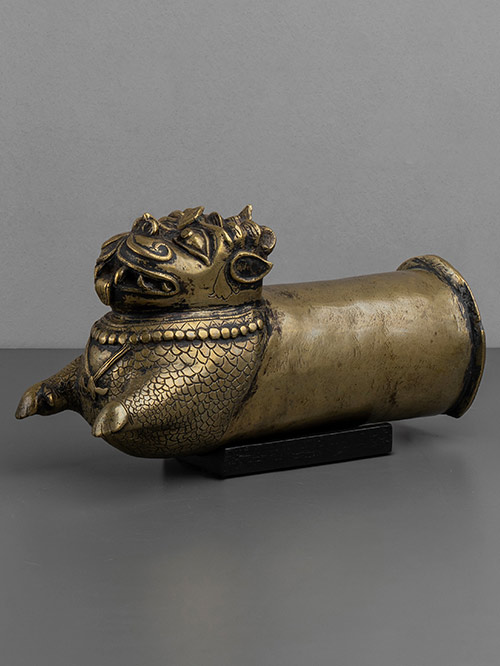
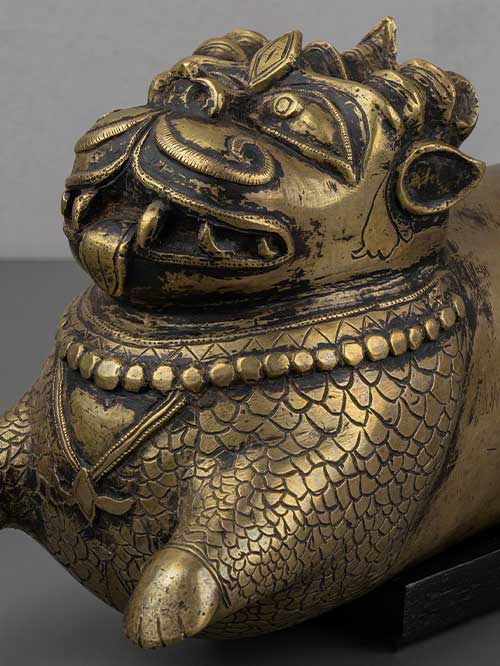
An ornamental palanquin pole finial in the sculptural form of a vyali with a pointed nose, wavy brows culminating in small protruding ears and ovular eyes. The vyali is open-mouthed, exposing large teeth and a small extended tongue. A collar in the form of a festooned necklace with a central medallion hangs on his scaly torso, in between the vyali’s outstretched paws.
Palanquins or sedan chairs were used throughout India, the larger ones to transport people and the smaller ones for religious deities to be taken around the temple complex on festival days. The present example is from the latter category. It was fitted to the wooden forward pole of the palanquin; the rear pole was usually covered with a simple metal cover or cylinder.
Size (cms): 17(H) x 31(W) x 11(D)
Size (inches): 6.5(H) x 12(W) x 4.5(D)