“Hanuman Mukhavata” has been added to your cart.
View cart
-
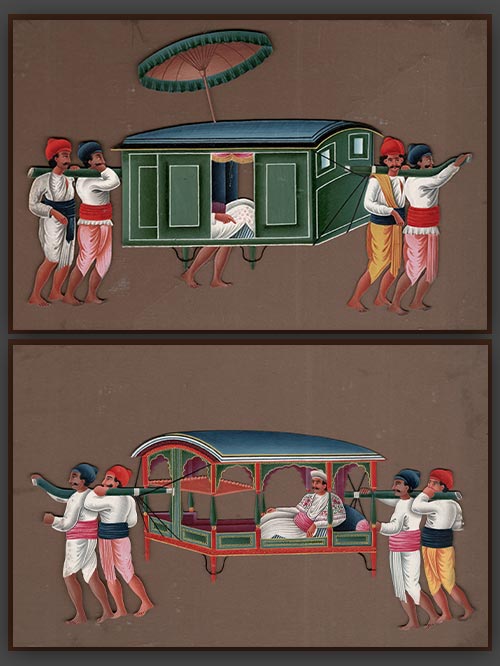
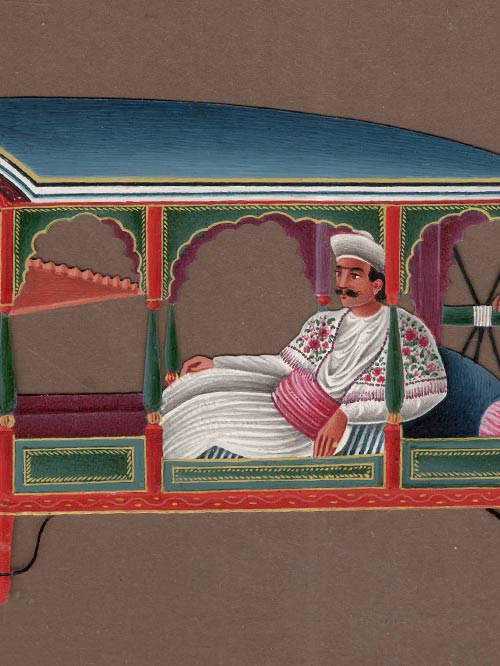
Patna (Eastern India)
Pigments on Mica
A charming and finely painted pair of mica paintings of palanquins carried by colourfully dressed palanquin bearers and a partially obscured parasol bearer. The closed palanquin affording only a glimpse of its seated patron, the open palanquin occupied by an elegantly dressed gentleman reclining against a large bolster wearing a floral patterned shawl.
Under the Mughals, Patna had never been a great artistic centre and although its Muhammadan governors had employed Mughal artists, there is no evidence that any strongly marked local style had developed. Yet Patna, like Murshidabad, was undergoing a social revolution and various circumstances in the later eighteenth century were to make it a centre of Indian-British painting. As a result of its increasing prosperity, a number of artists of the Kayasth caste were attracted to Patna from Murshidabad. One of these was a certain Sewak Ram, who had migrated there by 1790. He began to produce sets of occupations as well as large paintings of ceremonies and festivals. One such set, now in the India Office Library, was purchased by Lord Minto, while a painting from a similar set in the Indian Department of the Victoria and Albert Museum was acquired by Lord Amherst when he was Governor-General (August 1823 to March 1828). British taste in the early nineteenth century shows itself in both subjects and colour range – sepia wash enlivened with touches of brighter colour – adopted by the Patna artists.
Individual Sizes (cms): 11.5(H) x 18(Diam)
Individual Size (inches): 4.5(H) x 7(Diam)
-
Karnataka (South India)
brass
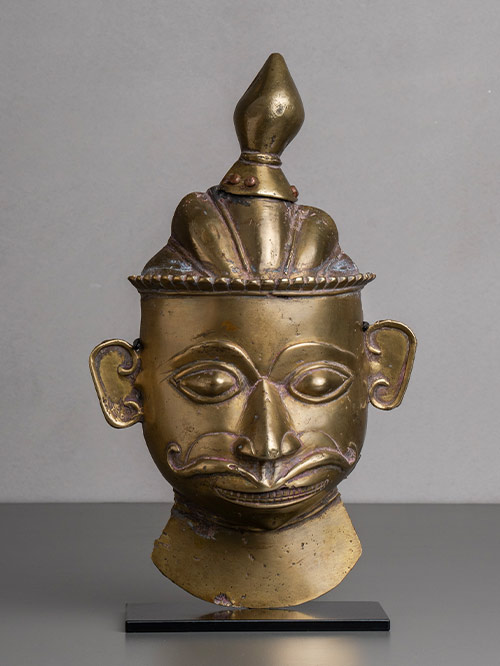
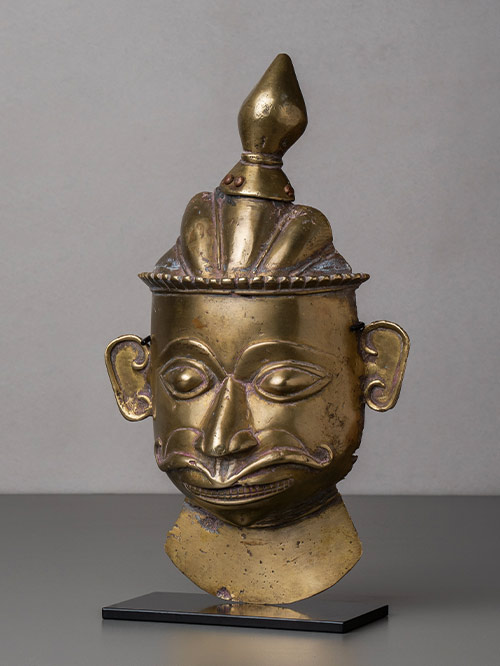
A striking Hanuman face with a protruding mouth and nose, curving moustache, bulging eyes and forehead tilaka. He wears a necklace and a rimmed and pointed crown.
Mukhavata or facial masks are two-dimensional metal castings of the crowned or turbaned heads of various deities, mostly manifestations of Shiva and Parvati. Included in this group are Khandoba, Mallanna, Gauri and their regional variants who are worshipped under different names.
The story of Hanuman is found in the Ramayana where he is the ubiquitous servant, the epitome of devoted service and loyalty. His search for the heroine Sita, captured by Ravana, illustrates his superhuman powers and zealous performance of the tasks that were given to him.
Size (cms): 32(H) x 19(W) x 11(D)
Size (inches): 12.5(H) x 7.5(W) x 4.5(D)
-
Kerala
Wood, polychromed
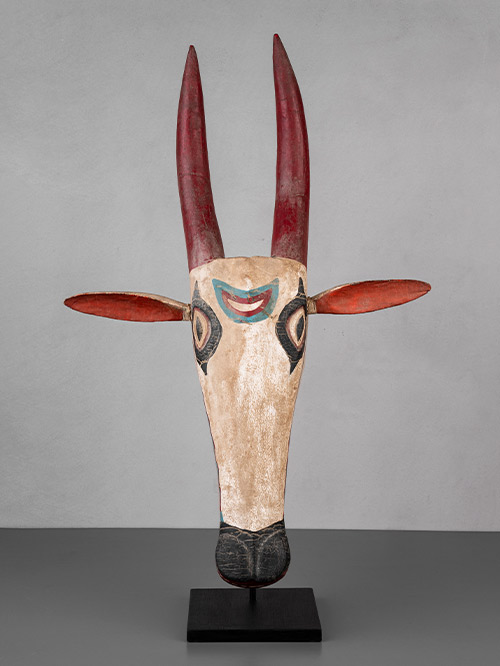
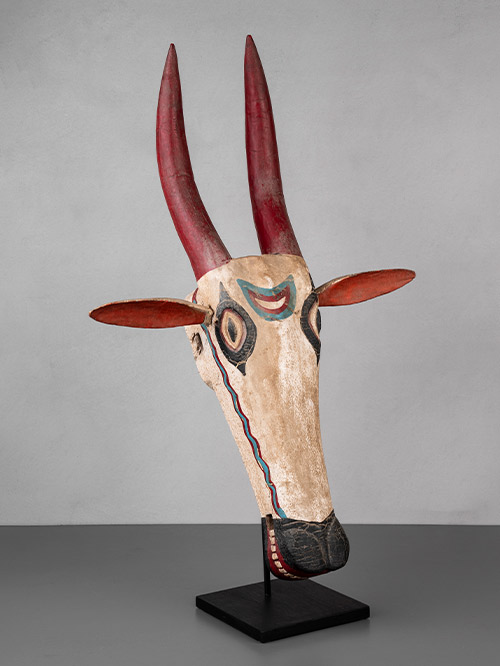
A finely painted Nandi festival head.
These heads are used in bull festivals known as kala velas. Bull festivals originated out of people’s desire to keep their bulls, bullocks and oxen healthy as they were used for ploughing and other work. In a society whose well-being was linked to good and bountiful crops and who therefore sought the benevolence of nature, these animals played a major role. The idea was to make an offering of them to their local deity- Bhagavathi. Their importance can be realised by the fact that at Mulayankavu there are forty pairs of these effigies at both the main festival in the Malayalam month of Medam (mid-April to mid-May) and their other festival in Meenam (mid-March to mid-April). The difference is that in Meenam there are also eleven single bullocks belonging to particular families in the area. These festivals are exclusive to the region of northern Kerala known as Valluvanad, formerly a small kingdom.
Mask Size (cms): 86.5(H) x 59(W) x 14(D), 92.5 (H with stand)
Mask Size (inches): 34(H) x 23(W) x 5.5(D), 36.5 (H with stand)