
Centre Table From Wood Bark
TROPICAL HARDWOOD
SIZE (cms): 175 (W) X 100 (D) X 38 (H)
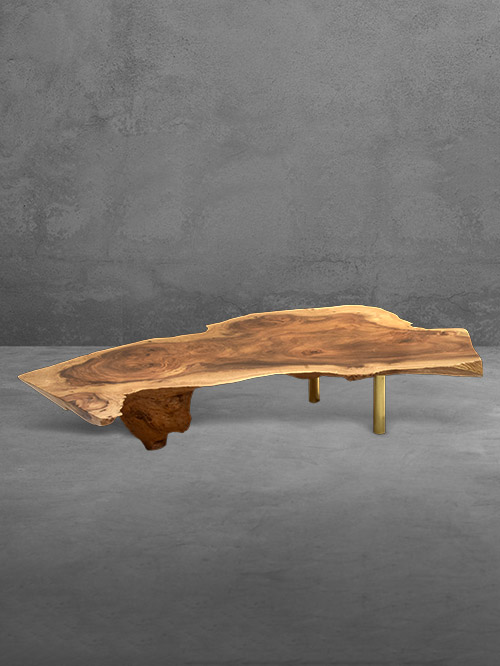
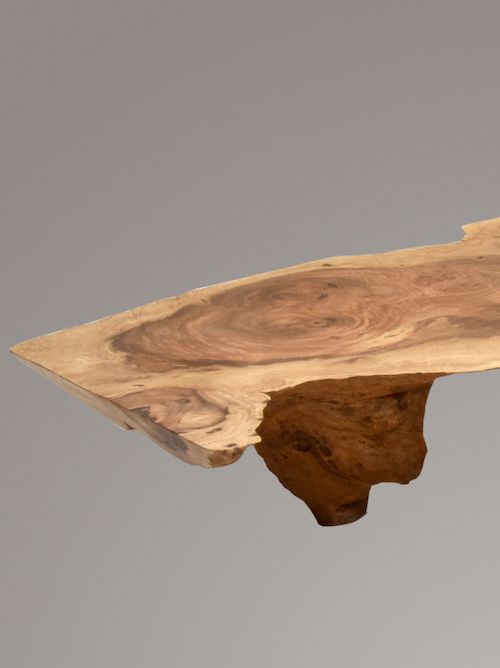
TROPICAL HARDWOOD
SIZE (cms): 175 (W) X 100 (D) X 38 (H)
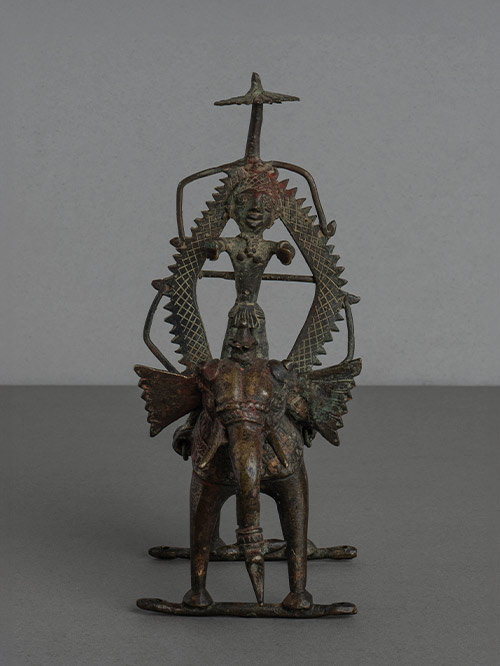
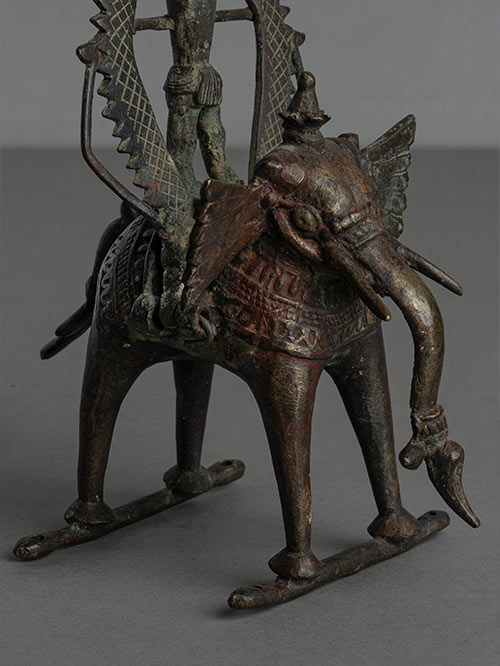
Orissa
brass alloy
A finely crafted figure of an elephant with its mahout. The caparisoned elephant is adorned with head and neck ornaments and a decorated saddle cloth, and it has a lovely curled trunk. Atop the elephant stands the Goddess Danteshwari, enclosed in a howdah shaped like a prabhavali, forming a ritual arch around the deity.
The elephant was the vahana or vehicle of god Indra. Later it became associated with deities such as Lakshmi and Danteshwari (Durga). In art and literature it became a symbol of power and might and was associated with royalty and deities. Danteshwari Mata who is a form of the powerful Goddess Durga and is also the family goddess of the princes of Bastar. The last ruler of Bastar who died in 1966 was considered her incarnation. The goddess was brought to Bastar in the 15th century by Annamdeo, an ancestor of the princely dynasty. On the run from the advancing Muslims, he had sought refuge in the impassable mountainous region of Bastar. Legend has it that the goddess appeared to him in through his royal sword and showed him the way. The sword represents the power of the victorious goddess and bestows military prowess upon its owner.
Size (cms): 19(H) x 12(W) x 8.5(D)
Size (inches): 7.5(H) x 4.5(W) x 3.5(D)
Central India
brass alloy
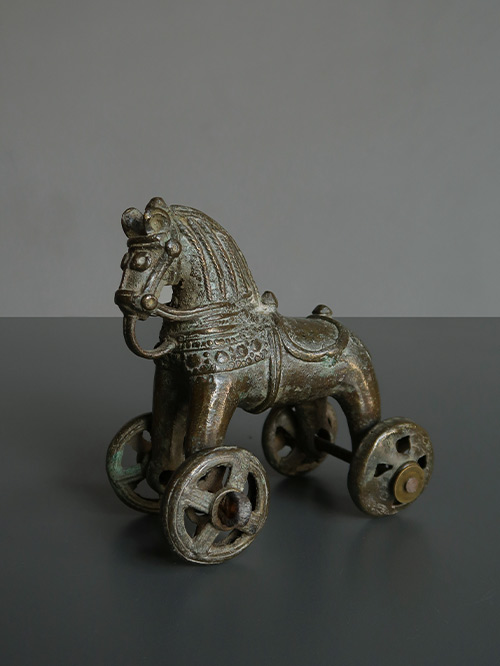
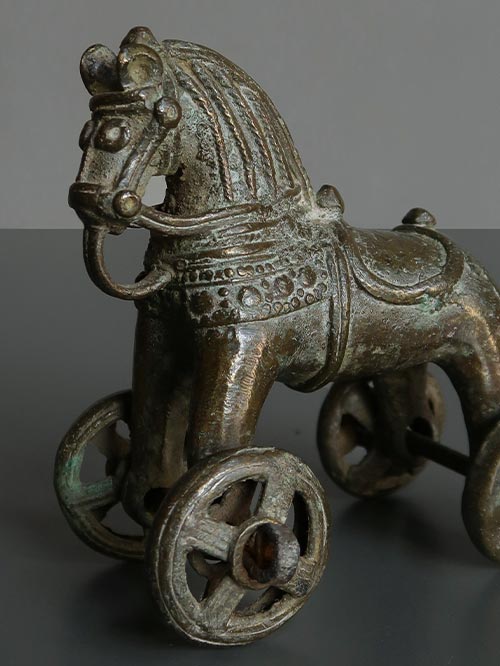
A lovely diminutive figure of a horse on wheels adorned with trappings and a decorated saddle cloth secured by ropes. Temple toys were used as ritual display in temples during important festivals such as Holi, Shivaratri and Durga Puja.
The horse played a pivotal role in establishing the supremacy of kings, as demonstrated, for instance by the great horse sacrifice, the Ashvamedha, which might have been established in the course of the Vedic period. Equestrian motifs appear prominently in Indian art, for example in Orissan sculpture of the 12th and 13th centuries, and in that of the late Vijaynagara and Nayak periods (early 16th to early 18th century) in southern India. There is a branch of literature specialising in the training of horses, which contains detailed passages on colouring, proportions, gait, auspicious and inauspicious marks and lists of appropriate names for horses.
Size (cms): 16.5(H) x 15.25(W) x 11(D)
Size (inches):6.5(H) x 6(W) x 4.5(D)
Maharashtra/ Karnataka
Brass alloy
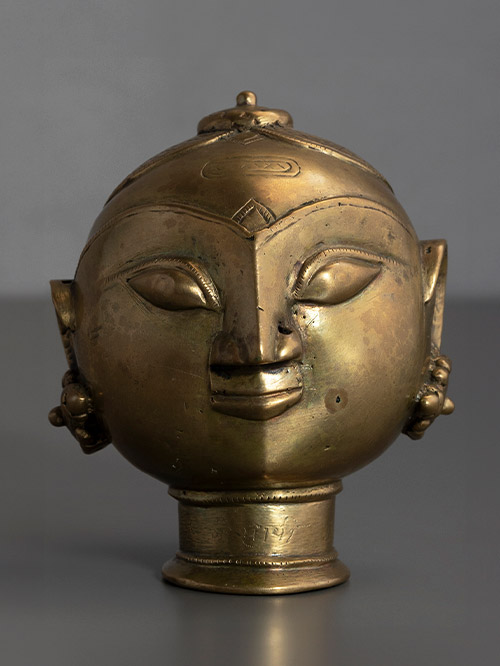
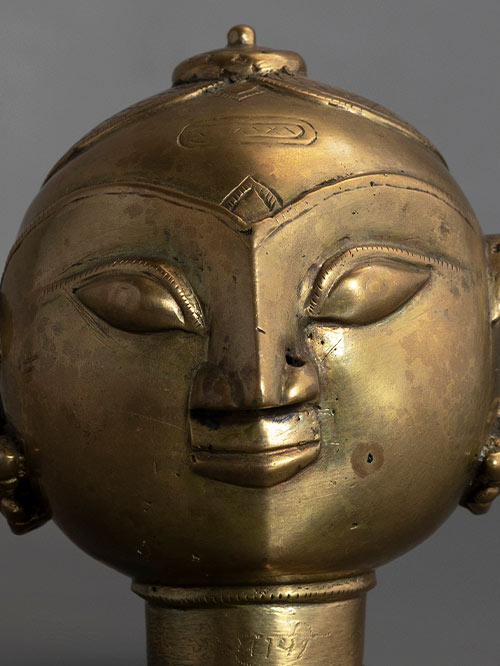
Gauri is the name of a benevolent goddess, consort of Shiva or Varuna. Connected with the rains, she is reputed to be the source of the world and the embodiment of motherhood. She is depicted as a two-or four-armed woman of fair complexion, carrying in her upper arms prayer beads and a water pot, while the lower hands are in Abhaya and Varadamudra. She may also carry a mirror, a fish, a lotus, a trident and a floral wreath. Her mount is the godhika (iguana). Occasionally she is shown riding either a lion, a wolf, a pig or a goose.
Size (cms): 12(H) x 10(W) x 10(D)
Size (inches): 4.5(H) x 4(W) x 4(D)
Karnataka (South India)
Brass alloy
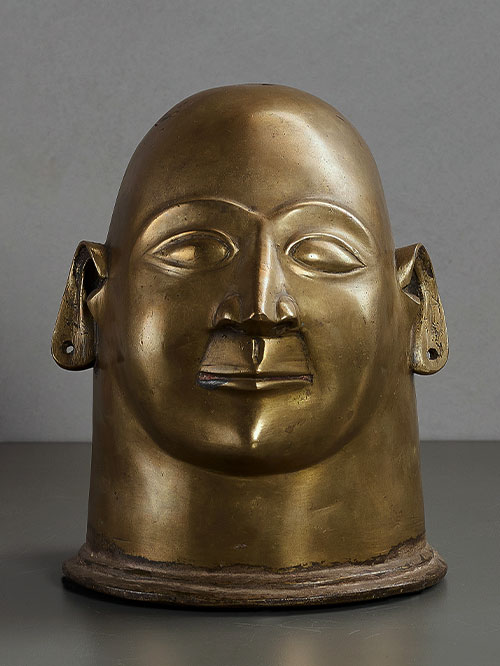
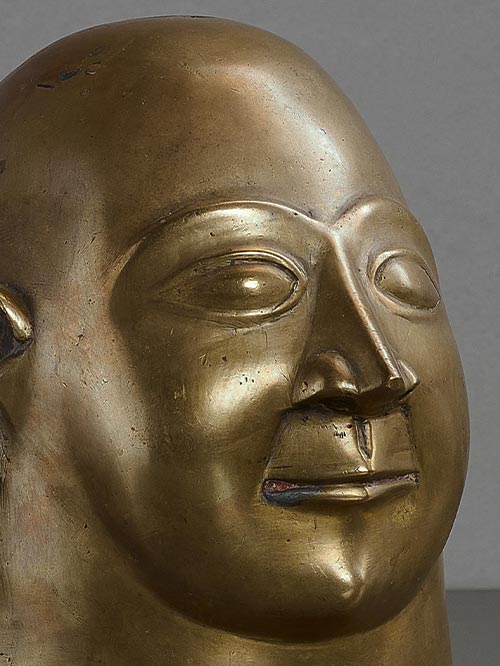
A very unusual Gauri head with large almond shaped eyes, pierced ears and a smooth rounded head.
Gauri is the name of a benevolent goddess, consort of Shiva or Varuna. Connected with the rains, she is reputed to be the source of the world and the embodiment of motherhood. She is depicted as a two-or four-armed woman of fair complexion, carrying in her upper arms prayer beads and a water pot, while the lower hands are in Abhaya and Varadamudra. She may also carry a mirror, a fish, a lotus, a trident and a floral wreath. Her mount is the godhika (iguana). Occasionally she is shown riding either a lion, a wolf, a pig or a goose.
Size (cms): 26.75(H) x 22.8(W) x 20.3(D)
Size (inches): 10.5(H) x 9(W) x 8(D)
Maharashtra/Karnataka
Brass
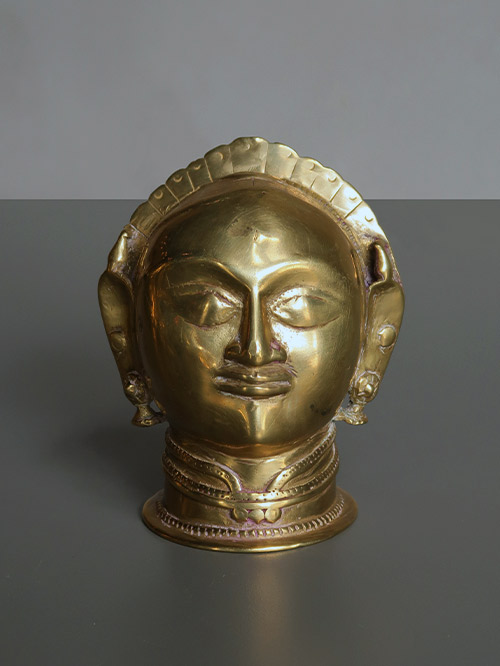
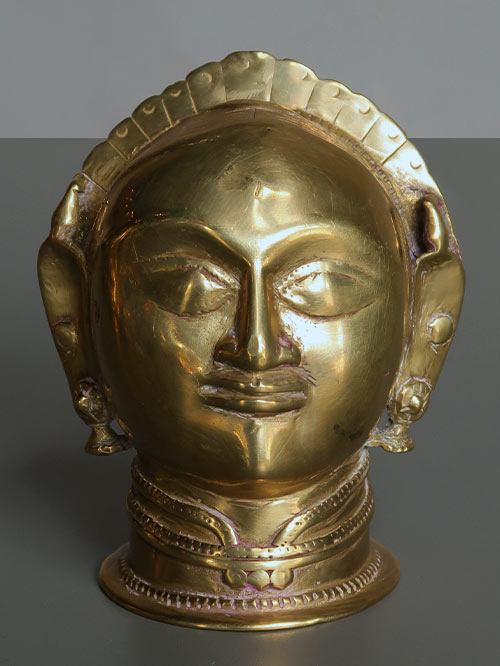
An attractive diminutive Gauri head with finely modelled features including necklaces, hair and ear ornaments as well as an engraved crown. Gauri is the name of a benevolent goddess, consort of Shiva or Varuna. Connected with the rains, she is reputed to be the source of the world and the embodiment of motherhood.
In household shrines in Maharashtra and Karnataka, the deity was considered a privileged house guest and treated accordingly. Images of the god were bathed, clothed, bejeweled and nourished in preparation for puja and darshan. Often elaborate turbans were placed on the head and bound by the finest cloths usually in the auspicious deep red colour. In some cases the masks were mounted on a wooden framework and covered with cloths. Sometimes separate metal cast arms and legs were attached to the figure, thus providing a more realistic depiction of the deity.
Size (cms): 12(H) x 9(W) x 8(D)
Size (inches): 4.5(H) x 3.5(W) x 3(D)
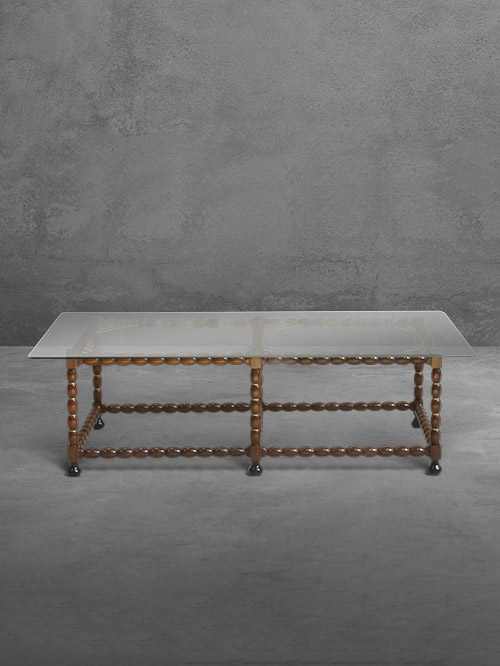
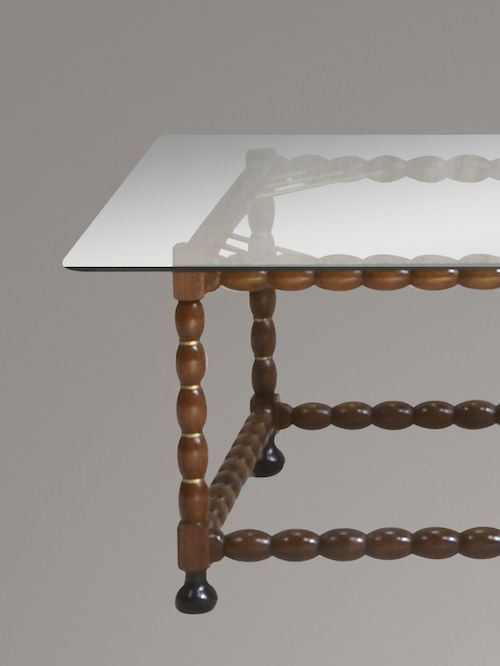
TEAK WITH BRASS TRIM
c. 1940
Size (cms): 137 (W) X 71 (D) X 41 (H)
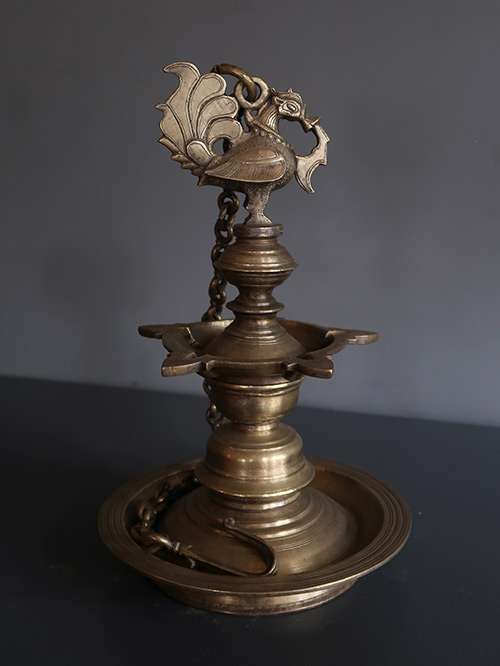
Kerala
Brass Alloy
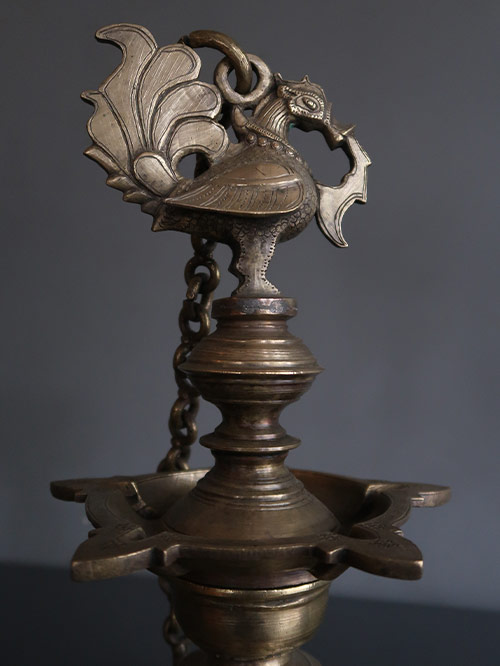
A fine two-tiered temple lamp with a Hamsa (goose) final. The upper circular reservoir with five lotus petal shaped spouts in each of which a wick would be placed.
The Hamsa is a familiar motif in Indian art, literature, sculpture and textiles. It is an aquatic bird that resembles a goose or a swan. It is reputed to eat pearls and to be able to separate milk from water. The Hamsa is seen as a symbol of purity, detachment, divine knowledge, cosmic breath (prana) and the highest spiritual accomplishment.
Hanging lamps, sometimes called chain lamps, may have originated from as far afield as Greece or Rome, entering South Asia from the early ports of Arikamedu and Mammalapuram (both near present day Chennai). Used primarily in a temple context, the chain lamp cast its light broadly, and in so doing extended spiritual agency. Much like other lamp types, it served as a backdrop to images placed before it on the altar. A group of hanging temple lamps within the temple would have generated a tremendous play of light and shadows over walls, ceilings and floors.
Size(cms): 35 (H w/o Chain) x 21.5 (Diameter), 94 (H with Chain)
Size(inches): 13.75 (H w/0 Chain ) x 8.5 (Diameter), 37 (H with Chain)
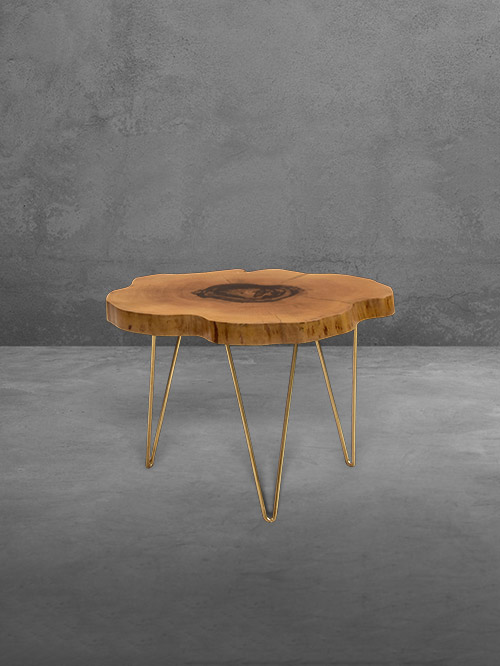
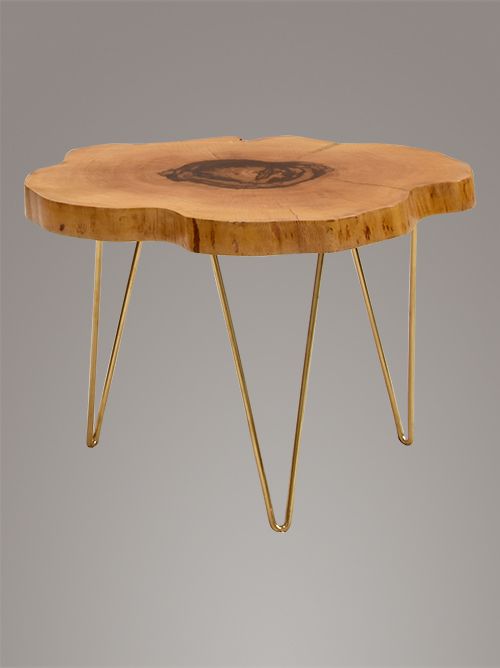
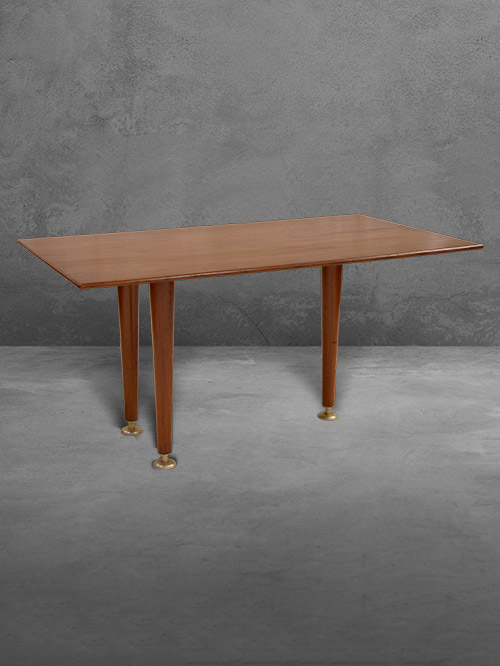
TEAK & BRASS
c. 1950-60
SIZE (CMS): 154 (W) X 90 (D) X 76 (H)
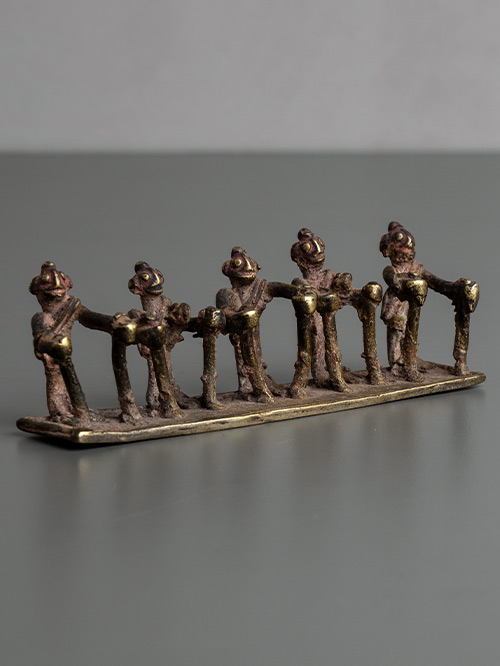
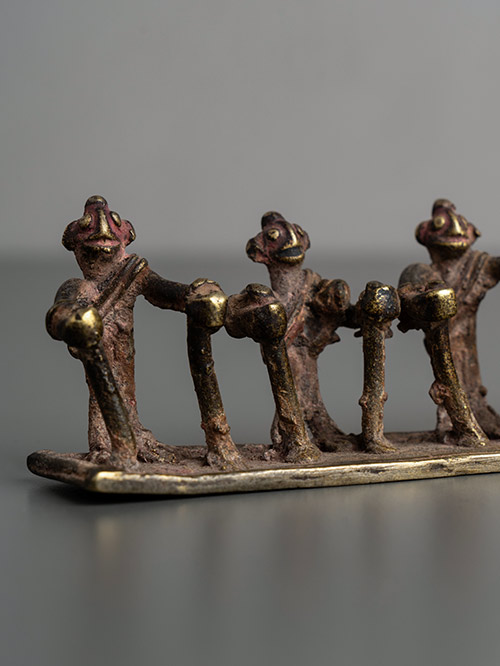
Maharashtra
Brass alloy
This folk bronze depicts a group of munjas (spirits) represented as five men, each holding a pair of sticks and adorned with a yajnopavita (sacred thread). These figures symbolise young men who tragically passed away at the age when they had just begun their studies. To honour their memory and appease their spirits, such figurines are placed on household altars. Through ritual ablution and ceremonies, these ghosts are believed to be transformed into pitra (protective ancestors) who safeguard the family.
Size (cms): 5(H) x 14.5(W) x 3(D)
Size (inches): 2(H) x 5.5(W) x 1(D)
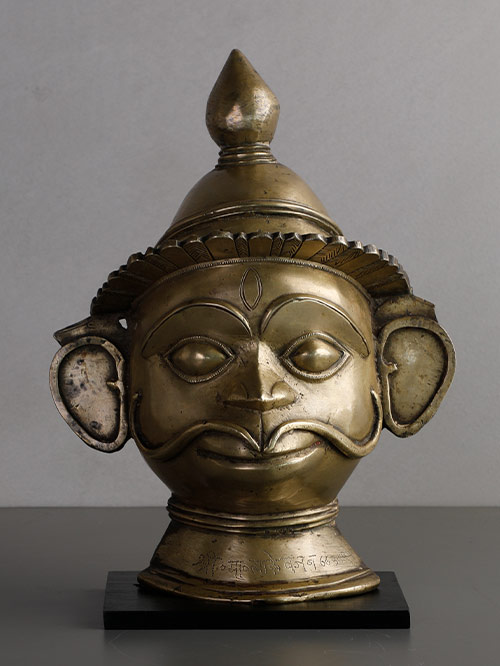
Karnataka (South India)
brass alloy
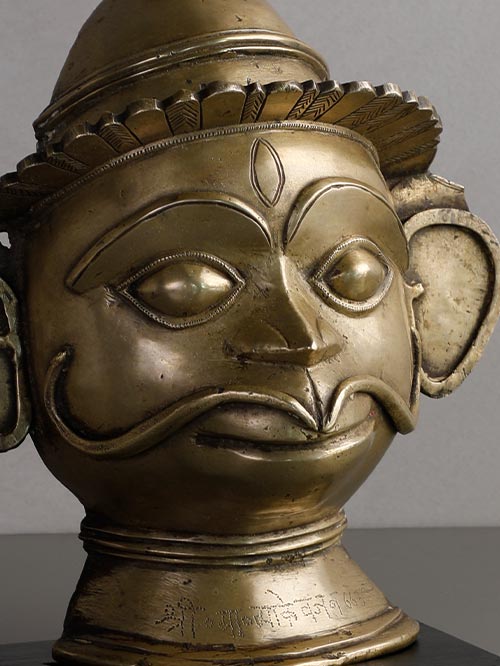
A striking Hanuman face with a protruding mouth and nose, curving moustache, bulging eyes and forehead tilaka. He wears a necklace and a rimmed and pointed crown.
Mukhavata or facial masks are two-dimensional metal castings of the crowned or turbaned heads of various deities, mostly manifestations of Shiva and Parvati. Included in this group are Khandoba, Mallanna, Gauri and Hanuman and their regional variants who are worshipped under different names.
Hindu devotees believe that when an icon is consecrated and its eyes anointed by the priest, the figure becomes a living god. In household shrines in Maharastra and Karnataka, the deity was considered a privileged house guest and treated accordingly. Images of the god were bathed, clothed, bejeweled and nourished in preparation for puja and darshan. Often elaborate turbans were placed on the head of the mukha-vata and bound by the finest cloths usually in the auspicious deep red colour. In some cases the masks were mounted on a wooden framework and covered with cloths. Sometimes separate metal cast arms and legs were attached to the figure, thus providing a more realistic depiction of the deity.
Size (cms): 35.5(H) x 26(W) x 11.5(D)
Size (inches): 14(H) x 10(W) x 4.5(D)
Karnataka (South India)
brass
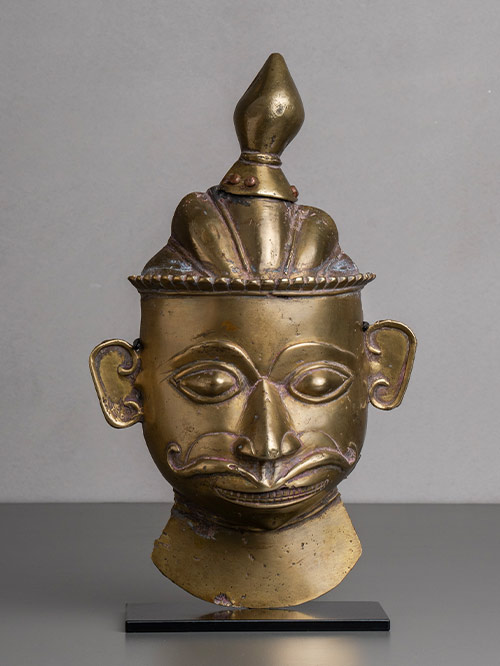
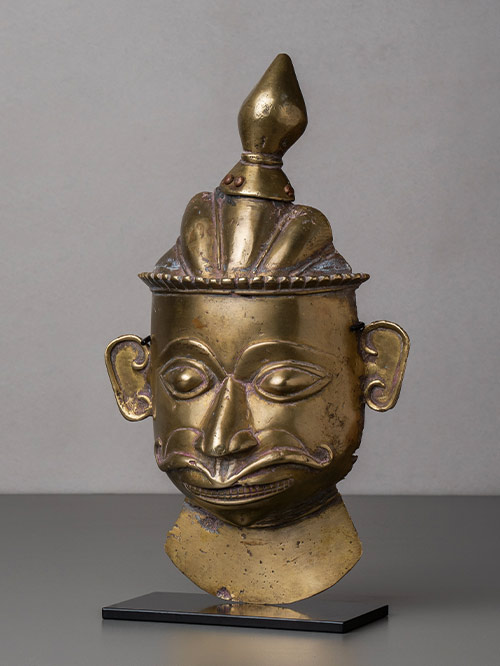
A striking Hanuman face with a protruding mouth and nose, curving moustache, bulging eyes and forehead tilaka. He wears a necklace and a rimmed and pointed crown.
Mukhavata or facial masks are two-dimensional metal castings of the crowned or turbaned heads of various deities, mostly manifestations of Shiva and Parvati. Included in this group are Khandoba, Mallanna, Gauri and their regional variants who are worshipped under different names.
The story of Hanuman is found in the Ramayana where he is the ubiquitous servant, the epitome of devoted service and loyalty. His search for the heroine Sita, captured by Ravana, illustrates his superhuman powers and zealous performance of the tasks that were given to him.
Size (cms): 32(H) x 19(W) x 11(D)
Size (inches): 12.5(H) x 7.5(W) x 4.5(D)
Karnataka (South India)
brass
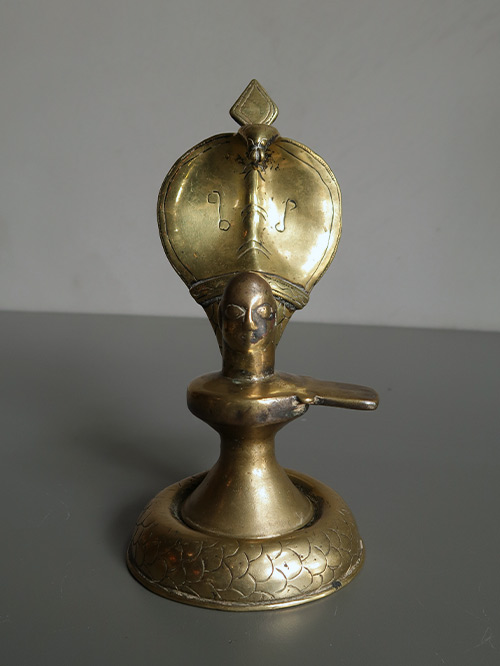
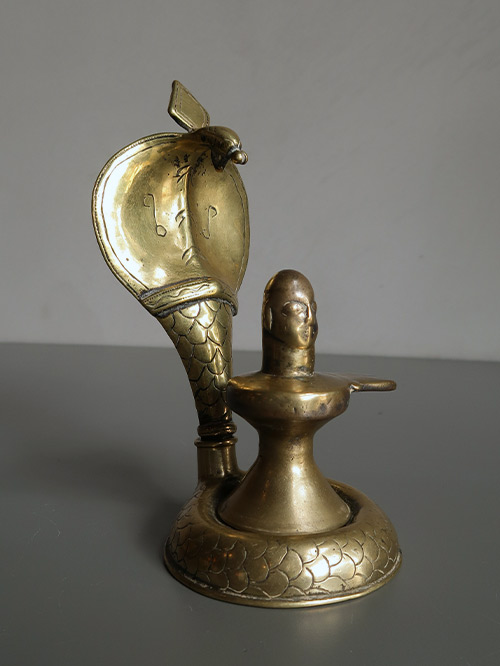
A finely cast lingam resting on the patterned coils of the serpent Vasuki which forms a canopy overhead.
The Lingam is an abstract or aniconic representation of the Hindu deity Shiva in Shaivism. Lingams are shaped like a pillar with a round top and were made of stone, wood or metal.Eventually, during the Kushan period (1st century to 3rd century CE) in north India, human faces came to be added to the lingams, hence the name mukhalinga. This object marks the presence of the invisible transcendental reality of Shiva, the Hindu god of destruction.
Size (cms): 19(H) x 6.5(W) x 9(D)
Size (inches): 7.5(H) x 2.5(W) x 3.5(D)

Karnataka (South India)
brass
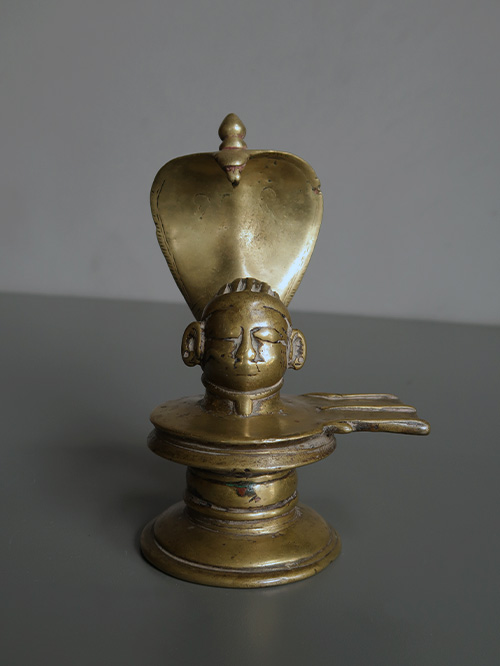
A finely cast Mukha lingam with a serpent canopy that extends overhead.
The Lingam is an abstract or aniconic representation of the Hindu deity Shiva in Shaivism. Lingams are shaped like a pillar with a round top and were made of stone, wood or metal.Eventually, during the Kushan period (1st century to 3rd century CE) in north India, human faces came to be added to the lingams, hence the name mukhalinga. This object marks the presence of the invisible transcendental reality of Shiva, the Hindu god of destruction.
Size (cms): 16(H) x 10(W) x 9(D)
Size (inches): 6.5(H) x 4(W) x 3.5(D)
