“Oil Lamp with Nandi Finial” has been added to your cart.
View cart
-
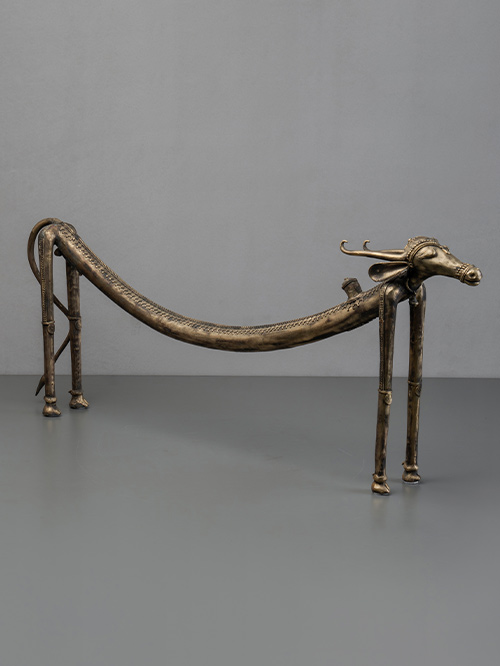
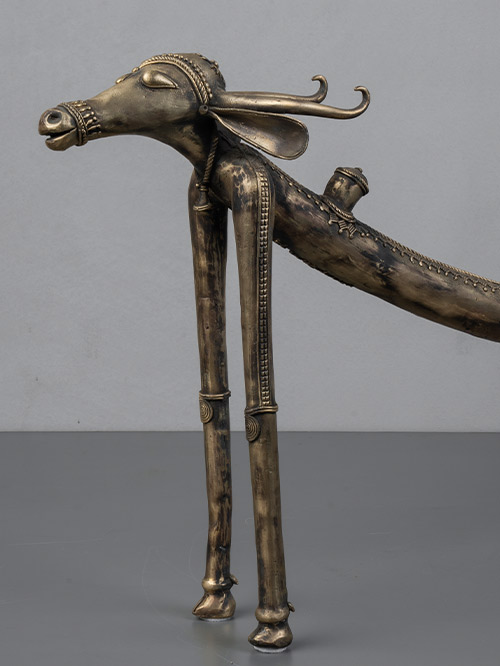
Bastar (Chhattisgarh, Central India)
Brass, Dokra work
Nandi or nandin means rejoicing, gladdening. It is the name of shivas conveyance (vahana) the white bull, son of kashyapa and of surabhi. Nandii was probably a folk deity later incorporated into the brahamanic lore. Nandi symbolises on the one hand moral and religious duty (dharma) , and on the other, virility, fertility and strength. Apart from being shivas vehicle, nandi in his form as nandikeshvara, depicted as a human with a bulls head, is believed to be one of the great masters of music and dancing. In southern India his recumbent image is placed either opposite the main sanctuary or in the hall leading to it, facing the linga.
Suresh Waghmare (signed)
Born in 1970 in a Maharashtrian family in Bastar district, he began to study the technique of Bell Metal Casting with Guru Phool Singh Bisara when he was twelve. Since then he has been working as a member of the co-operative of craftsmen. He is a master craftsman in the art of metal casting and has participated in many international exhibitions.
Size (cms): 38(H) x 81(W) x 10(D)
Size (inches): 15(H) x 32(W) x 4(D)
-
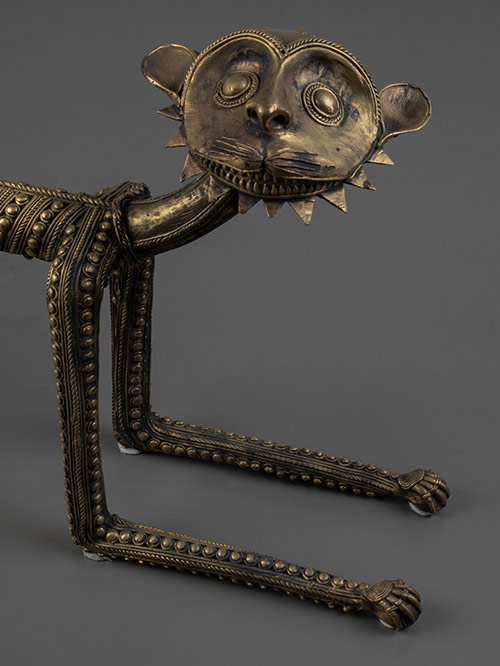
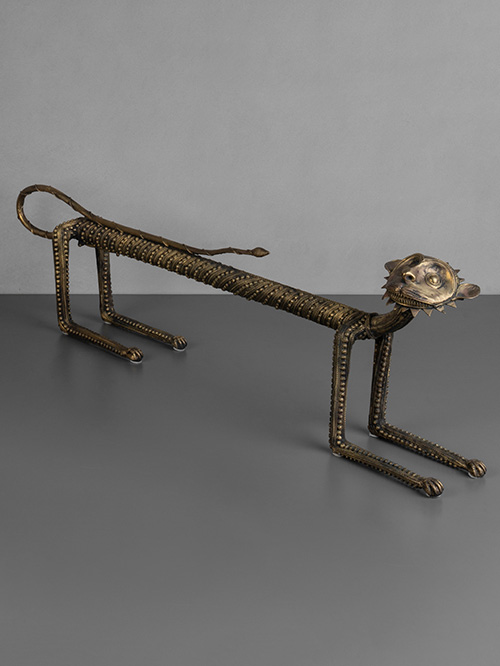
Bastar (Chhattisgarh, Central India)
Brass, Dokra work
The tiger is the vehicle of, and sacred to, Danteshwari Mata who is a form of the powerful Goddess Durga and is also the family goddess of the princes of Bastar.
Suresh Waghmare (signed)
Born in 1970 in a Maharashtrian family in Bastar district, he began to study the technique of Bell Metal Casting with Guru Phool Singh Bisara when he was twelve. Since then he has been working as a member of the co-operative of craftsmen. He is a master craftsman in the art of metal casting and has participated in many international exhibitions.
Size (cms): 29.5(H) x 106(W) x 11(D)
Size (inches): 11.5(H) x 41.5(W) x 4.5(D)
-
Karnataka
Brass alloy
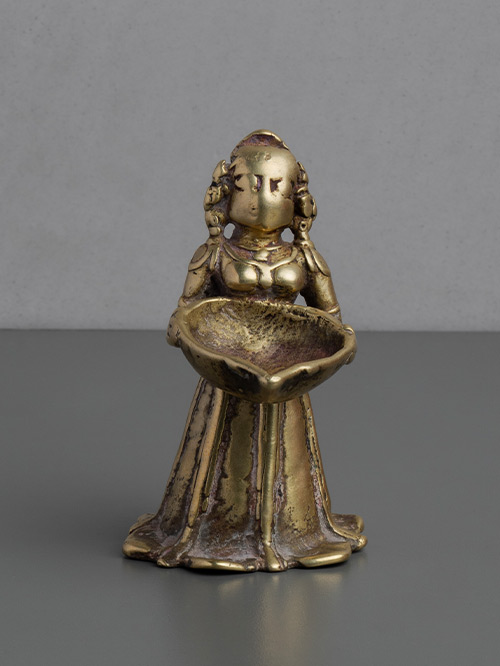
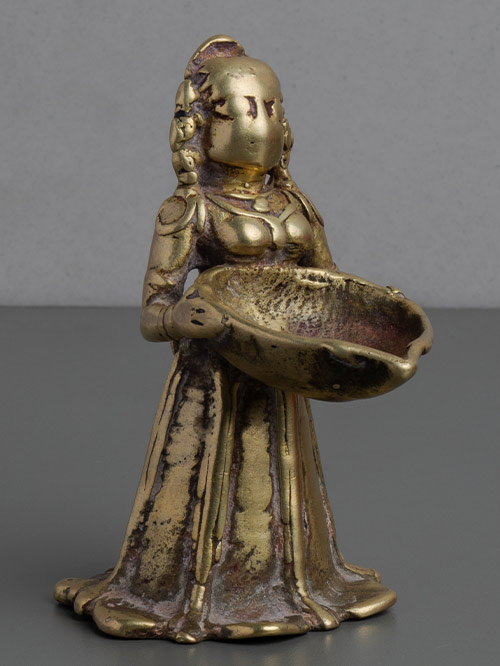
This attractive and patinated Lakshmi of diminutive proportions stands proudly, holding a deep reservoir burner in her outstretched hands. She wears a long, flowing skirt that touches the floor. Her features, once delicately carved, have been partially worn by years of ritual use. Her hair is tied in a long braid that hangs along her back.
Dipalakshmi or Deepalakshmi is identifiable with Lakshmi, the Goddess of light and wealth. Dipalakshmi is usually shown holding the lamp bowl in her hands cupped in the gesture of anjali or offering of the flame of ‘divine light’ which, when lit kindles light into the image. The lamp is conceived as the vehicle through which the divine can be accessed. Lamps are used in rituals within the domestic realm, as well as religious or temple settings, in order to propitiate the gods.
Size (cms): 9.5(H) x 6(W) x 7.5(D)
Size (inches): 3.5(H) x 2.5(W) x 3(D)
-
Bastar (Chhattisgarh, Central India)
Brass, Dokra work
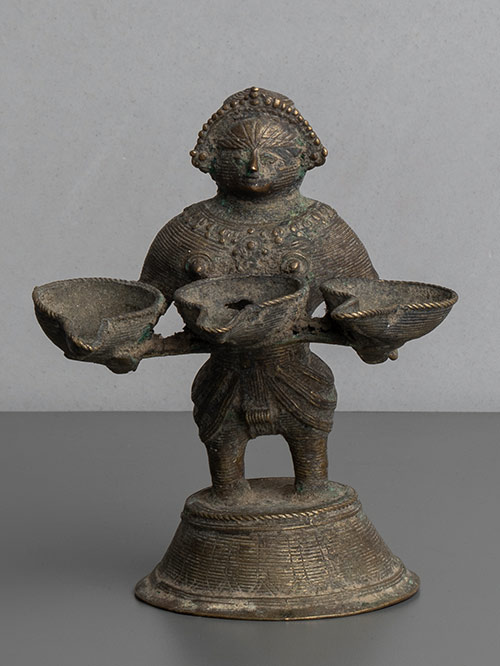
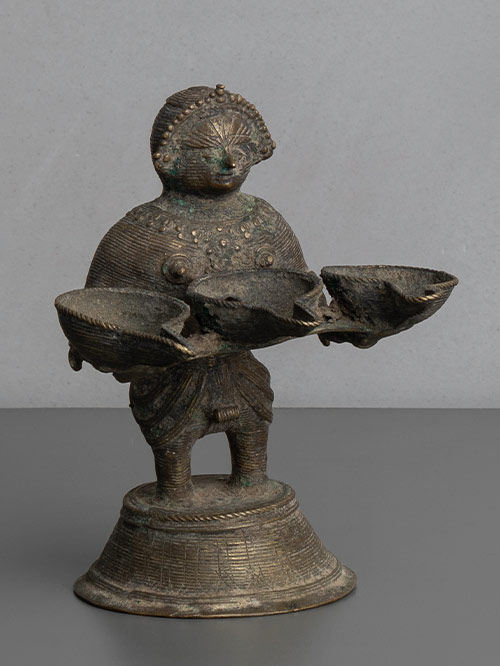
An unusual Dipalakshmi lamp from the Bastar region, in the form of a female figure standing holding three teardrop-shaped lamp bowls in her hands. The fine cross-hatching and details are typical of Bastar casting. Dipalakshmi, the Goddess of light and wealth, is usually shown holding the lamp bowl in her hands cupped in the gesture of anjali or offering of the flame of ‘divine light’ which, when lit, kindles light into the image.
Dhokra is non–ferrous metal casting using the lost-wax casting technique. This sort of metal casting has been used in India for over 4,000 years and is still used. One of the earliest known lost wax artefacts is the dancing girl of Mohenjo-Daro. The product of dhokra artisans is in great demand in domestic and foreign markets because of primitive simplicity, enchanting folk motifs and forceful form. Dhokra horses, elephants, peacocks, owls, religious images, measuring bowls, and lamp caskets, etc., are highly appreciated.
Size (cms): 14(H) x 12(W) x 12.5(D)
Size (inches): 5.5(H) x 4.5(W) x 5(D)
-
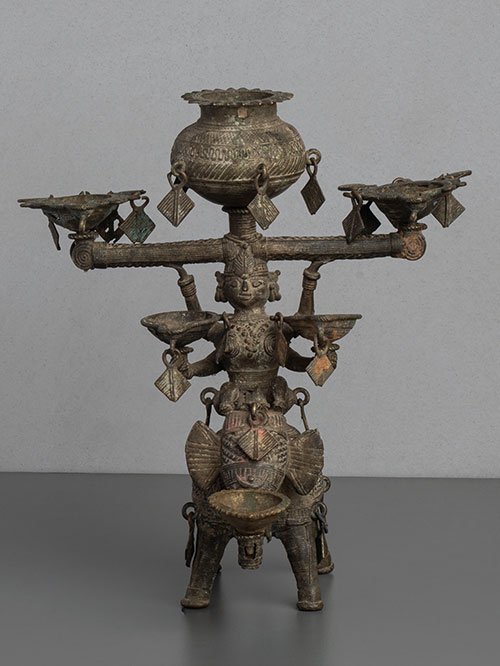
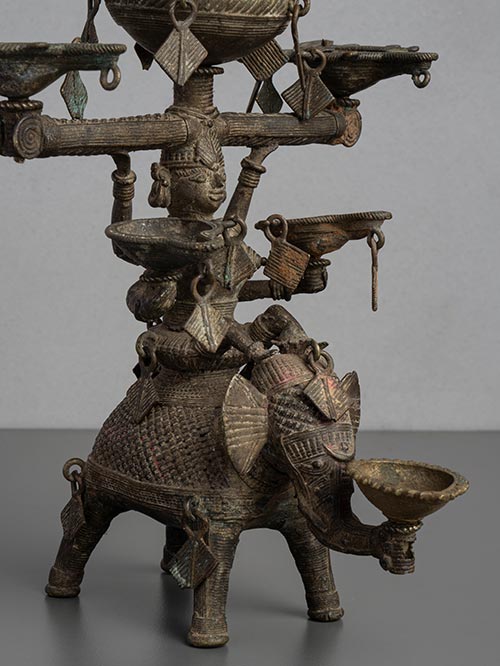
Bastar (Chhattisgarh, Central India)
Brass, Dokra work
An oil lamp depicting Panchdipa, the Goddess of Light who is depicted riding an elephant and bearing a kalasha, or pitcher for oil, on her head. The Goddess also provides support to four oil burners and the elephant holds an additional burner with his trunk. The fine cross-hatching and details are typical of Bastar casting.
Dhokra is non–ferrous metal casting using the lost-wax casting technique. This sort of metal casting has been used in India for over 4,000 years and is still used. One of the earliest known lost wax artefacts is the dancing girl of Mohenjo-Daro. The product of dhokra artisans is in great demand in domestic and foreign markets because of primitive simplicity, enchanting folk motifs and forceful form. Dhokra horses, elephants, peacocks, owls, religious images, measuring bowls, and lamp caskets, etc., are highly appreciated.
Size (cms): 23(H) x 21(W) x 17(D)
Size (inches): 9(H) x 8.5(W) x 6.5(D)
-
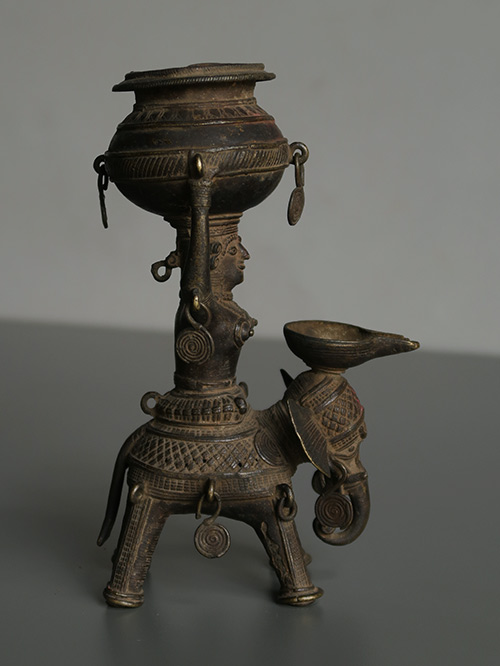
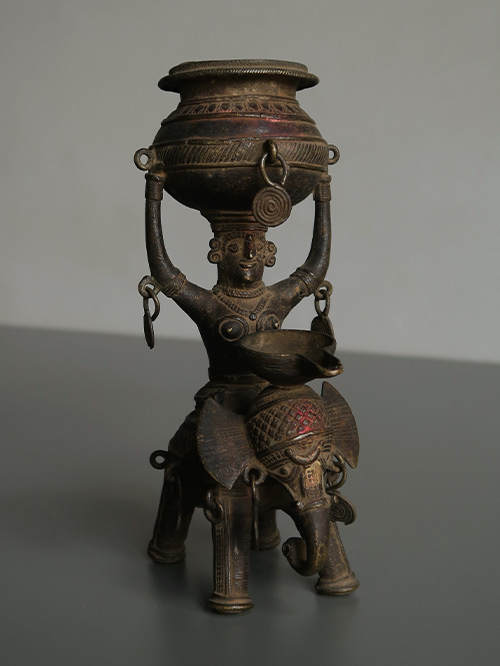
Bastar (Chhattisgarh, Central India)
Brass, Dokra work
An oil lamp depicting Panchdipa, the Goddess of Light who is depicted riding an elephant and bearing a kalasha, or pitcher for oil, on her head. The Goddess and elephant also provide support to a singular oil burner. The fine cross-hatching and details are typical of Bastar casting.
Dhokra is non–ferrous metal casting using the lost-wax casting technique. This sort of metal casting has been used in India for over 4,000 years and is still used. One of the earliest known lost wax artefacts is the dancing girl of Mohenjo-Daro. The product of dhokra artisans is in great demand in domestic and foreign markets because of primitive simplicity, enchanting folk motifs and forceful form. Dhokra horses, elephants, peacocks, owls, religious images, measuring bowls, and lamp caskets, etc., are highly appreciated.
Size (cms): 20(H) x 12.5(W) x 8.3(D)
Size (inches): 8(H) x 5(W) x 3.5(D)
-
Bihar (East India)
Brass Alloy
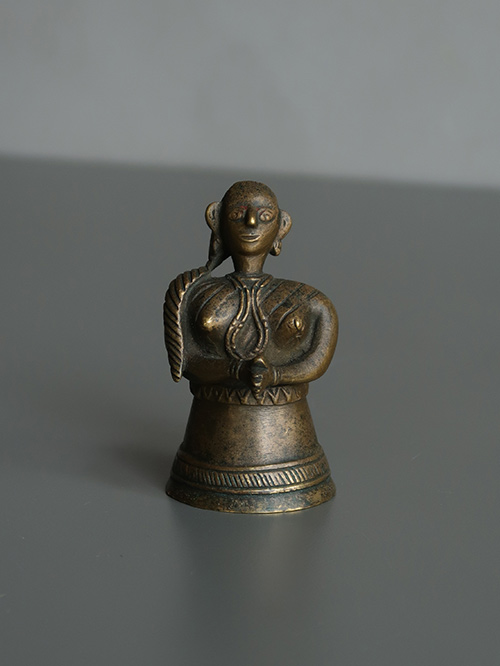
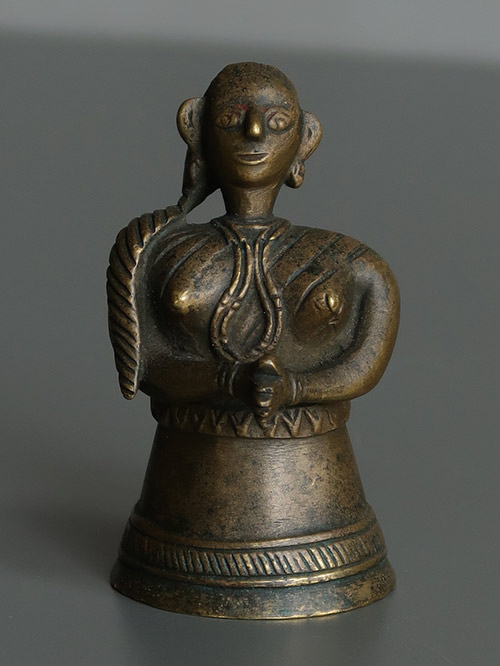
An unusual bell cast in the form a girl with her hands held in anjali mudra with her long braided hair resting across her shoulder. Such figures were made using the cire-perdue technique (lost-wax) using dhuna, a black wax-like substance.
Bells play in an important role in anu puja (worship), especially when offering aarati ( waving a camphor or oil lamp before the deity to ward off evil); the worshipper rings the bell with the right hand, holding the lamp in the left hand.
Size (cms): 8.5(H) x 4.6(W) x 5.6(D)
Size (inches): 3.5(H) x 2(W) x 2(D)
-

Kerala
Brass Alloy
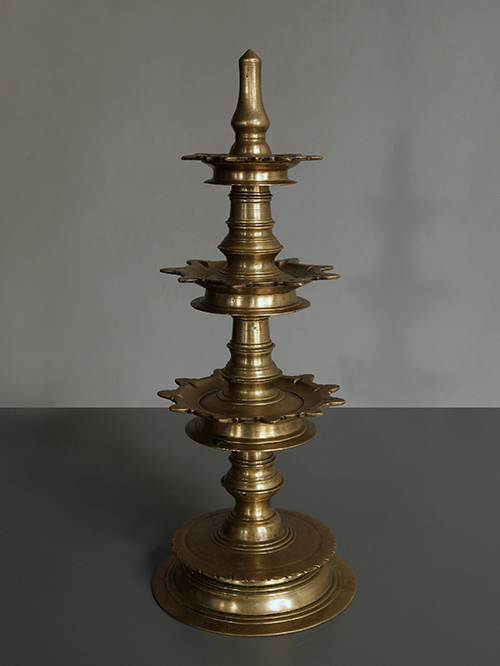
A striking three tiered Kerala temple lamp, called Ammai Villaku in Kerala.
The lamp is conceived as the vehicle through which the divine can be accessed. Lamps are used in rituals within the domestic realm, as well as religious or temple settings, in order to propitiate the gods. There are innumerable ways in which lamps are employed depending on the specific location and society. Within the more private setting of the home, the lamp is used in Hindu practice to activate the presence of the deity with the arati ritual – the moving of a lamp, held on a plate, in a circular fashion in front of an image. This allows the devotee to acknowledge and to accept blessings.
While the form of the lamp changes, depending on the religious context in which it is made and used, it is the lamp’s “carrying” of light that is significant, whether it takes the form of a goddess, an animal, or a tree. The preservation of light signifies the deity’s favour and presence. An intersection of the human and the divine is thus central to the crafting of the lamps and incense burners under consideration.
Size (cms): 60(H) x 20(W) x 20(D)
Size (inches): 23.5(H) x 8(W) x 8(D)
-
Kerala
Brass Alloy
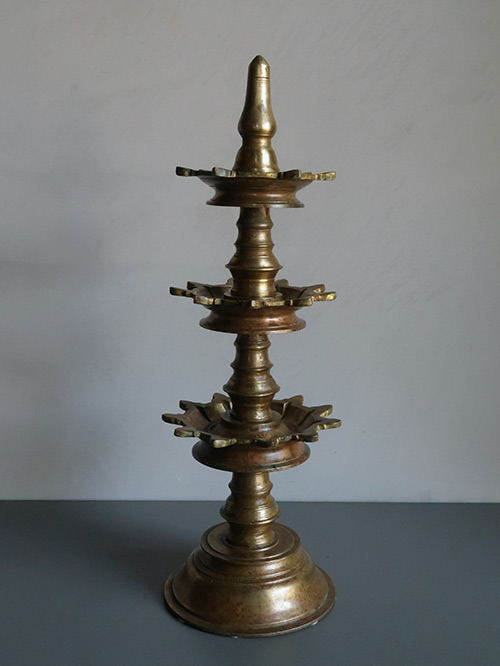
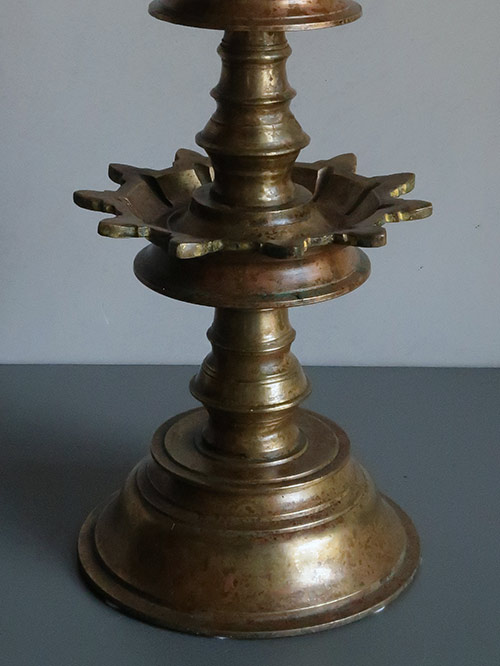
A striking three tiered Kerala temple lamp, called Ammai Villaku in Kerala.
The lamp is conceived as the vehicle through which the divine can be accessed. Lamps are used in rituals within the domestic realm, as well as religious or temple settings, in order to propitiate the gods. There are innumerable ways in which lamps are employed depending on the specific location and society. Within the more private setting of the home, the lamp is used in Hindu practice to activate the presence of the deity with the arati ritual – the moving of a lamp, held on a plate, in a circular fashion in front of an image. This allows the devotee to acknowledge and to accept blessings.
While the form of the lamp changes, depending on the religious context in which it is made and used, it is the lamp’s “carrying” of light that is significant, whether it takes the form of a goddess, an animal, or a tree. The preservation of light signifies the deity’s favour and presence. An intersection of the human and the divine is thus central to the crafting of the lamps and incense burners under consideration.
Size (cms): 59(H) x 21(Diam)
Size (inches): 23(H) x 8.5(Diam)
-

Kerala
Brass Alloy
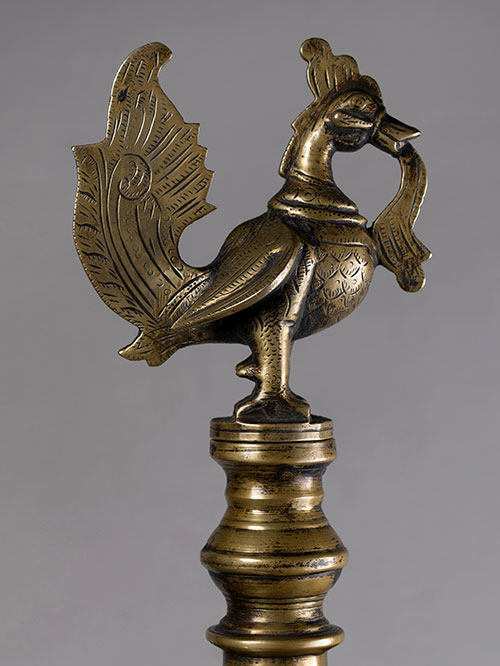
A fine five tiered Kerala temple lamp with a hamsa ( goose) final and a turtle (Kurma) base. These Kerala temple lamps are called Ammai Villaku – the turtle symbolising the primordial support of the universe of luminaries.
The lamp is conceived as the vehicle through which the divine can be accessed. Lamps are used in rituals within the domestic realm, as well as religious or temple settings, in order to propitiate the gods. There are innumerable ways in which lamps are employed depending on the specific location and society. Within the more private setting of the home, the lamp is used in Hindu practice to activate the presence of the deity with the arati ritual – the moving of a lamp, held on a plate, in a circular fashion in front of an image. This allows the devotee to acknowledge and to accept blessings.
While the form of the lamp changes, depending on the religious context in which it is made and used, it is the lamp’s “carrying” of light that is significant, whether it takes the form of a goddess, an animal, or a tree. The preservation of light signifies the deity’s favour and presence. An intersection of the human and the divine is thus central to the crafting of the lamps and incense burners under consideration.
Size (cms): 89.5(H) x 20(W) x 17(D)
Size (inches): 35(H) x 8(W) x 6.5(D)
-


Kerala
Brass Alloy
A fine three tiered Kerala temple lamp with a nandi bull final. These Kerala temple lamps are called Ammai Villaku.
The lamp is conceived as the vehicle through which the divine can be accessed. Lamps are used in rituals within the domestic realm, as well as religious or temple settings, in order to propitiate the gods. There are innumerable ways in which lamps are employed depending on the specific location and society. Within the more private setting of the home, the lamp is used in Hindu practice to activate the presence of the deity with the arati ritual – the moving of a lamp, held on a plate, in a circular fashion in front of an image. This allows the devotee to acknowledge and to accept blessings.
While the form of the lamp changes, depending on the religious context in which it is made and used, it is the lamp’s “carrying” of light that is significant, whether it takes the form of a goddess, an animal, or a tree. The preservation of light signifies the deity’s favour and presence. An intersection of the human and the divine is thus central to the crafting of the lamps and incense burners under consideration.
Size (cms): 88(H) x 32(W) x 32(D)
Size (inches): 34.5(H) x 12.5(W) x 12.5(D)
-
Kerala
Brass Alloy
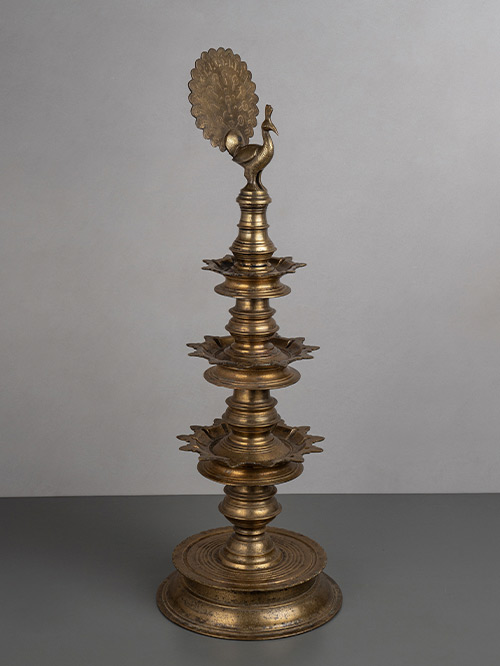
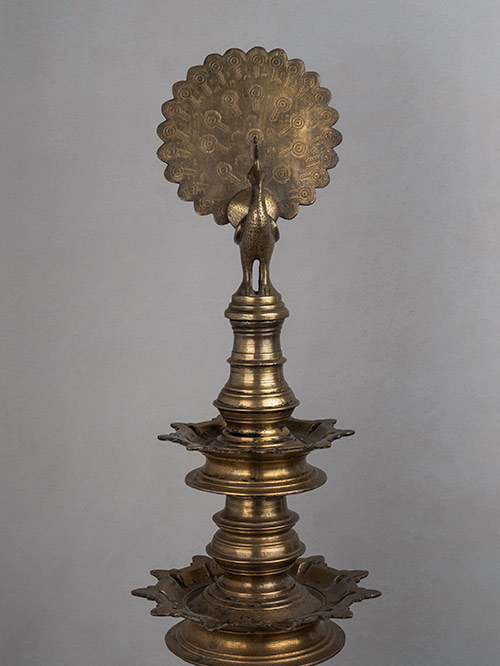
A fine three tiered Kerala temple lamp with a peacock final. These Kerala temple lamps are called Ammai Villaku.
The lamp is conceived as the vehicle through which the divine can be accessed. Lamps are used in rituals within the domestic realm, as well as religious or temple settings, in order to propitiate the gods. There are innumerable ways in which lamps are employed depending on the specific location and society. Within the more private setting of the home, the lamp is used in Hindu practice to activate the presence of the deity with the arati ritual – the moving of a lamp, held on a plate, in a circular fashion in front of an image. This allows the devotee to acknowledge and to accept blessings.
While the form of the lamp changes, depending on the religious context in which it is made and used, it is the lamp’s “carrying” of light that is significant, whether it takes the form of a goddess, an animal, or a tree. The preservation of light signifies the deity’s favour and presence. An intersection of the human and the divine is thus central to the crafting of the lamps and incense burners under consideration.
Size (cms): 89(H) x 32.5(W) x 32.5(D)
Size (inches): 35(H) x 13(W) x 13(D)