Filter products Showing all 4 results
Sort By
Filter By Style
Show Per Page
  • Mukhalingam

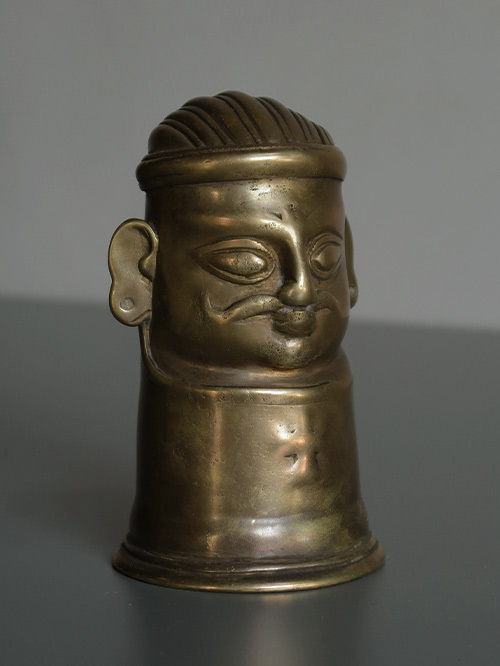
    Mukhalingam

    Karnataka (South India)

    brass

    Shiva is one of the three principal deities of Hinduism. He is labelled the ‘destroyer’ with the Trimurti, Hinduism’s trinity which includes Brahma and Vishnu. While sometimes depicted iconically, he is usually worshipped in the aniconic from of a lingam. The lingam is shaped like a pillar with a round top and can be made of stone, wood or metal. Mukha-linga signifies a visage or face on a metallic, cylindrical casting used to cover a stone lingam. The cover is thought to protect the viewer from the harm that could occur on visualization of the linga, especially one with eyes painted on its surface, which is believed to energize the figure. The metallic visage iconically depicts Shiva, wearing his characteristic moustache, earrings and matted hair.

    Size (cms): 14(H) x 9(W) x 8(D)
    Size (inches): 5.5(H) x 3.5(W) x 3.2(D)

  • Bhairava 'Demon Scarer'

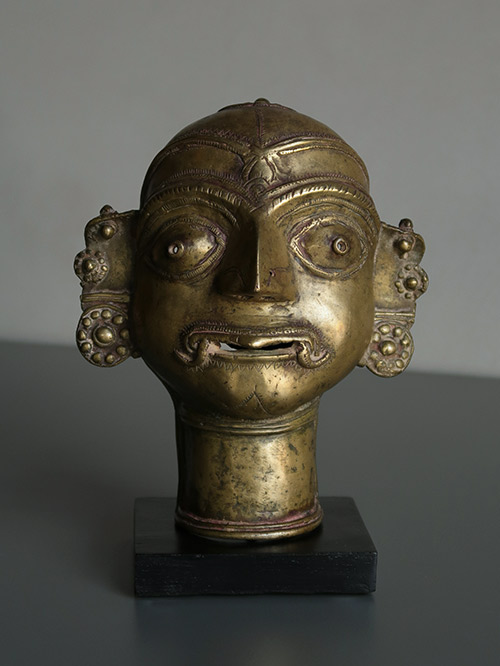
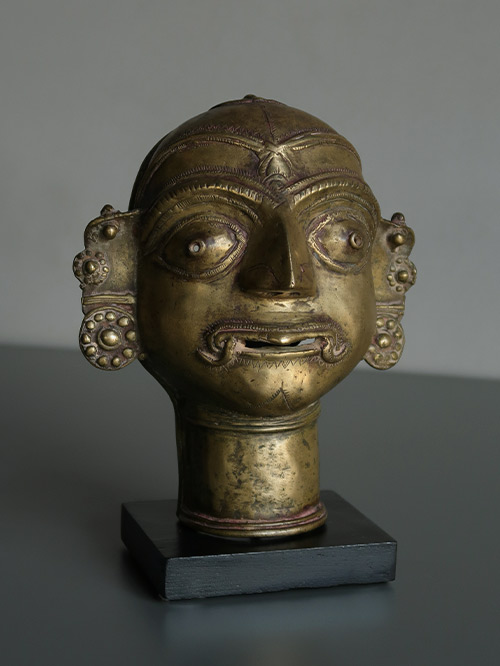
    Bhairava ‘Demon Scarer’

    Northern Karnataka (South India)

    brass

    A finely cast small Bhairava head, the ferocious form of Shiva. The head has a rounded tubular extension at its base, which would fit over a pole and could be carried above the heads of the populace during festivals and processions. The fanged visage has bulging eyes and cheeks and with finely cast earrings. A prominent third eye, a symbol of Shiva’s destructive force, is a key identifier. ⁠

    The use of monster figures and monster masks, usually made of bronze, was also used for this purpose. These mostly depicted a demonic form of Bhairava, one of the avatars of Shiva.  They were made with a rounded tubular extension at its base, which would fit over a  pole and could be carried above the heads of the populace during festivals and processions. A moustachioed visage was usually portrayed characterised by a vicious face with bulging eyes and cheeks and with a huge gaping mouth with large teeth and fangs. The forehead of the figure often carried the third eye, a symbol of Shiva’s destructive force, and sometimes also include sectarian marks consisting of three horizontally oriented straight or slightly curved lines. Other masks exhibited a distinct animal-like visage with huge teeth and a gigantic mouth. Those were often referred to as ‘tiger masks’. Some masks assumed the expression of a gargoyle with huge, bulging cheeks. Others incorporated composite features including tusks, bossing of the skull and occasionally the horns of a ram.

    Protective deities such as viras (deified heroes),  kshetrapalas (guardians), bhutas (spirits of various deities),  including some daivas (devils) were expected to provide protection against invaders, thieves, the elements- fire , storms, floods, drought, disease etc. Since the earth was populated by gods and their counterparts in the nether world, demons, evil spirits and ghosts, prayers, offerings and sacrifices were made to both groups to propitiate them.

    Size (cms): 18.5(H) x 15.5(W) x 9(D)
    Size (inches): 7.5(H) x 6(W) x 3.5(D)

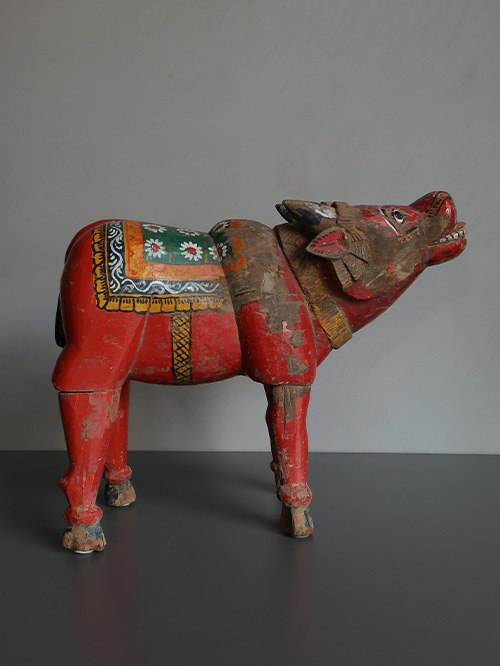
  • Bhuta Nandikona (Bull)

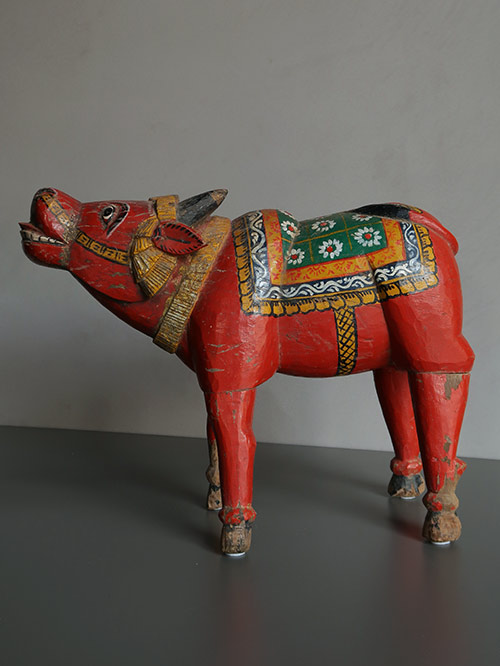
    Bhuta Nandikona (Bull)

    Coastal Karnataka (Bhuta culture)

    Wood, polychromed

    A large painted wood figure of a standing nandi. Displaying the typical folk bhuta style of coastal Karnataka, this figure is painted predominantly in red with a floral painted saddlecloth and a curled back tail resting on its back.

    The bhuta tradition is popular on the Malabar coast. Bounded by the dramatic sweep of the forested ghats to the east and the Arabian sea to the west, and encircled by rivers, the South Kanara district of coastal Karnataka has enjoyed relative geographic isolation until recent years. The totemic origin of this bull bhuta is quite obvious in a land of agriculture and farms where ploughs are pulled by bulls and where cow milk is one of the main sources of protein. The link with Hinduism is also easily established through Nandi the vahana (“vehicle”) of god Shiva.

    Size (cms): 36(H) x 46(W) x 16(D)
    Size (inches): 14(H) x 18(W) x 6.5(D)

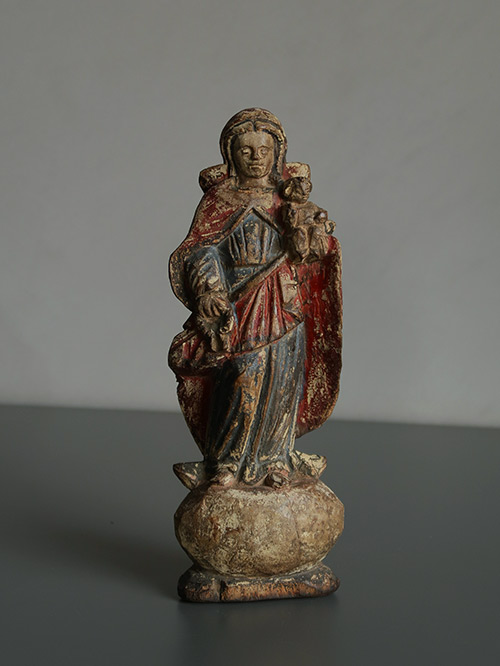
  • Virgin Mary with Child

    Virgin Mary with Child

    Goa (Indo-Portuguese)

    Polychromed wood

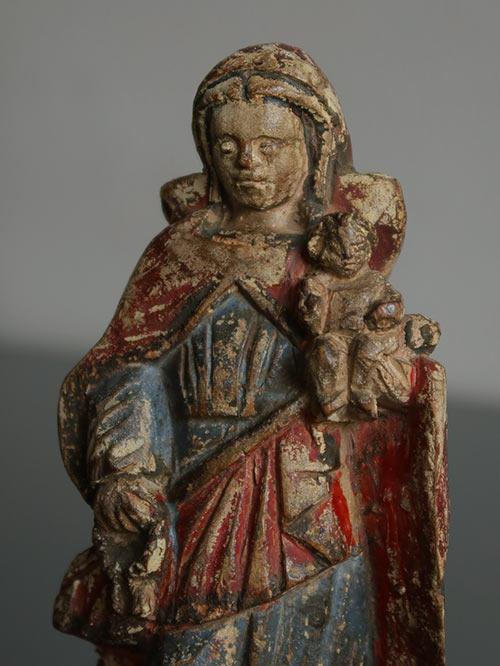
    A fine yet diminutive sculpture of the standing Virgin holding the infant Jesus of the Salvatore Mundi type, (Christ giving a benediction with his raised right hand and crossed fingers while holding a crystal sphere in his left hand). The figure of Mary has a slightly advanced right knee, typical of the Goan workshops. She wears a long blue patterned tunic with a round collar and a red cape is draped around her head. The style of the figure closely echoes the Portuguese rococo style with its graciousness and elaborate movement of drapery.

    Size (cms): 22(H) x 8(W) x 4.5(D)
    Size (inches): 8.5(H) x 3(W) x 2(D)
Phillips Antiques

PHILLIPS

Subscribe to our Newsletter to stay updated with newest arrivals.
SUBSCRIBE NOW
close-link