“Manorath Painting” has been added to your cart.
View cart
-
Central India
brass alloy
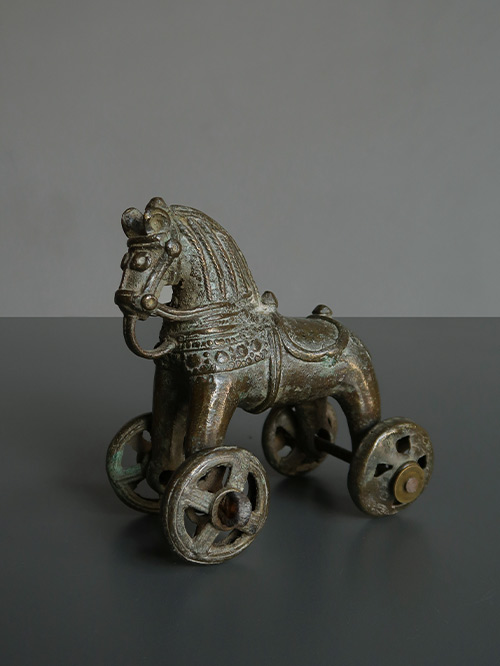
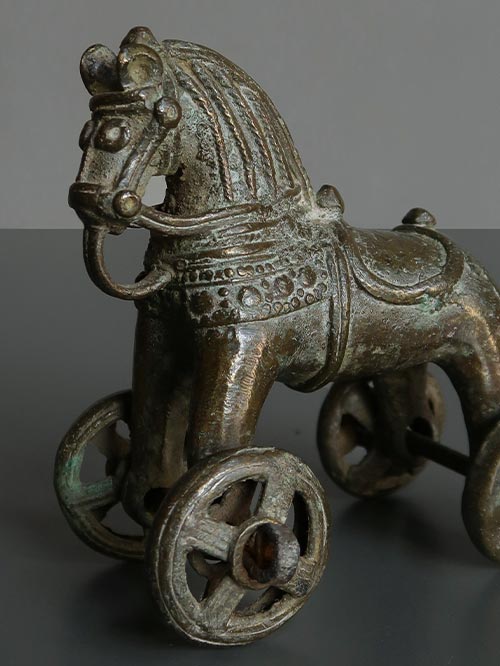
A lovely diminutive figure of a horse on wheels adorned with trappings and a decorated saddle cloth secured by ropes. Temple toys were used as ritual display in temples during important festivals such as Holi, Shivaratri and Durga Puja.
The horse played a pivotal role in establishing the supremacy of kings, as demonstrated, for instance by the great horse sacrifice, the Ashvamedha, which might have been established in the course of the Vedic period. Equestrian motifs appear prominently in Indian art, for example in Orissan sculpture of the 12th and 13th centuries, and in that of the late Vijaynagara and Nayak periods (early 16th to early 18th century) in southern India. There is a branch of literature specialising in the training of horses, which contains detailed passages on colouring, proportions, gait, auspicious and inauspicious marks and lists of appropriate names for horses.
Size (cms): 16.5(H) x 15.25(W) x 11(D)
Size (inches):6.5(H) x 6(W) x 4.5(D)
-
Deccan
Wood
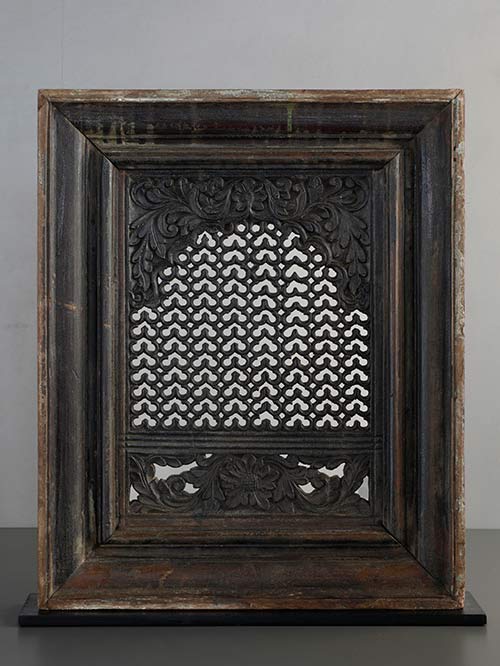
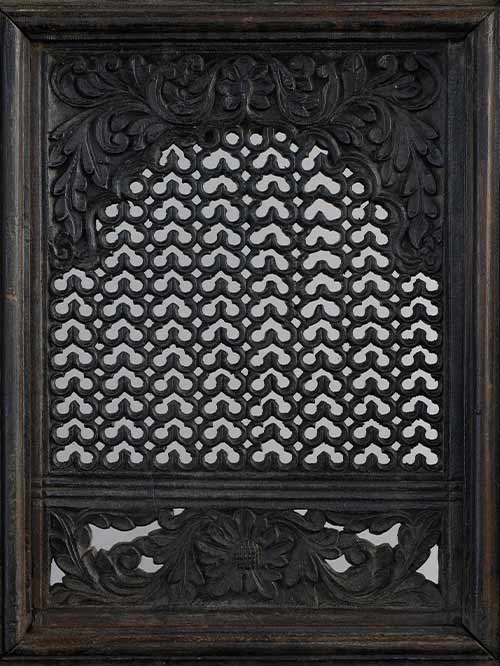
An enchanting play of light and shadow is created from this jali or lattice window. Ideal during the hot humid Indian summer, the jalis dispel the harsh rays of the sun and allow a cool breeze to circulate indoors. Moreover, the purdah- conscious women used the jalis of their balconies and terraces to enjoy an outside view, without being seen themselves by the public.
Wooden construction was once widespread throughout most of Southern India, but the intense heat and the severe monsoonal rains have meant that a large proportion of the wooden buildings in private and public use have now disappeared. The typical southern Indian wooden building, was supported on a framework of columns, with an elaborate system of interlocking brackets and beams to support the floors and roofs. Carved doors, windows, and screens and panels filter light and ventilate the interiors, creating an environment that is both comfortable and richly detailed. The scale and shape of houses was dictated by the maximum height and span of timber beams, resulting in a modular system of construction. The woodwork was deeply cut and naturalistic, the intention of the artisans was to capture the forms and energies of the natural world.
Size (cms): 63(H) x 54(W) x 11(D)
Size (inches): 25(H) x 21.5(W) x 4.5(D)
-
Nathdwara (Rajasthan)
opaque watercolour and gold on paper
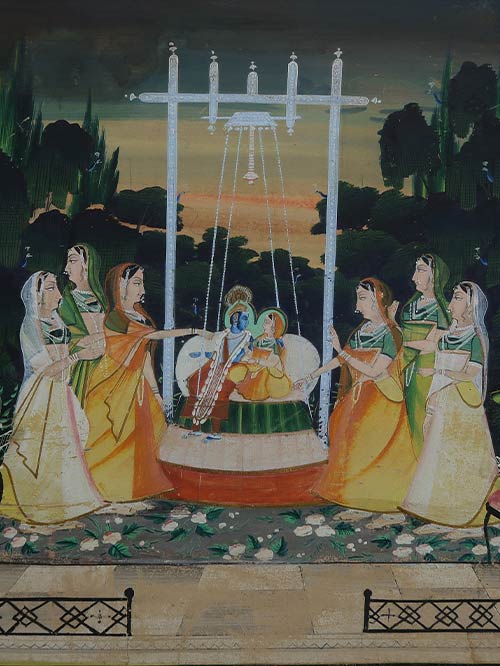
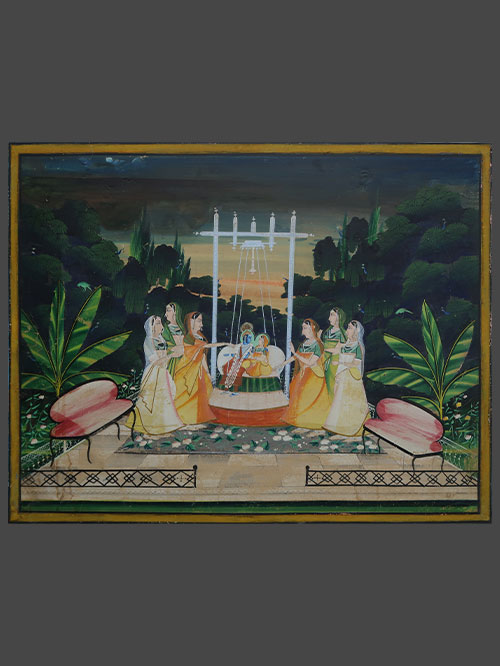
Krishna and Radha sit resting against a large white bolster on an ornate silver swing. Underfoot is a floral decorated carpet on a chequered marble floor with iron balustrades. Six female attendants flank the nimbate couple whose gazes are firmly fixed on each other. In the foreground are a pair of European style pink settees while in the distance an orange hued sky indicates the setting sun. Dense clusters of trees and foliage sprinkled with parrots and peacocks envelope the central scene.
Such large and dramatic scenes were painted by Nathdwara artists who produced these images for devotees who visited the great Krishna temple at Nathdwara in Rajasthan. Founded in the 17th century, this temple has attracted an enormous following even to this day, in turn ensuring a continuing tradition of devotional images. The extravagant size and conception of these paintings remind one of the constant importance of religious images in India, not only as ritual objects but also items for pilgrims to acquire and bring home from the great Hindu shrines.
Towards the end of the nineteenth century and early twentieth century Nathdwara artists were exposed for the first time to European art prints whose influence can be seen in the paintings of this period.
Size Painting (cms): 44.5 (H) x 57 (W)
Size Painting (inch): 17.5 (H) x 22.4 (L)
-
Nathdwara (Rajasthan)
Opaque watercolour, gold and gelatin silver print on paper
Inscribed on recto ‘Nathulal Kaluramji Sharma, Nathdwara’
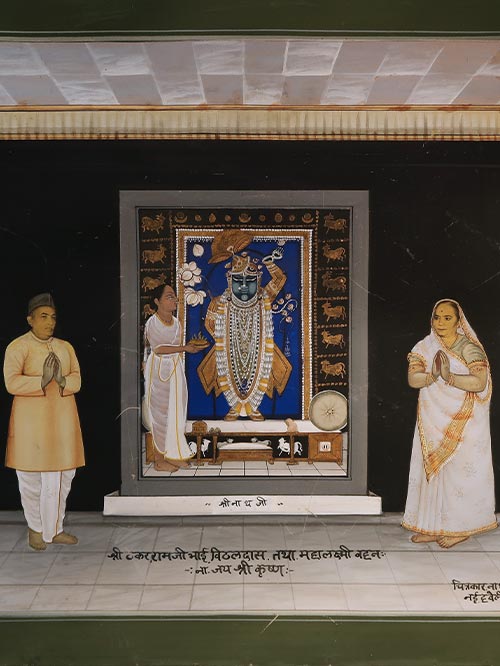
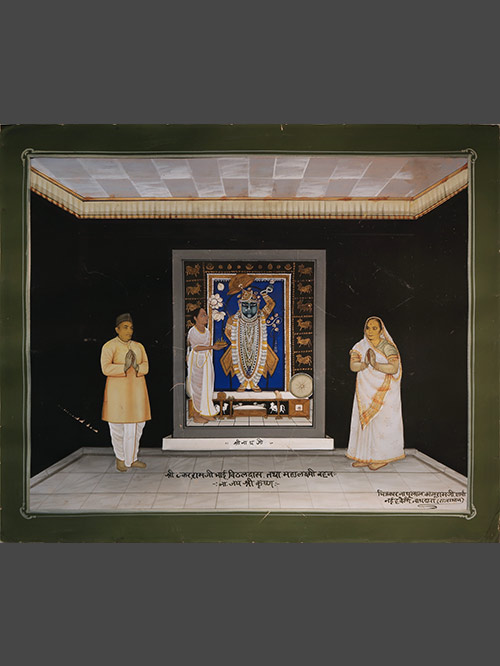
In Pushti Marga terminology, to perform a manoratha is to offer a seva ( ritualistic service) to the deity in fulfilment of a long cherished inner yearning to serve him in a special way on a particular day. Only a few select Goswamis, direct descendants of Vallbhacharya, are given this privilege and every Goswami longs to perform a manoratha at least once in a lifetime. A wealthy devotee can also perform a manoratha on an important day of his life or in the fulfilment of a vow. This is done by contributing towards the expenses of a particular darshana ( formal viewing of a deity) or by paying for the seva of an entire day. To commemorate this event, devotees usually commission a painting showing them on both sides of Srinathji outside the threshed of the sanctum. In the present painting actual photographs of the donors faces are incorporated into the painting. This served as a visual record of their worship before the famed icon.
Sri-Nathji ( The Lord of Shri, Goddess of Wealth) enshrined at Nathdwara is the most important svarupa (own form) in the Pushti Marga, and represents Krishna at the age of seven. Sri-Nathji is Krishna incarnate, the tutelary deity of the Vallabhacharya whose swarupa or image is enshrined at Nathdwara.
Painting Size (cms): 50.5 (H) x 60.5 (L)
Painting Size (inch): 19.9 (H) x 23.8 (L)
-
Delhi
pigments and gold on paper, painted gilt arabesque borders
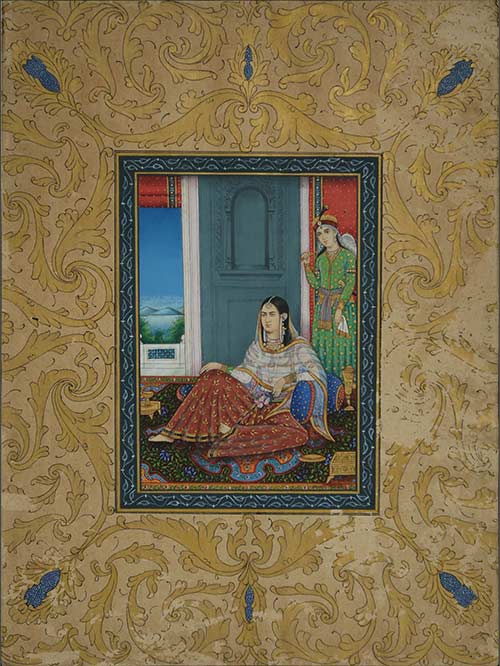
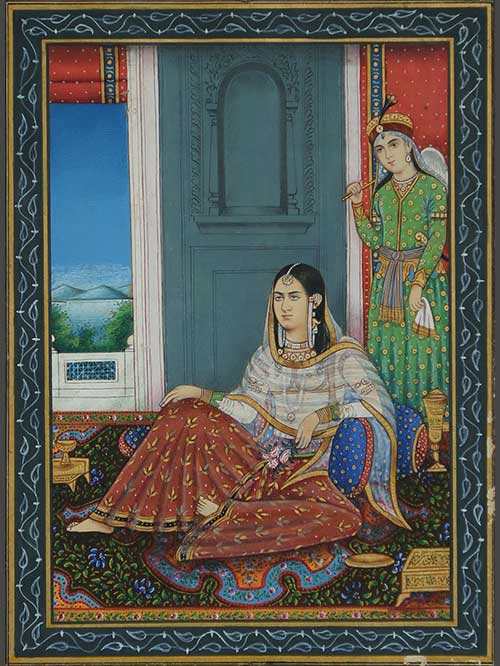
A finely painted portrait of a seated lady, most likely a courtesan, as suggested by her stance and attire. She wears loose fitting pyjamas and a bodice under a diaphanous odhani or veil and is seated against a large blue bolster. A female attendant stands behind her holding a fly-whisk. Assorted gilded cups and a betel box are placed beside her on an intricately patterned floral carpet. A scene of a moonlit lake and hills visible in the distance through a marbled balcony.
Courtesans (tawaifs) occupied an honoured place in the Muslim cultures of India, especially in Lucknow and Delhi. They were trained to be women of great refinement, skilled in music and dancing and appreciative of courtly literature in Persian and Urdu. Their company was eagerly sought by the great men of Delhi, and they would entertain their visitors by performing a nautch (dance).
Miniature Size (cms): 18.3 (L) x 13.5 (W)
Miniature Size (inch): 7.2 (L) x 5.3 (W)
Page Size (cms): 33.5 (L) x 25 (W)
Page Size (inch): 13.2 (L) x 9.8 (W)
-
Rewa (Central India)
pigments on paper
Company Painting, Signed by the artist Avadh Sharan
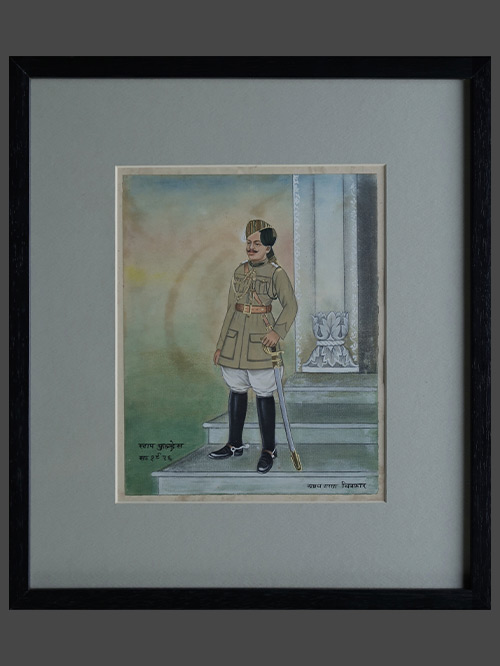
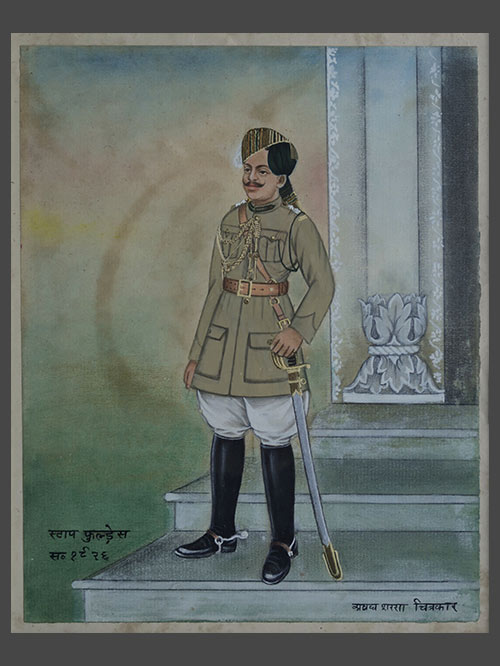
A charming Company painting of a Staff officer captioned, “Staff Full-dress 1926.” Military personnel were chiefly shown in full dress by-military artists and photographers. Yet the undress uniform is equally important since the greater part of the military personnel’s daily life was spent in their undress uniform. Full-dress uniform, also known as a ceremonial dress uniform or parade dress uniform, is the most formal type of uniforms used by military and police. Full-dress uniforms typically include full-size orders and medals insignia.
The military staff was a group of officers, enlisted and civilian staff who serve the commander of a division or other large military unit in his command in a control role through planning, analysis, and information gathering, as well as by relaying, coordinating, and supervising the execution of his plans and orders. During this period, the Indian army was a separate organisation to the British Army. The main task of the Indian Army was to police the Indian Empire. During the first and second world wars, Indian troops served with distinction in France in 1940, Egypt, Libya, the Sudan, Abyssinia, Syria, Persia, Iraq, Malaya and Burma.
Painting Size (cms): 22 (H) x 18 (W)
Painting Size (inch): 8.5 (H) x 7 (L)
Framed Size (cms): 36.5 (H) x 32 (W)
Framed Size (inch): 14.5 (H) x 12.5 (L)
-
Karnataka (South India)
brass alloy
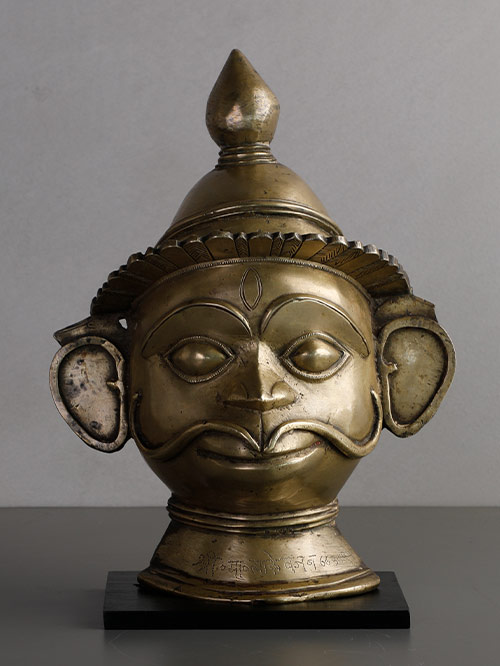
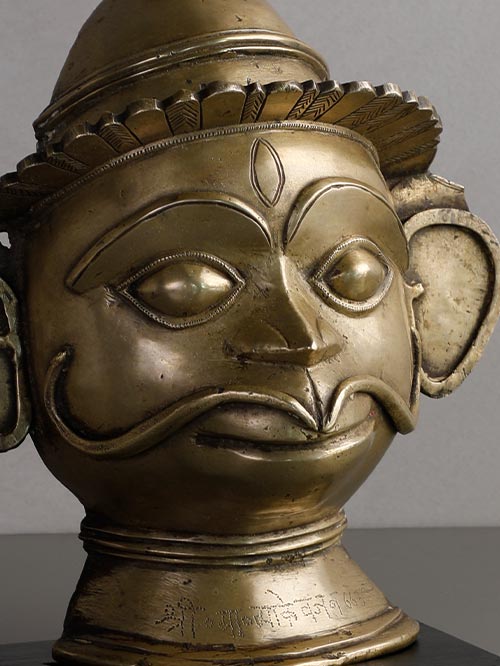
A striking Hanuman face with a protruding mouth and nose, curving moustache, bulging eyes and forehead tilaka. He wears a necklace and a rimmed and pointed crown.
Mukhavata or facial masks are two-dimensional metal castings of the crowned or turbaned heads of various deities, mostly manifestations of Shiva and Parvati. Included in this group are Khandoba, Mallanna, Gauri and Hanuman and their regional variants who are worshipped under different names.
Hindu devotees believe that when an icon is consecrated and its eyes anointed by the priest, the figure becomes a living god. In household shrines in Maharastra and Karnataka, the deity was considered a privileged house guest and treated accordingly. Images of the god were bathed, clothed, bejeweled and nourished in preparation for puja and darshan. Often elaborate turbans were placed on the head of the mukha-vata and bound by the finest cloths usually in the auspicious deep red colour. In some cases the masks were mounted on a wooden framework and covered with cloths. Sometimes separate metal cast arms and legs were attached to the figure, thus providing a more realistic depiction of the deity.
Size (cms): 35.5(H) x 26(W) x 11.5(D)
Size (inches): 14(H) x 10(W) x 4.5(D)
-
Karnataka (South India)
brass
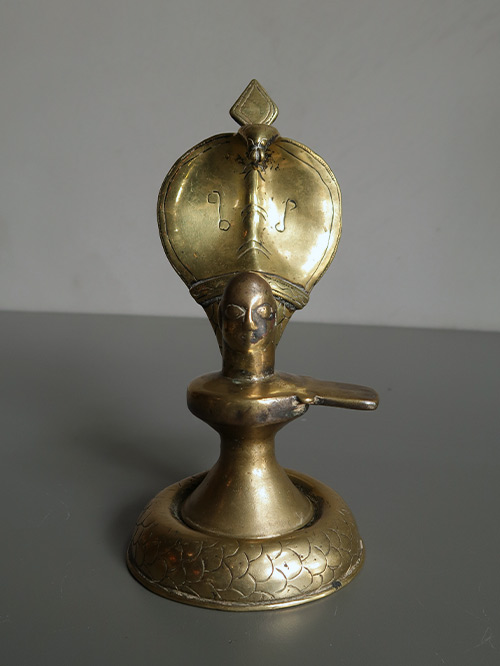
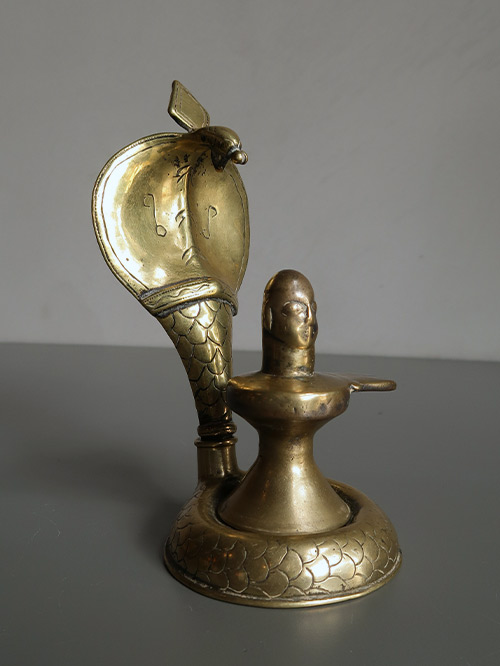
A finely cast lingam resting on the patterned coils of the serpent Vasuki which forms a canopy overhead.
The Lingam is an abstract or aniconic representation of the Hindu deity Shiva in Shaivism. Lingams are shaped like a pillar with a round top and were made of stone, wood or metal.Eventually, during the Kushan period (1st century to 3rd century CE) in north India, human faces came to be added to the lingams, hence the name mukhalinga. This object marks the presence of the invisible transcendental reality of Shiva, the Hindu god of destruction.
Size (cms): 19(H) x 6.5(W) x 9(D)
Size (inches): 7.5(H) x 2.5(W) x 3.5(D)
-
Karnataka
Wood, extensively polychromed
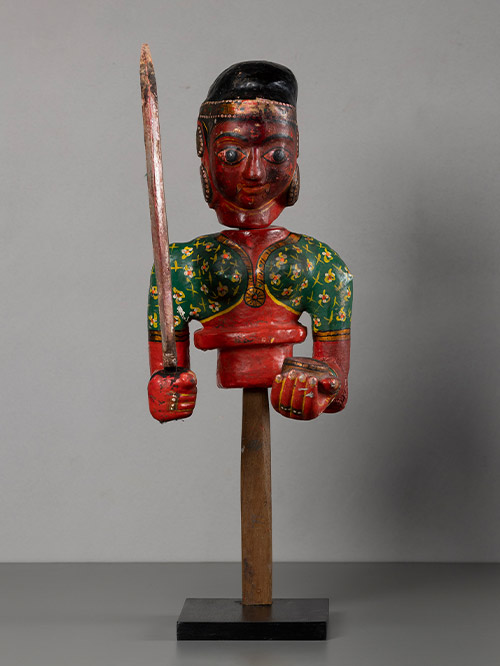
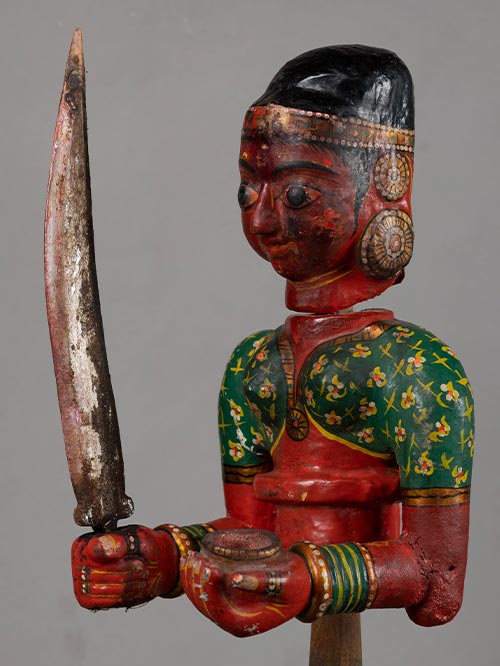
A fine two armed bust of the Goddess Durga wearing a patterned blue blouse. She is adorned with jewelled necklaces and bracelets and wears large globular earrings. In her hands she carries a sword and a bowl.
Durga – “The Unconquerable form of Devi” – Durga is the most splendid manifestation of Devi. Virginal and sublime, contain within her the power of all the gods combined, she is the invincible power of Nature who triumphs over those who seek to subjugate her. Durga is one of the names of the goddess that is the wife of Shiva. Durga has the role of a warrior goddess who destroys demons. She is usually depicted with ten arms that hold the weapons of the various gods. Her vahana is a lion which acts as her means of transportation and one of her many weapons.
During festive occasions, the utsavar (portable figures of deities) are placed on chariots or pedestals in the mandapam (audience hall of a temple) or on their respective vahana (vehicle) and taken out for public viewing or darshana. Darshana refers to the occasion where the devotee is not only able to see the image of the deity but also to sense its omnipresence.
Size (cms): 59(H) x 20(W) x 18(D)
Size (inches): 23(H) x 8(W) x 7(D)
-
Tibet
Wood, with original polychroming
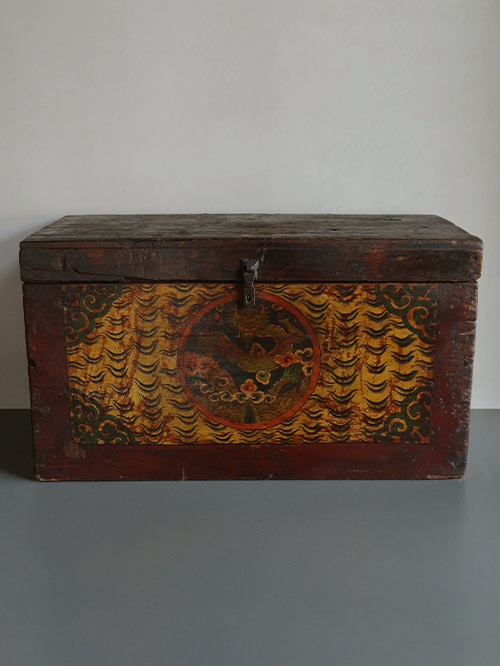
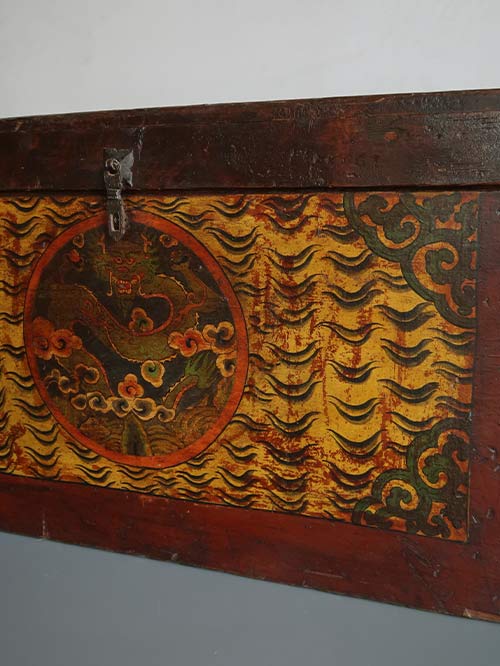
The chest is decorated in vibrant polychrome pigments with a central roundel enclosing a ferocious writhing dragon grasping a flaming pearl amongst cloud scrolls. The roundel is centred on top of a geometric tiger pattern which is set within cusped corner spandrels.
Tibetan chests and trunks were used as storage in homes and monasteries. Boxes are normally made from cedar, pine, or poplar. If they are painted it is usually just the front and two sides. They can either be painted directly on the wood or on some pieces onto a fabric applied to the wood. The colours and designs used are very decorative. It’s painted with paints mixed from minerals, as was the way during this period, and it will therefore always retain its vibrancy. The sides are decorated with stylised foliate panels.
Size (cms): 47(H) x 88(W) x 48.5(D)
Size (inches): 18.5(H) x 34.5(W) x 19(D)
-
Orissa (Eastern India)
Wood, extensively polychromed
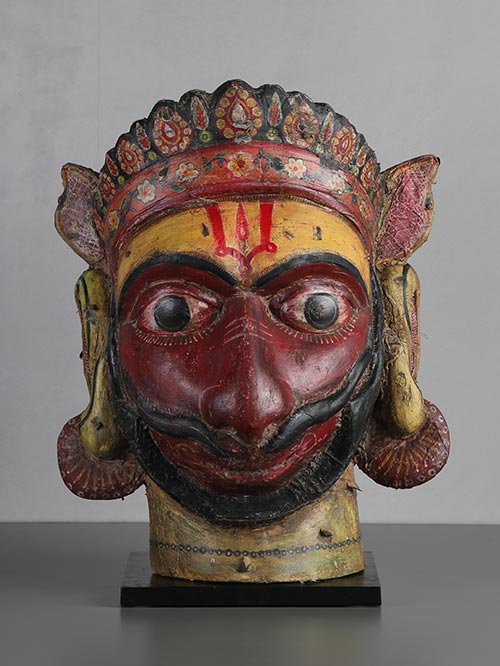
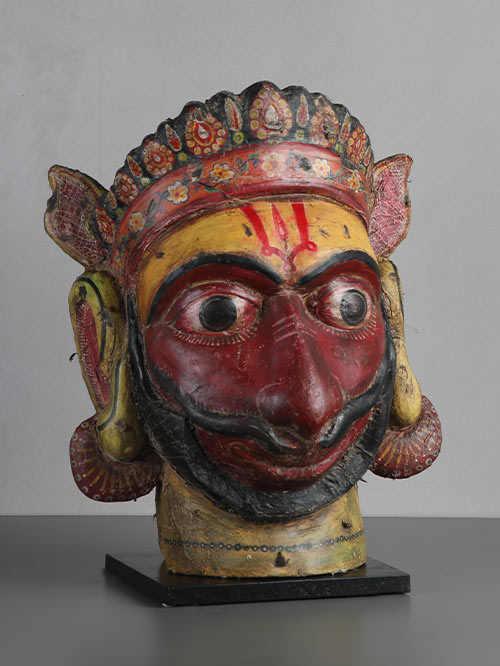
A magnificent and rare processional head in good condition with original colour and patina
Hanuman is a popular deity who is worshipped all over India, particularly in villages and in the South. His story is found in the Ramayana where he is the ubiquitous servant of Rama, the epitome of devoted service and loyalty. His search for the heroine Sita, captured by Ravana, illustrates his superhuman powers and zealous performance of the tasks that were given to him.
Shahi Jatras (royal processions) of Orissa present different episodes from the Ramayana during the spring season, usually lasting for for one week. Actors, carrying huge wooden masks and gorgeous costumes, walk on the streets with stylized gait and mime with the accompaniment of loud drumming. The Desia Nata of Koraput, Orissa, also uses masks for representing gods, goddesses, animals, birds and demons. These themes are also taken from Ramayana.
Size (cms): 56(H) x 46(W) x 43(D)
Size (inches): 22(H) x 18(W) x 17(D)