Filter products Showing all 10 results
Sort By
Filter By Style
Show Per Page
  • 'temple pillar' candlestand'temple pillar' candlestand

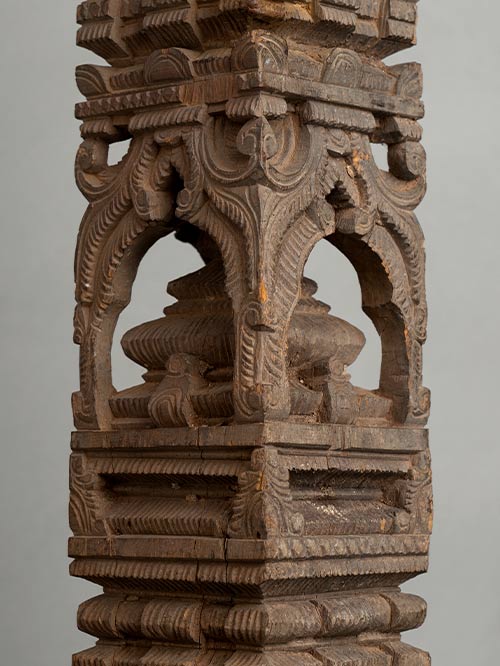
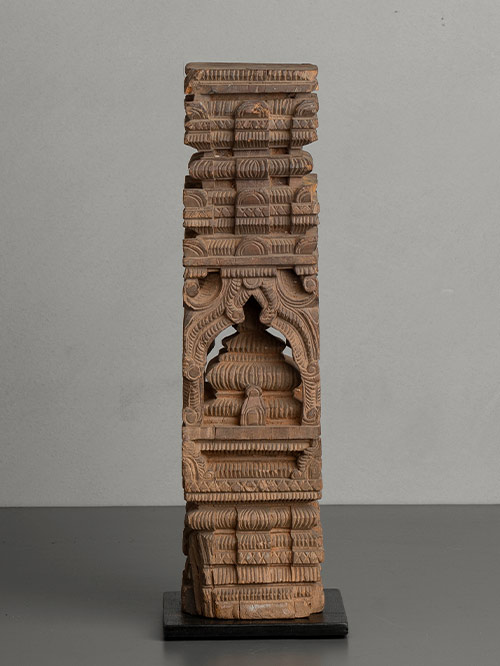
    ‘Temple Pillar’ Candlestand

    Tamil Nadu

    Wood

    An attractive candlestand which is unusually inspired by the temple pillars found in traditional Indian temples.

    Indian temple pillars exhibit a rich diversity of designs, styles, and intricate carvings that reflect the cultural and artistic heritage of the country. Different regions and time periods in India have produced distinct styles of temple architecture, and the pillars play a significant role in supporting the temple structures while also serving as platforms for artistic expression. The design of these pillars was influenced by architectural styles such as the Nagara and Dravidian, with careful consideration given to structural engineering principles, mathematical precision, and adherence to Vastu Shastra.

    Size (cms): 38(H) x 12(W) x 12(D)
    Size (inches): 15(H) x 4.5(W) x 4.5(D)

  • elephant chariot panelelephant chariot panel

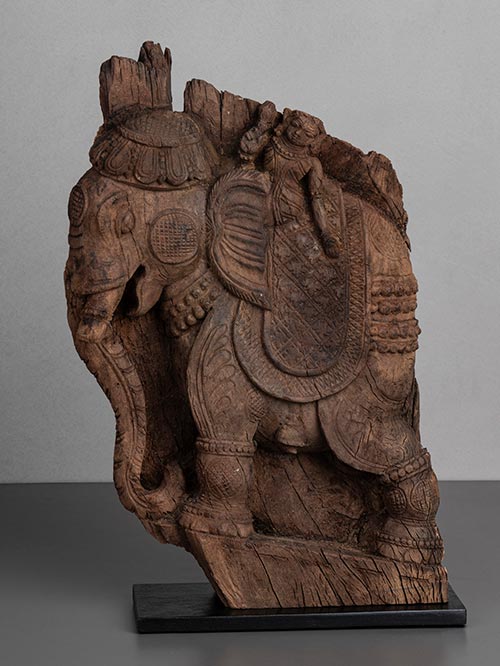
    Elephant Chariot Panel

    Tamil Nadu

    Wood

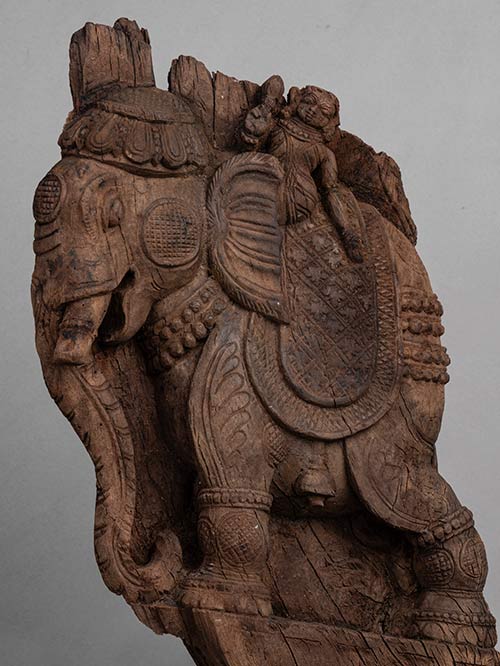
    A finely detailed chariot panel of caparisoned elephant with a mahout holding a chauri (fly-whisk).

    The elephant is an auspicious symbol in Indian and Southeast Asian cultures, embodying cosmic splendor and fertility. In mythology, Indra’s divine mount Airavata emerged from the ocean during its churning, linking elephants to life-giving rains. Revered in Buddhism as well, Siddhartha was conceived as a white elephant, and the welfare of elephants remained central to Indian rulers, including the Mughals.

    Chariots of Tamil Nadu, locally called ter, are intricate wooden structures of monumental size. The lower portion of the chariots are completely covered with timber panels carved with a wide range of figural and animal sculptures. These friezes, which constitute the finest wooden sculptures in the region, can be viewed only during the chariot festival; for the remainder of the year the chariots are parked in shelters to protect them from the sun and rain.

    Size (cms): 45(H) x 32(W) x 10(D)
    Size (inches): 17.5(H) x 12.5(W) x 4(D)

  • holy water carrier paintingholy water carrier painting

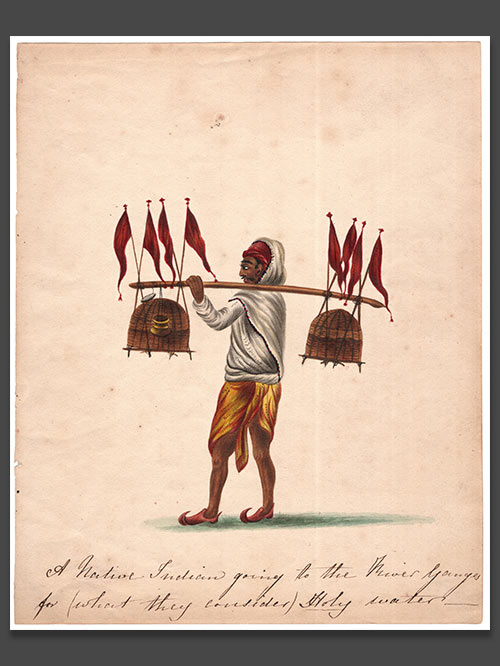
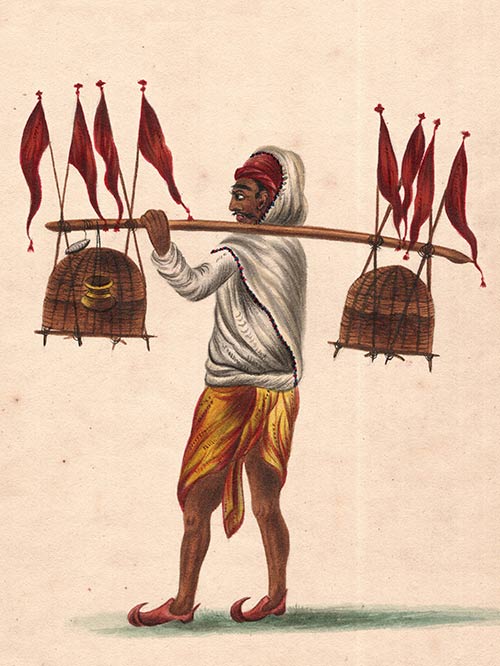
    Holy Water Carrier Painting

    Patna (Eastern India)

    Opaque watercolour on European paper

    This captivating Company Painting depicts a man carrying two baskets suspended on a pole, with red flags attached at either end. A brass lota peeks out from one of the baskets. The water carrier is on his way back from Benares carrying the holy water from the sacred river

    Under the Mughals Patna had never been a great artistic centre and although its Muhammadan governors had employed Mughal artists, there is no evidence that any strongly marked local style had developed. Yet Patna, like Murshidabad, was undergoing a social revolution and various circumstances in the later eighteenth century were to make it a centre of Indian-British painting. As a result of its increasing prosperity, a number of artists of the Kayasth caste were attracted to Patna from Murshidabad. One of these was a certain Sewak Ram, who had migrated there by I790. He began to produce sets of occupations as well as large paintings of ceremonies and festivals. One such set, now in the India Office Library, was purchased by Lord Minto, while a painting from a similar set in the Indian Department of the Victoria and Albert Museum was acquired by Lord Amherst when he was Governor-General (August 1823 to March 1828). British taste in the early nineteenth century shows itself in both subjects and colour range – sepia wash enlivened with touches of brighter colour – adopted by the Patna artists.

    Painting Size (cms): 23(H) x 18.5(W)
    Painting Size (inches): 9(H) x 7.5(W)

  • panjurli (boar) maskpanjurli (boar) mask

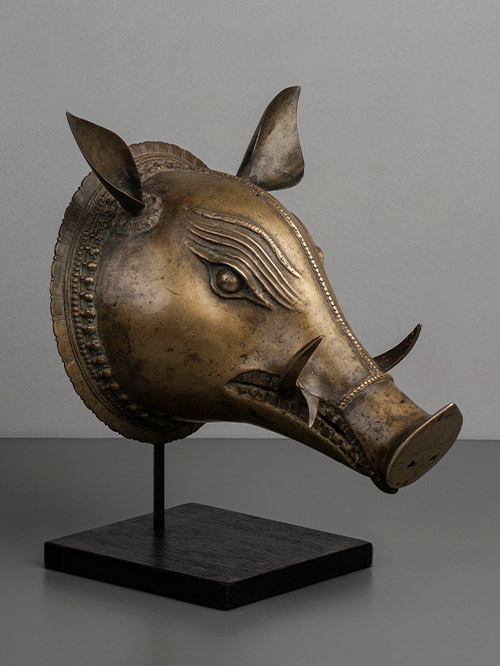
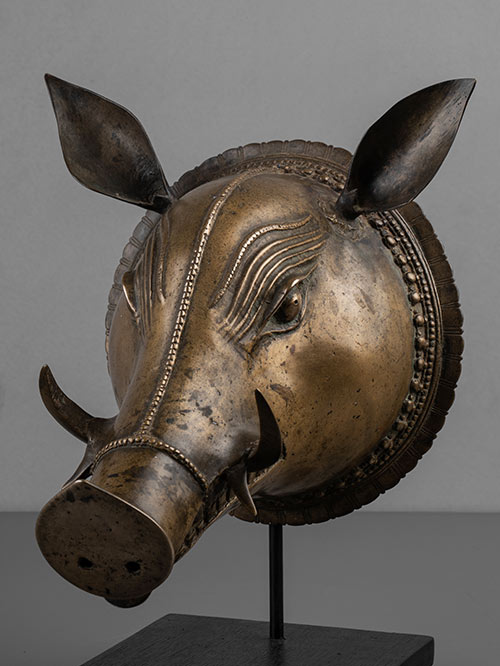
    Panjurli (Boar) Mask

    Coastal Karnataka (South India)

    brass alloy

    A finely detailed Panjurli (boar) mask with a symmetric conical shape, attractive colour, and rich patina. The head is adorned with a central vertical beaded rope that encircles the snout at one end and the head at its widest point. Features such as the eyes, ears, tusks, and snout are meticulously crafted.

    This mask comes from the bhuta tradition on the Malabar coast. The bhuta and daiva, local divine or deified beings are highly prevalent in the southern parts of the Kannara district. Though now largely confined to south Kannara, certain areas of north Kannara and even Sri Lanka, bhuta cults once existed all over India under different names and forms. These cults, which are of considerable antiquity, have much in common with those of the yakshas, for instance. Like bhutas, yakshas are a ‘queer blend of what is sublime and mundane, profound and profane.’⁠⠀

    In Tulu Nadu, hordes of boars often invaded and destroyed the cultivated lands so the farmers started worshipping and giving offerings to Panjurli, the spirit in the form of a boar, thinking that this would appease his mood and thus keep the wild animals away from their fields.

    Mask Size (cms): 27(H) x 26(W) x 33(D), 35(H with stand)
    Mask Size (inches): 10.5(H) x 10(W) x 13(D), 14(H with stand)

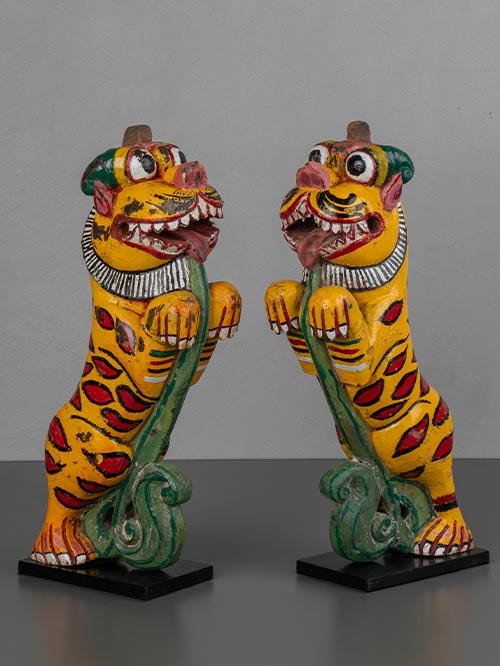
  • pair of tiger bracketspair of tiger brackets

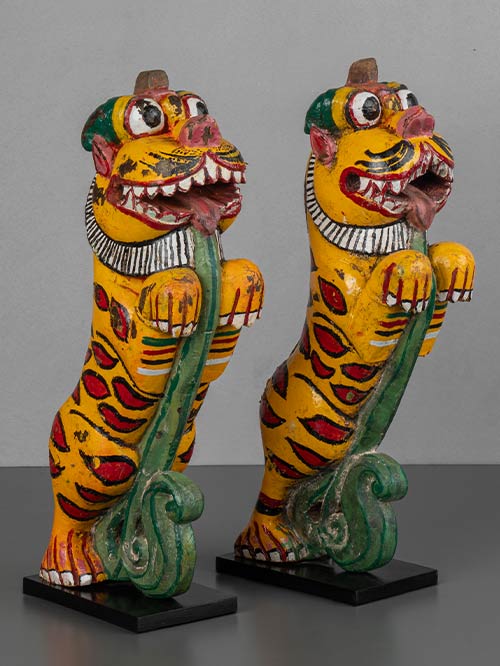
    Pair of Tiger Brackets

    Karnataka

    Wood, polychromed

    A delightful, richly polychromed pair of rearing tiger brackets. The wide-eyed tigers have large open mouths, exposing their fangs and long, protruding tongues. They stand on their hind legs, and their muscular torsos are painted with red and black bubris (stripes). Their forelegs are raised, as if poised to pounce, and swirling foliage sprouts from their raised paws.

    The tiger is the vehicle of, and sacred to, the Hindu goddess, Durga. From a certain perspective she is India’s Mother Nature, for she is the deification of Energy. Her consort, Shiva, sometimes evoked as Shambo, wears a tiger skin to indicate that he is beyond the bounds of the natural world.

    Individual Sizes (cms): 44.5(H) x 22(W) x 10(D) each
    Individual Sizes (inches): 17.5(H) x 8.5(W) x 4(D) each

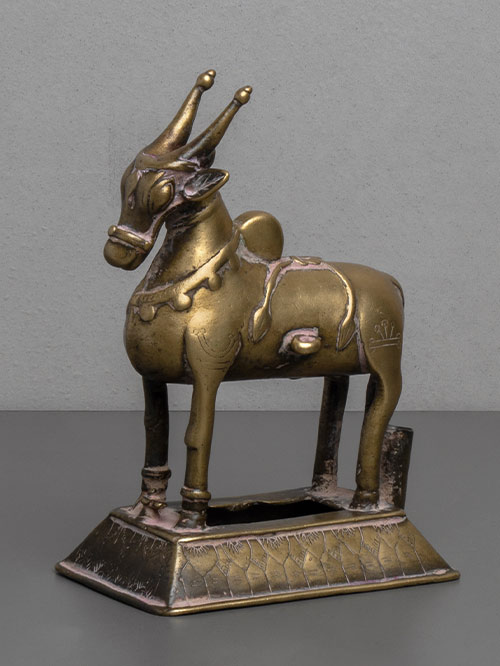
  • nandinandi

    Nandi

    Karnataka (South India)

    brass alloy

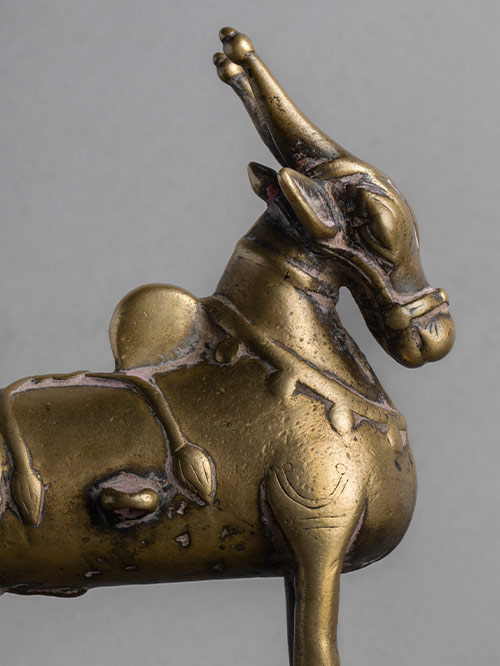
    This gracefully proportioned standing Nandi is delicately incised with head and neck ornaments and stands on a trapezoidal base.

    Nandi or nandin, the bull vahana of Shiva has always been noted for his strength and virility. Usually depicted in a life-like naturalistic manner, Nandi is present in every Shaivite temple, often with his own temple enclosure but facing the Shiva lingam. Figures like this of Nandi on a platform base with a cobra canopy are common objects of worship, especially found in home shrines.

    Size (cms): 16.5(H) x 10.8(W) x 7.6(D)
    Size (inches): 6.5(H) x 4.5(W) x 3(D)

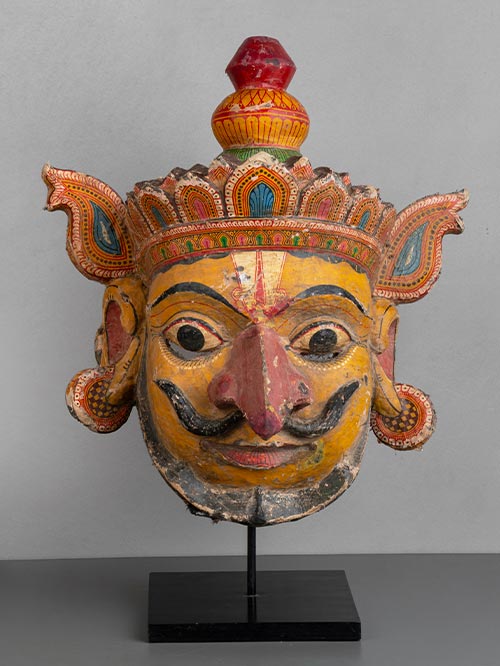
  • garuda dancing maskgaruda dancing mask

    Garuda Dancing Mask

    Orissa

    Wood, polychromed

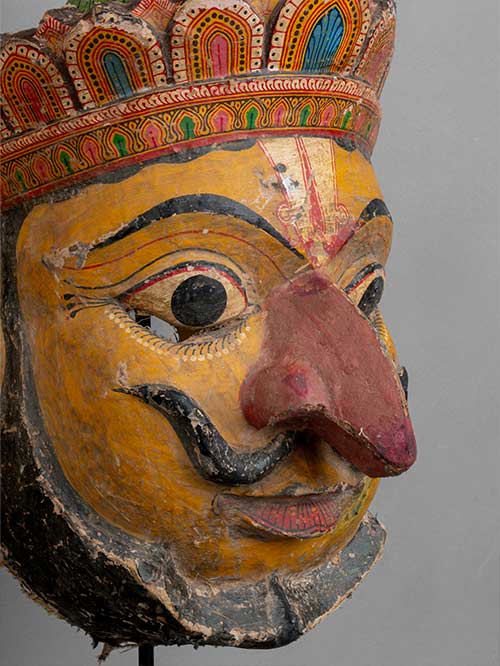
    A magnificent and rare Ramlila festival mask from Orissa, in excellent condition with original colour and patina. Notable features include a Vaishnavite tilak (mark), a tiered crown with geometric and floral motifs and an upturned moustache emanating from a large beaked nose. Two large earrings with decorative swirls hang from his elongated ears and tiny ovular slits have been cut out beneath the eyes to help the dancer navigate while wearing the mask.

    Garuda is often shown as the mount of Vishnu. He was originally (in the Rig Veda) regarded as the sun in the form of a bird but this association was taken over by Surya. His earliest appearance in Indian sculpture was as a mythical bird forming part of the animal kingdom paying homage to the Buddha. The necessity of emphasising its mythological aspect resulted in characteristic distortions of its form combining sometimes a parrot like beak and human elements and wearing ear-rings. By the end of the Pallava period the bird element in his appearance had shrunk to a beak-like nose and wings attached to an otherwise human body. In this form he is usually shown with two hands (often in anjali mudra).

    Shahi Jatras (royal processions) of Orissa present different episodes from the Ramayana during the spring season, usually lasting for for one week. Actors, carrying huge wooden masks and gorgeous costumes, walk on the streets with stylized gait and mime with the accompaniment of loud drumming. The Desia Nata of Koraput, Orissa, also uses masks for representing gods, goddesses, animals, birds and demons. These themes are also taken from Ramayana.

    Mask Size (cms): 55(H) x 48(W) x 28(D), 66(H with stand)
    Mask Size (inches): 21.5(H) x 19(W) x 11(D), 26(H with stand)

  • lakshmilakshmi

    Lakshmi

    Published at the Ravi Varma Press, Karla, Lonavla

    by Raja Ravi Varma

    chromolithograph with fabric appliqué

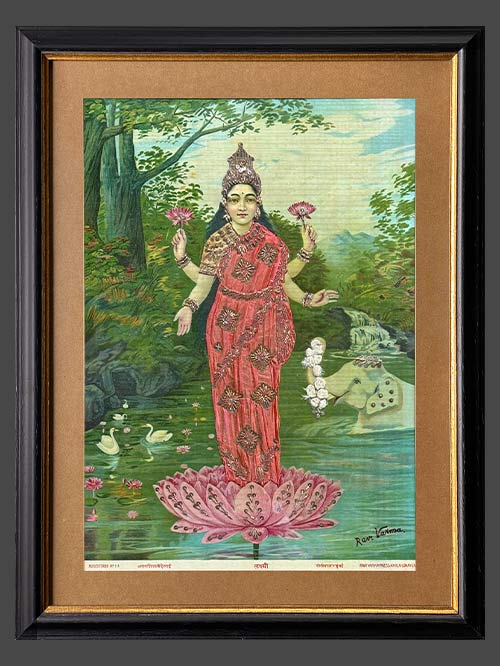
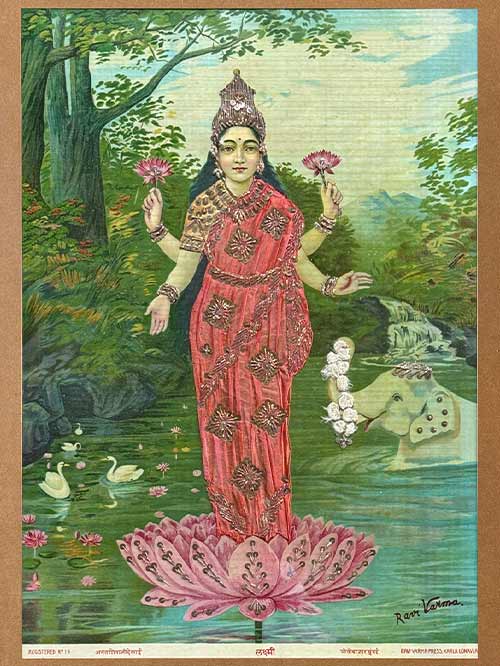
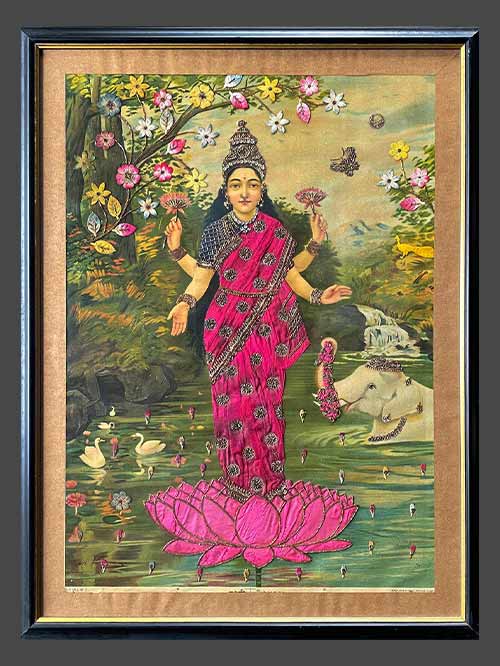
    Lakshmi, the goddess of beauty, prosperity, luck and wealth- is shown standing on a lotus emerging from a river, an elephant (gaja) half submerged, stands to her left holding a garland in his trunk. A cascading waterfall in the background. Lakshmi has four arms, the upper two holding lotuses and the lower two in Abhayamudra (a gesture of reassurance, safety) and Varadamudra (gesture of granting of wishes).

    Ravi Varma occupies an important place in Indian art history. He developed a painting style that appropriated the illusionary techniques of European oil painting with traditional Indian subject matter. The popularity of Ravi Varma’s paintings gave him the idea to make oleographs that would be available to the general public, instead of only elite patrons. Oleographs, also called chromolithographs, are multi-colour art prints, stemming from the process of lithography. 

    These immensely popular chromolithographs from the Ravi Varma press quickly set a new iconographical standard for the traditional Indian heroes and deities. Often the figures were embellished with embroidered sequins and other decorative material, creating vibrant pulsating images. 

    Image Size (cms): 49.5 (H) x 34.5 (W)
    Image Size (inches): 19.5 (H) x 13.6 (W)

    Framed Size (cms): 62 (H) x 48.5 (W)
    Framed Size (inches): 24.5 (H) x 19 (W)

  • large lakshmi and saraswati pairlarge lakshmi and saraswati pair

    Large Lakshmi and Saraswati Pair

    Published at the Ravi Varma Press, Malavli, Lonavla

    by Raja Ravi Varma

    chromolithograph with fabric appliqué

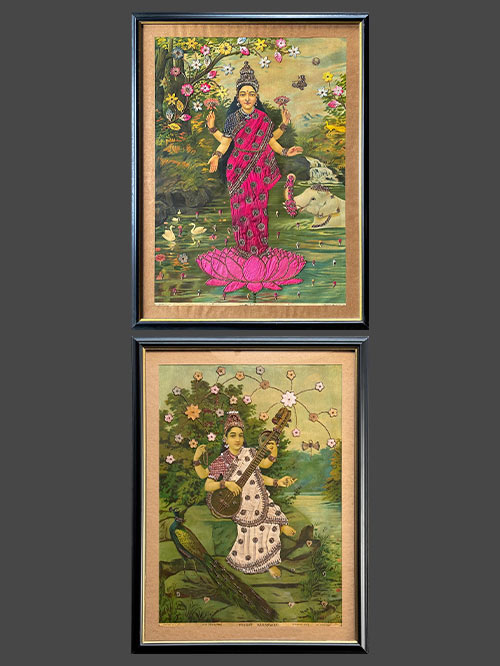
    Lakshmi, the goddess of beauty, prosperity, luck and wealth- is shown standing on a lotus emerging from a river, an elephant (gaja) half submerged, stands to her left holding a garland in his trunk. A cascading waterfall in the background. Lakshmi has four arms, the upper two holding lotuses and the lower two in Abhayamudra (a gesture of reassurance, safety) and Varadamudra (gesture of granting of wishes).

    Saraswati is the goddess of speech and learning, the inventor of Sanskrit, patroness of the arts and the wife of Brahma. Four armed, she is shown seated holding a rosary and a book and playing the veena. A peacock ( her vahana or vehicle) stands to her right. 

    Ravi Varma occupies an important place in Indian art history. He developed a painting style that appropriated the illusionary techniques of European oil painting with traditional Indian subject matter. The popularity of Ravi Varma’s paintings gave him the idea to make oleographs that would be available to the general public, instead of only elite patrons. Oleographs, also called chromolithographs, are multi-colour art prints, stemming from the process of lithography. 

    These immensely popular chromolithographs from the Ravi Varma press quickly set a new iconographical standard for the traditional Indian heroes and deities. Often the figures were embellished with embroidered sequins and other decorative material, creating vibrant pulsating images. 

    Image Size (cms): 69 (H) x 49 (W)
    Image Size (inches): 27 (H) x 19.3 (W)

    Framed Size (cms): 82.5 (H) x 62.3 (W)
    Framed Size (inches): 32.5 (H) x 24.5 (W)

  • shantanu and matsyagandhashantanu and matsyagandha

    Shantanu and Matsyagandha

    Published at the Ravi Varma Press, Malavli, Lonavla

    by Raja Ravi Varma

    chromolithograph with fabric appliqué

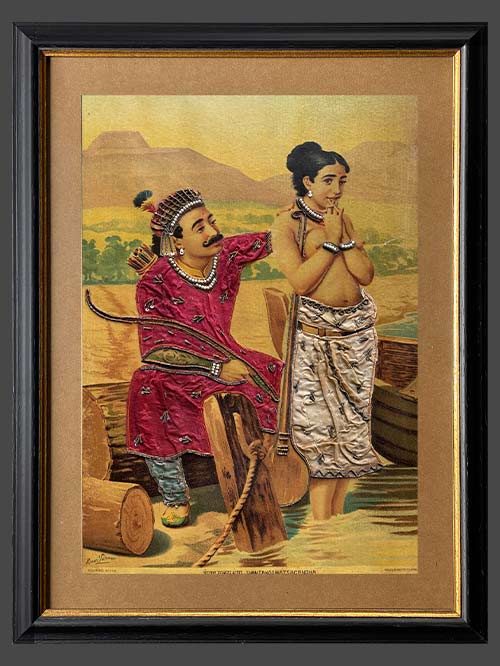
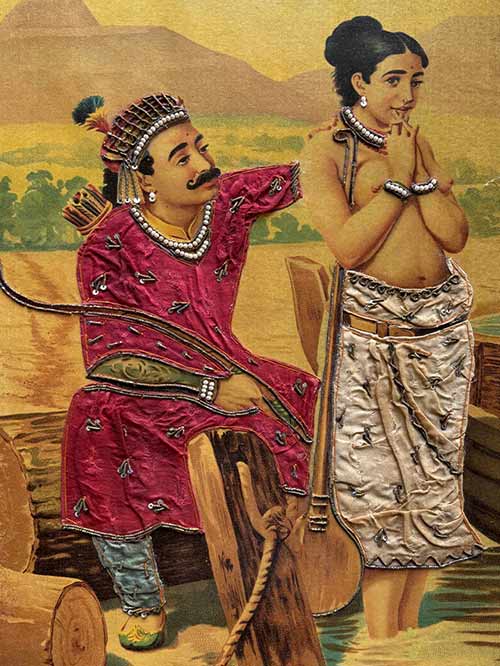
    King Shantanu’s encounter with Satyavati, also known as Matsyagandha, marks a pivotal episode in the Mahabharata, skilfully captured by Raja Ravi Varma on oil, later published as an oleograph. While hunting along the Ganga’s banks, Shantanu is drawn by the intoxicating scent of musk and discovers its source in Satyavati, a fisherwoman raised by a fisherman who found her as an infant inside a fish. Enchanted by her beauty, Shantanu desires to marry her, but Satyavati agrees only on the condition that her future children inherit the throne, denying Shantanu’s son Devavrata (later Bhishma) his rightful claim. Initially hesitant, Shantanu consents after Devavrata vows lifelong celibacy to uphold his father’s happiness. The union results in two sons, Chitrangada and Vichitravirya, setting the stage for the Mahabharata’s complex lineage and conflicts. Varma’s artwork portrays this moment of enchantment, with Shantanu in regal attire, captivated by Satyavati’s charm, as she stands poised with an oar, embodying her fisherwoman origins and fateful allure.

    Ravi Varma occupies an important place in Indian art history. He developed a painting style that appropriated the illusionary techniques of European oil painting with traditional Indian subject matter. The popularity of Ravi Varma’s paintings gave him the idea to make oleographs that would be available to the general public, instead of only elite patrons. Oleographs, also called chromolithographs, are multi-colour art prints, stemming from the process of lithography. 

    These immensely popular chromolithographs from the Ravi Varma press quickly set a new iconographical standard for the traditional Indian heroes and deities. Often the figures were embellished with embroidered sequins and other decorative material, creating vibrant pulsating images. 

    Image Size (cms): 49.5 (H) x 34.5 (W)
    Image Size (inches): 19.5 (H) x 13.6 (W)

    Framed Size (cms): 62 (H) x 48.5 (W)
    Framed Size (inches): 24.5 (H) x 19 (W)
Phillips Antiques

PHILLIPS

Subscribe to our Newsletter to stay updated with newest arrivals.
SUBSCRIBE NOW
close-link