“Mukhalingam with Naga” has been added to your cart.
View cart
-

Karnataka (South India)
brass
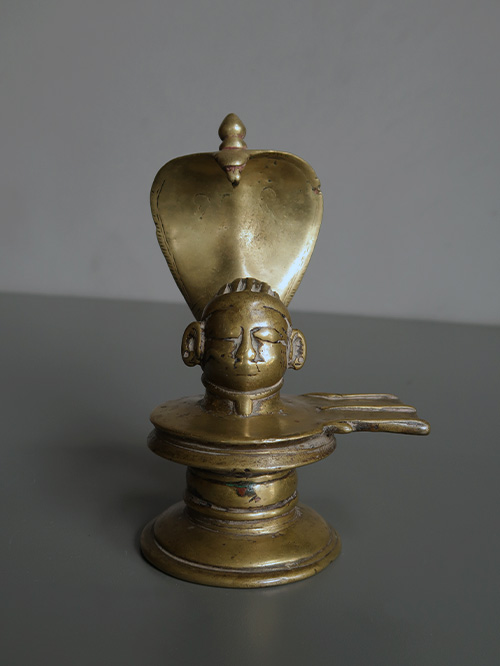
A finely cast Mukha lingam with a serpent canopy that extends overhead.
The Lingam is an abstract or aniconic representation of the Hindu deity Shiva in Shaivism. Lingams are shaped like a pillar with a round top and were made of stone, wood or metal.Eventually, during the Kushan period (1st century to 3rd century CE) in north India, human faces came to be added to the lingams, hence the name mukhalinga. This object marks the presence of the invisible transcendental reality of Shiva, the Hindu god of destruction.
Size (cms): 16(H) x 10(W) x 9(D)
Size (inches): 6.5(H) x 4(W) x 3.5(D)
-
Karnataka (South India)
brass
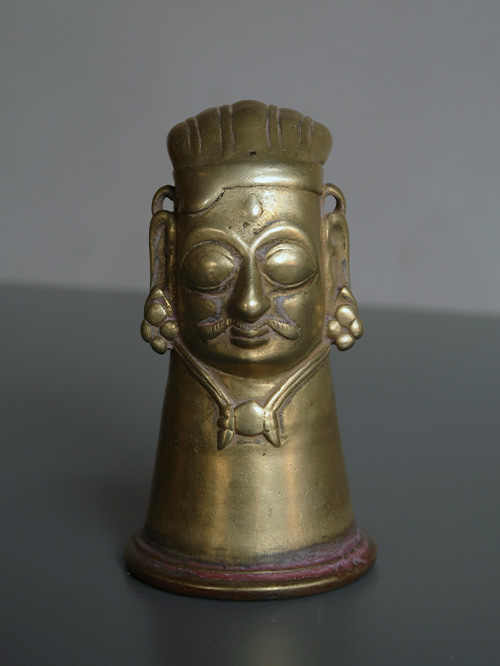
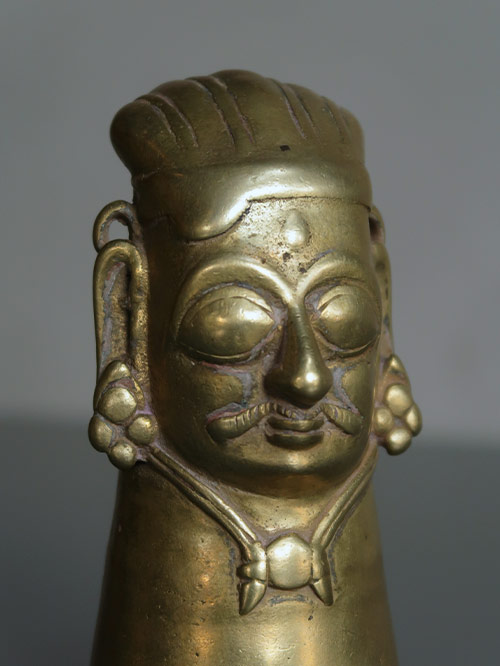
Shiva is one of the three principal deities of Hinduism. He is labelled the ‘destroyer’ with the Trimurti, Hinduism’s trinity which includes Brahma and Vishnu. While sometimes depicted iconically, he is usually worshipped in the aniconic from of a lingam. The lingam is shaped like a pillar with a round top and can be made of stone, wood or metal. Mukha-linga signifies a visage or face on a metallic, cylindrical casting used to cover a stone lingam. The cover is thought to protect the viewer from the harm that could occur on visualization of the linga, especially one with eyes painted on its surface, which is believed to energize the figure. The metallic visage iconically depicts Shiva, wearing his characteristic moustache, earrings and matted hair.
Size (cms): 14.5(H) x 7.7(Diam)
Size (inches): 5.5(H) x 3(Diam)
-

Karnataka (South India)
brass
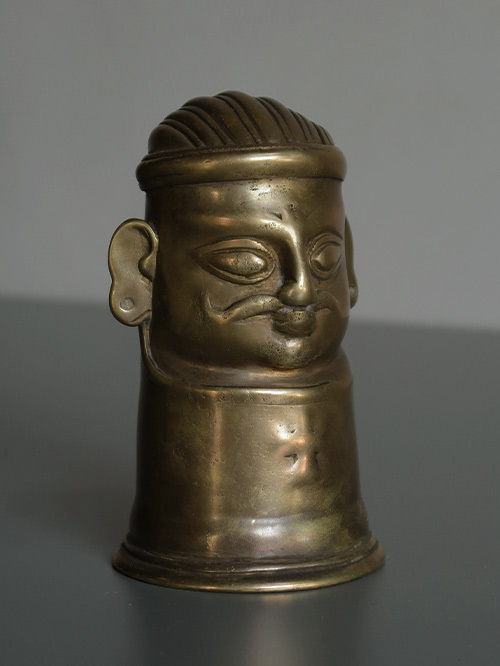
Shiva is one of the three principal deities of Hinduism. He is labelled the ‘destroyer’ with the Trimurti, Hinduism’s trinity which includes Brahma and Vishnu. While sometimes depicted iconically, he is usually worshipped in the aniconic from of a lingam. The lingam is shaped like a pillar with a round top and can be made of stone, wood or metal. Mukha-linga signifies a visage or face on a metallic, cylindrical casting used to cover a stone lingam. The cover is thought to protect the viewer from the harm that could occur on visualization of the linga, especially one with eyes painted on its surface, which is believed to energize the figure. The metallic visage iconically depicts Shiva, wearing his characteristic moustache, earrings and matted hair.
Size (cms): 14(H) x 9(W) x 8(D)
Size (inches): 5.5(H) x 3.5(W) x 3.2(D)
-
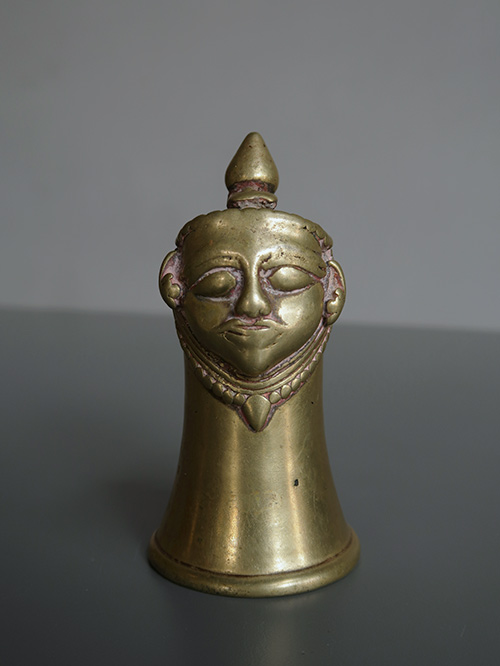

Karnataka (South India)
brass
Shiva is one of the three principal deities of Hinduism. He is labelled the ‘destroyer’ with the Trimurti, Hinduism’s trinity which includes Brahma and Vishnu. While sometimes depicted iconically, he is usually worshipped in the aniconic from of a lingam. The lingam is shaped like a pillar with a round top and can be made of stone, wood or metal. Mukha-linga signifies a visage or face on a metallic, cylindrical casting used to cover a stone lingam. The cover is thought to protect the viewer from the harm that could occur on visualization of the linga, especially one with eyes painted on its surface, which is believed to energize the figure. The metallic visage iconically depicts Shiva, wearing his characteristic moustache, earrings and matted hair.
Size (cms): 12.5(H) x 6.3(Diam)
Size (inches): 5(H) x 2.5(Diam)
-
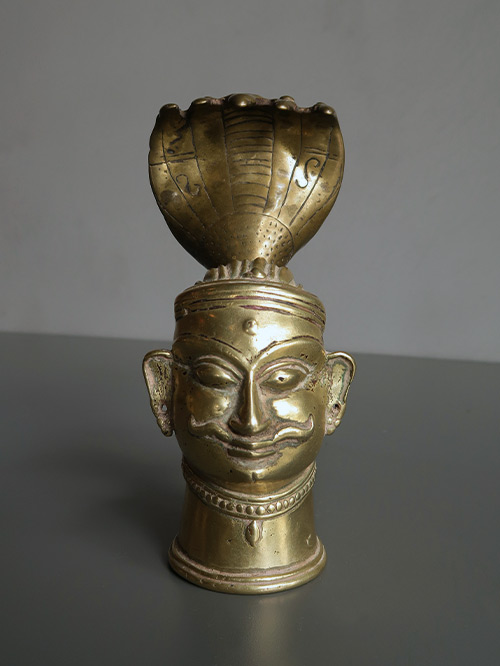
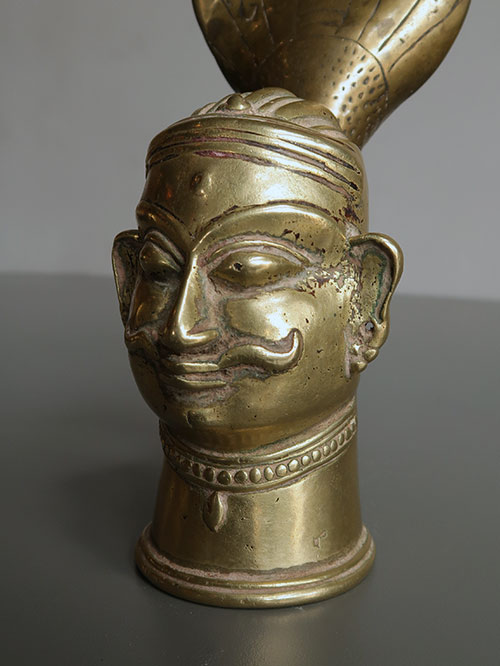
Karnataka (South India)
brass alloy
A finely cast Mukhalingam with a five-headed serpent canopy that extends over the head of the moustached god. Shiva wears a jewelled necklace, a decorated turban and his third eye is prominently displayed on his forehead.
Shiva is one of the three principal deities of Hinduism. He is labelled the ‘destroyer’ with the Trimurti, Hinduism’s trinity which includes Brahma and Vishnu. While sometimes depicted iconically, he is usually worshipped in the aniconic from of a lingam. The lingam is shaped like a pillar with a round top and can be made of stone, wood or metal. Mukhalinga signifies a visage or face on a metallic, cylindrical casting used to cover a stone lingam. The cover is thought to protect the viewer from the harm that could occur on visualization of the linga, especially one with eyes painted on its surface, which is believed to energize the figure. The metallic visage iconically depicts Shiva, wearing his characteristic moustache, earrings and matted hair.
Size (cms): 20(H) x 9(W) x 10(D)
Size (inches): 8(H) x 3.5(W) x 4(D)
-
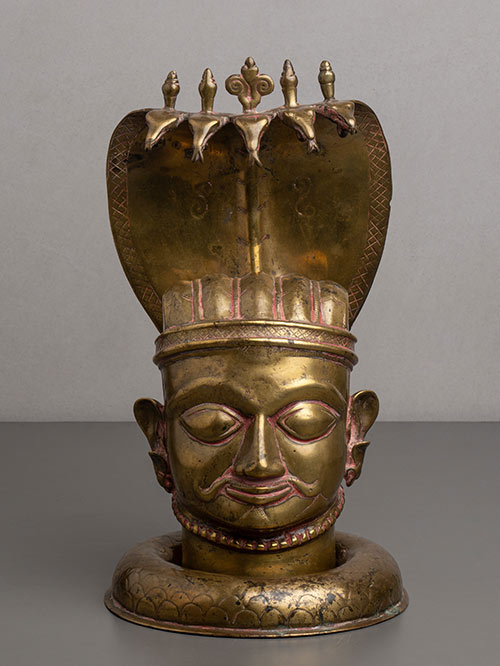

Karnataka (South India)
brass
A finely cast and decorated Mukhalingam, – the moustachioed Shiva wears a simple turban, delicate naga (snake) earrings and a beaded necklace. His head rests on the patterned coils of the serpent Vasuki whose five-headed hood forms a canopy over his head.
Shiva is one of the three principal deities of Hinduism. He is labelled the ‘destroyer’ with the Trimurti, Hinduism’s trinity which includes Brahma and Vishnu. While sometimes depicted iconically, he is usually worshipped in the aniconic from of a lingam. The lingam is shaped like a pillar with a round top and can be made of stone, wood or metal. Mukha-linga signifies a visage or face on a metallic, cylindrical casting used to cover a stone lingam. The cover is thought to protect the viewer from the harm that could occur on visualization of the linga, especially one with eyes painted on its surface, which is believed to energize the figure. The metallic visage iconically depicts Shiva, wearing his characteristic moustache, earrings and matted hair.
Size (cms): 30.5(H) x 17(W) x 17(D)
Size (inches): 12(H) x 6.5(W) x 6.5(D)
-
Maharashtra/ Karnataka
Brass alloy
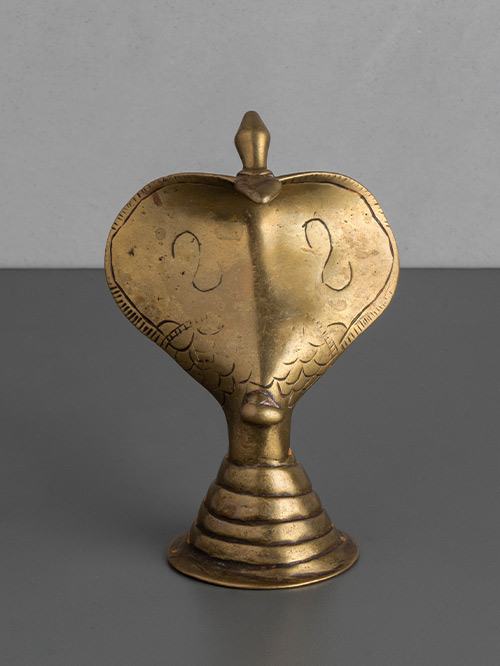
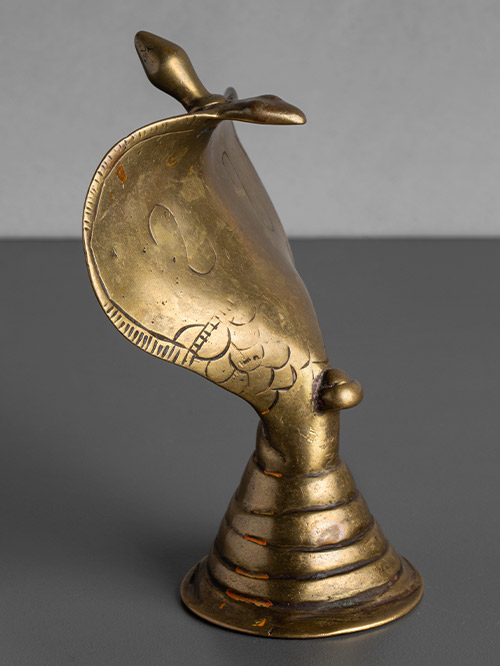
A decorative cylindrical cover in the shaped of a coiled naga (snake) which may have fit over a lingam (or might have been worshipped in its own right in lieu of a lingam). Many covers have faces (in which case they are called a mukhalinga). Lingam covers are used in puja or prayer rituals and are a visible form of the mantra namah Shivaya through which devotees invoke the blessings of Shiva.
Shiva is one of the three principal deities of Hinduism. He is labelled the ‘destroyer’ with the Trimurti, Hinduism’s trinity which includes Brahma and Vishnu. While sometimes depicted iconically, he is usually worshipped in the aniconic from of a lingam. The lingam is shaped like a pillar with a round top and can be made of stone, wood or metal.
Size (cms): 12(H) x 8(W) x 5(D)
Size (inches): 4.5(H) x 3(W) x 2(D)
-


Orissa
Brass alloy
A beautiful patinated tantric ritual vessel with a stupa shaped lid. Symbols related to water and fertility and depicted including rows of grains, two step wells in cruciform shape, sun and moon symbols and five water Goddesses.
The Sätiasarā are non-Brahminic river deities or water nymphs worshiped primarily in rural Maharashtra. They have no distinctive mythology, and their cult lacks temples and priests, festivals and places of pilgrimage. They are considered sisters, depicted up to seven in number and are sometimes accompanied by Mhaskoba, their brother. Little is known about their mythology and they are associated with fertility. If angered, they are considered to harm women, mostly related to maternity, and are responsible for infertility, miscarriage or death of infants. To appease them, up to thirty-four different items such as fruits, flowers, small trinkets, and cosmetics, seven at a time, must be placed in seven new baskets and deposited in a waterhole by the river. This vessel was probably used as part of the puja (prayer) ritual to appease the Goddesses.
Size (cms): 14.5(H) x 11(W) x 11(D)
Size (inches): 5.5(H) x 4.5(W) x 4.5(D)
-
Karnataka (South India)
brass
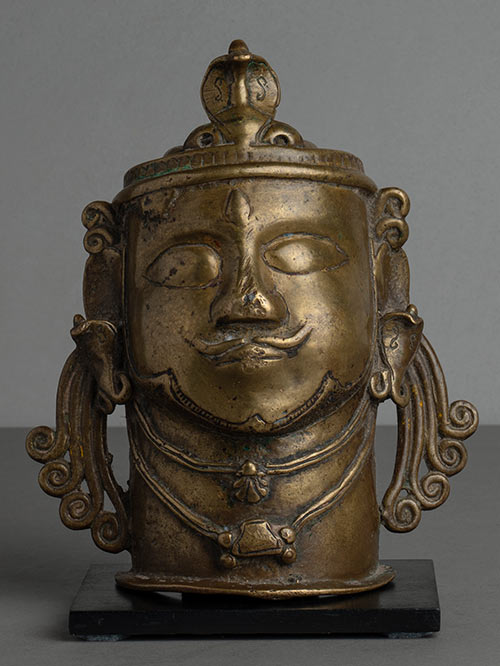
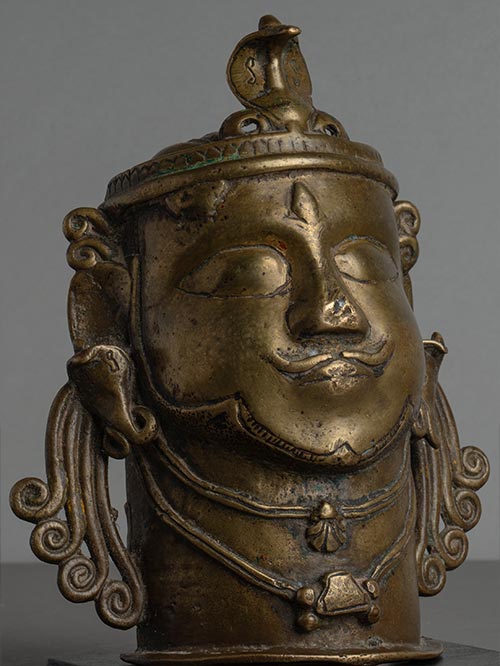
A finely detailed Mukhavata boasts an attractive shape, colour, and patina. The moustachioed Shiva is adorned with extensive jewellery, including a headband topped by a serpent (naga), and his curled and matted hair splays out from either side of his ears. Shiva’s third eye is prominently visible on his forehead.
Mukhavata or facial masks are two-dimensional metal castings of the crowned or turbaned heads of various deities, mostly manifestations of Shiva and Parvati. Included in this group are Khandoba, Mallanna, Gauri and their regional variants who are worshipped under different names.
Shiva is one of the three principal deities of Hinduism. He is labelled the ‘destroyer’ with the Trimurti, Hinduism’s trinity which includes Brahma and Vishnu. While sometimes depicted iconically, he is usually worshipped in the aniconic from of a lingam. The lingam is shaped like a pillar with a round top and can be made of stone, wood or metal. Mukha-linga signifies a visage or face on a metallic, cylindrical casting used to cover a stone lingam. The cover is thought to protect the viewer from the harm that could occur on visualization of the linga, especially one with eyes painted on its surface, which is believed to energize the figure. The metallic visage iconically depicts Shiva, wearing his characteristic moustache, earrings and matted hair.
Size (cms): 21.5(H) x 16.5(W) x 9.5(D)
Size (inches): 8.5(H) x 6.5(W) x 3.5(D)
-
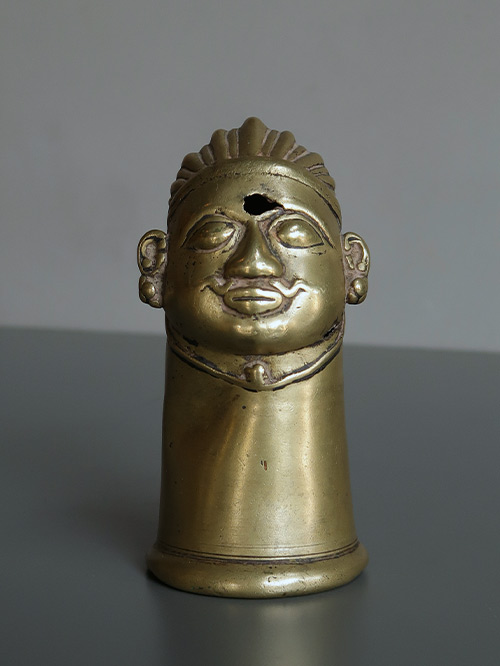
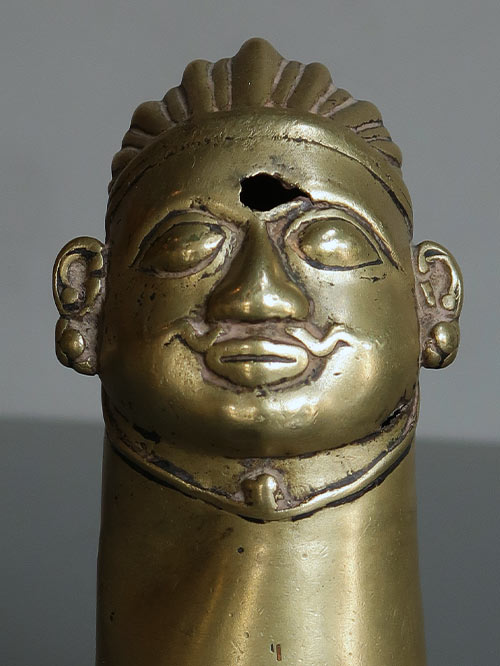
Karnataka (South India)
brass
Mukha-linga signifies a visage or face on a metallic, cylindrical casting used to cover a stone linga (phallus), which is the phallus symbol of the god Shiva. The linga is made of natural or dressed stone usually in an ovoid configuration. The cover is thought to protect the viewer from the harm that could occur on visualization of the linga, especially one with eyes painted on its surface, which is believed to energize the figure.
Size(cms): 14 (H) x 7 (Diameter)
Size(inches): 5.5 (H) x 2.8 (Diameter)
-
Tanjore (Tamil Nadu)
Opaque pigments and gold on panel
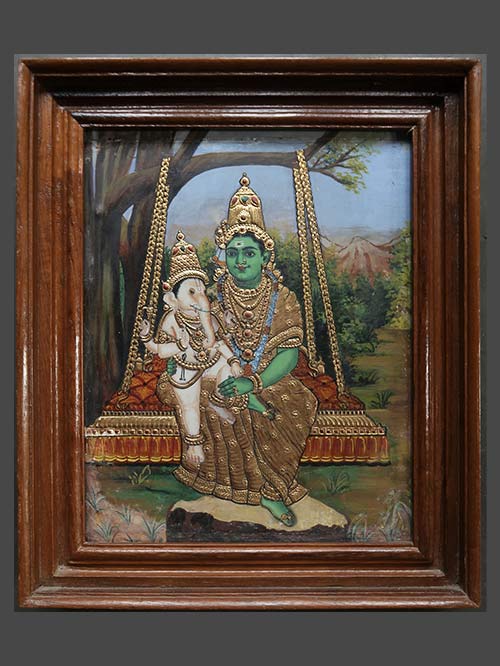
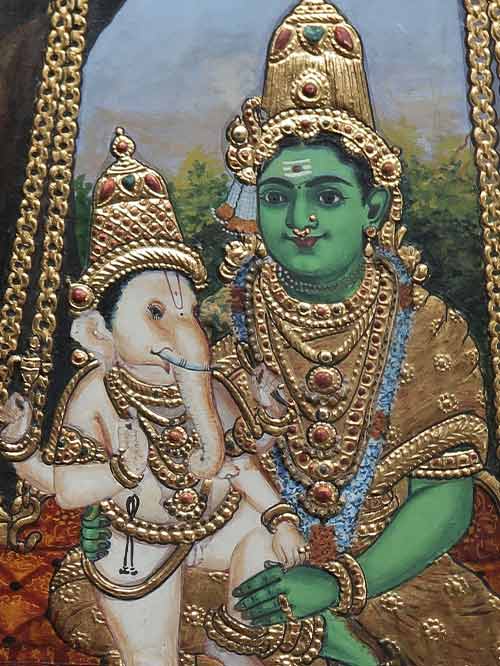
Parvati, crowned and dressed is an ostentatious golden sari, is seated on a plush swing balanced on a tree within a forest. On her lap sits her son Ganesha depicted as a child. Ganesha, naked but for his sumptuous jewellery carries an Ankusa (goad) and a Pasha (noose) in his hands.
Traditional Tanjore paintings were done on wooden panels which were typically seasoned teak wood or jack wood whose narrow strips were joined together. In some exceptional paintings precious stones were used as insets, but usually it was paste and strips of pure gold foil in which exquisite patterns were etched. Colours were prepared from natural extracts. There was a complete absence of light and shade effects except sometimes on the faces of the main figures. Strong bright and flat colours such as red, white, yellow, green and blue were used. Figures were often rotund, suggesting prosperity. Background colours were typically red, blue or green. The themes were predominantly religious but also included portraits of rulers and courtesans. Figures were usually placed within a pavilion with arches, curtains, pillars etc.
Painting Size (cms): 34 (H) x 28.5 (W)
Painting Size (inches): 13.4 (H) x 11.2 (W)
Framed Size (cms): 45.5(H) x 38.5(W)
Framed Size (inches): 18(H) x 15(W)
-
Karnataka
Wood, extensively polychromed
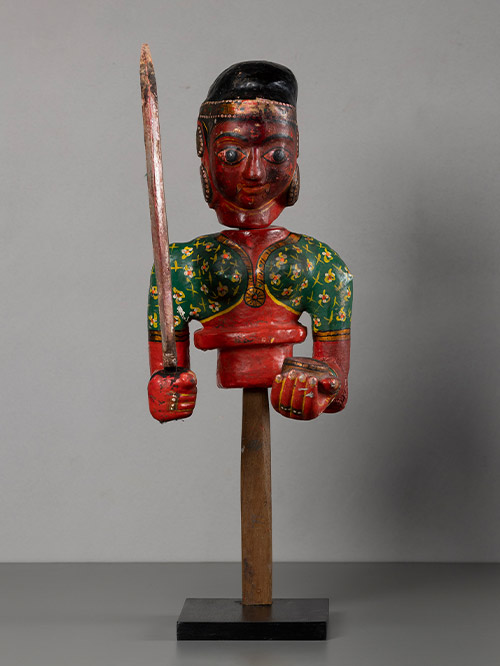
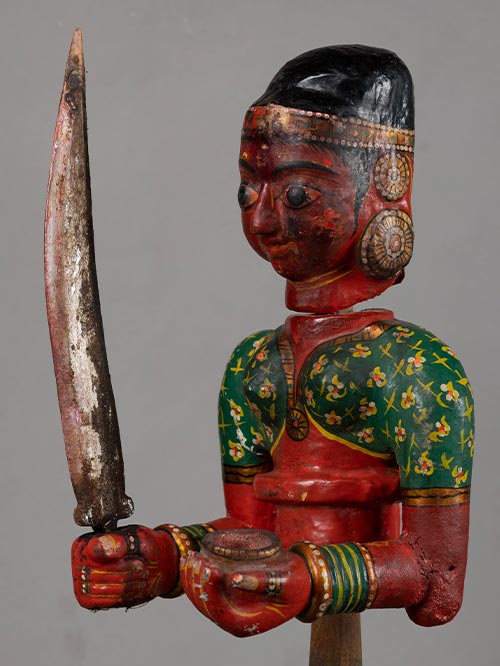
A fine two armed bust of the Goddess Durga wearing a patterned blue blouse. She is adorned with jewelled necklaces and bracelets and wears large globular earrings. In her hands she carries a sword and a bowl.
Durga – “The Unconquerable form of Devi” – Durga is the most splendid manifestation of Devi. Virginal and sublime, contain within her the power of all the gods combined, she is the invincible power of Nature who triumphs over those who seek to subjugate her. Durga is one of the names of the goddess that is the wife of Shiva. Durga has the role of a warrior goddess who destroys demons. She is usually depicted with ten arms that hold the weapons of the various gods. Her vahana is a lion which acts as her means of transportation and one of her many weapons.
During festive occasions, the utsavar (portable figures of deities) are placed on chariots or pedestals in the mandapam (audience hall of a temple) or on their respective vahana (vehicle) and taken out for public viewing or darshana. Darshana refers to the occasion where the devotee is not only able to see the image of the deity but also to sense its omnipresence.
Size (cms): 59(H) x 20(W) x 18(D)
Size (inches): 23(H) x 8(W) x 7(D)
-
Karnataka
Wood with traces of polychroming
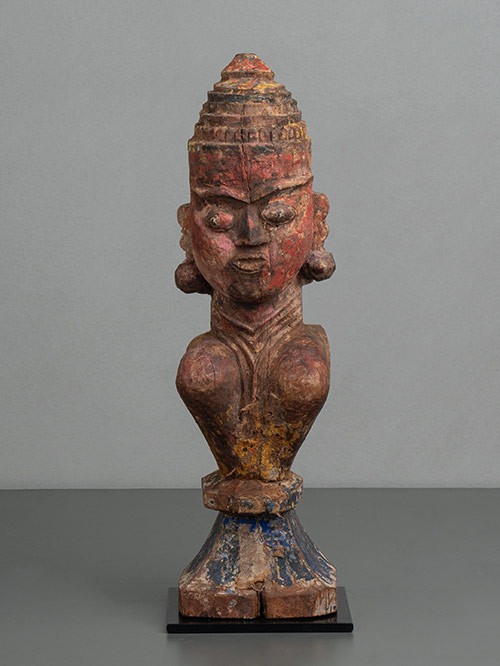
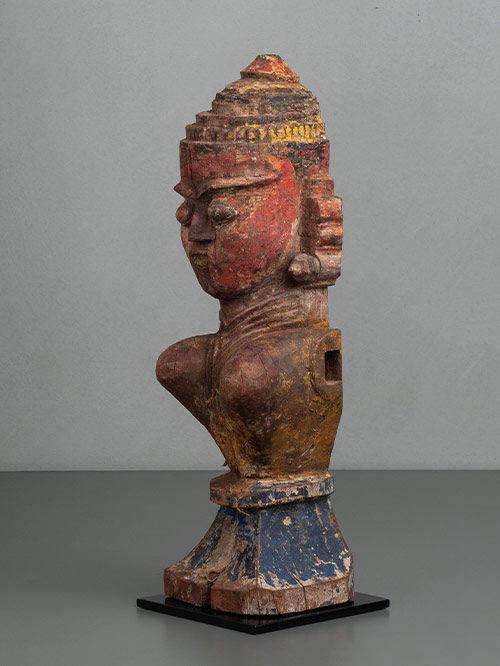
This decorative folk bust of Durga has an austere expression and an exaggeratedly proportioned torso, once painted to resemble a blouse. She is richly adorned with globular earrings, layered necklaces that hang low on her chest, and a striking tiered crown.
Durga – “The Unconquerable form of Devi” – Durga is the most splendid manifestation of Devi. Virginal and sublime, contain within her the power of all the gods combined, she is the invincible power of Nature who triumphs over those who seek to subjugate her. Durga is one of the names of the goddess that is the wife of Shiva. Durga has the role of a warrior goddess who destroys demons. She is usually depicted with ten arms that hold the weapons of the various gods. Her vahana is a lion which acts as her means of transportation and one of her many weapons.
During festive occasions, the utsavar (portable figures of deities) are placed on chariots or pedestals in the mandapam (audience hall of a temple) or on their respective vahana (vehicle) and taken out for public viewing or darshana. Darshana refers to the occasion where the devotee is not only able to see the image of the deity but also to sense its omnipresence.
Size (cms): 39(H) x 13(W) x 13(D)
Size (inches): 15.5(H) x 5(W) x 5(D)
-
Karnataka
Wood, extensively polychromed
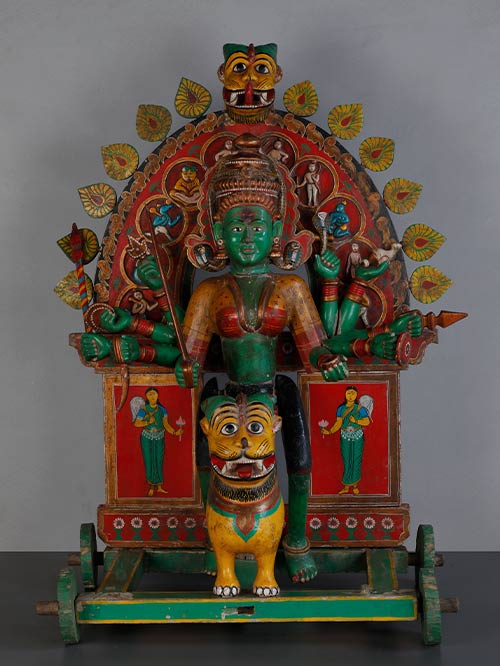
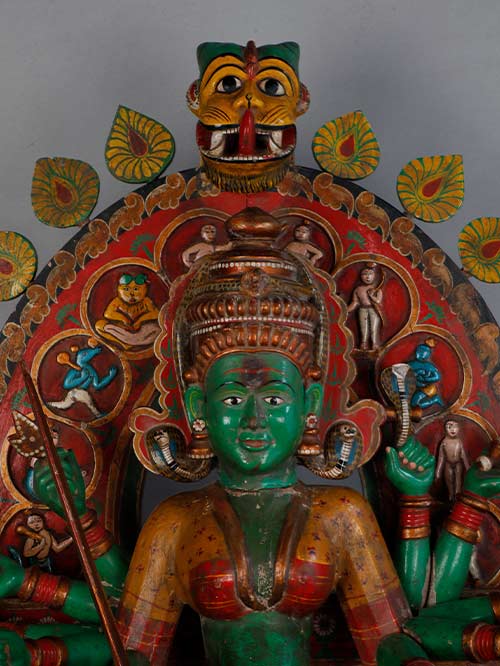
An exceptional multi-armed articulated figure of the Goddess Durga riding her Tiger vahana. She is seated on a complete chariot with a resplendent prabhavali which is painted with chauri bearers and a flaming aureole. Diminutive roundels are placed in an arch within the prabhavali each depicting the ten incarnations of Lord Vishnu starting with Matysa and ending with Kalki. The Goddess wears a patterned red and yellow blouse and an elaborate tiered crown. In her arms she carries various weapons, including a sword, cakra, conch, naga and blood bowl.
Durga – “The Unconquerable form of Devi” – Durga is the most splendid manifestation of Devi. Virginal and sublime, contain within her the power of all the gods combined, she is the invincible power of Nature who triumphs over those who seek to subjugate her. Every year, during Navratri, processional images of the goddess are carried in evocative ceremonies. Depending on the day of the festival, her vahana, the vehicle on which she rides changes, with each of her vehicles holding a different and unique significance. The tiger she rides here signifies her ferociousness and strength.
Size (cms): 95(H) x 69(W) x 44(D)
Size (inches): 37.5(H) x 27(W) x 17.5(D)
-
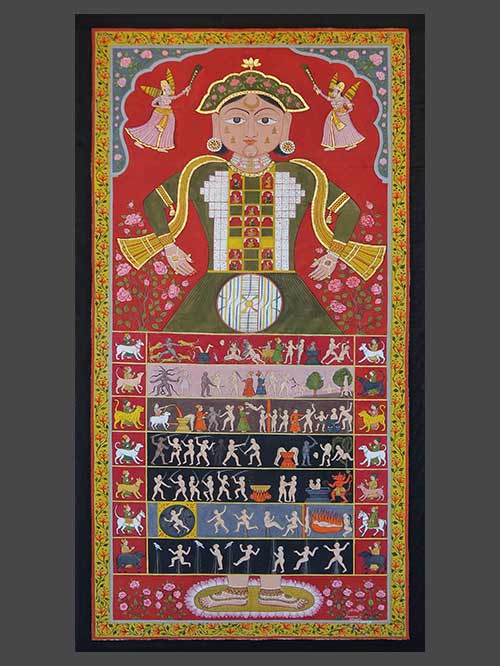
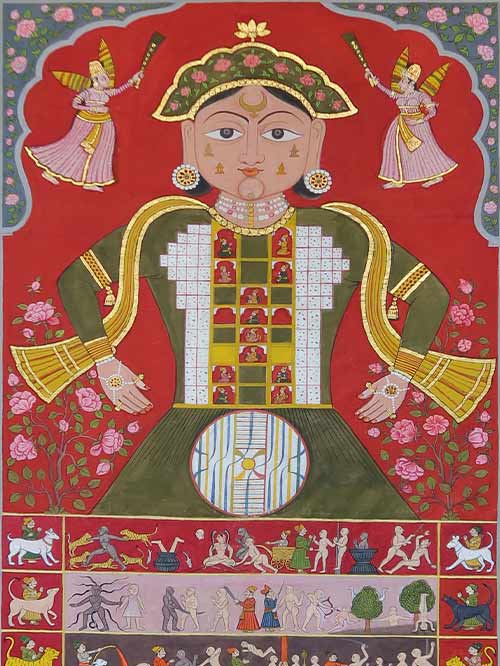
Rajasthan
Opaque watercolour on cloth with highlights in gold
Size (cms): 136(H) x 68(W)
Size (inches): 53.5(H) x 27(W)
-
Gujarat
Mordants, painted and printed, and dyes on cotton cloth
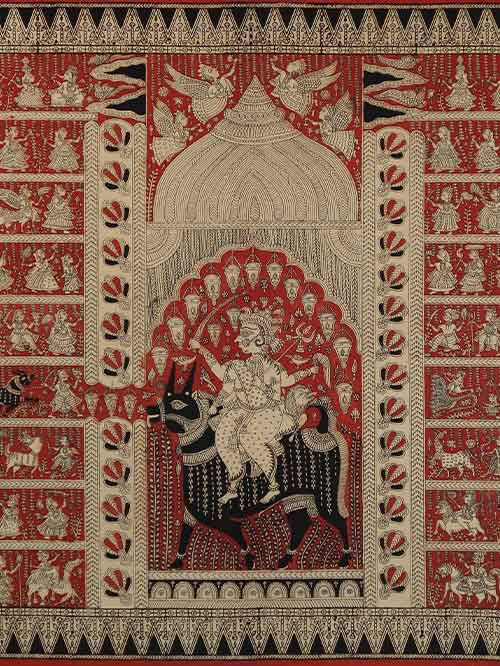
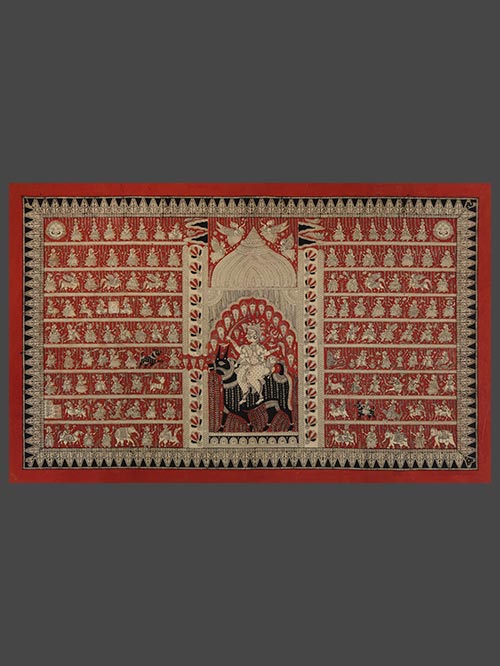
The cloth features a prominent, centrally placed iconic image of Meladi Mata enshrined within a pavilion. A folk goddess worshiped by the Vaghri community of Gujarat, Meladi Mata is identified by her mount, the black goat. The four armed Goddess is sitting astride a goat carrying various weapons and implements. Around the central form on either side, are horizontal registers demarcated with lines. These registers are filled with rows of small hand-printed figures; some, portraying devotees, while others are singular images representing mythological characters or deities. On the left side in the middle register, a priest is depicted leading a buffalo to the central pavilion. On the right side, one row depicts various manifestations of the mother-goddess such as Ambika on a Tiger and Khodiar on a crocodile. Above them are depictions from the Hindu Epics, Mahabharata and Ramayana including Rama and Lakshman hunting the two-headed deer Maricha. The overall composition with its rows of devotees replicates the grand religious ceremony that would take place. The pictorial area of the composition is framed by geometric and floral bands.
In many regions of India, various types of imaged temple cloths, executed with different materials and techniques, have originated to serve narrative, iconic, or ritual ends for diverse groups of believers. One such tradition is found in Gujarat, where temple cloths painted and printed with mordants that combine with dyes to fix their colors are a component in goddess worship. The cloths, which were formerly made in villages in the areas surrounding Ahmedabad but now probably are produced only in the city proper, honour the Great Goddess under the aspect of Mother Goddess (Mata) one or more of several manifestations peculiar to Gujarat, such as Ambika on tiger, Bahuchara on a cock, Meladi on a billy goat, Khodiar on a crocodile, and Vihat on a water buffalo.
Size (cms): 99(H) x 159(W)
Size (inches): 39(H) x 62.5(W)