Filter products Showing 33 - 47 of 47 results
Sort By
Filter By Style
Show Per Page
  • Pichhwai for Gopashtami

    Pichhwai for Gopashtami

    Nathdwara (Rajasthan)

    Cotton, painted on pigments

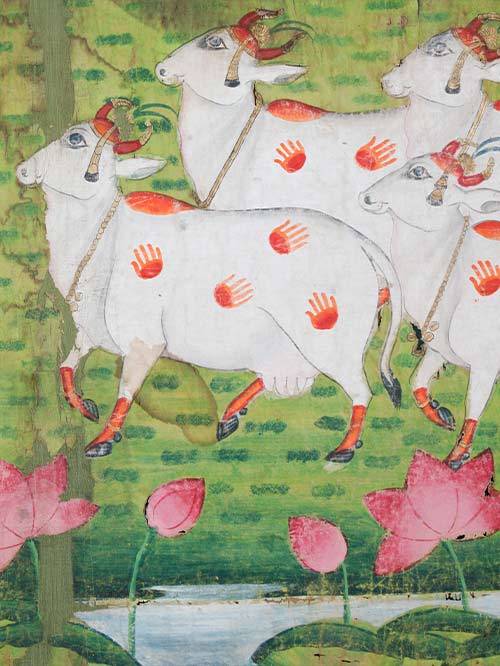
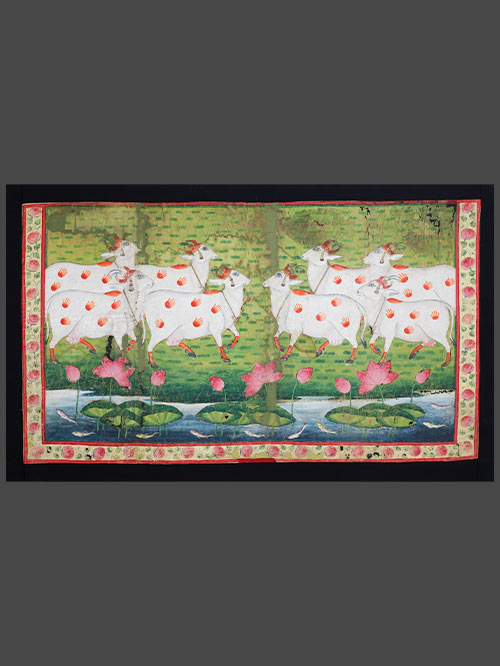
    An attractive small Pichhwai depicting eight white cows grouped in a meadow with a lotus and fish filled stream in the foreground. The cows are bedecked and have henna on their horns and hooves. Large handprints painted in saffron henna cover bodies. A floral border surrounds the panel. This pichhwai would have either accompanied a larger pichhwai in a prominent shrine or constituted part of a small domestic shrine.

    Gopashtami is a festival that commemorates Krishna’s elevation from a young herder of calves to full cowherd. Krishna grows into the perfect cowherd, the one all the cows heed, answering to the golden strains of his flute. At Nathdwara the cows, decked in their finest, are brought into the haveli. There is a playful spirit about this festival that is well expressed in this pichhwai. The cows, gentle creatures with limpid eyes and expressive ears, are constant reminders of Vraja and Krishna’s childhood occupation as cowherd.

    Size (cms): 75(H) x 124(W)
    Size (inches): 29.5(H) x 49(W)
  • pichhwai of sapta swarupa annakutotsavapichhwai of sapta swarupa annakutotsava

    Pichhwai of Sapta Swarupa Annakutotsava

    Nathdwara (Rajasthan)

    Cotton, painted on pigments

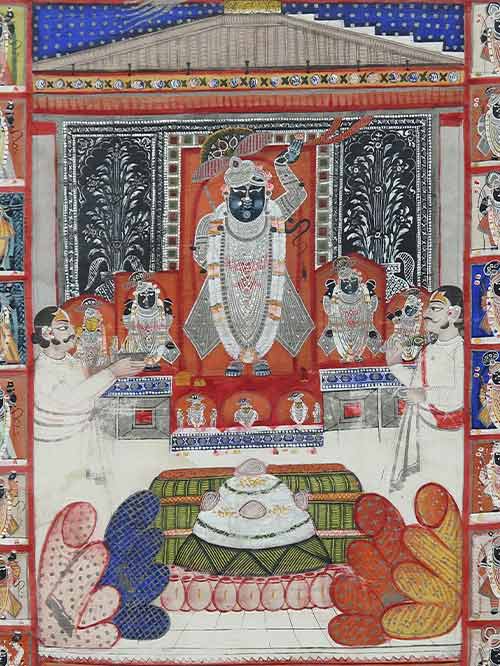
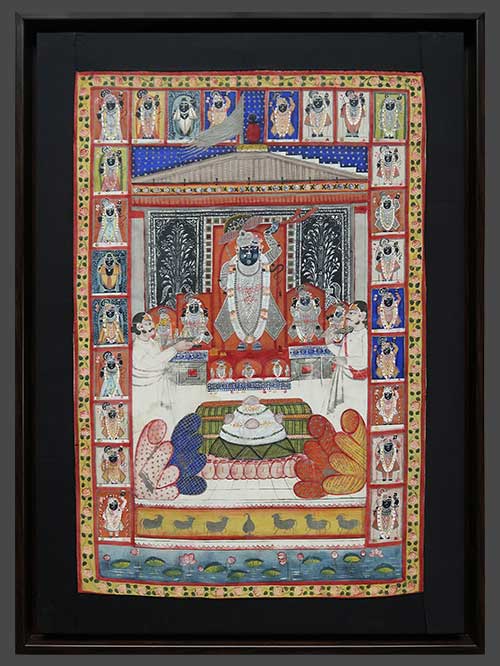
    A scarce small Pichhwai celebrating Sapta Swarupa Annakutotsava, with the central figure of Srinathji accompanied by his seven forms (Sapta Swarupa) and attended by two goswamis. Srinathji and the sath swarupa, are all richly adorned and bejewelled and they stand upon an elevated altar in front of a saffron covered thada vastra. A richly embroidered tree-of-life hanging encrusted with jewels and pearls is placed behind the shrine.

    A veritable feast of chhappan bhoga (fifty-six offerings) in the form of large mounds of rice and curd, festooned with pink sweet meats are laid out in front of Srinathji. These offering commemorate the grand festival of Annakuta, the largest yearly festival celebrated at Nathdwara, which is held the day after Diwali. The festival is celebrated in recognition of an episode in the life of Krishna when he persuaded the villagers of Vraj to present their harvest offerings to the spirit of Mount Govardhana, instead of Indra. The mountains of rice symbolically represent Mount Govardhana which are topped by a sweet cake called gunja representing the head of Vishnu flanked by four more signifying the four ayudhyas or weapons of Vishnu.

    The pichhwai is bordered by bands depicting Srinatji in twenty-four different Darshan attires on its sides and top and a row of nandis (cows) above a lotus filled lake below.

    Size (cms): 81(H) x 59(W)
    Size (inches): 32(H) x 23(W)

  • Ganesha with Lakshmi and Saraswati

    Ganesha with Lakshmi and Saraswati

    Tamil Nadu (South India)

    silver repoussé on velvet 

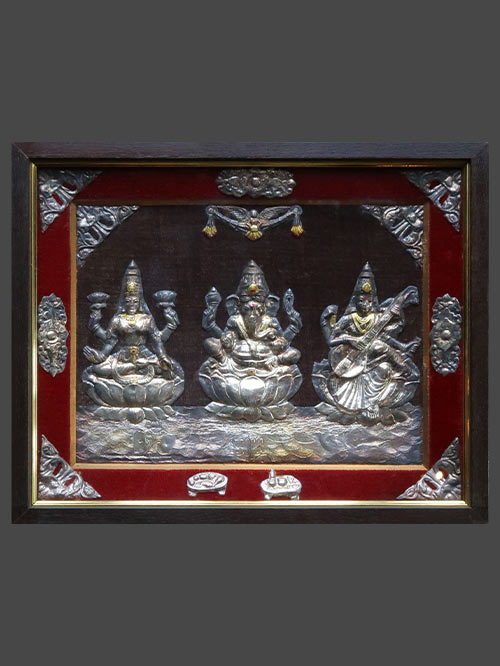
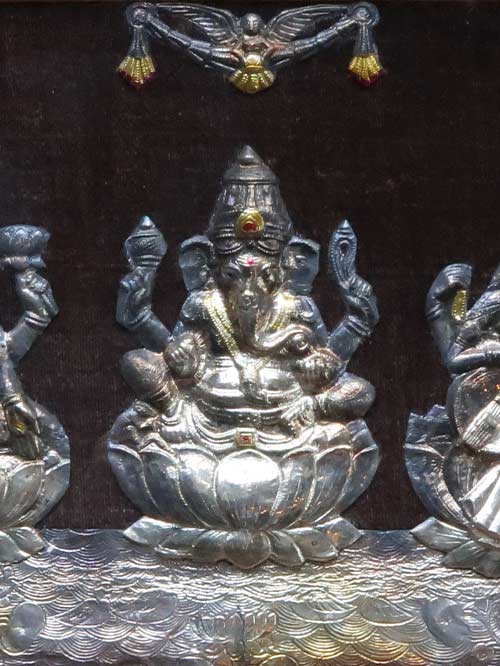
    Ganesha, four armed, is seated cross legged on a lotus throne. He carries a mace, a noose, a ball of modak and his broken tusks in his four hands. Directly above is the figure of a single winged angel with stylised wings. He is flanked by the figures of Lakshmi and Saraswati, each seated on their lotus thrones. The deities appear to float on the waves of the cosmic ocean.

    Framed Size (cms): 42 (H) x 54 (W)
    Framed Size (inches): 16.5 (H) x 21 (W)

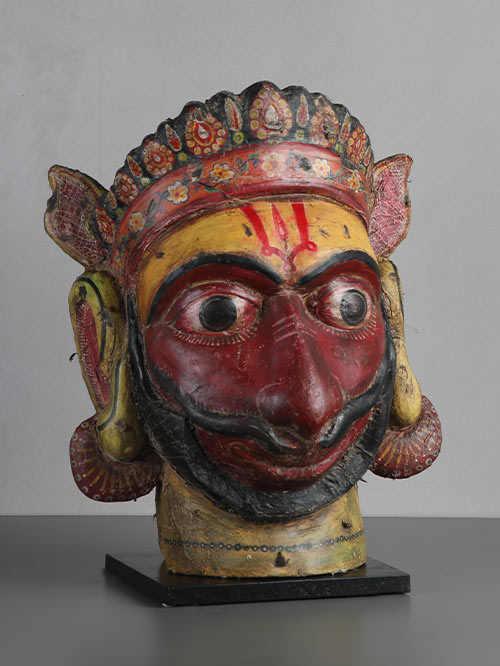
  • Hanuman Head

    Hanuman Head

    Orissa (Eastern India)

    Wood, extensively polychromed

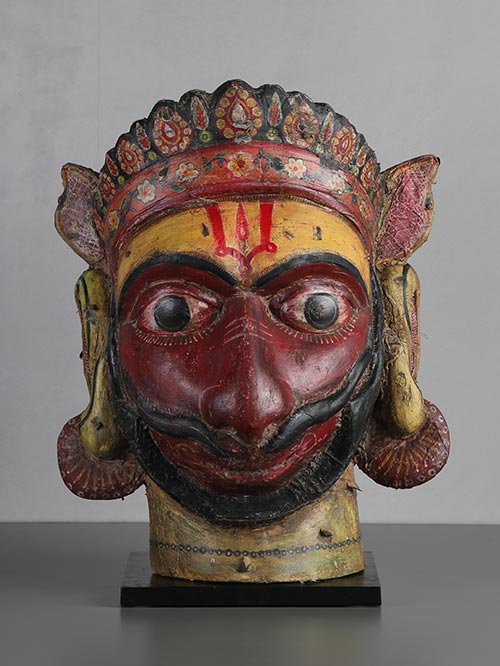
    A magnificent and rare processional head in good condition with original colour and patina

    Hanuman is a popular deity who is worshipped all over India, particularly in villages and in the South. His story is found in the Ramayana where he is the ubiquitous servant of Rama, the epitome of devoted service and loyalty. His search for the heroine Sita, captured by Ravana, illustrates his superhuman powers and zealous performance of the tasks that were given to him.

    Shahi Jatras (royal processions) of Orissa present different episodes from the Ramayana during the spring season, usually lasting for for one week. Actors, carrying huge wooden masks and gorgeous costumes, walk on the streets with stylized gait and mime with the accompaniment of loud drumming. The Desia Nata of Koraput, Orissa, also uses masks for representing gods, goddesses, animals, birds and demons. These themes are also taken from Ramayana.

    Size (cms): 56(H) x 46(W) x 43(D)
    Size (inches): 22(H) x 18(W) x 17(D)

  • tiger head (copy)tiger head (copy)

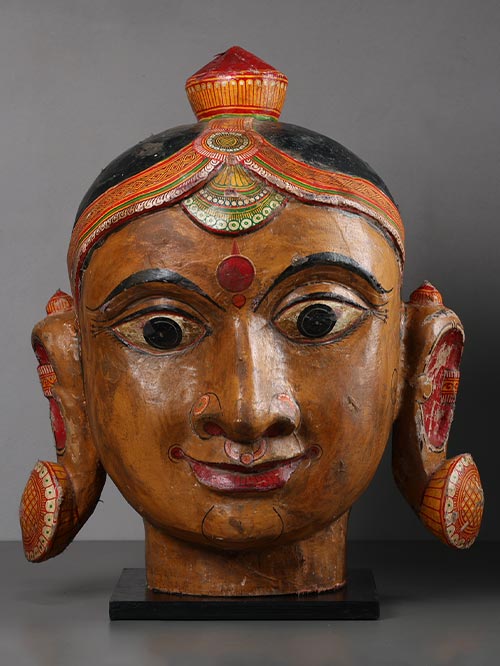
    Sita Head

    Orissa (Eastern India)

    Wood, extensively polychromed

    A magnificent and rare processional head in good condition with original colour and patina

    Sita, is the central female character of the Hindu epic Ramayana and a daughter of King Janak of Janakpur. She is the consort of the Hindu god Rama (avatar of Vishnu) and is an avatar of Lakshmi (Aadi Shakti of Lord Vishnu), goddess of wealth and wife of Vishnu. She is esteemed as a paragon of spousal and feminine virtues for all Hindu women. Sita is known for her dedication, self-sacrifice, courage and purity.

    Shahi Jatras (royal processions) of Orissa present different episodes from the Ramayana during the spring season, usually lasting for for one week. Actors, carrying huge wooden masks and gorgeous costumes, walk on the streets with stylized gait and mime with the accompaniment of loud drumming. The Desia Nata of Koraput, Orissa, also uses masks for representing gods, goddesses, animals, birds and demons. These themes are also taken from Ramayana.

    Size (cms): 61(H) x 50(W) x 48(D)
    Size (inches): 24(H) x 19.5(W) x 19(D)

  • tiger headtiger head

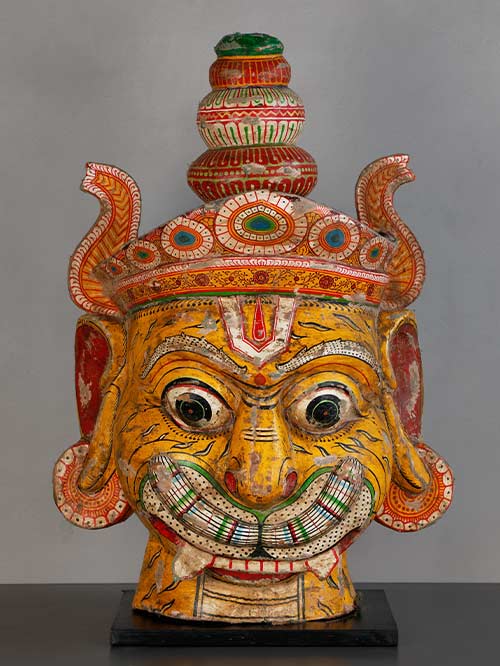
    Tiger Head

    Orissa (Eastern India)

    Wood, extensively polychromed

    A beautiful large polychromed wooden head of a Tiger painted yellow with large white and black bubris (stripes) and a characteristic candy cane moustache. In typical Orissan style, the tiger has large geometric earrings and a decorated tiered crown. ⁠

    Shahi Jatras (royal processions) of Orissa present different episodes from the Ramayana during the spring season, usually lasting for for one week. Actors, carrying huge wooden masks and gorgeous costumes, walk on the streets with stylized gait and mime with the accompaniment of loud drumming. The Desia Nata of Koraput, Orissa, also uses masks for representing gods, goddesses, animals, birds and demons. These themes are also taken from Ramayana.

    Size (cms): 76(H) x 56(W) x 47(D)
    Size (inches): 30(H) x 22(W) x 18.5(D)

  • varaha headvaraha head

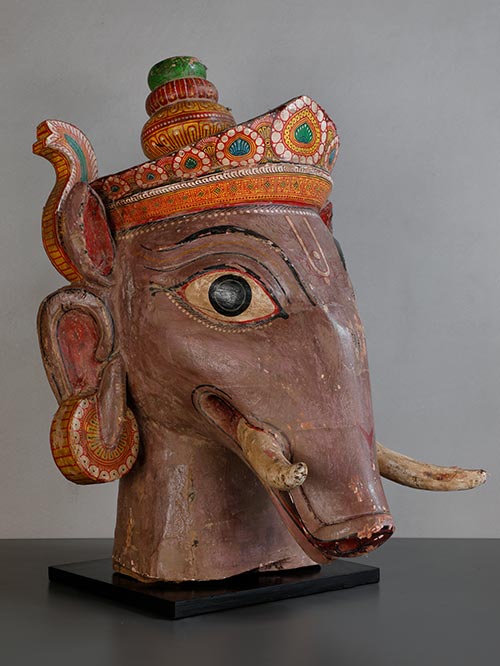
    Varaha Head

    Orissa (Eastern India)

    Wood, extensively polychromed

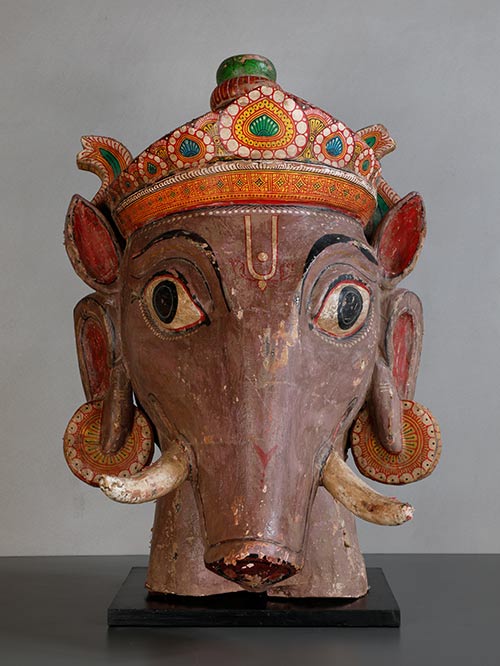
    A magnificent and rare processional head in good condition with original colour and patina. Varaha is the third avatar of Lord Vishnu. He is usually depicted as half-human and half-boar, slaying the asura Hiranyaksha and carrying a conch shell, a discus, a mace, and a lotus flower in his four hands. He is considered to be the saviour of the world and the protector of the earth and his worship is believed to bring prosperity and good fortune.

    Shahi Jatras (royal processions) of Orissa present different episodes from the Ramayana during the spring season, usually lasting for for one week. Actors, carrying huge wooden masks and gorgeous costumes, walk on the streets with stylized gait and mime with the accompaniment of loud drumming. The Desia Nata of Koraput, Orissa, also uses masks for representing gods, goddesses, animals, birds and demons. These themes are also taken from Ramayana.

    Size (cms): 75.5(H) x 59(W) x 56(D)
    Size (inches): 29.5(H) x 23(W) x 22(D)

  • Crocodile Puppet

    Crocodile Puppet

    Andhra Pradesh (South India)

    Framed Leather Shadow Puppet

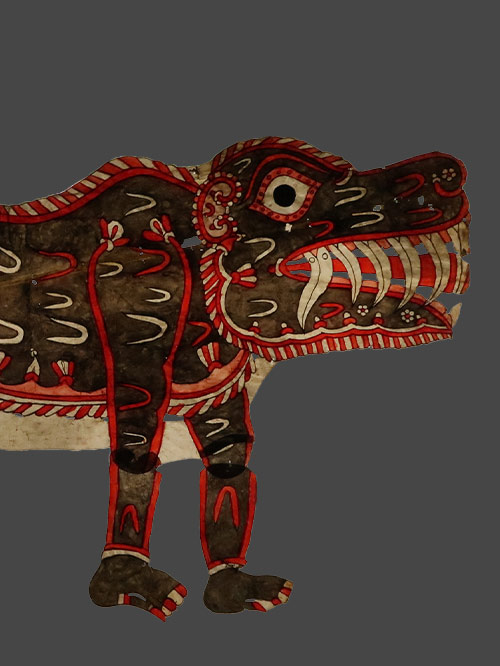
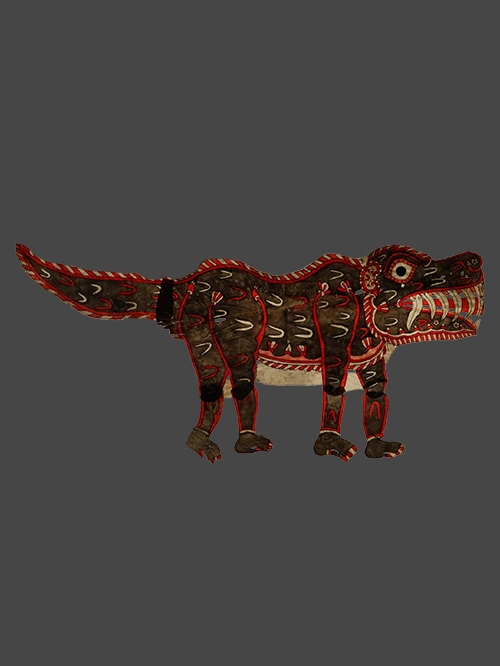
    In Andhra Pradesh the Tholu Bomalatta tradition of travelling shadow puppet theatre typically enacts the voluminous epics, Ramayana and Mahabharata. Made from goat, cow or buffalo skin, the Andhra Pradesh puppets are sometimes more than five feet high. They are translucent, stained in vegetable dyes and are extremely stylised in facial garment rendering. Viewed as shadows from behind a lamp-lit cloth screen, the puppets are manipulated with the help of bamboo sticks at certain points, usually at the joints on the shoulders, knees, elbows and head. The highly animated performance, along with the drum beat and loud narration of stories is highly effective in mesmerising the spectators transporting them into another world.

    Size (cms): 81.3(H) x 160(W)
    Size (inches): 32(H) x 63(W)

  • lakshmilakshmi

    Lakshmi

    Published at the Ravi Varma Press, Karla, Lonavla

    by Raja Ravi Varma

    chromolithograph with fabric appliqué

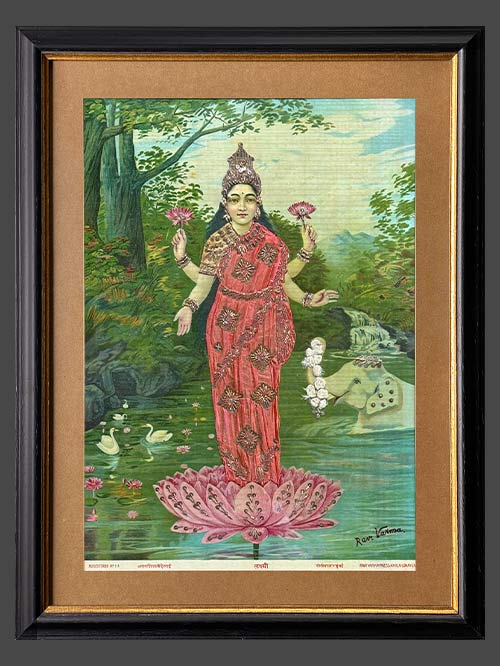
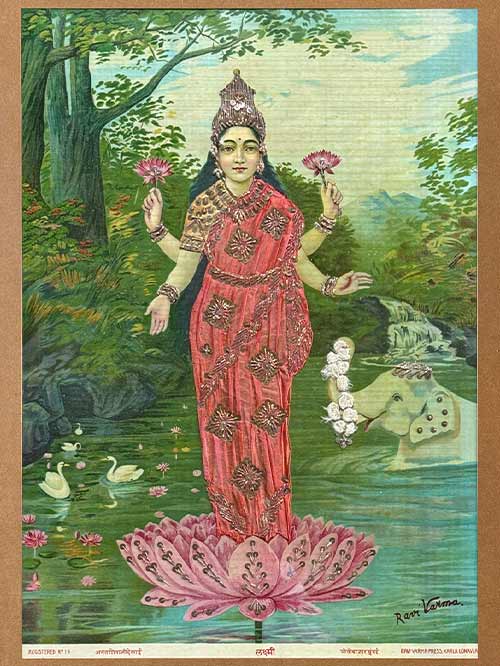
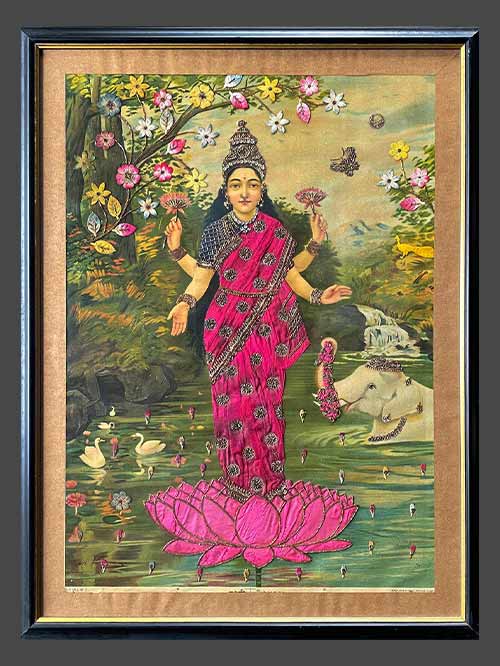
    Lakshmi, the goddess of beauty, prosperity, luck and wealth- is shown standing on a lotus emerging from a river, an elephant (gaja) half submerged, stands to her left holding a garland in his trunk. A cascading waterfall in the background. Lakshmi has four arms, the upper two holding lotuses and the lower two in Abhayamudra (a gesture of reassurance, safety) and Varadamudra (gesture of granting of wishes).

    Ravi Varma occupies an important place in Indian art history. He developed a painting style that appropriated the illusionary techniques of European oil painting with traditional Indian subject matter. The popularity of Ravi Varma’s paintings gave him the idea to make oleographs that would be available to the general public, instead of only elite patrons. Oleographs, also called chromolithographs, are multi-colour art prints, stemming from the process of lithography. 

    These immensely popular chromolithographs from the Ravi Varma press quickly set a new iconographical standard for the traditional Indian heroes and deities. Often the figures were embellished with embroidered sequins and other decorative material, creating vibrant pulsating images. 

    Image Size (cms): 49.5 (H) x 34.5 (W)
    Image Size (inches): 19.5 (H) x 13.6 (W)

    Framed Size (cms): 62 (H) x 48.5 (W)
    Framed Size (inches): 24.5 (H) x 19 (W)

  • large lakshmi and saraswati pairlarge lakshmi and saraswati pair

    Large Lakshmi and Saraswati Pair

    Published at the Ravi Varma Press, Malavli, Lonavla

    by Raja Ravi Varma

    chromolithograph with fabric appliqué

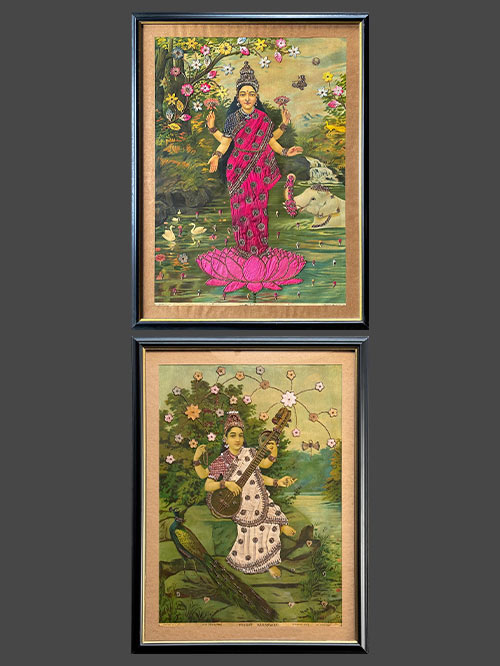
    Lakshmi, the goddess of beauty, prosperity, luck and wealth- is shown standing on a lotus emerging from a river, an elephant (gaja) half submerged, stands to her left holding a garland in his trunk. A cascading waterfall in the background. Lakshmi has four arms, the upper two holding lotuses and the lower two in Abhayamudra (a gesture of reassurance, safety) and Varadamudra (gesture of granting of wishes).

    Saraswati is the goddess of speech and learning, the inventor of Sanskrit, patroness of the arts and the wife of Brahma. Four armed, she is shown seated holding a rosary and a book and playing the veena. A peacock ( her vahana or vehicle) stands to her right. 

    Ravi Varma occupies an important place in Indian art history. He developed a painting style that appropriated the illusionary techniques of European oil painting with traditional Indian subject matter. The popularity of Ravi Varma’s paintings gave him the idea to make oleographs that would be available to the general public, instead of only elite patrons. Oleographs, also called chromolithographs, are multi-colour art prints, stemming from the process of lithography. 

    These immensely popular chromolithographs from the Ravi Varma press quickly set a new iconographical standard for the traditional Indian heroes and deities. Often the figures were embellished with embroidered sequins and other decorative material, creating vibrant pulsating images. 

    Image Size (cms): 69 (H) x 49 (W)
    Image Size (inches): 27 (H) x 19.3 (W)

    Framed Size (cms): 82.5 (H) x 62.3 (W)
    Framed Size (inches): 32.5 (H) x 24.5 (W)

  • shantanu and matsyagandhashantanu and matsyagandha

    Shantanu and Matsyagandha

    Published at the Ravi Varma Press, Malavli, Lonavla

    by Raja Ravi Varma

    chromolithograph with fabric appliqué

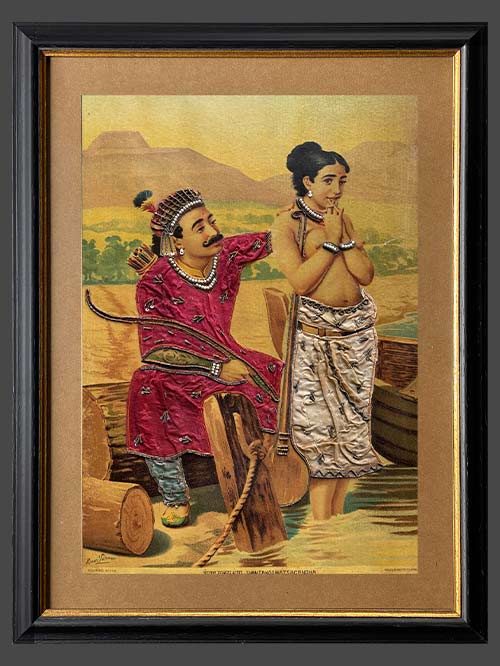
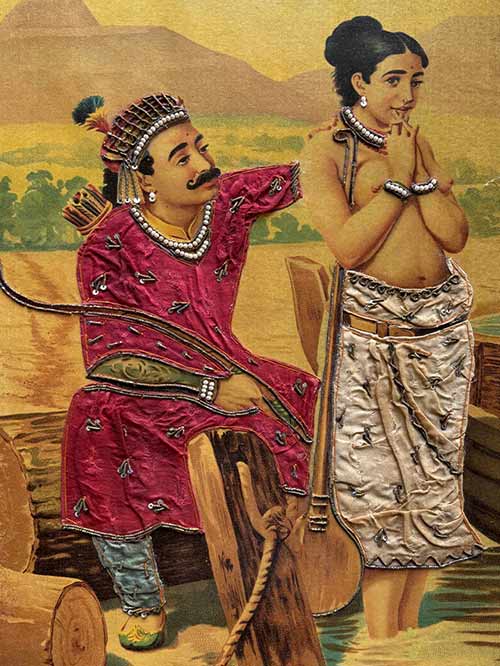
    King Shantanu’s encounter with Satyavati, also known as Matsyagandha, marks a pivotal episode in the Mahabharata, skilfully captured by Raja Ravi Varma on oil, later published as an oleograph. While hunting along the Ganga’s banks, Shantanu is drawn by the intoxicating scent of musk and discovers its source in Satyavati, a fisherwoman raised by a fisherman who found her as an infant inside a fish. Enchanted by her beauty, Shantanu desires to marry her, but Satyavati agrees only on the condition that her future children inherit the throne, denying Shantanu’s son Devavrata (later Bhishma) his rightful claim. Initially hesitant, Shantanu consents after Devavrata vows lifelong celibacy to uphold his father’s happiness. The union results in two sons, Chitrangada and Vichitravirya, setting the stage for the Mahabharata’s complex lineage and conflicts. Varma’s artwork portrays this moment of enchantment, with Shantanu in regal attire, captivated by Satyavati’s charm, as she stands poised with an oar, embodying her fisherwoman origins and fateful allure.

    Ravi Varma occupies an important place in Indian art history. He developed a painting style that appropriated the illusionary techniques of European oil painting with traditional Indian subject matter. The popularity of Ravi Varma’s paintings gave him the idea to make oleographs that would be available to the general public, instead of only elite patrons. Oleographs, also called chromolithographs, are multi-colour art prints, stemming from the process of lithography. 

    These immensely popular chromolithographs from the Ravi Varma press quickly set a new iconographical standard for the traditional Indian heroes and deities. Often the figures were embellished with embroidered sequins and other decorative material, creating vibrant pulsating images. 

    Image Size (cms): 49.5 (H) x 34.5 (W)
    Image Size (inches): 19.5 (H) x 13.6 (W)

    Framed Size (cms): 62 (H) x 48.5 (W)
    Framed Size (inches): 24.5 (H) x 19 (W)

  • shiva, parvati, ganesha on nandishiva, parvati, ganesha on nandi

    Shiva, Parvati, Ganesha on Nandi

    Published at the Ravi Varma Press, Malavli, Lonavla

    by Raja Ravi Varma

    chromolithograph with fabric appliqué

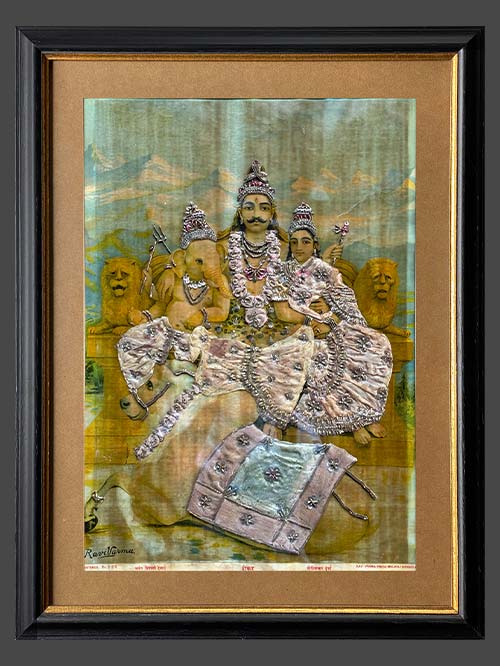
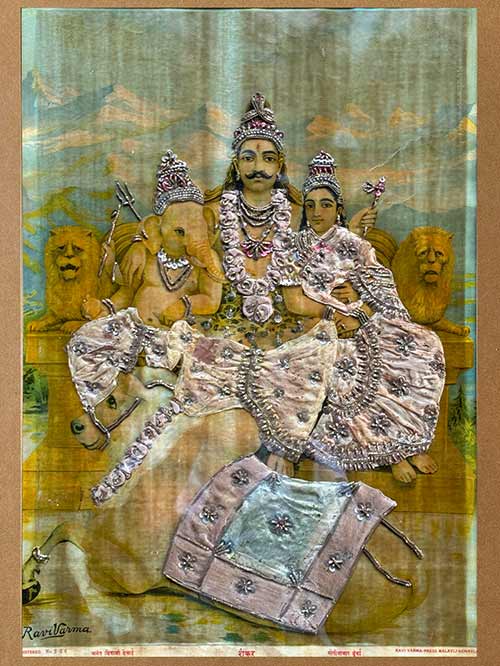
    Shiva, Parvati & Ganesha are seated on a lion throne with Shiva’s caparisoned vahana Nandin seated under them. Shiva is known as the “destroyer and the transformer.” His wife Parvati, is the Hindu goddess of fertility, love and devotion; as well as of divine strength and power. Ganesha is widely revered as the remover of obstacles, the patron of arts and sciences and the deva of intellect and wisdom.

    Ravi Varma occupies an important place in Indian art history. He developed a painting style that appropriated the illusionary techniques of European oil painting with traditional Indian subject matter. The popularity of Ravi Varma’s paintings gave him the idea to make oleographs that would be available to the general public, instead of only elite patrons. Oleographs, also called chromolithographs, are multi-colour art prints, stemming from the process of lithography. 

    These immensely popular chromolithographs from the Ravi Varma press quickly set a new iconographical standard for the traditional Indian heroes and deities. Often the figures were embellished with embroidered sequins and other decorative material, creating vibrant pulsating images. 

    Image Size (cms): 49.5 (H) x 34.5 (W)
    Image Size (inches): 19.5 (H) x 13.6 (W)

    Framed Size (cms): 62 (H) x 48.5 (W)
    Framed Size (inches): 24.5 (H) x 19 (W)

  • sri bala subrahmanyasri bala subrahmanya

    Sri Bala Subrahmanya

    Published at the Ravi Varma Press, Malavli, Lonavla

    chromolithograph with fabric appliqué

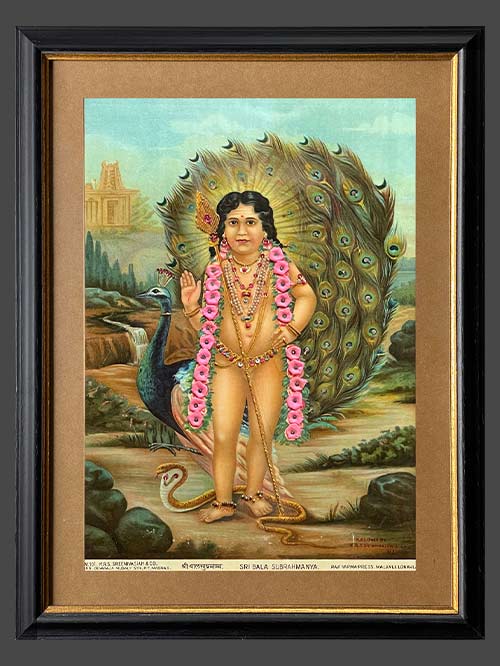
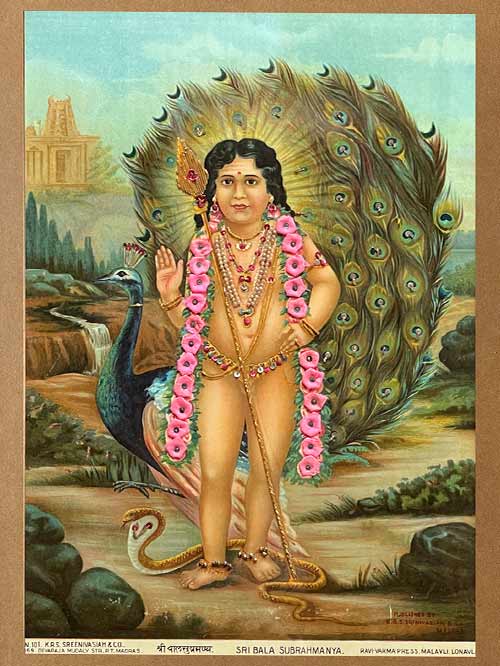
    Subrahmanyam (also known as Kartikeya, Murugan or Skanda) stands next to his conveyance, a majestic peacock with its spotted train of feathers on full display. Subrahmanyam, naked but for his sumptuous jewellery stands with one arm raised in Abaya mudra (fear not gesture) while the other is firmly planted on his hip. A golden cobra rests behind his feet. Subhramanyam is generally thought of as the son of Shiva and Parvati.

    Oleographs, also called chromolithographs, are multi-colour art prints, stemming from the process of lithography. These immensely popular oleographs from the Ravi Varma press quickly set a new iconographical standard for the traditional Indian heroes and deities. Often the figures were embellished with embroidered sequins and other decorative material, creating vibrant pulsating images. After Ravi Varma was forced to sell the press along with the reproduction rights in 1901, the press began producing work by other contemporaries of Ravi Varma including C.G. Ramanujam, producing equally vibrant work with new themes and subjects. The influence of the oleographs from this press is still felt strongly in modern Indian popular art forms such as calendar art.

    Image Size (cms): 49.5 (H) x 34.5 (W)
    Image Size (inches): 19.5 (H) x 13.6 (W)

    Framed Size (cms): 62 (H) x 48.5 (W)
    Framed Size (inches): 24.5 (H) x 19 (W)

  • subrahmanya on peacock (copy)subrahmanya on peacock (copy)

    Subrahmanya on peacock

    Published at the Ravi Varma Press, Malavli, Lonavla

    chromolithograph with fabric appliqué

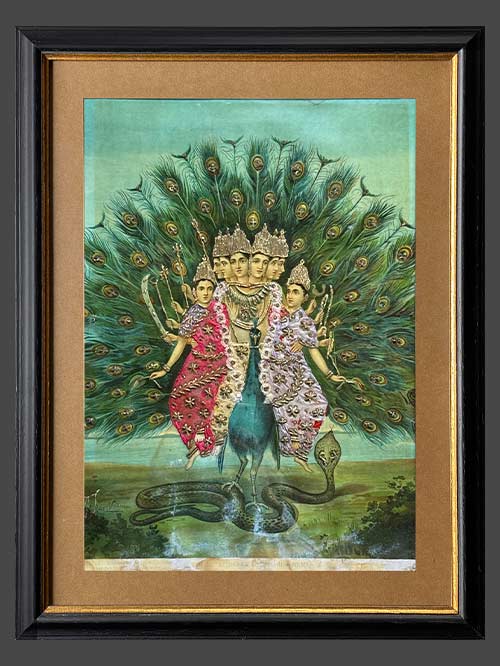
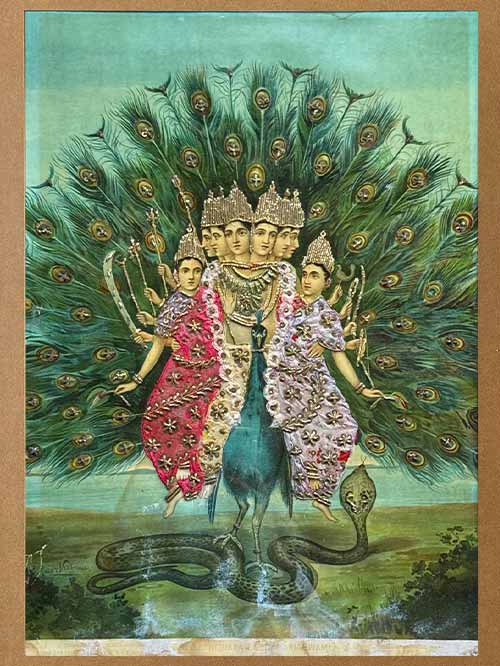
    Subrahmanyam (also known as Kartikeya, Murugan or Skanda) stands next to his conveyance, a majestic peacock with its spotted train of feathers on full display. Subrahmanyam, naked but for his sumptuous jewellery stands with one arm raised in Abaya mudra (fear not gesture) while the other is firmly planted on his hip. A golden cobra rests behind his feet. Subhramanyam is generally thought of as the son of Shiva and Parvati.

    Ravi Varma occupies an important place in Indian art history. He developed a painting style that appropriated the illusionary techniques of European oil painting with traditional Indian subject matter. The popularity of Ravi Varma’s paintings gave him the idea to make oleographs that would be available to the general public, instead of only elite patrons. Oleographs, also called chromolithographs, are multi-colour art prints, stemming from the process of lithography. 

    These immensely popular chromolithographs from the Ravi Varma press quickly set a new iconographical standard for the traditional Indian heroes and deities. Often the figures were embellished with embroidered sequins and other decorative material, creating vibrant pulsating images. 

    Image Size (cms): 49.5 (H) x 34.5 (W)
    Image Size (inches): 19.5 (H) x 13.6 (W)

    Framed Size (cms): 62 (H) x 48.5 (W)
    Framed Size (inches): 24.5 (H) x 19 (W)

  • vishnu on garudavishnu on garuda

    Vishnu on Garuda

    Published at the Ravi Varma Press, Malavli, Lonavla

    by Raja Ravi Varma 

    chromolithograph

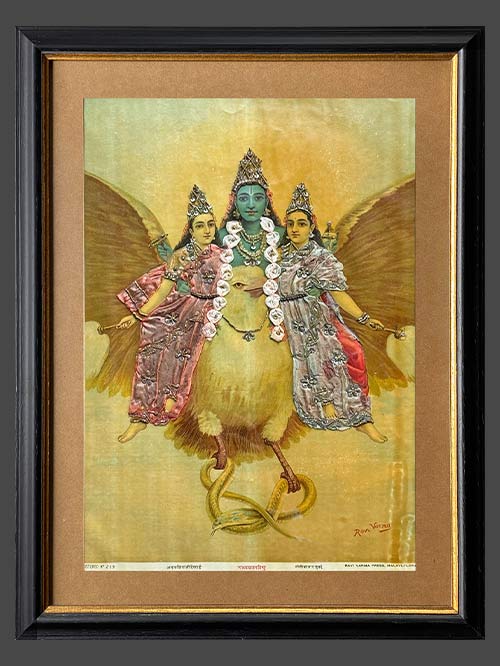
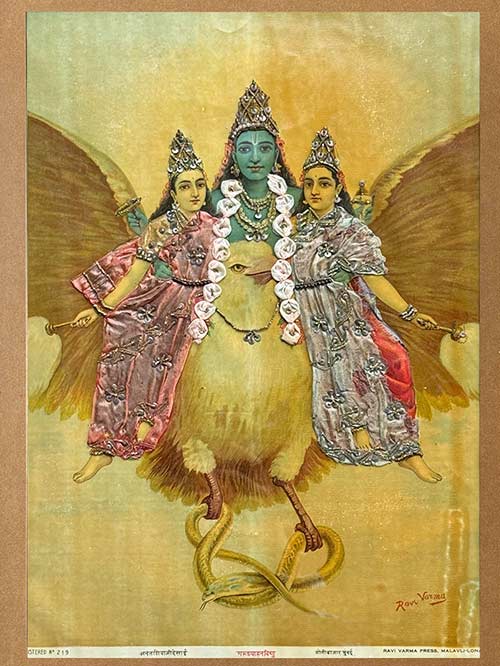
    Vishnu is is seen here riding on his vahana (vehicle), the mythical bird Garuda with his consorts Sridevi and Bhudevi on either side. The blue skinned Vishnu carries two of his usual attributes, the disc (cakra) and conch (sankha) in his hands. His consorts both bejewelled wear saris and hold chauris (fly whisks) in their outstretched arms. Garuda is depicted mid-flight carrying the trio and holding a golden cobra firmly within its talons.

    Ravi Varma occupies an important place in Indian art history. He developed a painting style that appropriated the illusionary techniques of European oil painting with traditional Indian subject matter. The popularity of Ravi Varma’s paintings gave him the idea to make oleographs that would be available to the general public, instead of only elite patrons. Oleographs, also called chromolithographs, are multi-colour art prints, stemming from the process of lithography. 

    These immensely popular chromolithographs from the Ravi Varma press quickly set a new iconographical standard for the traditional Indian heroes and deities. Often the figures were embellished with embroidered sequins and other decorative material, creating vibrant pulsating images. 

    Image Size (cms): 49.5 (H) x 34.5 (W)
    Image Size (inches): 19.5 (H) x 13.6 (W)

    Framed Size (cms): 62 (H) x 48.5 (W)
    Framed Size (inches): 24.5 (H) x 19 (W)

Phillips Antiques

PHILLIPS

Subscribe to our Newsletter to stay updated with newest arrivals.
SUBSCRIBE NOW
close-link