
Vatapatrasayi
Tanjore (South India)
reverse painting on glass
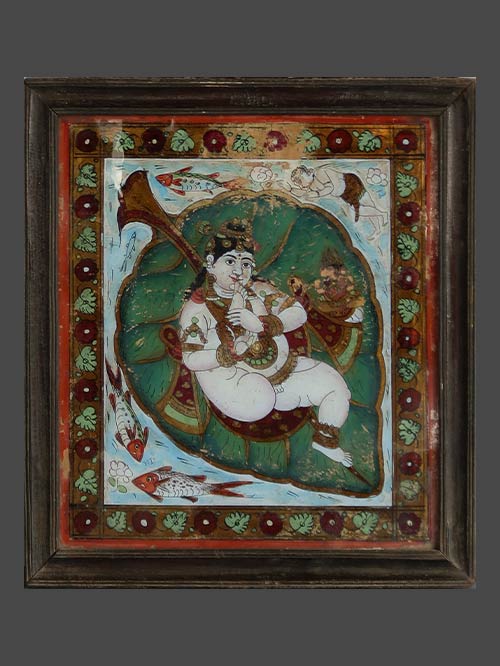
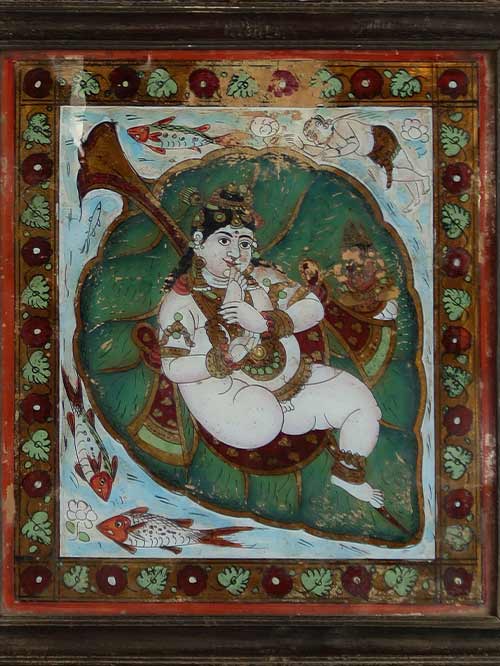
Krishna as a child lies on a giant banyan leaf content, innocent, with a hint of amusement on his face. Naked but for his jewellery and a draped angavastra, he is depicted sucking his raised toe. As always, he is shown as a chubby child. The leaf he rests on is encircled by a school of fish, swimming amidst the primordial waters. Depicted on the top right is the sage Markandeya reaching out for the safety of the banyan leaf. A diminutive Brahma hovers above Krishna’s left foot. A border of leaves and roundels frames the scene.
The story of Krishna as Vatapatrasayi, or the Lord of the Banyan Leaf, occurs during the end of the world when the sage Markandeya sees the destruction caused by the great flood. In the midst of the chaos, he sees a small child floating on a banyan leaf, sucking his raised toe. Markandeya is drawn into the child’s body where he discovers the entire world, with all its realms, contained within the child who is oblivious to the disaster happening outside. The sage then realises that the child is a god who has taken the world into himself before recreating the universe.
Reverse glass paintings were introduced into India the late 18th century from China by way of the China Trade. Indian artists adopted the technique of reverse glass painting partly on account of its novelty and also because it was a relatively inexpensive medium which could produce rich effects. The technique proved extremely popular and soon spread through western and southern India and even to former provincial Mughal capitals of Oudh, Murshidabad. In Tanjore a distinctive school of glass painting developed, with a rich colour and bold and defiant style. The subjects were clearly presented with a certain opulence and glamour.
Framed Size (cms): 46.5(H) x 41.5(W)
Framed Size (inches): 18.5(H) x 16.5(W)
Painting Size (cms):39.5(H) x 31.5(W)
Painting Size (inches):15.5(H) x 12.5(W)


