“Dancer” has been added to your cart.
View cart
-
Tanjore (South India)
reverse painting on glass
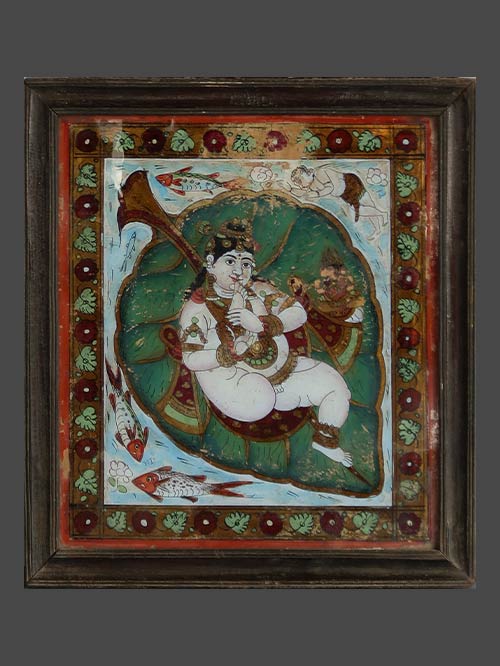
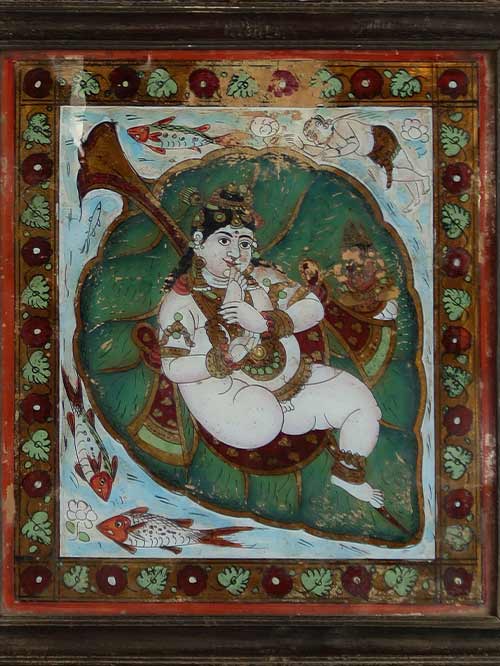
Krishna as a child lies on a giant banyan leaf content, innocent, with a hint of amusement on his face. Naked but for his jewellery and a draped angavastra, he is depicted sucking his raised toe. As always, he is shown as a chubby child. The leaf he rests on is encircled by a school of fish, swimming amidst the primordial waters. Depicted on the top right is the sage Markandeya reaching out for the safety of the banyan leaf. A diminutive Brahma hovers above Krishna’s left foot. A border of leaves and roundels frames the scene.
The story of Krishna as Vatapatrasayi, or the Lord of the Banyan Leaf, occurs during the end of the world when the sage Markandeya sees the destruction caused by the great flood. In the midst of the chaos, he sees a small child floating on a banyan leaf, sucking his raised toe. Markandeya is drawn into the child’s body where he discovers the entire world, with all its realms, contained within the child who is oblivious to the disaster happening outside. The sage then realises that the child is a god who has taken the world into himself before recreating the universe.
Reverse glass paintings were introduced into India the late 18th century from China by way of the China Trade. Indian artists adopted the technique of reverse glass painting partly on account of its novelty and also because it was a relatively inexpensive medium which could produce rich effects. The technique proved extremely popular and soon spread through western and southern India and even to former provincial Mughal capitals of Oudh, Murshidabad. In Tanjore a distinctive school of glass painting developed, with a rich colour and bold and defiant style. The subjects were clearly presented with a certain opulence and glamour.
Framed Size (cms): 46.5(H) x 41.5(W)
Framed Size (inches): 18.5(H) x 16.5(W)
Painting Size (cms):39.5(H) x 31.5(W)
Painting Size (inches):15.5(H) x 12.5(W)
-
Orissa
Wood, polychromed
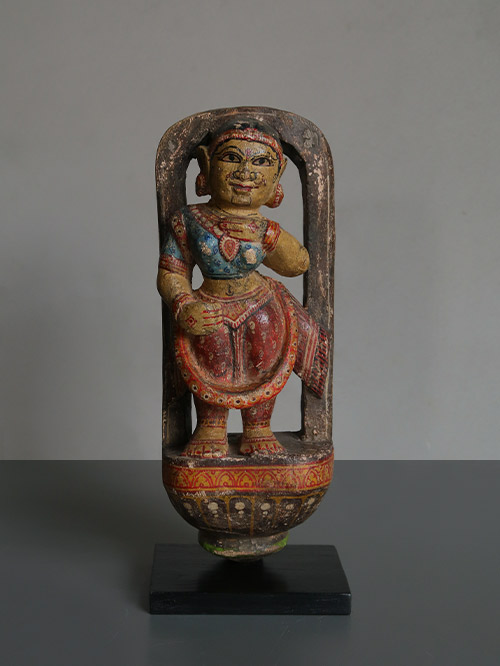
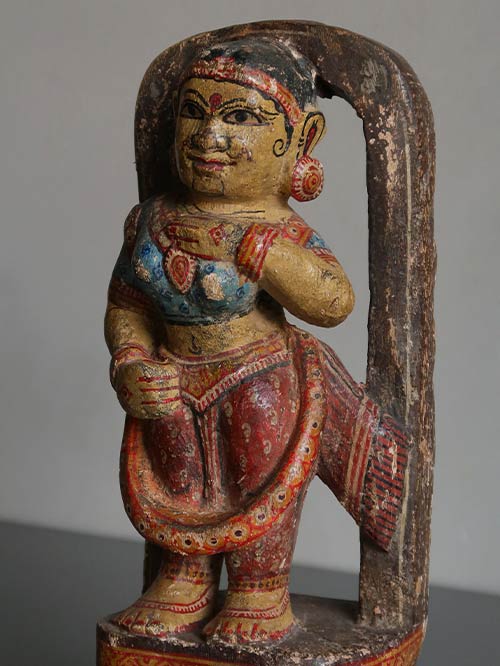
An elegant figure of an apsara wearing a patterned blouse. The apsara wears extensive jewellery; including multiple hand and leg ornaments. She has a stylised form with a narrow waist and large breasts and carries a flute in her hands. She has a full face with a pronounced chin, large arched eyebrows over bulbous eyes and a gentle smile.
Apsaras means ‘essence of the waters’ or ‘moving in or between the waters’. The Apsaras are divine beauties, the dancers of the gods, who dwell in Indra’s paradise, svarga (heaven). Mistresses of the Gandharva’s (semi divine beings) and, occasionally, of men, they can assume any form at will. Generally they are believed to have originated from the churning of the ocean, alone with the wish fulfilling Parijata, their favoured tree. They are often sent by the gods to seduce Rishis (holy men) and ascetics. Heroes who fall in battle are swept away to Svarga by the Apsaras. They are reputed to dwell in trees along with the Gandharvas. The chief of the Apsaras is Urvashi.
Size (cms): 33(H) x 13(W) x 10(D)
Size (inches): 13(H) x 5(W) x 4(D)
-
Karnataka
Wood, polychromed
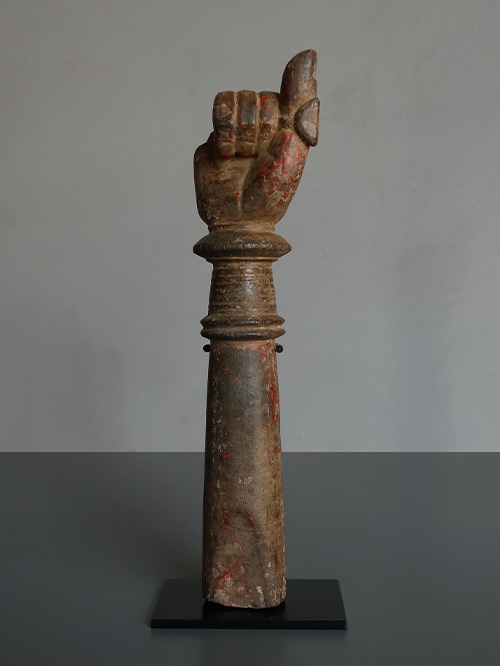
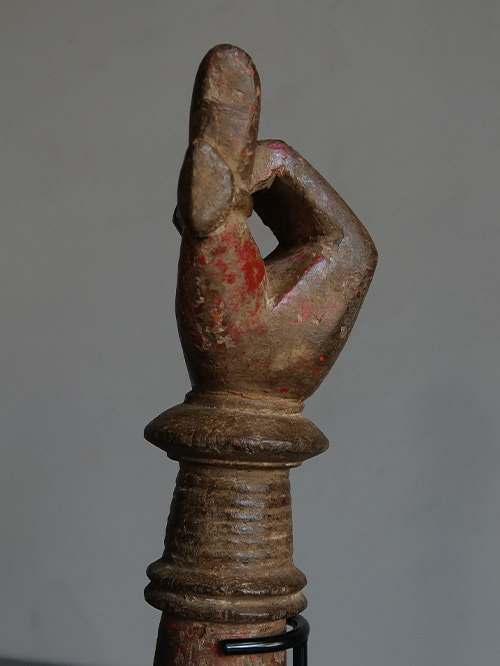
A finely carved wooden hand, with original polychroming wearing bangles and rings. Originally from an articulated multi-armed processional figure of a Devi. During festive occasions, the utsavar (portable figures of deities) are placed on chariots or pedestals in the mandapam (audience hall of a temple) or on their respective vahana (vehicle) and taken out for public viewing or darshana. Darshana refers to the occasion where the devotee is not only able to see the image of the deity but also to sense its omnipresence. To enhance the visibility of the utsavar, they are elaborately dressed in dhoti or sari, garlanded with flowers and decked with the most exquisite jewellery, made of gold and semi-precious stones before being brought out in procession. Sometimes additional hands or legs are added to increase the physical presence of the image. These features may allow the deity to stand, sit or clasp multiple weapons.
Size with the Stand (cms): 34(H) x 13(W) x 7.5(D)
Size with the Stand (inches): 13.5(H) x 5(W) x 3(D)
-


Staffordshire, England
Earthenware, transfer-printed
Marked ‘Copeland, late Spode’
A beautiful earthenware dish Arabic inscriptions made for the Islamic markets. The inscription in the Center translates as ‘Allah the one, there is no partner to Him/ Muhammad is the Prophet of Allah/ Indeed you are the Conqueror.’ The top and bottom inscriptions on the outer border translate as ‘There is no God but Allah.’ The names of the four Caliphs, Abubaker, Umar, Usman and Ali also appear on the outer border in vignettes among foliate swirls.
Manufacturers and retailers in Britain, looking to expand their markets to the British empire and beyond, started production of plates with inscriptions in Arabic taken from the Qur’an. These plates sometimes found in Indonesia and India were made for sale in countries with a significant Muslim population. An identical Copeland plate, but in blue is in the collection of the V&A, London.
Size (cms): 5.75(H) x 29.25(Diam)
Size (inches): 2.5(H) x 11.5(Diam)
-
China (for the export market)
Porcelain, ‘floral patterns and characters’
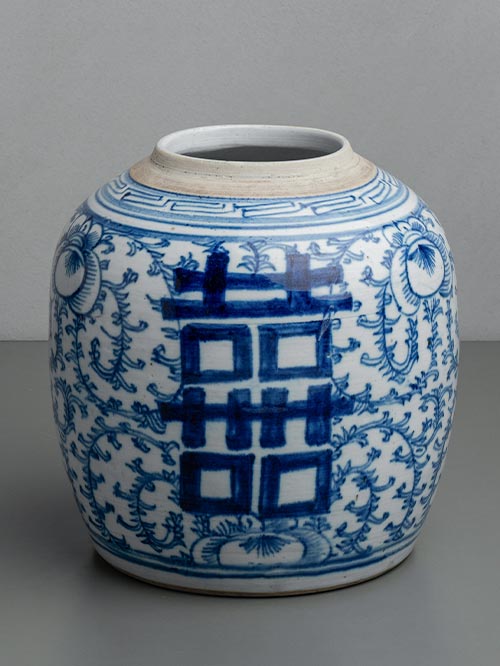
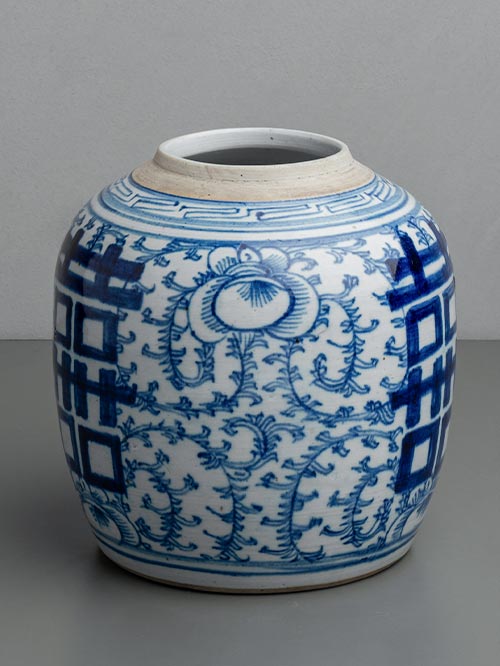
Ginger jars are steeped in centuries of Chinese culture and history. Shaped with a wide mouth, a domed lid and a bulging, bulbous spherical hand painted body, they come in various styles and sizes and many different colours. Porcelain Chinese ginger jars were originally used to store food supplies like salt, herbs, oil and ginger (rare spices at that time), other ginger jars were allocated to be used as gifts. The jars acquired the name “ginger jars” because they often contained ginger when they were exported to the West. Some of the decorative treatments on ginger jars have included dragons, carp, landscapes, and florals, either glazed in a rainbow of colours or limited to the blues and whites of flow blue. Because of their wide shape, ginger jars lent themselves to a “rose medallion” treatment, in which florid designs around the jar framed smaller scenes, almost like a graphic novel in porcelain.
Size (cms): 22.5(H) x 22(Diam)
Size (inches): 9(H) x 8.5(Diam)