“Lokapurusha (Cosmic Being)” has been added to your cart.
View cart
-
Orissa
brass alloy
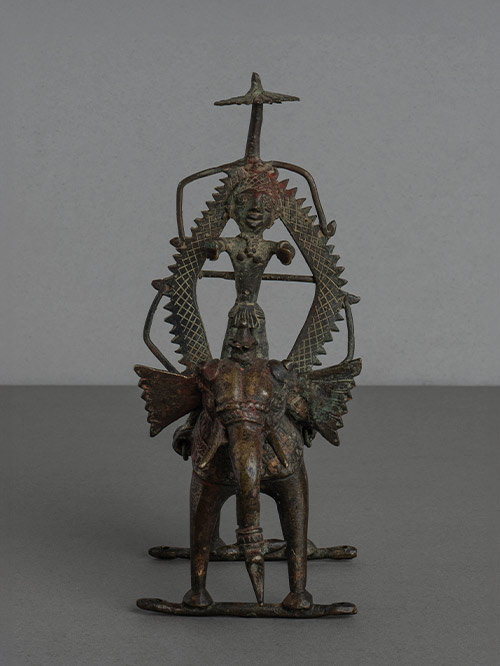
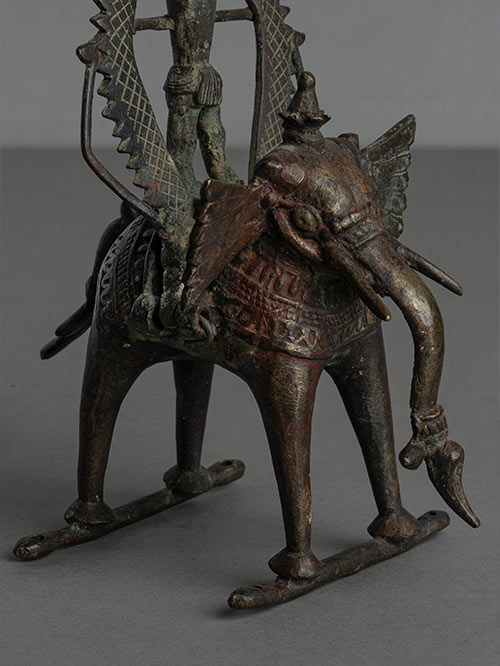
A finely crafted figure of an elephant with its mahout. The caparisoned elephant is adorned with head and neck ornaments and a decorated saddle cloth, and it has a lovely curled trunk. Atop the elephant stands the Goddess Danteshwari, enclosed in a howdah shaped like a prabhavali, forming a ritual arch around the deity.
The elephant was the vahana or vehicle of god Indra. Later it became associated with deities such as Lakshmi and Danteshwari (Durga). In art and literature it became a symbol of power and might and was associated with royalty and deities. Danteshwari Mata who is a form of the powerful Goddess Durga and is also the family goddess of the princes of Bastar. The last ruler of Bastar who died in 1966 was considered her incarnation. The goddess was brought to Bastar in the 15th century by Annamdeo, an ancestor of the princely dynasty. On the run from the advancing Muslims, he had sought refuge in the impassable mountainous region of Bastar. Legend has it that the goddess appeared to him in through his royal sword and showed him the way. The sword represents the power of the victorious goddess and bestows military prowess upon its owner.
Size (cms): 19(H) x 12(W) x 8.5(D)
Size (inches): 7.5(H) x 4.5(W) x 3.5(D)
-
Lucknow (North India)
Opaque watercolour on European paper
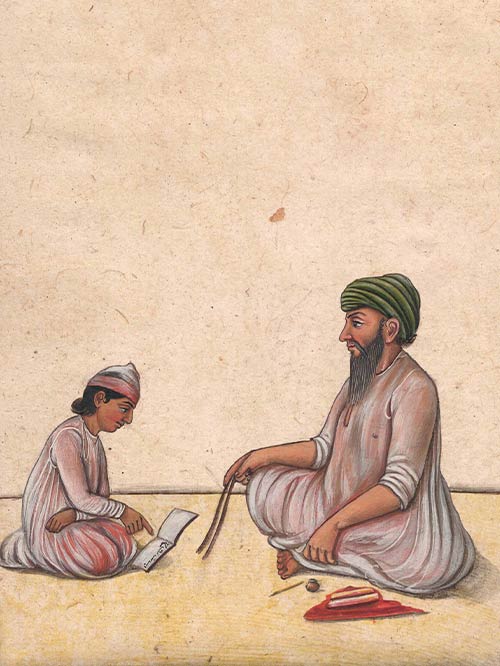
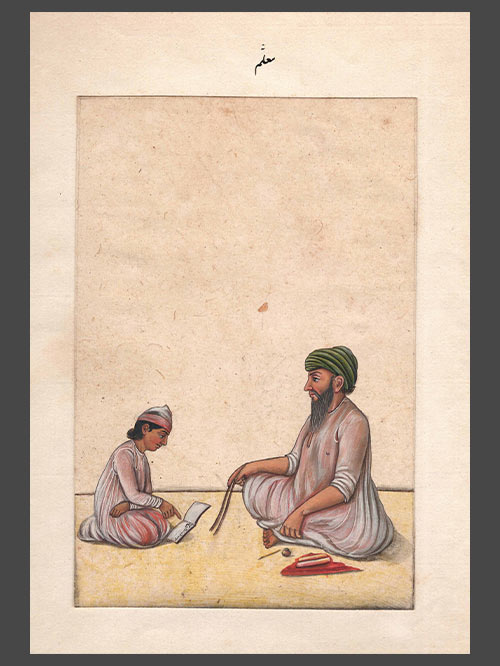
Company painting in Oudh developed on individual lines. This was largely because the European communities in Faizabad and later in Lucknow differed greatly from those in cities which came under direct British rule. Apart from the British Resident and his staff, and the British garrison, the Europeans who flocked to Oudh in the late eighteenth and early nineteenth centuries were adventurers and tradesmen looking for quick fortunes. They were not the serious-minded soldiers and administrators who, in other parts of India, were purchasing paintings of ‘manners and customs’ to paste in their scrapbooks or to send home to relatives in England. It followed that there was little demand in Oudh, until later in the nineteenth century, for paintings of this kind. There were undoubtedly a few cultivated Europeans – Colonel Gentil, General Claude Martin, Colonel Polier and Richard Johnson – but they were interested either in European work of good quality or in oriental culture. They patronised the British professional painters who visited Oudh or collected Indian and Persian manuscripts and miniatures. Oudh was a flourishing centre for acquiring oriental works for, with the break-up of the Mughal libraries at Delhi, many Persian manuscripts had found their way to it. The Nawabs and their courtiers were also lavish patrons of Indian artists. With the decline of patronage at Delhi, Mughal artists had moved to Faizabad and later to Lucknow, and a school of painting had arisen which was marked by feverish brilliance, a fitting expression of Oudh society under Nawab Shuja-ud-daula (1753-75) and Nawab Asaf-ud-daula (1775-97). Many portraits and paintings of musical or literary themes with a semi-erotic flavour were made at this time. The artists were well patronised and felt confident in the traditional character of their work.
Painting Size (cms): 15(H) x 10(W)
Painting Size (inches): 6(H) x 4(W)
-
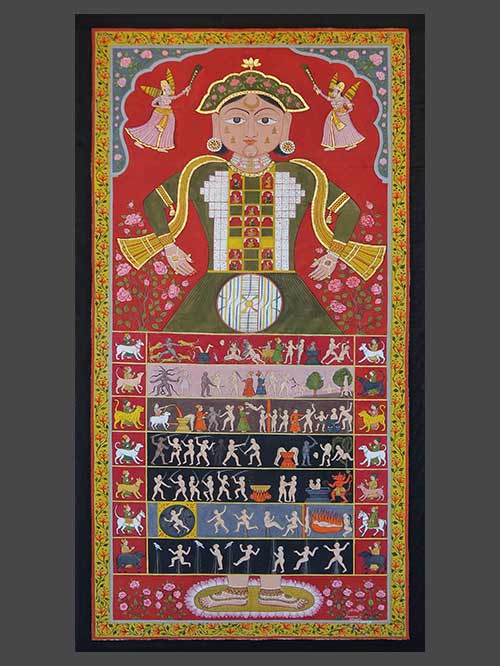
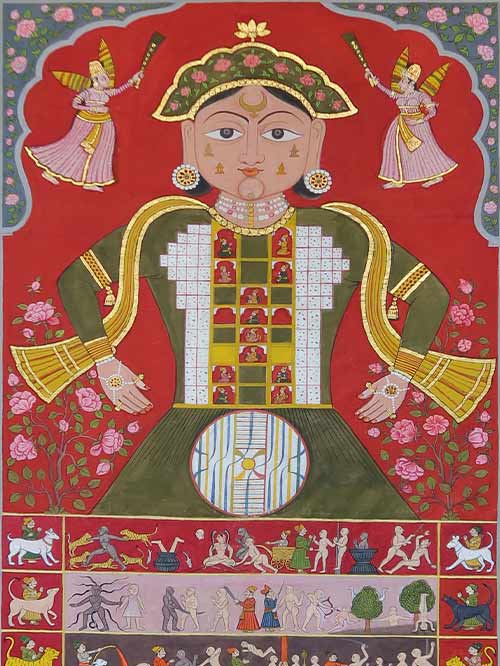
Rajasthan
Opaque watercolour on cloth with highlights in gold
Size (cms): 136(H) x 68(W)
Size (inches): 53.5(H) x 27(W)
-
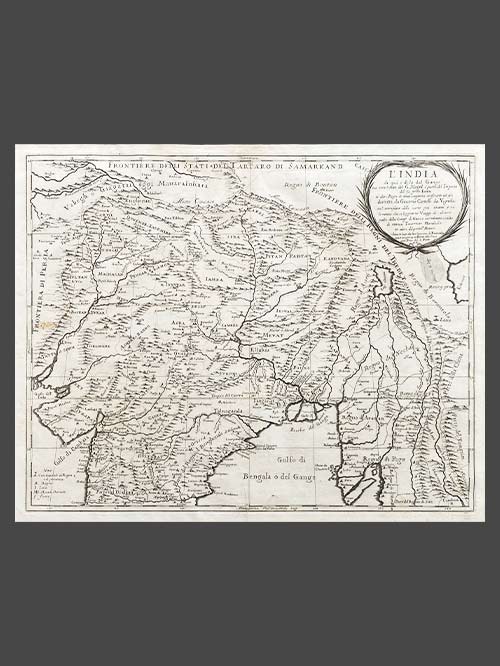
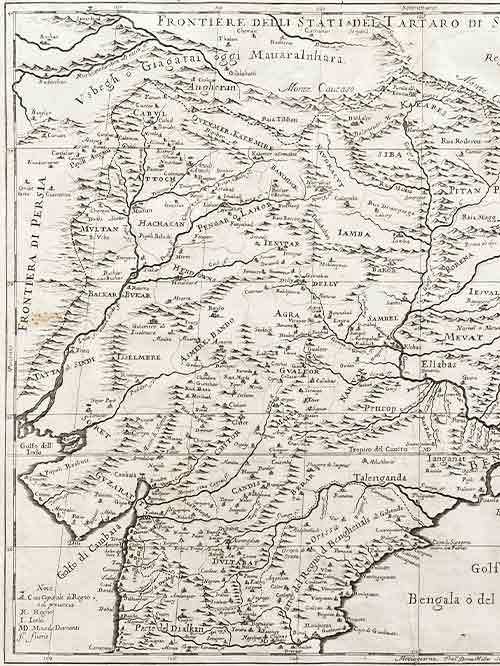
Pub. Rome by Giacomo Giovanni Rossi
Original engraved map
This is a fine representation of the Cantelli-Rossi map showcasing Northern India, Pakistan, Afghanistan, and Tibet. The map’s title includes a dedication to Jean-Baptiste Tavernier. It covers the northern frontier, reaching up to Cabul, Samarkand, Nupal, Boutan, and Lassa. Notably, the sources of the Indus and Ganges Rivers are accurately depicted on the map.
Cantelli (1643-1695), a geographer and cartographer from Montorsello near Vignola, began his journey in Bologna, where he pursued humanistic studies. In 1669, he became the secretary to Marquis Obizzo da Ferrara before traveling to Venice and eventually Paris. There, he established connections with prominent French geographers of the time, including Du Val, Nicola Sanson, and Michel Antoine Baudrand. Cantelli collaborated with the renowned De Rossi cartographic workshop, which published most of his maps. With a growing reputation as a skilled cartographer, Cantelli caught the attention of Pope Innocent XI and the Duke of Modena and Reggio Francesco II d’Este, both of whom sought him as their official cartographer. He chose to work for Francesco II and was appointed court geographer in November 1685. Over the following years, he produced numerous maps of European countries and territories. The majority of his maps were featured in the well-known Mercurio Geografico atlas, published in Rome by the De Rossi family.
Size (cms): 44(H) x 55(W)
Size (inches): 17.5(H) x 21.5(W)
Mounted Size (cms): 64(H) x 75(W)
Mounted Size (inches): 25(H) x 29.5(W)
-


Rajasthan
silver
Fine silver circular tray with a domed perfume container. The outer border of the tray is tray decorated with chased floral and geometric designs enclosing a double band of petal like cusped lobes reminiscent of architectural niches. The central perfume container sits within a chased floral band and has a hinged onion shaped domed lid with stepped patterns and a knop finial. Perfumes in Mughal India were used not just to scent oneself but also for medicinal purposes, the most common type of perfume was attar of roses.
Size (cms): 7(H) x 18.5(Diam)
Size (inches): 3(H) x 7.5(Diam)
-

Orissa
Wood, polychromed
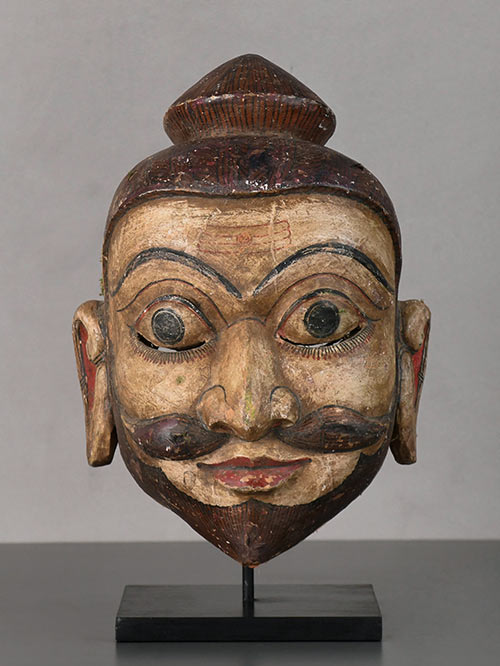
This striking festival mask unusually depicts an ascetic. The moustached and bearded ascetic wears a characteristic topknot. Exquisitely carved, the Ascetic has a serene expression with almond-shaped eyes below elegantly arched eyebrows, and his full lips form a subtle smile. A prominent Shaivite Tripundra marks his forehead. Tiny ovular slits have been cut out beneath the eyes to assist the dancer in navigating while wearing the mask.
Shahi Jatras (royal processions) of Orissa present different episodes from the Ramayana during the spring season, usually lasting for for one week. Actors, carrying huge wooden masks and gorgeous costumes, walk on the streets with stylised gait and mime with the accompaniment of loud drumming. The Desia Nata of Koraput, Orissa, also uses masks for representing gods, goddesses, animals, birds and demons. These themes are also taken from Ramayana.
Mask Size (cms): 48(H) x 33(W) x 20(D), 51(H with Stand)
Mask Size (inches): 19(H) x 13(W) x 8(D), 20(H with Stand)