“Pair of Demon Scarers” has been added to your cart.
View cart
-
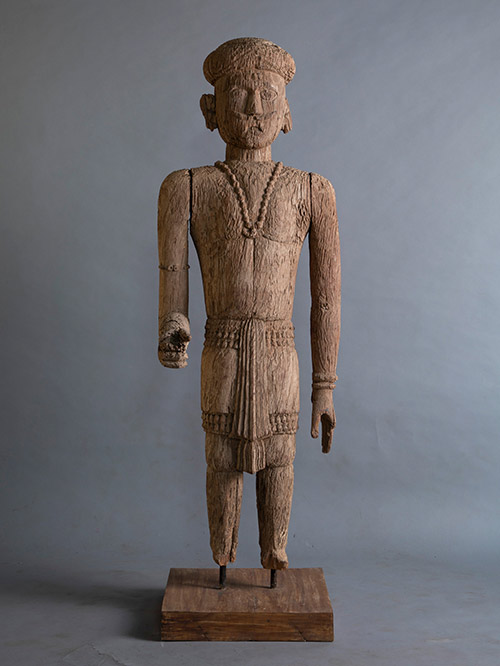
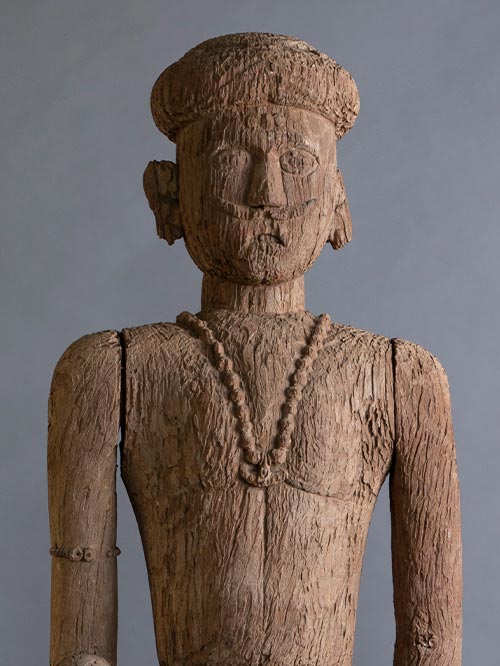
Coastal Karnataka (Bhuta culture)
Wood
A rare figure of a male donor chief. He wears a turban, has a prominent moustache and is decked with typical jewellery including a single strand necklace with a pendant, armlet and earrings. He wears an unstitched garment tied at the waist with pleats at the front, called a mundu.
The bhuta tradition is popular on the Malabar coast. Bounded by the dramatic sweep of the forested ghats to the east and the Arabian sea to the west, and encircled by rivers, the South Kanara district of coastal Karnataka has enjoyed relative geographic isolation until recent years. This has enabled the region to retain specific pre-Hindu belief systems and associated rituals, virtually intact, over several hundred years. These practices have a distinct identity of their own, although they have become linked in a variety of ways with mainstream Hinduism. Though now primarily confined to Coastal Karnataka, Bhuta cults once existed all over India under different names and forms. The factions, which are of considerable antiquity, have much in common with those of the yakshas (mysterious semi-divine beings), for instance.
Size (cms): 147(H) x 44(W) x 54(D)
Size (inches): 58(H) x 17.5(W) x 21.5(D)
-
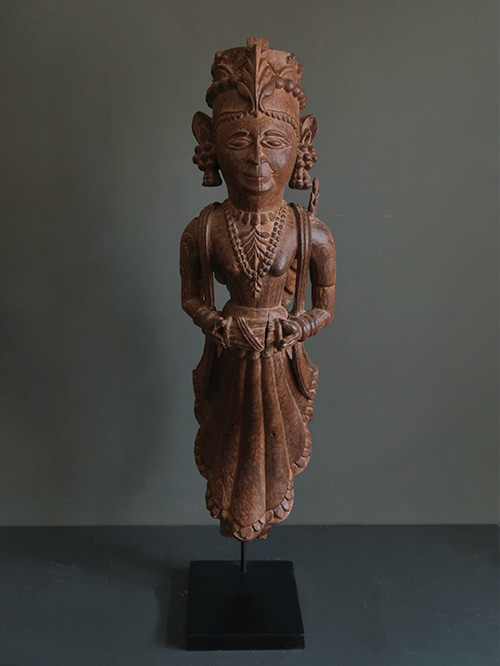
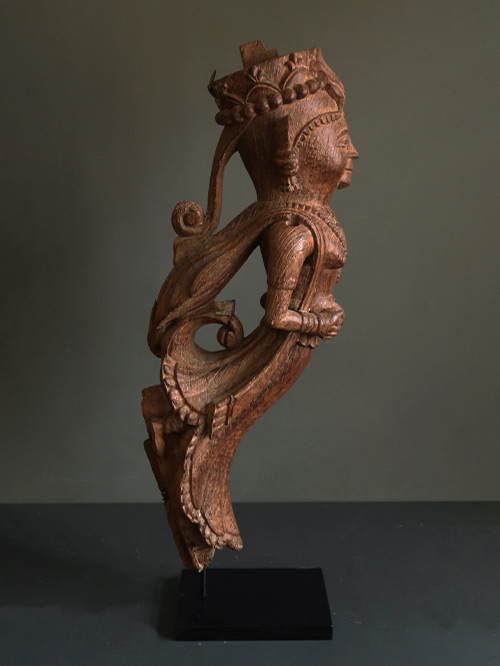
Patan (Gujarat)
Wood
A fine figural strut formed as a crowned celestial musician (Vidyadhara). She holds a small drum and wears a patterned blouse and a flowing pleated skirt standing in a typical curved posture. Her long veil drapes behind her shoulders resembling wings. The appearance of wings on figures is a very old tradition in Indian art. Although seen in many parts of Gujarat the treatment his novel : the robes of the figure turn up at the ends and the veil cross the shoulders and turns into wings.
The ancestral occupation of the Hindu Suthar community, the craft of wood carving was practiced in several districts of Gujarat including Patan, Kadi, Ahmedabad and Nadiad, although the legacy of exquisite wood carving seen in the traditional havelis, mansions, is evident in all the districts of Gujarat. Patan district is renowned for the intricately carved Bohra haveli or mansions at Siddhpur; these structures are characterised by their eclectic use of geometric or floral patterns as well as motifs inspired by European and West Asian decorative elements on the woodwork of the balconies and ceilings.The wooden architecture of Ahmedabad on the other hand, acquires its distinctive aesthetic through the use of patterns borrowed from block printing and textiles.
Size (cms): 72.5(H) x 20(W) x 28(D)
Size (inches): 28.5(H) x 8(W) x 11(D)
-
Karnataka
brass alloy
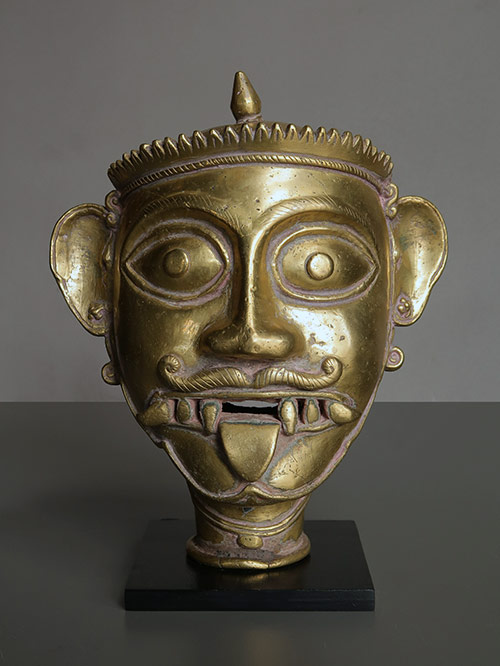
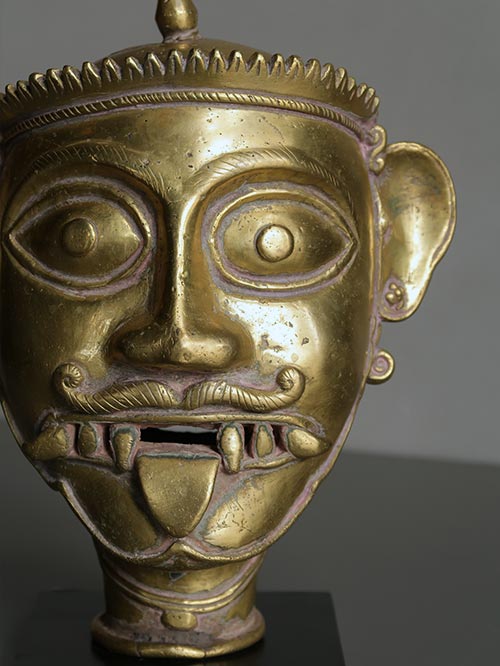
A finely cast Bhairava head also know as a ‘Demon Scarer’. The head has a rounded tubular extension at its base, which would fit over a pole and could be carried above the heads of the populace during festivals and processions. The moustachioed visage has a vicious face with bulging eyes and cheeks and with a huge gaping mouth with large teeth and fangs.
Such monster figures and monster masks depict a demonic form of Bhairava, one of the avatars of Shiva. Some masks exhibited a distinct animal-like visage with huge teeth and a gigantic mouth. Those were often referred to as ‘tiger masks’. Some masks assumed the expression of a gargoyle with huge, bulging cheeks. Others incorporated composite features including tusks, bossing of the skull and occasionally the horns of a ram.
Protective deities such as viras (deified heroes), kshetrapalas (guardians), bhutas (spirits of various deities), including some daivas (devils) were expected to provide protection against invaders, thieves, the elements- fire , storms, floods, drought, disease etc. Since the earth was populated by gods and their counterparts in the nether world, demons, evil spirits and ghosts, prayers, offerings and sacrifices were made to both groups to propitiate them.
Size (cms): 28(H) x 24(W) x 16(D)
Size (inches): 11(H) x 9.5(W) x 6.5(D)
-
Karnataka
brass alloy
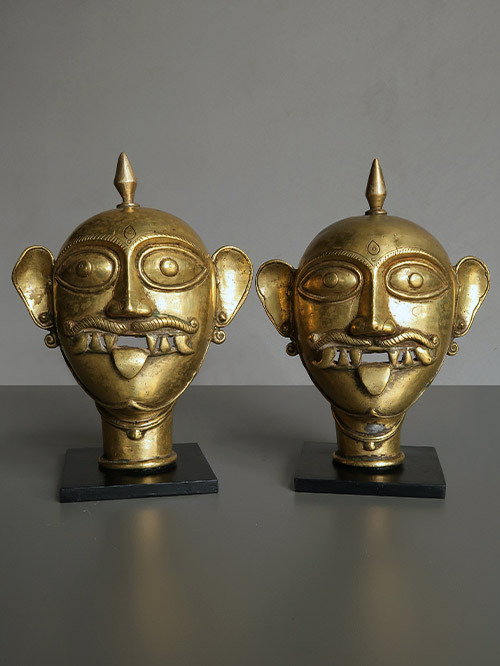
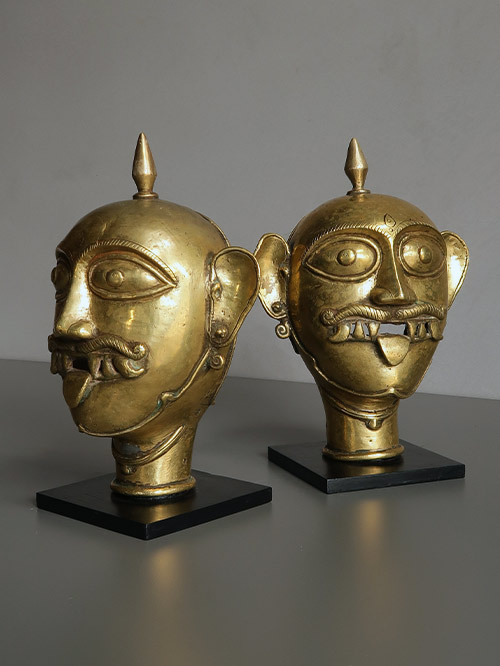
A beautiful pair of brass cast Bhairava heads also know as a ‘Demon Scarers’. Both visages are moustachioed with vicious gaping mouths with large teeth, fangs and protruding tongues. The heads have a rounded tubular extension at their base, which would fit over a pole and could be carried above the heads of the populace during festivals and processions.
Such monster figures and monster masks depict a demonic form of Bhairava, one of the avatars of Shiva. Some masks exhibited a distinct animal-like visage with huge teeth and a gigantic mouth. Those were often referred to as ‘tiger masks’. Some masks assumed the expression of a gargoyle with huge, bulging cheeks. Others incorporated composite features including tusks, bossing of the skull and occasionally the horns of a ram.
Protective deities such as viras (deified heroes), kshetrapalas (guardians), bhutas (spirits of various deities), including some daivas (devils) were expected to provide protection against invaders, thieves, the elements- fire , storms, floods, drought, disease etc. Since the earth was populated by gods and their counterparts in the nether world, demons, evil spirits and ghosts, prayers, offerings and sacrifices were made to both groups to propitiate them.
Size (cms): 29(H) x 23(W) x 15(D) each
Size (inches): 11.5(H) x 9(W) x 6(D) each
-
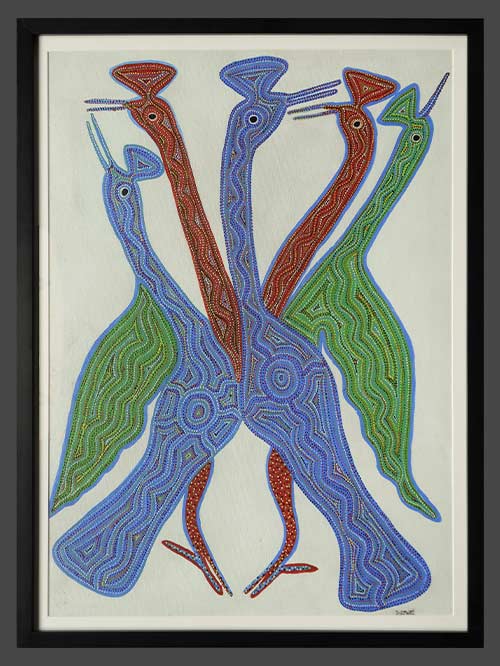
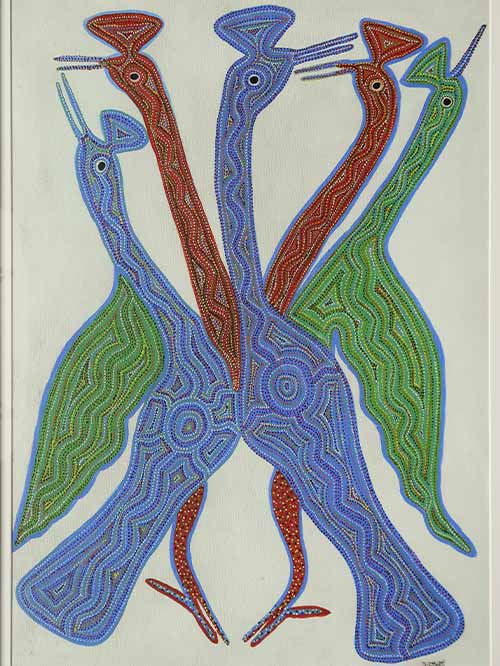
Bhil Tribes (Central India)
by Bhuri Bai
watercolour on canvas
Bhuri Bai grew up in the Jhabua district on the Madhya Pradesh-Gujarat border. J Swaminathan identified her as a potential artist nearly three decades ago, when she was a 20-year-old daily wage labourer. She picks up clues from the arts of embroidery as well as ritual narratives; her images shuttle between the intimate and the cosmic. This is especially evident in paintings where she depicts stags whose antlers grow into forests, their bodies distinctively patterned after desert dunes or river wavelets. She returns, often, to variations on the Tree of Life motif, playfully annotating its mythic presence with owls that stand on stilt-legs, timid snakes, and high-spirited elephants. Bhuri Bai demonstrates a lively and witty eye for observed detail, veining her observations with allegorical or parabolic intent.
Painting Size (cms): 74(H) x 54(W)
Painting Size (inches): 29(H) x 21.5(W)
Framed Size (cms): 79(H) x 59(W)
Framed Size (inches): 31(H) x 23(W)
-
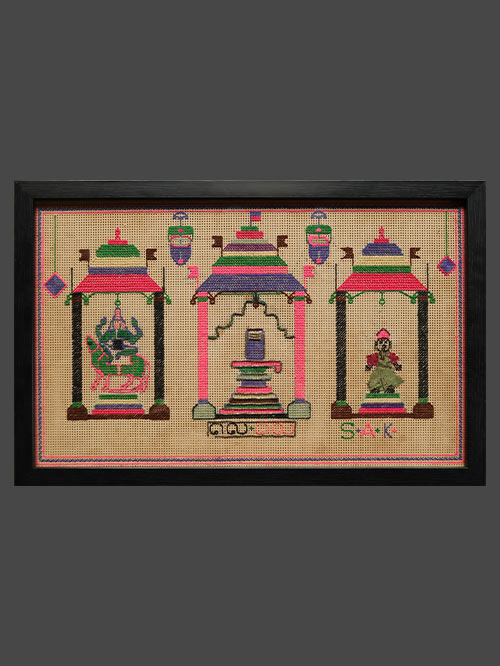
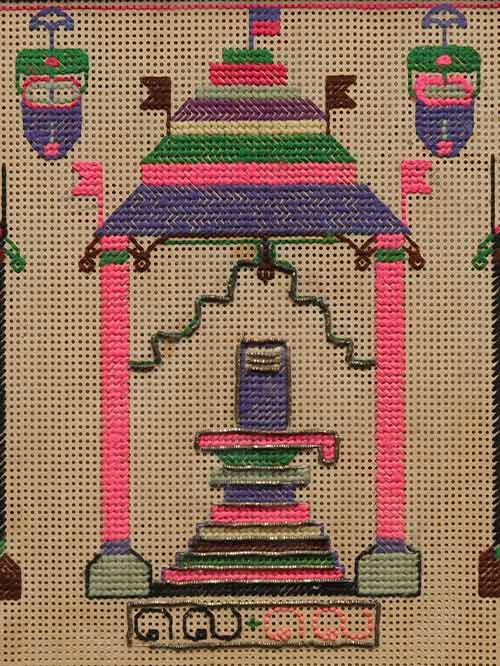
Chettinad (Tamil Nadu)
cross stitch embroidery
This decorative cross stitch embroidery artwork depicts three pillared niches, the central larger one with lingam flanked by two smaller ones with Ganesha and Kartikeya, temple lamps suspended above.
Framed Size (cms): 32(H) x 49(W)
Framed Size (inches): 12.5(H) x 19.5(W)
-
Chettinad (Tamil Nadu)
cross stitch embroidery
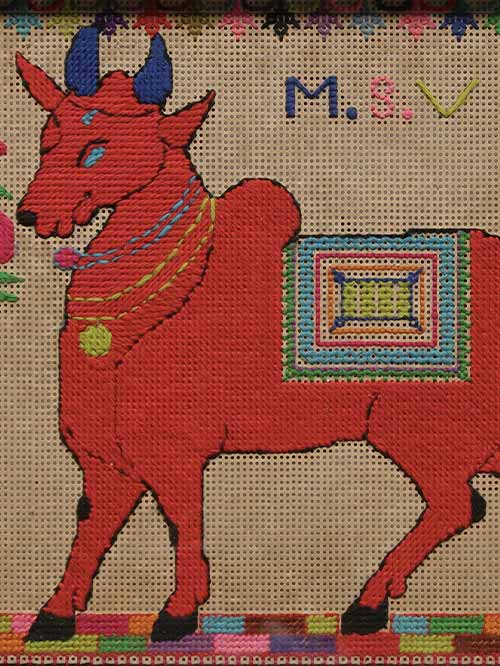
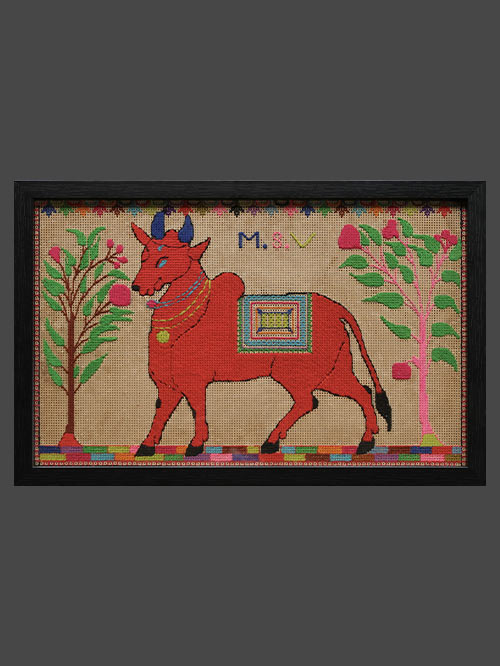
This whimsical cross stitch embroidery artwork depicts a bright orange caparisoned Nandi with blue horns stands facing left between two trees.
Framed Size (cms): 32(H) x 49(W)
Framed Size (inches): 12.5(H) x 19.5(W)
-

Maharashtra
silver
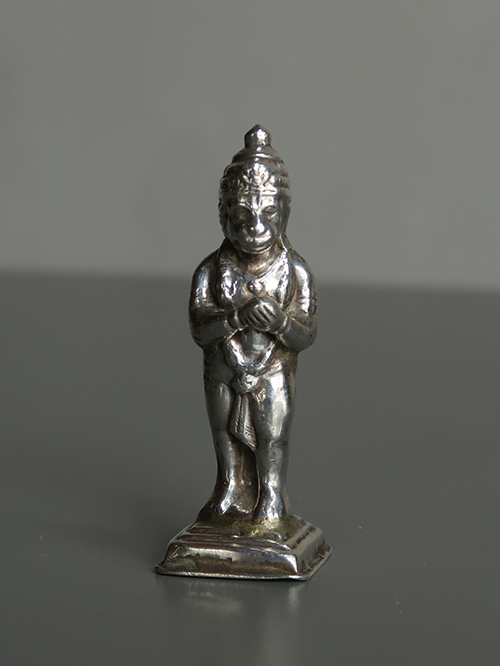
A charming yet worn figure of Hanuman standing with his hands held together. His tail extends from the right hip upward terminating above his head.
The story of Hanuman is found in the Ramayana where he is the ubiquitous servant, the epitome of devoted service and loyalty. His search for the heroine Sita, captured by Ravana, illustrates his superhuman powers and zealous performance of the tasks that were given to him.
Size (cms): 8.8(H) x 3.1(W) x 4.6(D)
Size (inches): 3.5(H) x 1(W) x 2(D)
-
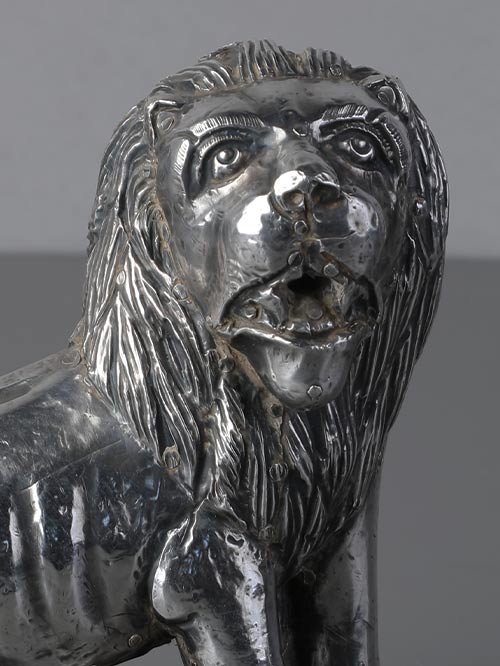
Gujarat
silver on wood
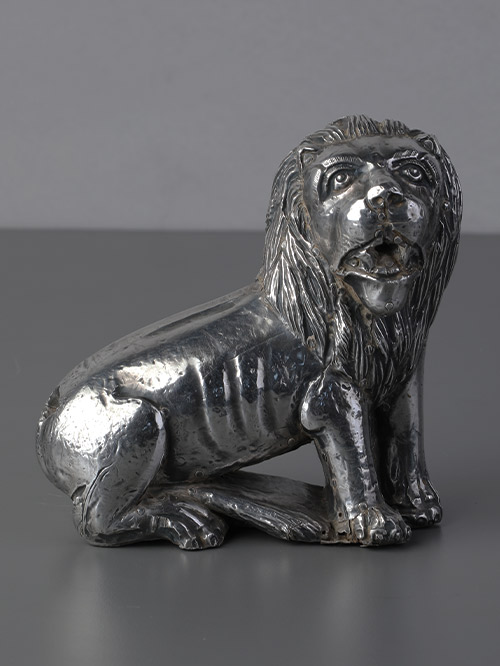
A decorative silver lion with a wooden frame. The ferocious looking lion is seated on its hind legs and is open mouthed, exposing large teeth. These would have served as symbolic supports to the inner sanctum of home shrine.
Among the Jains the lion served as the mount of Mahavira, the 24th and last Jina. Mahavira was the twenty-fourth Tirthankara (ford-maker) of Jainism which was revived and reestablished by him. In the Jain tradition, it is believed that Mahavira was born in the early part of the 6th century BC into a royal family in what is now Bihar, India. At the age of thirty, abandoning all worldly possessions, he left his home in pursuit of spiritual awakening and became an ascetic. For the next twelve and a half years, Mahavira practiced intense meditation and severe austerities, after which he is believed to have attained omniscience.
Size (cms): 15(H) x 14.5(W) x 7.5(D)
Size (inches): 6(H) x 5.5(W) x 3(D)
-
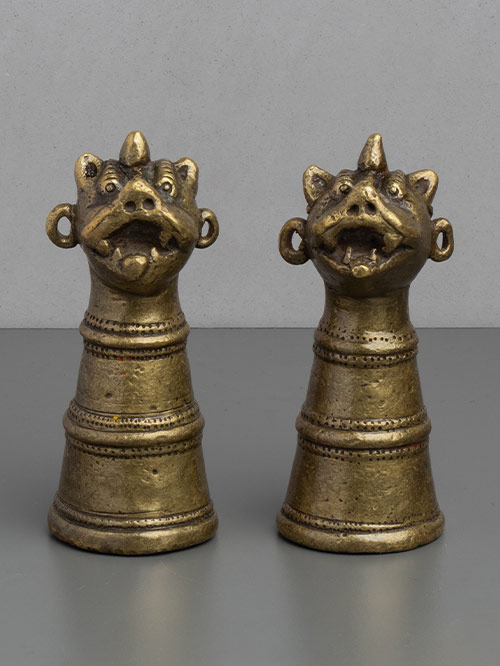

Karnataka
Brass
A decorative pair of horn cap ornaments with vyali (lion) finials. They would have been fixed to nandi (bull) horn ends as a decorations for the Pola festival, during which draft animals are thanked for their help in plowing the fields.
Nandi or nandin, the bull vahana of Shiva has always been noted for his strength and virility. Usually depicted in a life-like naturalistic manner, Nandi is present in every Shaivite temple, often with his own temple enclosure but facing the Shiva lingam. Figures like this of Nandi on a platform base with a cobra canopy are common objects of worship, especially found in home shrines.
Indiv. Sizes (cms): 12(H) x 5(W) x 5(D) each
Indiv. Sizes (inches): 4.5(H) x 2(W) x 2(D) each
-
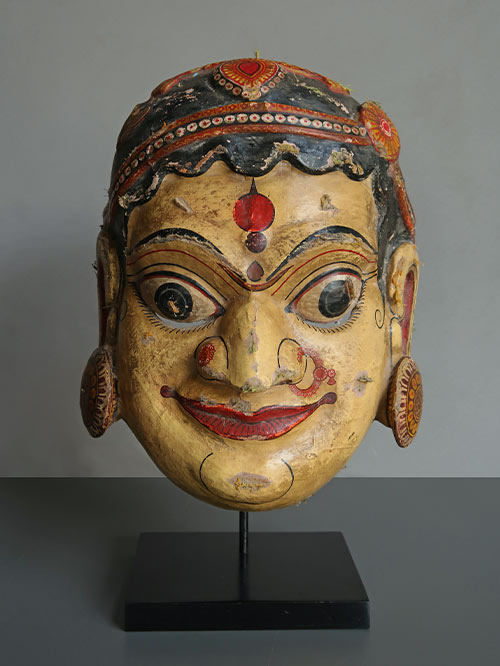
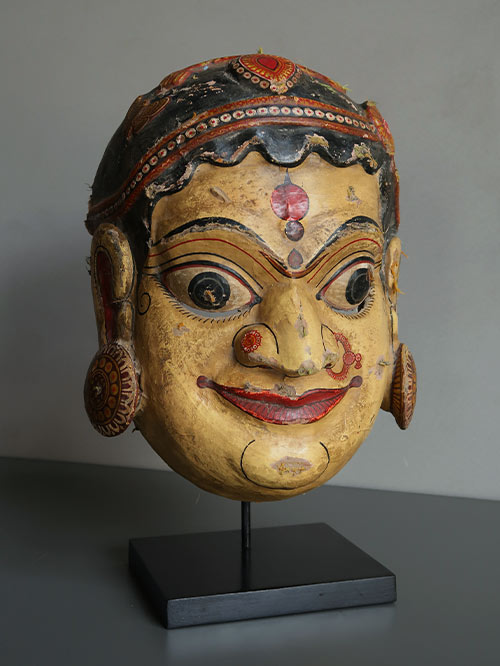
Orissa
Wood, extensively polychromed
This delicately painted and unusual dancing mask depicts Sita the consort of Lord Rama. Sita wear large kundala earrings and various nose and an unusual butterfly shaped hair ornament. A prominent tilaka adorns her forehead. Elongated slits have been cut out under her piercing eyes to help the dancer navigate while wearing the mask. This mask would have been used during folk performances of the Ramalila in Orissa.
The Ramalila (folk re-enactment of the life of Rama) is a widespread type of popular performance. The genre encompasses various dramatic enactments of the story of Rama by non-professional actors, men playing women’s roles, common throughout north India, ranging in duration from ten to thirty-one nights, concluding on the autumn holiday of Dussehra. In Orissa in particular, Ramalila is performed during the two weeks following Rama’s birthday, Ramanavami, in March or April, a time that makes sense for an enactment that begins with Rama’s birthday, on Ramanavami. This timing also coincides with the agricultural cycle, making the performance a celebration of the spring harvest. Also it is pleasant at the beginning of intense summer heat for villagers to enjoy the cool night hours with performances, generally from midnight till dawn, while actors and audience are free to sleep in the daytime.
Size with stand (cms): 40(H) x 27(W) x 22(D)
Size with stand (inches): 15.5(H) x 10.5(W) x 8.5(D)