“Horse Utsav Murti” has been added to your cart.
View cart
-
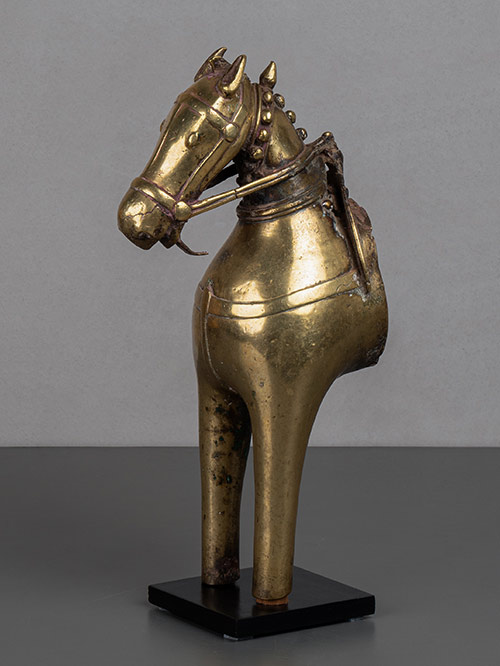
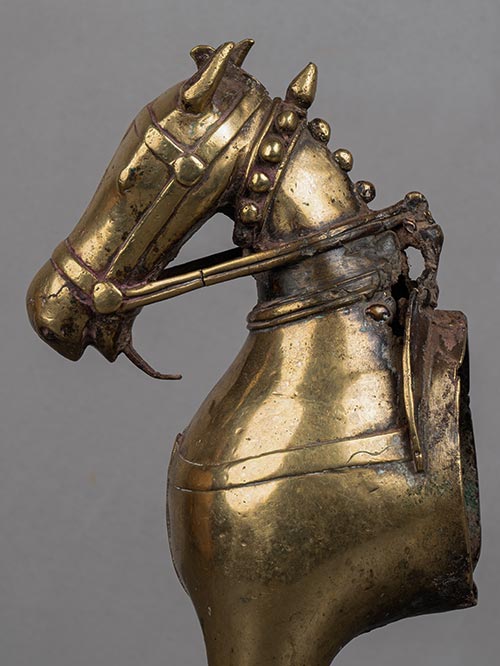
Maharashtra/ Karnataka
brass alloy
This finely modelled brass horse is most likely a procession image or Utsav Murti. Its primary function was to be used in festivals and processions outside the temple. The ‘half horse’ would have been kept against a backdrop adorned with floral garlands and vermillion.
Shiva was, and still is, the tutelary deity of Maharashtra, originally being a tribal protective deity. As Khandoba, he was widely worshipped throughout this region and contiguous areas of Karnataka, Rajasthan and Andra Pradesh where he is also called Mallanna and Khanderao. The traditional vahana (vehicle) of Shiva is Nandi, the bull, however in the form of Khandoba he is usually portrayed on horseback and occasionally on a camel or elephant.
Size (cms): 35(H) x 10.5(W) x 18(D)
Size (inches): 14(H) x 4(W) x 7(D)
-
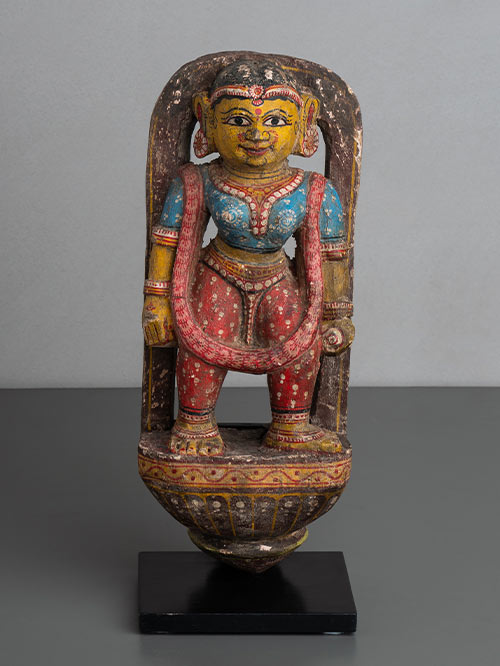
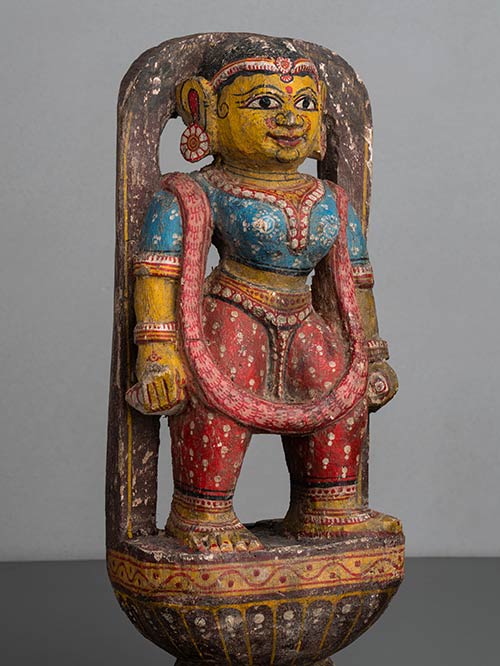
Orissa
Wood, polychromed
An elegant figure of an apsara wearing a patterned blouse. The apsara wears extensive jewellery; including multiple hand and leg ornaments. She has a stylised form with a narrow waist and large breasts and carries a conch in either hand. She has a full face with a pronounced chin, large arched eyebrows over bulbous eyes and a gentle smile.
Apsaras means ‘essence of the waters’ or ‘moving in or between the waters’. The Apsaras are divine beauties, the dancers of the gods, who dwell in Indra’s paradise, svarga (heaven). Mistresses of the Gandharva’s (semi divine beings) and, occasionally, of men, they can assume any form at will. Generally they are believed to have originated from the churning of the ocean, alone with the wish fulfilling Parijata, their favoured tree. They are often sent by the gods to seduce Rishis (holy men) and ascetics. Heroes who fall in battle are swept away to Svarga by the Apsaras. They are reputed to dwell in trees along with the Gandharvas. The chief of the Apsaras is Urvashi.
Size (cms): 33.5(H) x 13(W) x 10(D)
Size (inches): 13(H) x 5(W) x 4(D)
-
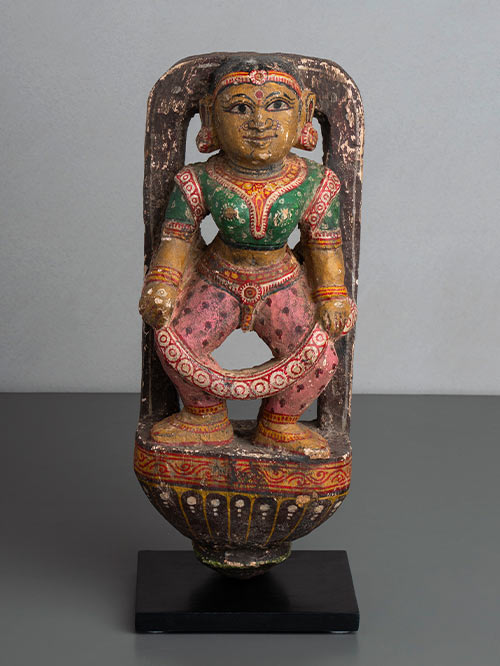
Orissa
Wood, polychromed
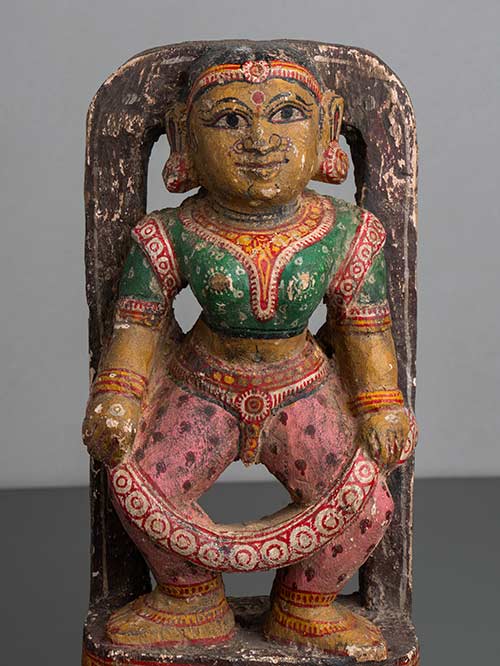
An elegant figure of an apsara wearing a patterned blouse. The apsara is adorned with extensive jewelry, including multiple hand and leg ornaments. She has a stylised form with a narrow waist and large breasts, and she holds a floral garland in front of her. Her full face features a pronounced chin, large arched eyebrows over bulbous eyes, and a gentle smile.
Apsaras means ‘essence of the waters’ or ‘moving in or between the waters’. The Apsaras are divine beauties, the dancers of the gods, who dwell in Indra’s paradise, svarga (heaven). Mistresses of the Gandharva’s (semi divine beings) and, occasionally, of men, they can assume any form at will. Generally they are believed to have originated from the churning of the ocean, alone with the wish fulfilling Parijata, their favoured tree. They are often sent by the gods to seduce Rishis (holy men) and ascetics. Heroes who fall in battle are swept away to Svarga by the Apsaras. They are reputed to dwell in trees along with the Gandharvas. The chief of the Apsaras is Urvashi.
Size (cms): 33.5(H) x 13(W) x 10(D)
Size (inches): 13(H) x 5(W) x 4(D)
-

Karnataka
Brass
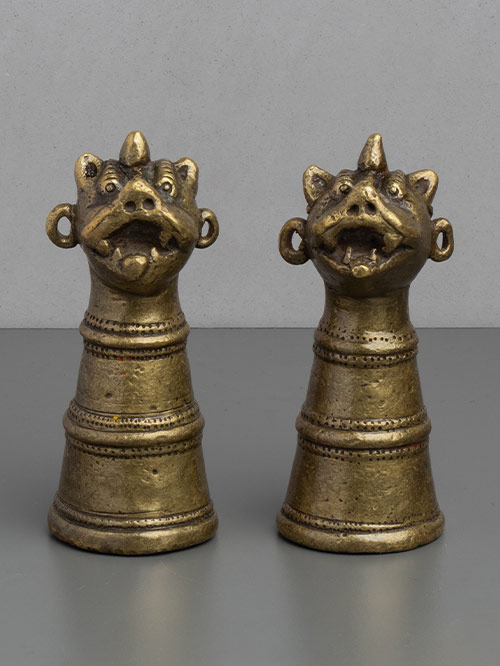
A decorative pair of horn cap ornaments with vyali (lion) finials. They would have been fixed to nandi (bull) horn ends as a decorations for the Pola festival, during which draft animals are thanked for their help in plowing the fields.
Nandi or nandin, the bull vahana of Shiva has always been noted for his strength and virility. Usually depicted in a life-like naturalistic manner, Nandi is present in every Shaivite temple, often with his own temple enclosure but facing the Shiva lingam. Figures like this of Nandi on a platform base with a cobra canopy are common objects of worship, especially found in home shrines.
Indiv. Sizes (cms): 12(H) x 5(W) x 5(D) each
Indiv. Sizes (inches): 4.5(H) x 2(W) x 2(D) each
-

Karnataka
Wood
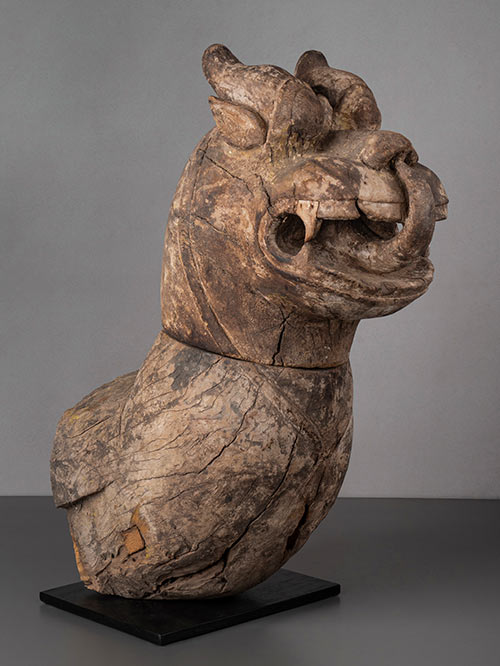
‘Yali’ or ‘Vyala’ denotes a mythical lion faced animal that appears on carved friezes on temple walls. They are fierce, leonine beasts with curvaceous bodies and enlarged heads surrounded by flame-like manes. They rear up on hind legs, the forelegs held out with clenched claws as if to pounce. Sometimes they are shown standing on human heads presumably of the demons that they have vanquished. In southern Indian sculpture from the 16th century onwards figures of rearing, almost three dimensional vyalis bearing heads either of horned lions or elephants and feline bodies guard the entrances of temples and line the approaches leading to sanctuaries.
Size (cms): 65(H) x 29(W) x 61(D)
Size (inches): 25.5(H) x 11.5(W) x 24(D)