“Makara Bracket” has been added to your cart.
View cart
-
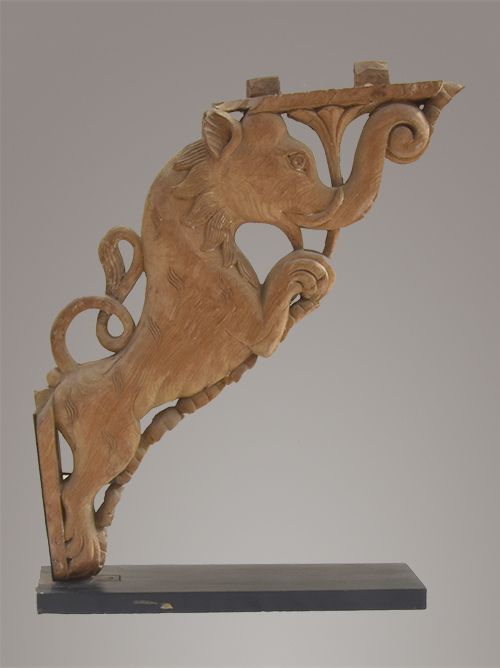
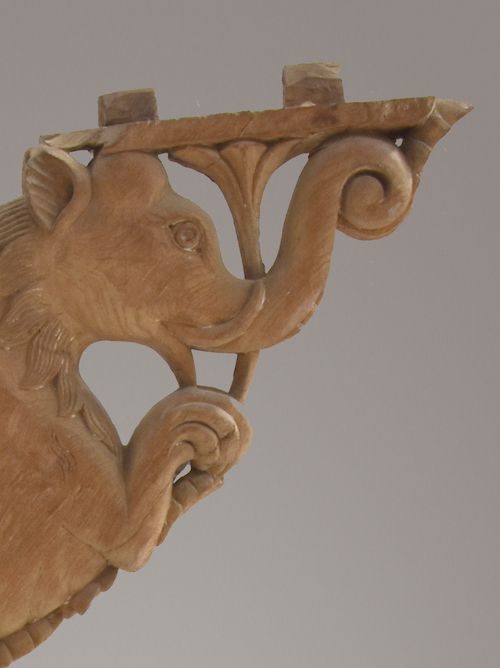
TEAK
c. 1920
The Makara is a mythical aquatic creature that combines the body of a crocodile with the head of a lion and the trunk of an elephant. One of India’s most ancient symbols, harking back more than two thousand years to a time when the natural world was seen as both symbol and reality, and fantastic creatures were invented to express the complexity of nature. The Makara is considered auspicious and purifying by Hindus and related to fertility. he is the vehicle (vahana) of Varuna, god of the waters of heaven and earth, and the emblem of Kama, the god of love.
Sizes (cms): 80 (H) x 62 (W) x 20 (D)
Sizes (inches): 31.4 (H) x 24.4 (W) x 7.9 (D)
-
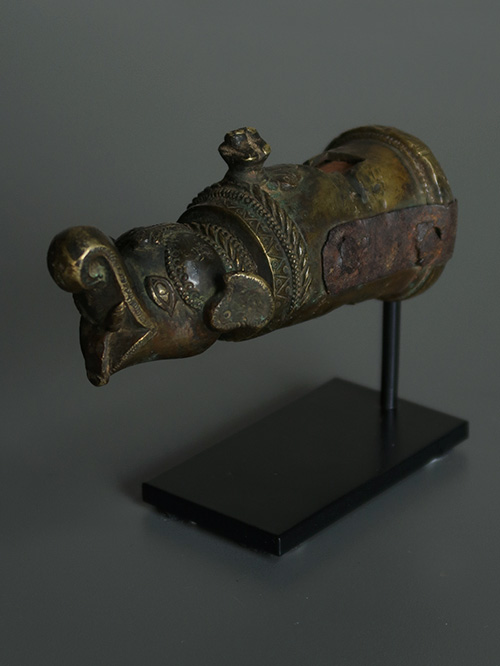
Karnataka
Brass alloy
A brass palanquin pole finial taking the sculptural form of a makara head with an elephantine trunk, with bulbous eyes, pointed ears and a gaping mouth. The emotive expression of the makara, with his open mouth is powerful yet unthreatening, underlying its protective function, benign in character though capable of potential ferocity when attacked. It is almost as if he is showing off, displaying his power and status, probably reflecting that of the palanquin’s grand passenger.
Palanquins or sedan chairs were used throughout India, the larger ones to transport people and the smaller ones for religious deities to be taken around the temple complex on festival days. The present example is from the latter category. It was fitted to the wooden forward pole of the palanquin; the rear pole was usually covered with a simple metal cover or cylinder.
Size (cms): 11.5(H with stand) x 13.5(W) x 5(D)
Size (inches): 4.5(H with stand) x 5.5(W) x 2(D)
-
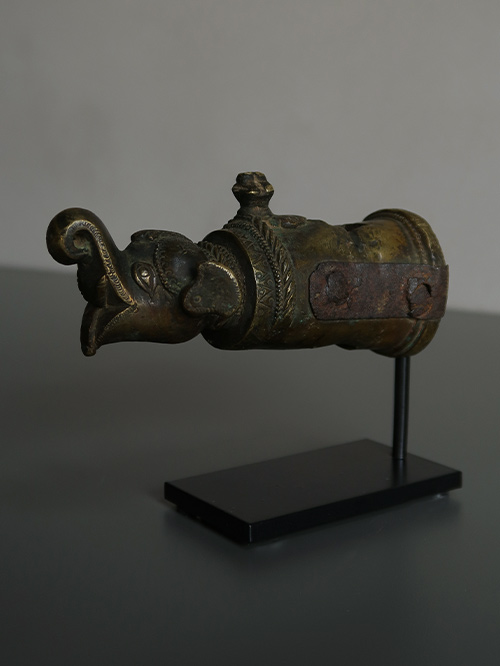
Karnataka
Brass alloy
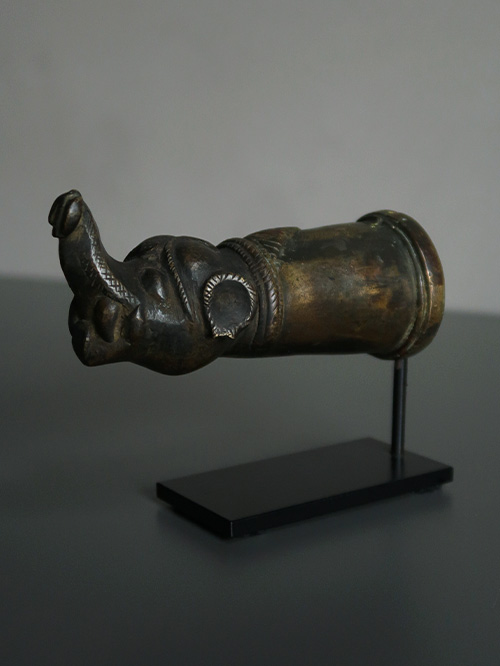
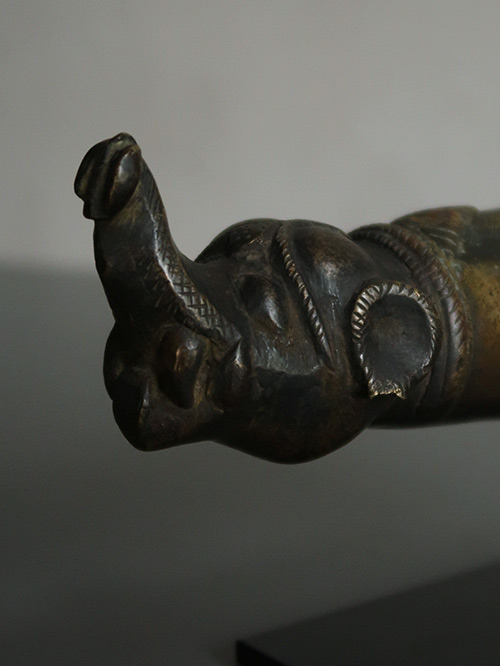
A diminutive palanquin pole finial taking the sculptural form of a makara head with large pointed ears, beady eyes and a gaping mouth. The emotive expression of the makara, with his open mouth is powerful yet unthreatening, underlying its protective function, benign in character though capable of potential ferocity when attacked. It is almost as if he is showing off, displaying his power and status, probably reflecting that of the palanquin’s grand passenger.
Palanquins or sedan chairs were used throughout India, the larger ones to transport people and the smaller ones for religious deities to be taken around the temple complex on festival days. The present example is from the latter category. It was fitted to the wooden forward pole of the palanquin; the rear pole was usually covered with a simple metal cover or cylinder.
Size (cms): 13(H with stand) x 14.5(W) x 6.5(D)
Size (inches): 5(H with stand) x 5.5(W) x 2.5(D)