“Pichhwai for Gopashtami” has been added to your cart.
View cart
-
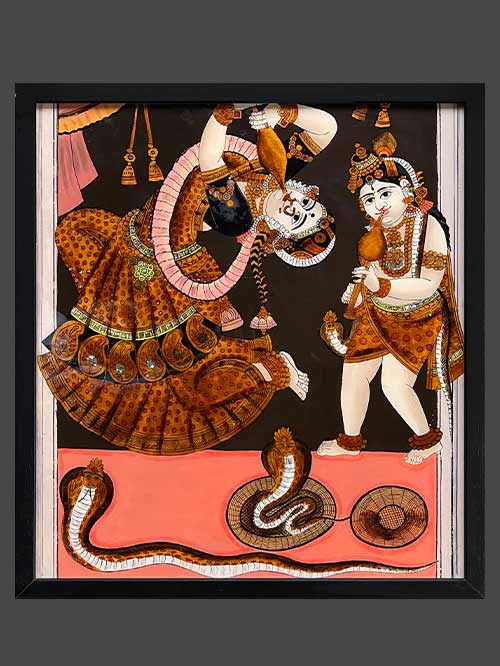
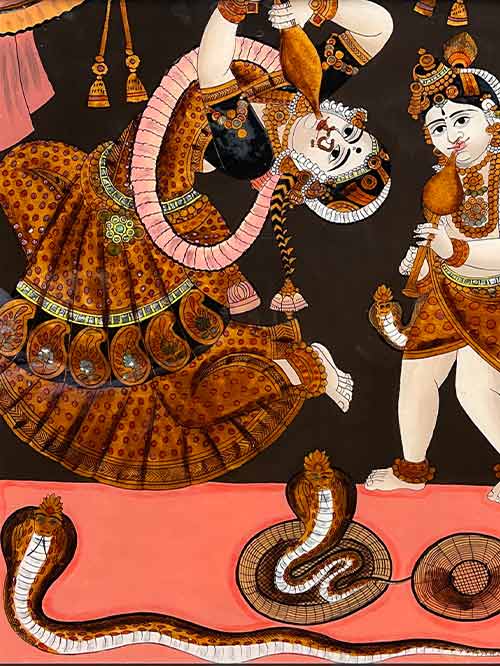
Tanjore (South India)
reverse painting on glass
A charming reverse glass painting depicting a Krishna and Yashoda as snake charmers each hypnotising a cobra with the melodic sounds of their fluted instruments called pungis. The adolescent Krishna is bejewelled and splendidly clad in a lower garment with a hip-hugging sash and a garland of flowers around his neck. His foster-mother Yashoda who is also gorgeously robed and jewelled contorts around to befuddle the snakes.
Reverse glass paintings were introduced into India the late 18th century from China by way of the China Trade. Indian artists adopted the technique of reverse glass painting partly on account of its novelty and also because it was a relatively inexpensive medium which could produce rich effects. The technique proved extremely popular and soon spread through western and southern India and even to former provincial Mughal capitals of Oudh, Murshidabad.
In Tanjore – a small state with an old art tradition- a distinctive school of glass painting developed in the early 19th century and continued for more than a hundred years. The style was essential Indian – it tended to repeat patterns of regional painting: images of deities, portraits and themes form the ancient myths, secular themes such as portraits of kings or nobles, courtesans and musicians. The colour was rich and the style bold and defiant. The subjects were clearly presented with a certain opulence and glamour.
Painting Size(cms): 47 (H) x 43.2 (W)
Painting Size(inch): 18.5 (H) x 17 (W)
Framed Size (cms): 49.5(H) x 46(W)
Framed Size (inches): 19.5(H) x 18(W)
-
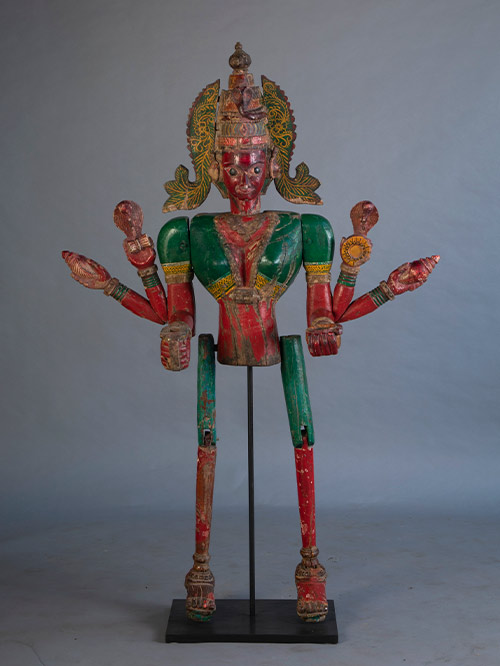
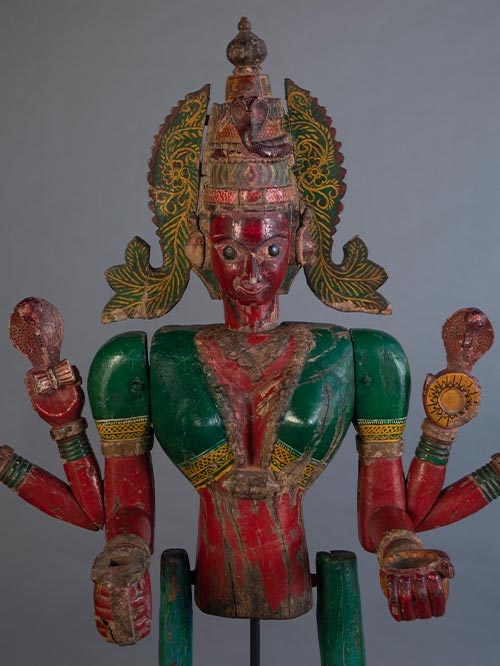
Karnataka
Wood, polychromed
An attractive multi-armed articulated standing figure of the Goddess Durga. Painted in a deep red, she wears a patterned green and yellow blouse. Her hands are adorned with multiple bangles and she carries a pair of nagas and conches in her upper hands with a blood bowl and sword in her lower two hands. An elaborate tiered crown sits on her head, decorated with geometric symbols and a serpent (naga).
Durga – “The Unconquerable form of Devi” – Durga is the most splendid manifestation of Devi. Virginal and sublime, contain within her the power of all the gods combined, she is the invincible power of Nature who triumphs over those who seek to subjugate her.
Size (cms): 132(H) x 88(W) x 31(D)
Size (inches): 52(H) x 34.5(W) x 12(D)
-
Deccan
Wood
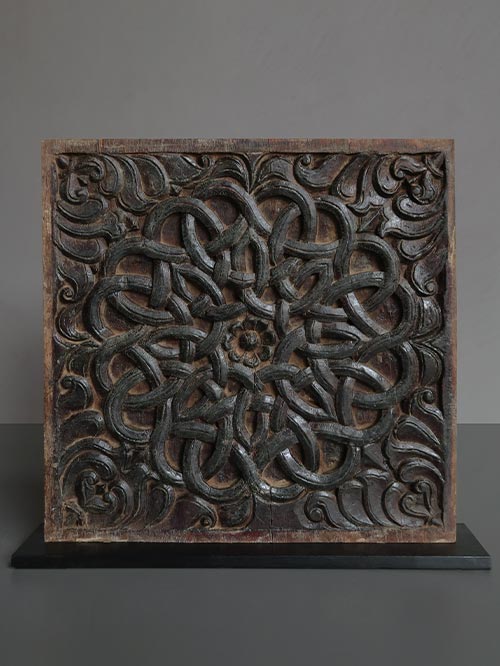
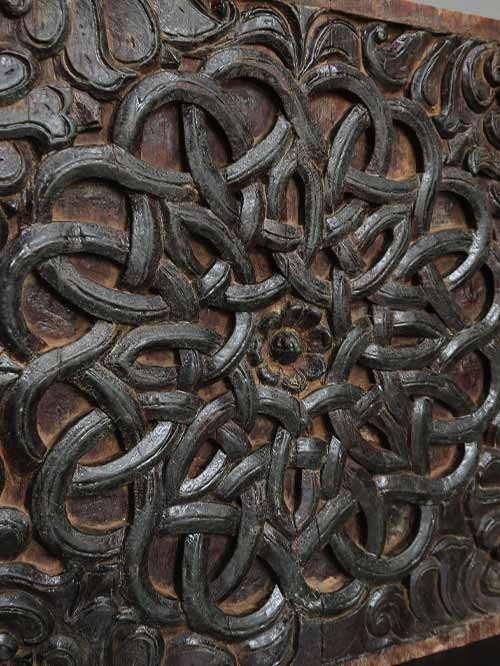
An attractive ceiling panel with a polished patina. The elegant design is comprised of swirling, interlocking leafy sprigs around a central flowerhead. The floral medallion is surrounded with mirrored scrolls and palmettes creating an almost kaleidoscopic effect.
Wooden construction was once widespread throughout most of Southern India, but the intense heat and the severe monsoonal rains have meant that a large proportion of the wooden buildings in private and public use have now disappeared. The typical southern Indian wooden building, was supported on a framework of columns, with an elaborate system of interlocking brackets and beams to support the floors and roofs. Carved doors, windows, and screens and panels filter light and ventilate the interiors, creating an environment that is both comfortable and richly detailed. The scale and shape of houses was dictated by the maximum height and span of timber beams, resulting in a modular system of construction. The woodwork was deeply cut and naturalistic, the intention of the artisans was to capture the forms and energies of the natural world. Panels such as these, with floral medallions radiating in full bloom or others with elaborate geometric modelling, ornamented the ceilings of palaces, houses and mosques.
Size (cms): 42(H) x 47(W) x 9(D)
Size (inches): 16.5(H) x 18.5(W) x 3.5(D)
-
Deccan
Wood
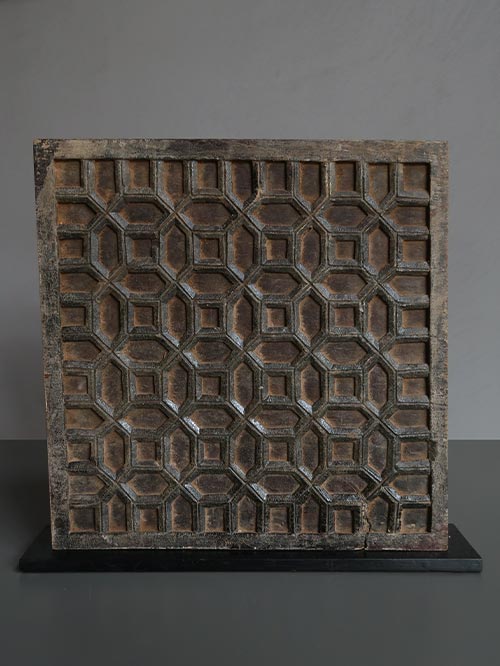
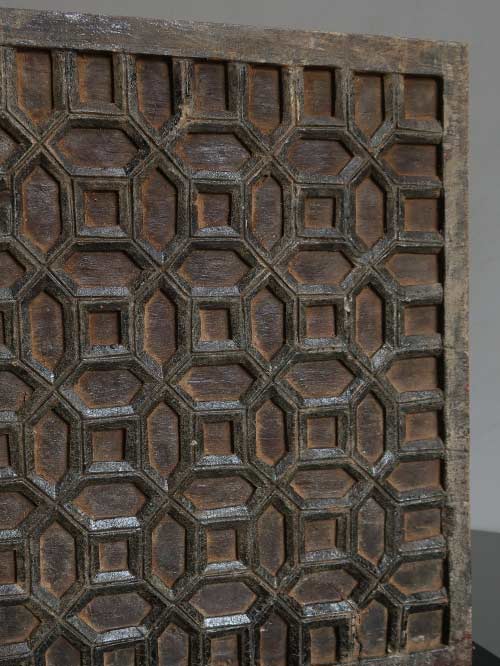
An attractive ceiling panel with a polished patina. The elegant design is consists of interlocking rectangles and octagons creating an almost kaleidoscopic effect.
Wooden construction was once widespread throughout most of Southern India, but the intense heat and the severe monsoonal rains have meant that a large proportion of the wooden buildings in private and public use have now disappeared. The typical southern Indian wooden building, was supported on a framework of columns, with an elaborate system of interlocking brackets and beams to support the floors and roofs. Carved doors, windows, and screens and panels filter light and ventilate the interiors, creating an environment that is both comfortable and richly detailed. The scale and shape of houses was dictated by the maximum height and span of timber beams, resulting in a modular system of construction. The woodwork was deeply cut and naturalistic, the intention of the artisans was to capture the forms and energies of the natural world. Panels such as these, with floral medallions radiating in full bloom or others with elaborate geometric modelling, ornamented the ceilings of palaces, houses and mosques.
Size (cms): 40(H) x 44.5(W) x 9(D)
Size (inches): 15.5(H) x 17.5(W) x 3.5(D)
-
Rajasthan
Wood, polychromed
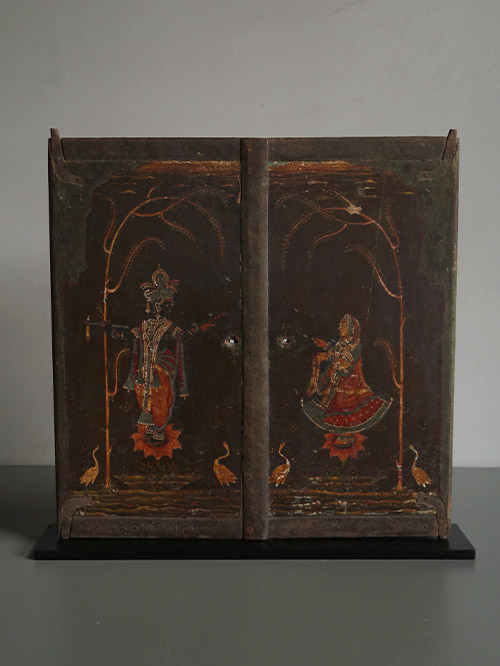
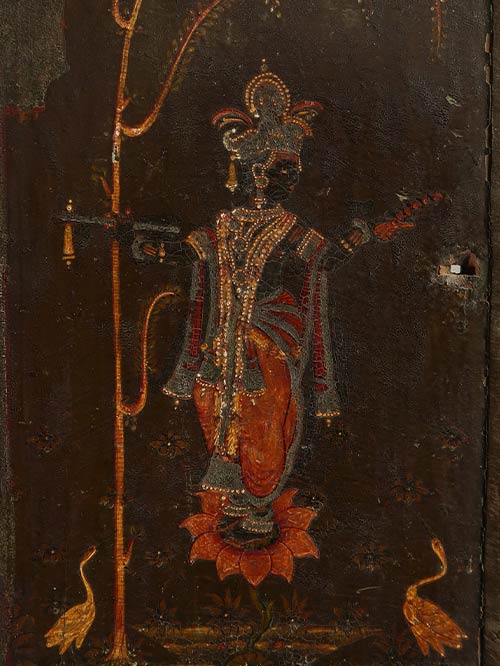
A beautiful pair of painted shutters from a household shrine. The shutter on the left depicts Krishna as Venugopala, standing on a lotus blossom upon a lake. Opposite him, Radha stands upon her own lotus, heavily bejewelled. She offers Krishna the floral garland which she holds. The nearby swans look upon the resplendent figures.
One of the most abiding images in Indian art is that of Krishna the flautist standing with his legs crossed at the ankles and playing the flute. He wears a tall decorative mukuta or crown, a dhoti and various necklaces, bangles and anklets. While other cowherders f Braj hold a shepherd’s staff, Krishna’s staff is also his flute. He, however does not play upon it to please the cows, but to charm the gopis or cowherdesses. Radha is of the Gopis of Vrindavan, who became a central figure of Vaishnava theology and she is considered to be Krishna’s favourite gopi. Radha’s selfless devotion to Krishna is regarded as a model for devotees, and she is also seen as the intermediary between man and God. According to other interpretations, Radha’s love for Krishna symbolizes the human soul’s yearning for God.
Size (cms): 51(H) x 53(W) x 10(D)
Size (inches): 20(H) x 21(W) x 4(D)
-
Maharashtra/Karnataka
Brass
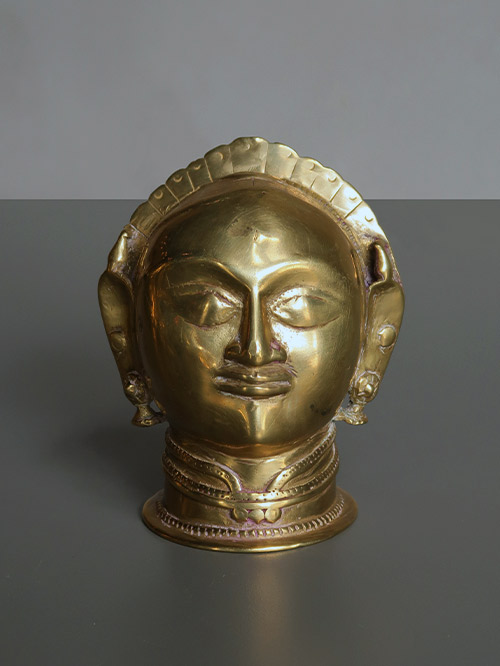
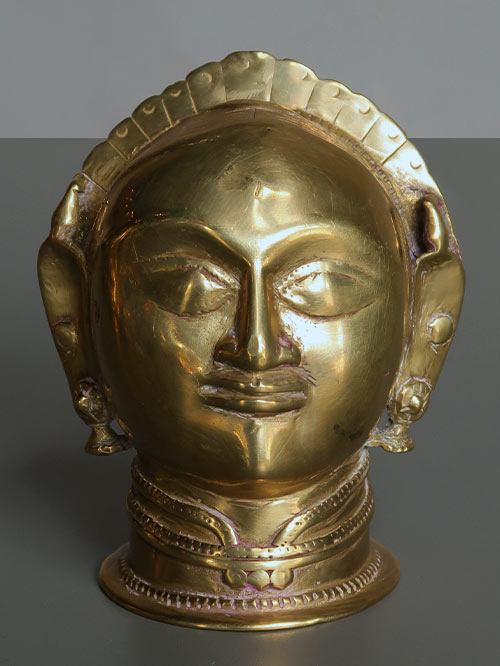
An attractive diminutive Gauri head with finely modelled features including necklaces, hair and ear ornaments as well as an engraved crown. Gauri is the name of a benevolent goddess, consort of Shiva or Varuna. Connected with the rains, she is reputed to be the source of the world and the embodiment of motherhood.
In household shrines in Maharashtra and Karnataka, the deity was considered a privileged house guest and treated accordingly. Images of the god were bathed, clothed, bejeweled and nourished in preparation for puja and darshan. Often elaborate turbans were placed on the head and bound by the finest cloths usually in the auspicious deep red colour. In some cases the masks were mounted on a wooden framework and covered with cloths. Sometimes separate metal cast arms and legs were attached to the figure, thus providing a more realistic depiction of the deity.
Size (cms): 12(H) x 9(W) x 8(D)
Size (inches): 4.5(H) x 3.5(W) x 3(D)
-
Karnataka (South India)
brass alloy
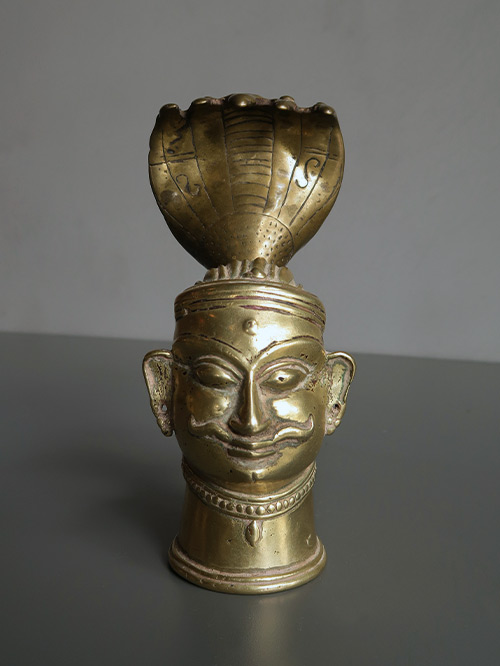
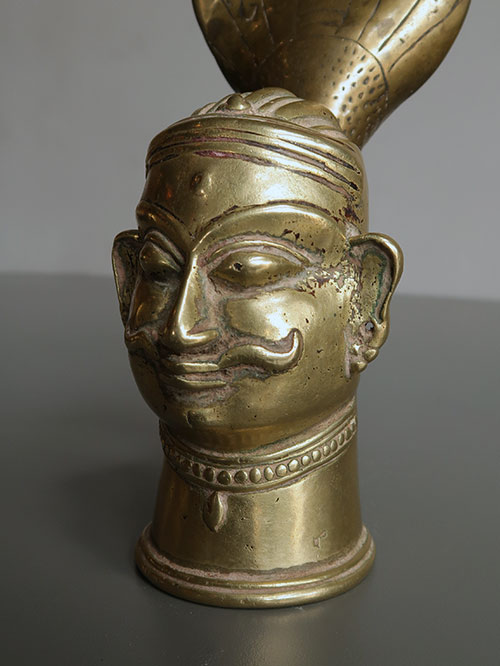
A finely cast Mukhalingam with a five-headed serpent canopy that extends over the head of the moustached god. Shiva wears a jewelled necklace, a decorated turban and his third eye is prominently displayed on his forehead.
Shiva is one of the three principal deities of Hinduism. He is labelled the ‘destroyer’ with the Trimurti, Hinduism’s trinity which includes Brahma and Vishnu. While sometimes depicted iconically, he is usually worshipped in the aniconic from of a lingam. The lingam is shaped like a pillar with a round top and can be made of stone, wood or metal. Mukhalinga signifies a visage or face on a metallic, cylindrical casting used to cover a stone lingam. The cover is thought to protect the viewer from the harm that could occur on visualization of the linga, especially one with eyes painted on its surface, which is believed to energize the figure. The metallic visage iconically depicts Shiva, wearing his characteristic moustache, earrings and matted hair.
Size (cms): 20(H) x 9(W) x 10(D)
Size (inches): 8(H) x 3.5(W) x 4(D)
-
Gujarat
Mordants, painted and printed, and dyes on cotton cloth
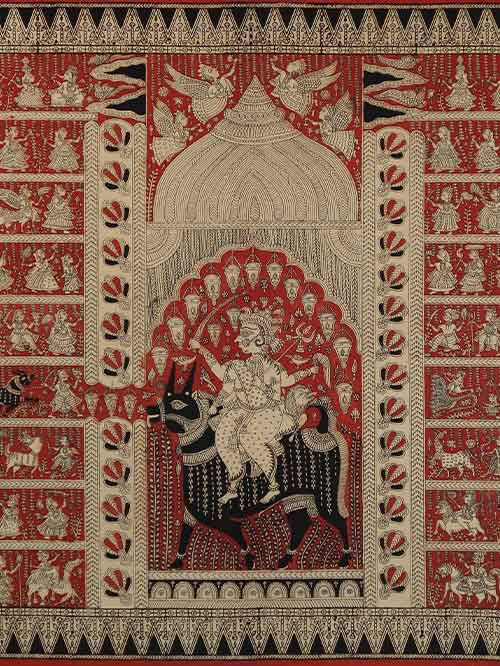
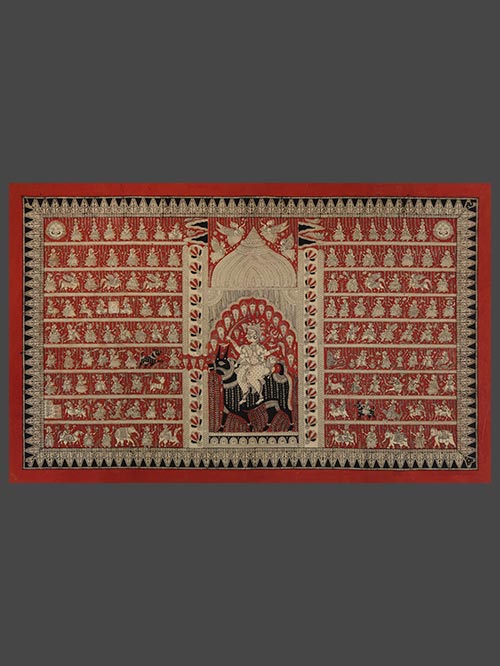
The cloth features a prominent, centrally placed iconic image of Meladi Mata enshrined within a pavilion. A folk goddess worshiped by the Vaghri community of Gujarat, Meladi Mata is identified by her mount, the black goat. The four armed Goddess is sitting astride a goat carrying various weapons and implements. Around the central form on either side, are horizontal registers demarcated with lines. These registers are filled with rows of small hand-printed figures; some, portraying devotees, while others are singular images representing mythological characters or deities. On the left side in the middle register, a priest is depicted leading a buffalo to the central pavilion. On the right side, one row depicts various manifestations of the mother-goddess such as Ambika on a Tiger and Khodiar on a crocodile. Above them are depictions from the Hindu Epics, Mahabharata and Ramayana including Rama and Lakshman hunting the two-headed deer Maricha. The overall composition with its rows of devotees replicates the grand religious ceremony that would take place. The pictorial area of the composition is framed by geometric and floral bands.
In many regions of India, various types of imaged temple cloths, executed with different materials and techniques, have originated to serve narrative, iconic, or ritual ends for diverse groups of believers. One such tradition is found in Gujarat, where temple cloths painted and printed with mordants that combine with dyes to fix their colors are a component in goddess worship. The cloths, which were formerly made in villages in the areas surrounding Ahmedabad but now probably are produced only in the city proper, honour the Great Goddess under the aspect of Mother Goddess (Mata) one or more of several manifestations peculiar to Gujarat, such as Ambika on tiger, Bahuchara on a cock, Meladi on a billy goat, Khodiar on a crocodile, and Vihat on a water buffalo.
Size (cms): 99(H) x 159(W)
Size (inches): 39(H) x 62.5(W)
-
Nathdwara (Rajasthan)
Cotton, painted on pigments
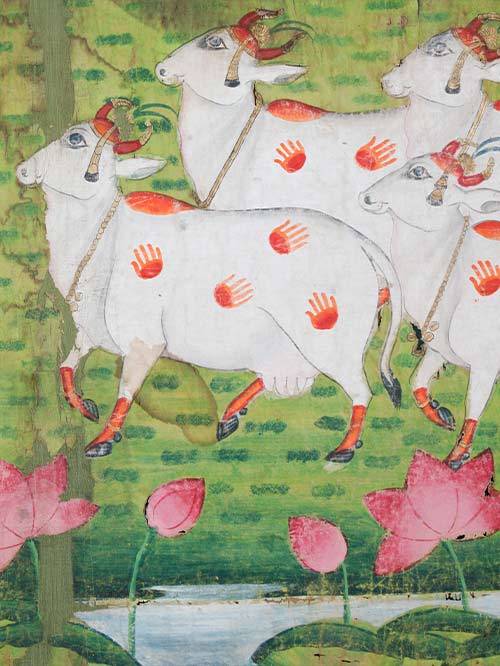
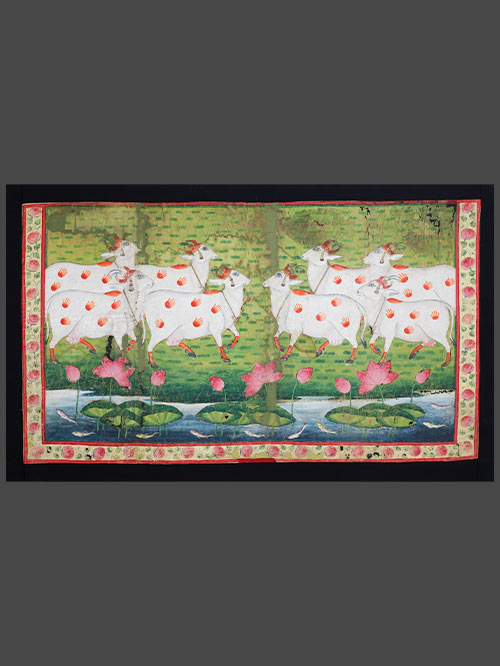
An attractive small Pichhwai depicting eight white cows grouped in a meadow with a lotus and fish filled stream in the foreground. The cows are bedecked and have henna on their horns and hooves. Large handprints painted in saffron henna cover bodies. A floral border surrounds the panel. This pichhwai would have either accompanied a larger pichhwai in a prominent shrine or constituted part of a small domestic shrine.
Gopashtami is a festival that commemorates Krishna’s elevation from a young herder of calves to full cowherd. Krishna grows into the perfect cowherd, the one all the cows heed, answering to the golden strains of his flute. At Nathdwara the cows, decked in their finest, are brought into the haveli. There is a playful spirit about this festival that is well expressed in this pichhwai. The cows, gentle creatures with limpid eyes and expressive ears, are constant reminders of Vraja and Krishna’s childhood occupation as cowherd.
Size (cms): 75(H) x 124(W)
Size (inches): 29.5(H) x 49(W)