“Dhodro Banam Instrument” has been added to your cart.
View cart
-
Santhals (North-Eastern India)
wood
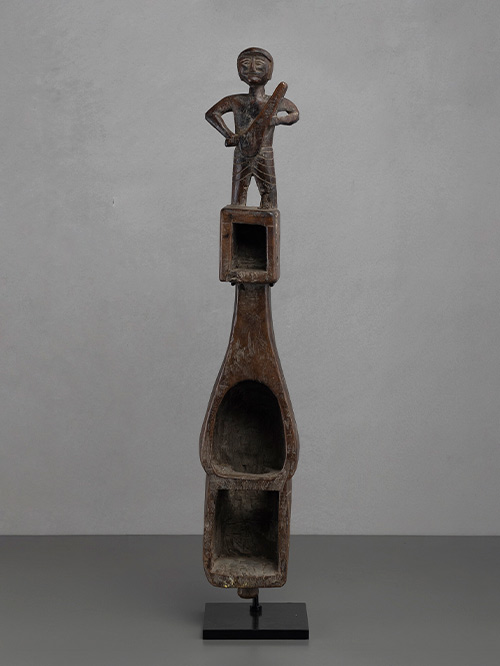
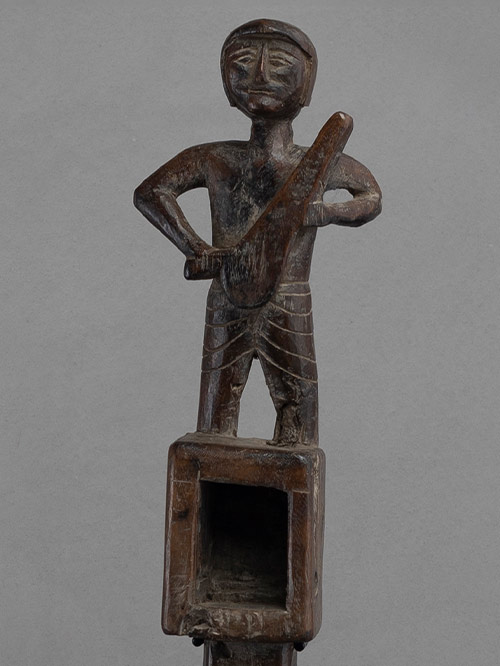
An unusual instrument designed with a finial above the peg box depicting a standing figure playing a Dhodro banam instrument.
The Santhals are the largest tribal community who live in the Indian states of Bihar, Orissa and West Bengal. Music is an important part of Santhal culture and the Santhal are gifted and passionate dancers and musicians and most of their songs and dances are related to various seasons and phases of life. A variety of sculptural instruments are used by the tribe, the most unique of which are the dhodro banam (hollow instrument).
The Santhal believe they are physically related to the dhodro banam and consider the instrument to be a human being. The dhodro banam is made of a single piece of wood, divided as such into distinct body parts such as the belly flanked with arms, open ribcage and a long neck ending in a head. The head is the key block and is often beautifully carved in the shape of a human head, a couple or whole groups of humans or animals.
The dhodro banam player holds the instrument vertically with its neck pointing upwards and the playing hand above the bow hand. The bow (banam ak) is made with horsehair and the string, and when strung brings life into the instrument through its vibrations.
Size (cms): 70(H) x 13(W) x 13(D)
Size (inches): 27.5(H) x 5(W) x 5(D)
-
Santhals (North-Eastern India)
wood
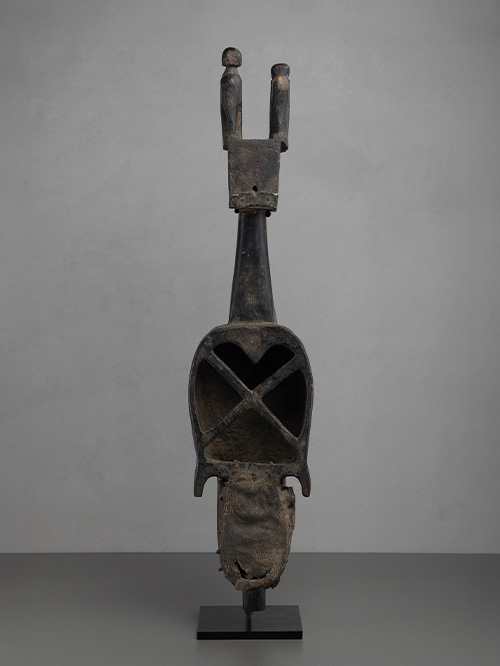
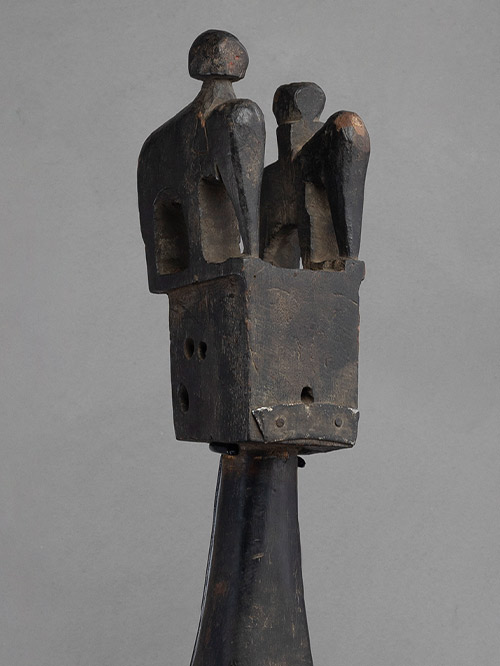
A patinated wooden instrument, carved with a finial above the peg-box, depicting two riders atop elephants. The bottom half of the resonator is skin covered, most probably buffalo or goat hide.
The Santhals are the largest tribal community who live in the Indian states of Bihar, Orissa and West Bengal. Music is an important part of Santhal culture and the Santhal are gifted and passionate dancers and musicians and most of their songs and dances are related to various seasons and phases of life. A variety of sculptural instruments are used by the tribe, the most unique of which are the dhodro banam (hollow instrument).
The Santhal believe they are physically related to the dhodro banam and consider the instrument to be a human being. The dhodro banam is made of a single piece of wood, divided as such into distinct body parts such as the belly flanked with arms, open ribcage and a long neck ending in a head. The head is the key block and is often beautifully carved in the shape of a human head, a couple or whole groups of humans or animals.
The dhodro banam player holds the instrument vertically with its neck pointing upwards and the playing hand above the bow hand. The bow (banam ak) is made with horsehair and the string, and when strung brings life into the instrument through its vibrations.
Size (cms): 88(H) x 19(W) x 17(D)
Size (inches): 34.5(H) x 7.5(W) x 6.5(D)
-
Santhals (North-Eastern India)
wood
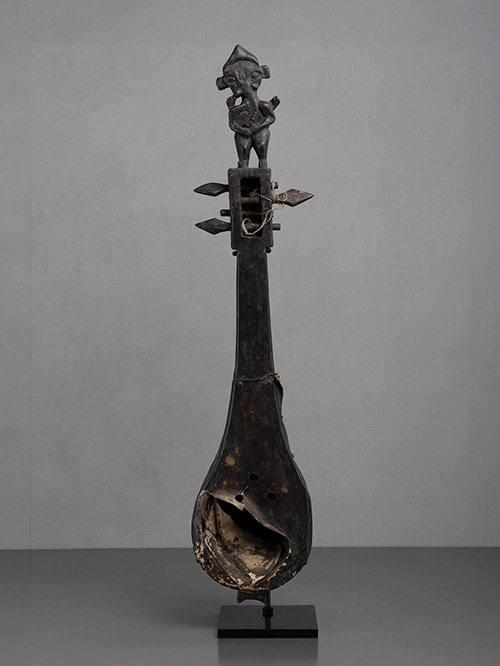
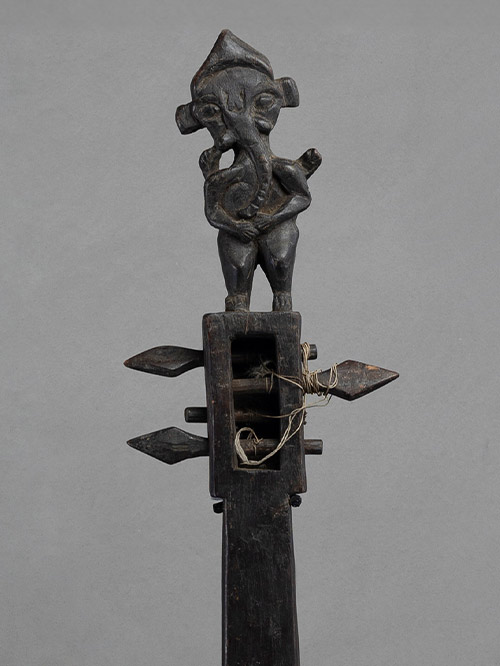
A patinated and rare wooden instrument depicting Ganesha standing atop the peg box. The bottom half of the resonator is skin covered, most probably buffalo or goat hide.
The Santhals are the largest tribal community who live in the Indian states of Bihar, Orissa and West Bengal. Music is an important part of Santhal culture and the Santhal are gifted and passionate dancers and musicians and most of their songs and dances are related to various seasons and phases of life. A variety of sculptural instruments are used by the tribe, the most unique of which are the dhodro banam (hollow instrument).
The Santhal believe they are physically related to the dhodro banam and consider the instrument to be a human being. The dhodro banam is made of a single piece of wood, divided as such into distinct body parts such as the belly flanked with arms, open ribcage and a long neck ending in a head. The head is the key block and is often beautifully carved in the shape of a human head, a couple or whole groups of humans or animals.
The dhodro banam player holds the instrument vertically with its neck pointing upwards and the playing hand above the bow hand. The bow (banam ak) is made with horsehair and the string, and when strung brings life into the instrument through its vibrations.
Size (cms): 79(H) x 17(W) x 13.5(D)
Size (inches): 31(H) x 6.5(W) x 5.5(D)
-
Santhals (North-Eastern India)
wood
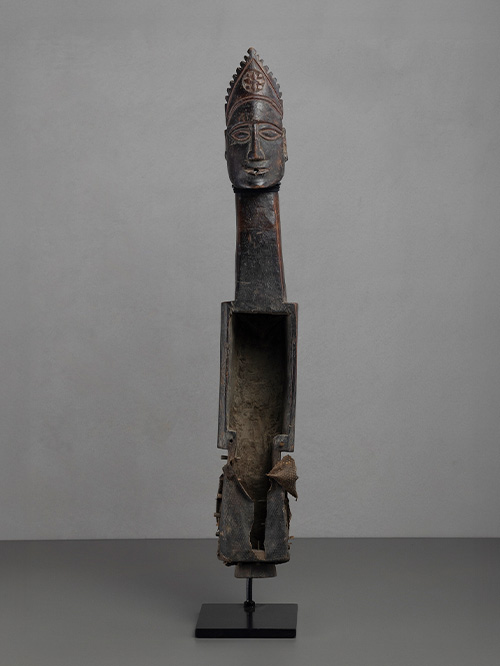
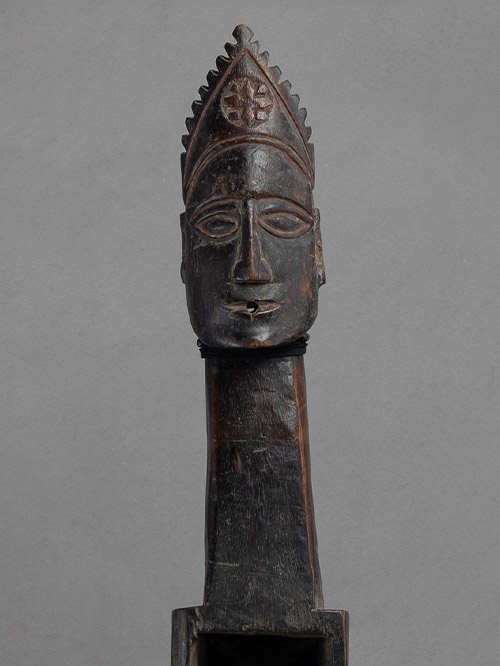
A decorative and sculptural wooden instrument with an anthropomorphic form, featuring a peg box in the shape of a crowned head on top of a rectangular resonator. Fragments of the original resonator covering, most likely made from buffalo or goat hide, still remain on the lower half of the resonator.
The Santhals are the largest tribal community who live in the Indian states of Bihar, Orissa and West Bengal. Music is an important part of Santhal culture and the Santhal are gifted and passionate dancers and musicians and most of their songs and dances are related to various seasons and phases of life. A variety of sculptural instruments are used by the tribe, the most unique of which are the dhodro banam (hollow instrument).
The Santhal believe they are physically related to the dhodro banam and consider the instrument to be a human being. The dhodro banam is made of a single piece of wood, divided as such into distinct body parts such as the belly flanked with arms, open ribcage and a long neck ending in a head. The head is the key block and is often beautifully carved in the shape of a human head, a couple or whole groups of humans or animals.
The dhodro banam player holds the instrument vertically with its neck pointing upwards and the playing hand above the bow hand. The bow (banam ak) is made with horsehair and the string, and when strung brings life into the instrument through its vibrations.
Size (cms): 79(H) x 17(W) x 13.5(D)
Size (inches): 29(H) x 5(W) x 6(D)
-
Santhals (North-Eastern India)
wood
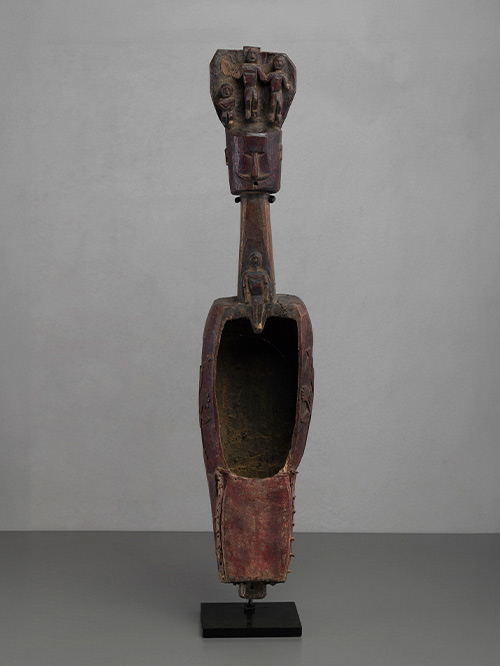
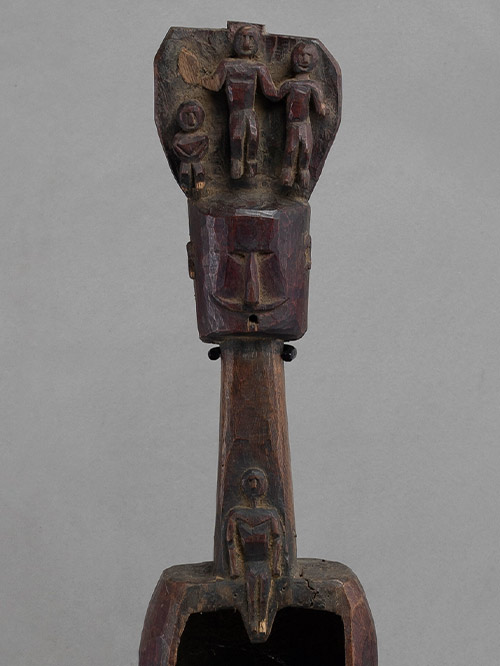
This spectacular wooden instrument with an anthropomorphic form features a peg box in the shape of a moustachioed man atop a shaped resonator. Atop the head, a finial depicts three cheerful figures, potentially symbolising a family. The handle, worn from use, connects the peg box and resonator and is adorned with a depiction of a standing man. The original resonator covering, most likely made from buffalo or goat hide, still covers the lower half of the resonator. On either side of the resonator, intricate carvings feature a bird perched atop a tree.
The Santhals are the largest tribal community who live in the Indian states of Bihar, Orissa and West Bengal. Music is an important part of Santhal culture and the Santhal are gifted and passionate dancers and musicians and most of their songs and dances are related to various seasons and phases of life. A variety of sculptural instruments are used by the tribe, the most unique of which are the dhodro banam (hollow instrument).
The Santhal believe they are physically related to the dhodro banam and consider the instrument to be a human being. The dhodro banam is made of a single piece of wood, divided as such into distinct body parts such as the belly flanked with arms, open ribcage and a long neck ending in a head. The head is the key block and is often beautifully carved in the shape of a human head, a couple or whole groups of humans or animals.
The dhodro banam player holds the instrument vertically with its neck pointing upwards and the playing hand above the bow hand. The bow (banam ak) is made with horsehair and the string, and when strung brings life into the instrument through its vibrations.
Size (cms): 75(H) x 15(W) x 17(D)
Size (inches): 29.5(H) x 6(W) x 6.5(D)
-
Santhals (North-Eastern India)
wood
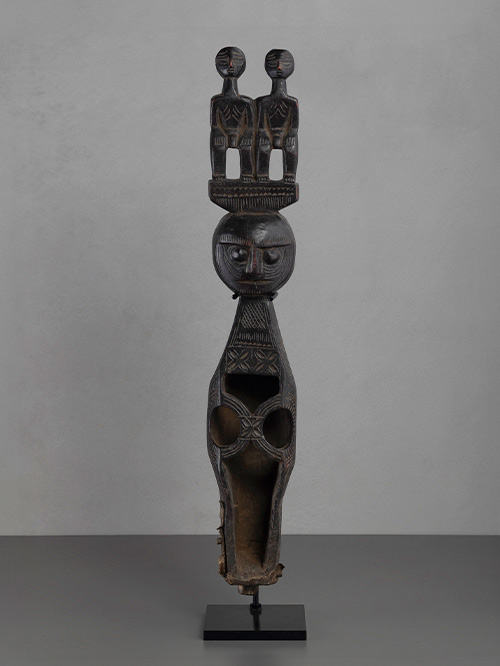
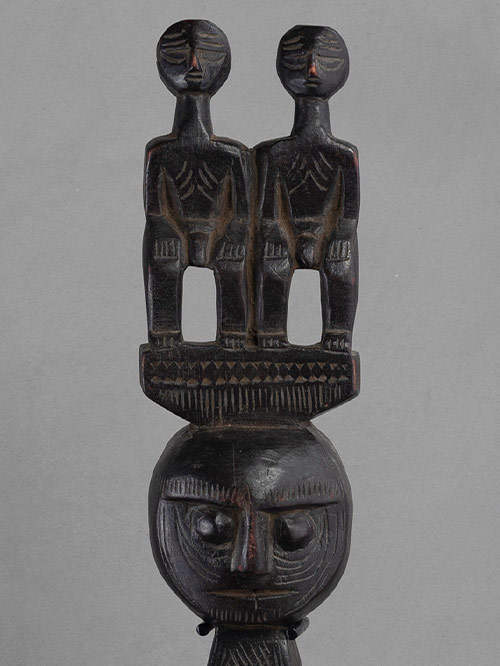
This striking wooden instrument with an anthropomorphic form features a peg box in the shape of a tattooed head atop a shaped resonator. Atop the head, a finial depicts a pair of standing figures. Incised geometric and floral decorations cover every surface of the instrument. Traces of the original resonator covering, most likely made from buffalo or goat hide, still remain on the bottom of the resonator.
The Santhals are the largest tribal community who live in the Indian states of Bihar, Orissa and West Bengal. Music is an important part of Santhal culture and the Santhal are gifted and passionate dancers and musicians and most of their songs and dances are related to various seasons and phases of life. A variety of sculptural instruments are used by the tribe, the most unique of which are the dhodro banam (hollow instrument).
The Santhal believe they are physically related to the dhodro banam and consider the instrument to be a human being. The dhodro banam is made of a single piece of wood, divided as such into distinct body parts such as the belly flanked with arms, open ribcage and a long neck ending in a head. The head is the key block and is often beautifully carved in the shape of a human head, a couple or whole groups of humans or animals.
The dhodro banam player holds the instrument vertically with its neck pointing upwards and the playing hand above the bow hand. The bow (banam ak) is made with horsehair and the string, and when strung brings life into the instrument through its vibrations.
Size (cms): 74(H) x 13(W) x 18(D)
Size (inches): 29(H) x 5(W) x 7(D)
-
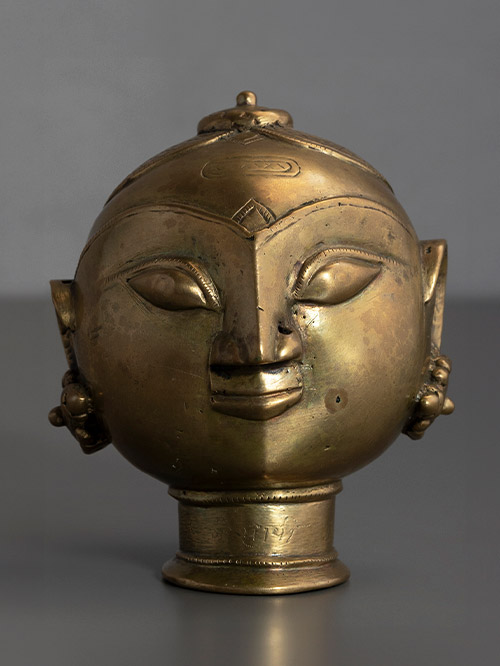
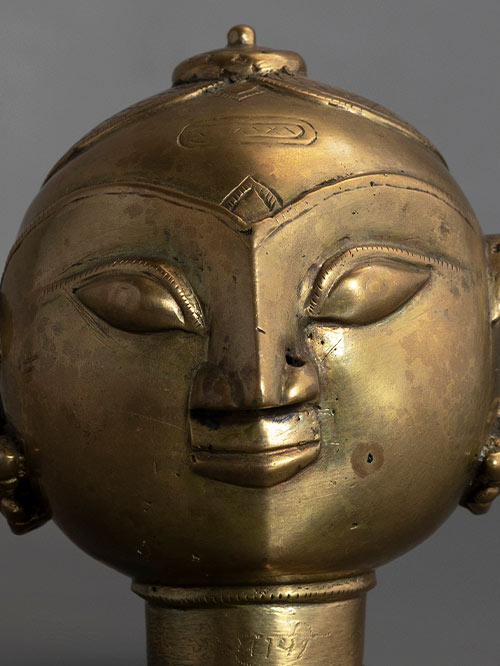
Maharashtra/ Karnataka
Brass alloy
Gauri is the name of a benevolent goddess, consort of Shiva or Varuna. Connected with the rains, she is reputed to be the source of the world and the embodiment of motherhood. She is depicted as a two-or four-armed woman of fair complexion, carrying in her upper arms prayer beads and a water pot, while the lower hands are in Abhaya and Varadamudra. She may also carry a mirror, a fish, a lotus, a trident and a floral wreath. Her mount is the godhika (iguana). Occasionally she is shown riding either a lion, a wolf, a pig or a goose.
Size (cms): 12(H) x 10(W) x 10(D)
Size (inches): 4.5(H) x 4(W) x 4(D)
-
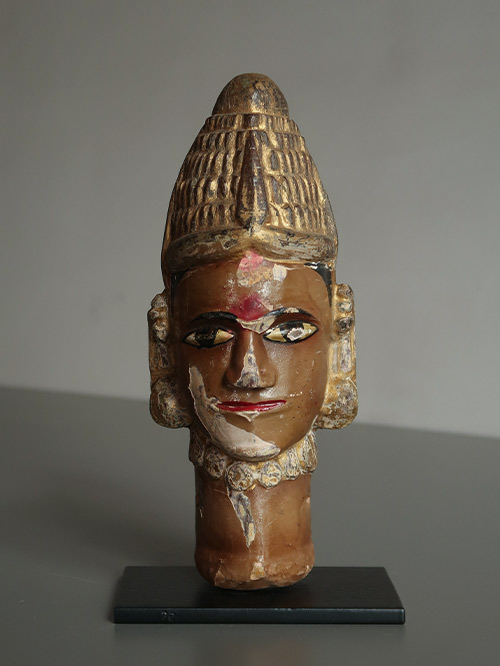
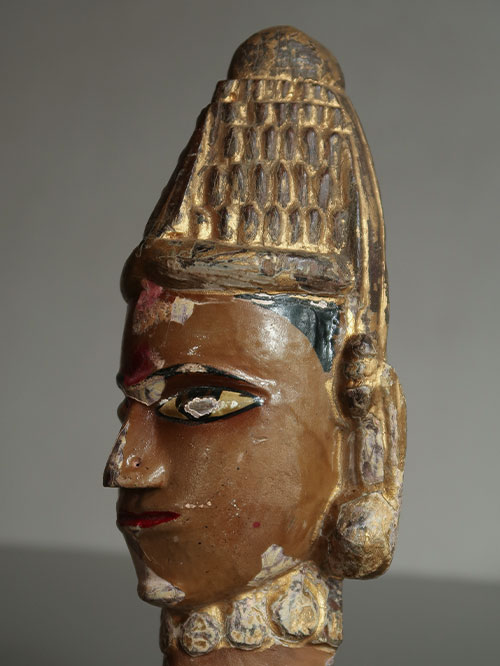
Konkan region (Karnataka)
Wood, polychromed
Gauri is the name of a benevolent goddess, consort of Shiva or Varuna. Connected with the rains, she is reputed to be the source of the world and the embodiment of motherhood. She is depicted as a two-or four-armed woman of fair complexion, carrying in her upper arms prayer beads and a water pot, while the lower hands are in Abhaya and Varadamudra. She may also carry a mirror, a fish, a lotus, a trident and a floral wreath. Her mount is the godhika (iguana). Occasionally she is shown riding either a lion, a wolf, a pig or a goose.
Size with stand (cms): 9.5(H) x 5(W) x 3(D)
Size with stand (inches): 24.5(H) x 13(W) x 7.5(D)
-
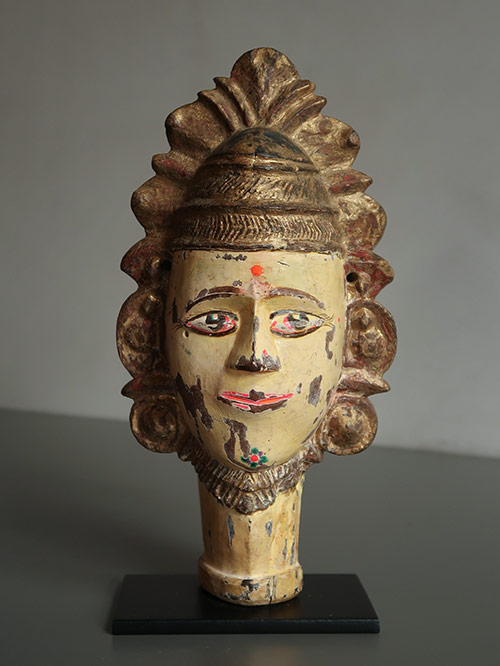
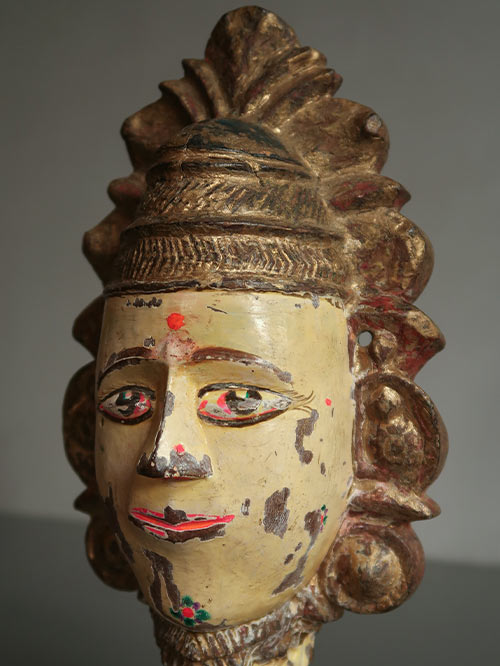
Konkan region (Karnataka)
Wood, polychromed
Gauri is the name of a benevolent goddess, consort of Shiva or Varuna. Connected with the rains, she is reputed to be the source of the world and the embodiment of motherhood. She is depicted as a two-or four-armed woman of fair complexion, carrying in her upper arms prayer beads and a water pot, while the lower hands are in Abhaya and Varadamudra. She may also carry a mirror, a fish, a lotus, a trident and a floral wreath. Her mount is the godhika (iguana). Occasionally she is shown riding either a lion, a wolf, a pig or a goose.
Size with stand (cms): 29.5(H) x 16(W) x 7.5(D)
Size with stand (inches): 11.5(H) x 6.5(W) x 3(D)
-
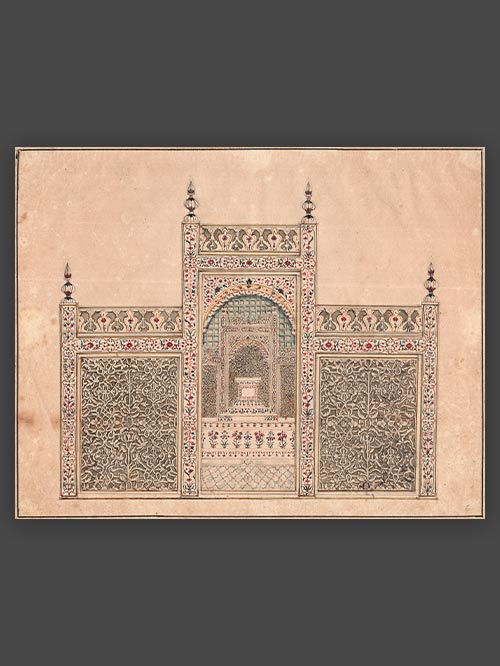
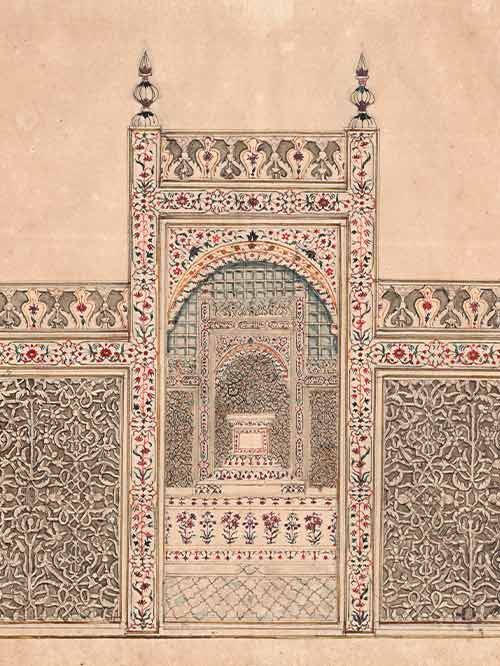
Delhi or Agra artist (Company School)
Watercolour on paper
This enchanting view captures the south façade of the eight-sided screen surrounding the two cenotaphs. This particular façade houses the sole entrance portal into the innermost part of the Taj complex. You can glimpse the south elevation of Mumtaz Mahal’s cenotaph through this portal. Originally, it was intended to be closed by a door made of agate. A matching portal, taller than the flanking panels on the north façade, is enclosed by a jali. The remaining six sides each feature three marble carved jalis of equal height, supported by posts adorned with finials. Above, there’s a continuous pierced frieze of vases. All the marble, with the exception of the jali panels, is inlaid with semi-precious stones in floral motifs. The octagonal marble screen was installed in 1643, replacing the one made of pure gold inlaid with jewels, which had been in place since 1633, during the second ‘urs ceremony marking the anniversary of her death.
Artists trained in the Mughal tradition were compelled to seek for patronage outside the imperial atelier after the capture of Delhi and Agra by the East Indian Company in 1803. Portraiture from this period still expressed imperial preoccupations but started leaning towards a more naturalistic representation. Indian artists also quickly learned to apply their skills to a very different European art form, that of the objective architectural elevation. The result miraculously combines many of the best qualities of both traditions: the almost fanatical Mughal attention to fine detail is fused with a scientific European rationalism to produce an architectural painting that both observes and feels the qualities of a building.
Painting Size (cms): 19.2(H) x 24.2(W)
Painting Size (inches): 7.5(H) x 9.5(W)
-
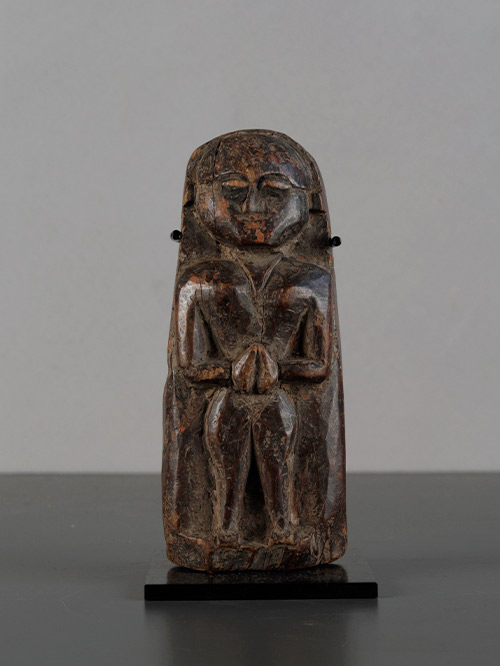
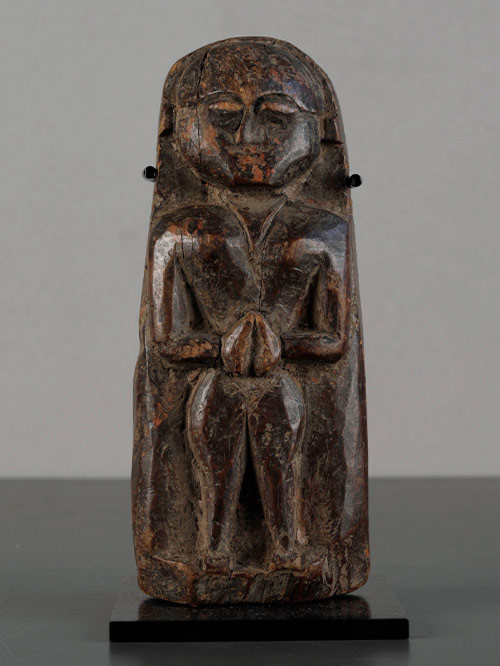
Maharashtra
Wood
A beautiful votive doll with its hands pressed in anjali mudra, a gesture of greeting and prayer. These small figures carved in wood, usually representing worshipping women, but also female water carriers, mothers, or pregnant women are simple in design, yet it is this implied simplicity that makes these figures attractive. They take various forms, triangular, rectangular, round or stepped. Often only the front of the sculptures are carved whereas the rears maybe left untreated. Often statuettes miss a nose, ears or arms. Many of the faces have been worn down from use, to a point where they reveal no detail.
These small figures were used for devotional purposes within the home, placed there as votive offerings to the Goddess Maulli/Mariai. Mauli is a powerful folk deity that protects against illness such as smallpox and cholera. But at the same time, neglecting her inflicts her wrath. She also takes the role of a fertility goddess to whom childless women seek respite. Figures of the Goddess are worshipped with turmeric, some red kunkum and oil which is daubed on her forehead.
Size (cms): 17.5(H) x 9(W) x 9(D)
Size (inches): 7(H) x 3.5(W) x 3.5(D)
-
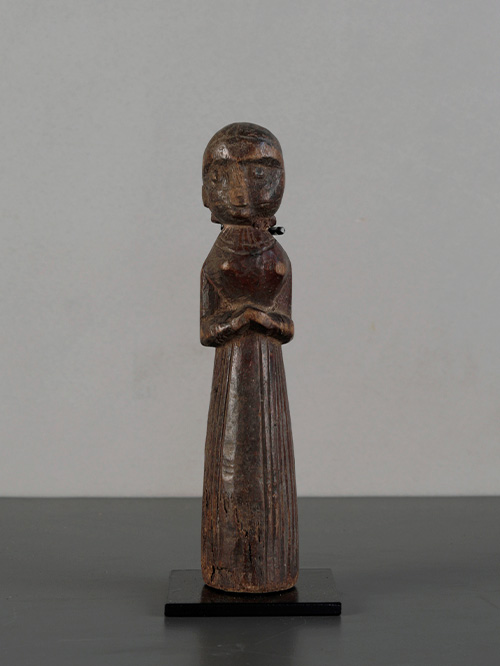
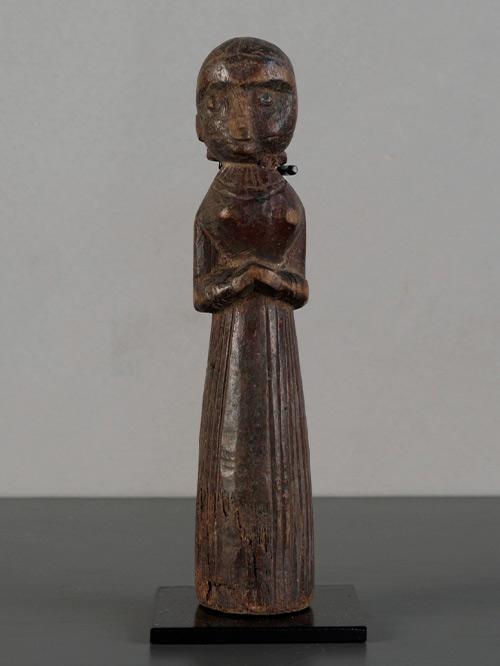
Maharashtra
Wood
A beautiful votive doll with its hands pressed in anjali mudra, a gesture of greeting and prayer. These small figures carved in wood, usually representing worshipping women, but also female water carriers, mothers, or pregnant women are simple in design, yet it is this implied simplicity that makes these figures attractive. They take various forms, triangular, rectangular, round or stepped. Often only the front of the sculptures are carved whereas the rears maybe left untreated. Often statuettes miss a nose, ears or arms. Many of the faces have been worn down from use, to a point where they reveal no detail.
These small figures were used for devotional purposes within the home, placed there as votive offerings to the Goddess Maulli/Mariai. Mauli is a powerful folk deity that protects against illness such as smallpox and cholera. But at the same time, neglecting her inflicts her wrath. She also takes the role of a fertility goddess to whom childless women seek respite. Figures of the Goddess are worshipped with turmeric, some red kunkum and oil which is daubed on her forehead.
Size (cms): 22(H) x 7.5(W) x 7.5(D)
Size (inches): 8.5(H) x 3(W) x 3(D)
-
Maharashtra
Wood
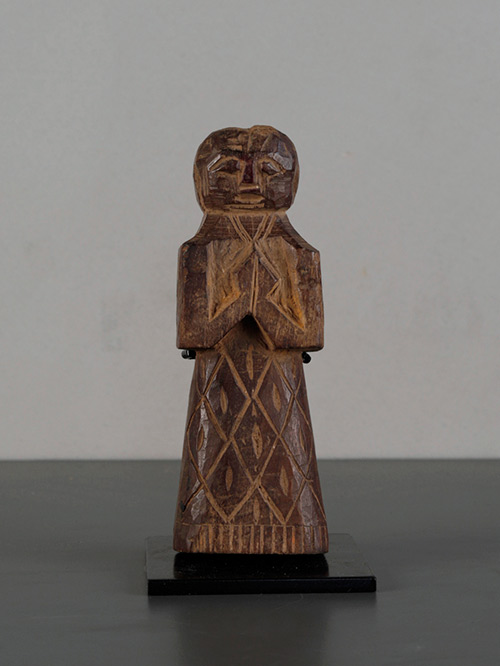
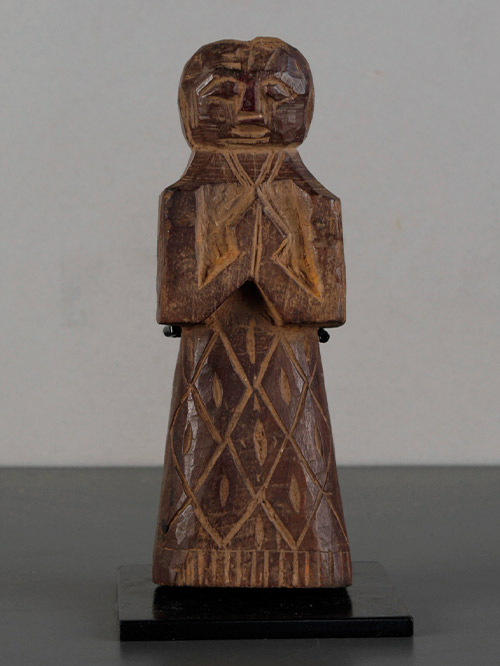
A beautiful votive doll with its hands pressed in anjali mudra, a gesture of greeting and prayer. These small figures carved in wood, usually representing worshipping women, but also female water carriers, mothers, or pregnant women are simple in design, yet it is this implied simplicity that makes these figures attractive. They take various forms, triangular, rectangular, round or stepped. Often only the front of the sculptures are carved whereas the rears maybe left untreated. Often statuettes miss a nose, ears or arms. Many of the faces have been worn down from use, to a point where they reveal no detail.
These small figures were used for devotional purposes within the home, placed there as votive offerings to the Goddess Maulli/Mariai. Mauli is a powerful folk deity that protects against illness such as smallpox and cholera. But at the same time, neglecting her inflicts her wrath. She also takes the role of a fertility goddess to whom childless women seek respite. Figures of the Goddess are worshipped with turmeric, some red kunkum and oil which is daubed on her forehead.
Size (cms): 18.5(H) x 9(W) x 9(D)
Size (inches): 7.5(H) x 3.5(W) x 3.5(D)