“Vibhishana Dancing Mask” has been added to your cart.
View cart
-
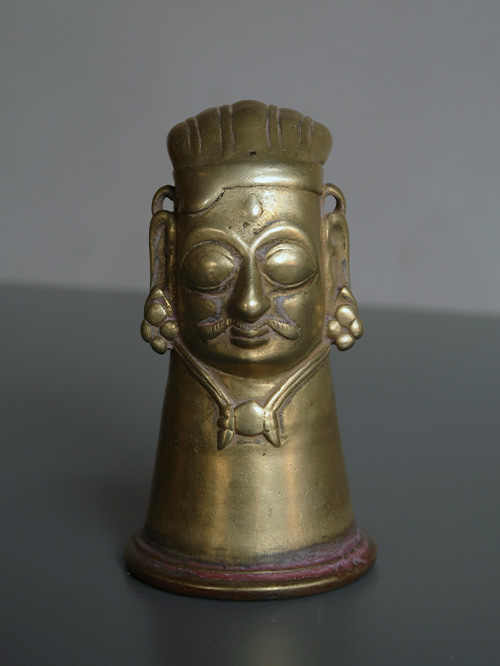
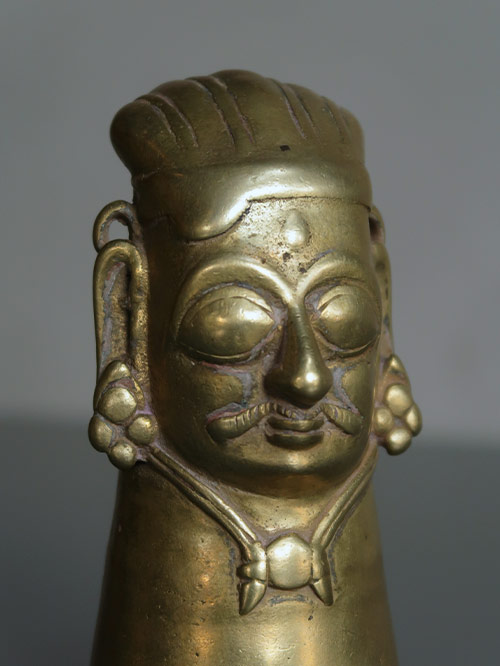
Karnataka (South India)
brass
Shiva is one of the three principal deities of Hinduism. He is labelled the ‘destroyer’ with the Trimurti, Hinduism’s trinity which includes Brahma and Vishnu. While sometimes depicted iconically, he is usually worshipped in the aniconic from of a lingam. The lingam is shaped like a pillar with a round top and can be made of stone, wood or metal. Mukha-linga signifies a visage or face on a metallic, cylindrical casting used to cover a stone lingam. The cover is thought to protect the viewer from the harm that could occur on visualization of the linga, especially one with eyes painted on its surface, which is believed to energize the figure. The metallic visage iconically depicts Shiva, wearing his characteristic moustache, earrings and matted hair.
Size (cms): 14.5(H) x 7.7(Diam)
Size (inches): 5.5(H) x 3(Diam)
-
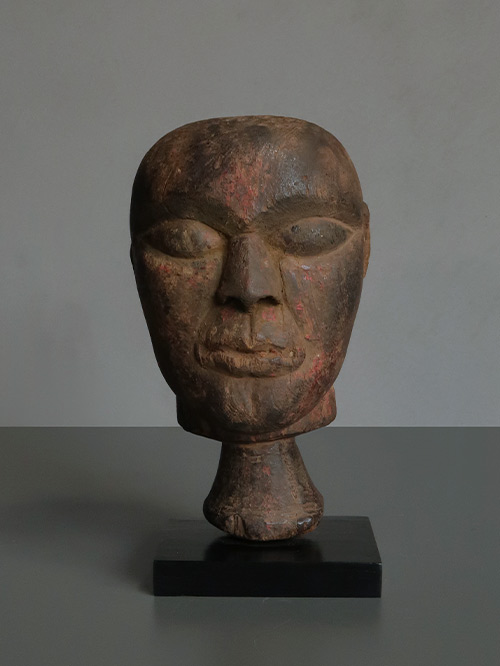
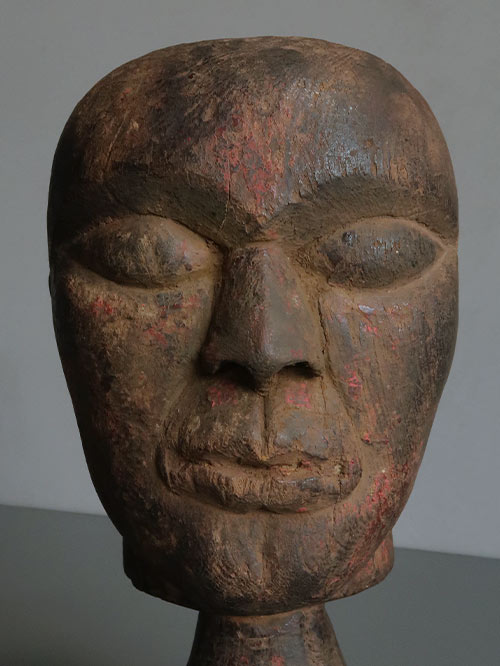
Karnataka
Wood
A charming folk wooden carved head of a male attendant/guardian figure. Such figures were placed in folk temples in Karnataka and usually painted and clothed. Attendant figures called Dvarapalas or ‘door guardians’ are placed at the entrance of temples, shrines or sacred precincts. Two or four-handed, they carry in their hands the emblem of the deity enshrined in the sanctuary. Their countenance may be fierce or gentle. Temples dedicated to goddesses have female guardians – the Dwarapalikas.
Size (cms): 27(H) x 13(W) x 14(D)
Size (inches): 10.5(H) x 5(W) x 5.5(D)
-
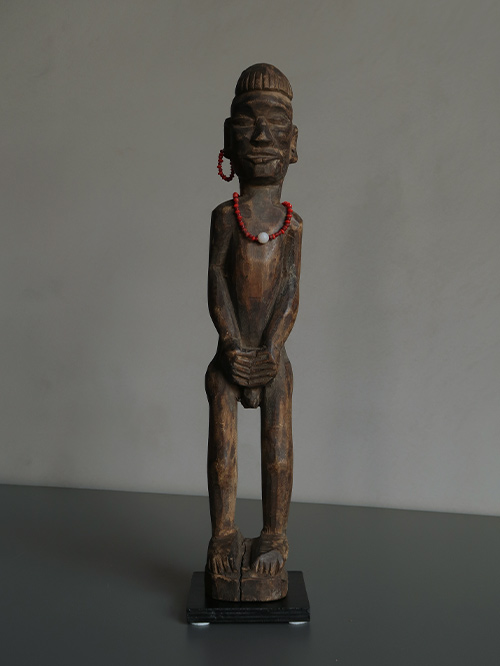
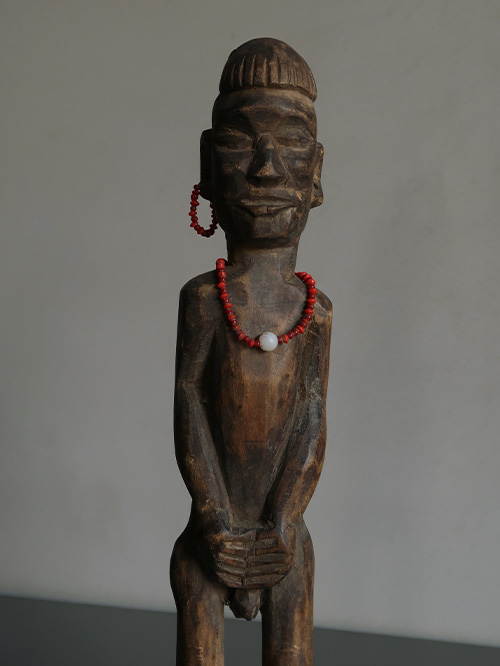
Nagaland (North-East India)
Wood
Male standing figure adorned with red and white glass bead necklaces. Carved from solid trunks of trees, the solemn expressions of these wood sculptures sometimes heightened by cowrie shells, bead necklaces or human and animal hair, combined with the blunt tubular carving on dark wood give these Naga figures a silent though persuasive identity.
A key fixture in nearly all Naga settlements was the Morung, or Men’s House, which served as something of a community center. It was usually the biggest and most beautifully furnished building in a village, spacious and decorated with ornate carvings. Numerous wooden sculptures decorated the walls and posts of the farthest end of the innermost space of the Morung. They expressed the narrative traditions of the Naga. Wooden sculpture such as this, depicting would be posted near the walls of the Morung, were not uncommon and thought to relate to fertility.
The Naga are a group of culturally and linguistically linked tribes who live in the mountainous regions of northeastern India and northwestern Burma (Myanmar). As headhunters, they were feared and avoided by their neighbours, allowing them to develop a distinctive material culture—in which objects they created are of impressive aesthetic value and possess great symbolic importance to the community—and a complex system of norms and taboos.
Size (cms): 46(H) x 9(W) x 7(D)
Size (inches): 18(H) x 3.5(W) x 3(D)
-
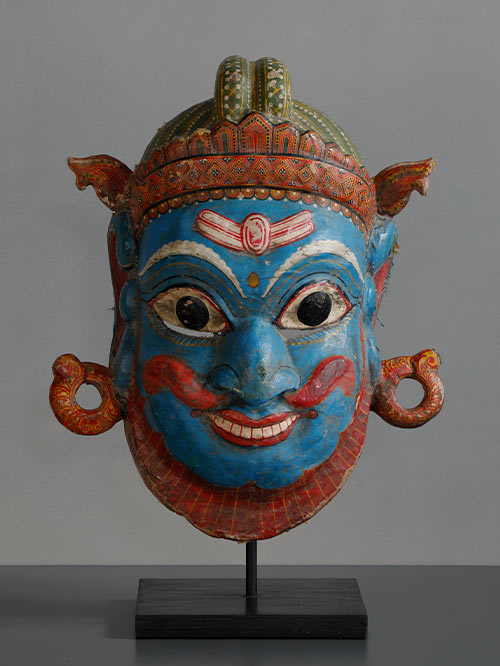
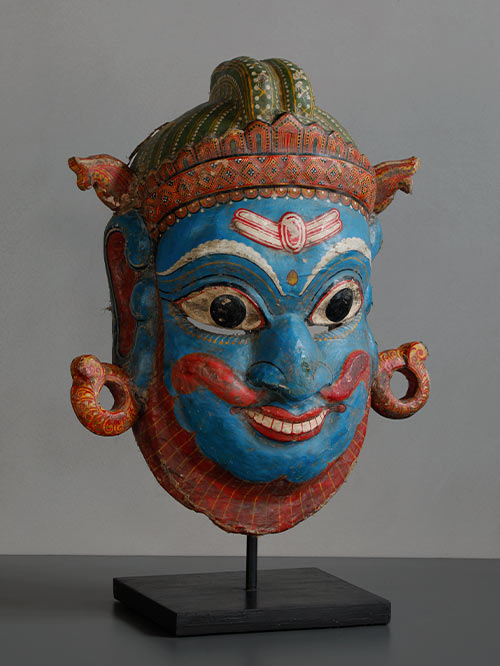
Orissa
Wood, extensively polychromed
An attractive dancing mask depicting the rakshasa Vibhishana. Painted in a brilliant blue, Vibhishana wears an elaborate turbaned crown decorated with geometric and floral patterns motifs and two large hooped earrings which dangle from his ears. Distinctive features include a prominent Shaivite tilaka, large piercing eyes and a joyous smile. The vibrant red twirling moustache and matching beard stands out on his blue skinned face. Ovular slits have been cut out beneath the eyes of Vibhishana to help the dancer navigate while wearing the mask.
Vibhishana, Ravana’s younger brother, was a rare good-hearted Rakshasa; he was beautiful, pious and assiduous in his religious observances. When Brahma granted him a boon, he asked never to swerve from the path of righteousness and to be illumined by divine knowledge. Vibhishana joined Rama in his campaign against Ravana, and helped Rama’s army to cross the ocean into Lanka. When invisible Rakshasas infiltrated Rama’s camp, Vibhishana caused them to become visible, and Rama’s monkey soldiers destroyed them. After Rama’s final victory over Ravana, the loyal Vibhishana was made king of Lanka.
Shahi Jatras (royal processions) of Orissa present different episodes from the Ramayana during the spring season, usually lasting for for one week. Actors, carrying huge wooden masks and gorgeous costumes, walk on the streets with stylized gait and mime with the accompaniment of loud drumming. The Desia Nata of Koraput, Orissa, also uses masks for representing gods, goddesses, animals, birds and demons. These themes are also taken from Ramayana.
Size(cms): 43(H) x 34(W) x 19(D), 51(H with stand)
Size(inches): 17(H) x 13.5(W) x 7.5(D), 20(H with stand)