“Hanuman” has been added to your cart.
View cart
-
Tamil Nadu (South India)
silver repoussé on velvet
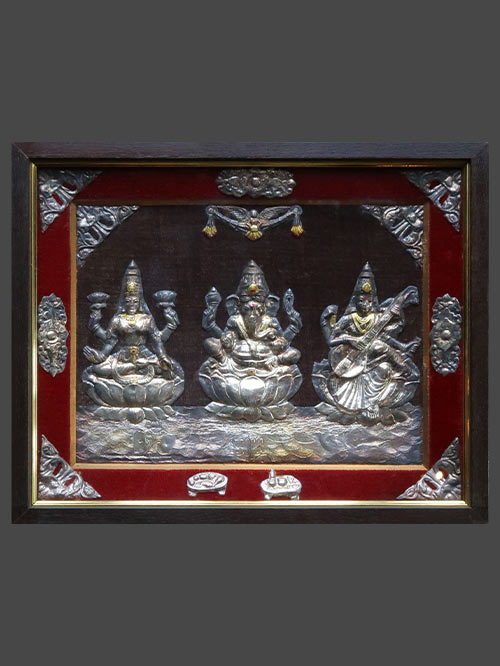
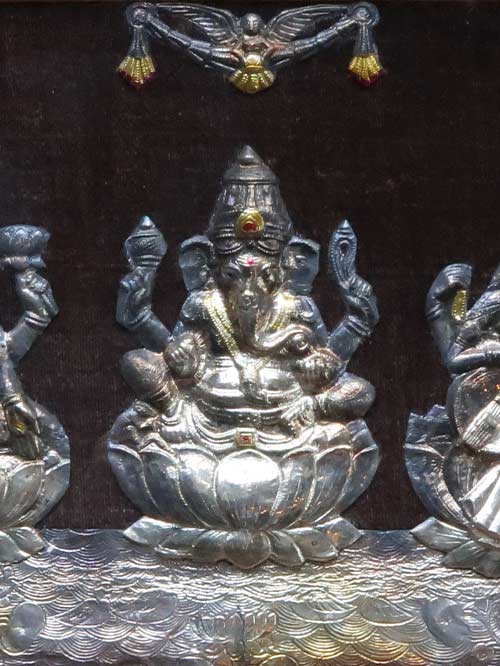
Ganesha, four armed, is seated cross legged on a lotus throne. He carries a mace, a noose, a ball of modak and his broken tusks in his four hands. Directly above is the figure of a single winged angel with stylised wings. He is flanked by the figures of Lakshmi and Saraswati, each seated on their lotus thrones. The deities appear to float on the waves of the cosmic ocean.
Framed Size (cms): 42 (H) x 54 (W)
Framed Size (inches): 16.5 (H) x 21 (W)
-

Maharashtra
silver
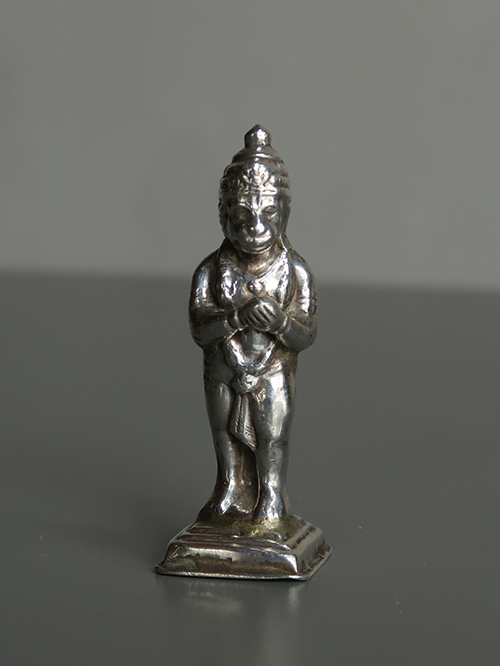
A charming yet worn figure of Hanuman standing with his hands held together. His tail extends from the right hip upward terminating above his head.
The story of Hanuman is found in the Ramayana where he is the ubiquitous servant, the epitome of devoted service and loyalty. His search for the heroine Sita, captured by Ravana, illustrates his superhuman powers and zealous performance of the tasks that were given to him.
Size (cms): 8.8(H) x 3.1(W) x 4.6(D)
Size (inches): 3.5(H) x 1(W) x 2(D)
-
Gujarat
silver on wood
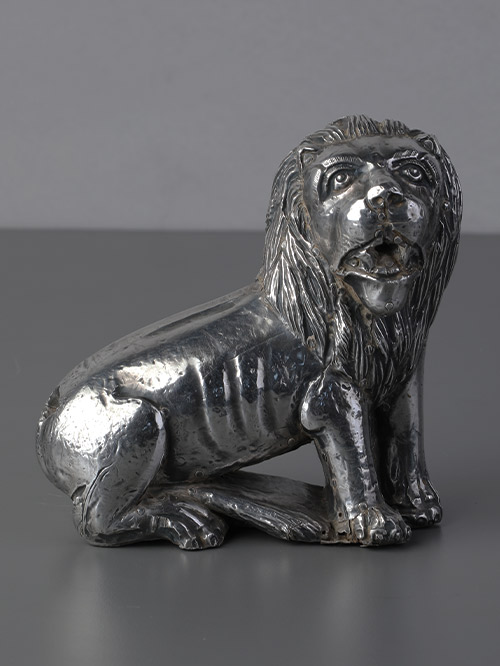
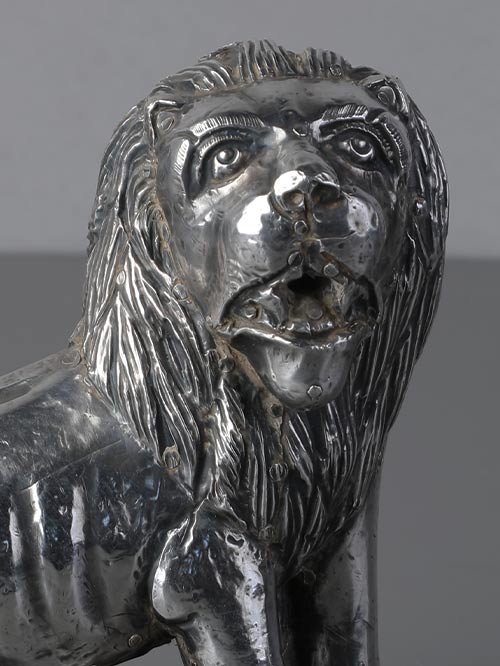
A decorative silver lion with a wooden frame. The ferocious looking lion is seated on its hind legs and is open mouthed, exposing large teeth. These would have served as symbolic supports to the inner sanctum of home shrine.
Among the Jains the lion served as the mount of Mahavira, the 24th and last Jina. Mahavira was the twenty-fourth Tirthankara (ford-maker) of Jainism which was revived and reestablished by him. In the Jain tradition, it is believed that Mahavira was born in the early part of the 6th century BC into a royal family in what is now Bihar, India. At the age of thirty, abandoning all worldly possessions, he left his home in pursuit of spiritual awakening and became an ascetic. For the next twelve and a half years, Mahavira practiced intense meditation and severe austerities, after which he is believed to have attained omniscience.
Size (cms): 15(H) x 14.5(W) x 7.5(D)
Size (inches): 6(H) x 5.5(W) x 3(D)
-


Rajasthan
silver
Fine silver circular tray with a domed perfume container. The outer border of the tray is tray decorated with chased floral and geometric designs enclosing a double band of petal like cusped lobes reminiscent of architectural niches. The central perfume container sits within a chased floral band and has a hinged onion shaped domed lid with stepped patterns and a knop finial. Perfumes in Mughal India were used not just to scent oneself but also for medicinal purposes, the most common type of perfume was attar of roses.
Size (cms): 7(H) x 18.5(Diam)
Size (inches): 3(H) x 7.5(Diam)
-
Maharashtra
silver
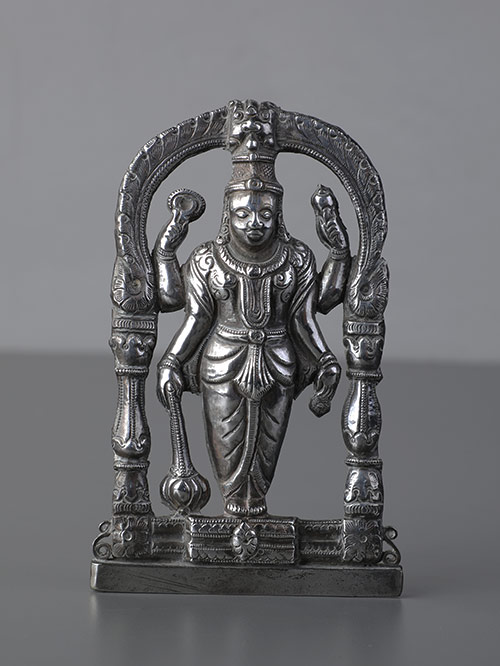
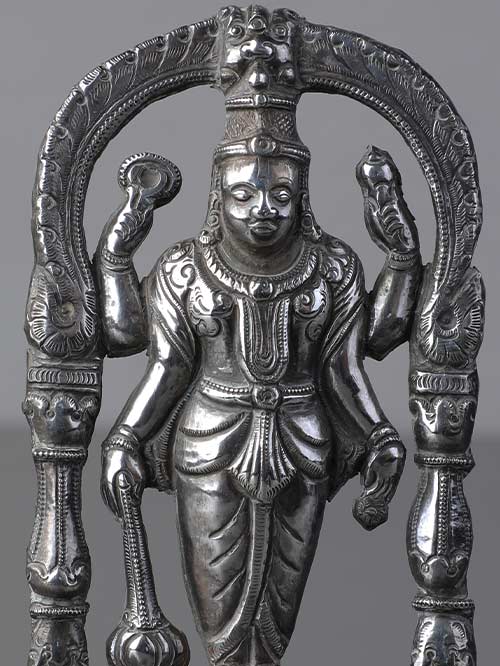
A finely cast and decorated standing figure of Vishnu. Four-armed, the figure carries a gada (mace), chakra (disc) conch and lotus. He wears multiple ear and neck ornaments and a tall crown surmounted by a Kirtimukha which forms a ritual arch around the figure. Vishnu means ‘All Pervader’, or taking many forms’ is one of the most important Hindu deities along with Shiva and Brahma. He is the sustainer of the universe and sometimes descends to earth assuming various forms (avatars) to redress the balance between good and evil, and hence is known as the Preserver.
Size (cms): 13.5(H) x 8.5(W) x 5(D)
Size (inches): 5.5(H) x 3.5(W) x 2(D)