“Venomous Snakes” has been added to your cart.
View cart
-
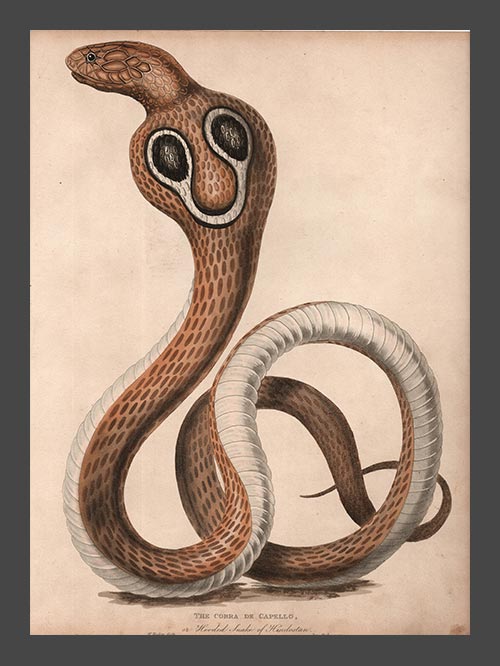
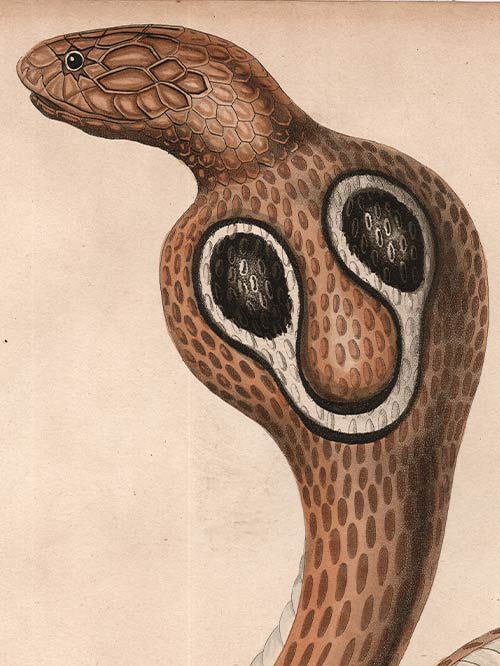
by William Hooker after James Forbes⠀
original hand coloured aquatint
Captioned ‘The Cobra de Capello, or Hooded Snake of Hindostan’
Forbes arrived in Bombay in 1766 as a Writer in the East India Company and spent his first five years in Bombay, living in the Fort area. At that time Bombay was developing as the premier port and commercial centre on the west coast and there were many oppoIntunities for young Company servants stationed there. The marshland between the seven islands was being filled up and eventually the islands were joined to form the Bombay peninsula. Forbes was adventurous and independent. He was an amateur artist, who sketched the Indian environment with no other training, as he himself stated, except encouragement from his friends. Forbes lived in India for 17 years after which he produced his Oriental Memoirs. Its narrative was based on a series of his letters from India and the contents of about 150 notebooks, which returned to England with him. William Hooker was a botanist and executed the superb natural history plates for James Forbes monumental work on Western India, ‘Oriental Memoirs’, in 1812.
Size (cms): 30 (H) x 23.5 (L)
Size (inches): 12 (H) x 9.5 (L)
-
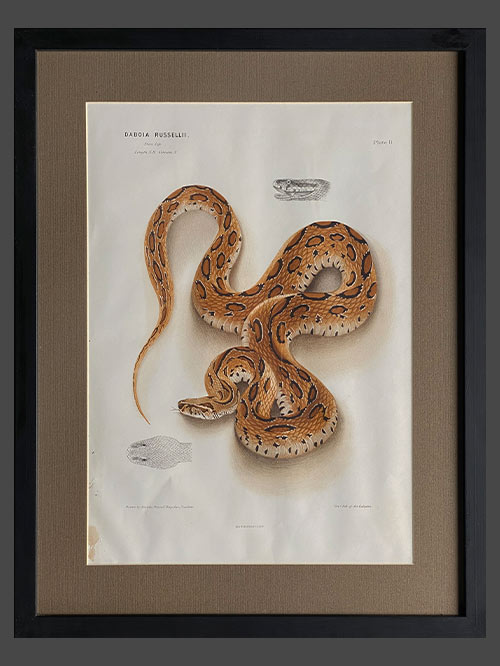
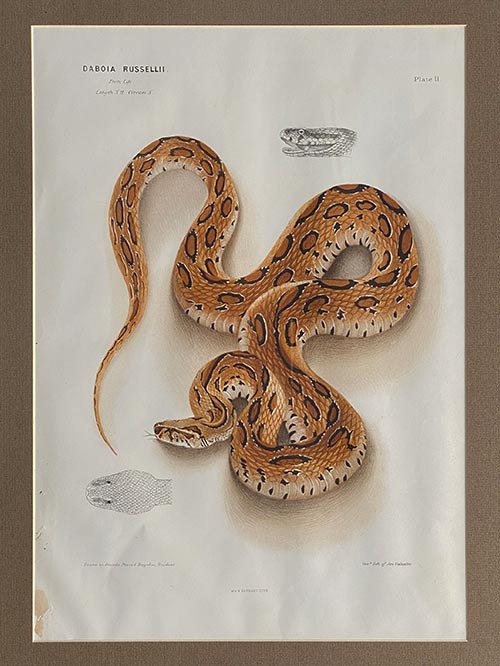
by Sir Joseph Fayrer
from The Thanatophidia of India
original hand coloured chromolithograph
Captioned ‘Daboia Russellii’
The Daboia Russellii (Russel’s Viper) is native to the Indian subcontinent. It was named after Patrick Russell who is considered the Father of Indian herpetology. It is part of the big four snakes that are responsible for causing the most snakebite cases and deaths. The other three snakes are the Indian Cobra, Common Krait and Saw-Scaled Viper. Russel’s Viper is a nocturnal species which remains active from late evening to late nights for foraging and other life activities.
Sir Joseph Fayrer, 1st Baronet (6 December 1824 – 21 May 1907) was an English physician noted for his writings on medicine in India. After studying medicine at Charing Cross Hospital, London and completing his medical degree in 1849, he was appointed as an assistant surgeon in Bengal in 1850. Fayrer, who became a fellow of the Royal Society in 1877, wrote much on subjects connected with the practice of medicine in India, and was especially known for his studies on the poisonous snakes of that country and on the physiological effects produced by their venom. He set up a zoological society and the zoo at Calcutta. He was President of the Asiatic Society of Bengal in 1867.
The Thanatophidia of India is a description of the venomous snakes of the Indian Peninsula and the physiological effects produced by their venom. These plates were drawn by students from the Govt. School of Art in Calcutta.
Size framed (cms): 57 (H) x 44 (L)
Size framed (inches): 22 (H) x 17.5 (L)
-
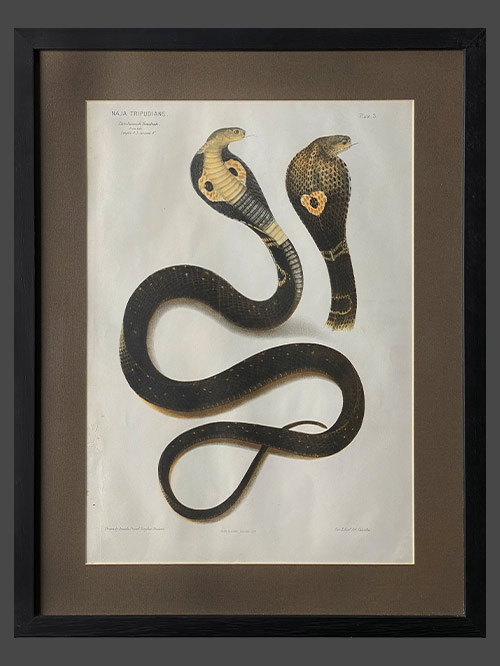
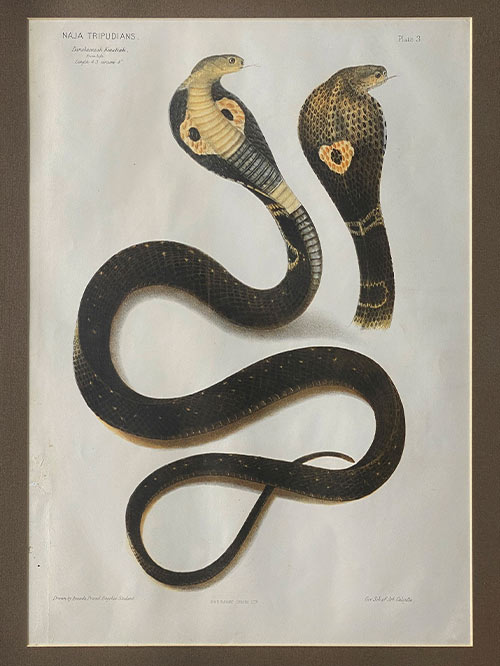
by Sir Joseph Fayrer
from The Thanatophidia of India
original hand coloured chromolithograph
Captioned ‘Naja Tripudians‘
The Naja Tripudians (Indian Cobra) is native to the Indian subcontinent. It is part of the big four snakes that are responsible for causing the most snakebite cases and deaths. The other three snakes are the Russel’s Viper, Common Krait and Saw-Scaled Viper. The Indian cobra is revered in Indian culture and mythology.
Sir Joseph Fayrer, 1st Baronet (6 December 1824 – 21 May 1907) was an English physician noted for his writings on medicine in India. After studying medicine at Charing Cross Hospital, London and completing his medical degree in 1849, he was appointed as an assistant surgeon in Bengal in 1850. Fayrer, who became a fellow of the Royal Society in 1877, wrote much on subjects connected with the practice of medicine in India, and was especially known for his studies on the poisonous snakes of that country and on the physiological effects produced by their venom. He set up a zoological society and the zoo at Calcutta. He was President of the Asiatic Society of Bengal in 1867.
The Thanatophidia of India is a description of the venomous snakes of the Indian Peninsula and the physiological effects produced by their venom. These plates were drawn by students from the Govt. School of Art in Calcutta.
Size framed (cms): 57 (H) x 44 (L)
Size framed (inches): 22 (H) x 17.5 (L)
-
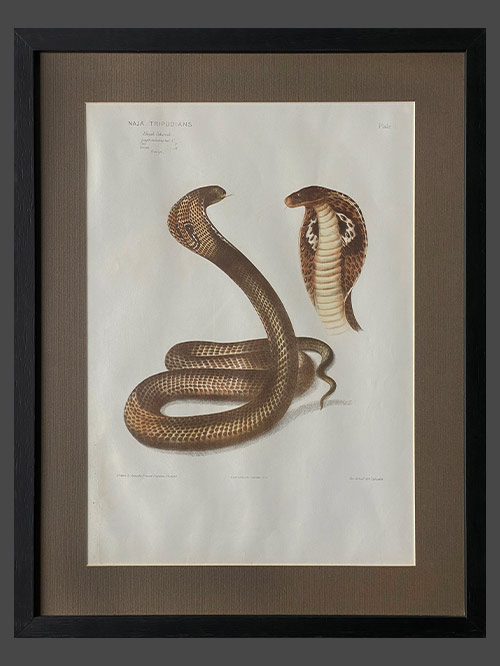
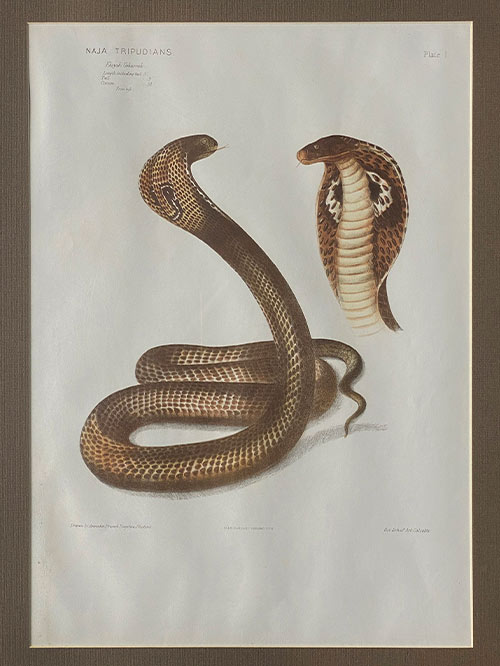
by Sir Joseph Fayrer
from The Thanatophidia of India
original hand coloured chromolithograph
Captioned ‘Naja Tripudians’
The Naja Tripudians (Indian Cobra) is native to the Indian subcontinent. It is part of the big four snakes that are responsible for causing the most snakebite cases and deaths. The other three snakes are the Russel’s Viper, Common Krait and Saw-Scaled Viper. The Indian cobra is revered in Indian culture and mythology.
Sir Joseph Fayrer, 1st Baronet (6 December 1824 – 21 May 1907) was an English physician noted for his writings on medicine in India. After studying medicine at Charing Cross Hospital, London and completing his medical degree in 1849, he was appointed as an assistant surgeon in Bengal in 1850. Fayrer, who became a fellow of the Royal Society in 1877, wrote much on subjects connected with the practice of medicine in India, and was especially known for his studies on the poisonous snakes of that country and on the physiological effects produced by their venom. He set up a zoological society and the zoo at Calcutta. He was President of the Asiatic Society of Bengal in 1867.
The Thanatophidia of India is a description of the venomous snakes of the Indian Peninsula and the physiological effects produced by their venom. These plates were drawn by students from the Govt. School of Art in Calcutta.
Size framed (cms): 57 (H) x 44 (L)
Size framed (inches): 22 (H) x 17.5 (L)
-
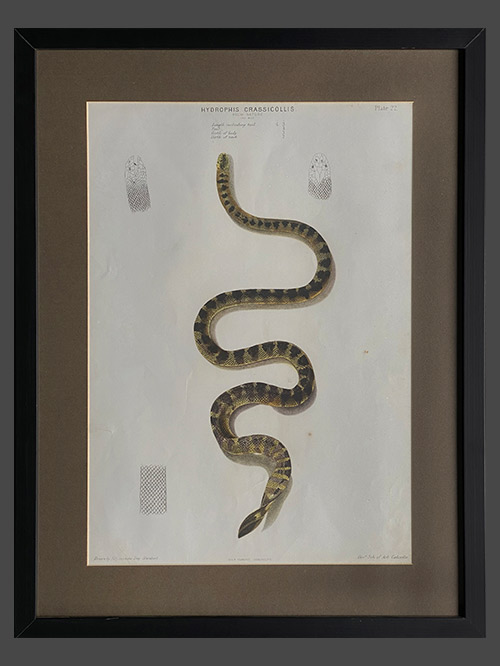
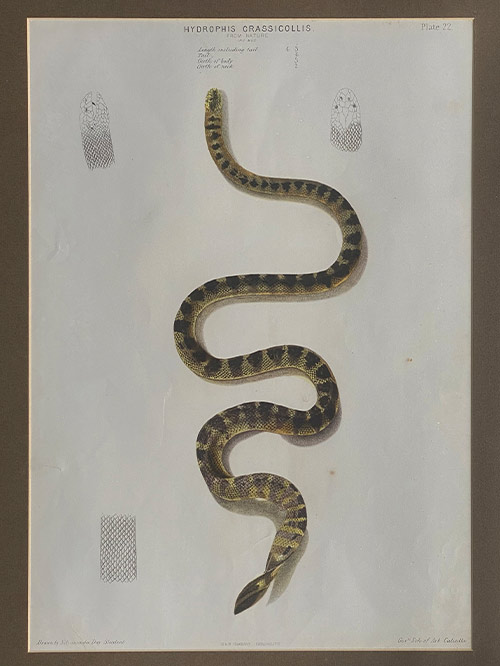
by Sir Joseph Fayrer
from The Thanatophidia of India
original hand coloured chromolithograph
Captioned ‘Hydrophis Crassicollis’
Sir Joseph Fayrer, 1st Baronet (6 December 1824 – 21 May 1907) was an English physician noted for his writings on medicine in India. After studying medicine at Charing Cross Hospital, London and completing his medical degree in 1849, he was appointed as an assistant surgeon in Bengal in 1850. Fayrer, who became a fellow of the Royal Society in 1877, wrote much on subjects connected with the practice of medicine in India, and was especially known for his studies on the poisonous snakes of that country and on the physiological effects produced by their venom. He set up a zoological society and the zoo at Calcutta. He was President of the Asiatic Society of Bengal in 1867.
The Thanatophidia of India is a description of the venomous snakes of the Indian Peninsula and the physiological effects produced by their venom. These plates were drawn by students from the Govt. School of Art in Calcutta.
Size framed (cms): 57 (H) x 44 (L)
Size framed (inches): 22 (H) x 17.5 (L)
-
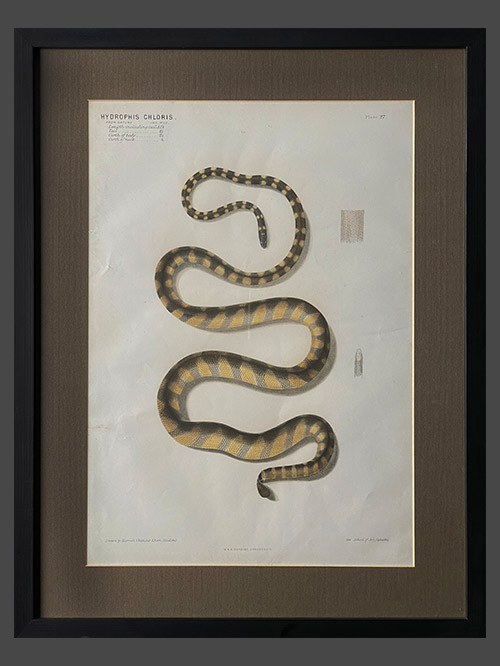
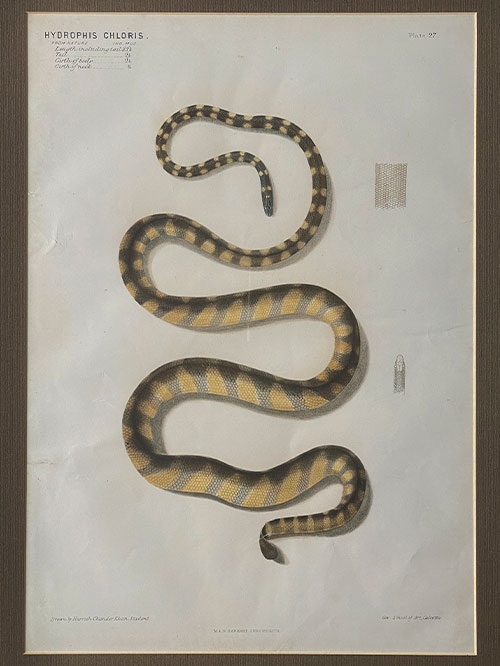
by Sir Joseph Fayrer
from The Thanatophidia of India
original hand coloured chromolithograph
Captioned ‘Hydrophis Chloris’
Sir Joseph Fayrer, 1st Baronet (6 December 1824 – 21 May 1907) was an English physician noted for his writings on medicine in India. After studying medicine at Charing Cross Hospital, London and completing his medical degree in 1849, he was appointed as an assistant surgeon in Bengal in 1850. Fayrer, who became a fellow of the Royal Society in 1877, wrote much on subjects connected with the practice of medicine in India, and was especially known for his studies on the poisonous snakes of that country and on the physiological effects produced by their venom. He set up a zoological society and the zoo at Calcutta. He was President of the Asiatic Society of Bengal in 1867.
The Thanatophidia of India is a description of the venomous snakes of the Indian Peninsula and the physiological effects produced by their venom. These plates were drawn by students from the Govt. School of Art in Calcutta.
Size framed (cms): 57 (H) x 44 (L)
Size framed (inches): 22 (H) x 17.5 (L)
-
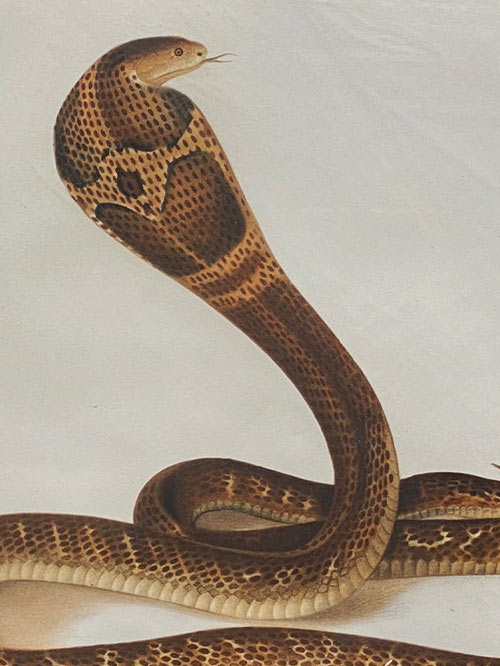
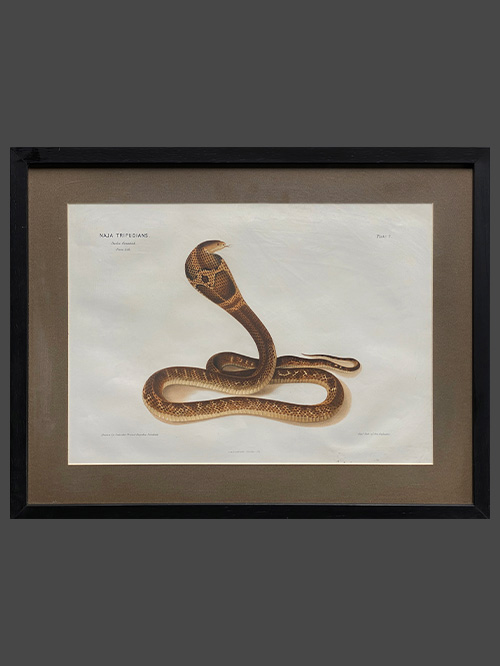
by Sir Joseph Fayrer
from The Thanatophidia of India
original hand coloured chromolithograph
Captioned ‘Naja Tripudians’
Sir Joseph Fayrer, 1st Baronet (6 December 1824 – 21 May 1907) was an English physician noted for his writings on medicine in India. After studying medicine at Charing Cross Hospital, London and completing his medical degree in 1849, he was appointed as an assistant surgeon in Bengal in 1850. Fayrer, who became a fellow of the Royal Society in 1877, wrote much on subjects connected with the practice of medicine in India, and was especially known for his studies on the poisonous snakes of that country and on the physiological effects produced by their venom. He set up a zoological society and the zoo at Calcutta. He was President of the Asiatic Society of Bengal in 1867.
The Thanatophidia of India is a description of the venomous snakes of the Indian Peninsula and the physiological effects produced by their venom. These plates were drawn by students from the Govt. School of Art in Calcutta.
Size framed (cms): 44 (H) x 57 (L)
Size framed (inches): 17.5 (H) x 22 (L)
-
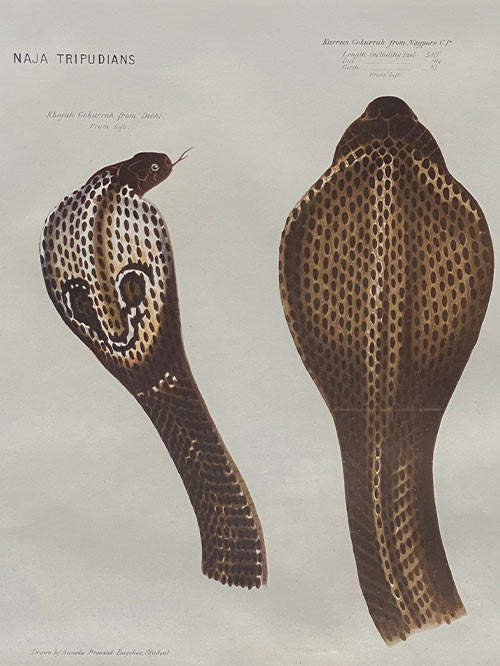
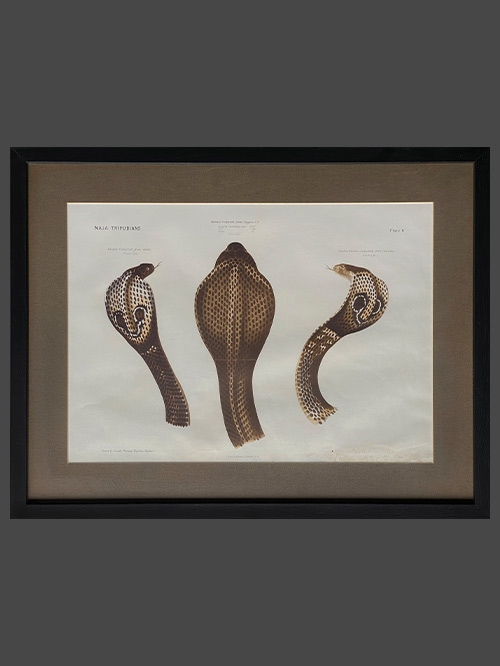
by Sir Joseph Fayrer
from The Thanatophidia of India
original hand coloured chromolithograph
Captioned ‘Naja Tripudians’
Sir Joseph Fayrer, 1st Baronet (6 December 1824 – 21 May 1907) was an English physician noted for his writings on medicine in India. After studying medicine at Charing Cross Hospital, London and completing his medical degree in 1849, he was appointed as an assistant surgeon in Bengal in 1850. Fayrer, who became a fellow of the Royal Society in 1877, wrote much on subjects connected with the practice of medicine in India, and was especially known for his studies on the poisonous snakes of that country and on the physiological effects produced by their venom. He set up a zoological society and the zoo at Calcutta. He was President of the Asiatic Society of Bengal in 1867.
The Thanatophidia of India is a description of the venomous snakes of the Indian Peninsula and the physiological effects produced by their venom. These plates were drawn by students from the Govt. School of Art in Calcutta.
Size framed (cms): 44 (H) x 57 (L)
Size framed (inches): 17.5 (H) x 22 (L)
-
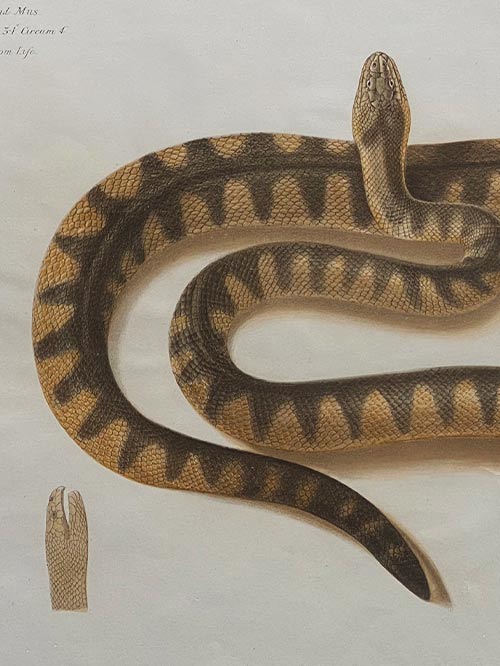
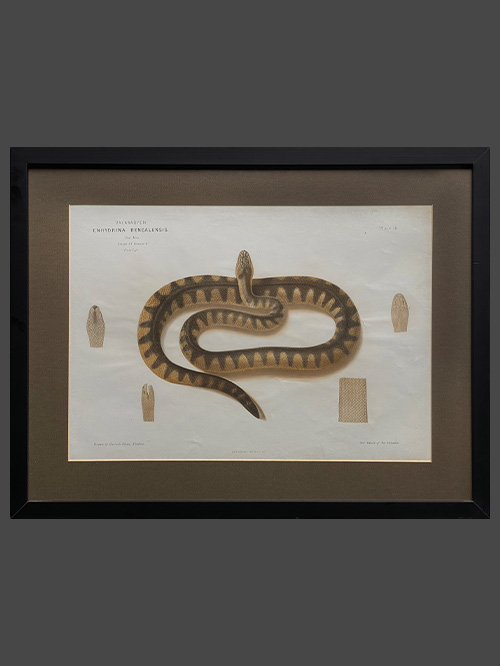
by Sir Joseph Fayrer
from The Thanatophidia of India
original hand coloured chromolithograph
Captioned ‘Enhydrina Bengalensis’
Sir Joseph Fayrer, 1st Baronet (6 December 1824 – 21 May 1907) was an English physician noted for his writings on medicine in India. After studying medicine at Charing Cross Hospital, London and completing his medical degree in 1849, he was appointed as an assistant surgeon in Bengal in 1850. Fayrer, who became a fellow of the Royal Society in 1877, wrote much on subjects connected with the practice of medicine in India, and was especially known for his studies on the poisonous snakes of that country and on the physiological effects produced by their venom. He set up a zoological society and the zoo at Calcutta. He was President of the Asiatic Society of Bengal in 1867.
The Thanatophidia of India is a description of the venomous snakes of the Indian Peninsula and the physiological effects produced by their venom. These plates were drawn by students from the Govt. School of Art in Calcutta.
Size framed (cms): 44 (H) x 57 (L)
Size framed (inches): 17.5 (H) x 22 (L)
-
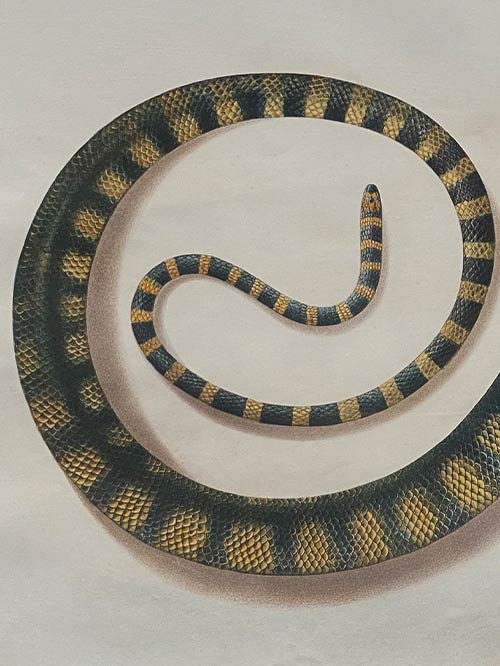
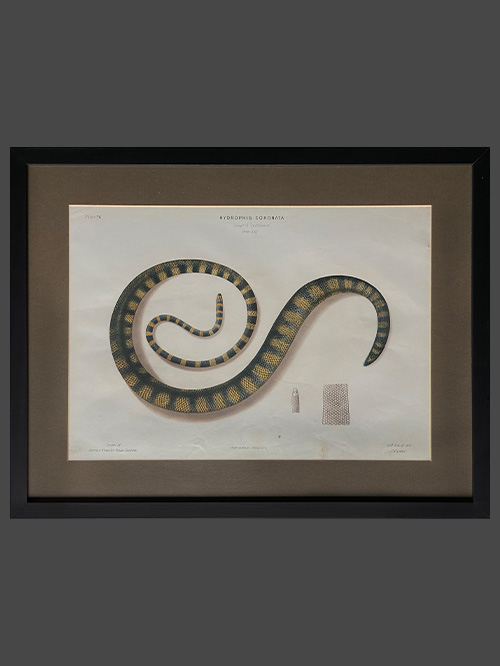
by Sir Joseph Fayrer
from The Thanatophidia of India
original hand coloured chromolithograph
Captioned ‘Hydrophis Coronata’
Sir Joseph Fayrer, 1st Baronet (6 December 1824 – 21 May 1907) was an English physician noted for his writings on medicine in India. After studying medicine at Charing Cross Hospital, London and completing his medical degree in 1849, he was appointed as an assistant surgeon in Bengal in 1850. Fayrer, who became a fellow of the Royal Society in 1877, wrote much on subjects connected with the practice of medicine in India, and was especially known for his studies on the poisonous snakes of that country and on the physiological effects produced by their venom. He set up a zoological society and the zoo at Calcutta. He was President of the Asiatic Society of Bengal in 1867.
The Thanatophidia of India is a description of the venomous snakes of the Indian Peninsula and the physiological effects produced by their venom. These plates were drawn by students from the Govt. School of Art in Calcutta.
Size framed (cms): 44 (H) x 57 (L)
Size framed (inches): 17.5 (H) x 22 (L)
-
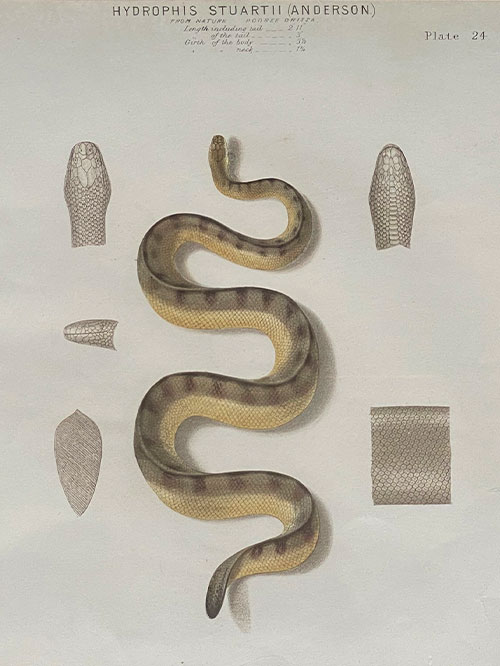
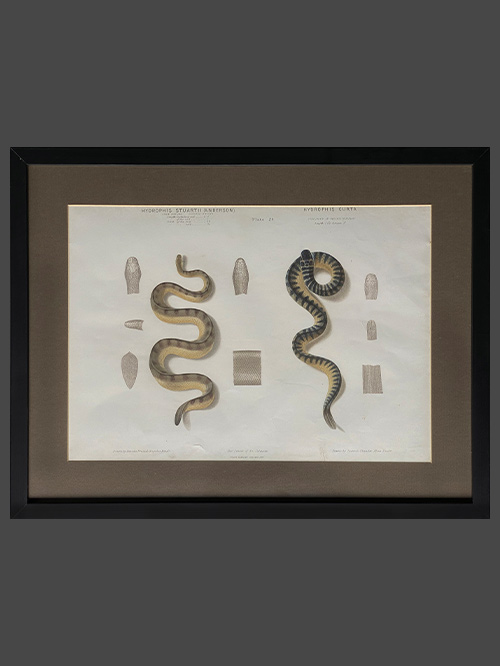
by Sir Joseph Fayrer
from The Thanatophidia of India
original hand coloured chromolithograph
Captioned ‘Hydrophis Stuartii and Hydrophis Curta’
Sir Joseph Fayrer, 1st Baronet (6 December 1824 – 21 May 1907) was an English physician noted for his writings on medicine in India. After studying medicine at Charing Cross Hospital, London and completing his medical degree in 1849, he was appointed as an assistant surgeon in Bengal in 1850. Fayrer, who became a fellow of the Royal Society in 1877, wrote much on subjects connected with the practice of medicine in India, and was especially known for his studies on the poisonous snakes of that country and on the physiological effects produced by their venom. He set up a zoological society and the zoo at Calcutta. He was President of the Asiatic Society of Bengal in 1867.
The Thanatophidia of India is a description of the venomous snakes of the Indian Peninsula and the physiological effects produced by their venom. These plates were drawn by students from the Govt. School of Art in Calcutta.
Size framed (cms): 44 (H) x 57 (L)
Size framed (inches): 17.5 (H) x 22 (L)
-
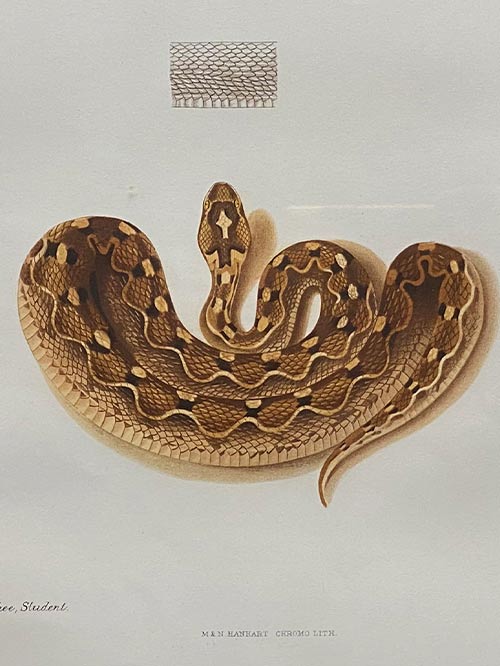
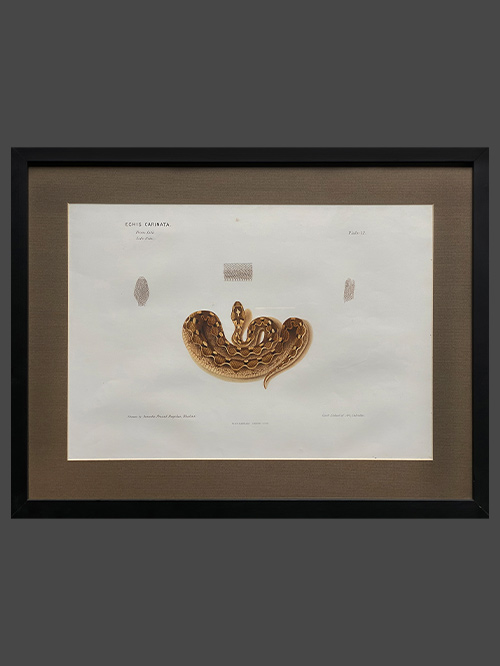
by Sir Joseph Fayrer
from The Thanatophidia of India
original hand coloured chromolithograph
Captioned ‘Echis Carinata’
Sir Joseph Fayrer, 1st Baronet (6 December 1824 – 21 May 1907) was an English physician noted for his writings on medicine in India. After studying medicine at Charing Cross Hospital, London and completing his medical degree in 1849, he was appointed as an assistant surgeon in Bengal in 1850. Fayrer, who became a fellow of the Royal Society in 1877, wrote much on subjects connected with the practice of medicine in India, and was especially known for his studies on the poisonous snakes of that country and on the physiological effects produced by their venom. He set up a zoological society and the zoo at Calcutta. He was President of the Asiatic Society of Bengal in 1867.
The Thanatophidia of India is a description of the venomous snakes of the Indian Peninsula and the physiological effects produced by their venom. These plates were drawn by students from the Govt. School of Art in Calcutta.
Size framed (cms): 44 (H) x 57 (L)
Size framed (inches): 17.5 (H) x 22 (L)
-
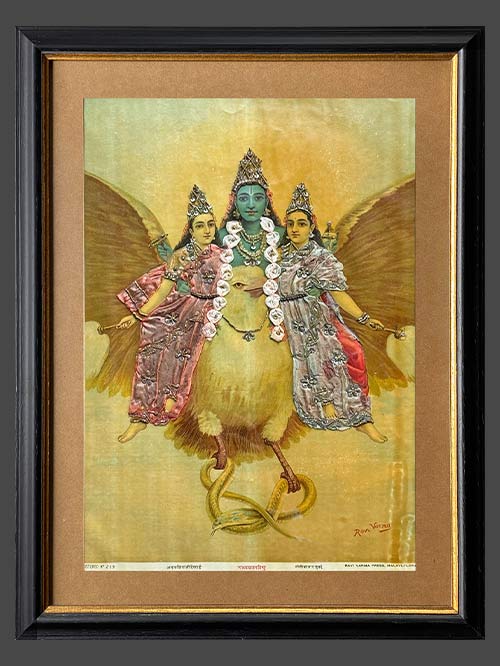
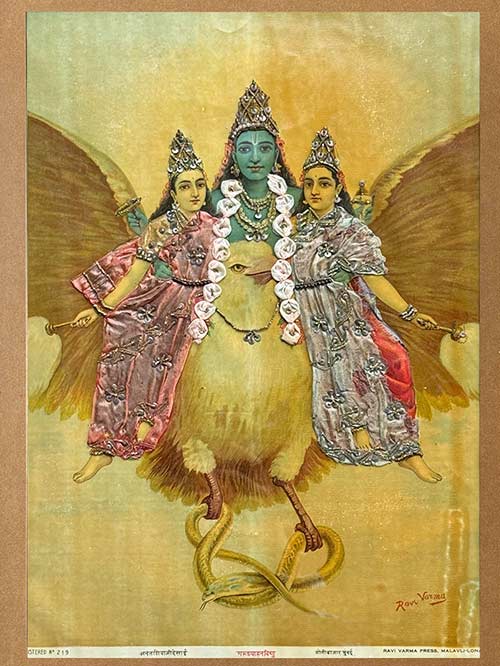
Published at the Ravi Varma Press, Malavli, Lonavla
by Raja Ravi Varma
chromolithograph
Vishnu is is seen here riding on his vahana (vehicle), the mythical bird Garuda with his consorts Sridevi and Bhudevi on either side. The blue skinned Vishnu carries two of his usual attributes, the disc (cakra) and conch (sankha) in his hands. His consorts both bejewelled wear saris and hold chauris (fly whisks) in their outstretched arms. Garuda is depicted mid-flight carrying the trio and holding a golden cobra firmly within its talons.
Ravi Varma occupies an important place in Indian art history. He developed a painting style that appropriated the illusionary techniques of European oil painting with traditional Indian subject matter. The popularity of Ravi Varma’s paintings gave him the idea to make oleographs that would be available to the general public, instead of only elite patrons. Oleographs, also called chromolithographs, are multi-colour art prints, stemming from the process of lithography.
These immensely popular chromolithographs from the Ravi Varma press quickly set a new iconographical standard for the traditional Indian heroes and deities. Often the figures were embellished with embroidered sequins and other decorative material, creating vibrant pulsating images.
Image Size (cms): 49.5 (H) x 34.5 (W)
Image Size (inches): 19.5 (H) x 13.6 (W)
Framed Size (cms): 62 (H) x 48.5 (W)
Framed Size (inches): 24.5 (H) x 19 (W)