“Bastar Horse with Riders” has been added to your cart.
View cart
-
Southern India
Wood
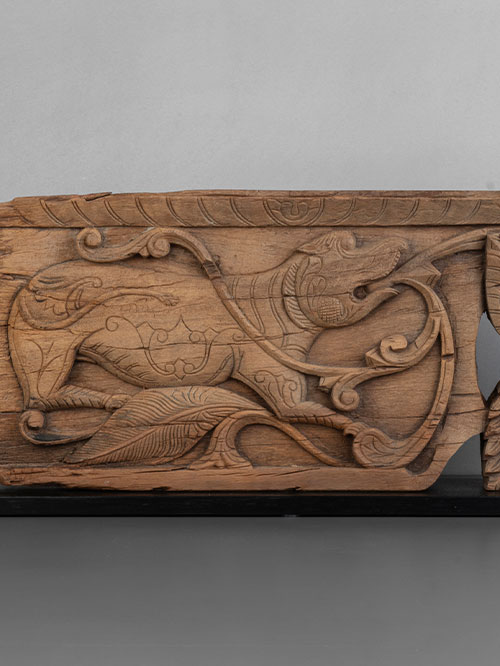
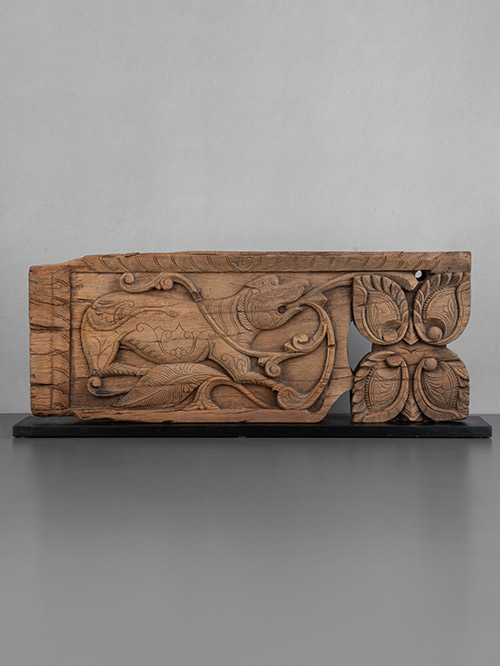
This large decorative panel depicts a confident, prowling tiger spewing vegetation from its open jaw. The foliage forms intricate decorative swirls around the tiger, with a floral sprig positioned to its right.
Wooden construction was once widespread throughout most of Southern India, but the intense heat and the severe monsoonal rains have meant that a large proportion of the wooden buildings in private and public use have now disappeared. The typical southern Indian wooden building, was supported on a framework of columns, with an elaborate system of interlocking brackets and beams to support the floors and roofs. Carved doors, windows, and screens and panels filter light and ventilate the interiors, creating an environment that is both comfortable and richly detailed. The scale and shape of houses was dictated by the maximum height and span of timber beams, resulting in a modular system of construction. The woodwork was deeply cut and naturalistic, the intention of the artisans was to capture the forms and energies of the natural world. Panels such as these, with floral medallions radiating in full bloom or others with elaborate geometric modelling, ornamented of palaces, houses and temples.
Size (cms): 32(H) x 82.5(W) x 14.5(D)
Size (inches): 12.5(H) x 32.5(W) x 5.5(D)
-
Karnataka
Wood, extensively polychromed
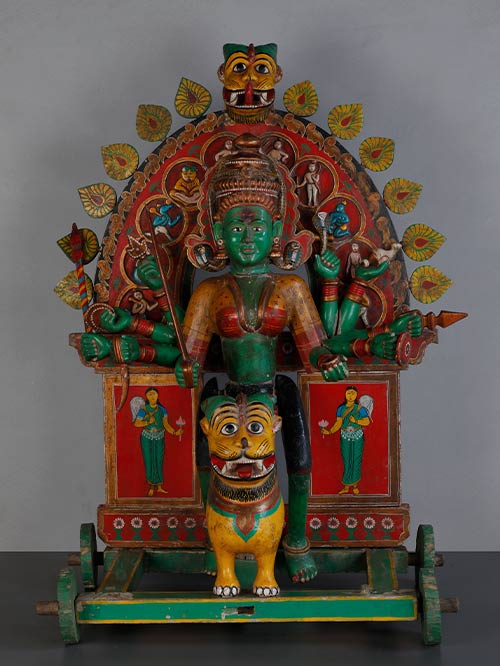
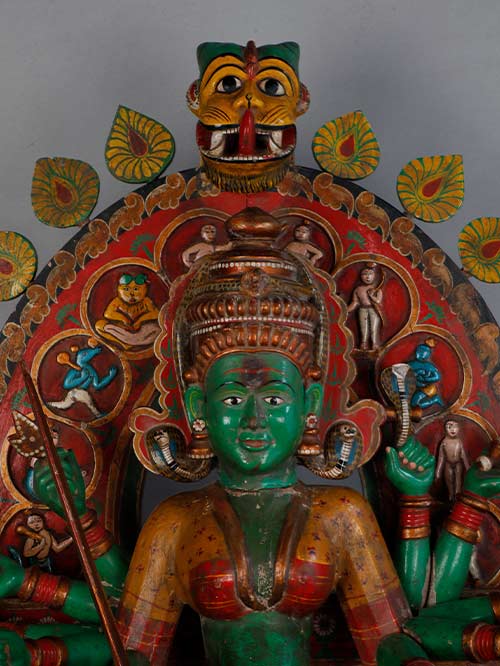
An exceptional multi-armed articulated figure of the Goddess Durga riding her Tiger vahana. She is seated on a complete chariot with a resplendent prabhavali which is painted with chauri bearers and a flaming aureole. Diminutive roundels are placed in an arch within the prabhavali each depicting the ten incarnations of Lord Vishnu starting with Matysa and ending with Kalki. The Goddess wears a patterned red and yellow blouse and an elaborate tiered crown. In her arms she carries various weapons, including a sword, cakra, conch, naga and blood bowl.
Durga – “The Unconquerable form of Devi” – Durga is the most splendid manifestation of Devi. Virginal and sublime, contain within her the power of all the gods combined, she is the invincible power of Nature who triumphs over those who seek to subjugate her. Every year, during Navratri, processional images of the goddess are carried in evocative ceremonies. Depending on the day of the festival, her vahana, the vehicle on which she rides changes, with each of her vehicles holding a different and unique significance. The tiger she rides here signifies her ferociousness and strength.
Size (cms): 95(H) x 69(W) x 44(D)
Size (inches): 37.5(H) x 27(W) x 17.5(D)
-
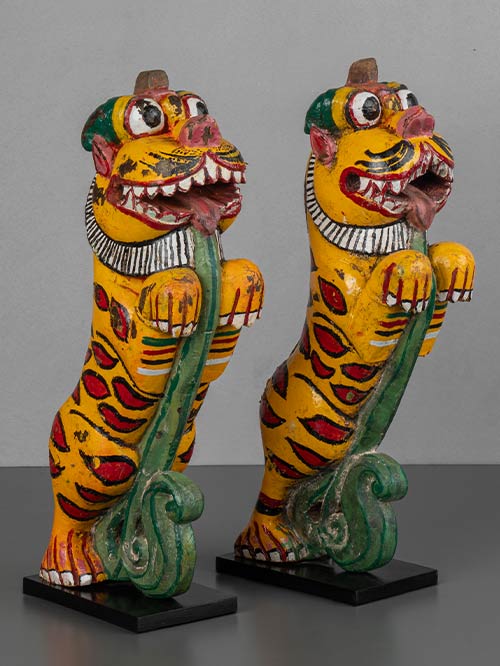
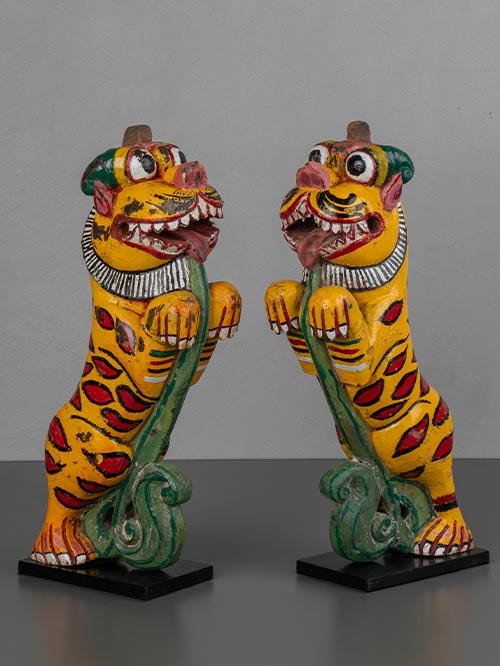
Karnataka
Wood, polychromed
A delightful, richly polychromed pair of rearing tiger brackets. The wide-eyed tigers have large open mouths, exposing their fangs and long, protruding tongues. They stand on their hind legs, and their muscular torsos are painted with red and black bubris (stripes). Their forelegs are raised, as if poised to pounce, and swirling foliage sprouts from their raised paws.
The tiger is the vehicle of, and sacred to, the Hindu goddess, Durga. From a certain perspective she is India’s Mother Nature, for she is the deification of Energy. Her consort, Shiva, sometimes evoked as Shambo, wears a tiger skin to indicate that he is beyond the bounds of the natural world.
Individual Sizes (cms): 44.5(H) x 22(W) x 10(D) each
Individual Sizes (inches): 17.5(H) x 8.5(W) x 4(D) each
-
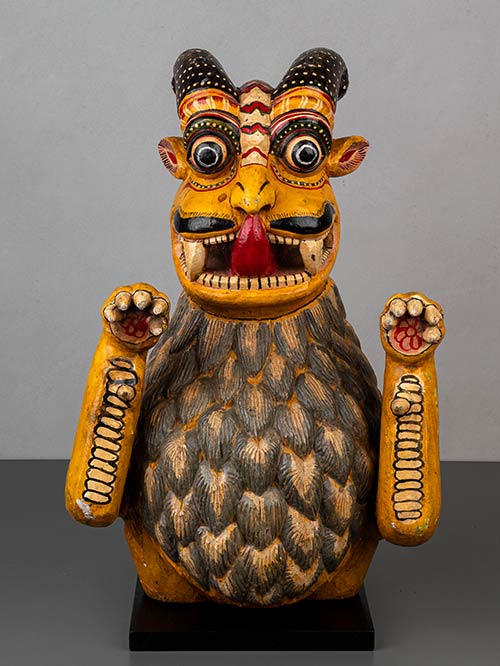

Karnataka
Wood, extensively polychromed
This striking large Tiger Vahana with an unusual, prominent flowing mane. The tiger has wide bulging eyes and an open mouth with large exposed teeth and a long protruding tongue. His fore legs are raised, as if to pounce.
The tiger is the vehicle of, and sacred to, the Hindu goddess, Durga. From a certain perspective she is India’s Mother Nature, for she is the deification of Energy. Her consort, Shiva, sometimes evoked as Shambo, wears a tiger skin to indicate that he is beyond the bounds of the natural world.
Size (cms): 61(H) x 38(W) x 27(D)
Size (inches): 24(H) x 15(W) x 10.5(D)
-
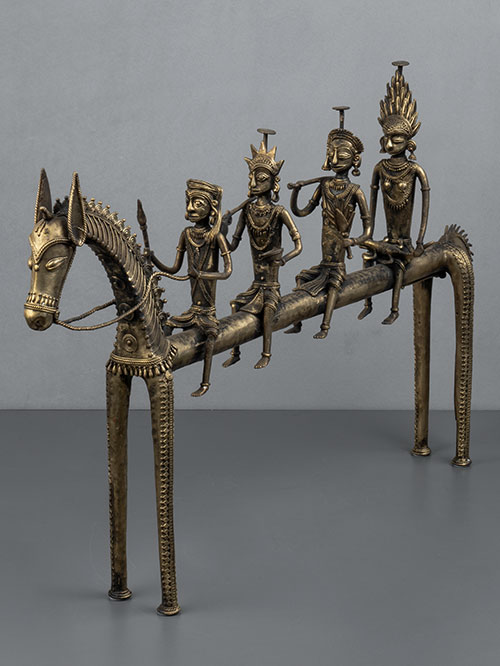
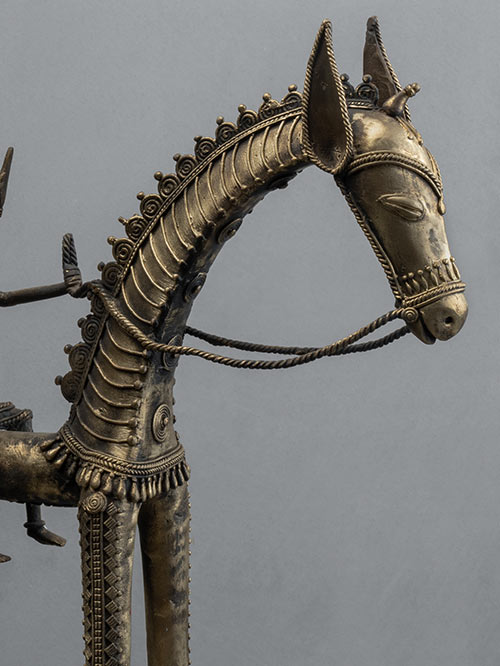
Bastar (Chhattisgarh, Central India)
Brass, Dokra work
A fine sculpture of a horse and four riders (hunters). The figures carry a spear, mace, club and a crocodile.
Suresh Waghmare (signed)
Born in 1970 in a Maharashtrian family in Bastar district, he began to study the technique of Bell Metal Casting with Guru Phool Singh Bisara when he was twelve. Since then he has been working as a member of the co-operative of craftsmen. He is a master craftsman in the art of metal casting and has participated in many international exhibitions.
Size (cms): 51(H) x 84.5(W) x 9(D)
Size (inches): 20(H) x 33.5(W) x 3.5(D)
-
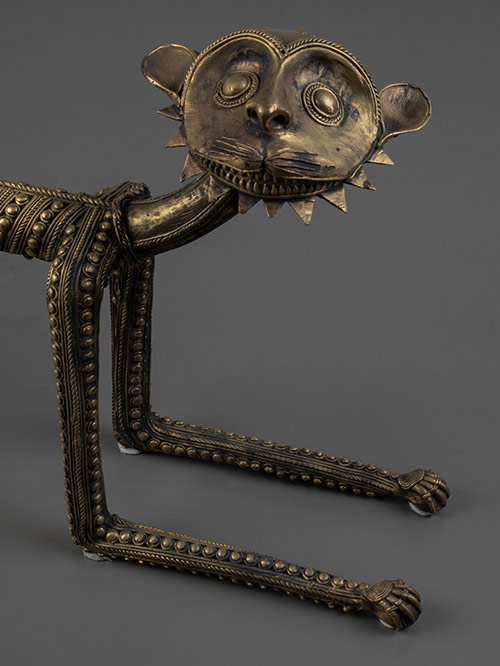
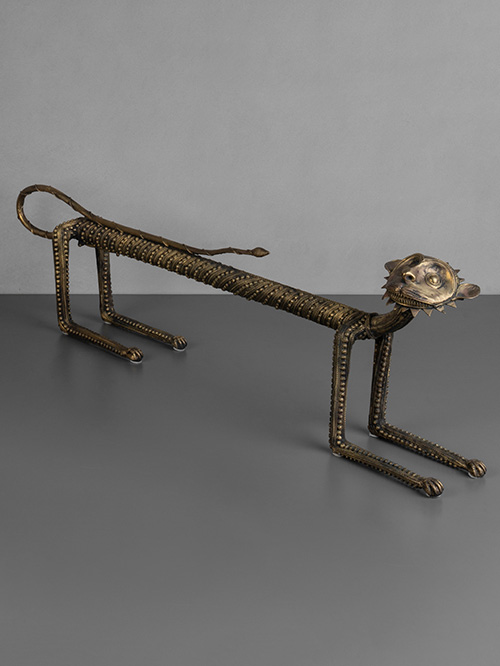
Bastar (Chhattisgarh, Central India)
Brass, Dokra work
The tiger is the vehicle of, and sacred to, Danteshwari Mata who is a form of the powerful Goddess Durga and is also the family goddess of the princes of Bastar.
Suresh Waghmare (signed)
Born in 1970 in a Maharashtrian family in Bastar district, he began to study the technique of Bell Metal Casting with Guru Phool Singh Bisara when he was twelve. Since then he has been working as a member of the co-operative of craftsmen. He is a master craftsman in the art of metal casting and has participated in many international exhibitions.
Size (cms): 29.5(H) x 106(W) x 11(D)
Size (inches): 11.5(H) x 41.5(W) x 4.5(D)
-
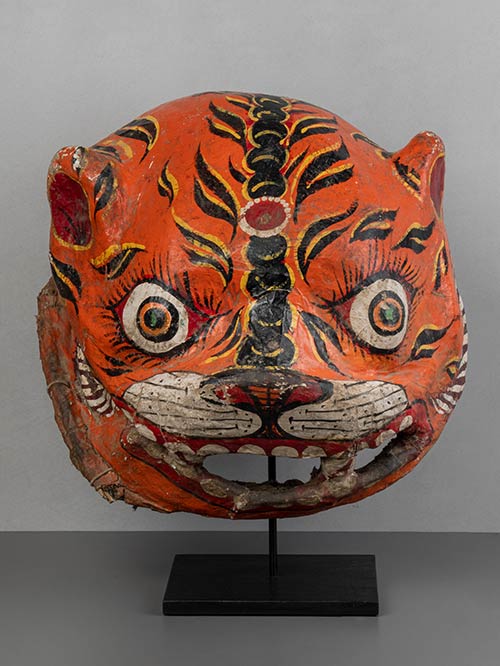

Southern Orissa
Papier-mâché, wood and cloth
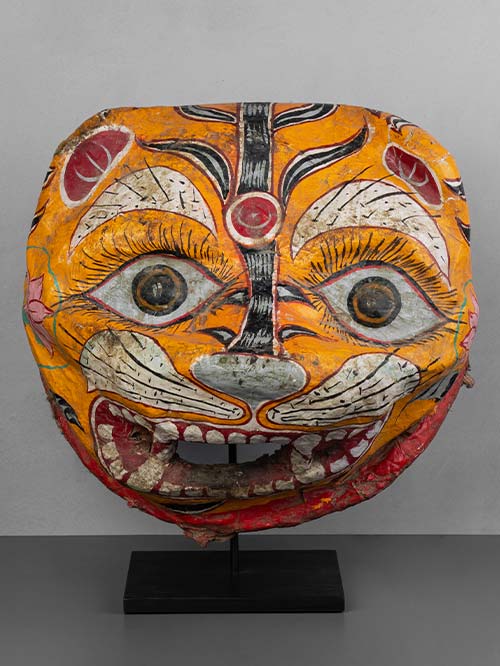
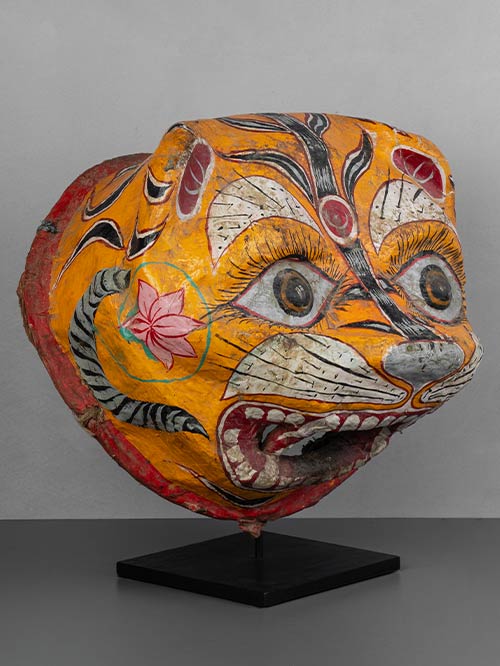
The Bhaga Naacha (Tiger Dance) was once a popular and highly regarded unique folk dance form in Orissa. It used to be performed before and after hunting. Now it intricately associated with the Thakurani Yatra festival that is celebrated in the Ganjam district in Southern Orissa. The ritual festival celebrates the Mother Goddess Thakurani or Durga who also rides on a tiger or lion. Apart from Tiger, the Bull, Deer and Horse dance are also typical features of this region.
During the performance the dancers are surrounded by a group of Changu (drum) players who by beating the changus encourage them to dance. The dancers work in coordination under the cane frame concealed by a thick cloth richly decorated with mirrors and applique. The masks are bigger than the head with colourful traditional paintings and decorations. This fast and dynamic dance needs enthusiasm and energy not only for the dancers but also for the drummers and bell players. Acrobatic movements and hissing sound charm, captivate and excite the audience especially children. Although visibly it seems simple, it needs skills, energy, coordinated staging and skilled direction. The thematic variations within the dance include encounter between tiger and ox, encounter between tiger and hunter and tiger preying on horse etc.
Mask Size (cms): 63(H) x 67(W) x 34(D), 70(H with Stand)
Mask Size (inches): 25(H) x 26.5(W) x 13.5(D), 27.5(H with Stand)
-
Southern Orissa
Papier-mâché, wood and cloth
The Bhaga Naacha (Tiger Dance) was once a popular and highly regarded unique folk dance form in Orissa. It used to be performed before and after hunting. Now it intricately associated with the Thakurani Yatra festival that is celebrated in the Ganjam district in Southern Orissa. The ritual festival celebrates the Mother Goddess Thakurani or Durga who also rides on a tiger or lion. Apart from Tiger, the Bull, Deer and Horse dance are also typical features of this region.
During the performance the dancers are surrounded by a group of Changu (drum) players who by beating the changus encourage them to dance. The dancers work in coordination under the cane frame concealed by a thick cloth richly decorated with mirrors and applique. The masks are bigger than the head with colourful traditional paintings and decorations. This fast and dynamic dance needs enthusiasm and energy not only for the dancers but also for the drummers and bell players. Acrobatic movements and hissing sound charm, captivate and excite the audience especially children. Although visibly it seems simple, it needs skills, energy, coordinated staging and skilled direction. The thematic variations within the dance include encounter between tiger and ox, encounter between tiger and hunter and tiger preying on horse etc.
Mask Size (cms): 63(H) x 67(W) x 34(D), 70(H with Stand)
Mask Size (inches): 25(H) x 26.5(W) x 13.5(D), 27.5(H with Stand)
-

Orissa (Eastern India)
Wood, extensively polychromed
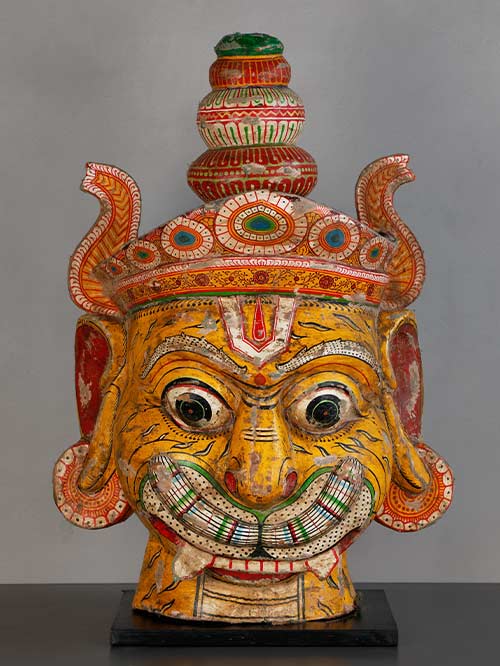
A beautiful large polychromed wooden head of a Tiger painted yellow with large white and black bubris (stripes) and a characteristic candy cane moustache. In typical Orissan style, the tiger has large geometric earrings and a decorated tiered crown.
Shahi Jatras (royal processions) of Orissa present different episodes from the Ramayana during the spring season, usually lasting for for one week. Actors, carrying huge wooden masks and gorgeous costumes, walk on the streets with stylized gait and mime with the accompaniment of loud drumming. The Desia Nata of Koraput, Orissa, also uses masks for representing gods, goddesses, animals, birds and demons. These themes are also taken from Ramayana.
Size (cms): 76(H) x 56(W) x 47(D)
Size (inches): 30(H) x 22(W) x 18.5(D)
-
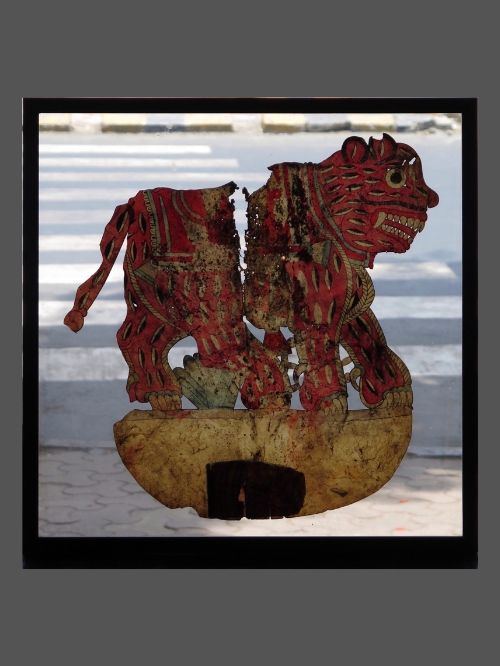
Karnataka (South India)
Framed Leather Shadow Puppet
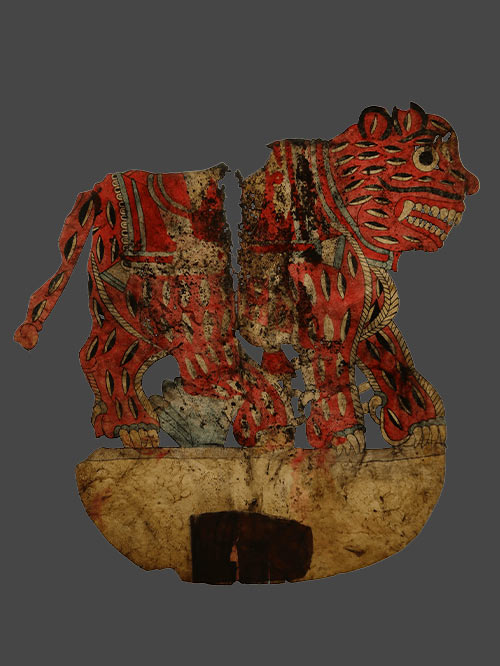
The art of puppetry, called Togalugombayeta in Karnataka, involves acting out well known epic episodes using puppets made of flat leather pieces operated by a stick. The perforated leather is illuminated from behind, making this a form of shadow theatre. It is thought that the puppets were invented to avoid having gods and goddesses – who feature prominently in Indian epics like the Ramayana and Mahabharata – depicted by humans.
Size(cms): 57 (H) x 57 (L)
Size(inches): 24.5 (H) x 24.5 (L)