“Makara Bracket” has been added to your cart.
View cart
-
Orissa
brass alloy
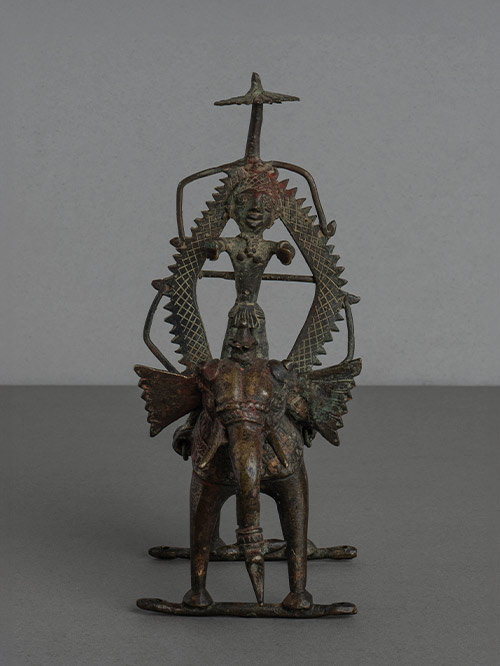
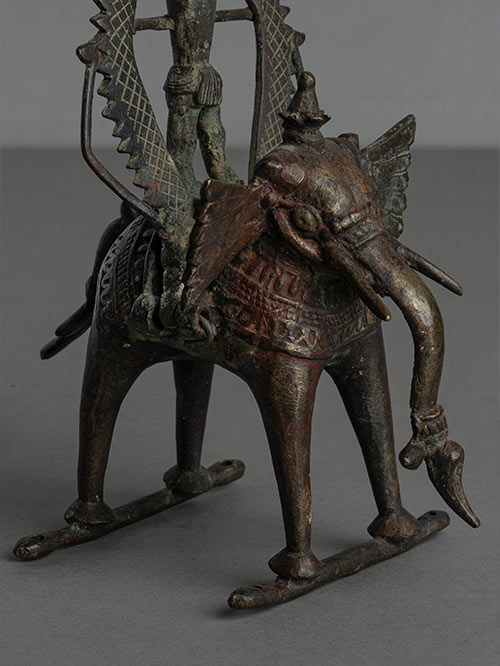
A finely crafted figure of an elephant with its mahout. The caparisoned elephant is adorned with head and neck ornaments and a decorated saddle cloth, and it has a lovely curled trunk. Atop the elephant stands the Goddess Danteshwari, enclosed in a howdah shaped like a prabhavali, forming a ritual arch around the deity.
The elephant was the vahana or vehicle of god Indra. Later it became associated with deities such as Lakshmi and Danteshwari (Durga). In art and literature it became a symbol of power and might and was associated with royalty and deities. Danteshwari Mata who is a form of the powerful Goddess Durga and is also the family goddess of the princes of Bastar. The last ruler of Bastar who died in 1966 was considered her incarnation. The goddess was brought to Bastar in the 15th century by Annamdeo, an ancestor of the princely dynasty. On the run from the advancing Muslims, he had sought refuge in the impassable mountainous region of Bastar. Legend has it that the goddess appeared to him in through his royal sword and showed him the way. The sword represents the power of the victorious goddess and bestows military prowess upon its owner.
Size (cms): 19(H) x 12(W) x 8.5(D)
Size (inches): 7.5(H) x 4.5(W) x 3.5(D)
-
Central India
brass alloy
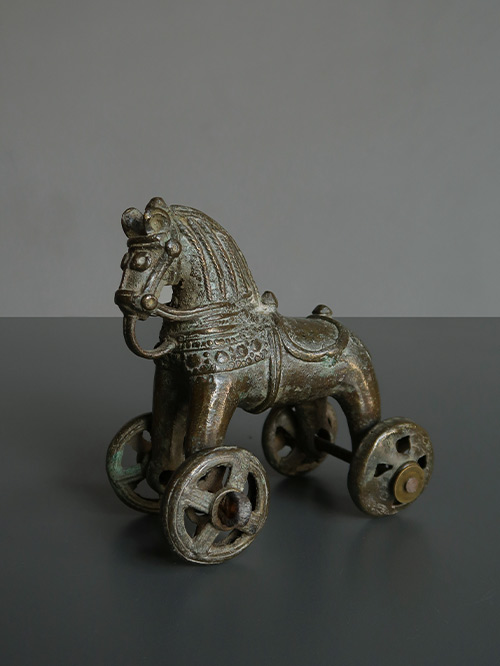
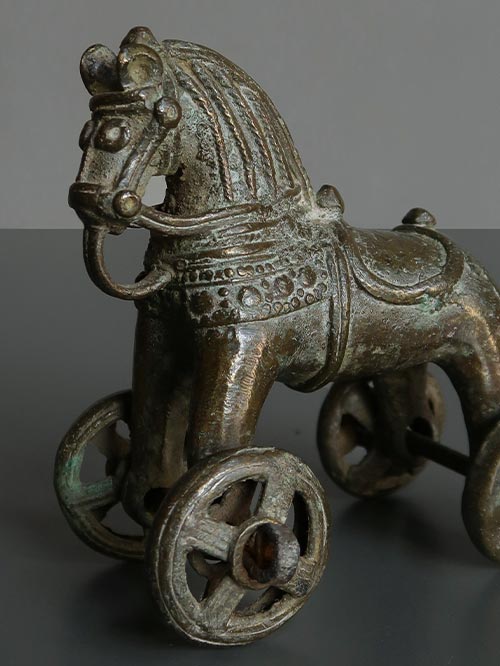
A lovely diminutive figure of a horse on wheels adorned with trappings and a decorated saddle cloth secured by ropes. Temple toys were used as ritual display in temples during important festivals such as Holi, Shivaratri and Durga Puja.
The horse played a pivotal role in establishing the supremacy of kings, as demonstrated, for instance by the great horse sacrifice, the Ashvamedha, which might have been established in the course of the Vedic period. Equestrian motifs appear prominently in Indian art, for example in Orissan sculpture of the 12th and 13th centuries, and in that of the late Vijaynagara and Nayak periods (early 16th to early 18th century) in southern India. There is a branch of literature specialising in the training of horses, which contains detailed passages on colouring, proportions, gait, auspicious and inauspicious marks and lists of appropriate names for horses.
Size (cms): 16.5(H) x 15.25(W) x 11(D)
Size (inches):6.5(H) x 6(W) x 4.5(D)
-
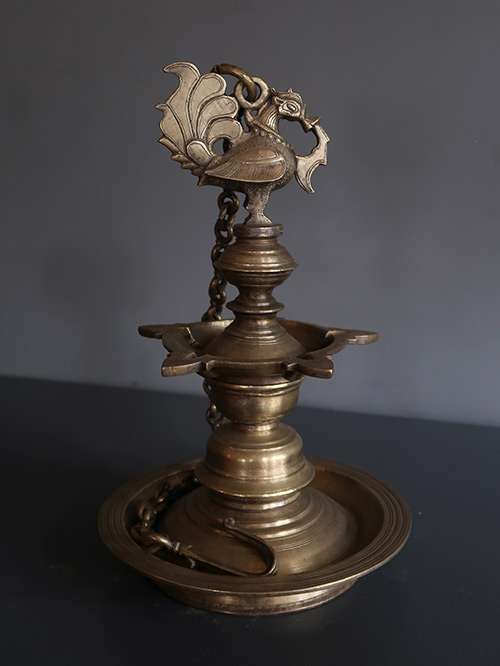
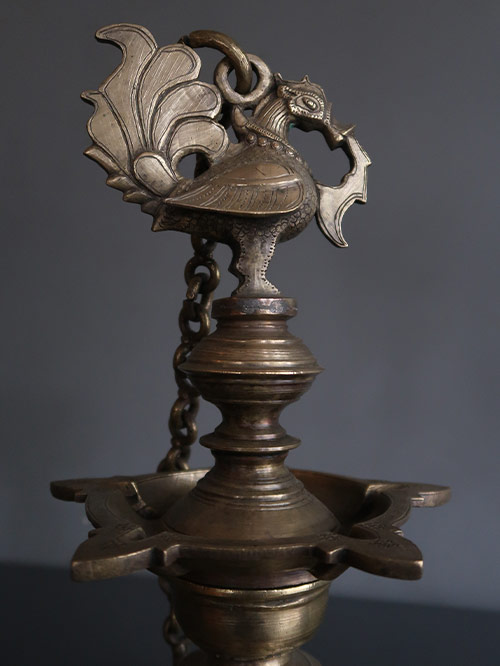
Kerala
Brass Alloy
A fine two-tiered temple lamp with a Hamsa (goose) final. The upper circular reservoir with five lotus petal shaped spouts in each of which a wick would be placed.
The Hamsa is a familiar motif in Indian art, literature, sculpture and textiles. It is an aquatic bird that resembles a goose or a swan. It is reputed to eat pearls and to be able to separate milk from water. The Hamsa is seen as a symbol of purity, detachment, divine knowledge, cosmic breath (prana) and the highest spiritual accomplishment.
Hanging lamps, sometimes called chain lamps, may have originated from as far afield as Greece or Rome, entering South Asia from the early ports of Arikamedu and Mammalapuram (both near present day Chennai). Used primarily in a temple context, the chain lamp cast its light broadly, and in so doing extended spiritual agency. Much like other lamp types, it served as a backdrop to images placed before it on the altar. A group of hanging temple lamps within the temple would have generated a tremendous play of light and shadows over walls, ceilings and floors.
Size(cms): 35 (H w/o Chain) x 21.5 (Diameter), 94 (H with Chain)
Size(inches): 13.75 (H w/0 Chain ) x 8.5 (Diameter), 37 (H with Chain)
-
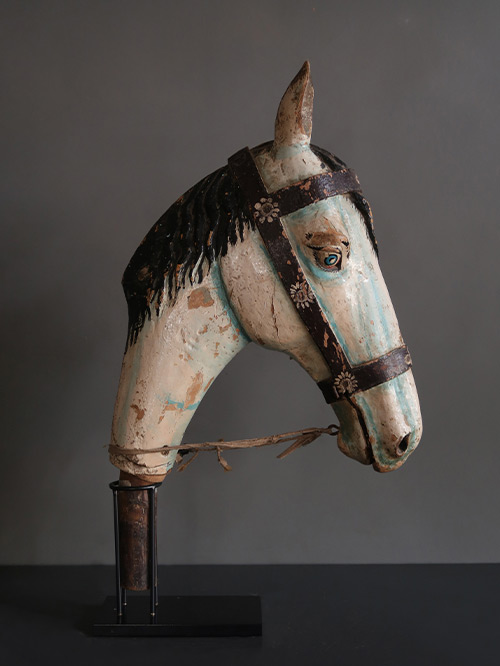
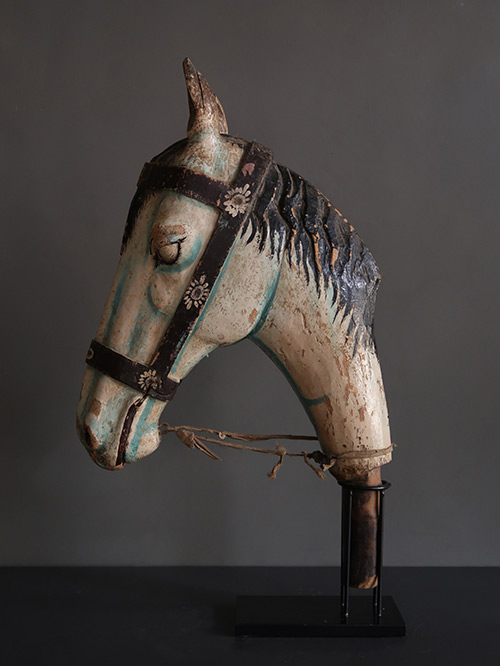
Konkan Region (Western India)
wood, polychromed
A painted wooden horse dancing mask with an articulated jaw. The head is worn through use but still shows its typical trappings.
This is a tribal dancing masks from the Konkan region used in the Perni Zagor, a folk play danced by Christian Gaud tribals. Perni Zagor is an indigenous dance-drama form of the Perni community of Goa. This is an ancient art form and is believed to have evolved on the banks of the Zuari river. It has its origins in fertility rites related to Neolithic shamanism. The dancers don wooden masks while performing the musical drama. The masks represent deities, animals, birds and demons. The characters are derived from various episodes in Hindu mythology. Perni Zagor is currently performed by only a few families in the community and is almost on the verge of extinction.
Size (cms): 77(H) x 44(W) x 17(D)
Size (inches): 30.5(H) x 17.5(W) x 6.5(D)
-
Konkan Region (Western India)
wood, polychromed
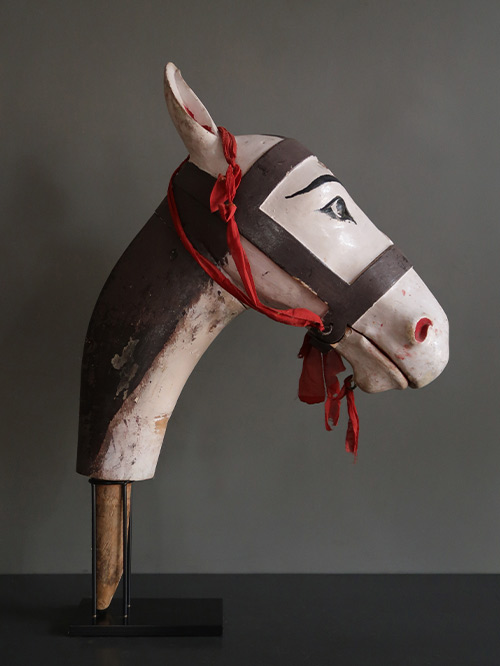
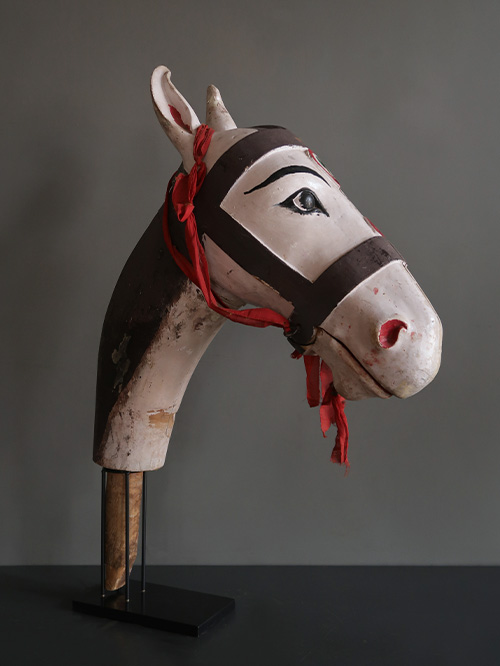
A painted wooden horse dancing mask with an articulated jaw. The head is worn through use but still shows its typical trappings.
This is a tribal dancing masks from the Konkan region used in the Perni Zagor, a folk play danced by Christian Gaud tribals. Perni Zagor is an indigenous dance-drama form of the Perni community of Goa. This is an ancient art form and is believed to have evolved on the banks of the Zuari river. It has its origins in fertility rites related to Neolithic shamanism. The dancers don wooden masks while performing the musical drama. The masks represent deities, animals, birds and demons. The characters are derived from various episodes in Hindu mythology. Perni Zagor is currently performed by only a few families in the community and is almost on the verge of extinction.
Size (cms): 86.5(H) x 57(W) x 17(D)
Size (inches): 34(H) x 22.5(W) x 6.5(D)
-
TEAK
c. 1920
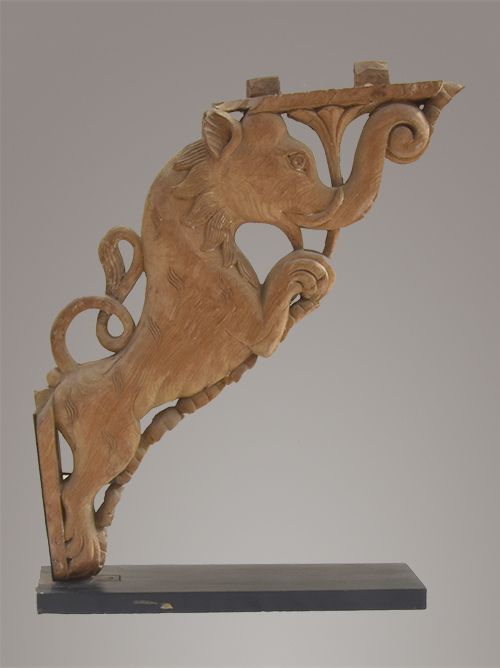
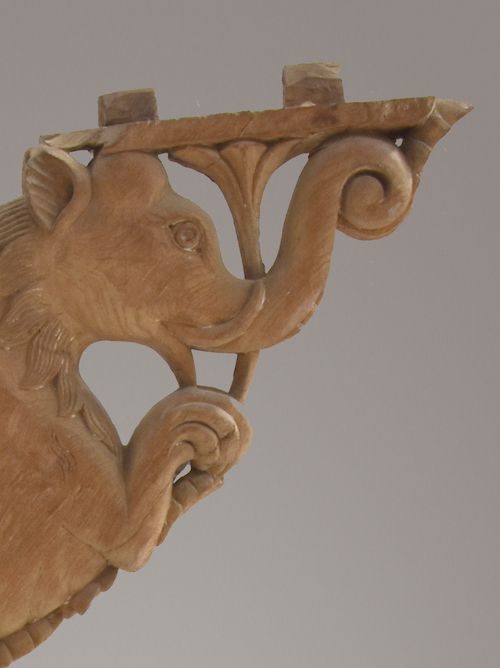
The Makara is a mythical aquatic creature that combines the body of a crocodile with the head of a lion and the trunk of an elephant. One of India’s most ancient symbols, harking back more than two thousand years to a time when the natural world was seen as both symbol and reality, and fantastic creatures were invented to express the complexity of nature. The Makara is considered auspicious and purifying by Hindus and related to fertility. he is the vehicle (vahana) of Varuna, god of the waters of heaven and earth, and the emblem of Kama, the god of love.
Sizes (cms): 80 (H) x 62 (W) x 20 (D)
Sizes (inches): 31.4 (H) x 24.4 (W) x 7.9 (D)
-
Maharashtra/Karnataka
Wood, polychromed
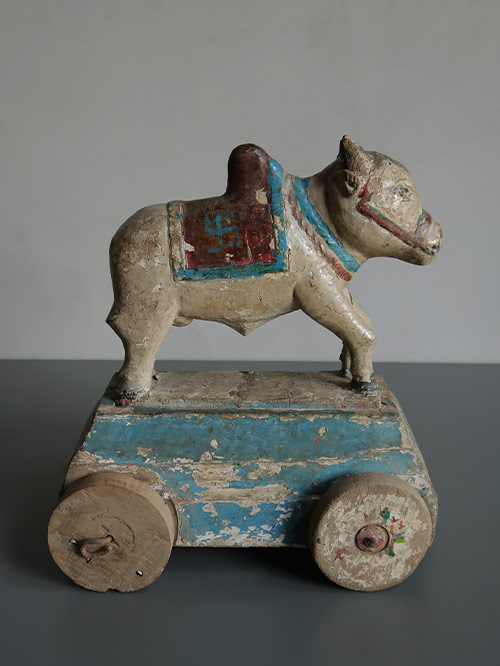
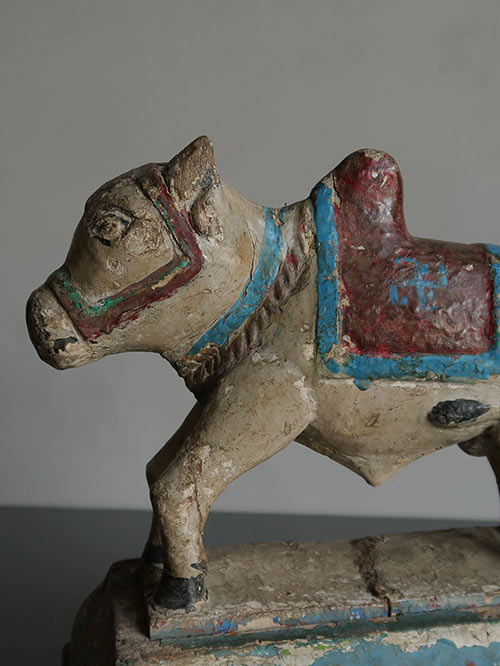
A decorative Nandi painted with patterns symbolising typical trappings including a saddle and head and neck ornaments. A right-facing swastik is painted on the saddle, symbolizing the sun, prosperity and good luck. The Nandi stands on a pedestal with wheels. Animal festival toys are used for ritual display and celebration during important festivities such as Pola, Holi, Shivaratri and Durga Puja.
Nandi festival toys have a special importance during the festival of Pola. Pola is an ancient thanks giving festival celebrated during the Hindu month of Sharavan during which farmers celebrate their cattle.
Nandi or Nandin means rejoicing, gladdening. It is the name of Shiva’s conveyance (vahana) the white bull, son of Kashyapa and of Surabhi. Nandi was probably a folk deity later incorporated into the Brahmanic lore. Nandi symbolises on the one hand moral and religious duty (dharma), and on the other, virility, fertility and strength. Apart from being Shiva’s vehicle, nandi in his form as nandikeshvara, depicted as a human with a bulls head, is believed to be one of the great masters of music and dancing. In southern India his recumbent image is placed either opposite the main sanctuary or in the hall leading to it, facing the linga.
Size (cms): 33.5(H) x 30(W) x 20(D)
Size (inches): 13(H) x 12(W) x 8(D)
-
Maharashtra/Karnataka
Wood, polychromed
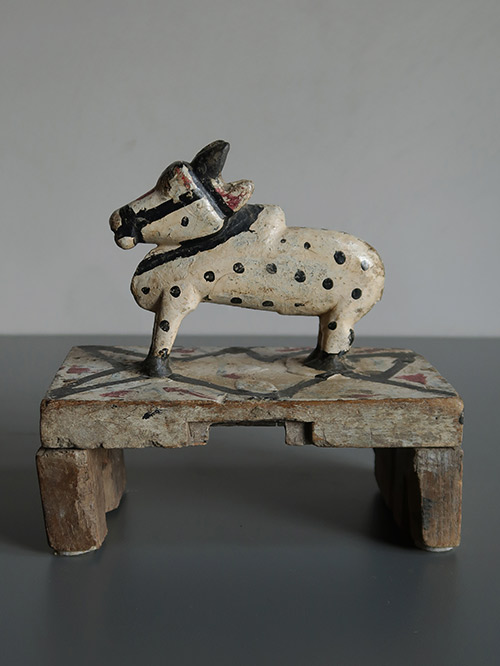
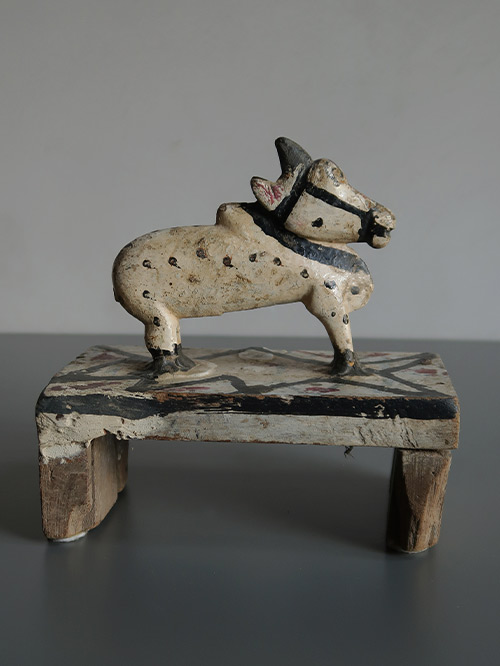
A decorative Nandi painted in white with black dots and typical trappings including a bridle bit. The Nandi stands on a pedestal painted with a geometric star. Animal festival toys are used for ritual display and celebration during important festivities such as Pola, Holi, Shivaratri and Durga Puja.
Nandi festival toys have a special importance during the festival of Pola. Pola is an ancient thanks giving festival celebrated during the Hindu month of Sharavan during which farmers celebrate their cattle.
Nandi or Nandin means rejoicing, gladdening. It is the name of Shiva’s conveyance (vahana) the white bull, son of Kashyapa and of Surabhi. Nandi was probably a folk deity later incorporated into the Brahmanic lore. Nandi symbolises on the one hand moral and religious duty (dharma), and on the other, virility, fertility and strength. Apart from being Shiva’s vehicle, nandi in his form as nandikeshvara, depicted as a human with a bulls head, is believed to be one of the great masters of music and dancing. In southern India his recumbent image is placed either opposite the main sanctuary or in the hall leading to it, facing the linga.
Size (cms): 21(H) x 20(W) x 12(D)
Size (inches): 8.5(H) x 8(W) x 4.5(D)
-
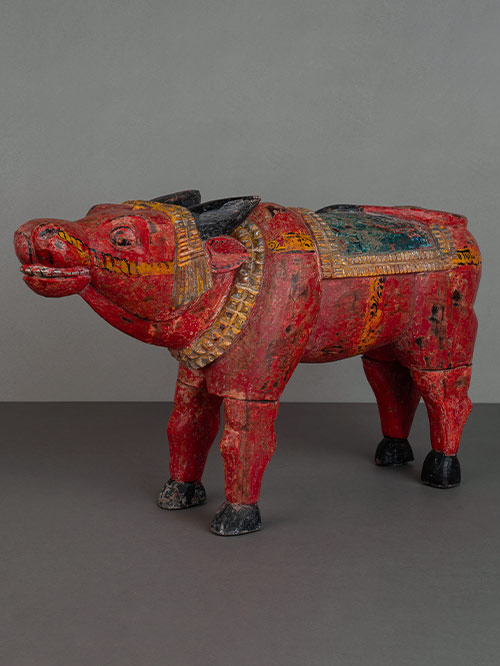
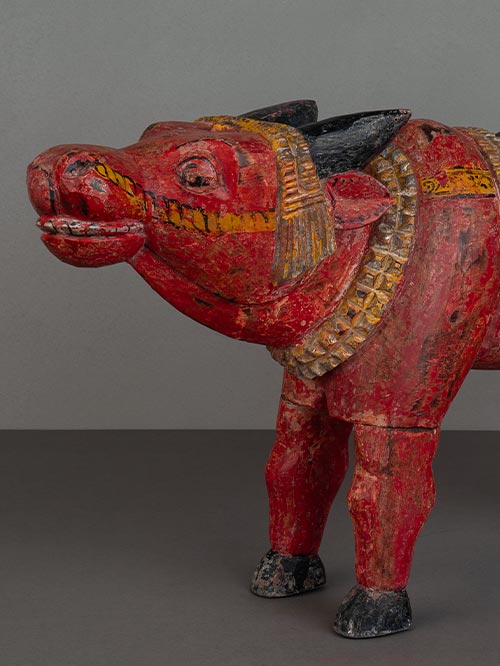
Coastal Karnataka (Bhuta culture)
Wood, polychromed
A fine painted wood figure of a standing nandi. Displaying the typical folk bhuta style of coastal Karnataka, this figure is painted predominantly in red with a painted saddlecloth and a curled back tail resting on its back.
The bhuta tradition is popular on the Malabar coast. Bounded by the dramatic sweep of the forested ghats to the east and the Arabian sea to the west, and encircled by rivers, the South Kanara district of coastal Karnataka has enjoyed relative geographic isolation until recent years. The totemic origin of this bull bhuta is quite obvious in a land of agriculture and farms where ploughs are pulled by bulls and where cow milk is one of the main sources of protein. The link with Hinduism is also easily established through Nandi the vahana (“vehicle”) of god Shiva.
Size (cms): 32(H) x 52(W) x 14(D)
Size (inches): 12.5(H) x 20.5(W) x 5.5(D)
-
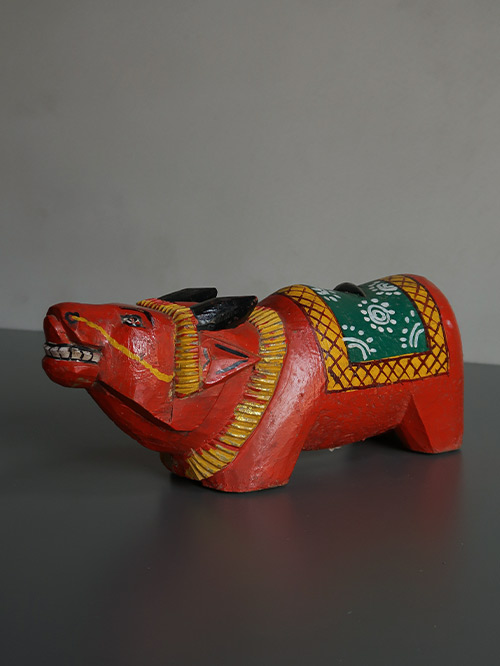
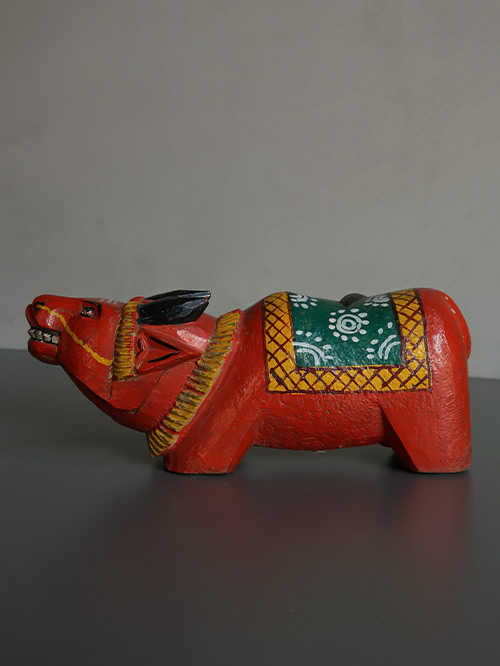
Coastal Karnataka (Bhuta culture)
Wood, polychromed
A fine painted wood figure of a standing nandi. Displaying the typical folk bhuta style of coastal Karnataka, this figure is painted predominantly in red It displays a typical stylised form with a horizontal head with slightly protruding tongue, horns adorned with ornaments, a floral painted saddlecloth and a curled back tail resting on its back.
The bhuta tradition is popular on the Malabar coast. Bounded by the dramatic sweep of the forested ghats to the east and the Arabian sea to the west, and encircled by rivers, the South Kanara district of coastal Karnataka has enjoyed relative geographic isolation until recent years. The totemic origin of this bull bhuta is quite obvious in a land of agriculture and farms where ploughs are pulled by bulls and where cow milk is one of the main sources of protein. The link with Hinduism is also easily established through Nandi the vahana (“vehicle”) of god Shiva.
Size (cms): 14(H) x 35.5(W) x 11(D)
Size (inches): 5.5(H) x 14(W) x 4.5(D)
-
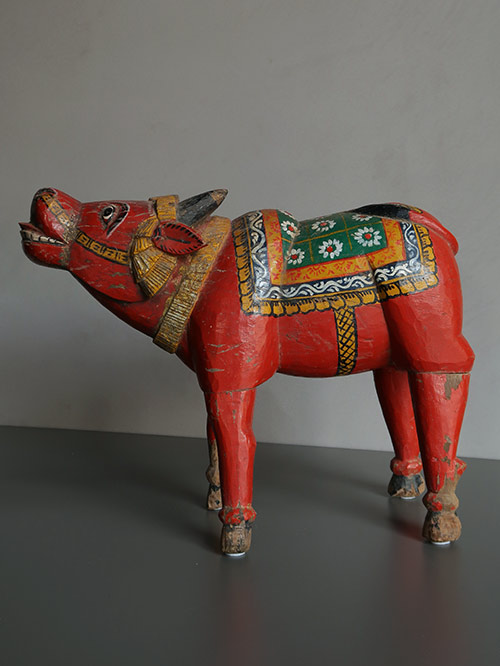
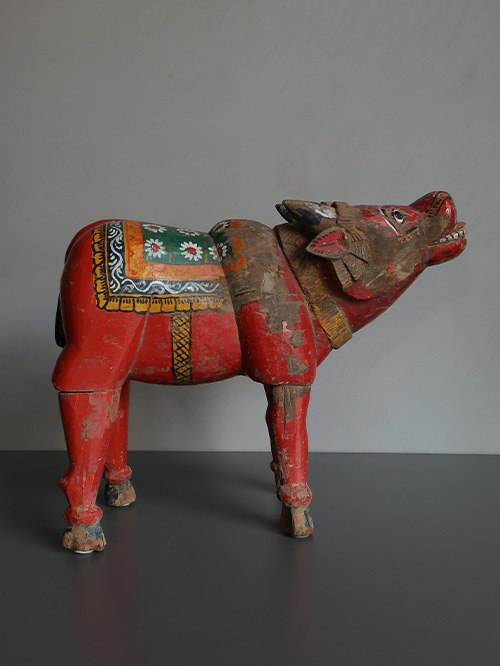
Coastal Karnataka (Bhuta culture)
Wood, polychromed
A large painted wood figure of a standing nandi. Displaying the typical folk bhuta style of coastal Karnataka, this figure is painted predominantly in red with a floral painted saddlecloth and a curled back tail resting on its back.
The bhuta tradition is popular on the Malabar coast. Bounded by the dramatic sweep of the forested ghats to the east and the Arabian sea to the west, and encircled by rivers, the South Kanara district of coastal Karnataka has enjoyed relative geographic isolation until recent years. The totemic origin of this bull bhuta is quite obvious in a land of agriculture and farms where ploughs are pulled by bulls and where cow milk is one of the main sources of protein. The link with Hinduism is also easily established through Nandi the vahana (“vehicle”) of god Shiva.
Size (cms): 36(H) x 46(W) x 16(D)
Size (inches): 14(H) x 18(W) x 6.5(D)
-
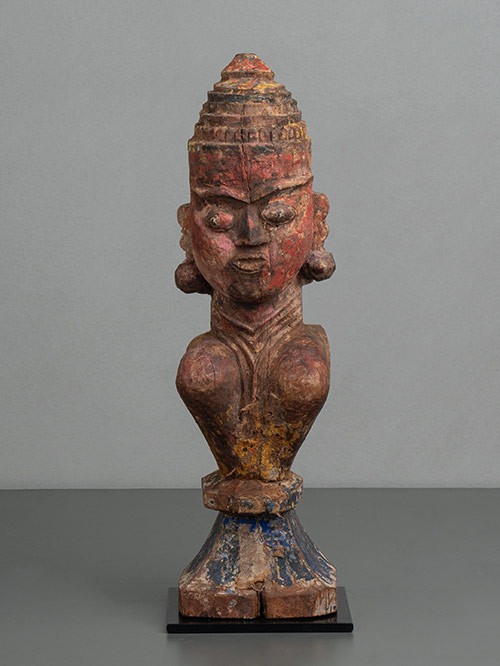
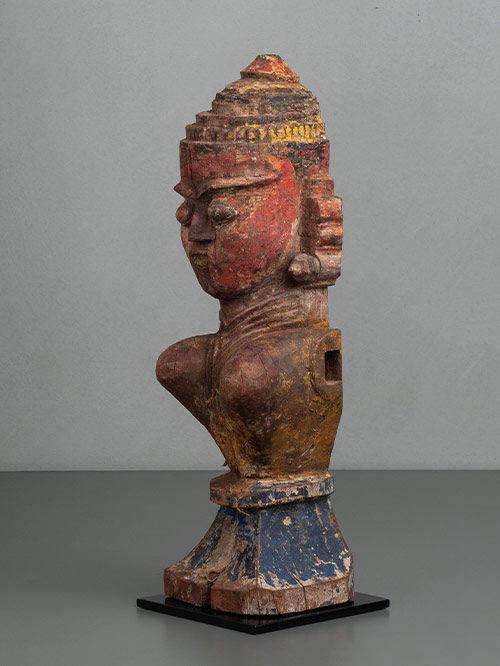
Karnataka
Wood with traces of polychroming
This decorative folk bust of Durga has an austere expression and an exaggeratedly proportioned torso, once painted to resemble a blouse. She is richly adorned with globular earrings, layered necklaces that hang low on her chest, and a striking tiered crown.
Durga – “The Unconquerable form of Devi” – Durga is the most splendid manifestation of Devi. Virginal and sublime, contain within her the power of all the gods combined, she is the invincible power of Nature who triumphs over those who seek to subjugate her. Durga is one of the names of the goddess that is the wife of Shiva. Durga has the role of a warrior goddess who destroys demons. She is usually depicted with ten arms that hold the weapons of the various gods. Her vahana is a lion which acts as her means of transportation and one of her many weapons.
During festive occasions, the utsavar (portable figures of deities) are placed on chariots or pedestals in the mandapam (audience hall of a temple) or on their respective vahana (vehicle) and taken out for public viewing or darshana. Darshana refers to the occasion where the devotee is not only able to see the image of the deity but also to sense its omnipresence.
Size (cms): 39(H) x 13(W) x 13(D)
Size (inches): 15.5(H) x 5(W) x 5(D)
-
Karnataka
Wood, extensively polychromed
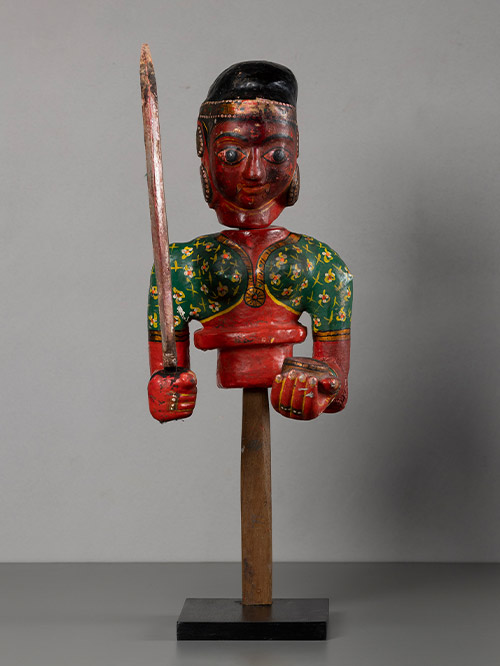
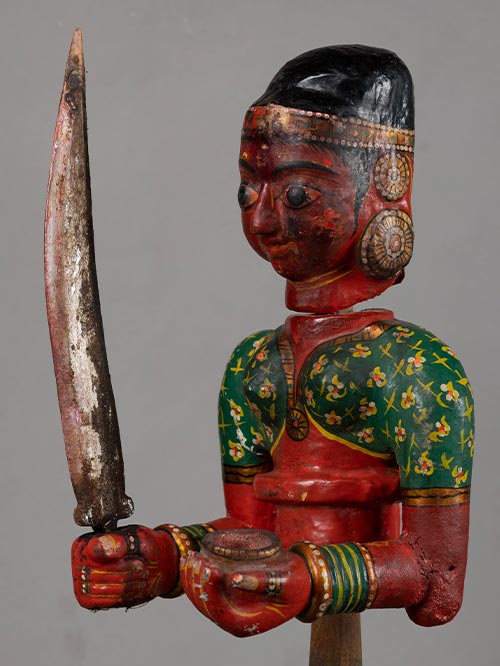
A fine two armed bust of the Goddess Durga wearing a patterned blue blouse. She is adorned with jewelled necklaces and bracelets and wears large globular earrings. In her hands she carries a sword and a bowl.
Durga – “The Unconquerable form of Devi” – Durga is the most splendid manifestation of Devi. Virginal and sublime, contain within her the power of all the gods combined, she is the invincible power of Nature who triumphs over those who seek to subjugate her. Durga is one of the names of the goddess that is the wife of Shiva. Durga has the role of a warrior goddess who destroys demons. She is usually depicted with ten arms that hold the weapons of the various gods. Her vahana is a lion which acts as her means of transportation and one of her many weapons.
During festive occasions, the utsavar (portable figures of deities) are placed on chariots or pedestals in the mandapam (audience hall of a temple) or on their respective vahana (vehicle) and taken out for public viewing or darshana. Darshana refers to the occasion where the devotee is not only able to see the image of the deity but also to sense its omnipresence.
Size (cms): 59(H) x 20(W) x 18(D)
Size (inches): 23(H) x 8(W) x 7(D)
-
Karnataka
Wood, extensively polychromed
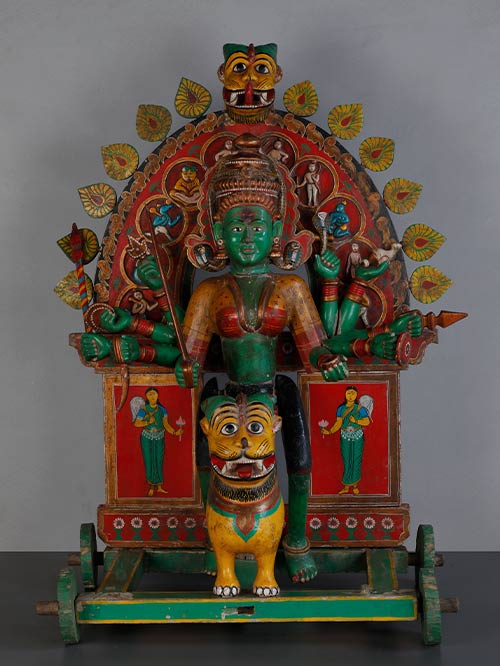
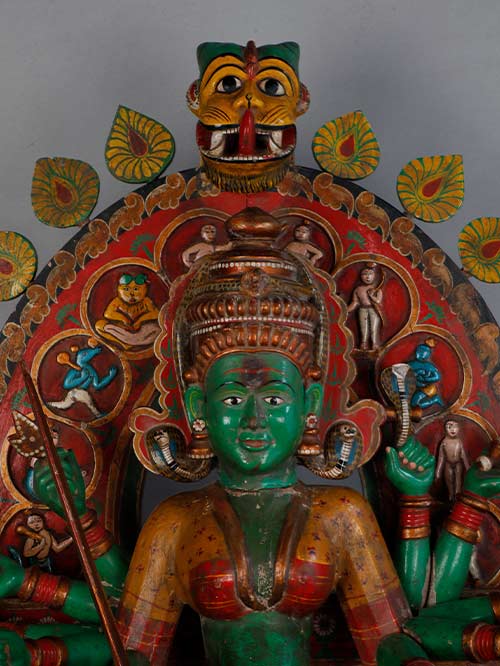
An exceptional multi-armed articulated figure of the Goddess Durga riding her Tiger vahana. She is seated on a complete chariot with a resplendent prabhavali which is painted with chauri bearers and a flaming aureole. Diminutive roundels are placed in an arch within the prabhavali each depicting the ten incarnations of Lord Vishnu starting with Matysa and ending with Kalki. The Goddess wears a patterned red and yellow blouse and an elaborate tiered crown. In her arms she carries various weapons, including a sword, cakra, conch, naga and blood bowl.
Durga – “The Unconquerable form of Devi” – Durga is the most splendid manifestation of Devi. Virginal and sublime, contain within her the power of all the gods combined, she is the invincible power of Nature who triumphs over those who seek to subjugate her. Every year, during Navratri, processional images of the goddess are carried in evocative ceremonies. Depending on the day of the festival, her vahana, the vehicle on which she rides changes, with each of her vehicles holding a different and unique significance. The tiger she rides here signifies her ferociousness and strength.
Size (cms): 95(H) x 69(W) x 44(D)
Size (inches): 37.5(H) x 27(W) x 17.5(D)
-
Andhra Pradesh (South India)
Wood, polychromed
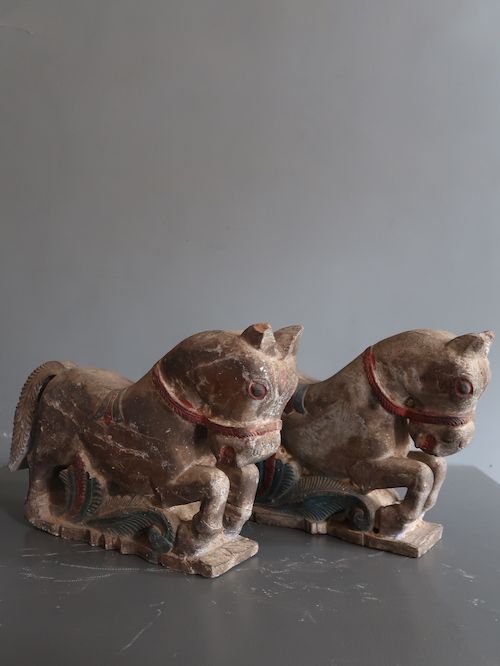
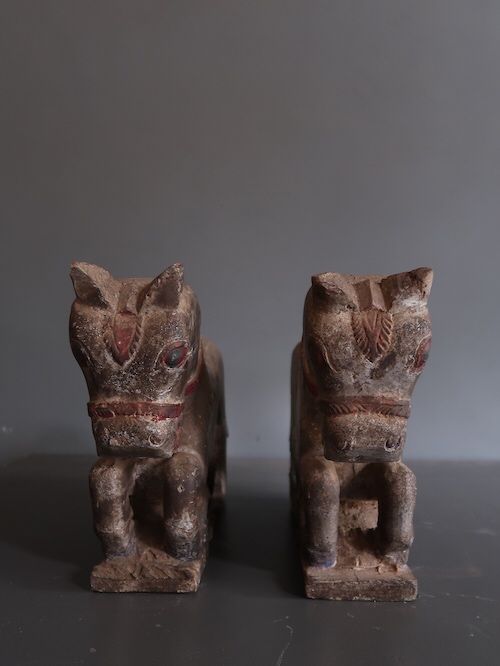
These horse brackets once formed the two ends of a door lintel. The horse or ashva was a very popular motif in architectural wood carvings in South India. Its prototype, the divine Uchchaihshravas emerged from the churning of the ocean. It was white and endowed with wings. The god Indra appropriated it and, after cutting its wings to ensure that it would remain on earth, donated it to mankind.
The horse played a pivotal role in establishing the supremacy of kings, as demonstrated, for instance by the great horse sacrifice, the Ashvamedha, which might have been established in the course of the Vedic period. Equestrian motifs appear prominently in Indian art, for example in Orissan sculpture of the 12th and 13th centuries, and in that of the late Vijaynagara and Nayak periods (early 16th to early 18th century) in southern India. There is a branch of literature specialising in the training of horses, which contains detailed passages on colouring, proportions, gait, auspicious and inauspicious marks and lists of appropriate names for horses.
Size(cms): 27 (H) x 41 (W) x 9 (D)
Size(inches): 10.5 (H) x 16 (W) x 3.5 (D)
-
Andhra Pradesh (South India)
Wood
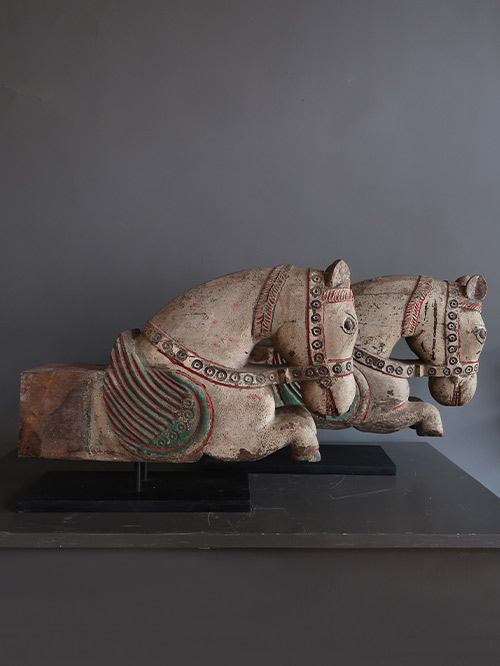
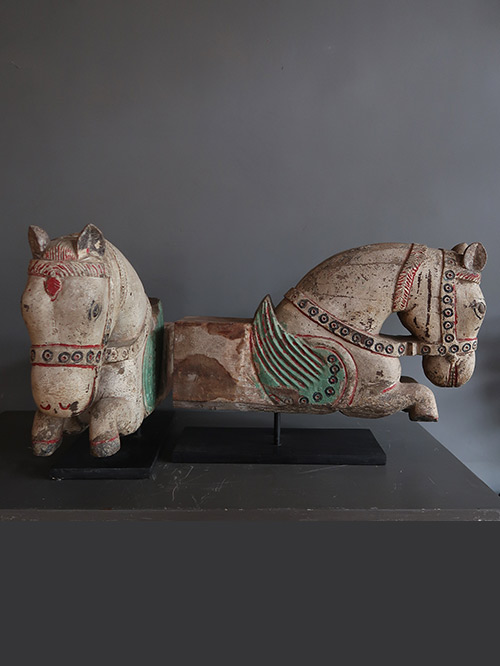
These horse brackets once formed the two ends of a door lintel. The horse or ashva was a very popular motif in architectural wood carvings in South India. Its prototype, the divine Uchchaihshravas emerged from the churning of the ocean. It was white and endowed with wings. The god Indra appropriated it and, after cutting its wings to ensure that it would remain on earth, donated it to mankind.
The horse played a pivotal role in establishing the supremacy of kings, as demonstrated, for instance by the great horse sacrifice, the Ashvamedha, which might have been established in the course of the Vedic period. Equestrian motifs appear prominently in Indian art, for example in Orissan sculpture of the 12th and 13th centuries, and in that of the late Vijaynagara and Nayak periods (early 16th to early 18th century) in southern India. There is a branch of literature specialising in the training of horses, which contains detailed passages on colouring, proportions, gait, auspicious and inauspicious marks and lists of appropriate names for horses.
Individual Sizes (cms): 36 (H) x 61 (W) x 15 (D)
Individual Sizes (inches): 14.2 (H) x 24 (W) x 5.9 (D)