-
You cannot add another "Head of a Saint" to your cart. View cart
-
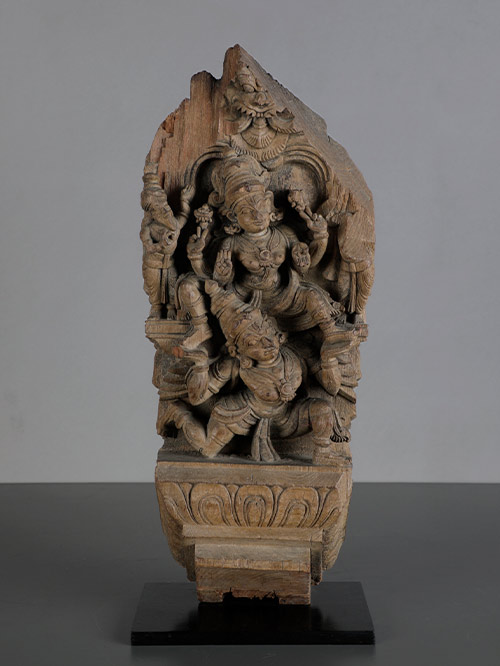
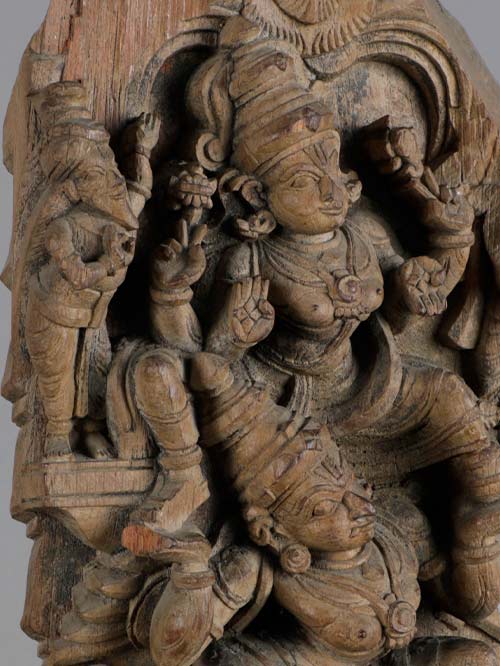
Tamil Nadu
Wood
A finely carved and rare chariot panel depicting Vishnu seated on the shoulders of Garuda. The four-armed Vishnu carries a discus (chakra) and conch shell (shankha) in his upper hands while his lower hands are in abhaya and varada mudra. The kneeling Garuda holds up Vishnu in an act of devotion. A prabhavali, formed by a pair of rishis (sages) on columns holding up a Kirtimukha, creates a ceremonial arch around Vishnu and his vahana.
Chariots of Tamil Nadu, locally called ter, are intricate wooden structures of monumental size. The lower portion of the chariots are completely covered with timber panels carved with a wide range of figural and animal sculptures. These friezes, which constitute the finest wooden sculptures in the region, can be viewed only during the chariot festival; for the remainder of the year the chariots are parked in shelters to protect them from the sun and rain.
Size (cms): 51(H) x 20(W) x 11.5(D)
Size (inches): 20(H) x 8(W) x 4.5(D)
-
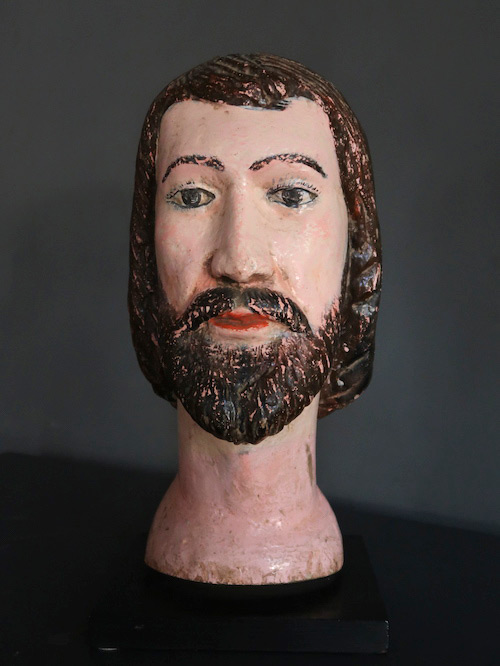
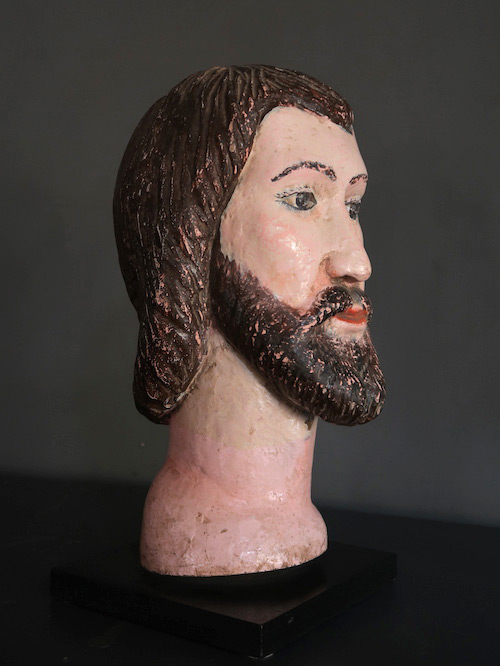
Indo-Portuguese, probably Goa
Polychromed wood
Saints figures normally used in processions, were called ‘Cribb’ (skeletal) figures, and were common in the East as well as in Portugal, Spain and Italy. In these figures most of the artistic effort went into rendering the head. The body comprised a simple wood structure which would be dressed, thus avoiding the need to sculpt the entire figure. To this were attached the head, hands and feet.
Size(cms): 44 (H) x 19 (W) x 19 (D)
Size(inches): 17 (H) x 7.5 (W) x 7.5 (D)
-
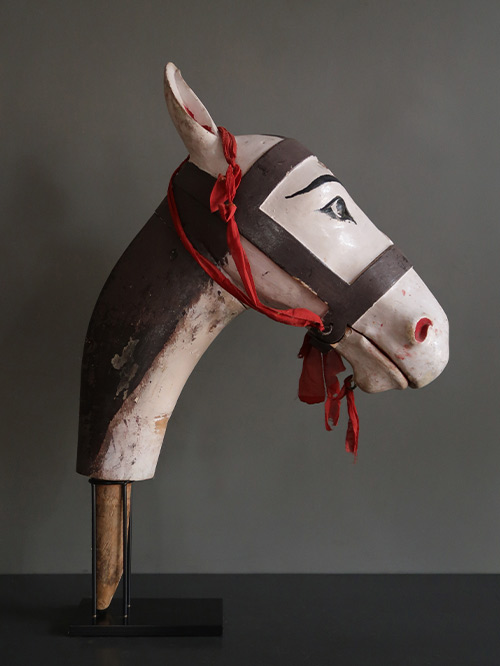
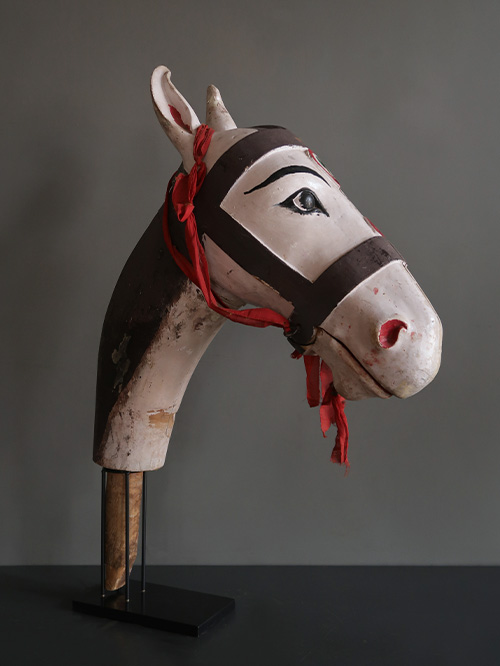
Konkan Region (Western India)
wood, polychromed
A painted wooden horse dancing mask with an articulated jaw. The head is worn through use but still shows its typical trappings.
This is a tribal dancing masks from the Konkan region used in the Perni Zagor, a folk play danced by Christian Gaud tribals. Perni Zagor is an indigenous dance-drama form of the Perni community of Goa. This is an ancient art form and is believed to have evolved on the banks of the Zuari river. It has its origins in fertility rites related to Neolithic shamanism. The dancers don wooden masks while performing the musical drama. The masks represent deities, animals, birds and demons. The characters are derived from various episodes in Hindu mythology. Perni Zagor is currently performed by only a few families in the community and is almost on the verge of extinction.
Size (cms): 86.5(H) x 57(W) x 17(D)
Size (inches): 34(H) x 22.5(W) x 6.5(D)
-
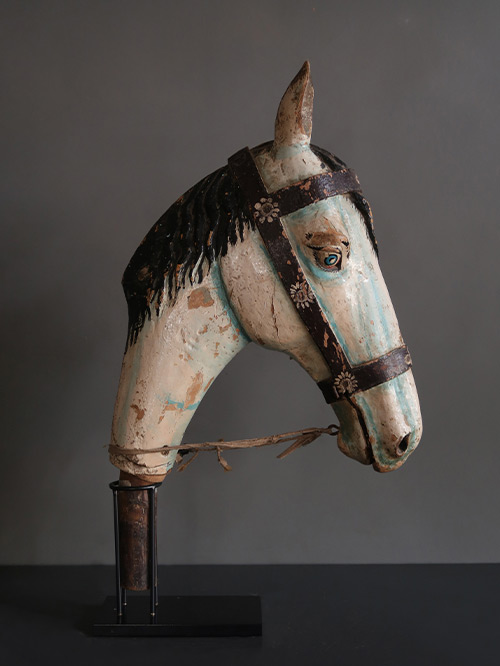
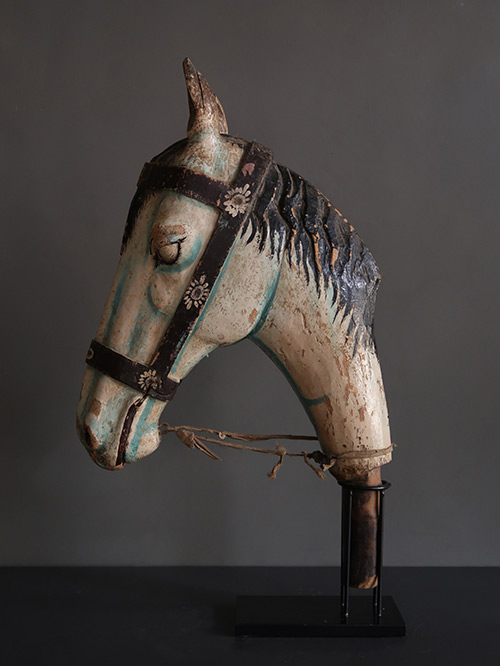
Konkan Region (Western India)
wood, polychromed
A painted wooden horse dancing mask with an articulated jaw. The head is worn through use but still shows its typical trappings.
This is a tribal dancing masks from the Konkan region used in the Perni Zagor, a folk play danced by Christian Gaud tribals. Perni Zagor is an indigenous dance-drama form of the Perni community of Goa. This is an ancient art form and is believed to have evolved on the banks of the Zuari river. It has its origins in fertility rites related to Neolithic shamanism. The dancers don wooden masks while performing the musical drama. The masks represent deities, animals, birds and demons. The characters are derived from various episodes in Hindu mythology. Perni Zagor is currently performed by only a few families in the community and is almost on the verge of extinction.
Size (cms): 77(H) x 44(W) x 17(D)
Size (inches): 30.5(H) x 17.5(W) x 6.5(D)
-
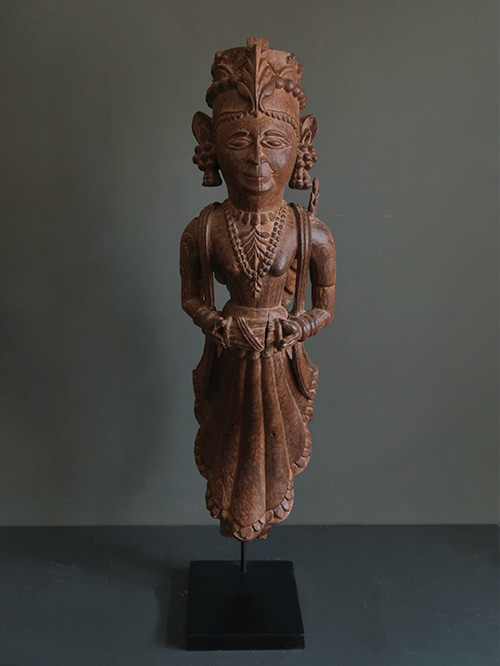
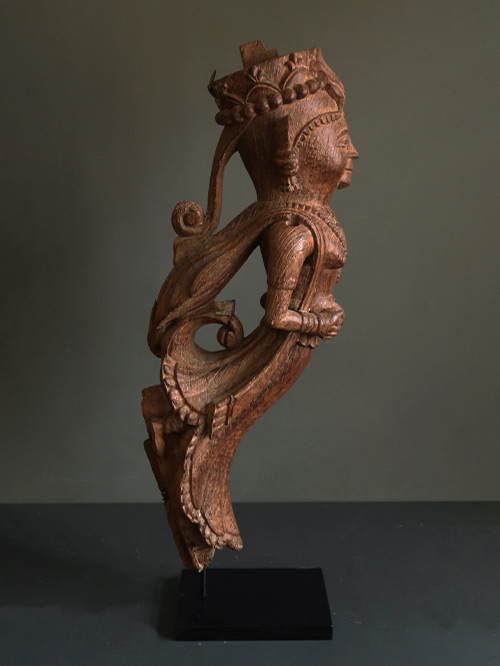
Patan (Gujarat)
Wood
A fine figural strut formed as a crowned celestial musician (Vidyadhara). She holds a small drum and wears a patterned blouse and a flowing pleated skirt standing in a typical curved posture. Her long veil drapes behind her shoulders resembling wings. The appearance of wings on figures is a very old tradition in Indian art. Although seen in many parts of Gujarat the treatment his novel : the robes of the figure turn up at the ends and the veil cross the shoulders and turns into wings.
The ancestral occupation of the Hindu Suthar community, the craft of wood carving was practiced in several districts of Gujarat including Patan, Kadi, Ahmedabad and Nadiad, although the legacy of exquisite wood carving seen in the traditional havelis, mansions, is evident in all the districts of Gujarat. Patan district is renowned for the intricately carved Bohra haveli or mansions at Siddhpur; these structures are characterised by their eclectic use of geometric or floral patterns as well as motifs inspired by European and West Asian decorative elements on the woodwork of the balconies and ceilings.The wooden architecture of Ahmedabad on the other hand, acquires its distinctive aesthetic through the use of patterns borrowed from block printing and textiles.
Size (cms): 72.5(H) x 20(W) x 28(D)
Size (inches): 28.5(H) x 8(W) x 11(D)
-
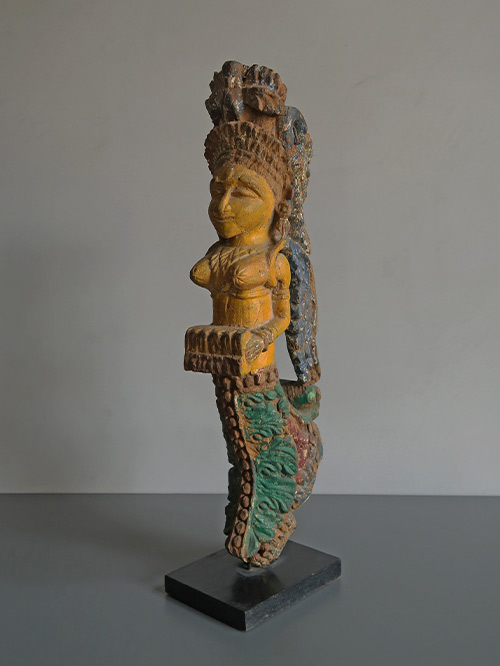
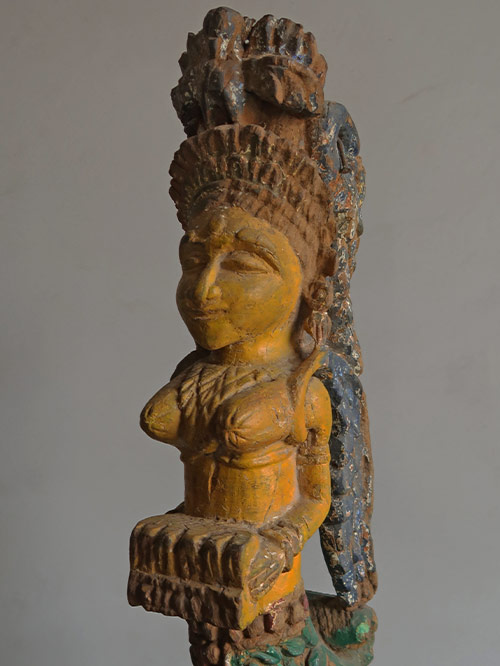
Patan (Gujarat)
Wood, polychromed
A decorative winged musician bracket, the figure who is crowned holds a percussion instrument. She wears a patterned blouse and a pleated skirt.
The ancestral occupation of the Hindu Suthar community, the craft of wood carving was practiced in several districts of Gujarat including Patan, Kadi, Ahmedabad and Nadiad, although the legacy of exquisite wood carving seen in the traditional havelis, mansions, is evident in all the districts of Gujarat. Patan district is renowned for the intricately carved Bohra haveli or mansions at Siddhpur; these structures are characterised by their eclectic use of geometric or floral patterns as well as motifs inspired by European and West Asian decorative elements on the woodwork of the balconies and ceilings.The wooden architecture of Ahmedabad on the other hand, acquires its distinctive aesthetic through the use of patterns borrowed from block printing and textiles.
Size (cms): 64(H) x 14(W) x 21(D)
Size (inches): 25(H) x 5.5(W) x 8.5(D)
-
Gujarat (Western India)
Wood with traces of polychrome
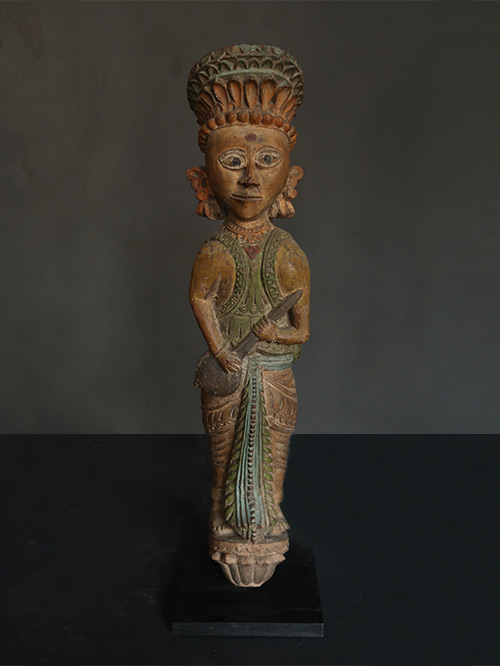
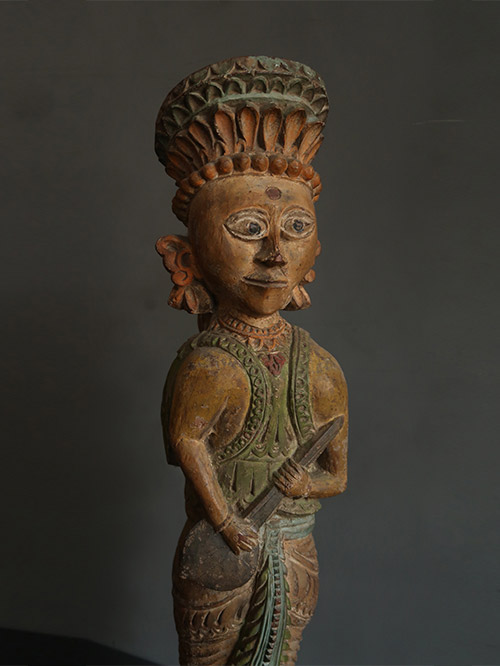
An attractive architectural bracket with original colour depicting a figure holding an instrument, possibly a Tanpura. The figure wears a decorated crown and has a stylised face with large ovular eyes pressing into a pointed nose and ears in the shape of swirling foliage. He is dressed in a pleated dhoti and a patterned vest. A stylised stole that is draped across his shoulders, turn into wings that emerge from either end of his body. A tilak is marked on his forehead.
Dwarapalas or ‘door guardians’ are placed at the entrance of every temple, shrine or sacred precinct. Two or four-handed, they sometimes carry in their hands the emblem of the deity enshrined in the sanctuary. Their countenance may sometimes be fierce and occasionally fangs protrude from their mouths. Temples dedicated to goddesses have female guardians – the Dwarapalikas.
Size (cms): 75 (H) x 20 (W) x 19 (D)
Size (inches): 29.5 (H) x 8 (W) x 7.5 (D)
-
Patan (Gujarat)
Wood
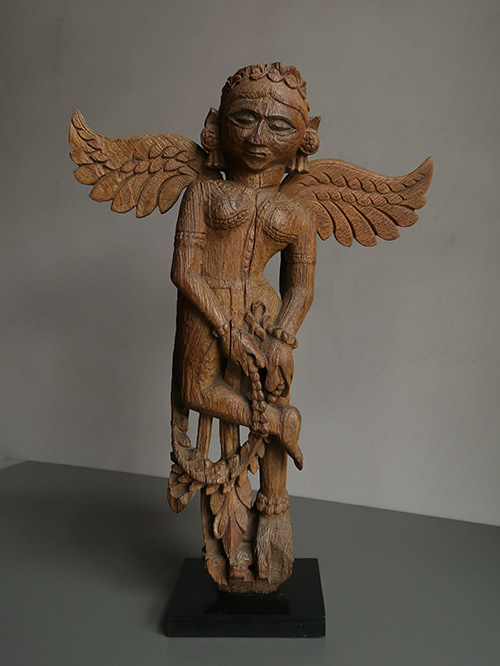
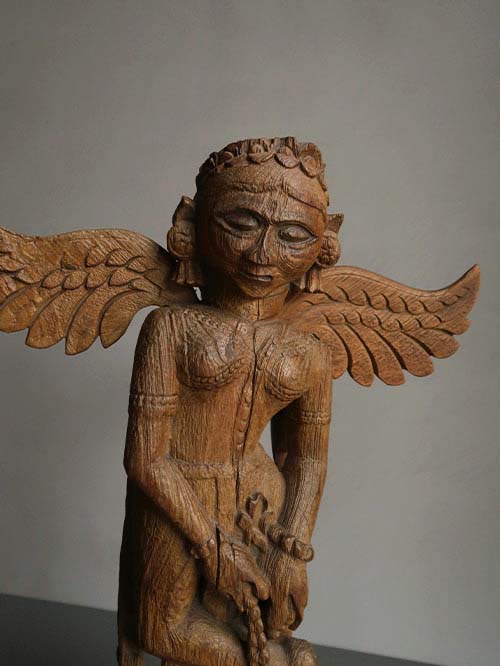
An attractive wooden winged apsara bracket. The crowned figure has patterned wings and holds a long garland which is looped around her leg.
The ancestral occupation of the Hindu Suthar community, the craft of wood carving was practiced in several districts of Gujarat including Patan, Kadi, Ahmedabad and Nadiad, although the legacy of exquisite wood carving seen in the traditional havelis, mansions, is evident in all the districts of Gujarat. Patan district is renowned for the intricately carved Bohra haveli or mansions at Siddhpur; these structures are characterised by their eclectic use of geometric or floral patterns as well as motifs inspired by European and West Asian decorative elements on the woodwork of the balconies and ceilings.The wooden architecture of Ahmedabad on the other hand, acquires its distinctive aesthetic through the use of patterns borrowed from block printing and textiles.
Size (cms): 77(H) x 55(W) x 18(D)
Size (inches): 30.5(H) x 21.5(W) x 7(D)
-
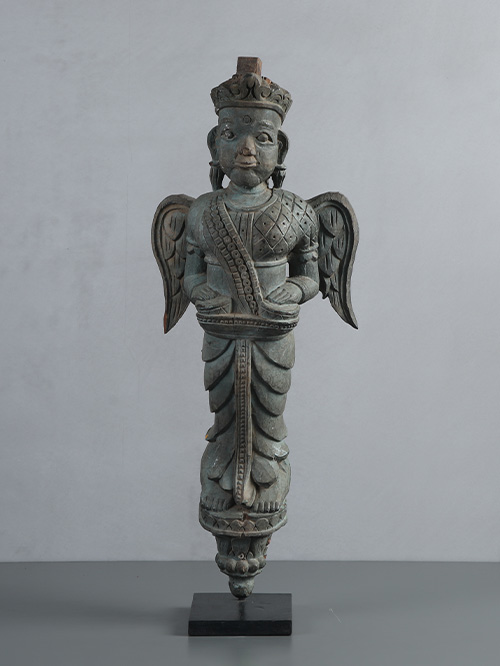
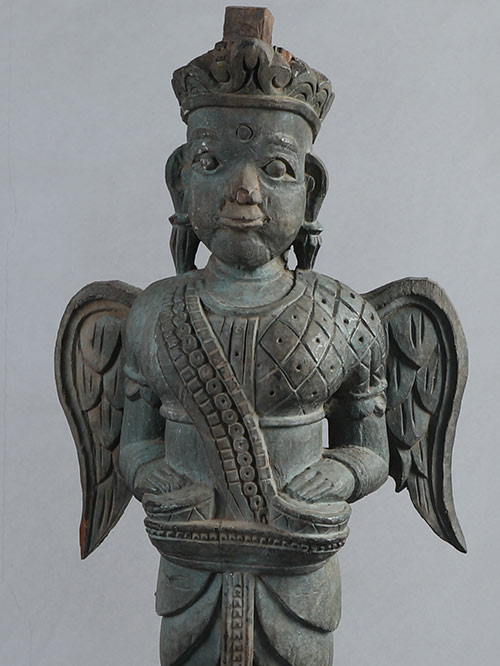
Patan (Gujarat)
Wood, polychromed
A fine figure of a winged angel, crowned, holding a pair of small cymbals. She wears a patterned blouse and a pleated skirt and stands on a lotus shaped base.
The ancestral occupation of the Hindu Suthar community, the craft of wood carving was practiced in several districts of Gujarat including Patan, Kadi, Ahmedabad and Nadiad, although the legacy of exquisite wood carving seen in the traditional havelis, mansions, is evident in all the districts of Gujarat. Patan district is renowned for the intricately carved Bohra haveli or mansions at Siddhpur; these structures are characterised by their eclectic use of geometric or floral patterns as well as motifs inspired by European and West Asian decorative elements on the woodwork of the balconies and ceilings.The wooden architecture of Ahmedabad on the other hand, acquires its distinctive aesthetic through the use of patterns borrowed from block printing and textiles.
Size including the stand (cms): 80 (H) x 28 (W) x 19 (D)
Size including the stand (inches): 31.5 (H) x 11 (W) x 7.5 (D)
-
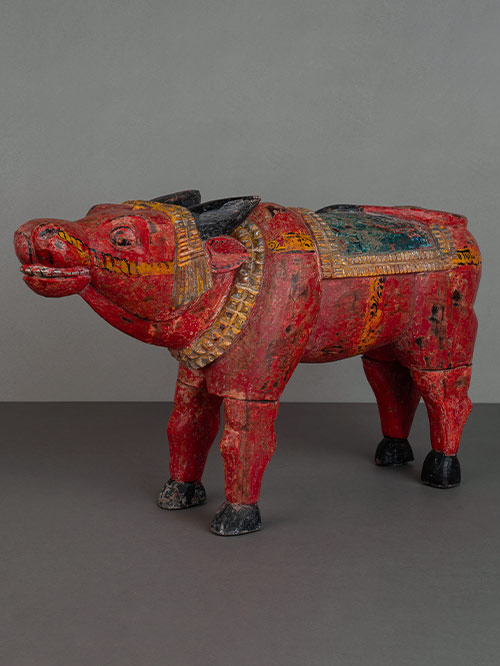
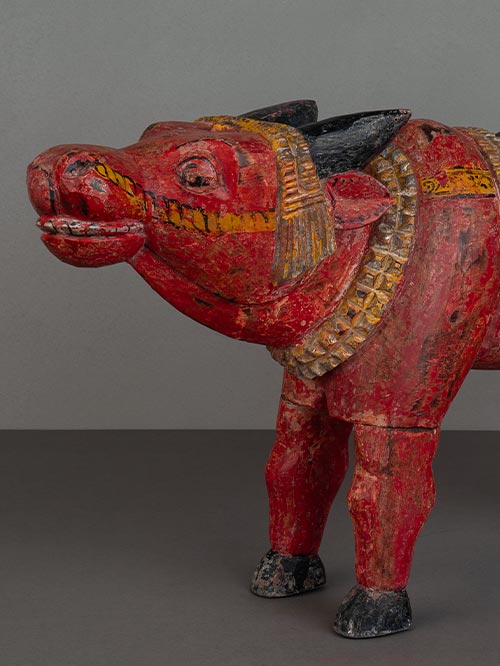
Coastal Karnataka (Bhuta culture)
Wood, polychromed
A fine painted wood figure of a standing nandi. Displaying the typical folk bhuta style of coastal Karnataka, this figure is painted predominantly in red with a painted saddlecloth and a curled back tail resting on its back.
The bhuta tradition is popular on the Malabar coast. Bounded by the dramatic sweep of the forested ghats to the east and the Arabian sea to the west, and encircled by rivers, the South Kanara district of coastal Karnataka has enjoyed relative geographic isolation until recent years. The totemic origin of this bull bhuta is quite obvious in a land of agriculture and farms where ploughs are pulled by bulls and where cow milk is one of the main sources of protein. The link with Hinduism is also easily established through Nandi the vahana (“vehicle”) of god Shiva.
Size (cms): 32(H) x 52(W) x 14(D)
Size (inches): 12.5(H) x 20.5(W) x 5.5(D)
-
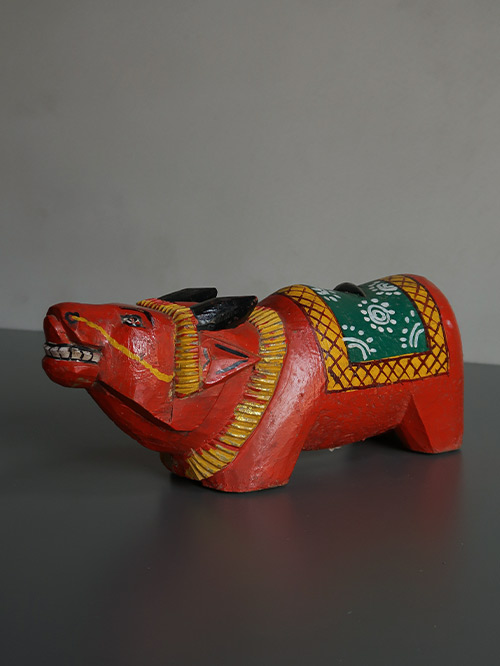
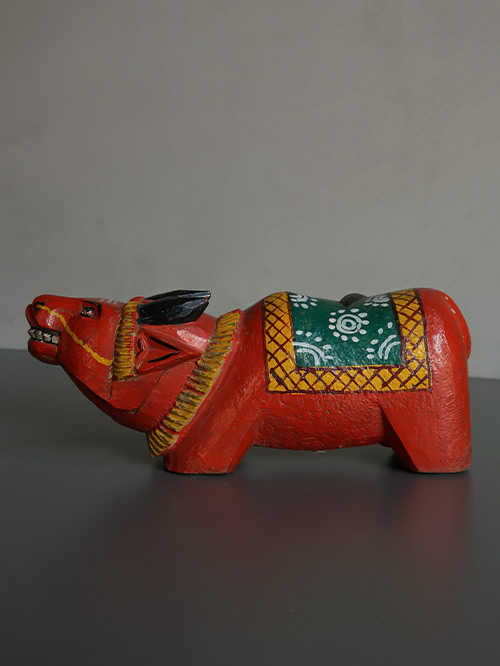
Coastal Karnataka (Bhuta culture)
Wood, polychromed
A fine painted wood figure of a standing nandi. Displaying the typical folk bhuta style of coastal Karnataka, this figure is painted predominantly in red It displays a typical stylised form with a horizontal head with slightly protruding tongue, horns adorned with ornaments, a floral painted saddlecloth and a curled back tail resting on its back.
The bhuta tradition is popular on the Malabar coast. Bounded by the dramatic sweep of the forested ghats to the east and the Arabian sea to the west, and encircled by rivers, the South Kanara district of coastal Karnataka has enjoyed relative geographic isolation until recent years. The totemic origin of this bull bhuta is quite obvious in a land of agriculture and farms where ploughs are pulled by bulls and where cow milk is one of the main sources of protein. The link with Hinduism is also easily established through Nandi the vahana (“vehicle”) of god Shiva.
Size (cms): 14(H) x 35.5(W) x 11(D)
Size (inches): 5.5(H) x 14(W) x 4.5(D)
-
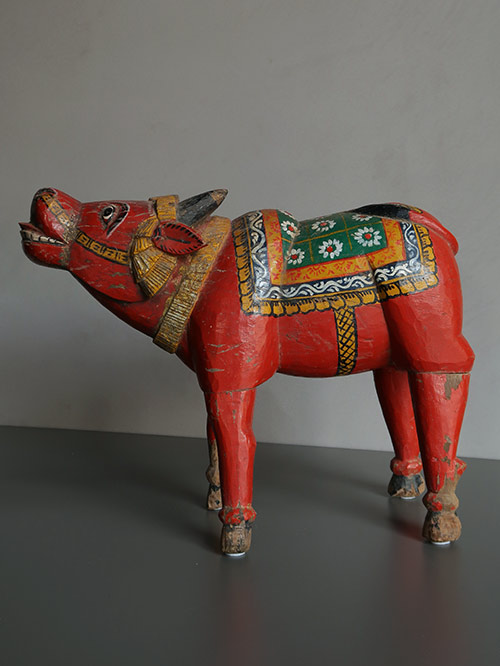
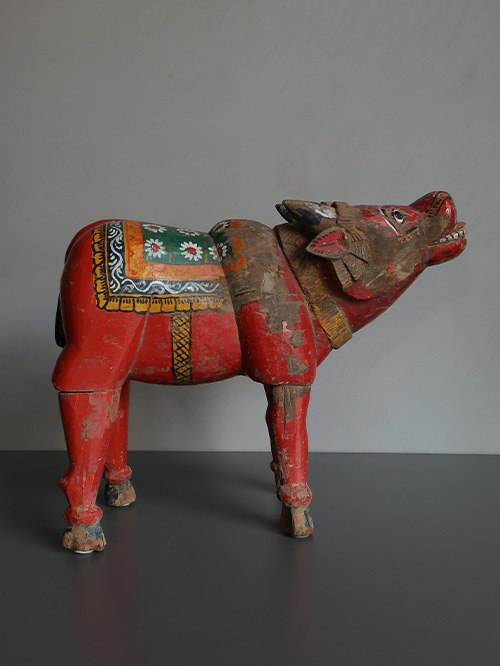
Coastal Karnataka (Bhuta culture)
Wood, polychromed
A large painted wood figure of a standing nandi. Displaying the typical folk bhuta style of coastal Karnataka, this figure is painted predominantly in red with a floral painted saddlecloth and a curled back tail resting on its back.
The bhuta tradition is popular on the Malabar coast. Bounded by the dramatic sweep of the forested ghats to the east and the Arabian sea to the west, and encircled by rivers, the South Kanara district of coastal Karnataka has enjoyed relative geographic isolation until recent years. The totemic origin of this bull bhuta is quite obvious in a land of agriculture and farms where ploughs are pulled by bulls and where cow milk is one of the main sources of protein. The link with Hinduism is also easily established through Nandi the vahana (“vehicle”) of god Shiva.
Size (cms): 36(H) x 46(W) x 16(D)
Size (inches): 14(H) x 18(W) x 6.5(D)
-
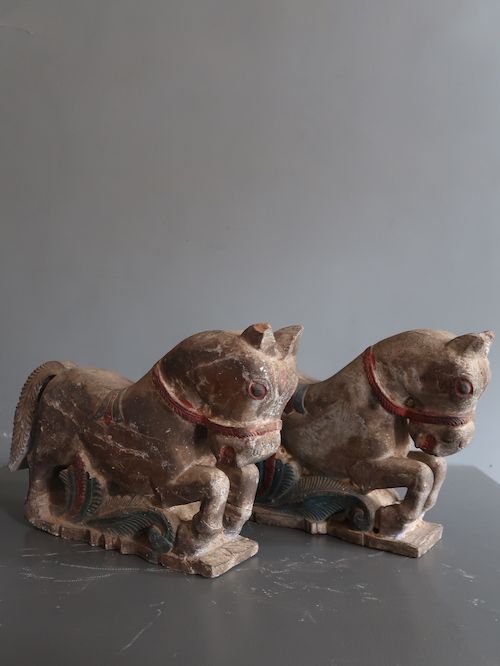
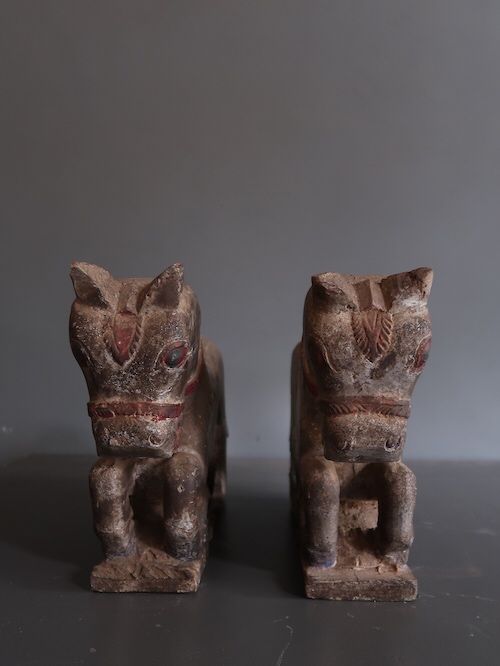
Andhra Pradesh (South India)
Wood, polychromed
These horse brackets once formed the two ends of a door lintel. The horse or ashva was a very popular motif in architectural wood carvings in South India. Its prototype, the divine Uchchaihshravas emerged from the churning of the ocean. It was white and endowed with wings. The god Indra appropriated it and, after cutting its wings to ensure that it would remain on earth, donated it to mankind.
The horse played a pivotal role in establishing the supremacy of kings, as demonstrated, for instance by the great horse sacrifice, the Ashvamedha, which might have been established in the course of the Vedic period. Equestrian motifs appear prominently in Indian art, for example in Orissan sculpture of the 12th and 13th centuries, and in that of the late Vijaynagara and Nayak periods (early 16th to early 18th century) in southern India. There is a branch of literature specialising in the training of horses, which contains detailed passages on colouring, proportions, gait, auspicious and inauspicious marks and lists of appropriate names for horses.
Size(cms): 27 (H) x 41 (W) x 9 (D)
Size(inches): 10.5 (H) x 16 (W) x 3.5 (D)
-
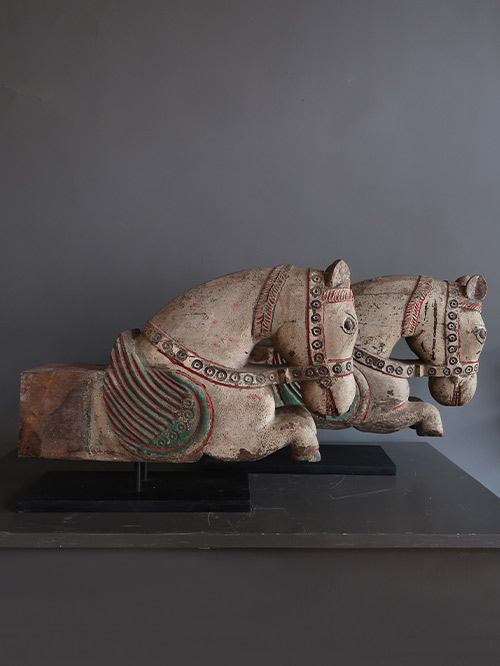
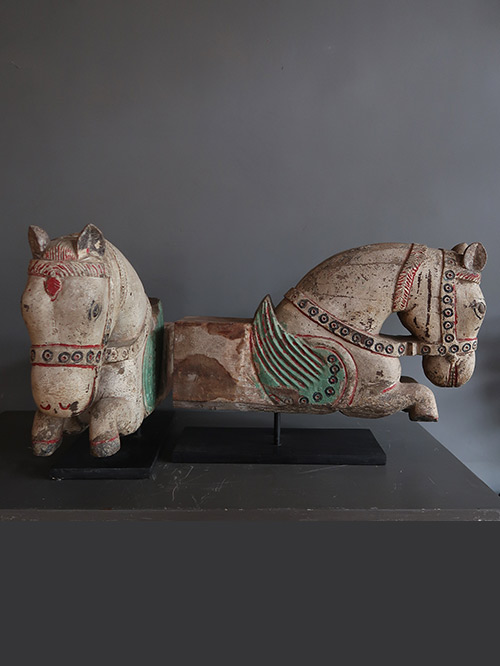
Andhra Pradesh (South India)
Wood
These horse brackets once formed the two ends of a door lintel. The horse or ashva was a very popular motif in architectural wood carvings in South India. Its prototype, the divine Uchchaihshravas emerged from the churning of the ocean. It was white and endowed with wings. The god Indra appropriated it and, after cutting its wings to ensure that it would remain on earth, donated it to mankind.
The horse played a pivotal role in establishing the supremacy of kings, as demonstrated, for instance by the great horse sacrifice, the Ashvamedha, which might have been established in the course of the Vedic period. Equestrian motifs appear prominently in Indian art, for example in Orissan sculpture of the 12th and 13th centuries, and in that of the late Vijaynagara and Nayak periods (early 16th to early 18th century) in southern India. There is a branch of literature specialising in the training of horses, which contains detailed passages on colouring, proportions, gait, auspicious and inauspicious marks and lists of appropriate names for horses.
Individual Sizes (cms): 36 (H) x 61 (W) x 15 (D)
Individual Sizes (inches): 14.2 (H) x 24 (W) x 5.9 (D)
-
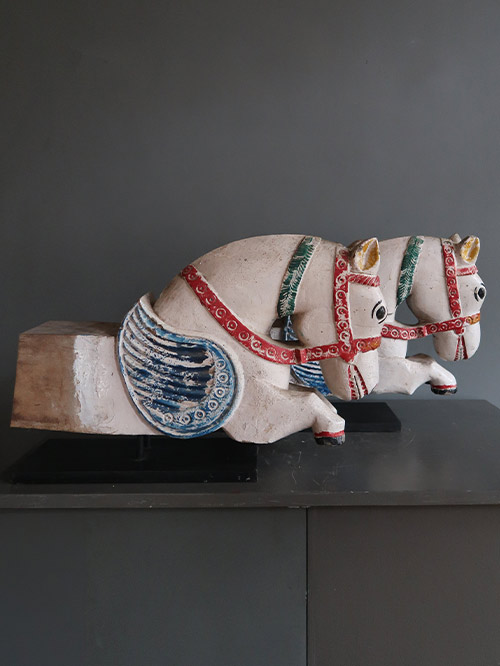
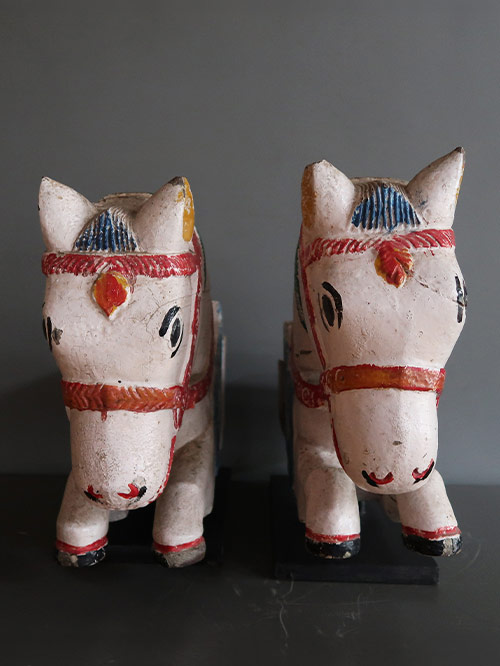
Andhra Pradesh (South India)
Wood
These horse brackets once formed the two ends of a door lintel. The horse or ashva was a very popular motif in architectural wood carvings in South India. Its prototype, the divine Uchchaihshravas emerged from the churning of the ocean. It was white and endowed with wings. The god Indra appropriated it and, after cutting its wings to ensure that it would remain on earth, donated it to mankind.
The horse played a pivotal role in establishing the supremacy of kings, as demonstrated, for instance by the great horse sacrifice, the Ashvamedha, which might have been established in the course of the Vedic period. Equestrian motifs appear prominently in Indian art, for example in Orissan sculpture of the 12th and 13th centuries, and in that of the late Vijaynagara and Nayak periods (early 16th to early 18th century) in southern India. There is a branch of literature specialising in the training of horses, which contains detailed passages on colouring, proportions, gait, auspicious and inauspicious marks and lists of appropriate names for horses.
Individual Size (cms): 40(H) x 64(W) x 18(D)
Individual Size (inches): 15.5(H) x 25(W) x 7(D)
-
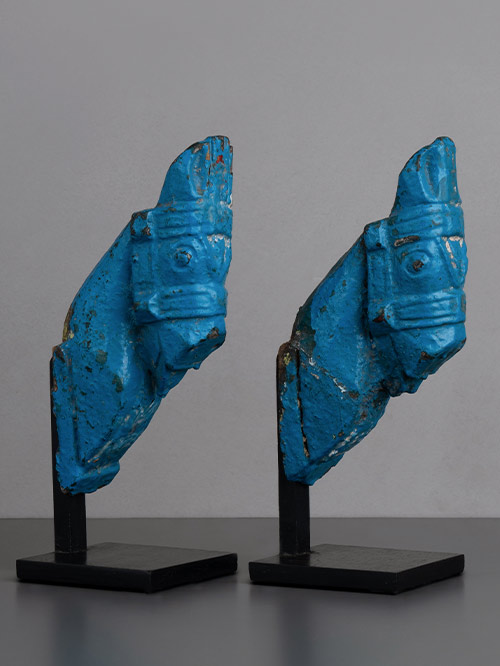
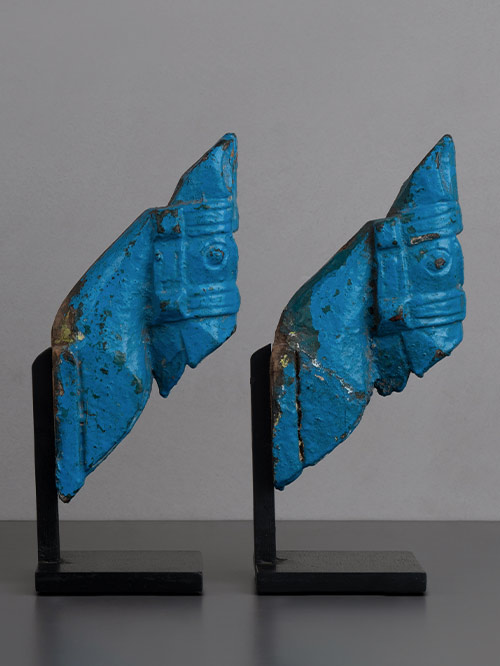
Andhra Pradesh (South India)
Wood, extensively polychromed
These horse brackets once formed the two ends of a door lintel. The horse or ashva was a very popular motif in architectural wood carvings in South India. Its prototype, the divine Uchchaihshravas emerged from the churning of the ocean. It was white and endowed with wings. The god Indra appropriated it and, after cutting its wings to ensure that it would remain on earth, donated it to mankind.
The horse played a pivotal role in establishing the supremacy of kings, as demonstrated, for instance by the great horse sacrifice, the Ashvamedha, which might have been established in the course of the Vedic period. Equestrian motifs appear prominently in Indian art, for example in Orissan sculpture of the 12th and 13th centuries, and in that of the late Vijaynagara and Nayak periods (early 16th to early 18th century) in southern India. There is a branch of literature specialising in the training of horses, which contains detailed passages on colouring, proportions, gait, auspicious and inauspicious marks and lists of appropriate names for horses.
Individual Sizes (cms):28(H) x 10(W) x 13(D)
Individual Sizes (inches): 11(H) x 4(W) x 5(D)